Section 06. South East Zambia
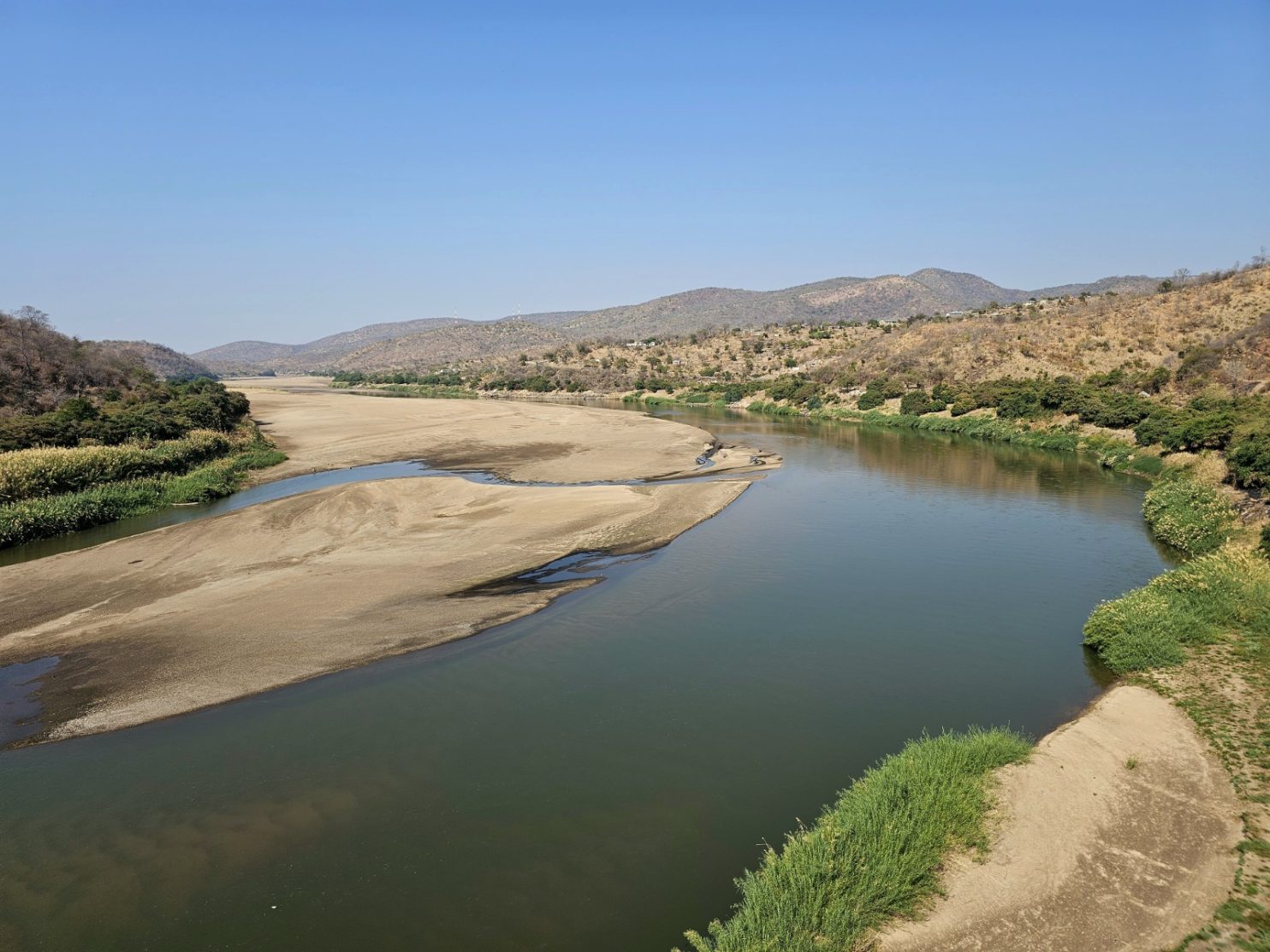
Day 081. 29 July. Jumbe to Chipata. 90 km. 10 Hours. 930m up. 400m down. I got up early in the morning, having slept surprisingly well. I did not linger at the guesthouse for breakfast as I knew it would take ages to prepare and it would not be worth the wait so packed and was off by 0730 having paid the night before. No one was about as I pushed the bike through the dusty yard and into the lane which led past shops, which were opening up, to reach the main road. There was a stronger headwind and a slight climb and it felt like I was cycling in treacle. The sun was in my eyes and the driver’s eyes but there were so few cars I did not think it would matter so did not cross over to the other side.
It was a long few hours as the gentle gradient of the road and the headwind conspired to slow me down considerably and I was only averaging about 10 km per hour. In all the villages I went through I was barely keeping up with the children going to school. There were many market stalls beside the road, mostly with tomatoes and sweet bread rolls, and a few with bananas. I stopped at one and bought 15 small bananas and had about 10 for breakfast. I did not see any papayas now and think I might have climbed above the areas where the trees grew or that they were still ripening here.

456. The extensive plains covered in agricultural hamlets around Jumbe which were all part of the traditional lands of the Chief of Jumbe.
The houses here were built of brick and there was quite an industry of it. Every kilometre I passed was a homestead where there was some artisanal brick production in someone’s compound or an adjacent field. It looked quite a laborious procedure. Firstly the brown clay like earth was piled up in and wetted. Then the brickmakers walked on this mixture thoroughly mixing the water and soil together so it became a glutinous mud. The mud was then placed into small wooden moulds and packed into every corner. The mould was then tipped out and the soft brick was carefully placed in a row of other wet bricks to dry off in the sun for days. During this time it was further stacked so air could flow around it until the brick had dried out. This was just half the process. The next stage involved stacking all these dried bricks into a pile about a meter or meter and a half high and 3-4 metres wide. Within this pile were channels at the bottom where dried logs could be put in until it was packed with wood. I think then the whole pile was then covered with mud and grasses to insulate the top. Then logs in the channels were lit and the dried bricks were “fired” or heated to as high a temperature as possible to bake them hard. During this process they seemed to change colour from brown to an orange red and they were finished. However they still had to be transported to the site and this was done on an ox cart with two bulls pulling the heavily laden cart.

460. A typical homestead now was made of brick under a tin roof. There was often and unfinished building and a pile of loose bricks.
There were bricks everywhere and virtually all the houses were made of brick. The nearer I got to Chipata the more bricks there were and the houses were slightly bigger with 3-4 rooms. In every village there were men with spirit levels assembling houses, binding the bricks together with cement. It was almost a building boom as people changed en masse from the bamboo or mud huts to these new brick houses. In many places half finished houses stood with the 4 outside walls and all the internal walls finished and they were just waiting for a tin roof. Some of these half finished houses and shops looked like they had been in this state for a year or three.

457. Slogging up the ridge after leaving the plain Jumbe was on. On the far side of the ridge (eastern side) was another agricultural plain.
After a few hours of peddling into the wind up the slope I got to the base of a ridge of hills. I now left the extensive plain which were the traditional lands of the Chief of Jumbe and started to climb. Looking back I could see the whole plain was well cultivated and that there were villages scattered across it and not just beside the road. I had seen many signs for primary schools with their aspirational mottos and then a track leading for 6 or 14 kilometres to the schools of some distant cluster of hamlets. There are many many school children here and they seemed very diligent. At a rough guess I would say the children out number the adults and that each couple are having 3-5 children. The children here though are not as in awe of me as the more rural children and some barely wave back when I greet them. The children seemed much more self assured and confident, and cooler.
At the top of the ridge I had to slog up, I freewheeled down the other side for less than I climbed and reached another plain. This one was a bit more undulating and equally well populated. There were a number of crops grown here with the staple of maize just being one of them. I think there was also tobacco grown here in the growing season. Everything now though was parched and then goats and cattle were foraging in the fields. I saw a few more maize granaries in the compounds but also many more places where the smallest merchants in the ladder were buying crops, notably maize, soya, sunflower seeds and peanuts and their quite uniform prices were displayed everywhere.

458. The plain on the east side of the ridge after Jumbe. The haze is from deliberate grass fires. Note the brick houses in the hamlet.
After some 6 hours of continuous cycling I was hungry but had to wait until the village of Kalichelo to find a simple restaurant with nshima, the vegetables called rep, and chicken. I stopped here and ate while watching the thriving village in full flow. There were more and more cars now and hundreds of motorbikes. The tarmac road here was generally OK but there were some quite badly potholed places which motorbikes could weave around but they were often so heavily loaded they were not that nimble. There were a few bicycles with a platform or on the back with a goat tied to it, bleating helplessly as it passed small herds of goats on the roadside. I fear these goats were probably being taken to a market or butchers.

459. The small town of Kalichelo where I had lunch in a simple restaurant.
After the meal I only had about 25 kilometres to go to reach Chipata. The brick industry seemed to get more fervent the nearer I got with some piles of bricks unused and returning to earth in the weather while others were being produced. The houses that were being built were undoubtedly larger and more useful for living in or storing produce in but they totally lacked any character. As I neared Chipata the road got busy and I stopped to put my hi-visibility vest on. On the outskirts of the city I met the Great East Road which I left at Petauke a week ago.

461. Bicycles carried everything from sheet of corrugated iron to goats and pigs. Here is a goat probably on the way to a market or the butcher’s
There was a lot of industry here, there were huge tobacco warehouses, cement plants and flour mills and then lots of shopping complexes with furniture shops, supermarkets, phone and electronic shops. I think Chipata was perhaps the biggest place I had been in since leaving Windhoek and it was certainly the biggest city in Eastern Zambia. As I reached the Great East Road and headed into town I was delighted to see a proper bicycle lane. It was separated from the main carriageway with a row on concrete bollards. It was busy with cyclists and the occasional pedestrian who had been squeezed off the pavement. Where there was a crossroads I had to be a little careful but otherwise I joined the throng of people heading home from work. I cycled for some 5-6 km through the entire centre of the city on the bike lane to reach my chosen guesthouse, the Crystal River Hotel.
Rather surprisingly they were full. The place was busy with larger, taller Africans who all seemed to have an Islamic hat and clothes on. I don’t think it was a conference but there seemed to be many business people here. As Chipata is the gateway to Malawi and vice versa a lot of trade must go through the town. I wonder if the Islamic traders here might be better, or more ruthless, businessmen than their rural Christian counterparts who had not been in business for many many generations. The fact they were all so large, but not fat, meant they had been well nourished down the generations rather than eeking a living off the land as the farmers had.
With this hotel full I continued east down a long hill on the same cycle track to the east side of town to the Easy Does It Lodge. I got there at dusk and they had a large room for 500 kwacha £15. I had the best shower I have had in Zambia and then a large dinner of more chicken and chips. I tried to write the blog but fell asleep so went to bed at 2000 and slept well. I woke at 0500 and wrote the blog in the morning
I had just 15 kilometres to the Malawi border now so I would cross it around midday. I was sorry to be leaving Zambia. The countryside was not spectacular but there was plenty of interest for me in how people lived their lives here. It would have been marvelous if I was here in the rainy growing season to see rural life in full swing. However Zambia did have some extraordinary wildlife especially in South Luangwe National Park and even in the lodge garden at Chirundu and around the Victoria Falls. However what really set Zambia on a pedestal was its people. They were the nicest I had encountered so far and were extraordinarily friendly, polite and respectful. I don’t think it was because of the Christian principles which the missionaries had spread. I think that these missionaries had already found this friendliness when they arrived 100 years ago or so and their gospel fell on good ground and was readily adopted. Zambia society is very traditional and the 10 commandments would have been alive and well here before the missionaries arrived. I will miss Zambia and hope I revisit it sometime in my life.
Day 080. 28 July. Wildlife Camp to Jumbe 53 km. 5 Hours. 270m up. 200m down. I would have loved to have spent more time at the Wildlife Camp. Unfortunately all their spectacularly located, and great value for money, chalets were full and I also had to press on. I got up quite early and packed and then rode to the reception area wary of any elephants, which were a real concern. I paid for the chalets, game drives and all the food over the last 3 days and then had breakfast. After that I spent 2 hours finishing the blog and other admin duties. By that time the game drives had returned and I met Roberta and the others who were on our disappointing trip last night. They had all had a better experience this morning and said the lions had abandoned the buffalo to the hyenas. Eventually I was ready to go by 1130. As I said goodbye to Stefan, the camp manager, he said “ Watch out for elephants”
I was just 100 metres from the reception when I saw them approaching the camp from the river. The nearest was 100 metres from the road and quite happy stripping a coppiced tree of its foliage and the others were behind. I could not see any of the babies and looked around on both sides for them. With no sign of them I cycled on looking from side to side constantly for a good half kilometre until I was clear. I still had another 4 kilometres of this small track to cycle on before I reached the road but saw nothing more. At the road I was still not in the clear as this was where we saw the breeding herd of elephants drinking through the green weed yesterday at the same time, but there were not today. A bit later the road became tarmac and I passed another large pond covered in bright green weed and there were about 8-10 hippopotamus in it partially submerged and walking around with their mouths open gulping down the weed. I should imagine they would clear all the weed in a couple of days. I lingered here watching them a bit, conscious this would probably be my last wildlife experience in Zambia.

450. Just before reaching Mfuwe i cam across this pond at the side of the road with about 10 hippopotamus eating the weed on the surface. It is probably my last wildlife photo of Zambia.
A bit beyond the pond I met the main road and turned SE into the town of Mfuwe. It had some expensive gift shops and then the rest was like any other Zambian small town with a collection of general grocers, a few hardware stores, market stalls, a petrol station,barbers and struggling pubs. It was much smaller than I thought and I had passed through it in about 5 minutes. There was no return to the wild countryside with elephants and hippopotamus though as the homesteads now lined the road with the occasional small shop almost continuously for the next 10 kilometres or so.

451. Women walking down the road chatting amicably to each other is a common a Zambian sight as you can find.
I noticed in the hamlets there were some handpumps at boreholes, but there were also many wells. Women were gathered at them turning handles attached to a log over the well. As the log turned a chain wrapped round it brought a bucket of water up. I don’t know how deep the wells were but I suspect about 10 metres at least. I saw about 20 of them in all and some homesteads seemed to have their own private well. As I cycled on I noticed that there were quite a few ponds and rivers still with a smattering of water in them. I think the water table here was quite high and that is why the wells worked.

452. Beside the main road to Jumba were numerous small villages and shops with more solid homestead houses. But beyond these were the more traditional homesteads. However I saw very few granaries here.
I cycled for about 30 kilometres south of Mfuwe past the villages and almost took a wrong turn when the tarmac road split in two but checked the map and took the hard left turn – which was not intuitive. There were many small market stalls outside the homesteads. Some were just a bowl of bananas or papaya. Others had oil and then there was a return to the charcoal bags which were now quite large but only 100 kwacha. The price of charcoal certainly rises in urban areas. It was great there was so much fruit for sale now and I can see it becoming a large part of my diet. I stopped and bought 12 small tasty bananas for 4 kwacha or £0.12p. The kids continued to run out of the homesteads where they were playing and many genuinely thought I was going to give them money. Instead of the “how are you” or “sweeeetiiieee” it was now “give me my money”. I was much less inclined to engage with them. The ponds continued to pepper the landscape and there were many small vegetable gardens which were clearly irrigated from the adjacent pond. However I did not see many of the maize granaries. Perhaps the maize kernels were not stored but turned into flour after harvest. There were certainly a lot of small mills about now with electric or petrol machines milling the kernels.
After the 30 kilometres of barely noticeable gentle climbing past these hamlets and occasional villages the road now reached a ridge which it had to climb over. It was quite a steep climb, but short at just over a kilometre. But during this time it rose 100 metres. I had hoped for a gentle run down the other side but it was relatively short and steep and it plunged down to the plain again. On the descent I passed a red slabstone quarry where locals had cut slabs of stone and had them laid out on the roadside in huge mosaics with their phone number. A prospective buyer would look at the 20 or so options and then phone the relevant number to agree a deal for the collection .
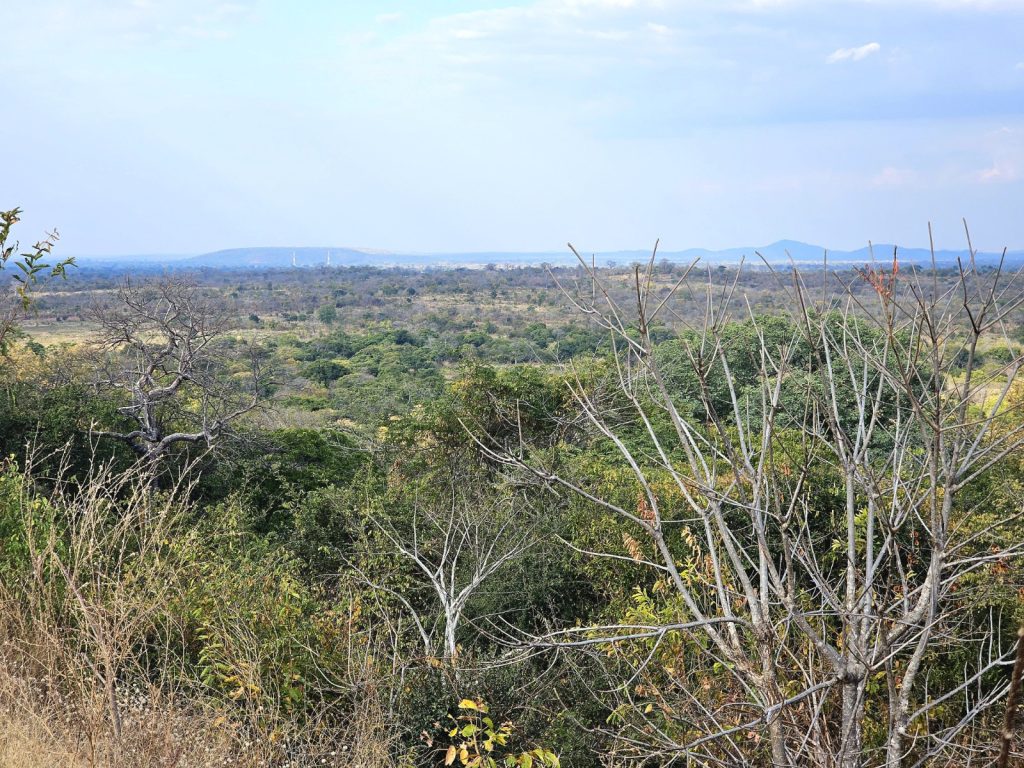
453. Looking downstream from the ridge I climbed over to the large plain where the small town of Jumbe lay.
At the bottom of the hill on the SE side of the ridge I was back on the plains again and followed the pot-holed road over a couple of bridges and farming areas to the very small town of Jumbe. It was something of an administrative centre for the district of Mambwe. I asked at the local petrol station if there was a lodge in town and she said there was and it was the Council Guest House. I have had good experiences with these even if they are a little dirty and poorly maintained. It was apparently the only one in town. I cycled through the town passing a nshima restaurant and loads of small grocery stores and found the faded sign for the “Council Guest House”.

454. On each side of the ridge before Jumbe there were still quite a few ponds and pools in the river beds. It must be far better here than the Kariba area.
I think these council guesthouses were built by the governments to facilitate people coming into town on official business, like land purchases or disputes, legal matters and also to visit the local hospital. I am sure they are subsidised for locals and provide a great place to stay. For me they were fine but totally lacked charm and were very perfunctory, but relatively cheap. This one was 150 kwacha or £5. The room had a table, a chair and a bed. The bathroom was really basic with just an old cast iron bath. Its enamel was heavily chipped and it did not have a plug and only the cold tap was connected. Tiles had fallen off all over the place. As usual the cistern was broken and the seatless toilet was flushed with a bucket filled from the bath’s single tap. There was a sink but it had no taps. It would have appalled genteel women. However the lady agreed to provide a bucket of hot water so I could stand in the bath and pour cups of hot water over myself and it worked well. They also said they would provide a meal of chicken, greens and nshima.

455. The most unsalubrious Council Guesthouse in Jumbe. In its prime 20 years ago it must have been tolerable but it had not seen any maintenance since then.
There was a bar where I had been to check in initially and I asked for the meal to be brought there. When I went to the bar now there were about 10 men in it but they were all 30 to 50 year olds and looked like sensible officials who were watching football. One man asked for an order “3 minute maid please.” I wrote some of the blog while the others were watching premier league football and listening to some very easy soft Zambian music. After the meal I returned to the room by which time the power had come back on and I could now see it was not that bad after all. However, of all the council guesthouses I have been to this was the worst. Even the most hardened traveller with the most liberal poetic licence would find it difficult to describe the Jumbe Council Guesthouse positively. However it was much nicer than JB’s in Rufunsa some 10 days ago.
Day 079. 27 July. Wildlife Camp Rest Day. 0 km. 0 Hours. 0m up. 0m down. I had already booked an early morning game drive starting at 0600. I got up at 0515 and got ready and then went to the reception at 0600 and met Roberta, an Italian travel agent, and Joel who was to be our guide. We got into an open backed Landrover with 9 seats in the back but we were Joel’s only two clients. We drove in the chilly morning air for 20 minutes to the park gate just as the great orange sun rose over the treeline and reflected off the Luangwe River as we crossed over the bridge to the Park Entrance. Here we paid our entry fee of $25 and then drove slowly into the park.

441. Sunrise over the Luangwa River on our way into the park for an early morning game drive.
In contrast to the night drives the morning drives go south of the main road. Roberta had been here a decade ago and had taken an award winning photo of a leopard called Alice. She was now keen to see Alice’s daughter, Lucy, who was the leopard I had seen the other night with Andrew. However Lucy, or her two cubs, each a year old, were not to be seen. After an hour we had barely seen anything except for an African Fish Eagle, a few elephants at a distance, lots of impala and some semi submerged hippopotamus. We drove round and round on small tracks to no avail. Occasionally we passed another safari vehicle and there was an exchange of info between the drivers in Kunda.

442. The pride of 14 Lions eating the bull buffalo the managed to kill just a few hours previously. They will spend 2 days feasting on the carcass.
On one occasion Joel must have got some information about the 14 lions we saw 2 nights ago. Apparently they had made a kill late in the night and were now devouring it. We drove off to investigate and soon came across 5-6 safari vehicles parked up with everyone looking into the bush in the same direction. There some 150 metres away were the lions feasting on the nearly intact body of a large male buffalo. Most were on their haunches facing the carcass and trying to find a soft area. One of the larger cubs was squeezed out and was gnawing on the cheeks. This pride was very experienced apparently and with 3-4 adult lionesses could tackle a large bull buffalo. We sat there watching them for 20 minutes as we were not allowed to go closer as there is a hefty fine for drivers who go off the established tracks. Then a monitor vehicle arrived with 2 rangers and rather than disperse us in an authoritarian way they said that one vehicle at a time could go to within 15 metres so the clients could take photos and then it should move on so the next could come within close range. It was typically Zambian in this law abiding, conservative country to err on the helpful, friendly side.
When our turn came Joel drove up and we had about 3 minutes to watch and take photos. Apparently the kill was at 0400 as locals across the river heard it in the night. The carcass was hardly eaten and the lions were not at all bloated. Joel seemed to think this would last for a couple of days during which time the lions would stay in the vicinity and only leave the carcass to go and drink before returning. Then after a couple of days they would start to hunt again leaving the remnants of the buffalo carcass to the vultures and hyenas, of which there was no sign yet. I got a selection of photos and a video and then we moved on. On the other side of the river were two dugout canoes which fishermen used. Joel said the younger fishermen are sometimes taken by crocodiles but the older ones are wise and can preempt the crocodiles behaviour. The price of fish though made it lucrative enough to take the risk.

443. The small dugouts which the lock fishermen used to cast their nets in the crocodile and hippopotamus infested Luangwa River.
We now drove down to the river and along its bank where we could see hippopotamus and some crocodiles before we stopped for biscuits and coffee. There was one enormous crocodile here which must have been 4 metres and weighed perhaps 250-300 kg. It was a strong animal. A heron stood still nearby but apparently crocodiles don’t care much for birds with their feathers. If it managed to lock onto an animal it would drown it and then stash the body in some logs along the river until it started to rot a little and became softer and easier to eat.

445. The large Nile Crocodile was about 4 metres long and about 300 kg. Easily big enough to capsize a dugout if it wanted to.
As we drove towards the exit we saw a few lonely hippopotamus on their own having been thrown out of the herd by the dominant bull, usually for trying it on with the females. These outcasts were lying in shallow marshes or even in the shade in the forest when they would either grow and challenge a dominant bull, or they would find a watering hole and try and establish their own herd by pinching females. This ran the risk of conflict with other males. On other occasions hippopotamus might lie in the shade of the forest for a couple of days rather than go in the water to allow a cut or gash to heal first.

444. A large hippopotamus resting under a tree rather than returning to the water for the day. It was either an outcast or wanted a wound to heal first.
On the way out of the park and quite close to the Wildlife Camp we came across a breeding herd of elephants. There were two bulls, about 8 mothers and 7-8 young ones of various sizes. They were in a shallow lagoon covered in weed and were sticking their trunks beneath the weed to drink the water. We watched them for a while and then returned to Wildlife camp at 1000 to have breakfast. I then spent the rest of the afternoon doing the blog and photos in the bar/dining room which was a quiet place. I was booked on another game drive for the evening which started at 1600. However when I wanted to go back to my chalet the route was blocked by a herd of elephants and there was one small baby elephant amongst them and I had to wait for nearly half an hour for them to move on.

447. Part of a breeding herd of elephants in a shallow weed covered pond near Wildlife Camp. The elephants were drinking water beneath the weeds.
The second game drive left at 1600 and we were 6 passengers altogether with Joel driving and George as a spotter with the torch when it got dark. We drove slowly to the park where the others paid their entry fees. I had already paid my 24 hour permit this morning. We then went into the park and surprisingly did not turn north where we went on the night drive with Ackim and Andrew 2 days ago, but turned south and followed the small roads we were on this morning.

446. Lilac Breasted Rollers were a common sight throughout Southern Africa and not just in the National Parks
We drove round and round but did not see much except for the lions who were still eating the buffalo carcass. The sun was low now and we were looking straight into it so the lions were not as clear as they had been this morning as we were 150 metres away. The monitor vehicle which gave us permission to go off the track was not there so we could not get close. When we left the lions we drove a short distance and came across three large spotted hyenas who were lying down and very relaxed. They were waiting for an opportunity to scavenge some of the buffalo carcass as soon as the lions went for a drink or left the carcass unguarded. There were also a few vultures gathering but their wait would be longer than the hyenas.

448. Three hyenas were waiting patiently in the evening for the lions to leave their buffalo and go and drink hoping to steal a meal before they returned.
As the sun went down in a blaze we stopped at an insignificant pond and had crisps and a coke and then set off again. We drove around for another hour and a half in the dark with George flashing the torch from side to side. We saw virtually nothing except for a few hippopotamus who were eating the long gourd-like fruit which had fallen from the sausage tree and also a mongoose and a few genets, a small carnivore which looks like a cat but is not. The landscape we were driving around did not look good for a leopard as it was predominantly open plain with few trees but much scrub. Eventually Joel veered towards the river where the trees were bigger but he did not go north of the road which we did a few days ago and where we spotted the 3 leopards. I felt Joel was almost killing time until we had to return to Wildlife Camp and George was lacklustre in trying to spot wildlife with his not so bright torch. Of all the game drives I have been on, which is about 7, this one was the most disappointing and I think the others felt the same way. I did have a tip looked out to give Joel but withheld it as I thought the game drive was perfunctory.

449. The usual vibrant African sunset on the evening game drive was also the sunset to my stay at South Luangwa National Park as tomorrow I would leave.
Once we returned to Wildlife Camp before 2000 I had a meal in the dining room and wrote a bit before it was time to return to my cabin. The waiter/barman on duty insisted on escorting me saying if he let me go alone and anything happened he would lose his job. So to keep the peace I complied. Tomorrow I would do the final part of this section which would be to cycle to Chipata on the Malawi border.
Day 078. 26 July. Wildlife Camp Rest Day. 0 km. 0 Hours. 0m up. 0m down. I had already put today aside as a rest day. The last three days were not hard but I was a little tired and needed some time to recover, wash clothes and generally relax. I also needed at least a day to do the blog – which I had mostly written in a crude form full of typos. After the large breakfast with Andrew and his partner I returned to my cabin to write while Andrew went on the road I cycled yesterday to sort out his plot of land which the Chief Malama had given him. His partner was related to the Chief so I am sure this was a joyful occasion for everyone.

438. My thatched chalet with the verandah facing the flood plain and river whereci spent the day.
Writing on the verandah was simply fantastic. It was warm yet shaded. The table and chair were perfect and the outlook was superb. The only trouble was there was so much going on it was not that productive. Before me was the flood plain and the Luangwa River was beyond that. I could see the rounded backs of the submerged hippopotamus in the river and their grunting, snorting and bellowing was carrying across the parched grass. There were perhaps 30 impala in the grass in the open. A few were mothers with larger fawns who were half the size. The scene was very relaxed and many of the fawns were sitting on the ground. There were also about 15 warthogs in two big groups which were grazing. The adults were on their front knees so they did not have to bend down so far but the smaller ones were more active and were grazing and moving at the same time. There was even a giraffe.

436. As I was sitting on the verandah of the chalet writing overlooking the flood plain of the Luangwa River a small herd of elephants wandered past right in front of me.
I continued doing the pictures and just looked up to see a herd of 6 elephants saunter past just 30 metres away. They were quite silent and had I not looked up I would have missed them. There were two very small babies among the herd and a teenager so hopefully they will not surprise a car camper in the other busier part of the Wildlife Camp 400 metres away. I then heard a sound behind me and there were two more elephants which must have wandered through the reception and were going along the path at the front of the cabin munching some of the ornamental hedge as they went.

437. Across the flood plain there were impala and warthog grazing peacefully in the sun all day.

439. The were also a large troop of baboons which arrived in the afternoon and spent time grazing on the flood plain.
With the pictures done I went for a siesta but closed the door and brought everything loose in as the baboons had arrived. There were about 100 of them and they spread out across the flood plain digging for roots. Many of them played and frolicked right by the balcony. They would have tapered with or tried to eat anything I left out. I slept longer than I wanted and it was not until 1600 I woke again. I also went to the reception to book an early morning game drive before reception closed. I was just starting to write when Andrew appeared after a good day for them. His conversation was infectious and he was a great conversationalist. It turned out we had some connections. I knew of a Hugh and Myrtle Simpson in Scotland who were well known Greenland Explorers in the 1950’s to 1970’s. Well it turned out Andrew was Hugh Simpson’s nephew. Another connection was that Andrews’ great, great uncle was a physician who invented chloroform and who the Simpson Memorial Hospital in Edinburgh was named after. It was a small world.

440. In the dusk two large warthogs strolled past, confident there speed would keep them out of danger.
I had an early dinner on my own as I ordered it before Andrew returned and I then returned to my chalet in the dark to catch up with the writing. It is a constant burden on this trip but if I don’t do it I have a dark cloud on the horizon which only clears to bright blue sky when I am up to date. Once I was almost finished I went to bed quite early with the alarm set for 0530 as I am getting picked up at 0600 for the early morning drive. It had been a great day at the Wildlife Camp and I hardly needed to do anything as animals were coming to my doorstep.
441. Sunrise over the Luangwa River on our way into the park for an early morning game drive.
Day 077. 25 July. Malama Umoyo Lodge to Wildlife Camp. 42 km. 4 Hours. 210m up. 210m down. During the night there were plenty of sounds from the area. The hippopotamus which did not go foraging for the night or returned early were snorting and grunting in the creek just below the cabin. At around 0400 there was also a pride of 4 lions which came through on the beach below the embankment and these roared a few times. I did not know what it was at the time but at breakfast Kevin asked me if I heard the lions. It was a great place to watch wildlife and a magical and serene spot. I would have liked to have spent another day but I was booked in at Wildlife Camp 40 km up the road. I had breakfast chatting with Kevin who was a major part of the ambience of the lodge, and then left at about 1030 after saying goodbye to everyone. In consideration to what Douglas had said yesterday and also what the guides who worked for Kevin said I ditched the white hoodie and wore my dark blue shirt so I would not be so visible to the elephants.

423. In the morning at Malama Umoyo Lodge the largest of the 3 crocodiles was floating in the creek just below the cabin. It must have been 4 metres or 13 feet.

422. After a night of foraging in the dark in the bush grazing on vegetation the hippopotamus had returned to wallow in the creek below the cabin for the day.
I was a bit apprehensive about meeting elephants on the road here. My mouth was dry with adrenaline and fear as I set off down the gauntlet. As promised the road was in quite good condition but a bit corrugated or washboarded in places and that made my bike rattle noisily. So after a few kilometers I stopped to bungee down the items which were rattling. I was looking from side to side like a tennis spectator peering behind every shrub. I remembered from Botswana how easy it was for these huge animals to remain hidden behind small shrubs. I did not want to surprise one at close quarters. There was lots of dung on the road but it was all quite old and there were lots of footprints but again they looked quite old and the tyre tracks of the last few days had obscured them as they drove over them. It was not a well used road with perhaps 3-5 cars a day on it and a few more motorbikes.

424. The gravel road from Malama Umoyo Lodge to Wildlife Camp was 40 km but it essentially went through a National Park and there were elephants, lions and buffalo in the area.
One track which I did notice a lot of were the hippopotamus tracks and their distinctive 3 toed print. Their tracks were everywhere, almost every hundred metres as they came up from the river, crossed the road and then headed into the bush to graze on the wide mantle between the road and the base of the hills some 2 kilometres to the east. They come out of the water after dusk and then wander off into the bush to graze all night and then return to the river at dawn. They have to do this because their skin is sensitive to sunlight and they need to wallow in water to stop themselves getting burnt. There were also various other prints which were both zebra and buffalo. I hoped the latter were deep in the bush grazing as I did not want to encounter one of them either.
There were about 20 streams crossing the road and most of them did not have a bridge. These were the most delicate sections and the road would drop down slightly into a sandy dip which was covered in thicker green vegetation. At the bottom of the dip was the riverbed which was also sandy and it was perpendicular to the road. It was a perfect alley way for elephants to migrate from the river to the bush, while finding plenty of fodder on the way. I was especially careful going into each of these and stopped and listened before I went down the sandy ramp to the bottom. It was a bit of a trap really as I had a sandy ramp on the other side too and would struggle to get up it. Sometimes I had to get off and push. It would not have been a quick exit even if an elephant was following me. I always had the airhorn ready as the defence of last resort.

425. I saw 2 herds of elephant on the cycle both 500 meters ways from the road. This one was a family group with mothers, teenagers and babies. The teenagers are the dangerous ones in this situation.
I had gone about 15 kilometres and done about 6-8 of these riverbeds in an hour and a half when, on a flat bit, I spotted a small herd of elephants on a grassy clearing some 500 metres to the west between me and the river. It was a safe distance I thought. It was a mixed herd with perhaps 3-5 mothers, 4 younger elephants and a couple of teenagers. Apparently it is the teenagers which are the worst for charging as they want to make a name for themselves within the herd, while the mothers tend to encircle the young ones in a protective ring. About a kilometre later I saw 2 large bulls also about 500 metres from the gravel road in a different clearing. I was obviously entering an area where they were more common. I saw virtually all the baobab trees here had damaged bark around the boles up to about 3 metres. I later found out the elephants use their tusks to gouge strips of it off and eat it. There were not many other animals except for small groups of zebras and many small herds of impala and troops of baboons. The impala would easily cross the whole road, about 5 meters wide, with a single high bound.
As I neared the half way point I saw lion prints and I was quite sure they were from last night as there were only 2 sets of tyre tracks over them. They were surprisingly small and I initially thought they were leopard but someone later confirmed it was a lion. It was known there were lions on this stretch as there was the National Park on one side and Game Management Area on the other and nothing to separate them except for the relatively shallow, but crocodile infested, Luangwe River. Local cyclists assumed that lions were active and hunting during the night and would kill prey then. They would then spend the whole night gorging themselves and during the day would find a grassy shaded spot out of the heat of the sun and sleep it off. The worry was there might be older males who were thrown out by the pride and these would get progressively desperate hunters as they got more geriatric and might not obey that nocturnal pattern. I glanced at my air horn again making sure it was ready to deploy.

426. I didn’t see any lions but heard them in the night at Malama Umoyo Lodge and saw this fresher prints about half way along the day’s cycle.
Perhaps the worst thing on the cycle though was the tsetse flies. They follow the herds of buffalo, impala and zebra. They are about the same size as a horse fly and have a painful bite as they need some serious jaws to get through even the softest buffalo hide. Unlike horseflies they are too fast for human reactions and fly off before you can swat them. They were getting so bad I wondered about stopping to put repellent on. The other problem with the tsetse flies is they can carry a disease called Sleeping Sickness in layman’s terms.
About half way I reached a security checkpoint. The guard looked very military and efficient. He confirmed the prints I saw were lion prints and said there had been three there last night. He also gave me some tips for dealing with elephants if I came across them, which was essentially to be patient and give them a wide berth. He said the elephants on this side of the river were much more wary and afraid of humans because of historical poaching and confrontations with farmers chasing them off crops with catapaults. The ones in the park are more confident and curious and less likely to feel the need to defend themselves by attacking. He also mentioned my dark shirt was a good colour and white was bad. I think this guard was essentially an anti-poaching guard and monitoring traffic. There were also specialist anti poaching units but they were often roaming in the bush. I am not sure if poaching is prevalent now as the penalties are harsh, but it was prevalent 20 years ago.

427. On the latter half of today’s cycle I passed a couple of large clearings where I thought I might see elephants crossing but didn’t.
The second half of the trip was faster as the road was better with less stream bed coming down from the mountains. It was also more open with a few large clearings some a kilometre across. However there were more elephant prints here but again many were old. Towards the end I entered a forest which lasted maybe 10 kilometres in all and it was clearly shaped by elephants. There was an understory of small trees which had been coppiced by elephants so these trees were only 3 metres or 10 feet high. Anything which grew from these stocky stumps was eaten by the elephants who left the stumps. Then there were the larger trees of the same variety which were just clear bare trunks up to about 6 metres when a canopy formed just beyond the reach of elephant trunks. I guess a forester would be able to deduce when the elephants moved into this area as their numbers increased by deducing from the larger trees when they were too high for the elephants to coppice at 3 metres. I saw little here except for the odd safari truck whose white occupants seemed surprised to see me. After 38 km I reached the turnoff to wildlife camp and had a gentle descent down a good gravel road to Wildlife Camp.

428. I cycled past many forest areas which have been shaped by grazing elephants. The underfloor only grows 8 foot high as it is continually stripped and the canopy starts out of reach of elephants trucks.
Here I had pre-booked a chalet for 3 days to catch up and explore the park. It was a lovely setting overlooking a parched grass flood plain on a bend in the river. The chalet overlooked this and had a verandah. Beside the chalets was a thatched area with drinks and where I could order food. It was all quite good value for what you got and a fraction of the price of the other lodges in the area which were essentially the same but with champagne and other superfluous luxuries. I unpacked into the thatched chalet and then went to the bar area for a drink.
I had barely sat down when I met Andrew Cairns with a well educated English accent. We quickly asked questions of each other and found we were a kindred spirit. Andrew had grown up and gone to posh schools in Rhodesia as it was then. His father was a medical doctor and was the clinical director of one of the largest hospitals in East Zambia for about 40 years. Andrew had returned to England as a young man and had set up a financial advice business for a few decades before returning to Africa. He was now involved in a lot of charity work especially within the Malama area, so much so the Chief Malama had given him some land and was going to inaugurate him as a member of the tribe in a couple of months. Andrew spoke fluent Chewa and Kunda from his near 6 decades association with the areas. He could hold a conversation on any topic from Verdi’s operas to Kunda syntax.

429. In the evening we went for a game drive and on crossing the bridge over the Luangwa River were could look down on a young bull elephant on the riverbank.
Andrew invited me along on a night drive that evening leaving in half an hour and I would only have to pay for the park entrance fee. I jumped at the chance and left to wash my face and change clothes. We then drove to Mfuwe town centre, the gateway to the park and met Ackim who was a guide and owned an old landrover 110. Andrew, his partner and myself then hopped in the open seats in the back and went into the park. It was across a large bridge over the Luangwe River where we saw an elephant emerging from the water. A little later was the park gate where I paid the $25 entry fee.

430. We saw a younger giraffe which was on is own and seemed somewhat vulnerable especially as there was a pride of 14 lions nearby.

431. Two of the lions from the pride of 14. They were still sleeping and relaxing at the end of the hot day but would soon get up and begin to hunt around dusk.
Ackim was a self employed guide with his own vehicle and was very competent. We also had a scout who was a spotter. Both were qualified. We drove up the road a little and then headed north and spent the next hour and a half looking for wildlife. We saw waterbuck, hundreds of impalas, a small looking teenage giraffe on its own, a pride of 14 lions still basking in the sun after the hot day, a pond full of weed which had a herds of hippopotamus wallowing in it and a plethora of birdlife. All the time we were heading for an ox bow lake and an embankment on the edge of the river where there was a view of the sunset which went down over a herd of hippopotamus in a blaze of orange, which I am starting to take for granted now. Across the river there were some fishermen starting to get ready to go into their tiny vulnerable dugout to do some fishing, probably with attended nets. It was a very African scene.

432. At sunset we went to the banks of the Luangwa River to watch the orange sun set. The camp on the east side of the river are fishermen just outside the park.
Just across the water was a lodge called Takina. It was here that two lady tourists were killed by an elephant 3 weeks ago. Apparently they were walking some 150 metres from the boat to the lodge when they stumbled across a herd of elephants. Unknown to them a mother and baby were at the side of this herd and being elephants which had previously been poached were very nervous and defensive of people on foot who they assumed were there to do them harm. The mother emerged from the bush and charged at them from the side, trumpeting loudly. The scout, with the gun, and the guide fled leaving the two ladies on their own to face the wrath of the mother elephant who quickly killed them. It was only then the scout reappeared and shot over the head of the elephant which then fled.

433. After dark we spotted a leopard which was just starting to hunt in the early night. Impala would have been the prey of choice.
After dark we started the night drive. The scout had a powerful torch to spot wildlife. I was amazed how many hippopotamus were now out and about, usually single but mothers with babies, grazing on the short grass. We looked for the lions but they had gone to start hunting apparently, Then we came across a cluster of safari vehicles with their torches focused on a leopard. It was initially distant but slowly came towards us moving with supreme confidence and seemingly completely unfazed by the number of bright torches pointing at it. It was not big, but powerful, and I am sure it would have made short work of me as it disembowled me with its claws. It went straight between the vehicles without any effort to avoid us and then went into the thicket to look for impala.

434. We saw a pair of leopards up a large tree with an impala which they had dragged up there some 10 metres above the ground.
A bit further we came across two more leopards. They had just made a kill and were now dragging their impala up a large tree. They must be incredibly powerful to climb 10 metres up a tree with the 30 kilo impala in its jaws. It had laid the impala over a branch and the two leopards were starting to eat it in peace away from other predators. I am not sure if it was a mother and an offspring or a pair. In the end one of the leopards came down and slunk off into the forest away from the lights. Sitting near the bottom of the tree and looking patient was a large spotted hyena. It was obviously hoping that a leg or perhaps the whole impala might slip off the bough and then it would have its meal. I don’t think a leopard would tangle with the hyena to get it back.

435. Below the tree where the leopards had carried the impala up was a hyena patiently waiting for flesh or bone which might fall from the tree.
After this sensational find it was time to head back to the gate and vehicles. We saw many more animals but did not really have time to linger. It took us half an hour to leave the park, pick up Andrew’s vehicle, say good bye to Ackim and the scout and return to Wildlife Camp. When we got here the meal we preordered was ready and we had finished by 2100. I was tired after the long day and the large meal and headed off to my adjacent chalet having been warned to not wander about outside at night. I was too tired to write so I went to bed. It had been an extraordinary day to cap off the last three exceptional days since leaving Petauke.
Day 076. 24 July. Sandwe to Malama Umoyo Lodge. 60 km. 6.5 Hours. 240m up. 400m down. I slept well under the large mango tree and woke up as it was getting light. I thought I better get into my cycling clothes and get out of the tent before the chief’s representative in the nearby house got up. As I was getting up a tall elegant woman, but bare foot, turned up and started chatting to me. I hurried a bit and then stood up to greet her. She spoke English quite well and explained she was the chief’s niece and the man I met last night and the chief’s representative, was her brother and the chief’s nephew. I chatted with her for about 10 minutes about the chief and his palace and then she offered to give me a tour of the garden and the farm.

409. Chief Sandwe has a representative when he is not there. It was his nephew who was the one I met last night and gave me permission to camp under the mango trees.
We went into the compound through the gate formed by the chief’s accounting office and the land office buildings. I presume the land office had the records of all the farmers in the chief’s large chiefdom with apparently 100 different villages and hamlets. The driveway was past the pump I used last night and under an avenue of mango trees and some small pines to his palace. It was essentially a large bungalow with a few attached buildings. A tractor and plough stood outside. The chief’s niece then showed me the farm at the back of the palace. It was very varied with two large poultry houses full of hens, perhaps 200 in each house with a few feeders. It was almost battery style and not free range at all. There were also turkeys and ducks in separate houses. There was a large coral for the cattle, perhaps 200 in all, which I had seen go in last night and come out this morning with a few herdsmens looking after them. There were also some 200 goats and a few sheep which also went into the chief’s compound last night and came out this morning. They were plump and well fed and obviously the shepherds took them to the best grazing. They spent the night in a small stockade with a log roof and would have been secure against leopards. There was also a piggery in a concrete block shed. The chief’s niece encouraged me in and asked the guys working there to unlock the door. Inside there were perhaps 8 different sties with 3-5 pigs in each one. It was very clean and the pigs were also clean and not at all dusty. Perhaps they spent their lives in this sty. In one of them were 3 enormous males which sired the sows. There was even a dove cot with perhaps 100 doves in it which could come and go as they pleased. After the tour of the farm we headed back to the palace where the chief’s daughter was coming out and going to school. She was a confident 15 year old with just one sock on her well shoed feet, probably as an act of individuality, as I am sure she had plenty of socks.

410. The maize granaries were very common and every homestead had one. More recently I have been seeing the smaller tall granaries on the right and they were for groundnuts which were stored in the shell.
At the gate the chief’s niece went back into her house within the compound and I went out to my bike and the chief’s representative. I chatted with him and asked him about a large pile of bricks waiting to be fired. He said they were for him and he would soon light a fire in the channels under the pile to harden the bricks off for a house he intended to build. I was also curious about a small granary which I had noticed in a few compounds. He explained they were for groundnuts and we went over to it and he gave me a handful, still in their shells. I chatted a bit more with him. He was very gentle and humble but I am sure quite wise and would be good at making decisions involving social issues. I gave him 200 Kwacha for his permission to camp. As I left I noticed just how many mango trees were in this village which must have a glut of them when they all ripen.

411. The pile of bricks which are stacked in such a way there are channels into which wooden logs can be placed to fire the bricks so they are harder.
Once back on the main road I headed north and was delighted to see the road was quite good and graded. A few people asked me where I was going and where I had been. When I told them I was at the Chief Sandwe they became a bit more respectful. The kids in these villages now had a different chant. Instead of “how are you, how are you” it is now “sweetiiiieeee, sweetiiieeee, sweetiiieee” when I tell them I have none they look disappointed. I would have to carry a trailer of them just to give each one. The women also seemed less friendly here and quickly asked for money. I was in a different tribal area now and everybody was from the Senga tribe, as they were in Petauke also. Perhaps they are more demanding and less in awe of Muzungo’s or white people.

412. Chief Sandwe’s Palace which lay in a large courtyard surrounded by offices. At the back was the farm with poultry seeds, pigsties and the corrals for the cattle and goats. His niece showed me round.
I passed a few villages and they seemed to be getting quite poor again. The electricity lines stopped at Chief Sandwe’s palace and did not continue further. I got the impression that this land was recently cleared, perhaps in the last generation as there were lots of stumps in the fields and the houses looked quite temporary really and quickly constructed from bamboo, with a thatched roof. There were a few houses made of mud brick and I passed a few areas where the bricks were getting made, which did not seem a specialist occupation, but hard work. The main transport here was ox cart and the sides were made of woven bamboo, and motor bikes. The only car I saw was a pick up with “Mary’s Meals” written on the side and I saw it parked at a school later. This school was busy with smart kids in a green uniform but the school was unfinished with no windows.

413. In the hamlets around Sandwe the farmers frequently further the forest floor. On the occasions birds like this Lizard Buzzard and Drongos gathered to swoop on the fleeing insects and reptiles.

414. Initially the track from Sandwe heading north was in good graded condition but after 10 km it deteriorated.
After about 10 large hamlets in nearly continuous homesteads I took a wrong turn. I was already 200 metres past it before I realized. I was sure it eventually led back onto the quite small and rough main road which was essentially a track. However this track did not lead back onto the main road for ages and took me deep into the scrub forest through a string of very poor and remote hamlets, where just about everybody was barefoot. Each of the hamlets did have a water bore hole and pump, and this area was always busy with women. I did not see many men around at all except older ones in the hamlet sitting under a thatched verandah discussing. Often one would leap up and come over. They were all very interested in what I was doing and had probably never seen a Muzungo in their hamlet before. They were all extremely gentle and wanted to shake hands and then give me directions on how to get back to the main track. I could see on my GPS map it was now about 2 kilometres to the west. However despite their directions I never seemed to veer west towards the track and just kept parallel with it. I was not too worried as each hamlet directed me to the next and they all said Malama was where I was already heading. I rather enjoyed the peace and quiet of these little hamlets lost in the bush. It seemed people here grew maize and cotton. The former for sustenance and the latter for cash. However some of the men explained that the rains had been poor and the cotton did not do well.

415. Many of the homesteads north of Sandwe were built of logs driven into the ground and were under a thatched roof.
While some conspiracy theorists in Europe and America claim that the earth has always gone through cycles of cooling and heating and this is just a normal part of that cycle. Here in these rural subsistence farms in Zambia at the cutting edge of climate change, the unpredictability of the rainfall is now very real. These conspiracy theorists have made up their minds on man made climate change based on lazy gossip and social media trends, rather than listening to the scientists who work in the field, who are referred to as crackpots with an agenda. Perhaps the conspiracy theorists should come to Africa and spend a season ploughing, planting and tending cotton hoping for a harvest to sell for a few dollars. Then just see the cotton not develop because this year the usual rains were insufficient for the cotton to produce anything and it was all a waste of effort.

416. Between Sandwe and Malama I lost the main track and detoured to the east of it on a remote rural path linking up idyllic hamlets lost in the bush.
I continued on this small path from hamlet to hamlet, meeting men from each hamlet, for nearly two hours. I was continually always just 2-3 kilometres from the main track to the west. A few times I was concerned I would not return to it and then a man at one village said “you should be careful of the elephants, they are very dangerous”. Not long after I started to see old dried piles of elephant dung here and there. These villagers must have a constant battle with them as a field of maize must be a delight for them. Perhaps that is why the farmers here grow cotton too as it might be less palatable for them. Eventually my lovely unplanned detour came to an end and I did return to the main track. It was in the same state as the ones I had just been on.

417. Some of the hamlets were very remote and poor and I dont think many of the children here would have gone to school. People were certainly surprised to see me.
The main track went through a couple more villages in the next 15 kilometres. Here the people were less gentle again and the kids were very demanding for sweeties. I tended to do a lot less waving and did not pause as I went through the villages. The track was very small and there was still elephant dung around but there were also many cattle and goat footprints too which mitigated my concern. I passed a couple of larger dry sandy river beds which marked the end of this remote section. I think that at these riverbeds I also passed from the Senga tribal lands to the Kunda tribe, and soon reached the sign for the Palace of Chief Malama. Here the rough sandy track, which was difficult to cycle on, suddenly changed into a smooth, graded gravel road worthy of Namibia. I reached the village of Malama soon afterwards but could not see any small shops. There was no heart to the village unless it was on a side track.

418. Just before Malama I had to cross two riverbeds and push the bike through short sections of deeper sand before reaching the graded road.
However with this gravel road I was up to 15 km per hour rather than the 7 I had averaged so far this day. I cycled fast through the sparse forest noticing elephant dung here and there and also how all the trees were bare up to the length of a trunk leaving just a canopy and flat bare forest floor. Then I started to notice elephant foot prints crossing the road and some seemed quite recent, although a vehicle had been here more recently. As I cycled, a local caught up. His name was Douglas and he looked like a strong sporty young man. “You should not wear white he explained. The best for elephants is black or blue” I went to put my red hi viz vest on and he said that was no good. I then saw he was wearing an Arsenal football top with red chest and back and white arms. Exactly as I would have looked. However, he was great to chat to and we cycled together for 4-5 km until just before the village of Nyamuluma. He invited me to his homestead for nshima but I wanted to get on to the village, quench my thirst and then continue to the lodge I had earmarked. I noticed his compound was ringed with tall tree posts and two strands of electric fence were strung between them. We shook hands and I continued to Nyamuluma. But after 3 km I realized I missed it. The road split and then came back together and it was on the other part of the road. I was pedaling hard and did not look at the map. It seemed the best option now was just to continue the last 8 km to Malama Umoyo Camp on the banks of the Luangwa River which was very cycle friendly according to the reviews.
As I cycled I continued to see elephant tracks. To my west was the South Luangwe Nation Park and I was now in the large Lupande GMA, (Game Management Area). Sperating the two was just the quite shallow Luangwa River which animals could easily cross. So this was now not just elephant country but also lion, leopard and buffalo country. I had to cycle along the road for about 6 km to reach a village and the lodge. I was alert as I went and was counting down each kilometre with a sense of relief. The only game I saw was 4 zebras running across the road. Pretty soon I reached the small village which seemed to be more of a government training camp for game scouts and anti poaching wardens rather than an agricultural village. Soon after was Malama Umoya Camp and I went down to it. It seemed deserted when I got there but then a man appeared and he went off to get the boss.

419. After cycling for 60 km non stop I reached the comfortable oasis of Malama Umoyo lodge on the banks of the Luangwe River. Here I could look down on crocodiles on the opposite bank.

420. There was also a herd of hippopotamus in the side creek just below the cabin and these were wallowing in the shallows.
Soon Kevin arrived. He was from Liverpool and I immediately warmed to him. He was my age and had owned this camp for 3 years. He was reluctant to let me camp as he had other guests, but offered me a cabin at a good price. He also could provide dinner. And he had cold drinks. We went off to the cabin which was absolutely fantastic. It overlooked a herd of hippopotamus basking on a sandbank and wallowing in the water. There were also 3 large crocodiles on the sandbank below me. The river here did a sharp turn and the cabins were on top of a near vertical embankment that animals would never scale. The cabin was delightful with two large rooms and a wonderful bathroom with hot water at a good pressure. I was sorry I had booked Wildlife Camp tomorrow as I could have spent another day here. I sat in a small pergola after the shower and watched the hippopotamus and crocodiles below me, and then warthogs, impala and many baboons, easily 100, grazing and relaxing on a large field like a flat plateau above another embankment. The whole place was enchanting. Kevin was very knowledgeable and a great talker and I could have listened to his stories but had to do the blog. I finished it just before dinner when I joined the other guests who were also a family from Liverpool. I was also told the road tomorrow was in great condition and it was only 38 km to the Wildlife Camp but there were occasional elephants on it. There was the possibility there were lions in the area but during the day they would not be hunting but lying in the grass digesting last night’s meal. After the great meal in very good company the family from Liverpool returned to their cabin with a chaperone as they were getting up at 0530 for a game drive. I also headed back to my lovely cabin a bit later with Justin escorting me in case there was wildlife about. We did not see anything but once I was back in my relatively remote cabin I heard a hippopotamus quite close by which must have somehow made it up a chink in the steep embankment.

421. The cabin I was given at Malama Umoyo Lodge was a delight. The roof had been repaired because two male baboons had been previously fighting on it and wrecked it.
Day 075. 23 July. Petauke to Sandwe. 75 km. 8.5 Hours. 530m up. 860m down. I had a last shower, revelling in one that worked well and then had breakfast at 0700. Despite not having much to pack I still did not get away until 0930. I was not too worried as I was only going some 60 km to Chilembwe. It was remarkably windy and overcast when I set off with gusts lifting great clouds of dust and leaves from the road and fields.

401. After leaving Petauke the red earth road drops down from the ridge Petauke sits on onto the intensively farmed plateau which is peppered with hamlets and small villages.
Initially it was quite a steep drop from the guesthouse down to the plateau for about 20 minutes on a road of red packed earth. Eventually the road veered north though and the gradient became perfect. It was dropping perhaps 10-15 metres every kilometre and with the wind partially behind me now and the red earth road smooth and firm I was cruising along at nearly 20 km per hour. It was a glorious cycle through very traditional hamlets which were almost continuous. The compounds here were now quite large with a few traditional round or square mud huts, a round storage granary, a chicken coup made from bamboo and elevated, and then a mud brick larger hut with a corrugated roof. All of this was sometimes surrounded by a stockade of posts buried in the ground, or alternatively there was a stockade nearby where the cattle spent the night. The villagers were friendly as I cycled through with many “how are you” yelled as I cruised by.

402. Many of the homesteads on plateau were traditional with a few mud brick buildings and bamboo huts, nearly all of which were thatched.
In one village I lingered a little as they were stockpiling a vast heap of sacks of maize kernels which the government was going to buy. A few kilometres further I came across a row of small shops and I stopped at one to buy some biscuits and sugar water as the breakfast was spent. I assumed I would get some nshima, green vegetables and meat when I got to Chilembwe so did not seek a proper lunch. I was quickly surrounded by young children so I did not have the heart to eat the two packets of biscuits in front of them, so I cycled off for a while until I was between hamlets and had them there.

403. Many of the homesteads on the plateau had a stockade, either a small one to keep the animals safe at night or a large one to prevent animals coming into the courtyard.
After my biscuit lunch the road turned more into a track as it climbed a gentle ridge. The hamlets and farming stopped as I went up, climbing nearly 100 metres in all. Some of it was steep and rough enough to warrant me getting off and pushing the bike up. From the top I got a great view over the surrounding plateau which was peppered with small knolls like the one I had just come up. The descent down the other side was disappointingly steep and I had to have the brakes on the whole time until I got to a village which was set back a little from the road on both sides and partly secluded by sparse trees. The houses here were again red earthen brick and I saw a few piles of untreated brick stacked up with a fire set underneath them to bake them hard.

404. Two chicken cups for sale. These are made of bamboo and are then placed on a high solid platform with a log ramp so the chickens could roost safely at night.
After a few more beautiful peaceful villages, where there was little sign of bored male youth gathering outside the very sparse shops, I came to a bridge being built. This bridge would shorten the route by some 5 kilometres as at the moment it goes south to a village, crosses a very sandy valley where the a stream flows in the rainy season washing more sand down, and then the track goes north again to complete this loop to the south. Except for the ridge I climbed over earlier the whole time there were fields beside the road. The fields had just been left since the harvest and cattle and goats grazed on the maize stalks and the weeds in them. Now they were dry and parched but in the growing season they must be bright verdant green with maize.
I now started a long climb up to Chilembwe. The track was never steep but it was quite relentless. However, after the last days on the Great East Road it was relatively small and there were no trucks or even cars on it, just motorbikes and these seemed by far the most sensible choice for villagers. Often bikes would bounce past me with 3 or even 4 people on them. At the top of the hill near Chilembwe there was a great view across the plateau where there must have been hundreds of hamlets, some just connected to the outside world with a path and no electricity. I passed a check point near Chilembwe which was the border between two districts. I asked the guard what was the reason and he mentioned that some goods had a levy.

405. After dropping off the plateau after Chilembwe the track descended through hills down to Sandwe and the Luangwa River valley.
Chilembwe was very small, or perhaps I turned off before I got to the village centre a kilometre or two ahead. There were a few tracks meeting in this village but the one I wanted heading north to Sandwe and Malama was one of the first. I took it and had a steeper climb up onto a ridge which was also covered in fields. From the top of this ridge the track started to descend. It was a long descent and soon I felt the farms were petering out and I was going into hills covered in forest. Down and down I went and soon I felt like I was dropping off the edge of the plateau and down into the Luangwa River valley. The hills I was weaving between as I descended were the ridges and spurs of a gentle escarpment I was dropping down. The track, which was very bumpy in places, was following a small valley which wove down through the forest clad spurs and hills. I spent a good hour coming down but could not go that fast due to the stony track. Eventually I smelt woodsmoke and cattle and knew a village was coming.

406. Just before reaching Sandwe I passed another village where there was a passionate football match with a neighbouring village.
It was a small hamlet and I passed through it and then down a bit more to another larger hamlet with a small shop. The keeper spoke good English and I asked him about somewhere to stay. He said I would be best going down to Sandwe and asking the Chief of Sandwe when I got there. He said it was a 30 minute walk so 15 on the bike. I have become very wary of these estimates though. I carried on down the track for another 3-4 km and came to a larger village where there was a football match with the neighbouring village. There were about 200 people watching and many motorbikes parked up. There was a real vibrant, festival atmosphere and everyone was passionate about the game. When they saw me they all turned and cheered, shouting “Bwana” and waving and I cycled past. I was sure this was Sandwe, but it was not. It was further down the track. I passed another two hamlets before I reached Sandwe which was lively with a children’s party in the sports ground.

407. One of the homesteads just as I was approaching Sandwe as the sun was setting.
In Sandwe people directed me to the chiefs further down the road until I got to the sign for “His Royal Highness Chief Sandwe Main Palace” I went down the track for the 300 metres and reached a large complex behind administrative buildings. There were gardens beyond the gate between the buildings. For Zambian standards it looked very grand. I suppose Chief Sandwe presided over 100,000-300,000 people in 100 or so hamlets. However there was a pole across the entrance. I parked my bike and walked over to a group of men.

408. The signpost to Chief Sandwe Palace and offices where I spent the night camped under mango trees.
One of them approached me and spoke good English. He explained the chief was away but the chief’s presiding headman was here and he made the decisions in the chief’s absence. I explained to him that everybody I asked about camping directed me here and I was seeking permission to camp somewhere nearby. He was very welcoming and said of course I could camp right here under the tree where it was very safe. I could also use the pump in the chief’s compound to fill my water bottles. Unfortunately it was now 1800 and getting dark so I could not see as much as I wanted. By the time I put the tent up and collected the water from the gardens it was dark. I had a quick supper of a dehydrated meal and some granola and then wrote the blog and was done by 2100. I am looking forward to the morning when I can investigate more of the chief’s surroundings and those associated with him where I am camped.
Day 074. 22 July. Petauke Rest Day. 0 km. 0 Hours. 0m up. 0m down. I had not really intended to have a rest day at Petauke but I was behind on the blog and also needed to do some admin for things back home. This guesthouse was comfortable and quiet. It was also great to know that when I turned on the hot tap in the shower hot water came out which is seldom the case. So after breakfast I sat at the big desk and opened the curtains to let the light in. It was windy and overcast outside, similar to yesterday and it felt like a weather system was approaching.
It took me all day with a meal break to do the blog and the admin for things back home and I was done by late afternoon. It was a relief however I also had to do some research on what I was going to do when I reached Mfuwe in 3 days time. Mfuwe was the gateway to South Luangwe National Park, arguably Zambias finest national park and I did not have a clue about where to stay or what to do.
After chatting on a forum about cycling in Africa and chatting with acquaintances I have met here and who had been to the park, a plan started to emerge. It seemed the best place to stay was some called Wildlife Camp. A budget campsite with reasonable chalets but with exceptional wildlife. The French couple I met at Ruperts in Nata stayed here and had seen a leopard in the campsite and there are often Hippopotamus here at night. They also organized safaris which were highly recommended. In the end I texted Wildlife Camp and booked a chalet for three nights from the 25th to the 28th July. It was a relief to get that sorted out. I just had to cycle from Petauke to Mfuwe, some 170 km on gravel tracks, in 3 days. I had enjoyed my stay at the plush guesthouse and it had been useful but it was quite a boring place with little soul or laughter amongst the staff.
Day 073. 21 July. Nyimba to Petauke. 75 km. 7.5 Hours. 740m up. 470m down. Dan, Meghdi and myself had breakfast together at 0700. They were political scientists from UCLA in California and Dan was a professor and had spent a lot of time in Malawi and Zambia. Their current project was to find some 10 quite remote villages which were off grid with no power or internet connection. They would then install a Starlink Satellite Internet station in 5 of these villages and leave 5 without and then monitor the development of the villages who received the internet connection compared with the ones who did not get it. Both Dan and Meghdi were incredibly bright, eloquent, and well-informed and acquainted with Zambia and I could have chatted with them all day but I had to cycle 70 km, and they had to wrestle with the technology of getting the units working.

388. A man repairing the thatched roof on his mud brick built rondalval in the large traditional villages to the east of Nyimba.
I left around 0800 and returned to the main road. It was overcast and windy and there was the threat of rain I thought. Unfortunately it was an easterly wind at about force 5 and it was going to slow me down considerably if it continued all day. On the main road there was a wide verge as the route led out of town but it needed to be as it was full of pedestrians and other cyclists, most with a load. I passed the outskirts of the town and the verge seemed to continue and it was at least a metre wide and the tarmac on it was very smooth. It would be great luck if it continued like this all day.
As I entered the countryside I could see it was well farmed with hamlets surrounded by maize fields. The fields at the moment were all fallow waiting to be ploughed and re sown. At the moment there were cattle and goats in them eating the debris from the harvest and any weeds which came up. There were many places along the road buying maize for about 4 kwacha a kilo and obviously many farmers here grew a surplus and sold the excess. The predominant type of house were square and they were mud brick, either under a corrugated iron or straw roof. In a few compounds there were large piles of grasses which had been collected and were drying out ready to place onto the roofs. In a couple of places I saw thatchers putting grass on the roof, standing on the roof timbers, which were just branches, without using ladders. I don’t think this was a specialized job and I think every farmer did his own rather than employing a thatcher.

389. There were many roadside stalls outside homesteads where farmers sold their sunflower oil in litre bottles. I think the oil was squeezed from the seeds in local presses.
There were also lots of small stalls with sunflower oil for sale beside the road. I had seen a few places to press the seeds and I think people took their sacks of seeds along to these to get pressed in a similar way to taking maize kernels to the community mill to get ground into flour. In a few very rural places I saw women, usually older women, pounding the maize into flour with a large mortar and pestle, but most is done by machine now. The homesteads here looked quite affluent and I also noticed that at the small grocery stores selling beer and spirits there were less young men hanging around.

390. The plateau became much flatter after Nyimba and the farming seemed to be easier. There were few trees here and virtually not charcoal for sale along the roadside
At the top of one of the rises I noticed that the land was flattening off more and more into a high plain. There were still hills but they were getting smaller and smaller. The road was much straighter and sometimes there was no bend for 2-3 kilometres and I could see it undulating before me. What I could also see was that the wide smooth verge continued all the way into the distance. I passed a road toll to collect charges for the improved road and signs saying the road had been ungraded was delighted to find out here that it did in fact go all the way to Petauke. It was the best section of the T4 road I had been on since leaving Chongwe nearly 400 kilometres ago. It was still not a delight to cycle on as this arterial road had changed the communities it went through or more commercial communities had evolved along it. My 400 km on the Great East Road, the T4, was a means to link up two more rural sections and there was no other option, but by the end of the day I should be off it.

391. The ox cart was the villagers main form of transport for wood, hauling water drums back from the borehole pump and moving the heavy 50 kg sacks of maize and flour around.
On the plateau I was now entering I saw a few granite looking hills sticking out of the flat farmed land. There was a clump of 3 of them clustered together and their sides were steep and smooth bare rock. Away in the distance I could see many more. I think they were granite “stocks” or small intrusions which were now exposed on the surface and, being harder, resisted erosion and so now stood proud of the surface. These granite stocks would have formed deep in the earth’s crust as a molten magma and then risen up through it like the globules in a lava lamp until they cooled and solidified without coming to the surface. It was only when they had solidified that they reached the surface by virtue of the surrounding softer rocks being eroded around them to expose them. Spitzkop, earlier in this cycle expedition, and Halfdome in Yosemite are supreme examples of granite socks or plutons.

393. A couple of the granitic “stocks” which protruded up from the plateau. They were scattered all over the place on this eroded plateau.
As I reached the roadside village of Minga I saw more and more craftsmen. When I was the tailor’s I sat in a very comfortable chair of bent sticks, with a goat skin seat. I now saw two cyclists, with perhaps 15 of these chairs stacked onto each bike taking them to Minga. I was astounded they could manage this as the wind was still significant and the bikes would have been really hard to control. I followed them for a bit just to see how they coped as they easily encroached onto the traffic lanes. The trucks and even the uncompromising long distance buses were very accommodating and they all slowed down and gave them a wide berth. Even a bus called the “Red Bomber”, whom I had noted over the last 5 days, and was the most uncompromising of the lot.

392. Before the roadside village of Minga I met these two cyclists with at least 15 chairs each battling the wind. The truck and bus drivers were quite considerate.
After a long climb up a relatively gentle hill I reached Minga. It was the usual road side town with perhaps 20-30 shops, mostly small grocery stores on each side of the road. My breakfast was long used up and I was very hungry so I had to find a local restaurant or at least a store with biscuits. There was a restaurant here and it had nshima, greens and chicken or goat. It was run by a very cheerful friendly lady who gave me large helpings and joked continually. A few other customers came in while I was there. As I left, now with enough energy to get to Petauke, I saw a group of boys playing draughts. It is a very common sight. They challenged me to a game but I chickened out, sure they would beat me easily. The boys were still too young to hang out at a bar during the day but hopefully they will find some occupation before they drift this way. Although as I said I had seen far fewer disenfranchised young men drinking and listening to loud music this side of Nyimba. As I was leaving I saw a sign for a “Barber and Mobile Phone Accessories” I thought they might be able to help me get some more internet data. He was busy cutting someone’s hair so I waited and then in a gif he put 7 GB of data onto my phone just using my phone number and paying from his account. It cost 100 kwacha but that should be me set now until I leave Zambia.

394. The restaurant in Minga where the jolly owner gave me nshima, green veg and chicken, which is fast becoming my staple fare.

395. The games of draughts seems to be played everywhere and i am sure Zambians have a range of opening gambits and moves.
When I left the town I passed a cluster of carpenters. They had all their wares on display beside the road and it mainly consisted of doors and beds. It was amazing to watch them using just old hand tools on workbenches made out of a trestle of wooden branches conjure up these beautiful bits of furniture. The doors had 6 panels within the rails, which is no easy job, and the beds looked very solid with dowels. They were skilled craftsmen.

396. The skillful carpenters of Minga were producing complicated doors and furniture using simple hand tools ob rough trestles.
From Minga there was a lovely descent down to the river bed of the Msumbazi river which was almost dry with just stagnant water for cattle to drink, and then the long gentle uphill to Petauke. The headwind of the morning had moderated a bit now and it was an easier 15 km climb up the rollercoaster of ridges with each one being a bit higher than the previous so I slowly climbed up to nearly 1000 metres altitude. The verge was still great as it had been all day and I was in a jubilant mood partly because this was my last day on the T4 as after Petauke I would head off on small roads again until I reached the Malawi Border.

397. The Great Eastern Road, T4, with its usual ups and downs as it approached Petauke. Note the wonderful verge i had enjoyed all day.
The whole day I was cycling there were cries of “how are you, how are you” ringing out from every compound where there were kids and would come running to the roadside to wave. They would chant “how are you” over and over again until I was out of earshot. I must have heard the phrase 5000 times today. On one occasion I saw two men on the other side listening to this chorus and joking about it and then one said to me “How are you” and realising what he had done they laughed loudly. I don’t think I have seen a Zambian yet in a bad mood and most seem extraordinarily cheerful. As I neared Petauke I came across a school which had just let its pupils out. Some walked about 3 km each way in the morning and afternoon to attend. I think people take education very seriously here and perhaps see it as the way out of poverty. It would be interesting to see the truancy statistics for Zambia compared to the UK. I am sure they would be higher in the UK now.

398. Children seemed to be enthusiastic to go to school despite the walk of 2-3 kilometres each way sometimes. They were always cheerful as I passed
At last I reached Petauke. There were two towns here really with the same name. There was the roadside one which was loud, dirty and full of commercial enterprises, garages and filth. I am sure it has grown since the road was built. Then 6 kilometres to the north of it is the original town. I was going to stop at a lodge in the roadside Petauke called the Chimwemwe Hotel. It was a large place with many cabins and looked clean and organized. However it was swamped with a health conference from district health boards in the region and there must have been 100 people there. So I headed north to Petauke proper. It was a very gentle climb up past leafy streets and increasingly affluent houses. I think this is where the officials and richer people of the district live. The road then took me to the centre of town where there was a vibrant and lively market. Because there was not the traffic it was much less chaotic. I watched it for a while near a stand of bicycle taxis. These bikes had an extra seat where the luggage rack was and some extra handle bars to take passengers.

399. Part of the market in Petauke which was a kaleidoscope of colour and chatter. Note the huge wheelbarrows with the car wheels and tyres for moving a few sacks.
Just on the north side of Petauke there was a quiet and more expensive lodge called the Petauke Plateau Guesthouse. It was nearly 1000 Kwacha a night (£30) but after some of the grotty truckers hotels of the Great Eastern Road ( except Bridge Camp) I wanted some with hot water, no blaring music and a calm atmosphere and this guesthouse promised all that. I took a room for two nights as I had a lot of writing, planning and admin to do and got a large room with a huge desk with a nice view.

400. One of the bicycle taxis at Petauke market. The passenger would sit on the back and hold onto the handlebars welded on behind the seat.
Day 072. 20 July. Kacholola to Nyimba. 46 km. 4 Hours. 390m up. 550m down. I was up at 0630 and had left by 0700. It was cold on my hands to start with as I freewheeled down a long slope with the wind also piecing through my hoodie top. It was much flatter once I had made the initial descent. On the way down I could see some plains below which did not look like they were extensively farmed. Indeed for much of the 40 kilometres today I wondered why there was not more efficient agriculture here. There was certainly scope for it unless the soil was very poor or it lies in a rain shadow and does not get enough rain even in the rainy season to sustain a crop.

384. After leaving Kacholola the landscape started to flatten out a bit with less hills and the start of the plateau.
There was a big hill in the middle of the day but it was nothing like the scale of the previous three days since leaving Chongwe and I just had to go down to the lowest gears because my legs were tired. The surface of the road was still great to cycle on and it was smooth although the road was frequently narrow and the verges were often non-existent, or covered in bushes or long grasses. Both yesterday and today there were stretches with really good drainage channels on one side of the road. As long as these were not too overgrown they provided an excellent place to cycle when a big truck or one of the aggressive long distance buses came roaring up.

385. There were still some very traditional villagers and hamlets, often made from bamboo as the hills gave was to the plateau east of Kacholola
It was overcast all day and this helped suck the colour and vibrancy out of the landscape but the villages seemed very drab and remained quite poor. There were still many kids running to the side of the road when I approached shouting “how are you, how are you” over and over long before I arrived and then there were the women in their colourful dresses heading down to the communal pump with the yellow buckets to get 20 litres of water. But the men were just sitting around the shops chatting and hoping they would acquire some money for a drink. They also shouted how are you as I went past hoping I would stop and shower them with kwacha so they could buy alcohol.

386. A view of the Great Eastern Road as it heads down onto the plain on which the town of Nyimba lies.
I saw there were more and more grain and bean merchants around as I neared the town. They were buying maize, soya beans and sunflower. The maize was 4 kwacha a kilo, the sunflower seeds 7 kwacha and the soya as much as 11 kwacha a kilo. If the merchants bought them at these prices and then sold them to the government at 7 kwacha for the maize they were making about 40% profit. No wonder farmers have a distrust of merchants. The merchant would of course have to store the sacks and was also running the risk of the government price dropping. The merchants became more and more prolific as I entered the town.
Nyimba was a busy noisy dirty town, like Chongwe but without the charm of the large market selling vegetables. I cycled down the main street which was the T4 road. The road was now busy with cyclists taking sacks of produce from one merchant to another or taking it home. In amongst this was a mass of people, small cars and then the large trucks which had slowed down. The worst of the low echelon commercial trading was at the west end of town and as I cycled through the town it got less frantic. There was even a mosque which was small and modest. It showed I was getting towards the East Coast of Africa now with its Arab influence down the centuries. I was looking for the Tiatania Lodge which had mixed reviews but nice photos. When I got there it was abysmal and very run down. They all seemed to be except for the Blue Sky Lodge so I went up to it. It was still in the process of being built but it had 6 finished rooms, a conference hall and a bar area. The room was nice and clean so I took it despite not being convinced about the hot water. It was only 1100 in the morning.

387. In the last few days I had seen a few mosques, but this one at Nyimba was the largest and looked quite active. It is a sign the east coast of Africa is approaching.
That afternoon I wrote the blog and had a lukewarm shower. Unfortunately my data had run out and I could not get more just yet but would tomorrow in Petauke. I finished in the late afternoon and went out of my room to meet two political scientists who were from the University of Los Angeles. They were doing a study to introduce some Starlink satellite internet to remote villages which were off the grid and then seeing how they changed compared to the ones which did not have the Starklink internet. I chatted with them and then we had supper together, eating what we ordered mid afternoon. We ate in the bar area and chatted about politics and political celebrities like Bill Gates or Donald Trump. It had been an easy day, but I needed it to catch up and rest my weary legs after yesterday.
Day 071. 19 July. Luangwa Bridge to Kacholola. 63 km. 7 Hours. 1030m up. 590m down. I had breakfast with Ian and Sarah on the main deck. It was nice and relaxing and a treat for me to have it in good company. I could have chatted for ages but they had to drive to Malawi and I had a long climb to Kachokola. We all departed at the same time after saying goodbye to Precious and Mulenga, who helped make the place special. Once on the road I started the first of many climbs. This one took me up the west bank of the Luangwa River passing a village until I got to the T junction with The Great East Road. Just before this I came across a small group of young boys hurling rocks into a culvert under the road. “Snake, Snake” they said when I looked at them with a questioning glance. I did not get off to have a look but guess it was a smaller non venomous snake. However it could have been a cobra or mamba, and if it was the latter it could well have fought back and chased them. I think 50% of the snake bites in the world occur when snakes are being cornered by drunk men or excitable kids. Unfortunately for non-venemous snakes they all get tarred with the same brush, and these kids surely assumed they were dealing with a harmful one. I was not going to intervene on the snakes behalf as it could have been a venomous one and there were probably kids or drunk men all over the world confronting thousands of other snakes with rocks and stones.
Just after the T junction the road dropped down to the banks of the river again and then followed it north for a couple of kilometers to Luangwa Bridge which crossed the river where the valley was pinched by two spurs from each side. I looked for crocodiles here but could not see any. However I did see a collection of dugout canoes the fishermen used and these were perhaps the same size as the crocodiles!

377. Looking downstream from the Luangwe Bridge over the crocodile infested river.. Bridge Camp is about 3 km downstream on the right side.
Once over the bridge I started the first of many climbs. The first two were the steepest and longest as the road had to climb up out of the deeper valley and up onto the plateau again. I just put the bike into the lowest gear and plodded away very slowly. Some of the trucks coming up behind me were not much quicker, with their enormous loads. There were not many of them but they roared and belched grey smoke as they clawed their way up. Across the road the descending trucks were also roaring as they came down in a low gear to prevent the brakes overheating. It took well over an hour to climb up the slope and this was the first of many today but it was the biggest.
Once up on the higher ground I was back into hamlets of homesteads again. The kids here were so aware of their surrounding they knew I was coming long before I even realized there was a hamlet there.Then I would hear cries of “how are you” “how are you” coming from behind the bush and thickets of tall grass until it cleared to reveal the hamlet and all the kids running from houses, sometimes screaming “how are you”. It seemed to be the appropriate thing to shout when a Musungo, or white person, was around and I assume it was one of the first things they learned at school. Often they were so excited they would jump or skip and wave frantically as I went past. I always felt I had to reciprocate the wave but if I was going up a steep hill slowly in first gear, or watching for traffic it would often mean a wobble on the bike.

378. Many of the houses on the homesteads east of the Luangwa River were made of wooden poles, or even bamboo.
The men hanging out at the shops which sold beer or spirits would also shout “how are you” but there was usually an ulterior motive. I just gave them a perfunctory wave and cycled on not really wanting to engage them at all. However sometimes I got very thirsty or hungry and then I would stop at the shop or shack they were hanging out at and run the gauntlet of those asking for money, or others being smartarses and showing off a bit. After these recent hills I was both thirsty and hungry but the two places I passed were full of young men waiting for something to happen in front of loudspeakers blaring out music. It was really such a waste to see so many young men just sitting around hoping something would happen to transform their lives. Despite the thirst I carried on as there would be something soon enough I hoped.
And there was in about 2 kilometres I came across the Green Home Project 2020. It was a cluster of green houses, one of which was a small shop and the others looked like homes. There was no one in the shop but there were two older men sitting under a round thatched shelter with no wall. I went over and the older one spoke good English. He went over to the shop to go behind the counter and I bought some biscuits and lemon drink and sat under the shelter and chatted to him. He was very gentle and quite charming. Soon a few kids appeared. “These are all my grandchildren,” he explained. He said I could take a photograph for some small money so I did. As usual everyone was very formal at the start until I showed them the first photo and they reveled in it and started to show off for the next ones. The whole place was so calm and friendly I bought 9 packets of biscuits and gave them to the charming grandfather to share out.

379. I stopped at a shop called the Green Home Project 2020 where a grandfather ran the shop while his grandchildren played in the compound.
There were many more hills and many more hamlets as I cycled on towards Kacholola. I noticed that many of the houses here were now made of wooden posts or even woven bamboo. The homesteads were very pretty but obviously this was a very poor area. I had gone through one area, The Nyalugwe Community Game Ranch, which was quite extensive where there were signs discouraging people to buy charcoal and not to start fires. I think this was part of tribal lands and the chief of the tribe was involved in setting up this game ranch so I should imagine he would strongly object to his tribal members producing charcoal on the land set aside for the game ranch. During my entire passage through it I did not see one charcoal seller but as soon as I was out of it some 20 kilometres later they were back with a vengeance.

380. The Great East Road was very hilly to the east of Luangwa Bridge with lots of corners in the road to as it threaded a route through green forest clad hills.
I saw many of the houses and the granaries in each compound were now made of bamboo. This must have been a choice to keep them cool as it would have been very easy to daub mud onto the wooden bamboo frame to make it more private and secure. On and on the hills went with some steep ups and then downs. It was very undulating terrain coming through these green hills. The traffic certainly seemed to be much quieter now on this side of the Luangwa River and the road was also a bit better with new smooth tarmac which the bike wheels rolled over beautifully. I still had to have my wits about me all day and the traffic I became most wary of was the large powerful long distance buses. I think the buses were on tight schedules and they drove as if they owned the road. There were many charcoal sellers along the road and sometimes I would see a truck overtake me and then I would pass it 5 kilometres later while it was buying some 10 sacks of charcoal to add to its already too heavy load.

381. Many of the homesteads between Luangwa Bridge and Kacholola were also made of woven bamboo which grew abundantly here.
As I neared Kacholola I needed to stop for biscuits again. I passed a hamlet with shops but they all seemed unsuitable to stop at due to the young men hanging around outside them. They were not malicious or untrustworthy at all, just a bit overwhelming and with the same predictable questions which I tired off. A bit further I saw a shop with a tailor sitting outside which looked far more suitable. He had biscuits and was very affable. I suddenly remembered I had a small sewing job which needed to be done and he did that quickly and well. We chatted for a good 15 minutes while I ate the biscuits and recharged before the final 5 kilometres along the flat road to Kacholola

382. The tailor just before Kacholola who repaired my stuff sack strap.
At Kacholola the road widened out considerably with an embankment on one side and a row of simple restaurants on the other. Behind the restaurants, which only served nshima, greens and either fish, chicken or goat, were a few scruffy streets. I could see the Riverside Lodge but it looked dire from the outside so I asked around if there was an alternative. There was and it was a quadrangle of concrete rooms around a dusty courtyard. It was preferable, I am sure, to the Riverside but I still had to have a bucket shower, pouring jugfuls of hot water over me in the communal bathroom, whose door handle and lock were missing. Clean and refreshed but with very tired legs after the enormous cumulative climb of over 1000 metres I went to Aunt Miso’s restaurant. It was very simple and there was nothing else to eat other than the staple fare. Tomorrow I will have an easier day to the larger town of Nyimba some 45 km away.

383. The row of simple restaurants in Kacholola. The all served the same thing which was maize meal (nshima), green vegetables, and then either chicken, goat or fish.
Day 070. 18 July. Luangwa Bridge Rest Day. 0 km. 0 Hours. 0m up. 0m down. My legs were tired after the last two days, mostly due to grinding up the relentless large hills in low gear. I had always planned to have a rest day here at Luangwa Bridge and this is perhaps why I pushed myself since leaving Chongwe. So when I woke I felt a wave of contented euphoria sweep over me and as it was still early I turned over and slept again. I eventually rose at 0700 by which time the sun was already above the hills in Mozambique and went up for breakfast. Although the cabin was overpriced the food was not at all. There were large helpings and it was very good. The cheerful chef, and manager in the absence of Mulenga, the owner, was a good cook. Her name was Precious and she made a great breakfast with real coffee.
After breakfast on the cool balcony overlooking the peaceful Luangwa River I wrote the blog as birds bathed in the concrete birdbath beside me. It was quite a magical place. In the end the sun hit the table so I went up to the shaded top deck for 3 hours until I was done around lunchtime. Just before I finished, Precious came up with a pair of binoculars and pointed out a large crocodile on the sandbank on the other side. We reckoned it was 4 metres and could probably easily take one of the local small breed of cow. There were younger boys playing with fishing nets in a creek and they would have been no match for the crocodile if it ambushed them. Mulenga said it sometimes did happen but generally the kids and adults here were very crocodile aware and had an intuitive knowledge about them which we didn’t have. The Luangwa River was famous for its large crocodiles so they would have to be.
After a great lunch of chicken grilled on charcoal I went down to the sandbanks beside the river. As I reached it a large crocodile, perhaps the same one we saw earlier, plopped into the water. It stayed there for 10 seconds looking at me and then disappeared under the surface and vanished. I did not go near the water’s edge as I did not have the local’s intuitive knowledge and it was easily big enough to overwhelm me if it ambushed me, and then do a death roll and tear one of my limbs off. I returned up the hill again to the cool lodge.
I thought I better do some long overdue bike maintenance. Firstly I removed the breakpads and checked them for wear. To my astonishment I still had well over 50% left. Then I filled the Rohloff gear hub with the rest of the cleaning oil and took it for a ride to mix it up. When I returned I attached the syringe and sucked out the black fluid which was a mix of the old oil and the cleaning fluid. Once that was done I put about 20 ml of the new oil into the syringe and injected into the hub and sealed it. That would be enough for another 5000 km and would certainly see me to Dar-es-Salam.
As the bike maintenance was completed two Australians, Ian and Sarah, arrived and I joined them for dinner. They were the first white people I had seen since leaving Livingstone neatly 3 weeks ago. They were both very able, good humoured and great conversationalists. Ian had a great wit and it was a joy to listen to his stories of a lifetime’s teaching in Australia. They had been to South Luangwa National Park and Malawi and it was really useful to pick their brains on those places. They were exactly the sort of person I hoped to meet at Luangwa Bridge Camp and I was lucky they showed up that night. It had been a lovely rest day and I really enjoyed the location and ambience at Bridge Camp. Mulenga and Precious were great hosts, great company and the location was quite magical.