Section 08. North Malawi
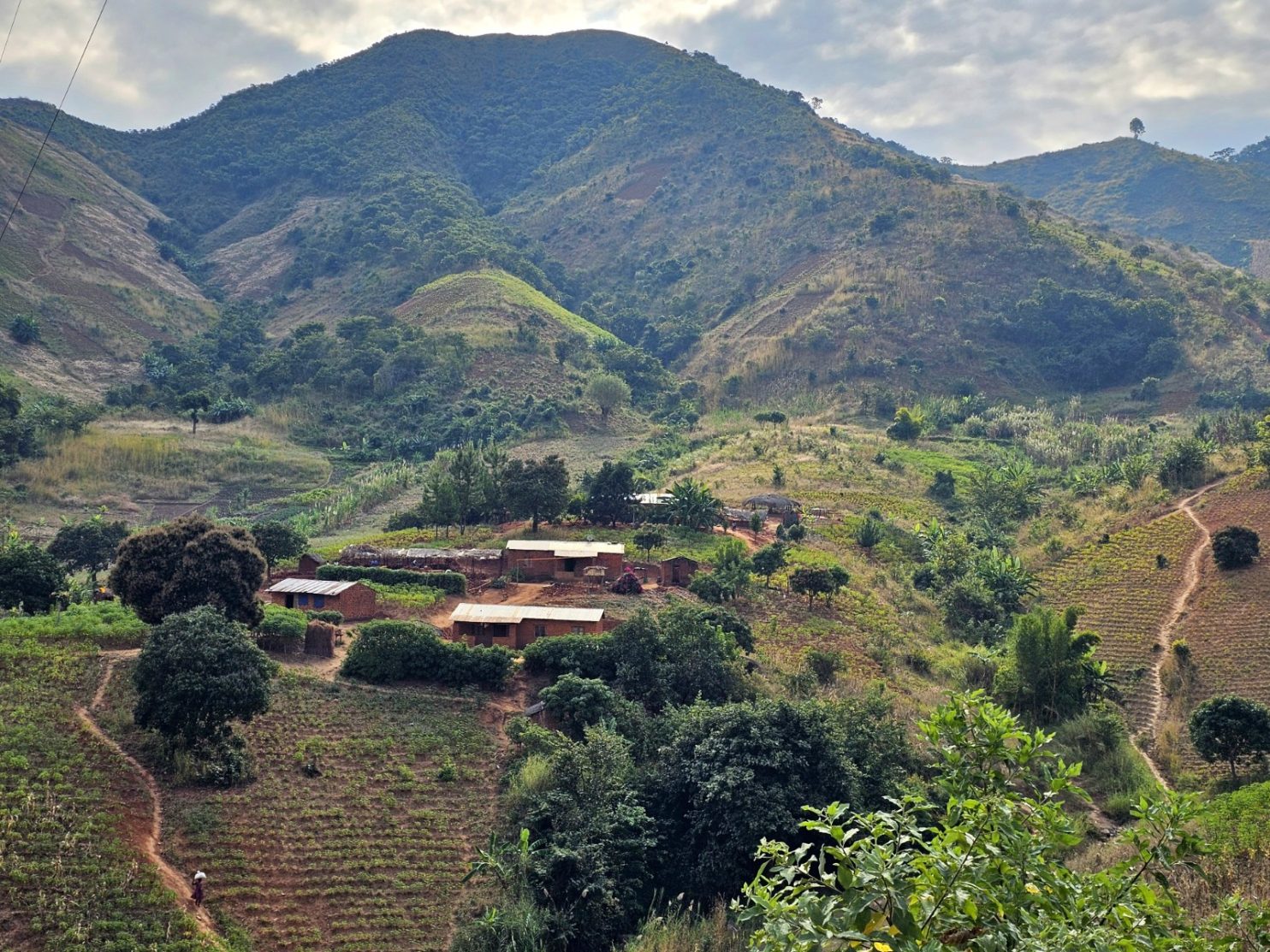
Day 98. 15 August. South Karonga to Kasumulu. 66 km. 5 Hours. 220m up. 120m down. The one thing about the Mikuma Beach Lodge which I was really sold on was the buffet breakfast. I started it at 0700 and finished at 0800 and was pretty much eating continually for the hour. It would mean I could get all the way to the border with Tanzania without stopping for more food. I eventually left the quite sterile and characterless lodge at 0830 and cycled up the track for just over a kilometre to reach the main road at a lively hamlet.
I was quite surprised at just how little traffic there was on the road. There were the occasional petrol tankers, some small lorries and the frequent collective taxi cars scraping their back bumpers along the road. But there was only one of these a minute. There were of course a lot of bicycles, a lot of motorbikes, a few ox carts and hundreds of pedestrians. As a rule everything moved quite slowly, partly because they were so overloaded. Indeed I saw one motor bike with two people on it. Nothing strange there except one had a large calf on his lap. The calf’s 4 legs were bound together and then 2 people helped lift the calf, which must have been 150-200 kilos onto the passenger’s lap. It looked quite resigned to its fate and when it overtook me its head was hanging down. I caught up with it at a police road block but they flagged him through as if it was a everyhour event. I eventually caught up with them again when they reached their destination and were untying the large calf to present it to its new owner on the north side of Karonga.

574. Approaching Karonga the road was busy with pedestrians, cattle and motorbikes but relatively few vehicles.
Karonga itself was a small city really and I guess it population was well over 100,000. It had little charm or redeeming features except for a large cement brontasaurus in the middle of a roundabout. I assume that is because some fossils were discovered nearby. Otherwise it was a large version of the towns, and even villages, with many groceries, market stalls, material shops, mobile money booths, bars and small frying stations making cassava and sweet potato chips. However it also had many busy mills dehusking rice, perhaps 10 in all and outside most of them was a huge pile of the discarded husks, some over 10 metres high and 30 meters in diameter. I had not really seen much agriculture on the 10 kilometres I had already cycled this morning on the way into Karonga, so this surprised me. After some 15 minutes I was leaving Karonga having peddled through the vibrant, noisy town with plenty of music blasting out at maximum volume so the speakers crackled, and people had to shout over and above that.
After Karonga it was like I had entered a different country. Suddenly there was agriculture and lots of it, especially rice. There were many hundreds of people in the rice fields getting it ready and hundreds more already planting the shoots into the muddy soup. I guess they might be able to get two crops out of these fields as what is planted now might mature in four months, just as the rainy season is starting. Then another crop can be grown from December to April. This is hard work for the farmer but it means he can make a substantial profit from his labours and prosper over the one crop farmers. There were not that many rice fields which were planted now, perhaps a fifth, as they needed irrigation. But there were numerous rivers which came down from the mountains to the west and crossed these extensive plains before entering the lake. There was a river or stream every 5 kilometers and all of these provided some irrigation on their banks.

575. North of Karonga the agriculture was much more vigerous with all the flat lands beside the rivers irrigated and ofter planted with fields of rice.
Where there was no irrigation the rice fields or paddies were fallow and dry. They stretched for miles until the distant mango trees around the homesteads obscured their view. I am sure they continued well beyond these homesteads and perhaps all the way to the base of the mountains some 20 kilometres away. There were many cattle grazing in these fields and they were nearly all tethered. Those that were freeroaming usually were dragging a length of rope tied round their neck or horns and often had a young cowherd to keep them off the road or neighbours fields or gardens. I think these rice fields which were fallow just had one crop a year and that was in the rainy season when it was easier to flood the field.

576. Where there was no irrigation the field were fallow and would probably remain so until the rains came in November when they would be planted with rice.
The kids were still very excited when I appeared. They spied me from quite a distance and then sprinted across the field from the homestead hoping to get to the road before I passed. Many now were holding out their grubby hands to do a high five as I passed and I must have done over 100 in the course of 50 km. There were a few shouts for money but they were the exception. These were great kids really and totally content with their family life and lot in life. Occasionally they slipped up and did not notice me as I passed, but I noticed them, and they were always playing games and jumping for joy, despite their relative poverty. Lake Malawi was quite special and Livintstonia unique but it will perhaps be the spontaneous excitement and joy of the children which I will remember most from Malawi.

577. In the rice growing areas the homesteads were much more substantial and better built showing how rice is much more profitable than maize.
These rice areas continued nearly all the way for the next 40 kilometres to the border with Tanzania. Where the land was unsuitable for rice, on the shallow ridges between the streams there were cassava plots everywhere. Where there was fallow land there were many cattle eating the rice grass and stubble from the previous harvest. Sometimes the cattle and paddyfields with rice growing in them were in close proximity and I am sure the cow and goat herds have to be on their guard to stop the livestock plundering the green grass of the rice paddies where rice is growing. The people here were much more industrious in their agriculture than south of Karonga. Whether they were blessed with fertile land or whether they had a more determined work ethic or culture I don’t know. But it is interesting to note that the tribe in the areas with the lacklustre agriculture south of Karonga were the Tumbuka, and the tribe north of Karonga with the vigorous agriculture were the Ngonde. However I am sure that there is more to it than tribal characteristics. The houses in the area north of Karonga were also more substantial. This again is probably due to the production of rice which I think is the most productive crop in terms of calories over a given area and therefore rice growers have more surplus to sell over maize growers.

578. Frequently there were areas of irrigated fields with rice growing in them next to fallow fields with livestock grazing them. The cowherds must gave a difficult job making sure they dont encroach onto the verdant rice shoots.
Eventually after nearly 60 kilometres I reached the border at the Songwe River. The Malawi side was very scruffy and chaotic with trucks all over the place and many looked broken down. The border area reverted to earth roads which was odd after the great road. I cycled through the parked lorries and scruffy buildings which looked like warehouses. I saw nothing official really until I crossed the bridge over the river and saw the Tanzania immigration building. I parked my bike and went in. At the counter for a visa I discovered that I could not get the exit stamp for Malawi here and I needed to go back a kilometre and get it before they would process my Tanzania visa. I am sure if I had not asked they would never have noticed but they were now aware so I dutifully went back to Malawi to get the exit stamp. With that done I returned to the Tanzania immigration and filled out the visa form. I had to pay 50 Euros or US dollars also and I had the former ready so handed it over. It was all done in about 10 minutes.
I left the building and went up to a nearby ATM and took out 800,000 Tanzania Schillings which was about £240. That should be enough to see me across most of Tanzania. There was also a stall selling preregistered sim cards so I bought one with 15 GB of data on it for 50,000 shillings (£16). It was with Vodacom which everybody said was the best. I was then good to go but spotted a restaurant right beside the mobile phone shop so went in and had some rice with beef stew. It was 5000 shillings which was cheaper than Malawi. I also took some time to decide what to do next. It was already 1530 so I thought I would just cycle to the edge of this border town and find some lodge for the night.

569. After the border on the Tanzanian side the agriculture looked very organized and these plots of maize must have been irrigated to thrive like this in the dry season.
The Wings Hotel was 4 kilometres away at the junction of a road I might take tomorrow. I decided to check it out and set off. I was disappointed to see that the marvellous quiet road I had been on for the last couple of days had gone and now I was on a busier road with a verge which had been eroded away in so many places it was virtually useless. To make matters worse there was a tall lip between the narrow road and the lower verge so it was either one or the other. I chose the road as most of the time the trucks and cars could pull out and overtake me but occasionally I had to go onto the verge and back onto the road which was a nuisance. This will play a major role in the decision I have to take tonight if I follow this road for the 40 km to Tukuyu or if I take small gravel roads for 70 km to get there.
The Wings Hotel was quite good. It was cheaper than most middle range hotels in Malawi and everything worked. I did not have to put my hand into the cistern to pull the syphon or worry if the water was hot or even flowing. I took a room for 40,000 shillings or £12, and was soon in the shower. I ate in the adjacent restaurant and it too was reasonable and cheap. I think Tanzanian prices are almost half the Malawi ones and everything is better and less hit or miss. From the very little I saw of the Tanzanian culture and character today I would say the people are much more gregarious and chatty and there was a fair bit of banter. It was almost like the population of an industrial working class city like Glasgow or Gothenburgh as opposed to its more staid professional counterpart like Edinburgh or Stockholm.
Day 97. 14 August. South Karonga Rest Day. 0 km. 0 Hours. 0m up. 0m down. I had not had a hard day in the last two days but had got hopelessly behind with the blog and other admin tasks and needed to take a day off just to catch up with them. I had come to the Mikoma Beach Lodge with the express purpose of doing just that. It was not as I hoped but then if I kept cycling until I got to a place which was suitable I would never stop. It was beside Lake Malawi and had a small beach and a cool breeze.
It also had a buffet breakfast and after the stay at the Mushroom Farm, which was vegetarian and with smaller portions, I was ready for an eat all you can breakfast. I made full use of it and left the table feeling full. I then spent the entire day in my cabin room writing. I even skipped lunch as the breakfast was so substantial. I had finished writing by supper time and then I spent the evening loading all the text and photographs and sending emails until I was completely up to date.
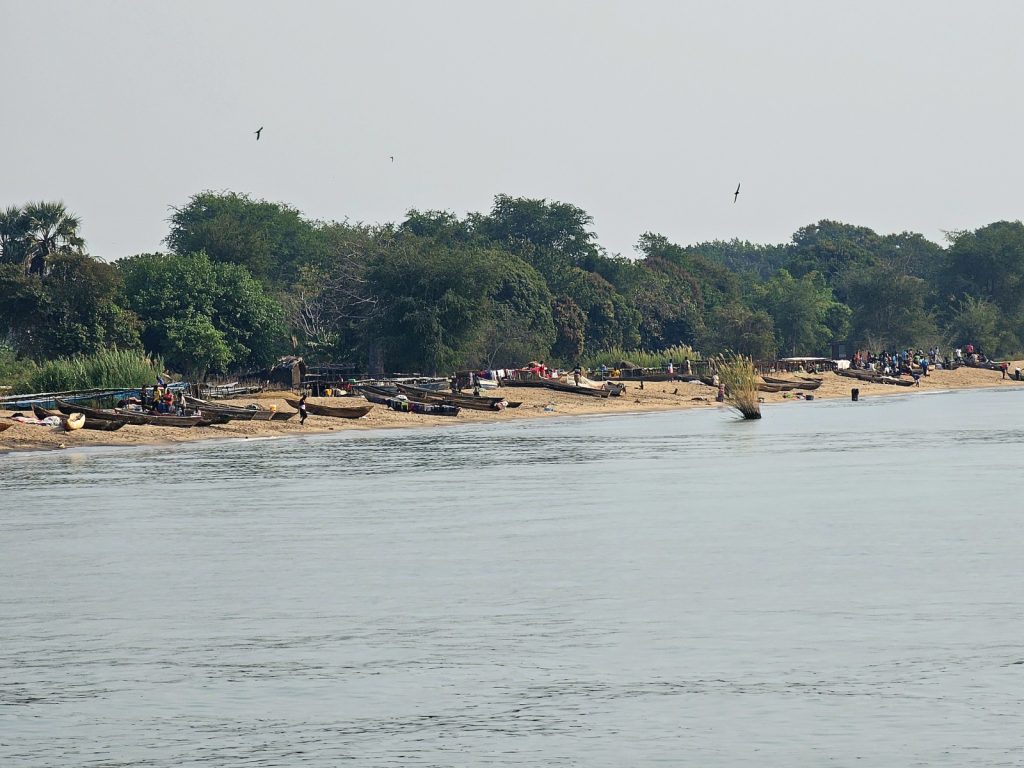
573. Beside the Mikoma Beach Lodge was an active fishing village with boats and dugout canoes landing their catch of cichlids.
Tomorrow will be my last day in Malawi as I cycle about 55 kilometres to the border with Tanzania and then get some money and buy a last sim card. After the border which is about 500 metres elevation I start a massive climb out of the rift valley and onto the lip of the escarpment at just under 3000 metres. This 2500 metre climb will take a couple of days and at the top of it I branch off to the east and leave the main road for small roads again.
Day 096. 13 August. Mushroom Farm to South Karonga. 92 km. 8 Hours. 410m up. 1030m down. The small agile green vervet monkeys woke me up just before 0600. It was just in time to see the magnificent sunrise across the lake at 0600 as it rose in a shimmering crescent of orange. The monkeys were all over the platform I was camped on and I think they smelt food. In the end I got up and scared them off a bit. I put my granola and milk in my pan to take over to the dining area and took the tent down. When my back was turned one monkey nipped in and took a half kilo granola bag and was up in the tree before I knew what was happening. She ripped it open, spilling granola everywhere and all the others rushed to the forest floor to eat the crumbs while a big male started to chase her for the rest but she was too nimble and was soon out of view.
After my breakfast I carried the bike and all the panniers up said good bye to Sam and Will and pushed my bike up the steep hill to the infamous track which descended to the coast. Once on the track the descent started immediately down the side of the escarpment. On one side of the track were the tree tops from the trees growing on the very steep slope, and on the other side an embankment where the road builders had hacked in and removed the rock and earth. It was quite a feat even if the road was narrow. Every few hundred meters or so was a hairpin bend and then the descent started again. In all I think there are some 30 hairpin bends. Occasionally the track was covered in laid concrete and these sections were great but there were only about 10 of them and they only amounted to a few hundred meters altogether. For the majority it was packed rubble type stones which jutted up from the surface and made the descent very bumpy. After a while I could see the escarpment looming above me as I descended but the plain below beside the lake did not seem any closer at all. There were motorbikes which came up and down here and they tended to follow the least bumpy path moving from one side to the other. It was easy to see their slightly smoother track and I followed it. There was also a pickup which overtook me and it was really old and battered and no doubt just used for this run.

563. Starting to head down the track descending the escarpment. Livingstonia is on top of a further rise on the right and out of the photo.
It took ages to get down and I pretty much had my hands on the brakes the whole time. I don’t think I pedalled once but just let the bike freewheel on its own, bumping from stone to stone. I had to go slowly to protect my rims and spokes as this would be an easy place to damage things. The trouble was I was constantly on the brakes wearing out the pads quickly. Down and down I went until suddenly I noticed the homesteads on the plain were getting closer and looking back I could see the cliffs which the road had somehow woven between. I stopped to feel the brakes once and wetted my fingers and put them on the discs. They sizzled like drops of water on a hot stove top. However after a careful hour and a half I at last reached the homesteads unscathed and then had an easy run down for a few hundred sandy metres to the main M1 road. At the junction there was the smell of drying fish and a material market with bamboo racks full of very vibrant colours.

564. Half way down the 30 something hairpin bends of the track looking back to the cliffs on which the Mushroom Farm sits.
I was pleasantly surprised how quiet the main road was and nothing like it had been outside Mzuzu and Lilongwe. It was also wide, with smooth tarmac and perfectly flat. There was also the smallest of tail winds. When I started cycling I realized everything was in my favour and I was cruising along at 20 km per hour with hardly any effort. The planets had aligned in my favour for once. For the first 20 kilometres or so the road frequently went close to the beaches along the lake where there were many fishing villages. I could smell them from a distance and see the boats moored off the beaches as I approached. There were many shacks along the beach but I don’t think the fishermen stayed in them as their main home, as they were very ramshackle. I think they were for staying when repairing nets or laying the fish out to dry and other work.

565. One down on the lakeside M1 main road at Chitimba i passed a few fishing villages with millions of net caught fish drying in the sun on racks.
It was a great shame to see millions of cichlids laid out in the sun drying and that this was happening all over the lake. Most aquarium fish in Europe are lake Malawi cichlids and I have heard it is unethical to source them as they are endangered. However, the reality is the aquarium trade is negligible compared to this extensive fishing. It must be relatively recent, perhaps in the last 30-40 years or so as this type of intensive fishing is only really possible with nylon monofilament nets. Previously there would have been fishing but this would have been done with baskets and traps and the amount of cichlids harvested would have been a 100th of its current unsustainable plunder.

566. After Chitimba there were a few rice growing areas where the muddy paddies had already been prepared and young grass shoots were being planted.
I passed frequent plains where there were small streams running and the farmers here were preparing large rice paddies. The fields were about 40 meters by 40 metres and already they were being ploughed by oxen and turned into muddy soup. The surface was then smoothed off with a wide rake-like tool to spread the mud evenly and people were already planting rice shoots. They planted a clump in each field and then took a handful of shoots and walked quickly in rows pushing in a shoot every 20 centimetres or so. It looked like back-breaking work but they were very quick and could probably do a field in a morning. That would be a substantial harvest of rice.

567. St Anne’s Church was part of a Catholic Mission originally started by nuns in 1948. It comprises a secondary school, small hospital and this church.
The road climbed very slightly past a point at Chilumba. There was a Catholic mission, St Anne’s, with a church in a large garden surrounded by bougainvillaea, a mission hospital and a secondary school. This mission was formed by Catholics nuns in the 1940s, but has since been handed over to the local Catholic diocese of Karonga. It was like Livingstonia in miniature. North of Chilumba and St Annes the road dropped very gradually for kilometres. On these sections I could get a good speed up and sustain it with very little effort. It continued like this for about 15 kilometres which I did in about 30 minutes.

568. Stephanie (father) and Rei (son) are a team of well seasoned African bike packers and this year were cycling from Uganda to Mozambique.

570. Malawi is full of good natured kids. They are all quite confident and well socialised and they must be well nurtured in their homes and villages. No one has a normal pose and they all like to show off with the camera.
At the bottom near the large village of Ngara I met Rei and Stephane, a father and son team from France. They came each year to cycle a few thousand kilometres in Africa and this year were on a trip from Uganda to Mozambique. Last year it was Angola, Namibia and South Africa. They really seemed to know what they were doing and were very relaxed about the trip and confident of being in Africa. We chatted for a good 15 minutes and then they continued south while I went into a local restaurant to have beef stew and rice for a change. The problem with rice is that it sometimes has small bits of grit or even stones in it and you have to remember to eat it carefully to avoid a broken tooth.

569. Ngara is a fishing village and harbour with a thriving industry in netting cichlids and drying them on racks in the sun.
North of Ngara there were still homesteads on each side of the road but the fields were all covered in tall weeds, as if they had been there for a few years. There was about 30 kilometres of this with no obvious agriculture at all yet plenty of houses. There were the occasional stalks of maize lying on the ground but even they were covered by last year’s weeds. It seemed the farmers here had just abandoned any farming. The only thing I saw were small herds of cattle and goats. I don’t know how the people of Ngara or Mulale survived at all. I cant imagine the men were migrant workers in Tanzania or there was enough fish caught to abandon farming.

572. Between Ngara and Karonga it seems most of the farmers have let their fields run riot and they have not been cultivating them in the last year.
As I neared Karonga I passed two large lagoons where sand had been carried by the prevailing waves to form a spit which eventually met the other side of the bay and created a lagoon. I am not sure if they were still connected to the main lake or not. The land around the lagoons was grazing pasture and there were many small herds of cattle here. There were also huge flocks of egrets in the shallows round the fringe of the lagoons and I am sure this would be a great birding area as migratory birds would stage here as they flew up and down the lake. A little beyond the lagoons I reached a lakeside lodge on a small beach which I had earmarked.

571. Well to the south of Karonga near the village of Mulale were two lagoons which were separated from the main lake with a drift of sand which now has trees growing on it. There was a lot of grazing nearby.
It was still some 10 kilometres south of Karonga but I did not want to go into that town to find somewhere. The one I earmarked was called the Mikoma Beach Lodge. It was expensive. Not by European standards at £25 but it would be way above budget for the Africa bikepacking community. I needed somewhere to write though and could pay a premium to catch up so took a cabin overlooking the beach. There were a group of 10 motorbikers staying here. They were mostly from Australia and New Zealand but the organizers were South African and quite brash so I gave them all a wide berth. After my meal I tried to write but was tired and had all day tomorrow.
Day 095. 12 August. Livingstonia to Mushroom Farm. 11 km. 1.5 Hours. 70m up. 350m down. The main reason for staying at Livingstonia was to explore the place in the morning and the first thing I did after the unusual breakfast of fried bread was to go to the Stone House. It was built in 1903 after the university and church were built. It was built as the head of the mission’s residence and office and somewhere he could receive guests. Much of the very scruffy and dilapidated display centred around Robert Laws. He was the founding father of the mission.
Robert Laws had grown up in Aberdeen and trained as a doctor. At that time the Church of Scotland had a number of missions in Malawi, notably in Blantyre and Cape McLear. However the latter especially did not fare well as people frequently died of malaria, not really knowing what it was. There was also one at Ekwendeni where I was 2 days ago and it was decided to try and build one at Livingstonia on the plateau where the air was clean and disease was hopefully not so prevalent. It was essentially Robert Laws and his team who set this up in the 1890’s.

560. The cabins at Livingstonia next to the Stone House were quite simple. Just to the left was a long steep slope down rge escarpment so they had a great view.
Robert Laws built the university with a view to educate the local Malawians in business, technical subjects, book keeping, christianity and other practical subjects. The university he built must have been exceptionally advanced and beautiful for its day and one of the most advanced in Africa I think. It thrived and produced leaders of industry and commerce in Malawi. It was often at odds with the colonial British masters in Blantyre who wanted to subjugate Malawi while Laws and his team wanted to educate Malawi so they could manage themselves in a world of change. He also built a hospital on the plateau and in this hospital the first caesarean operation anywhere in Africa was carried out, so in its time it was quite advanced too. Robert Laws lived at Livingstonia, much of it in the very house this faded museum was in, for about 50 years in all managing the Mission. After the disappointing museum I wandered round the outside of the Stone House and was distressed to see how badly it was being maintained. I looked through a few windows and saw that it was near derelict inside. There was one room with all the papers and history of the Mission and the Livingstonia Synod, which was the collection of all the churches in the region, and I am sure they are soon going to be destroyed by water ingress or even a fire.
I went back to the cabins and then met Jim Campbell. I had already met him at Ekwendeni at the church service. I knew Jim was a minister as he had a collar on then but I did not know he was the minister at Livingstonia for about 40 years. Indeed he had lived in the Stone House during this time with his wife who was a nurse at the Mission Hospital here. Jim was fascinating and explained how the Irish Presbyterian missionaries took over from the Scots around and after independence and that is how he ended up here. He told me about his time here and lamented the lack of maintenance and the woeful neglect of the Stone House and the church. He seemed to think the university now just taught social sciences and all the technical faculties had moved to other campuses. He had some great stories about the place.
I left Jim and then got on my bike and cycled round the campus. It did seem very quiet but then perhaps the universities were also off until after the election on 16th September along with the schools. I cycled on some of the smaller paths to cut across the whole plateau to get to the Mission Hospital which seemed busy. There were two main wards, one for women and one for men and a maze of covered corridors to other buildings. I went in and saw some empty hospital trolleys getting pushed around and medics walking briskly. There were large crowds of people outside, some selling food and drink and others waiting for patients. The hospital was functioning and busy but could also do with some maintenance.

561. The main building at the David Gordon Memorial Hospital at Livingstonia was set up 130 years ago by Scottish Missionaries and still operates.
It was now midday and I decided to go down to meet two fellow cyclists, Sam and Will, who were doing almost the exact opposite to me and were going from Dar-es Salem to Swakopmund. They were already at the Mushroom Farm having arrived late last night and this is where our paths would cross. The route down was steep but on a tarmac road past the local village of Livintstonia, still on the plateau, and then off the northern edge to where the Manchewe Waterfall was. Here the tarmac road stopped and turned into a narrow earth road. It seemed that the large well built tarmac road was built purely to access Livingstonia which shows how important it must have been up to about 10-20 years ago. I skipped the falls even though they were supposed to be the tallest in Malawi, and continued on the small undulating road. I passed the turn off to Msasa, a small lodge run by Ricus and Pietro Delport who I met in Nata 2 months ago. I had hoped to stay here but first I needed to get their phone number to make sure they were there as I really enjoyed their company. Ricus was the most knowledgeable person I had met about all things in Africa south of the Equator as he had worked in virtually all of the countries. After about half an hour and a worrying amount of descent I finally reached the fabled Mushroom Farm and met Sam and Will, who were on a day off carving small wooden elephants.

562. The dining room reception and relaxing area of the Mushroom Farm which was built right on the edge of the escarpment overlooking Lake Malawi.
The Mushroom Farm was built on the edge of a cliff on the escarpment. If you dropped something over the edge it would free fall for a good 100 metres before landing on the forest clad ridges below. There was a great view over the bottom of the escarpment and then a flatter farmed plain beside the lake before the lake itself some 5-6 kilometres away in a straight line. It was a spectacular spot. There was a main area with the dining room/reception area and relaxing area and that is where all the guests congregated and were fed. Then there were about 10 small cabins dotted about the hillside and a few camping platforms. There were about 30 tourists hanging about in the dining area and many seemed German. The atmosphere was very home made bread and hummus, with a massage and yoga workshop. Apart from Sam and Will I did not have much in common with anyone else who was here because it was on the traveller circuit. The staff were very nice and helpful but most of the clients were dull. After trying to get in touch with Ricus and Pietro for a couple of hours I eventually threw in the towel and decided to stay here and camped on a small wooden platform right on the edge of the cliff. It was a spectacular spot. It also meant I could relax with Sam and Will for the evening.
Sam and Will had taken the exact route through Tanzania I had planned on taking, but had never heard an account of anyone else doing it. They had come from Bagamoya next to Dar-es-Salem on roads beside the big truck clogged main highway to Mikumi where they had branched off to Njombe. They had used about 20 days so far but had said it was quite hilly with one day involving 1900 metres of ascent for them – and they were young fit lads in their prime. All in all they said it was very nice, quiet, friendly and rural. We spent the rest of the day hanging out and swapping more tips and stories. They had some funny tales and I was looking forward to getting to Tanzania. That evening we ate in a larger group and had the vegetarian evening meal which the cook prepared. It was a peanut stew and it was delicious but the portions were small. I tried to write but it was just too difficult with the conversations and people milling around and my brain was always looking for a distraction so I decided I would head on down tomorrow towards Karonga. There I will find a place beside the beach and have a rest day before leaving for Tanzania the next day.
Day 094. 11 August. Rumphi to Livingstonia. 74 km. 9 Hours. 1150m up. 880m down. I managed to get an early breakfast and then roll down the hill at 0730. A team of road builders were already hard at work. At the bottom of Rumphi I turned east and then cruised down the hill to the bridge over the South Rukuru River where there was the T junction. Here I left the tarmac and turned north along a gravel and earth road which was immediately quiet and delightful with the early morning sun. To the west was a row of quite arid hills which rose up above the hamlets and homesteads and to the west was the South Rukuru River and then the plains across which it flowed. The main crop grown here seemed to be maize but there were lots of tobacco fields also and long ramshackle drying sheds with grass roofs beside every home. The maize was for eating and the tobacco was to sell for cash. Around each homestead were mango trees and there must be a glut of mangoes in season so much so that I think some will even be fed to the animals.
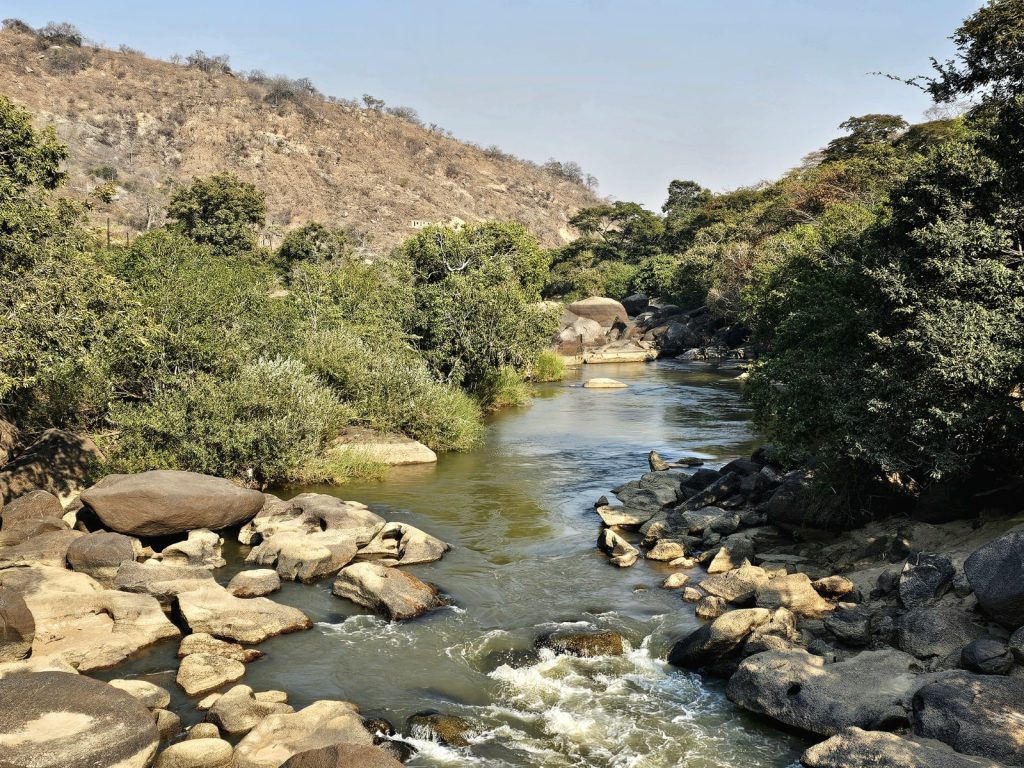
547. Just east of Rumphi the South Rukuru River tumbles through a narrower valley before spilling out onto the plains beneath the mountains to the west.

548. Looking west from the road between Rumphi and Mhuju to the western edge of the plains where they meet the mountains which rise up into the Nyika National Park.
As I cycled and the sun rose I passed a few larger villages. They were a hive of activity with people coming to the mills with sacks of maize kernels to turn into flour for nshima. The men frequently arrived on motorbikes with a 100 kilo sack strapped onto the pillion seat and women carrying 25kg bags on their heads. The kernels were ground twice. Firstly they went into a grinder which broke them into smaller fragments. Then they went into a grinder which turned them into a fine powder and this powder went up shute and dropped into a sack which collected it and could be tied up easily. It was then ready to take home and cooked with water into a paste which is the staple food of Africa, variously called nshima, ugali or fufu depending on the linguistic area.

551. Nearly all the larger hamlets and all the villages now have a maize mill for turning the kernels into flour to make nshima.
The villages were also busy with packing tobacco. The tobacco had been harvested a while ago and I did not even see any drying. However there were plenty of wads of leaves in the villages and these were getting compressed into bales. Firstly the wads of leaves were laid flat in a metal crate by people standing in the crate. They stood on them and compressed them down, squashing them. When the crate was full and their weight had squashed them as much as possible the metal crate was put under a large press. This press was made of a plate attached to the bottom of a threaded metal spindle which was turned with two handles at the top. As two people pushed the handles the spindle rotated driving the metal plate down and compressing the leaves further. Eventually there was bale, about a meter by 70 cm by 70 cm of compressed tobacco leaves, which was then wrapped in hessian. I guess each bale was about 100 kilograms as it needed two people to lift them. I saw quite a few small lorries bouncing along the road with perhaps 20 bales stacked on them taking them to a factory warehouse.

549. Tobacco is the cash crop in this area and virtually every homestead grows and dries it. It is then sold and the leaves are squashed into bales using presses with a screw plate.
The two largest of the villages Ngonga and Muhuju both looked like market towns for the hamlets. The whole 35 kilometer cycle looked quite hard working and industrious and everybody on the road was very friendly. As usual there was an explosion of excitement when the kids saw me. They just ran to the road to greet me, or high five, as I went past and none really asked for money and neither did the groups of women. As I travelled north to Muhuju the mountains to the west got higher and higher. These were the mountains of the Nyika National Park and they rose up to well above 2500 metres. They were quite green and lush and the tops were covered in a layer of low cloud. To the east the high plain between this small quiet rural road and the main M1 highway got wider and was covered in small homesteads but also had large grazing areas where cattle wandered lazily.

550. The pressed dried tobacco leaves are squeezed into steel crates and then wrapped in hessian cloth to form a square bale which must be about 100 kilos.
After Muhuju the quite good gravel and earth road I was on reached a T junction with a tarmac road. This tarmac road went all the way to Livingstonia and was very nice to cycle on initially. It was smooth tarmac with a wide lane in each direction and a good verge. It did not need that as the road was quiet with little traffic. There were many pedestrians and even ox carts on the road taking wood to a homestead or bundles of tobacco sacks to a press to get squashed into bales. There was still a lot of maize grown and the odd field of cassava too. The road was well constructed but there were many more ups and downs that I bargained for and my cumulative ascent was mounting quickly as I dropped down into a steep side valley and then had to climb up the other side. They were often short but taxing and as the road surface was good I tried to get as much momentum as possible for the climb up. On one occasion I was doing over 70 km per hour. There were still a lot of hamlets between these valleys and whenever I stopped to take photos I was soon surrounded by kids. They were always good natured and just wanted some interaction now. I would do many selfies with them or give them my sunglasses or bike helmet to try on.

552. The kids are everywhere and very excited to see me. Whenever I take a landscape photo I am soon surrounded. As the kids in North Malawi are less likely to pester for money I can relax more with them and lend them my sunglasses.
Just north of Chiwerewere the ups and downs of the side valleys ceased and I had a wonderful downhill run for at least five kilometers where I dropped down into a large valley. All my apps and maps said I would have a huge climb up the other side but I was living in denial, and just enjoyed freewheeling down the bends with the hills on each side getting steeper and steeper. The road here was well constructed and in many places where cuttings were made in the soft rock it was beautifully terraced. Down and down I went enjoying the cool breeze which comes with 40-50 km per hour. The road was still empty so I could lean into the sweeping corners keeping in the middle of the road. Eventually this joyous downhill finished at the junction village of Haniniya. I stopped here for some biscuits and a bunch of bananas as despite my denial I had an inkling as to what was coming next.
And it started straight away. There was a steep slope up from the bridge over the river in the village. It was so steep I decided just to push the bike for the best part of 20 minutes to the top of the slope. But this slope was just a warm up. There was a descent where I just about lost all the height I had just walked up into a higher valley which I found a bit of a Shangri La. It was surrounded by green slopes on all sides and streams came down these slopes to nourish the fields around the hamlets. Some hamlets were on the bowl of the valley floor while others were high up on spurs and knolls surrounded by fields. Above the slopes, especially to the west the mountains rose steeply into the mist over the Nyika National Park. However, I could see across the bowl to a series of hairpin bends which rose up and knew I had to go this way.

553. After the village of Haniniya a significant climb started up to Livingstonia. As I climbed I could look west across mountain hamlets on the eastern edge of the Nyika National Park which largely grew tobacco, cassava and maize.
The climb was relentless but I just put the bike into the lowest gear and started up. It was just doable but the 5-7 hairpin bends took at least an hour to climb. Slowly I gained height with my legs working hard but not over exerting. Occasionally I looked down across the bowl and was delighted to see I was really making good progress and the bottom was now far below me. As I passed one knoll a group of about 10 kids emerged from the distant doorway with sacks on their heads. They ran down the slope, crossed a small beck and then climbed up to the road just behind me. They were carrying maize kernels and I think each package was about 20-25 kilos. Despite their load they were cheerful and sprightly and were taking the maize to a relation in the next village. The strength and stamina these kids had was like nothing I have seen in Europe and only seen in Nepal before. They would make most plump spoiled European kids look like Little Lord Fontelroy. Perhaps their cheerful nature comes from the fact they are so physically able. There is no time to worry about mental health issues or ponder what gender you might be if you are striding up a hill with 25 kilos of maize on your head. They all kept up with me slowly grinding up the hill and I could not help but be in awe of them.

554. Some of the homesteads on the edge of the Nyika National Park were remote and without road, but most had electricity to them. The land must be lush and well watered for them to preserve growing crops on these steeper hillsides.
At the top of this middle climb there was another drop and then a further long, but much more gentle climb past another village to a saddle near the hamlet of Kajoni. I had climbed some 400 metres in the last two hours and stopped for a rest. The kids soon appeared and a few had a motorbike tyre which they propelled along the empty road with two sticks. These toys were everywhere and seemed to have replaced the bicycle wheel rim and a stick with a bit of wire on the end which was the previous generation’s toy. I have also seen some beautifully made replicas of cars and lorries made from wire with plastic bottle tops as wheels. These small wire vehicles are propelled with a stick and wire. Between the motorbike tyres and the small wire vehicles the kids keep themselves amused. They lead their entire waking life outdoors and are bright and healthy. Much more so than their plump European counterparts who are gaming on their phones. The Malawi kids are happier too.

555. Old motorbike tyres are the favoured toy to practice skills on and have taken over from the bicycle wheel and hooped wire a generation ago.
I could now see Livingstonia. It was on a small plateau above me to the east. It meant I still had another 150 metres to ascend but I knew the end was near. I clawed my way up the last slope and noticed how much cooler the air was up here now at about 1350 metres. At the top of the slope I had at last reached the plateau which was about 2 kilometres by 2 kilometres and surrounded by slopes on all sides. There was a local village up here and also the Livingstonia mission station. The mission station was the reason Livingstonia existed and it was composed of the University, the Church and the Mission Hospital. I had read about them previously and was sure I would find the place fascinating so had already decided to spend a night up here and find out more about its history. I knew that the early missionaries when they set up the station had some engineers in their ranks and they built a water supply to the plateau 130 years ago as there was none previously. This water supply was collected from a stream to the west and then entered a pipe. It travelled down the pipe to the saddle I had crossed an hour ago and then flowed up the slope to the top of the plateau where it was discharged into two huge tanks. Crucially the intake of the pipes was higher than the discharge at the tanks so the sealed gravity fed system worked.

556. At the top of the 400 metre climb i had some flat respite before the final 100 metre climb to the small plateau on which Livingstonia sat on top of the pictured hill.
On the plateau I cycled round to the University. It was set up 130 years ago also and was made of brick. It had a main hall and then two quadangles with classrooms around the quadrangles. There were serene arched walkways linking all the buildings up. The whole complex, which was quite small really, had been meticulously planned before building started, and it had not grown organically over time in a haphazard manner. It really was quite unbelievable that anything like this existed in Malawi let alone on a hilltop and it is testament to the vision, drive and foresight of the Scottish missionaries who set it up.

557. The Livingstonia University was set up by Robert Laws, a Scottish Missionary in the 1890’s to train Africans in engineering, entrepreneurship, bookkeeping, teaching and the ministry.
After the University I went to the adjacent Church. It was slightly larger than the one at Ekwendeni, but not as old. Perhaps it could seat 800 as opposed to Ekwendeni’s 500. It was also built of brick and this brick must have been fired very well as it was hard and weather resistant. The church has a lovely clocktower and stained glass windows. One was of David Livingstone himself with his two trusted companions Susi and Choma, who would eventually carry his body back to the coast so he could be returned to be buried in Westminster Abbey. It is difficult to overestimate the affection Livingstone was, and to an extent still is, held in Malawi and this is because over and above his explorations and missionary work he worked tirelessly to eradicate the slave trade from Malawi. While the Atlantic slave trade ceased in the early 1800’s it persisted for another century in the Indian Ocean with Muslim caliphates and states sourcing slaves through Zanzibar. Livingstone lobbied the British and French governments to pressure these Muslim states to abolish slavery in the early 1900’s

558. The Livingstonia Mission Church was built by Scottish Missionaries, notably Robert Laws who ran the whole mission at Livingstonia for over 40 years.
I was a bit alarmed at the lack of maintenance on the church and just simple things were not done. Many of the downpipes had slipped and become detached from the gutters meaning water poured down the walls to their base rather than down the pipes to be led away from the foundations. This would be so simple to fix. There were also small shrubs growing from some of the gutters and ledges. The person in charge of the church’s maintenance must be completely inept. In one place the saturation of the ground in the rainy season and then drying out in the dry season had caused the foundations to shift a bit and a large crack was appearing at a gable end that could prove terminal unless the gutters and downpipes are reconnected.

559. The stained glass window in the the Mission Church at Livingstonia features David Livingstone and his 2 trusted companions Susi and Choma (to the right).
From the church I cycled past the Stone House, once the head of the missions house and office, and looking remarkably like a Scottish mansion house, to the lodge. There were a few lodges and hostels on the plateau, mostly for the students, but this one was built for tourists and it consisted of about 6 cabins with a central kitchen. It was near the Stone House on the edge of the plateau overlooking a large rural shelf below the plateau but before the sharp drop of the escarpment. From the verandah of the log cabin I could look to the east and just see lake Malawi and sometimes you can even see Tanzania across the lake. I was tired and tried to write the blog but once I had eaten the nshima and chicken the hosts brought me I was just ready for bed.
Day 093. 10 August. Ekwendeni to Rumphi. 54 km. 5.5 Hours. 410m up. 530m down. I slept well in the monastic room with the cold shower and two old wooden single beds. When I woke at 0630 I realized there was already a service in full swing and the sounds of singing were ringing out across the grounds. I hoped there would be one later so I had a breakfast of the granola and powdered milk I carry. I was just cleaning up when there was a knock on the door. It was a very cheerful man and his wife and they had come to take me to the service at 0730. He was something of an elder I think and she had something to do with running the guesthouse. They must have gotten wind that I wanted to go to the service from the guard and he kindly said we could go together. We went in and his wife went to the pews on the left looking at the altar, where most of the women were sitting, and we went to the right where most of the men were sitting. There were a few other whites in the church and there were about 500 clean cut, tidy Malawis.Soon the whole place was packed and the ushers had to get spare plastic garden seats. There were two choirs of 20 ladies in each, and they were in two different dresses and they occupied the front three pews on each side.

540. The early morning service at 0730 in the packed church at Ekwendeni. One choir were on the yellowish dresses at the front. The other choir is out of sight.
There were some small introductions and then one choir got up and went to the front and some music started. It was very melodic and soon the ladies in the choir were singing and dancing. It was quite genteel initially. Then there was the sound of a loud whistle and a man with a white bandana took the aisle space in front of the ladies. He was very energetic and danced well but it was the blasts on the whistle which overwhelmed everything and got the atmosphere lively. After about a pulsating minute on the whistle, with the music getting louder and the ladies chorus now in full voice he started to sing. I don’t think I have ever been so struck by a voice. It was incredibly powerful and very clear and in tune. It sent goosebumps down my spine and made the hairs on my arms prickle. It was like there was a rockstar in the church singing gospel songs. It was more than I hoped for. The song lasted for about 4 minutes and I think the whole congregation was in awe. After it was over he handed the microphone over and headed out and the ladies in the choir returned to their seats. I was totally starstruck by his performance.
I hoped it was just the warm up and there was more to come. There was then a pause in the worship as one of the guardians of the church went through the accounts and how much had been raised and he also mentioned the names of certain individuals who had made special contributions. It was a bit like reading the minutes from an AGM and it meant very little to me. I was hoping it would conclude and we could get back to the singing. After 10 minutes it did end and then there was about 15 minutes of prayers and hymns. Then all the new visitors to the church that day were encouraged to go up. My host encouraged me to get up and I joined another four visitors, 3 Irish and a Mayasian. We introduced ourselves on the speaker system with a microphone.
I hoped then we would get back to the livelier singing but instead the minister started the sermon. He spoke very oddly, almost shouting every third or fourth word with huge emphasis and then quietly speaking the ones in between. Every phase started with a bellow, then reverted to a whisper before ending with a bellow again. I could not make out what he was saying and he was hidden from my view with a pillar. The sermon went on and on and there was no joy in it at all. I don’t think it was fire and brimstone but it was very Scottish Presbyterian. In the end I was hoping he would stop but he loved the sound of his voice and it went on for an hour. I felt a little trapped sitting next to my host but I noticed more than a few people were on their phones.
After an hour there were a few more hymns and prayers and then the collection. The collection was done in a remarkably efficient and well practiced manner. The entire congregation, pew by pew, formed two lines on each side of the church and then filed past a large basket in the nave. Once you had put some money in you went back to your seat by which time the next pews were already up and waiting in line. When I passed I peered into the basket and it was full of 2000 kwacha notes. If everyone put in 2000 kwacha that was a million kwacha, or £400 in all. After a few more quick prayers the service ended and the other choir got up to sing and dance to a tune while we all filed out. The courtyard outside was full with the congregation mingling and chatting to each other. I spoke briefly to the minister who gave the sermon and discovered he had spent a year in Edinburgh as part of his Theology degree. It was 1000 now so I went back to the room and packed and found someone to pay the 7000 kwacha (£2.50) room charge to. I left around 1100. As I left I noticed there was yet another service underway in the church and I had a quick look in through the open door. The church was again packed for the third service of the day. It was one of the oldest in Malawi and was built in the 1880’s and was an important Christian structure, apparently on a par with its sister church in Livingstonia

541. The red earthen road between Ekwendeni and Engucwini was easy to cycle and took me through less verdant homesteads.
Instead of going north down the M1, which was not the most relaxing road to cycle on, I decided to take small roads which almost went parallel to it. On the map they looked equidistant but in reality they were much slower and more convoluted. However they were very rural and quiet. So I returned on the small side streets to the main road through Ekwendeni and cycled through the vibrant chaos to the north end of town where there was a small tarmac road to the west which I opted to take. I was only on it for about 4 kilometres before I turned off onto a track with extremely red earth. There were a few other church denominations along this stretch, one even had drums playing, and they all seemed a lot more jolly than the Presbyterian one I went to.

542. To the west of the track were tobacco and maize growing homesteads and then the hills which rose to the west which eventually led up to distant mountains.
Once on the red road I cycled north past a large macadamia plantation and then descended for a long easy stretch on the lovely road. Suddenly I noticed how dry and arid it was. There were even a few baobab trees about which was in stark contrast to yesterday. To my west were hills and outcrops, some quite lofty and rising high as they formed a range of mountains well above 2500 metres. It eventually led up to the watershed which was the border with Zambia 100km to the west. The road continued to descend and got more rutted and remote. The homesteads here were much fewer and they were now all growing maize again but each one seemed to have some rough racks under a makeshift roof for drying tobacco leaves. Tobacco was obviously the cash crop now. After 2 hours on this red road, with the occasional climb, I reached Engucwini, a large village built around crossroads with the usual selection of grocers and market stalls. I stopped here for a drink and biscuits as the heat of the day was intense at 1330 in the afternoon, and there were no cooling breezes.

543. To the east of the track were more homesteads which stretched out onto the plains where the busier M1 road I was trying to avoid was.
I left Engucwini on the track heading NNE to Rumphi. The road was still earth and it still undulated across the edge of the plain which was to the east. To the west were the mountains and the track I was on kept along the base of them. They were covered in arid scrub and not the lush forests which I saw beside the lake. Virtually no one asked for money now and they were all very respectful, except for the children who were always excited to see a muzungu and could not contain themselves and came running to the track. I stopped and chatted with a thin older man in a bright green suit and hat to match. It was old and crumpled but he had a minister’s collar on. He had a lovely English accent but limited vocabulary. He was just returning home after giving a service in a more fringe denomination. After we parted I caught up with someone on a bike. His name was Bright Chirwa and he was going to a football match between two villages in about 10 kilometres at Kacheche village. We cycled together as his English was good. He was about 60 and a respected elder I think as everybody on the road knew him and greeted him warmly. It was lovely to cycle along and chat with him and he kept up easily on his old gearless bike. A few small lorries passed us and one carried the football team from his village and whom he was going to support. There were also lorries with maybe 20 women in the back. I have seen it before in Malawi and noticed it because all of them were singing a gospel type song and joking with all the pedestrians they passed, including me.

544. The well respected Bright Chirwa on his old bike in Kacheche village where he went to support his village’s football team.
At Kacheche I said goodbye to Bright and continued on my own on a small track to the west of a growing river. There were homesteads on each side of the track but they were sparse now. On the other side of the river was a great grazing plain and beyond that the M1 road which I was avoiding. Even this small track was full of chat with women greeting me, ladies carrying water from borehole pumps to their homestead and the occasional motorcyclist who stopped their bikes as I approached eager to talk. It was perhaps the most friendly bit of road I have been on in Malawi so far. Some 2 hours after my stop at Engucwini and an hour after I left Bright and Kacheche I reached a busier tarmac road which went up the valley to the west beside the South Rukuru River.

545. The small social track between Kacheche and the tarmac road near Rumphi was great on a bike but occasionally sandy.
I cycled up this road and then crossed a bridge over the river. It was now 1530 in the afternoon and I did not have anything in mind about where to stay. Just after the bridge was a T junction with a branch going to Livingstonia in about 70 km where I wanted to go, and another branch going west up to the town of Rumphi, which was in the wrong direction for me. However there was nowhere to stay on the small barren road to Livingstonia. I could always fill my bottles from a village pump and try and camp surreptitiously but I am sure I would be seen and soon mobbed. Alternatively I could go up to Rumphi and find a lodge and continue to Livingstonia tomorrow. I did the latter and after half an hour reached Rumphi and then after half an hour again I found a new lodge, The Sameda, which had a large room and hot shower for 15,000 kwacha (£15). I was soon in the shower washing yesterday’s sweat off and giving my cycling shorts and hoodie top a good scrubbing.

546. This young woman was only about 14 yet was quite happily carrying 15 litres of water on her head taking it from the communal bore hole to her homestead.
Day 092. 09 August. Nkhata Bay to Ekwendeni. 71 km. 8.5 Hours. 1340m up. 610m. I had really enjoyed my stay at Mayoka Village Lodge. It was the relaxation, peace and quiet I craved. I felt recharged, especially after the breakfast and the proper coffee. I said goodbye to Mathew, who was the main man working there I think, and also to the other staff and then carried my bike and panniers up the steps to the carpark and set off a little after 0800. I tried to leave early as I knew I had a tremendous climb ahead of me today up to Mzuzu, which lay on the plateau. I cycled over the small ridge and then cruised down into town past the prison vegetable plots which were now busy with cheerful prisoners who were weeding and watering. A little later I reached the town which was in full swing and all the stalls which seemed half full yesterday were now full of produce. I cycled slowly through trying to postpone the inevitable climb which started at the far end of the main street. When I reached it I dropped into the lowest gear and slowly started to ascend. It was not as bad as I feared but I went slowly. It took me a good half hour to climb back up the 150 metres I freewheeled down a few days ago. It was already warm and I was soon sweating – and this was just the beginning.

531. The lush fertile farmland of the plain before the climb started. The homestead is surrounded by large mango trees.
Once I reached the top of this first climb by the T junction with the main M5 road I had a delightful 15 kilometres which was an unexpected surprise. The road dropped slightly and crossed a fertile plain which was intensively farmed. There were crops everywhere and many homesteads, all of which looked relatively well off compared to the ones on the plateau I had seen and those north of Lake Kariba in Zambia. The main crops here were rice and cassava but there were also many small banana plantations and maize was making a comeback after being relatively scarce along the lake since Salima. Everything was green, even the road verges, and the crops and vegetables were verdant and well watered and despite it being the dry season were thriving. Although it is the dry season perhaps the land here does get some occasional rain or is frequently overcast and this prevents it drying out too much. The land here was nothing like the parched arid landscape covered in cactus and baobab trees like Botswana or Zambia.

532. At Mpamba just at the start of the climb there was rice laid out on tarpaulins on each side of the road. It was to dry it completely before dehusking it at the pictured adjacent mill.
After cruising along here I reached the town of Mpamba. It was here the climbs started in earnest. There was nothing else to do except to drop down to the lowest gears and just grind away. I stopped noticing much of what was happening beside the road and started to concentrate on the tarmac ahead of me. The road was in good condition and was smooth to cycle on and the verge was wide, although the vegetation often encroached onto it. Crucially the road was also quite quiet and the main traffic on it were the small overloaded cars which operated like a bus dropping people on and off. There were a few trucks but both those going up and down were slow. The ones coming down were using the engine as a brake and were roaring and the ones coming up were barely moving faster than me and belching fumes.

533. The small town of Mpamba was typical with small shops, mostly grocers, back from the road and market stalls in front of them, allways with tomatoes, beside the road.
This climb almost lasted for about 800 metres with the odd bit of respite as it dipped into a valley perpendicular to the road. As soon as one climb finished there was a bit of freewheeling, which was over in gif and then the next slog started. On and on I crept looking at my altimeter from time to time. In all I climbed from about 475 meters up to 1375. Half way up the climb I could look to the south and see distant bright green patches on the lower hills which I knew was the large Kawalazi Tea Plantation. It was about 15 kilometers to the south of me. As I climbed the vegetation started to change slightly. The lushness of the Garden of Eden started to become a bit more like a green scrub and the fields were often fallow with just a few green with cassava. The main crop higher up was now maize and even the ever present mango trees were starting to disappear.

534. As I climbed the road tended to follow the main ridges. On each side were side ridges and valleys where homesteaders farmed on steep ground and lived on the ridgelines.
Towards the top of the climb the road was following the crest of ridges which wove up between the steep deep valleys on each side. There were side ridges too and this seemed to be the place where farmers built their homesteads away from the dangers of landslides and floods. The houses looked very scenic and almost idyllic perched on the knolls and must have had great views. Below them on the hillsides were the cultivated fields. Some were very steep and all had been tilled so the furrows ran across the hill like contour lines to hinder erosion. Soon I started to pass the occasional pine tree. I am sure they were Bhutan Pines, Pinus wallichiana, as they had their long dropping needles in bundles of 5. Often I saw small plantations of them on the hillsides as if they were growing as a crop, probably for firewood but possibly for natural turpentine also. On and on the road climbed and I could see thick forest now on the hillsides beside me as it was too steep and too remote for farming at all. These hills were the edge of the plateau or escarpment and I at last climbed through them to reach the lip of the plateau and the end of the sustained climb. The city of Mzuzu was just 7 flattish kilometres away.

535. The digging hoe, or mommaty, is the farmers main tool. It is swung into the earth and then the chunk is pulled towards you turning it over.
With a lovely cooling wind I cruised west, largely descending slowly to the edge of the city. It remained rural right up to the edge of the urban area and there was no sprawl of warehouses and offices as there had been in Lilongwe. After a week of quiet roads I was now on a road with two lanes in each direction and a central reservation with ornamental shrubs and grass. I had to negotiate a few roundabouts with the traffic getting busier and busier until I climbed a small rise to reach the main intersection in town which was where the road I had been on since Salima, the M5, met the artery of Malawi, the M1, which connected Blantyre with Lilongwe and also with Tanzania and the ports. Just here at this roundabout was a shopping mall with a cashline and supermarket. I went in and withdrew a bit more cash as Malawi was more expensive than I originally calculated and certainly more expensive than Zambia. I also bought some drinks and biscuits at the supermarket and put them in my front basket to have somewhere quiet.
The trouble was there was nowhere quiet and so I decided to head north west on the M1 as I was going that way anyway and it would give me a good indication as to what that road was like for cycling. So I left the roundabout and passed hundreds of market stalls with people and carts all over the road which the lorries and taxi cars were trying to negotiate. As it was downhill I was fast but could not just let rip as there was so much going on. After a kilometre it quietened down near the start of the small airport and I pulled over onto the wider verge and had my snack and looked at the map for my options. It was only 1500 hrs and I could still make it to Ekwendeni I thought, where there was a much praised bed and breakfast. The problem with Malawi is that it is so densely populated along the roads that if I camped I would soon be discovered by kids who would then attract more and more until I was sitting there on the ground with I suspect 50 people staring at me.
The 17 kilometers to Ekwendeni were fast, as much of it was downhill. On one occasion I looked at my odometer and I was doing 61 km per hour. But there were some longer uphill sections also and the road was quite busy. It had virtually no verge and occasionally the ragged edge of the road made a big detour into the road as if something had taken a bite out of it. These were disastrous for the small cars as they dropped into the void and scraped a bit more off their spoilers and wing panels even. The town lay on the undulating plain-like plateau but all around to the north and the west were much larger craggy outcrops and hills. When I eventually got to Ekwendeni the lodge had no space and I had to find somewhere else.

536. The two clerics at the Ekwendeni CCAP mission church and guesthouse. The sign they are holding is the 100 year celebration of when the various presebytarian synods of South Central Africa merged.

537. The supposedly 150 year old CCAP church in red brick in Ekwendeni. When I arrived there was a service with singing bursting out of the windows.
I looked again at the map and saw there was a CCAP mission, hospital and guesthouse nearby. This was the same denomination as where I heard the beautiful singing in Salima a week ago, namely the Church of Central Africa Presbyterian which had strong Scottish roots and stems from David Livingstone himself. I decided to check it out and see if the guesthouse actually existed. 5 minutes later I had cycled past the mission hospital and was now standing in front of a large beautiful brick church with singing pouring out its windows. I then met two senior clerics of the church and I told them I was from Scotland. Their smiles lit up. The ladies said I was most welcome and I could stay in the guesthouse. I never asked how much it was. The security guard let me in and showed me a simple room with a small bathroom with just a cold shower. It was perfect for me as there was a table in the redundant dining area.

539. Inside the CCAP church at Ekwendeni which could probably seat at least 500 worshipers and singers during a service on the wooden pews.
After settling in, the security guard led me back into town as I was parched and hungry. I bought some drinks but did not want to waste time eating nshima in a local restaurant so decided to have a dehydrated meal with cold water later. Back at the guesthouse and church the service had ended and everyone was coming out. The security guard seemed to know everyone including the warm-hearted minister. They both said I should go inside so I did and took a few photos. The stained glass windows had many Scottish names on them. It was a simple church, typically presbyterian and rumoured to be 150 years old. If so it must have been built just after Livingstone’s time. I thought I would try and make it to the first Sunday service early tomorrow morning before setting off. I was so pleased that the original guesthouse I earmarked was full otherwise I might never have discovered this place. That evening I had my cold meal and then spent a couple of hours on the blog at the end of a long day.

538. The stained glass windows might have been made in Scotland and shipped over in the earliest colonial times. There are a few Scottish names mentioned at the bottom and these were perhaps the founding ministers.