Through Patagonia Section 01. Cabo Froward to Punta Arenas
October 1, 2026
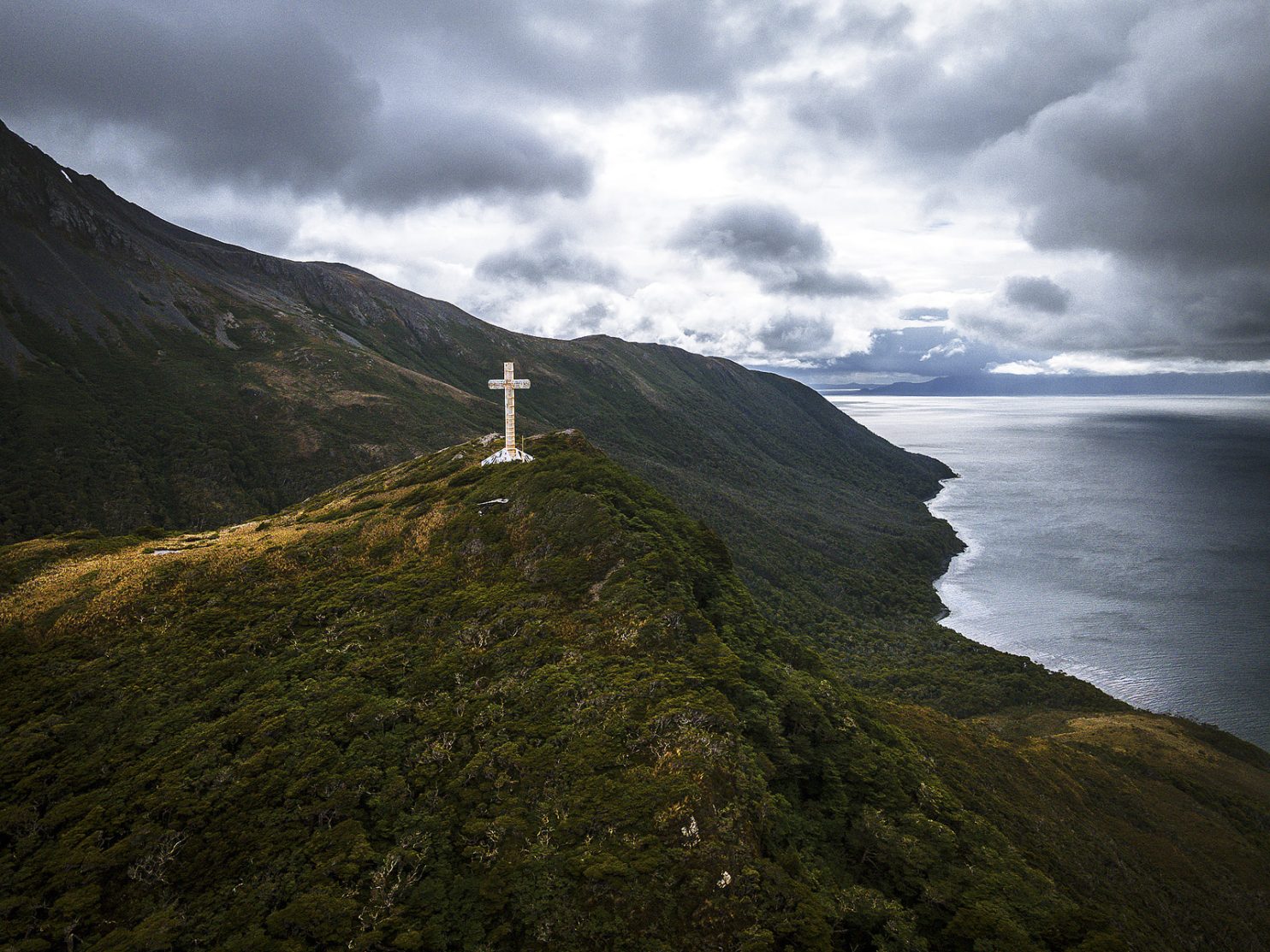
Click the main photo again to load the blog. The blog will be a series of links to google docs. One link per day. Eventually the link will get replaced by text and photos and photos in the gallery.
The links are here and the text and photos further down.
Day 000. 10 November. Punta Arenas
Day 001. 11 November. Punta Arbol to Rio Yumbel.
Day 002. 12 November. Rio Yumbel to Rio Nodales.
Day 003. 13 November. Rio Nodales to Cabo Froward return to Rio Nodales.
Day 004. 14 November. Rio Nodales to Rio Yumbel.
Day 005. 15 November. Rio Yumbel to Rio San Juan.
Day 006. 16 November. Rio San Juan to Rio Aqua Fresca.
Day 007. 17 Nov 26. Rio Aqua Fresca to Punta Arenas
Day 008. 18 Nov 26. Punta Arenas Rest Day.
Day 000. 10 Nov 26. Punta Arenas Preparation Day. 0 km. 0m up. 0m down. 0 hrs. Having arrived in Punta Arenas after 3 flights from Edinburgh I now had two days in the city to prepare myself before heading further south to start the hike. I went straight to the small family run Hotel Endurance where I stayed last time when I prepared to go to Antarctica. I got a warm welcome and they gave me a great room. I just had time to dump my bags and then rush off for dinner with Steve Jones. I had never met Steve before but we had spoken on the phone many times as he vetted and then prepared me to go to Antarctica. He was at my favourite restaurant in Punta Arenas, Mesita Grande, a down to earth pizza and pasta place. Steve was there with a few others from Antarctic Logistics and Exploration, ALE. This company employed roughly 100 people and they gathered in Punta Arenas like migrating birds every November to head down to Union Glacier in Antarctica. It was like an extended family of like minded adventurers and in this family Steve was the benevolent and respected father. It was a joy to be in their company but I had to leave early as I was tired after the flights.
For the next two days I spent much of the time going round some food shops and some outdoor equipment shops fine tuning what I needed. I got eight day’s worth of food altogether, but was a little light on the calories with just about 3000 a day. However at one of the outdoor shops, GradoZero, I met the owner Oscar, who was an acquaintance and a friend of friends. He suggested I could easily fish with a hand line on the way to Cabo Froward in the rivers I had to wade across. I got camping gas and also some alcohol for my two different stoves. I would also cook on an open fire, so I had 3 different ways to cook depending on the availability of fuel. Across the street from Oscar was a hardware store with fishing tackle and I bought a characterful wooden hand reel hand and some spinners to experiment with and learn from, as I would need this skill further north.
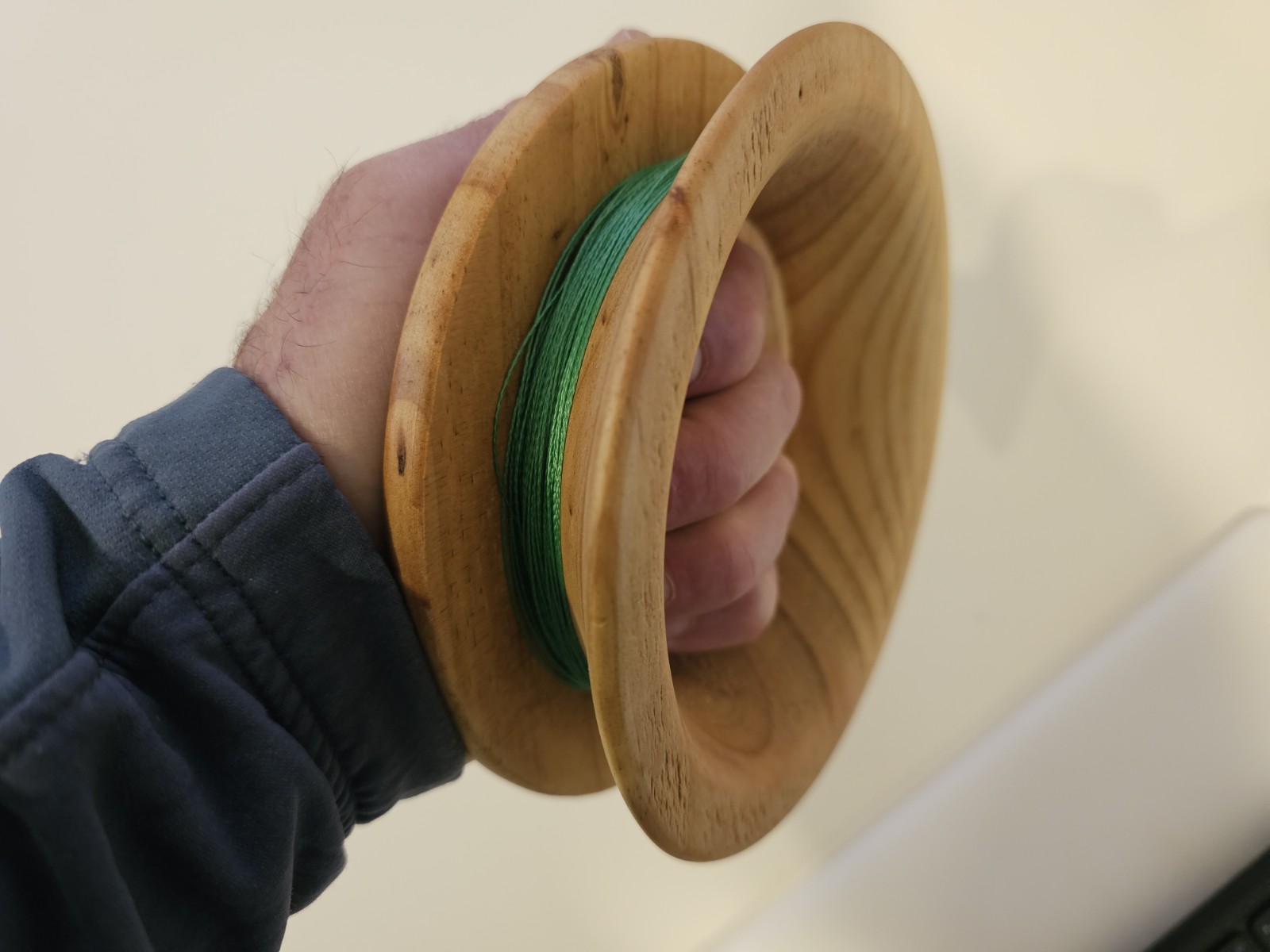
001. One of the purchases I made in Punta Arenas was a small artisanal hand reel, a “catalina de madera pesca” which I will hopefully use to supplement my diet.
On the second full day I had most of the packing done and the food parcelled up into small bags of daily rations. My rucksack was heavy at about 23 kilos, which was a bit worrying for my 67 year old joints, but this would reduce to a base weight of 16 kilos as I neared the end of the first section. I had the luxury of returning to Punta Arenas at the end of this section so I could leave some clothing and equipment here. I also had a parcel to send to Cochrane Post Restante some 1200 km to the north with new shoes and a change of clothes. Steve said ALE could help me with that and store it here and then post it to Cochrane in about 8 weeks time.
With these chores done I could now explore Punta Arenas a little. It was the fourth time I have been here and the city was beginning to endear itself. It has a harsh climate and although relatively dry and partially in the rain shadow of the coastal ranges to the west, it is windy. This has bred a resilient, down to earth population which are friendly and helpful even by Chile’s high standards. Around the main square were the salubrious villas of the once very wealthy landowners, the sheep barons, of a century ago. These mansion houses are now home to institutions or museums as the town had become more egalitarian and full of pioneers. In the centre of the square is a statue to Ferdinand Magellan, the Portuguese navigator who was entrusted in 1518 by the King of Spain to lead a small flotilla of 5 ships to establish a route to the Pacific Ocean. After some hardships and a mutiny he eventually found the Straits of Magellan, which although demanding avoided the much more hazardous Drake Passage further south.
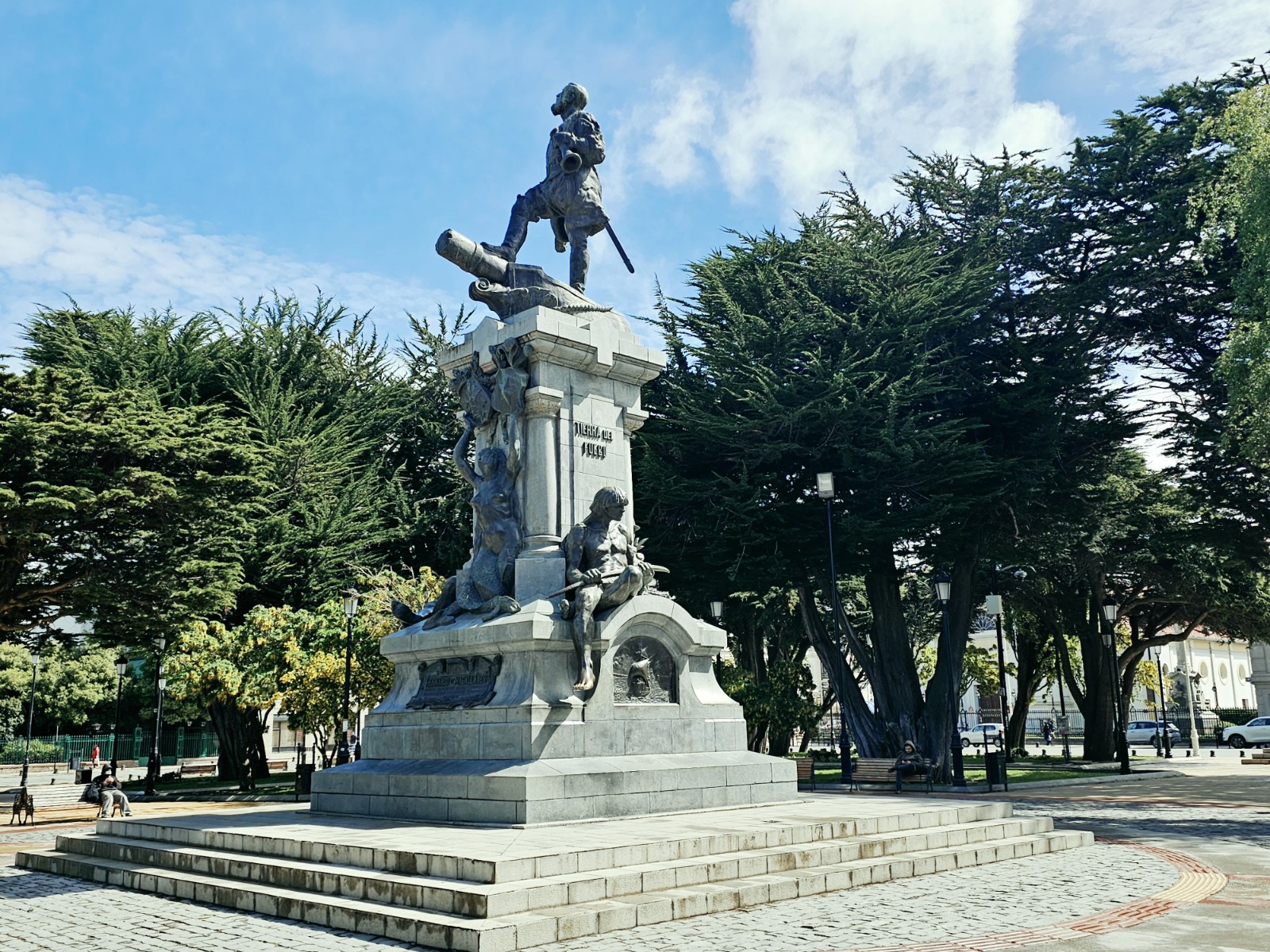
002. Punta Arenas main square with a statue of Ferdinand Magellan, whose small flotilla were the first Europeans to navigate through the Magellan Strait in 1520.
Of course although Magellan “discovered” the Straits of Magellan he was by no means the first and there were various indigenous peoples who were well established for some 5000 years before the Europeans arrived. Perhaps the most famous of the tribes were the Selknam, an immensely hardy people who lived by hunting and gathering along the shores and inlets of the inhospitable and mountainous archipeligos here. Unfortunately as was often the way the predominantly colonial Spanish settlers, and especially the sheep barons whose mansions surround the main square in Punta Arenas, had a policy to exploit and even exterminate these indigenous locals to the extent where today there are no true blood Selkman left.
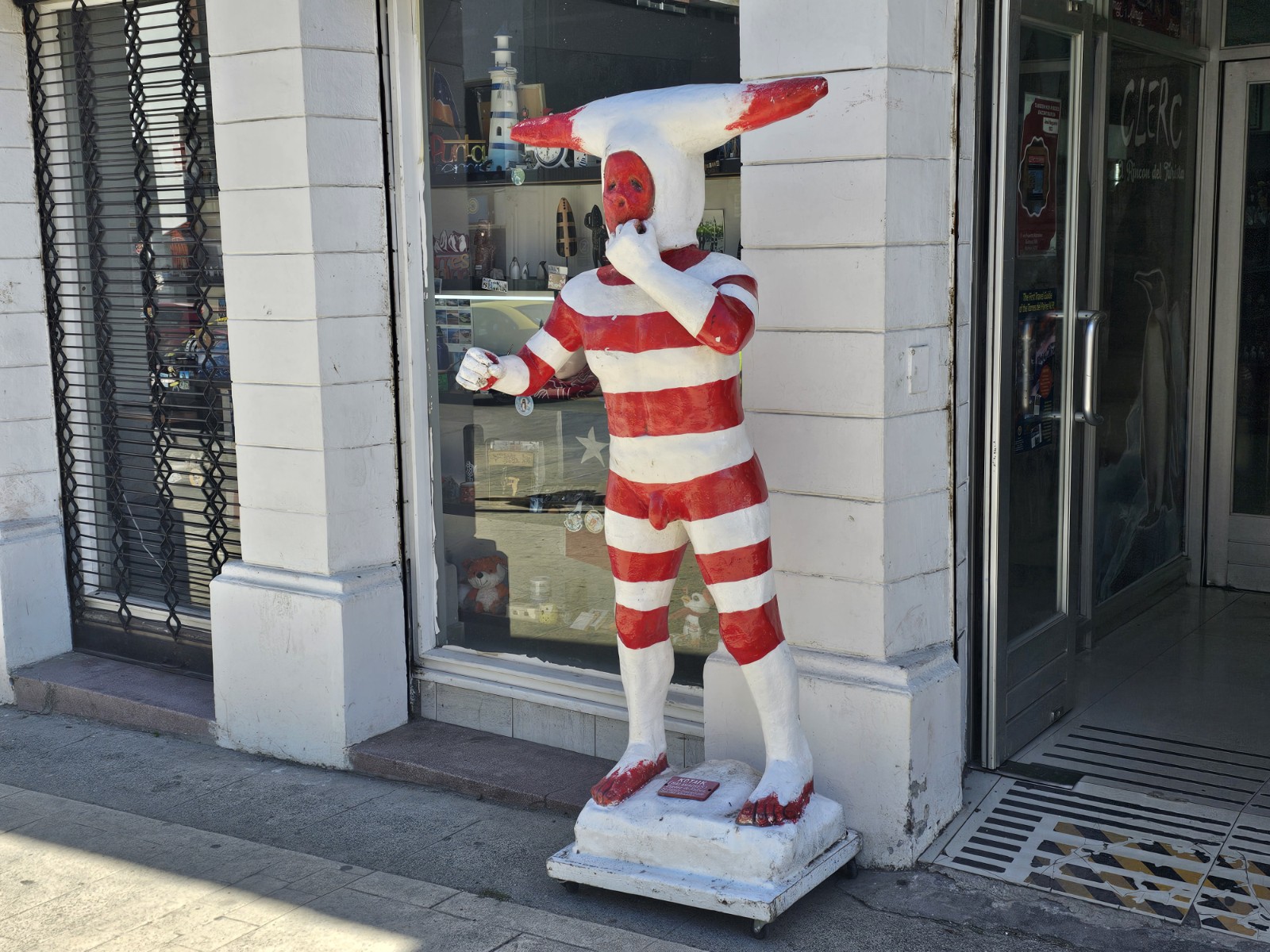
003. The Selkman were a shamanistic indigenous population of Tierra del Fuego and the surrounding archipeligos and lived by hunting and gathering. The above is a mock up of a Selkman in ritual attire.
Oscar Jaures, from GradoZero outdoor shop, offered to drive me to the start of my hike tomorrow at the end of the road at Punta Arbol. He was driving a friend down anyway but it was very kind of him to offer me a place also. Oscar is a well known outdoors man in Southern Chile and runs kayaking and hiking trips across the region. Despite Oscar’s encouragement and reassurance I still felt nervous last night before my long 5 month walk starts tomorrow morning on the 11 November. I will have to walk 3 days just to get to the start of my trip at Cabo Froward, the remote cape which is the most southerly point of the mainland of South America, before turning round to head north for 3000 km.
Day 001. 11 Nov 26. Punta Arbol to Rio Yumbel. 13 km. 260m up. 260m down. 5 hrs. Oscar picked me up at 1000 from the Hotel Endurance. He was also giving a lift to Javier who was also going to walk to Cabo Froward. Javier was local, bright, spoke great English and worked as a guide in the Torres de Paine Nation Park guiding clients. We chatted enthusiastically in the car as Oscar drove. After 20 km we stopped to register our trip at a roadside police station. Apparently if we didn’t, and there was a problem, we would get fined. It took another hour to get to the end of the road with the last section being a gravel road with one section even along the shingle beach to the very end of the road.
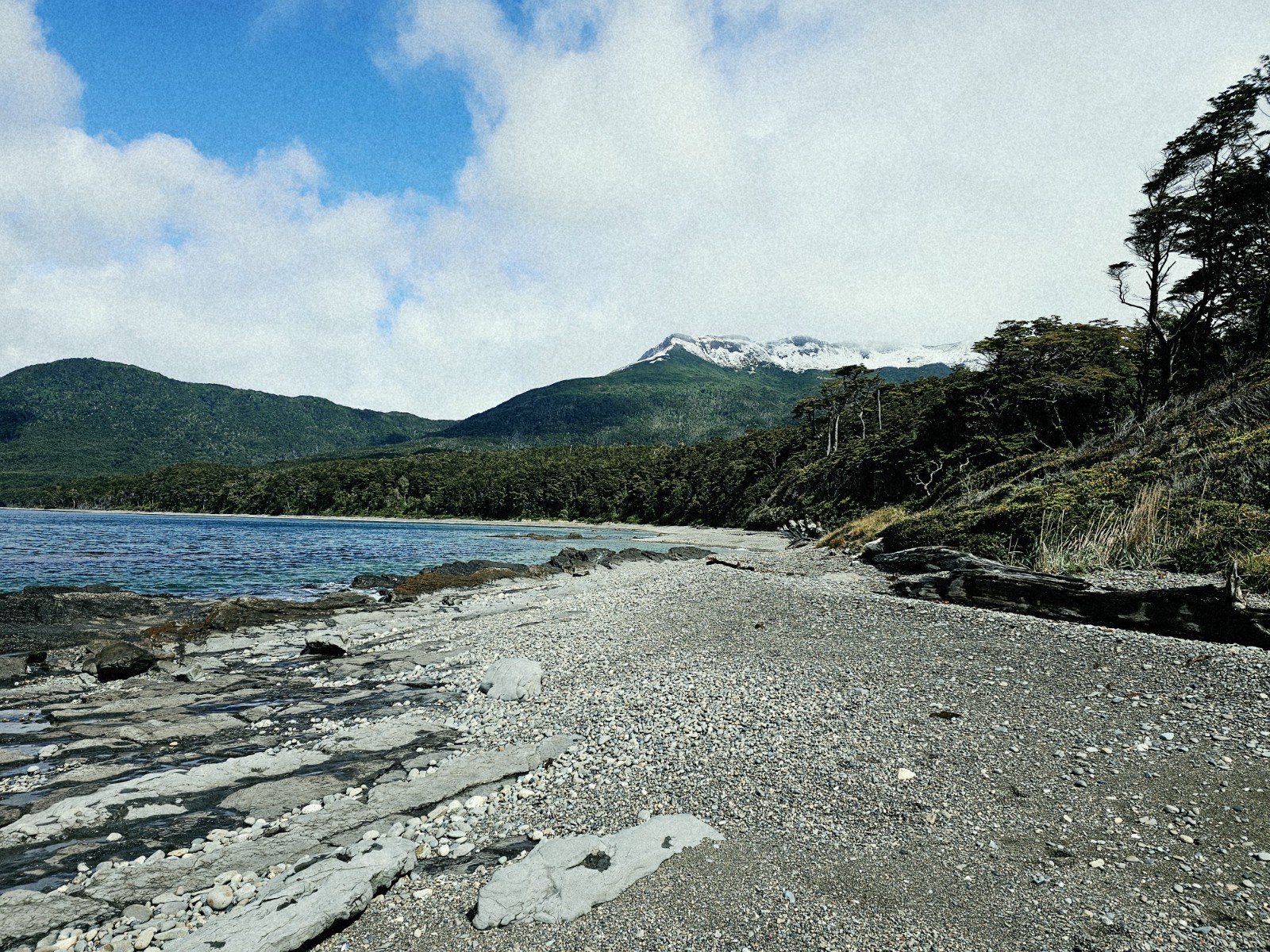
004. Heading down the beach from the end of the road.
This was it. This was the start of my 5 month walk. We set off at about midday in mixed weather. There were some frequent showers which were almost cold enough to be sleet but half an hour later the sun was out and so it continued all day. Initially we walked down the shingle beach past the path up to the snow covered Monte Tarn which loomed above. Across the water to the east was Isla Dawson, one of the many ferociously rugged islands which made up this vast and icy archipelago. I had been up Monte Tarn 3 years ago and remember it fondly. Occasionally our route took us into the nothofagus forest above the shoreline where there was a rocky outcrop or where the high tide forced us up. The forest was largely made up of coigue trees, Nothofagus betuloides – one of the three common southern beech trees which would accompany me for my entire journey north until I reached the Arucania zone.
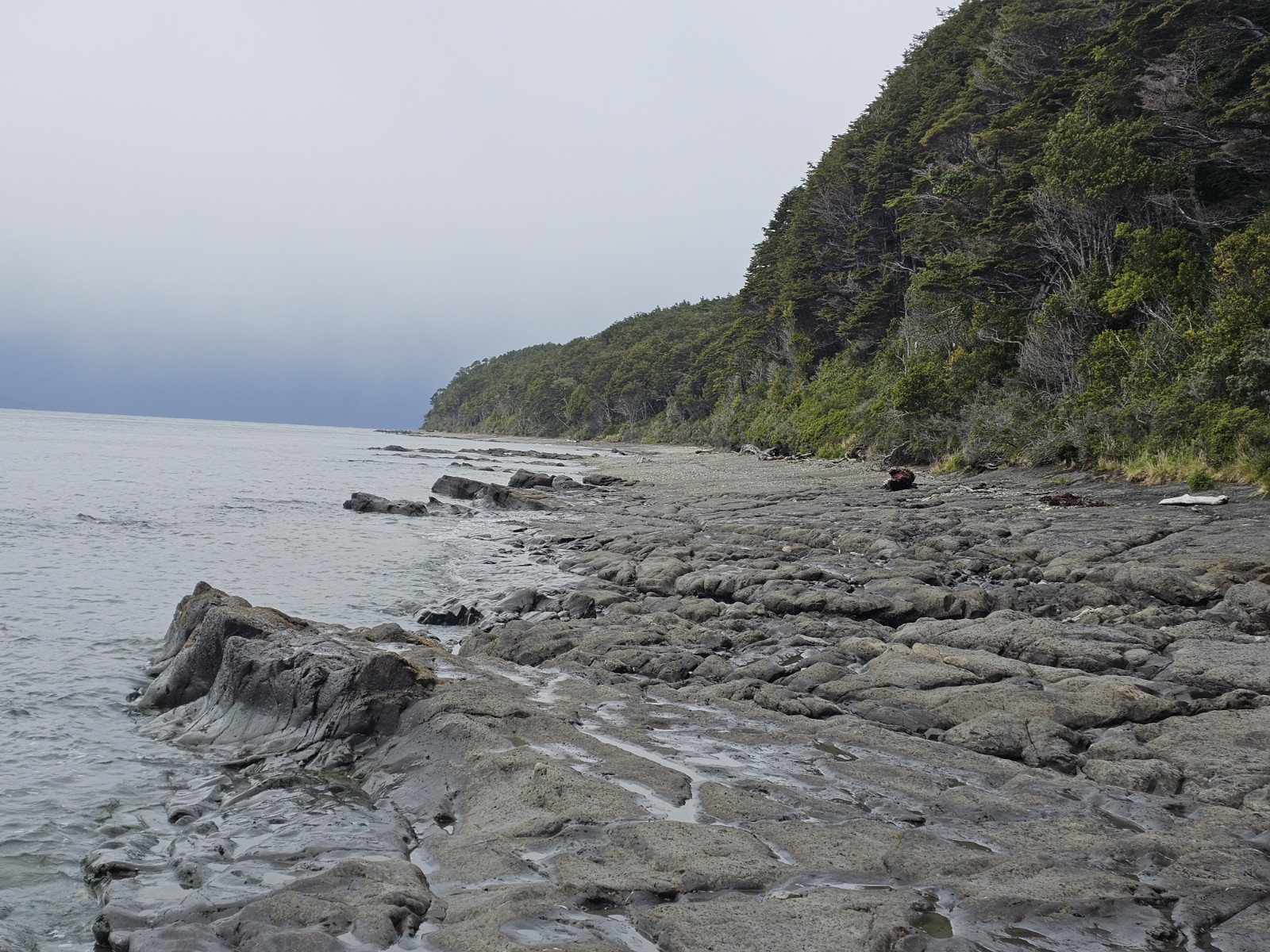
005. Occasionally the shoreline became quite rocky with steep headlands and we had to veer into the arduous forest to bypass it.
After about 2 hours we had done about 5 km and reached Faro San Isidro. I was a light house on an isthmus which jutted into the important Magellan Straits waterway. The lighthouse still functioned but the buildings around it were falling into disrepair. There was a lighthouse keeper in a nearby bungalow who had the key which we could have got but we just looked through the windows to see a large room full of the skeleton of an immense whale. There was also a hut nearby for hikers but it was now derelict. We sheltered in the lee of a wall on the knoll the lighthouse stood on and ate lunch before continuing south.
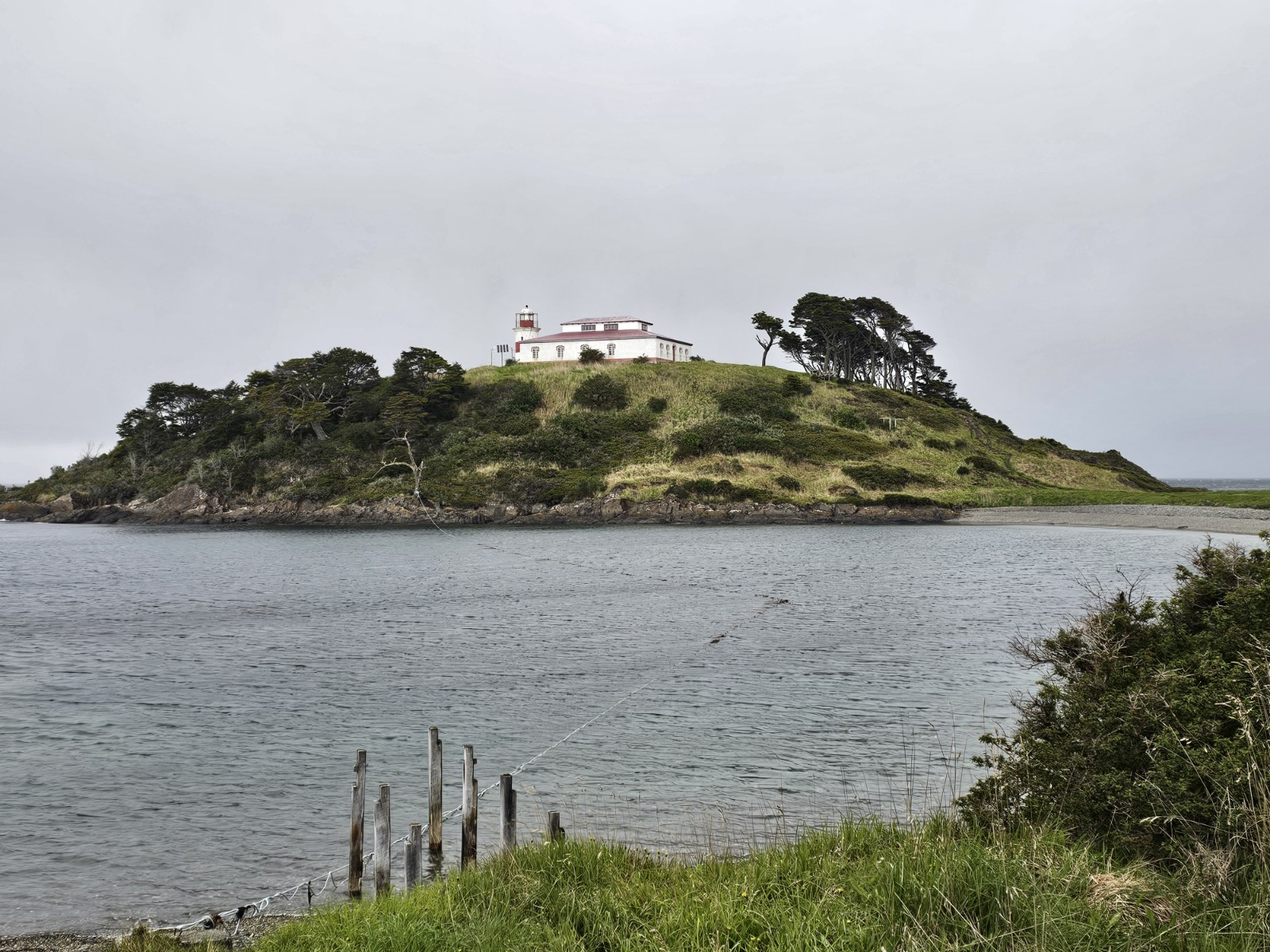
006. The Fara San Isidro on a peninsula was one of the more important lighthouses in the Straits of Magellan
The showers came and went as we continued down the shingle beach and rocky shoreline. It was cold and my hands were feeling it. Occasionally the shoreline was too rocky and there was an outcrop which blocked the way and then we had to climb into the forest above it. This was much slower going and very arduous. The first band of vegetation between the shore and the nothofagus forest was the worst as it was densely packed fuschia and berberis shrubs. The latter would eventually provide the blueberry like calafate berries but now they were just in flower. Beyond the shrubs was the mature forest with large trees and little ground cover so it was easier to push through. Eventually the rough path would spill us back onto the beach again and the speed increased.
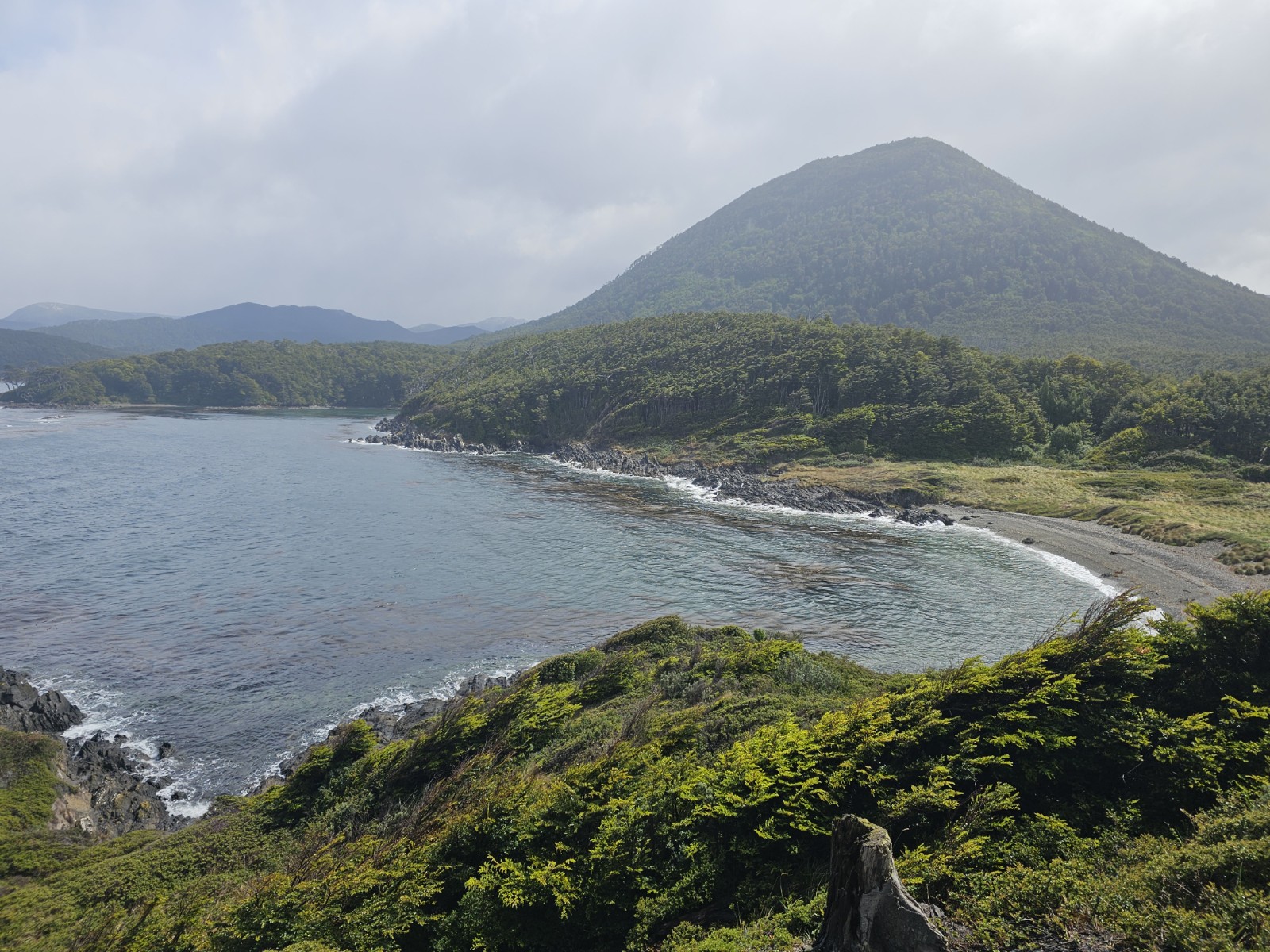
007. From the lighthouse the weather was showers and cold as we continued down beach and forest for another 3 hours to Rio Yumbel
The beach sections were lovely to walk along as it was in the shelter of the westerly wind. There were some thrushes and plovers but the most striking birds here were the Patagonian Geese. There were a few varieties with the most common having a very white male and a very dark female. They were always in pairs and perhaps preparing to breed now spring was here. On occasion as we neared the Rio Yumbel I saw the much rarer Colorado Geese, so called because of their rufous colour. The male and female of this species were almost identical.
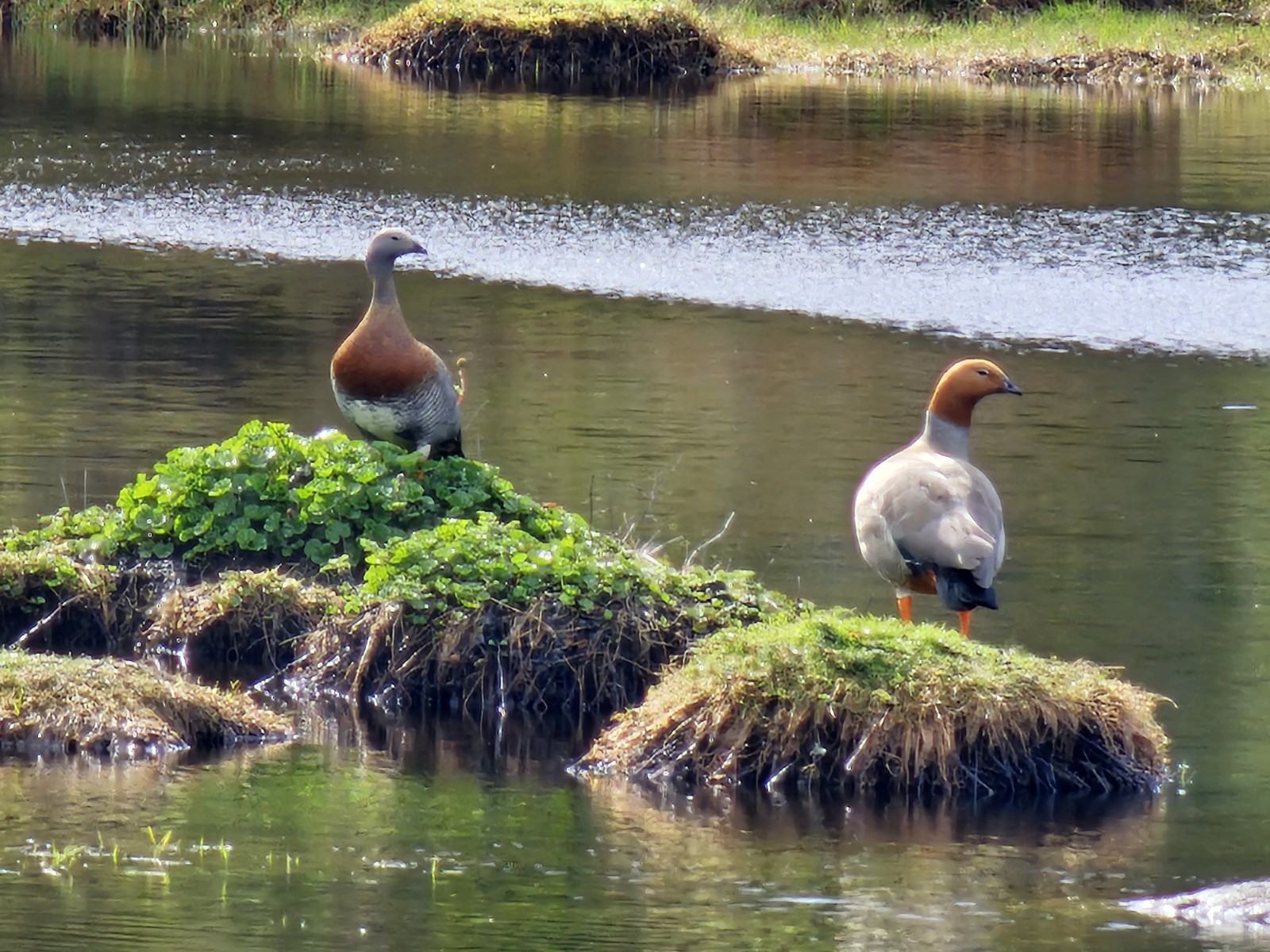
008. The rare and endangered Colorado Geese we saw near Rio Yumbel.
Eventually the beach led us to a small abandoned hut. It had a stove but was dirty and ramshackle inside and no doubt riddled with mice. It was not inviting and the mice droppings might contain hentavirus which is a problem in Patagonia. Javier explained to me it was once the home of a puesto. A puesto was a shepherd who the large landowner employed to look after a section of his vast farm, or estancia. Apparently puestos were usually single men and often liked a drink. Living in these harsh remote conditions on the very fringe of society one could understand why. Javier said the Rio Yumbel river was just beyond and we could camp in the sheltered forest here. The tents were soon up as hail fell through the coigue trees and then we went for water at the river and to check out the crossing for tomorrow. There seemed to be a log jam where it was possible to clamber over a cluster of fallen trees spanning the river.
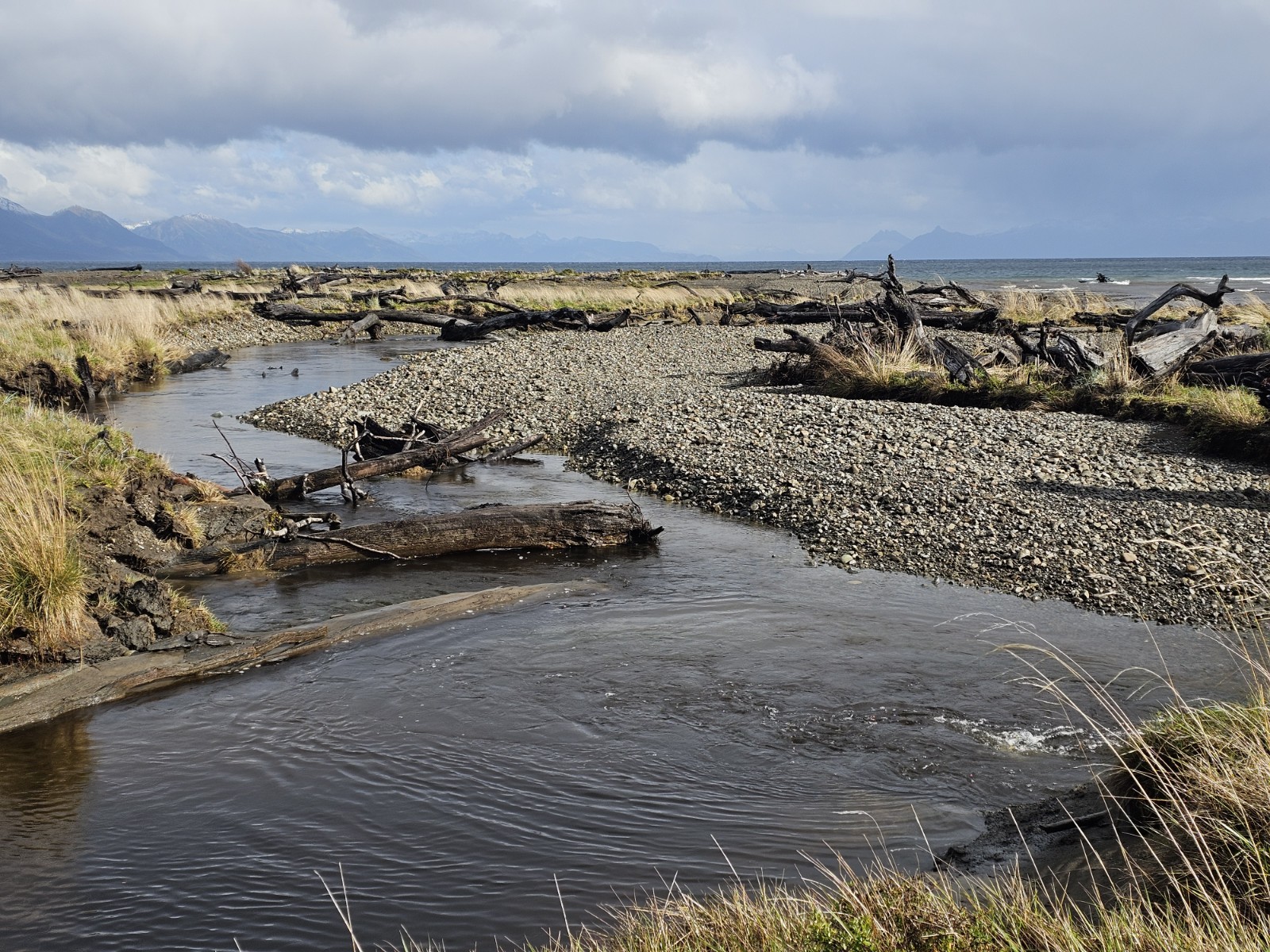
009. The Rio Yumbel was easily crossed on logs. The main jam behind me spanned both forks.
Back at camp we quickly cooked and then I got cold and went to bed. Javier was soon after me but he was cooking a magnificent meal with lots of ingredients. I tried to write but was just too tired and could not stay awake so soon I retreated into my warm sleeping bag and fell asleep as I warmed up.
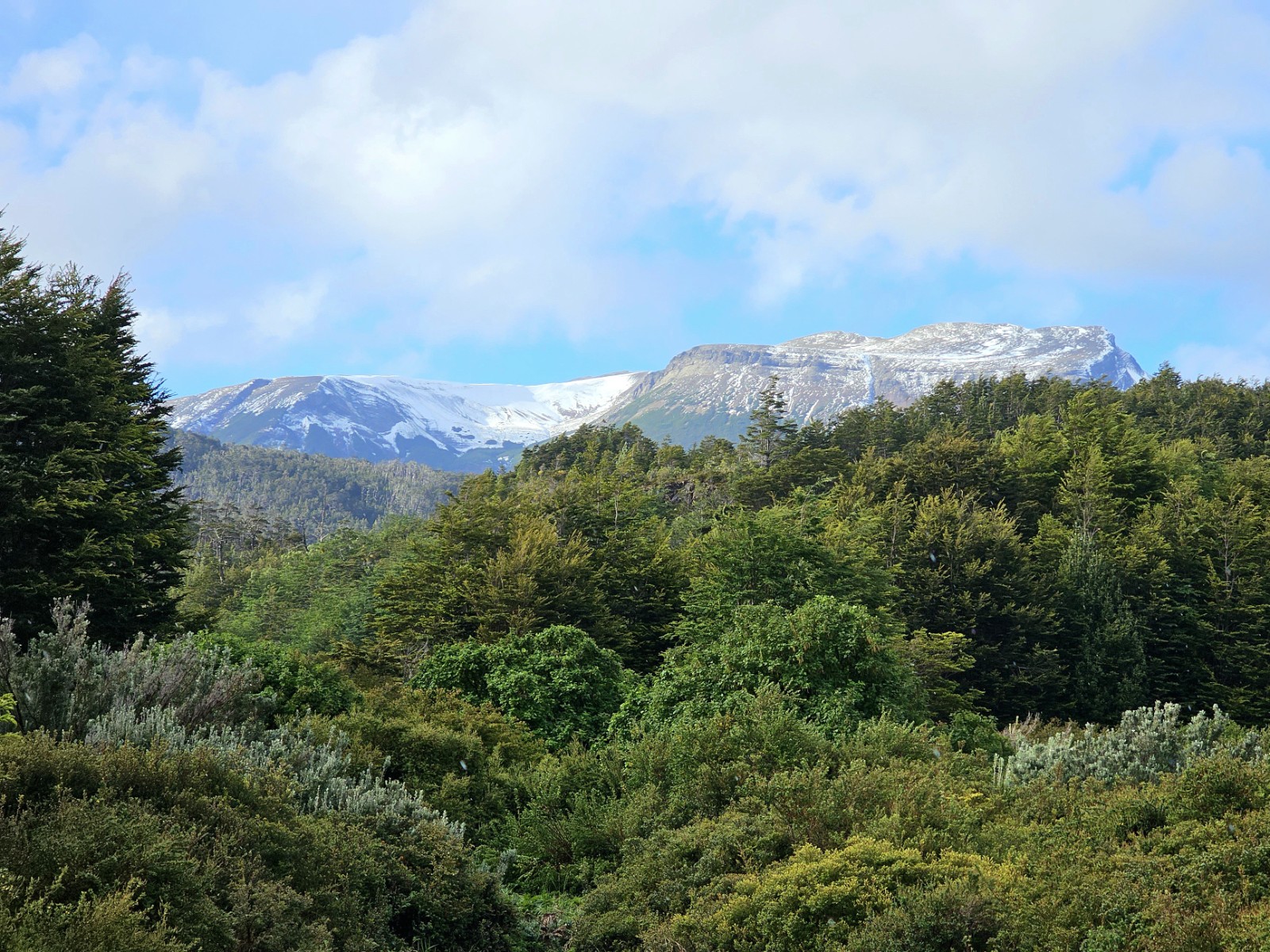
010. From our camp at Rio Yumbel it was possible to see above the forest to the snowy flanks on the south of Monte Tarn.
Day 002. 12 Nov 26. Rio Yumbel to Rio Nodales. 16 km. 280m up. 280m down. 8 hrs. All night I heard the howling of seal lions which must have been on a nearby island or headland. In Spanish Javier told me they are called “wolves of the sea” and I could see why. It did not take long to pack up and we were off by 0800. It was a lovely day with clearer skies, little wind and no threat of rain. We wandered to the river’s edge and crossed easily on a log. However it was the first channel and the second proved more tricky because there was a huge log jam and we could gingerly pick our way across its uprooted and twisted trees. Once over we returned to the beach and could now see the island about 500 metres off the coast. It was covered in cormorant type birds and maybe 30 sealions.
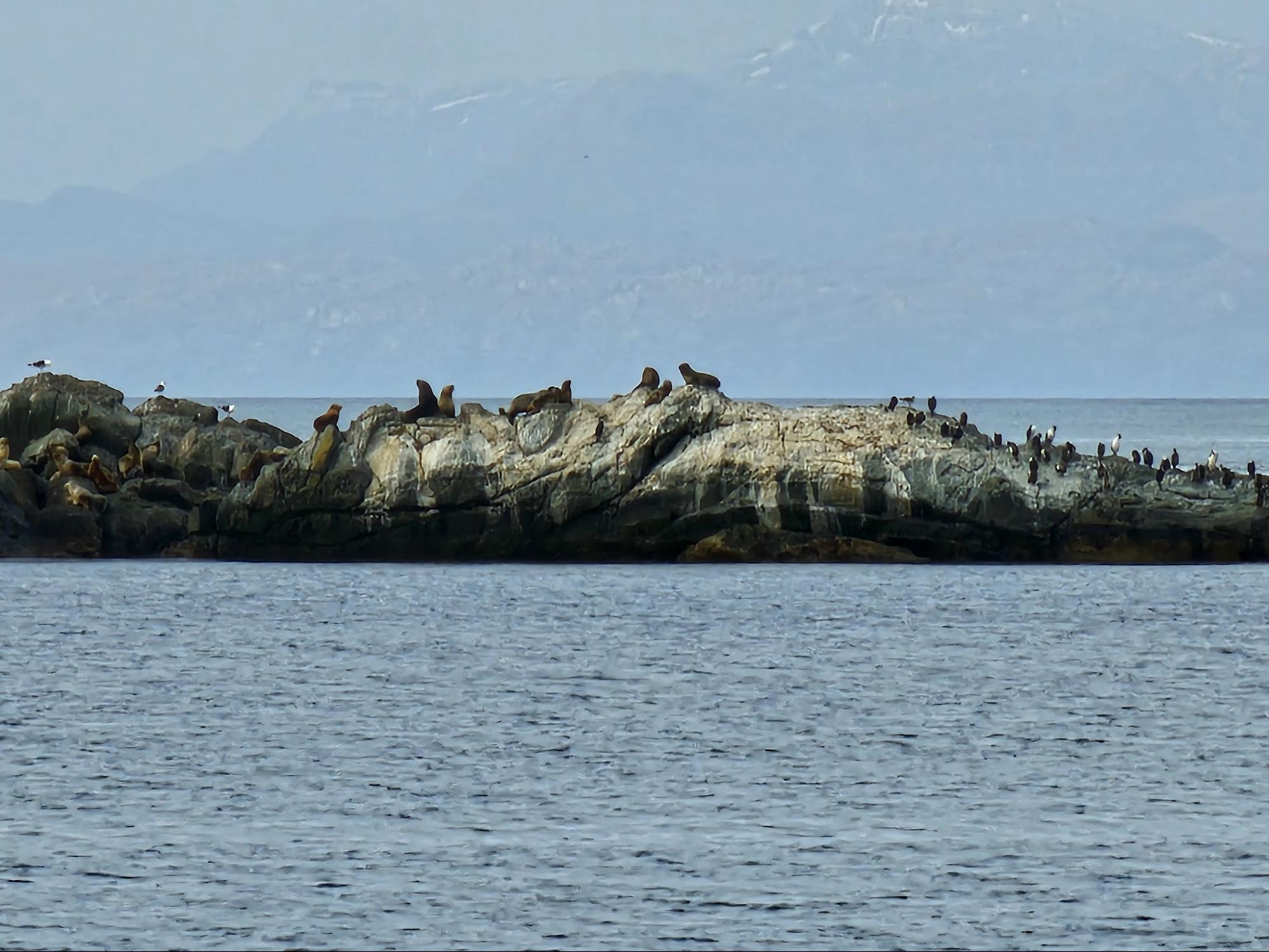
011. The islet with the sea lions near the mouth of the Rio Yumbel. They bellowed all night.
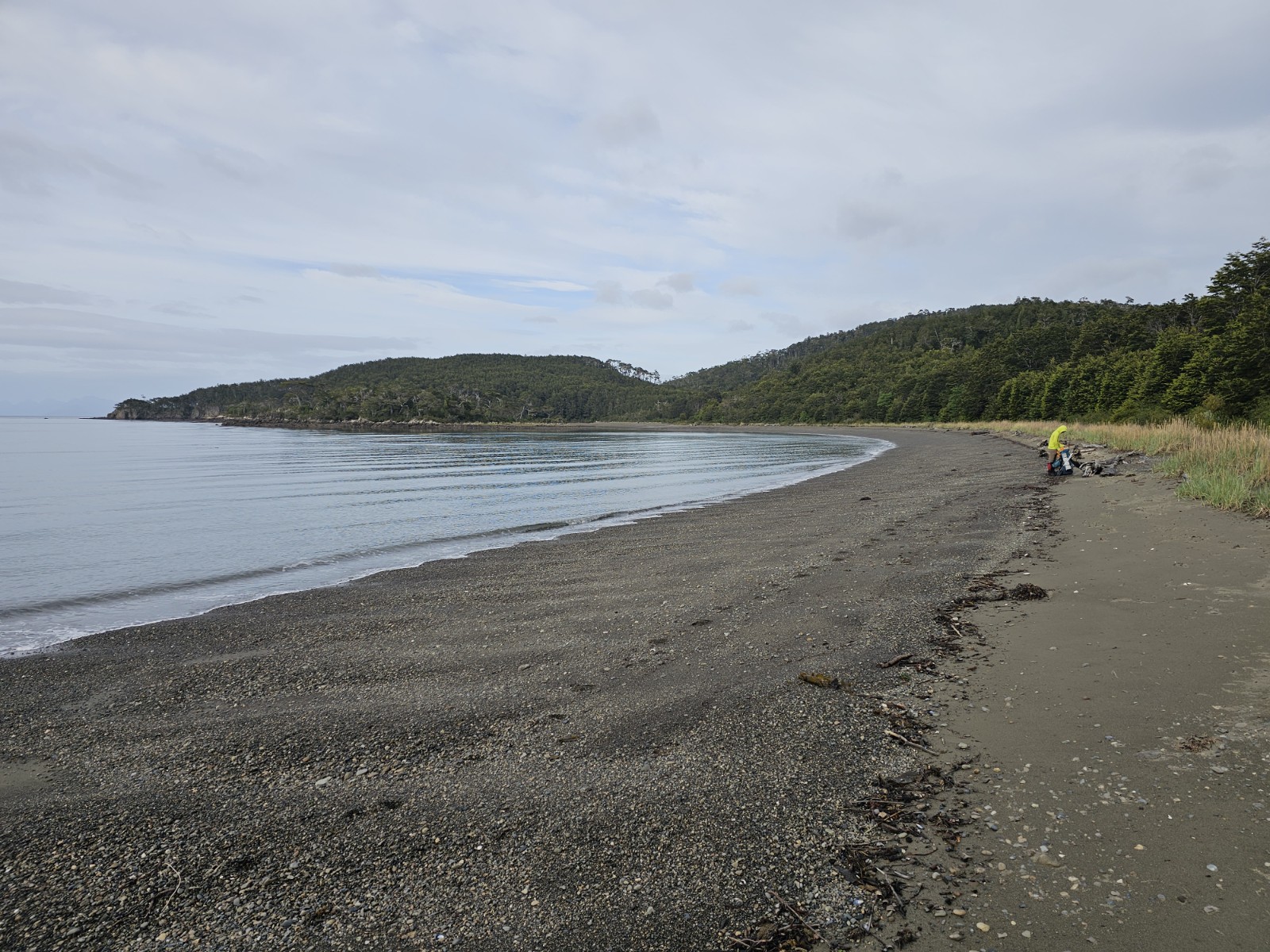
012. The easy expansive shingle beaches we walked down before climbing up in the forest to the turba bogland.
The beach was a delight to walk on and Javier and myself continued our enthusiastic chat. Despite his age he was very knowledgeable about the outdoors and also about the nature and culture of the area – of which he was part. I was learning a lot from him and it was nice to have his company. The shingle beach became quite rocky and slow but it was still preferable to the forest. However on 2 occasions the shoreline was blocked by a small cliff and we had to detour before returning to the shoreline. After some 2 hours since leaving the route, we left the shore and climbed up the wooded hillside until we reached a large expansive bog covered in spangnum. The nothofagus disappeared to be replaced by small cypress trees which tolerated the damp, it was relatively easy walking as we climbed up to the main bog and then descended again some 3 km later back onto the beach. A short saunter along the beach brought us to the estuary of the Rio San Nicolas.
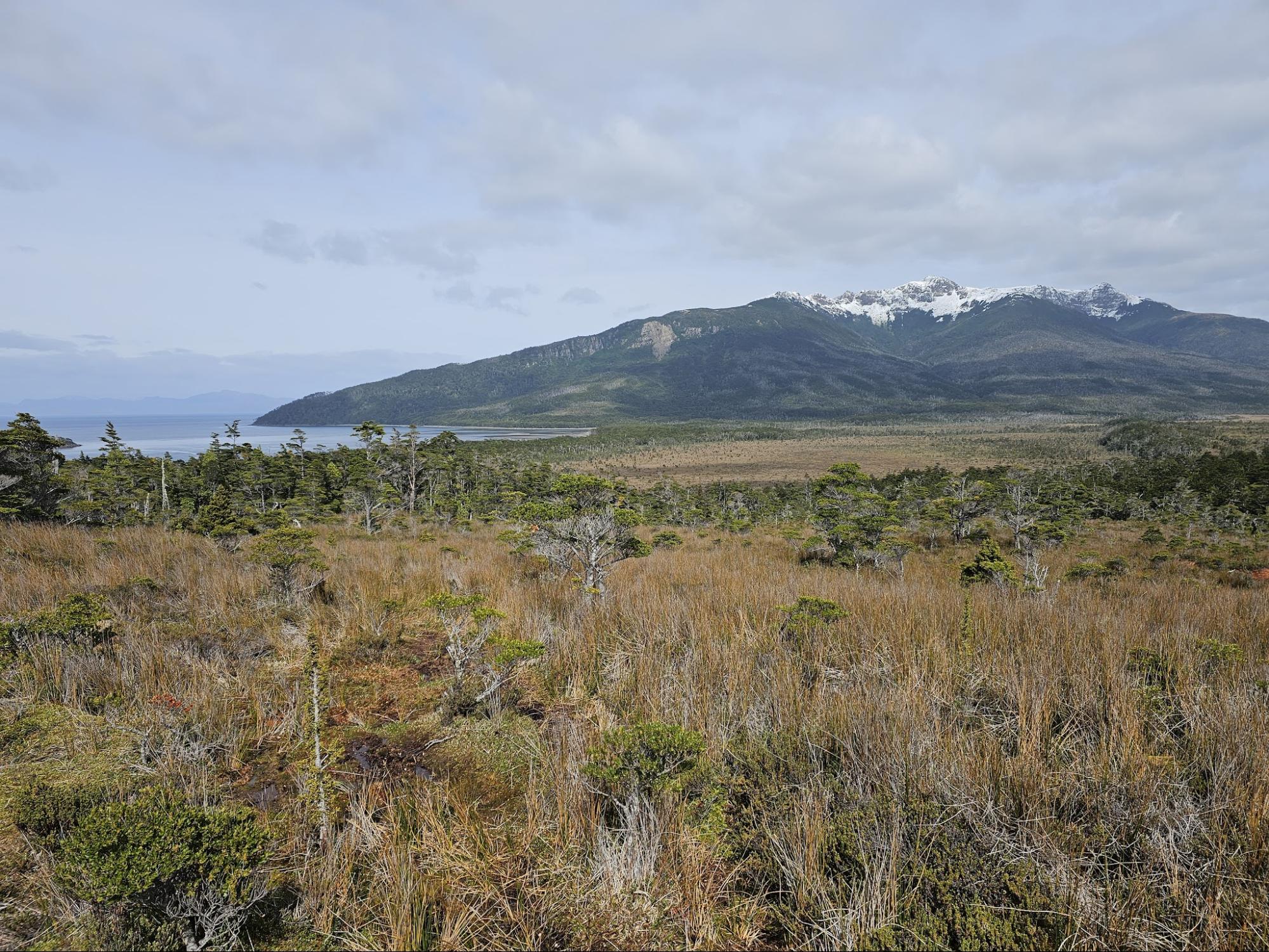
013. The turba bogland was largely sphagnum moss and small cypress trees on a wet peaty base.
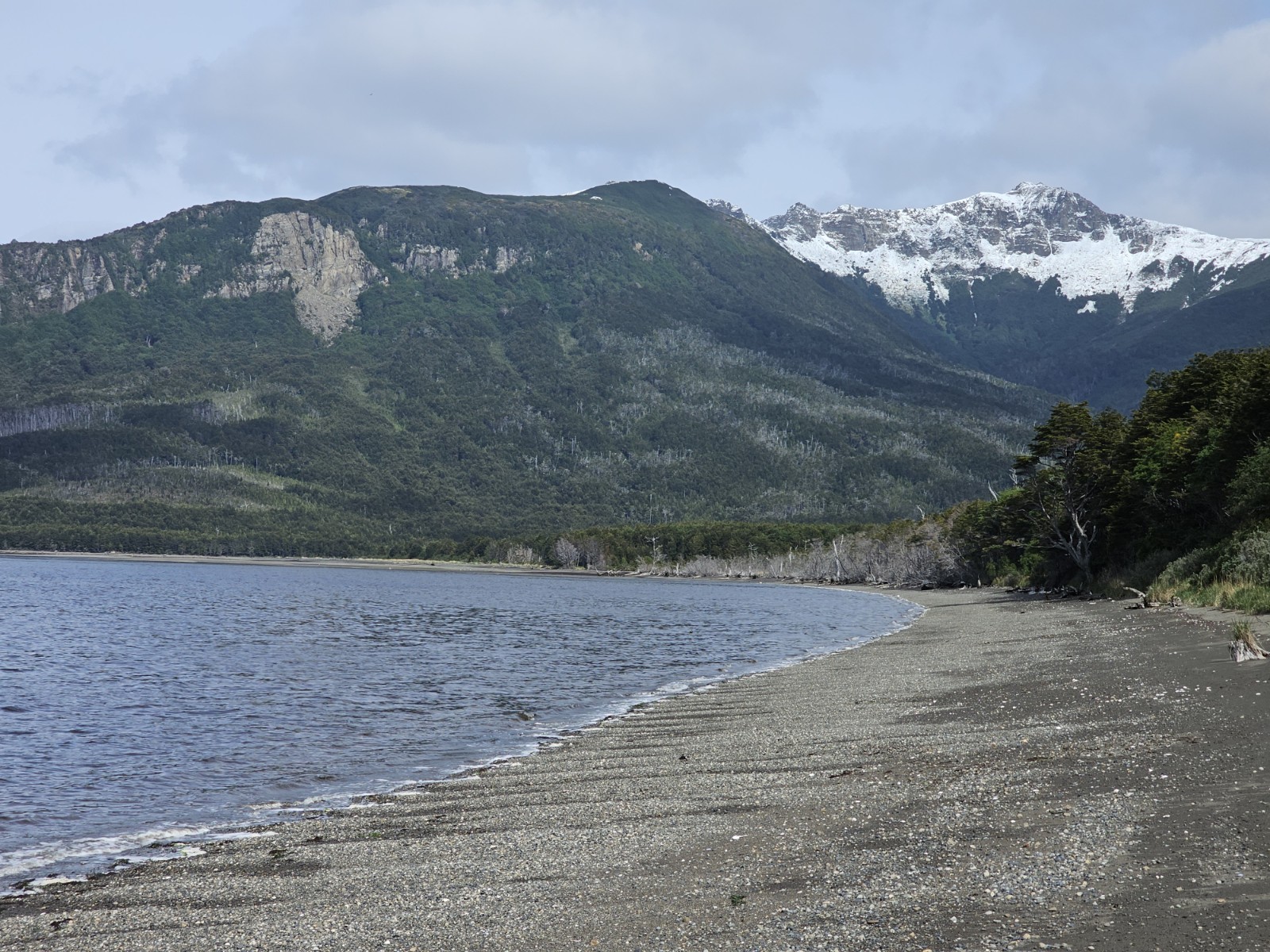
014. The final beach before the Rio San Nicolas. The river was at the base of the hill. The mountain is Monte Odales, 763m.
We needed it to be low tide but were at least 2 hours too late and the estuary was full. Geese bobbed about and looked at us as we pondered what to do. Given our plan to get to the next river and also given it was a mild day we decided to wade across. Initially it was only knee deep for ages but as we neared the other side our shorts were getting wet. We then decided I would go first with my rucksack held above my head to keep it dryish. It got deeper and deeper until I was up to my chest in the main channel. Then it mercifully became shallower as I reached the south side of the near 200 metre crossing. Javier followed and he was up to his neck almost. On the south side we realized all the water we waded through was fresh and once dry our clothes would be fine again. We found a sheltered spot for lunch in the sun and soon warmed up.
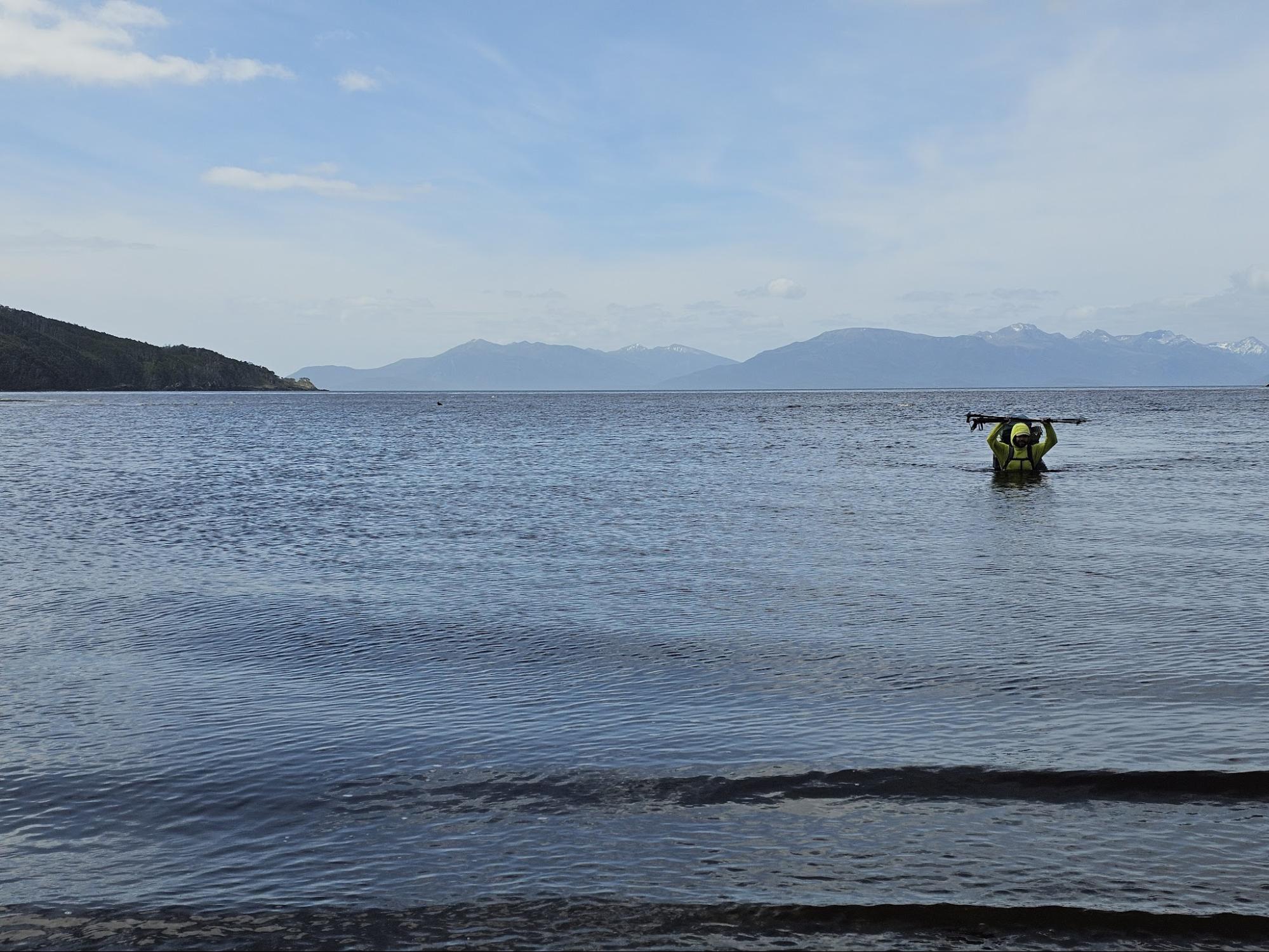
015. Javier doing the final part of wading across the Rio San Nicolas estuary some 2 ½ hours after low tide.
There was just a long kilometre to walk along the delightful beach in the sun with glorious views across the strait to Dawson Island and then the huge glaciated island with the Darwin Cordillera on it which was an ice cap and it shone in the sun. The beach was over far too quickly as we neared a headland, Punta Glascott, and had to cross over it. It was a bloodsome slog for about a kilometre up steep rocky forest and then down the other side. What made this area so difficult was the large amount of wind fall trees here which we had to go under and over. It took well over an hour to struggle through this tangle, but at last we returned to the beach again. It was a relief.
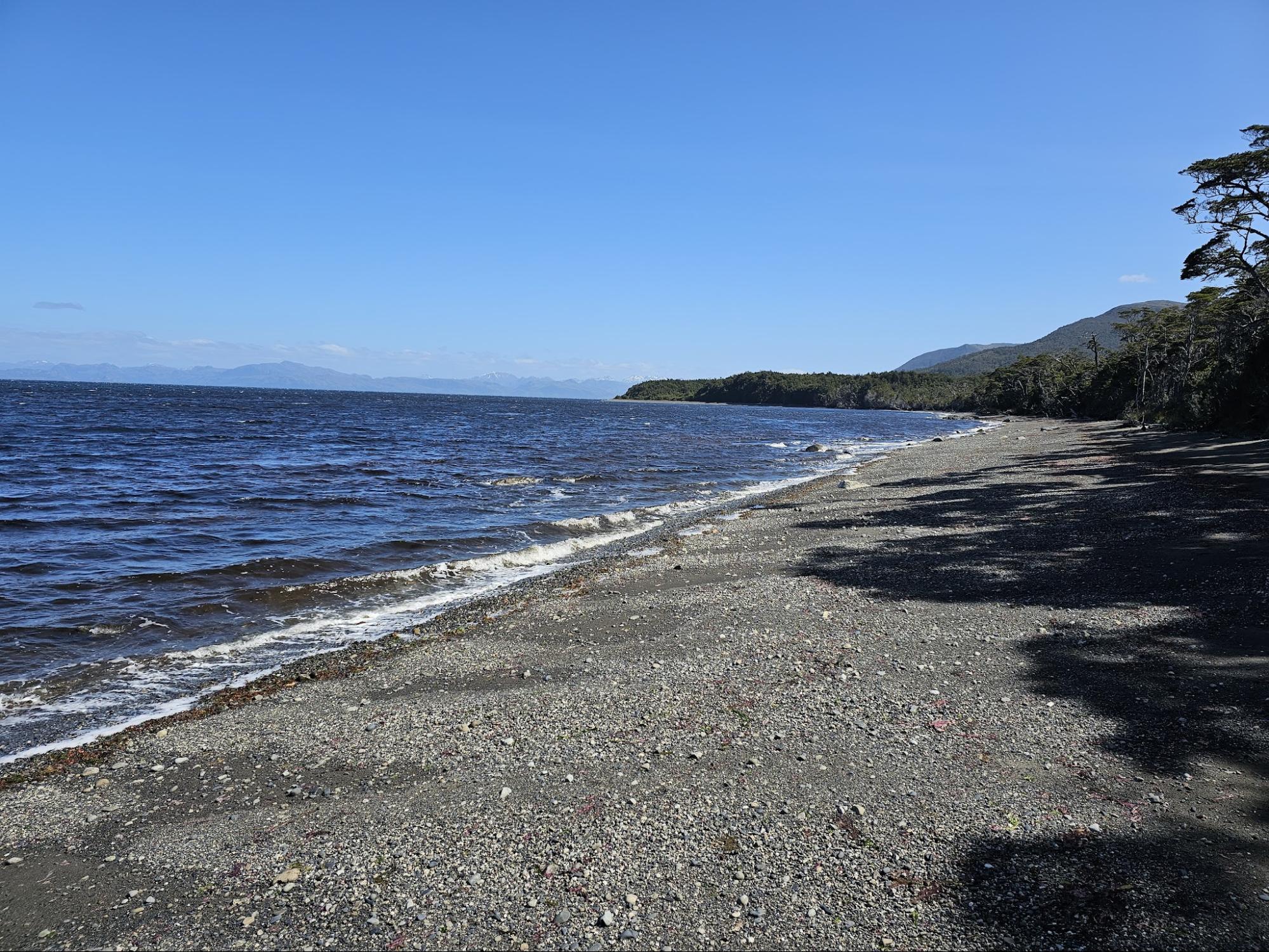
016. Another long shingle beach section before Rio Nodales.
Finally there was a varied shoreline of about 5 km where we could chat and only had to concentrate on the infrequent rocky shoreline. We made good time and reached the Rio Nodales. Our intention had been to cross it at its estuary and then camp. However it was just after high tide and we were assured to be wet and cold at least up to our chests again so we decided to wade it tomorrow morning at low tide. So we returned 200 metres and camped in the woods at a nice sheltered campsite. Our intention would be to leave the tents here tomorrow with most of the gear and set off with light packs to do the 8 km to Cabo Froward and return the same 8 km to this camp.
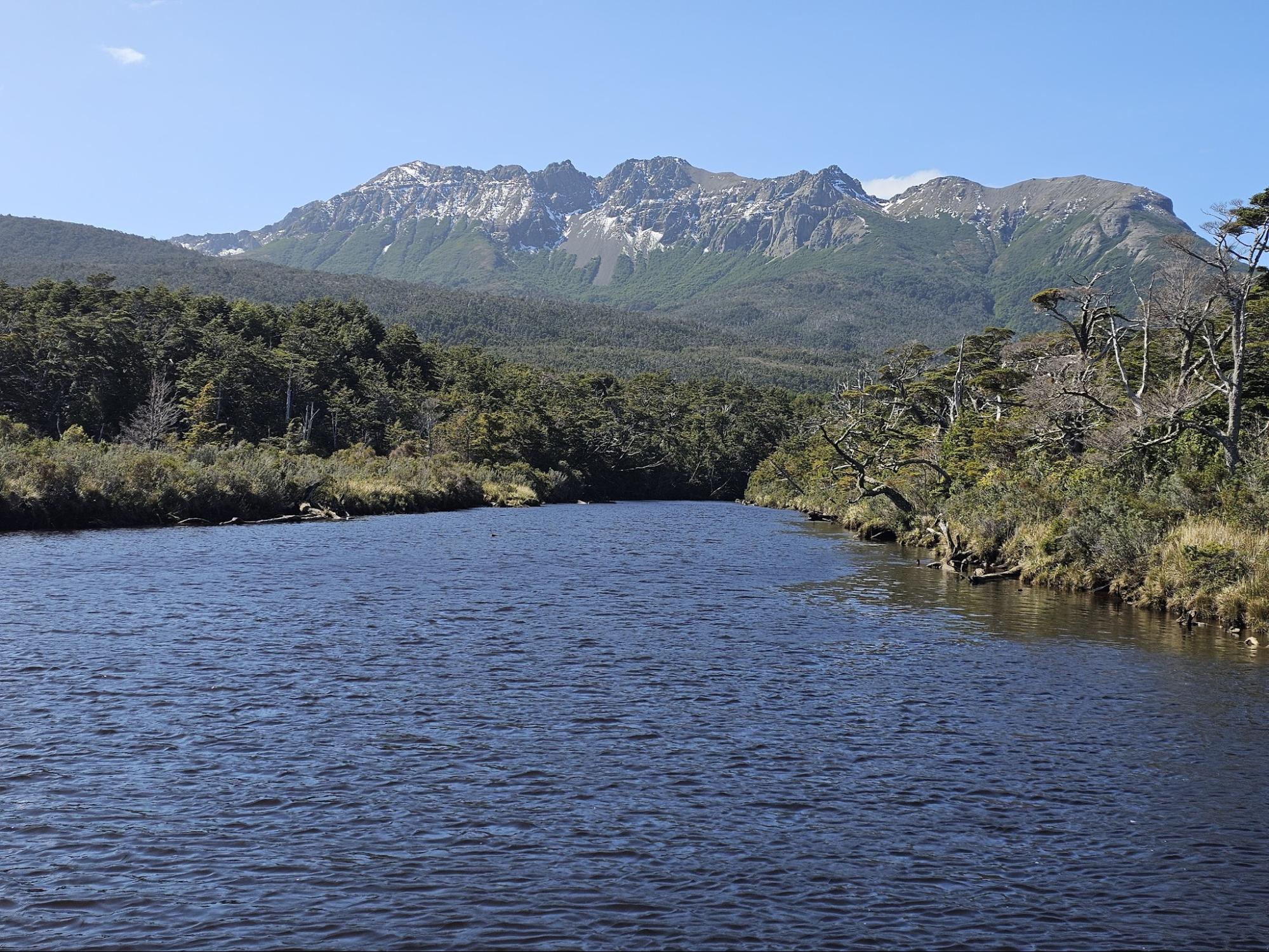
017. Rio Nodales estuary at high tide. We are looking up stream towards the south side of Monte Nodales. The sun was hot now.
With the tents set up we returned to the sunny bank of the Rio Nodales to collect water, relax in the remarkably hot sun and try some fishing. The fishing was disappointing and the catalina hand reel, which I wanted to love, was quite frustrating to use. The telescopic rod was a bit better but there were no fish here. However, it was lovely to stand on the banks and fish in the sun. Javier relaxed with a mate tea and gazed across the straits and the very impressive glaciated archipelagos to the south and south east. We returned to camp after a good hour to cook and write the blog. I had a dull pasta and parmesan while Javier made a pizza base with flour and then a topping with cheese and salami . He was an inventive and able camp cook and enjoyed it. It had been a great day with lovely weather, stunning vistas, 2 adventurous river crossings and varied terrain.
Day 003. 13 Nov 26. Rio Nodales to Cabo Froward and return. 21 km. 710m up. 710m down. 10 hrs. We were up at 0700 and had a very leisurely breakfast as we waited for the tide to fall. Eventually we felt it was OK to wade at 0900. It was thigh deep and I just avoided wetting my underpants in the murky brown peat laden and freezing water in the estuary. Once on the other side we put our boots on while watching an aggressive couple of geese harass all the others. A bit further was a small lagoon with 5 colorado geese on it. Initially the journey was easy down a shingle beach but it was short-lived.
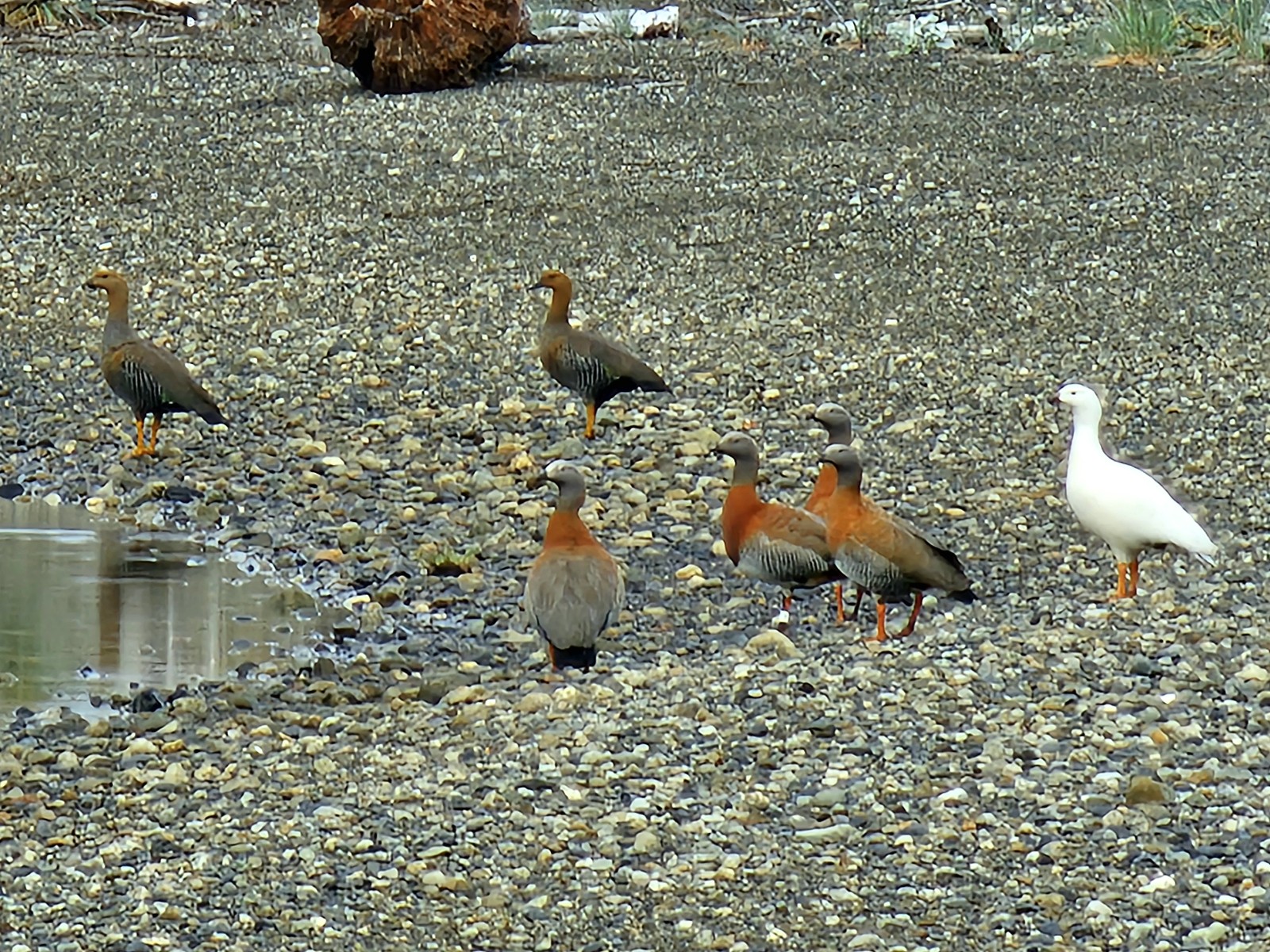
018. A collection of the Colorado Geese by the Rio Nodales estuary.
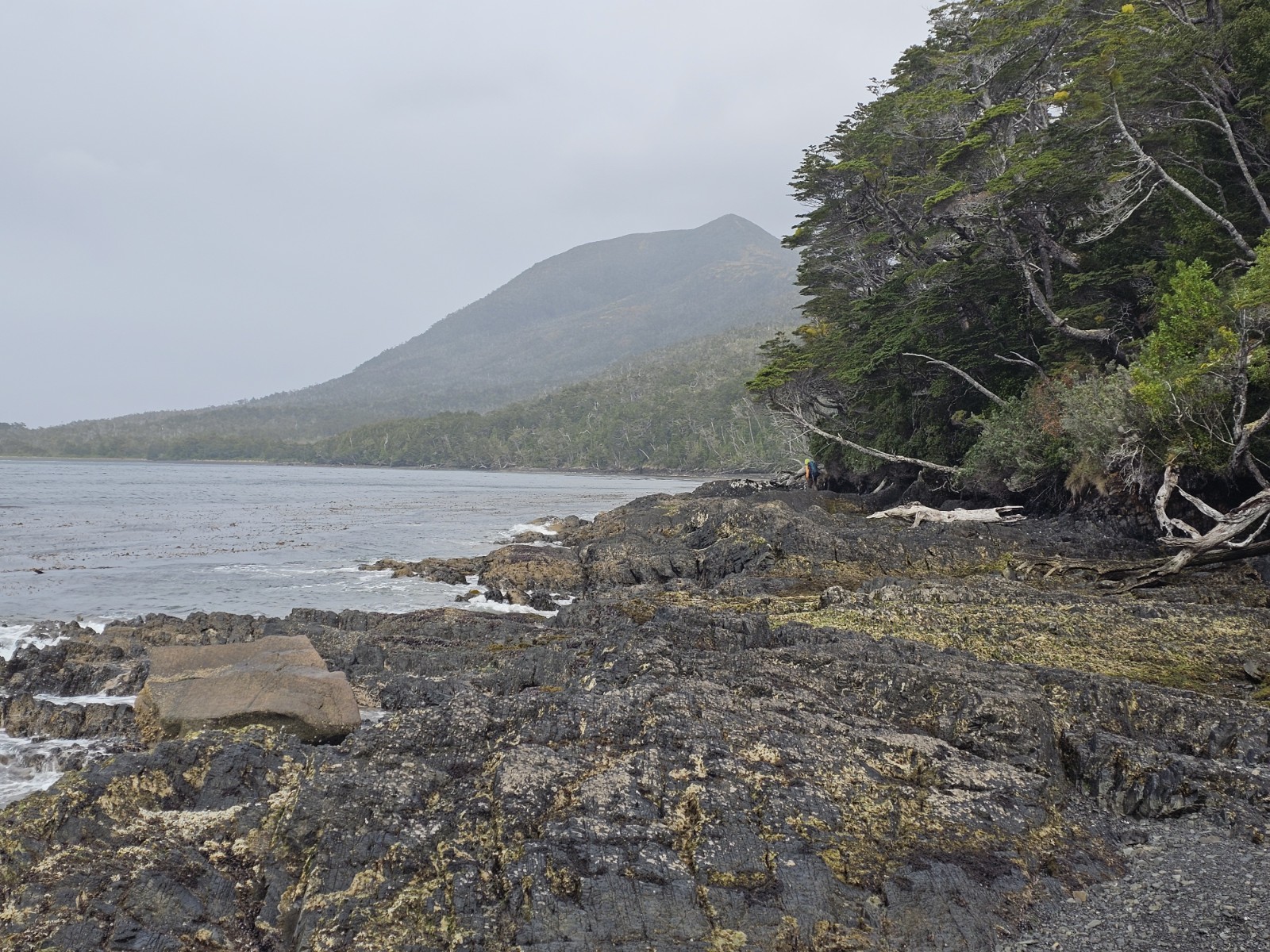
019. The shoreline was often a rocky shelf between the sea and forest frequently covered in fallen trees.
The next 2-3 km were a slow walk along a rocky shelf between the sea and the steep edge of the forest. This shelf was about 10 metres wide and covered in bare rock with frequent mussel beds and short seaweed. The waves crashed against the lower rocks sometimes showering us in spray and there were rain showers to keep the rocks wet. It was slow going and you had to look at every step. It could have been slippery but we each got the measure of it and were cautious. If this was not bad enough there were frequent fallen trees blocking the shelf and we either had to squeeze under them or clamber over them. It was slow going. After a short two hours we reached a better beach in Bahia Rosas bay. There were a couple of fishing boats anchored in this bay waiting for the gale to ease. The easy going was short lived and after the bay we reached Punta Sampaio. The next 3 km we did a slow careful dance along the rocks of the sea. There was one place where small cliffs blocked the way and we had to climb up knotted ropes into the forest and then bash through the thick scrub for 500 metres to emerge on the rocky foreshore again. The fallen trees were even worse here and each one was an obstacle. Back on the beach we reached a cleft and spied the cross on top of the hill at Cabo Froward. It was still a long way off. Our speed along this difficult shore was probably less than 2 km per hour. We flushed a few delicate ducks from the boulders where they were sheltering and watched as they crashed into the sea to escape us. I also saw a couple of dolphins surfacing frequently in the waves offshore. After a good 3 hours and with only 8km under our belts we finally reached the end of the last beach and were ready to start the climb.
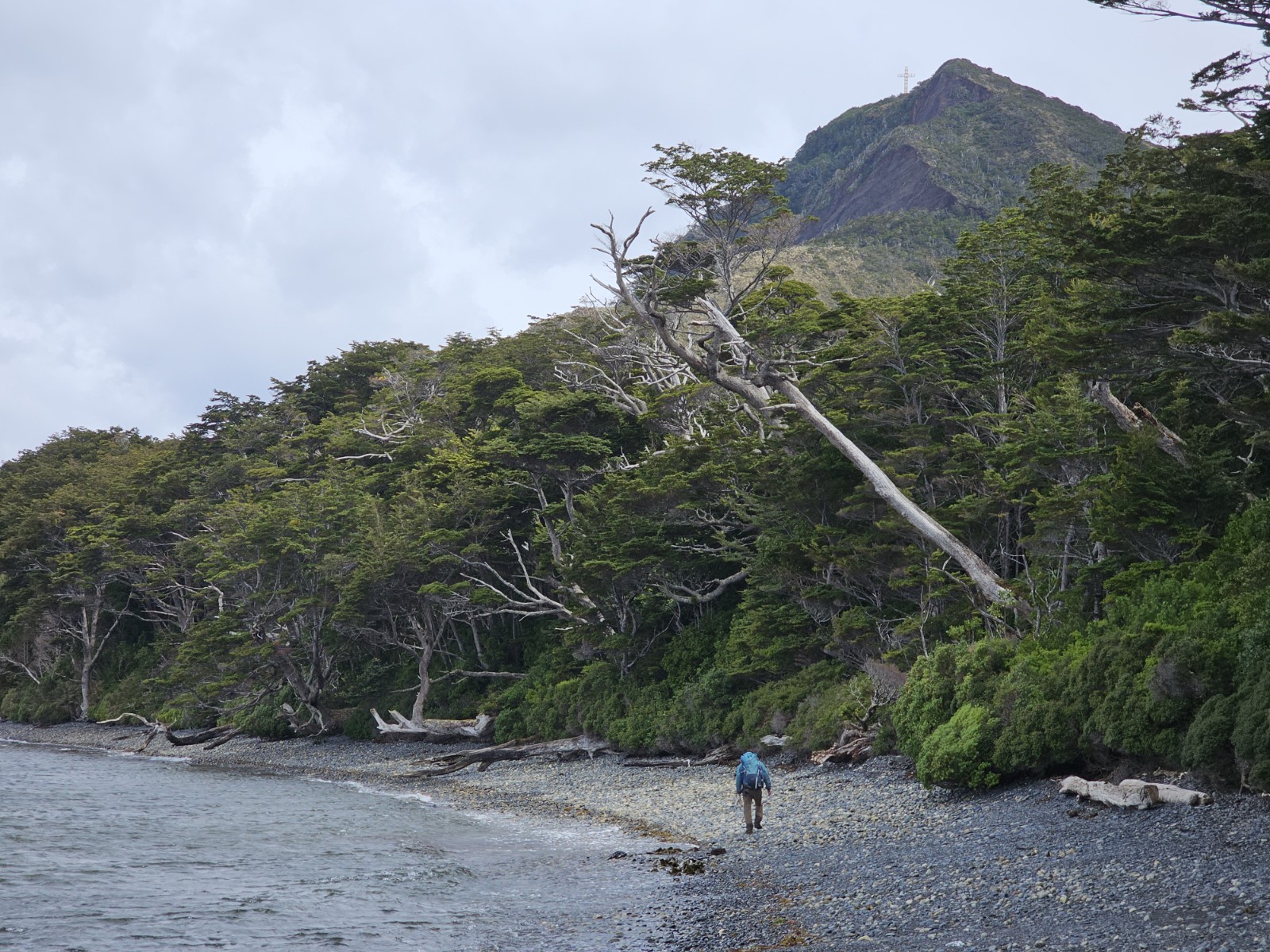
020. Rarely the shoreline was a clear shingle beach to make good time on.
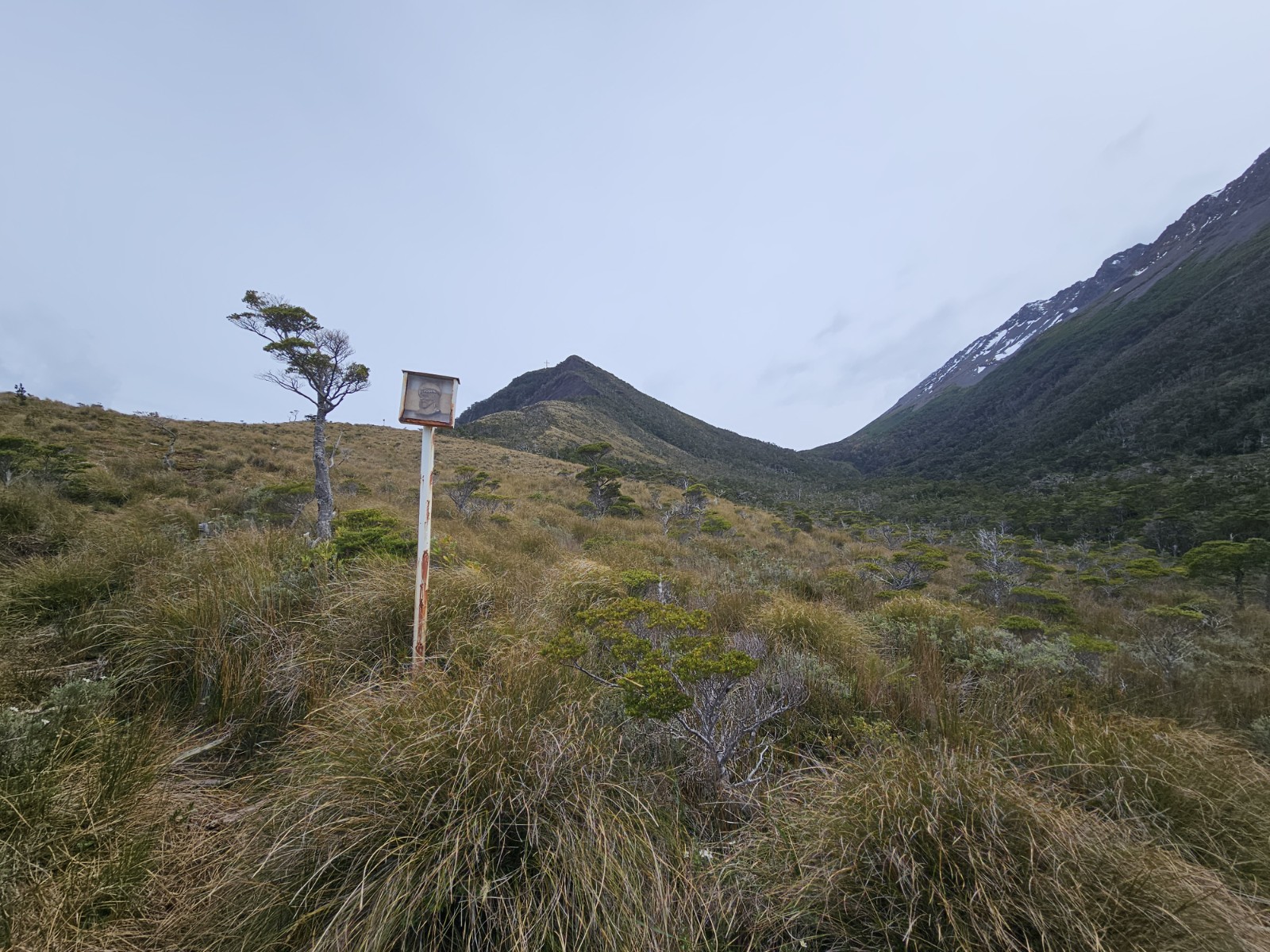
021. The near 400 metre climb from the beach to the cross at the cape was across grassland and through smaller trees. Due to a papal visit there were the 12 apostles marking the way across the otherwise barren hillside.
It was much higher than I thought to the cross and the going was steady but sustained. The path was in disrepair but must have been good once. I think about 40 years ago Pope Jean Paul made it up here to the cross for a sermon and the path must have been made for him. It had motifs of the 12 apostles in small boxes evenly spaced as we climbed. It was in total contrast to the otherwise wild scenery with deep wooded valleys and the jagged peaks. To the south and east were great empty islands with nothing but glaciers and icefields between the mountains. On and on the path climbed nearly 400 metres to the huge cross. The vegetation changed as we climbed from the coigue forests to scrub on the grassy hillside.
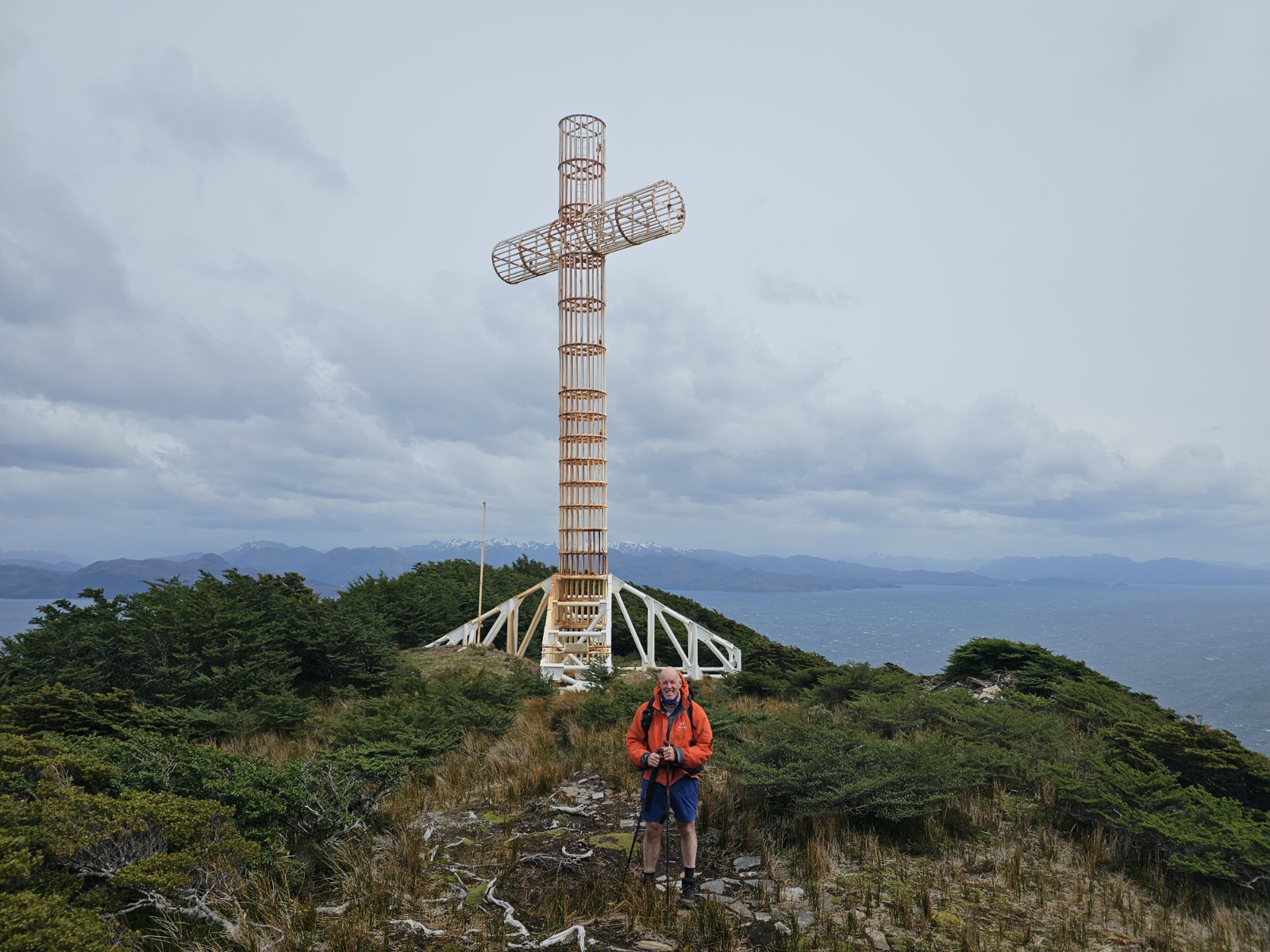
022. Up at the cross which was essentially the start of my journey northwards. The cross was swaying in the wind as many bolts on one ring had sheared.
At last we rounded a corner and there was the huge cross just 100 metres away. I commanded a great view over the Straits of Magellan below. Across the straits were the very very remote islands where nobody goes except rare fishermen. To the west and the pacific great headlands rose from the waterway like sentinels. It was very spectacular. We lingered here for half an hour and noticed how the wind would soon topple the cross. It was swaying in the wind and then we noticed some of the bolts on the lower ring had sheared and there was a gap of up to 2 cm between rings when the wind blew. the other bolts will soon shear and as this is one of the windiest places in the world I doubt the cross will last another year unless new bolts are inserted to hold the rings together.
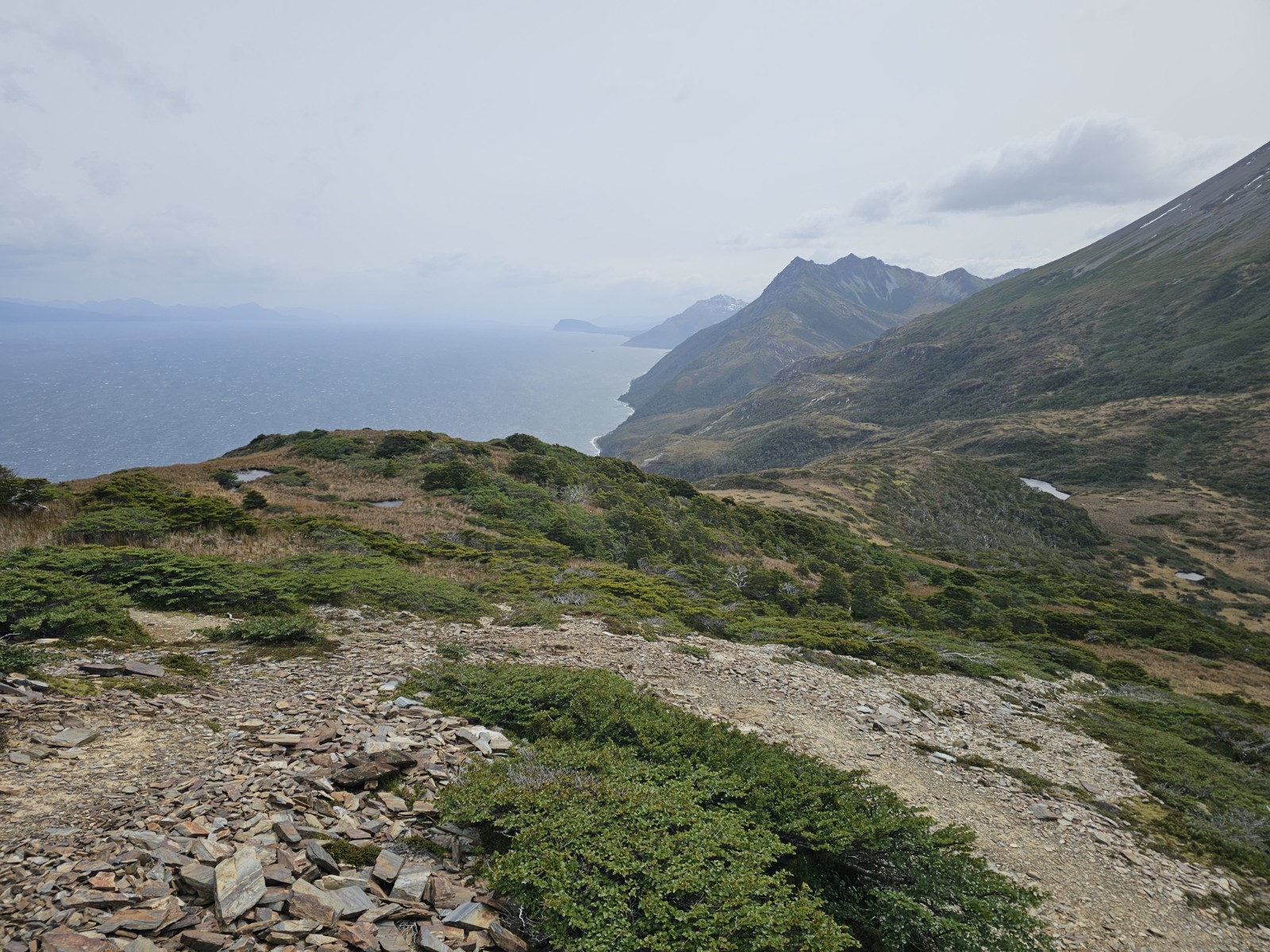
023. Looking from the cross north up the Pacific side with a wild seldom visited remote landscape which is soon to be a national park.
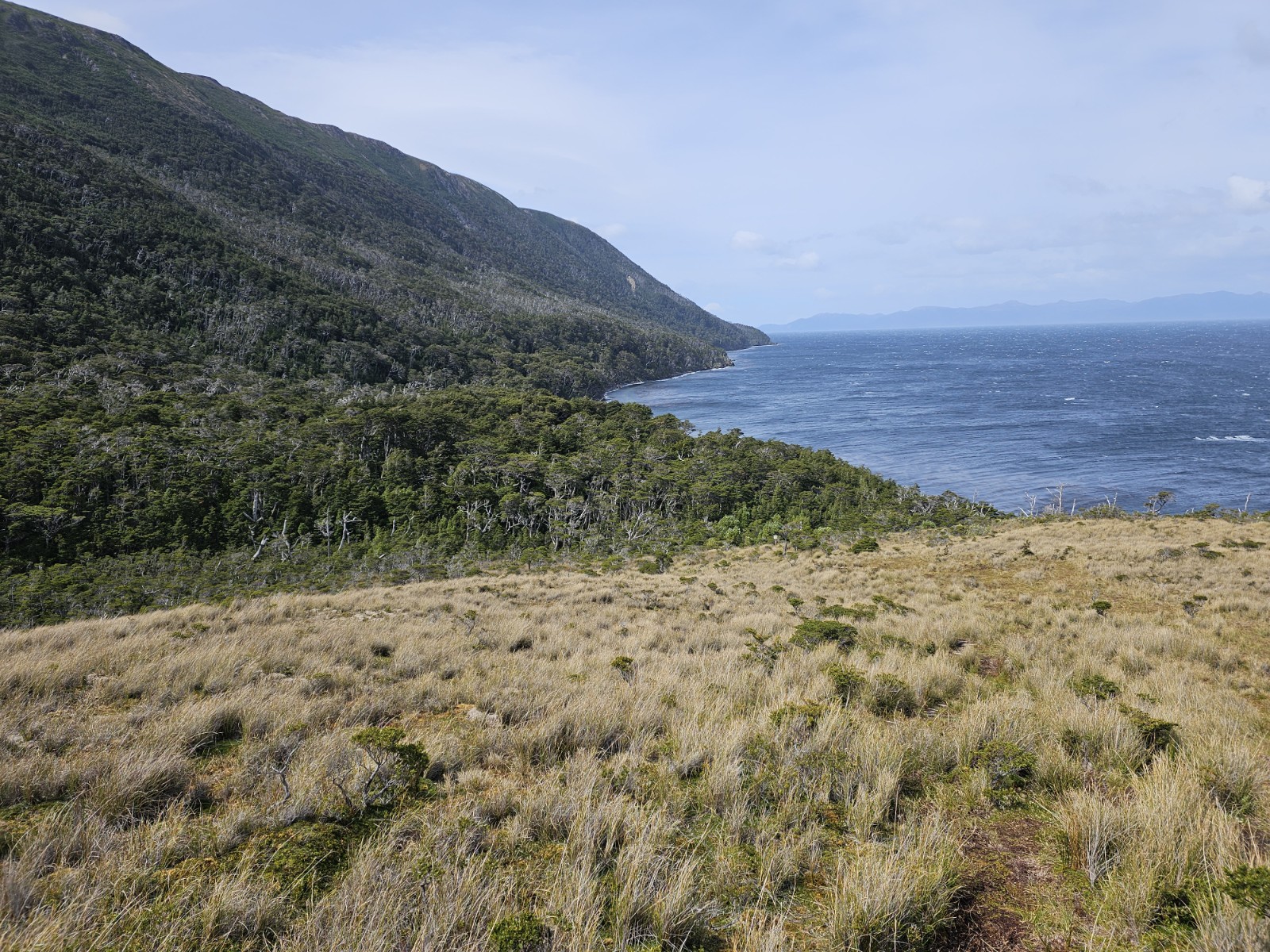
024. Looking from the cross back up the Atlantic side and the shore line we had to edge our way along back up to Rio Nodales well beyond the headland.
We retraced our footsteps for the 10 km to reach our camp at Rio Nodales. The return journey was even tougher as the tide was higher and it forced us higher on the shoreline and we had to go under or over hundreds of large trees which was very time consuming and tiring. We also had to clamber over the spur again where the small cliffs went directly into the sea and the shore vanished. The clamber over this spur involved descending some knotted ropes down a small 8 metre, almost sheer rockface. We were so thankful we were just doing it with day packs having left the tents waiting for us at Rio Nodales. It took a good 4 hours to reach the Rio Nodales again and find to our delight the ebbing tide meant the water was relatively low now and it was just the flow of the river without the tide swollen estuary we had to wade through and we only go wet to our knees.
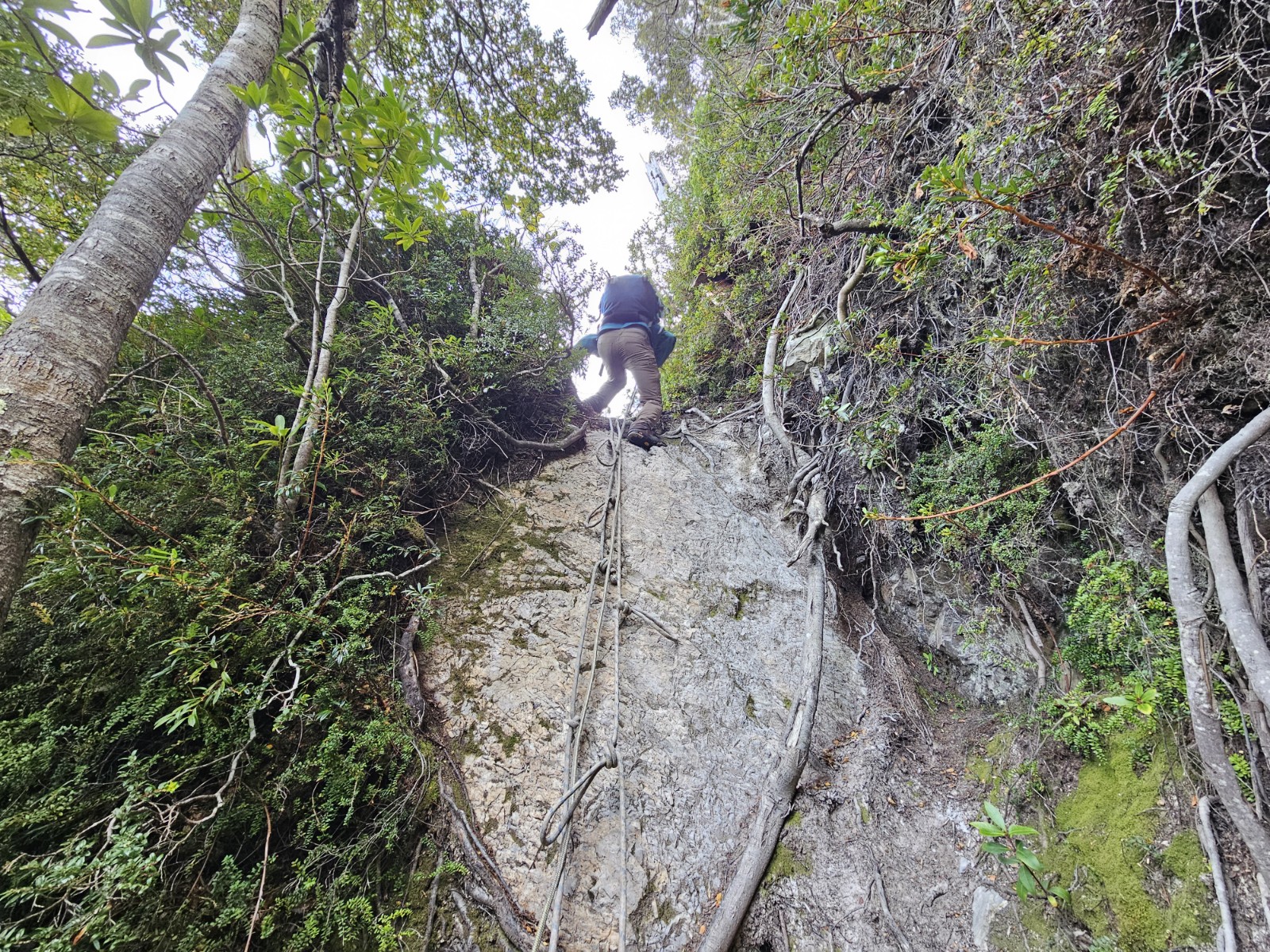
025. Descending a steep section on a detour round a cliff on the shore using a knotted rope to aid us down. There were about 3 such sections.
It was great having the camp ready for us and we quickly changed and got the dinner on. I had pasta and Javier made pizzas again. He made an extra one for me which was delicious. I had been very lucky to randomly meet up with Javier. He was easy going, bright and good company with a wealth of local and natural information gleaned from a decade working as a guide. I would have been wary about some of the river crossings or beach sections on my own but having him there too gave me confidence to tackle them. I think he felt the same. It was a nice evening as the wind dropped and the sun shone for a while but it had none of the warmth of yesterday.
Day 004. 14 Nov 26. Rio Nodales to Rio Yumbel. 16 km. 220m up. 220m down. 6.5 hrs. We were up relatively early as we intended to leave at 0800 to catch the low tide at the Rio San Nicolas estuary at 1100. It was noticeably calm after the near constant gale of the last 3 days. We dropped onto the beach nearly immediately after leaving our sheltered camp and began to walk along its shingle surface. The forest was on one side and the mirror calm sea on the other. Javier said it would be a good day to spot whales but we only saw dolphins.
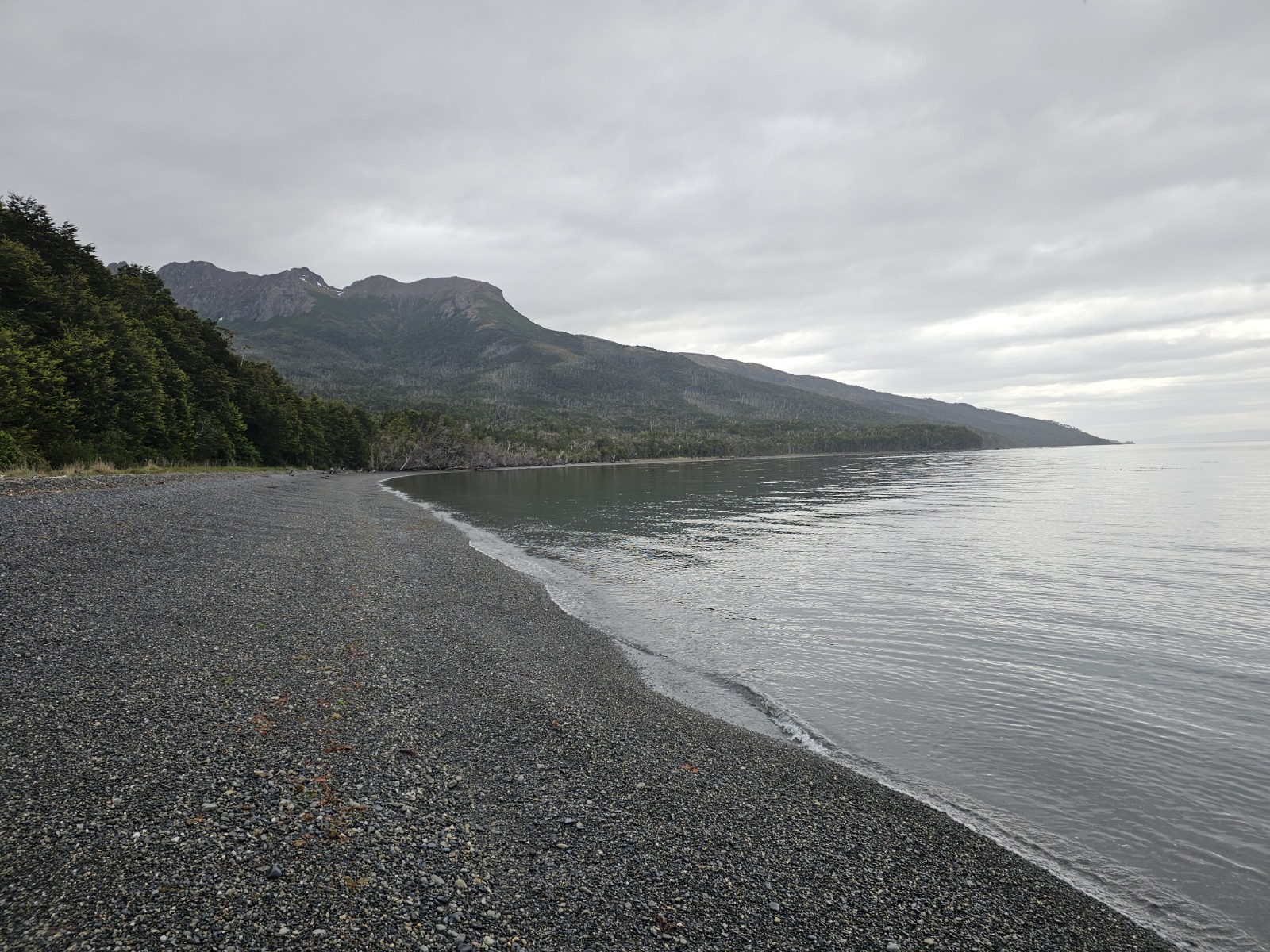
026. The long beach north of Rio Nodales was a joy to walk along.
It was an easy walk along about 5 km of easy beach shoreline and we made good time as we strode out across the shingle. Occasionally it was hard going where the shingle was loose but by and large down by the waters edge of the falling tide the shingle was small enough and wet enough to be firm. We passed many pairs of geese and had the small dipper-like “torottes” bird follow in front of us looking for insects. We passed a pair of ducks which already had 2 ducklings and they all fled into the water from a small lagoon as we approached. All in all it took about 1.5 hours to do the 5 km.
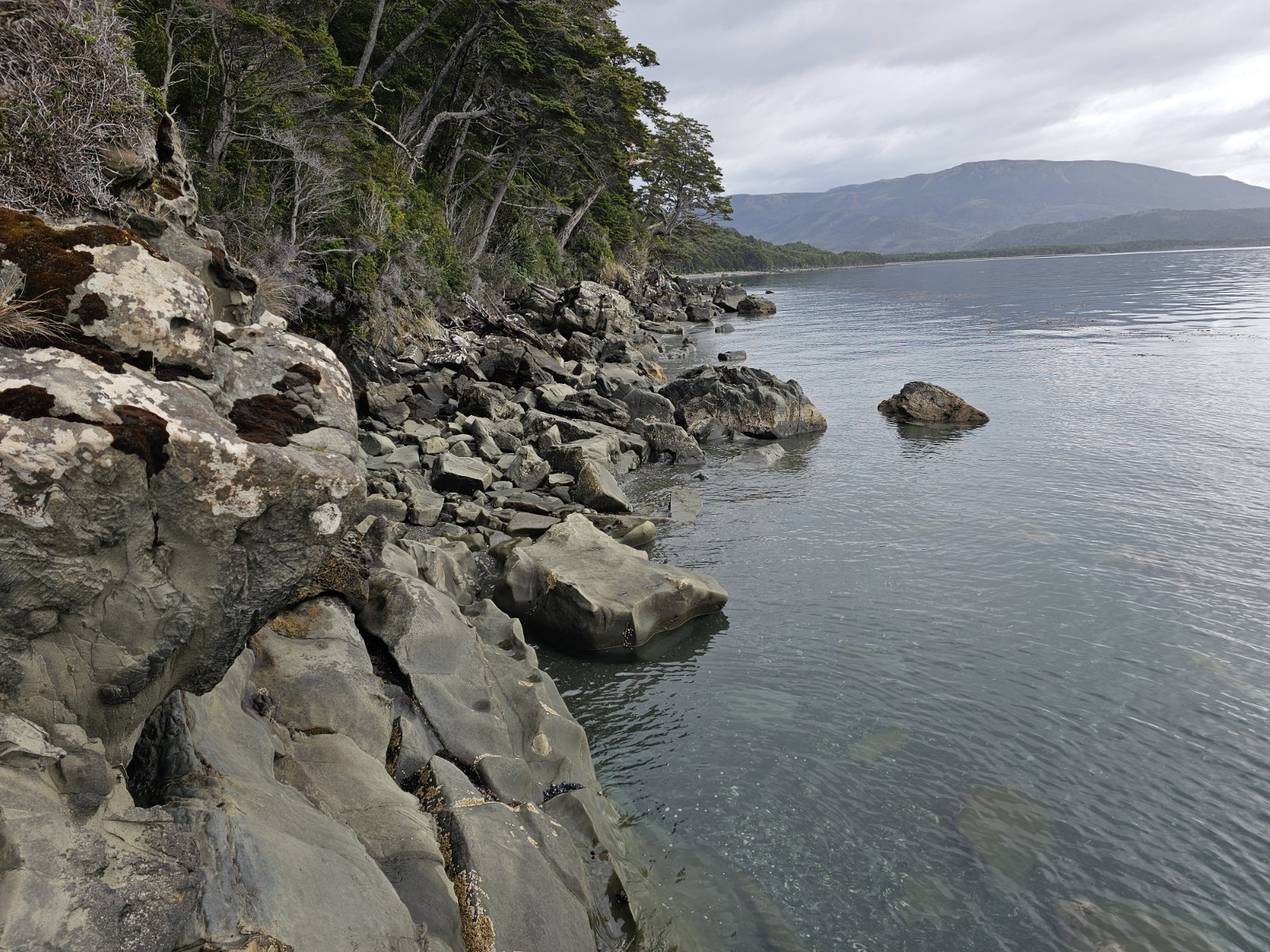
027. We missed the turnoff for the forest path and ended up on a very rocky shoreline which was slow going for 500 metres.
Just before Punta Glascott we were supposed to turn off the beach but we missed the ribbons marking the spot and continued on to the point with the shore line getting increasingly rocky with large boulders. By the time we realized our mistake it was too far to turn back so we persevered for about 500 metres of very difficult and tiring shoreline round the point and then north to reach the beach the forest detour would have taken us to. It was not a pleasant 500 metres and very slow and somewhat dangerous as the boulders were large and a slip likely. We were lucky it was low tide, as if anything but it would be even harder. It only took half an hour but that was undoubtedly slower than the forest detour.
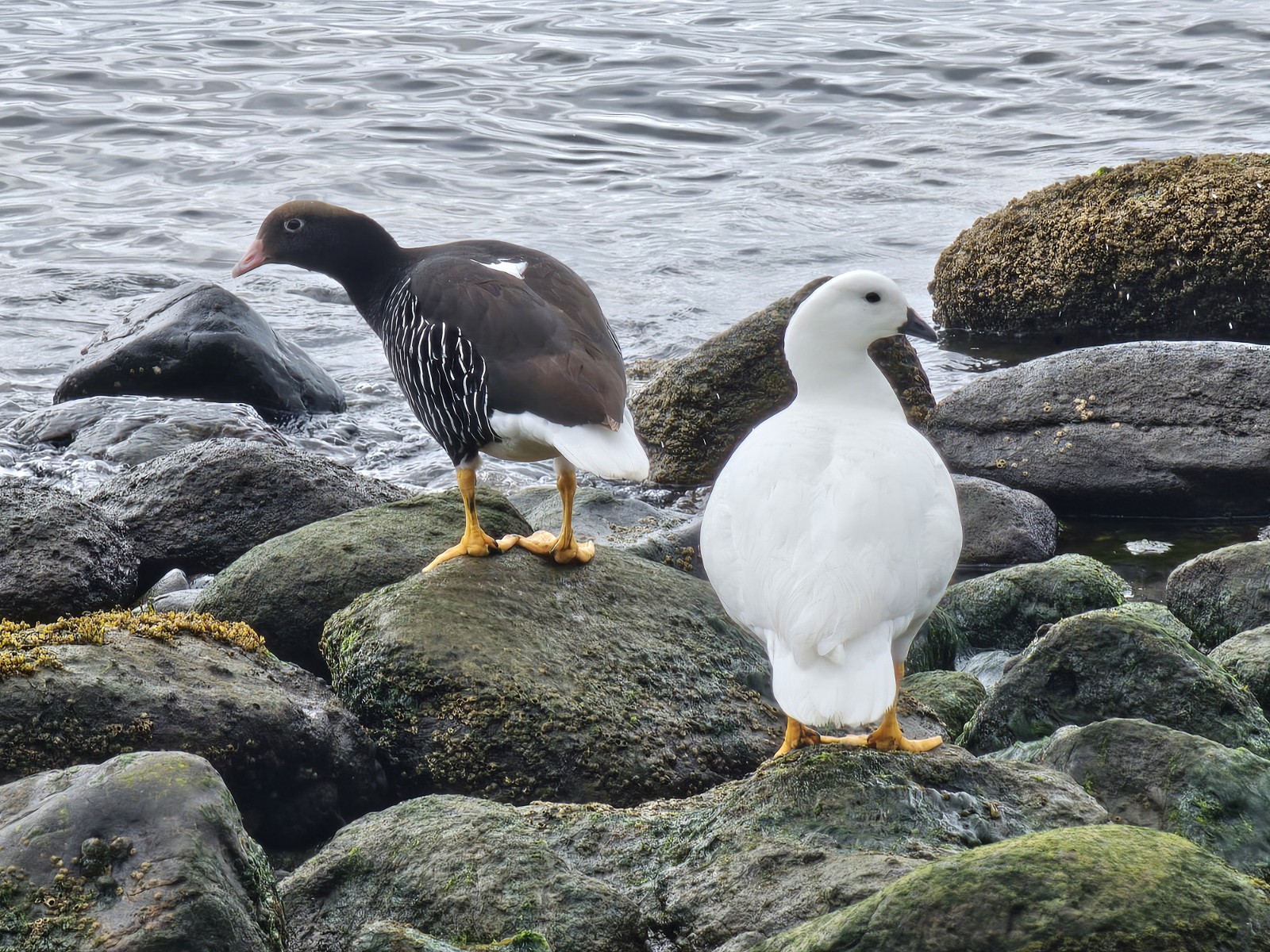
028. The iconic geese were plentiful along this coastline. I think the male is white but I am not sure of their name yet.
Once on the beach again it was a lovely walk in the occasional sunlight to round the curve of the bay to reach the estuary of Rio San Nicolas. The river above the estuary was a deep lagoon, dammed by gravel banks in the estuary. Previously when we crossed these were covered and we had to feel our way over but now the tide was 30 cm lower and there was a more obvious route further out. Javier went first and only went up to his waist so I followed without holding my rucksack aloft as I did previously. If we arrived here and the tide was high we would have to wait or swim.
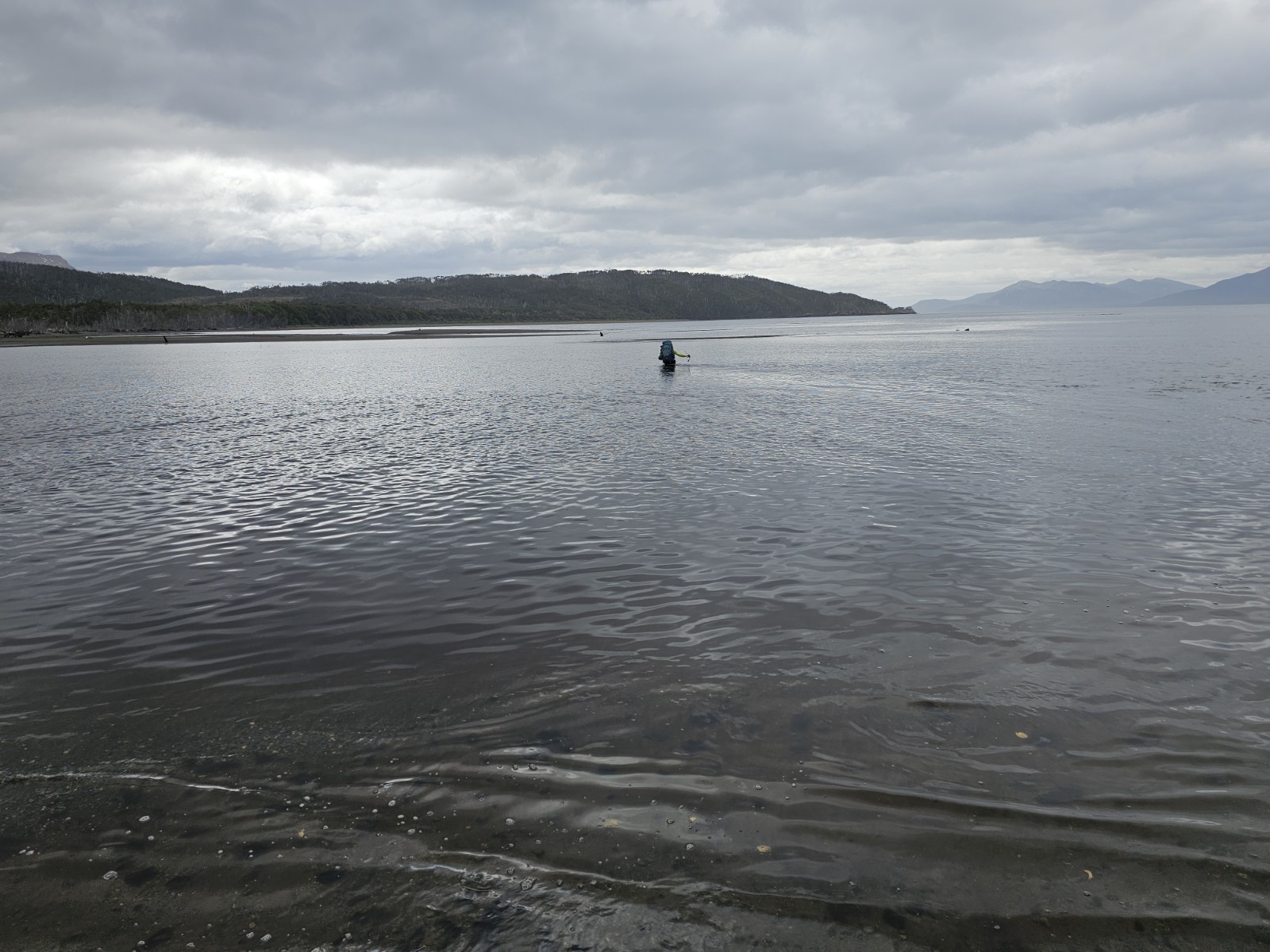
029. Javier leading the way across the Rio San Nicolas estuary at pretty much low tide. It was a good 30 cm lower than 3 days ago, and warmer too.
Once over the river we had a good kilometer of easy beach before we turned off to avoid a large headland and stopped at a campsite in the shoreline trees for a snack as we had been going for 3 hours. Here I noticed some flowers and Javier was wildly enthusiastic about them saying they were dog orchids but were unusually early.
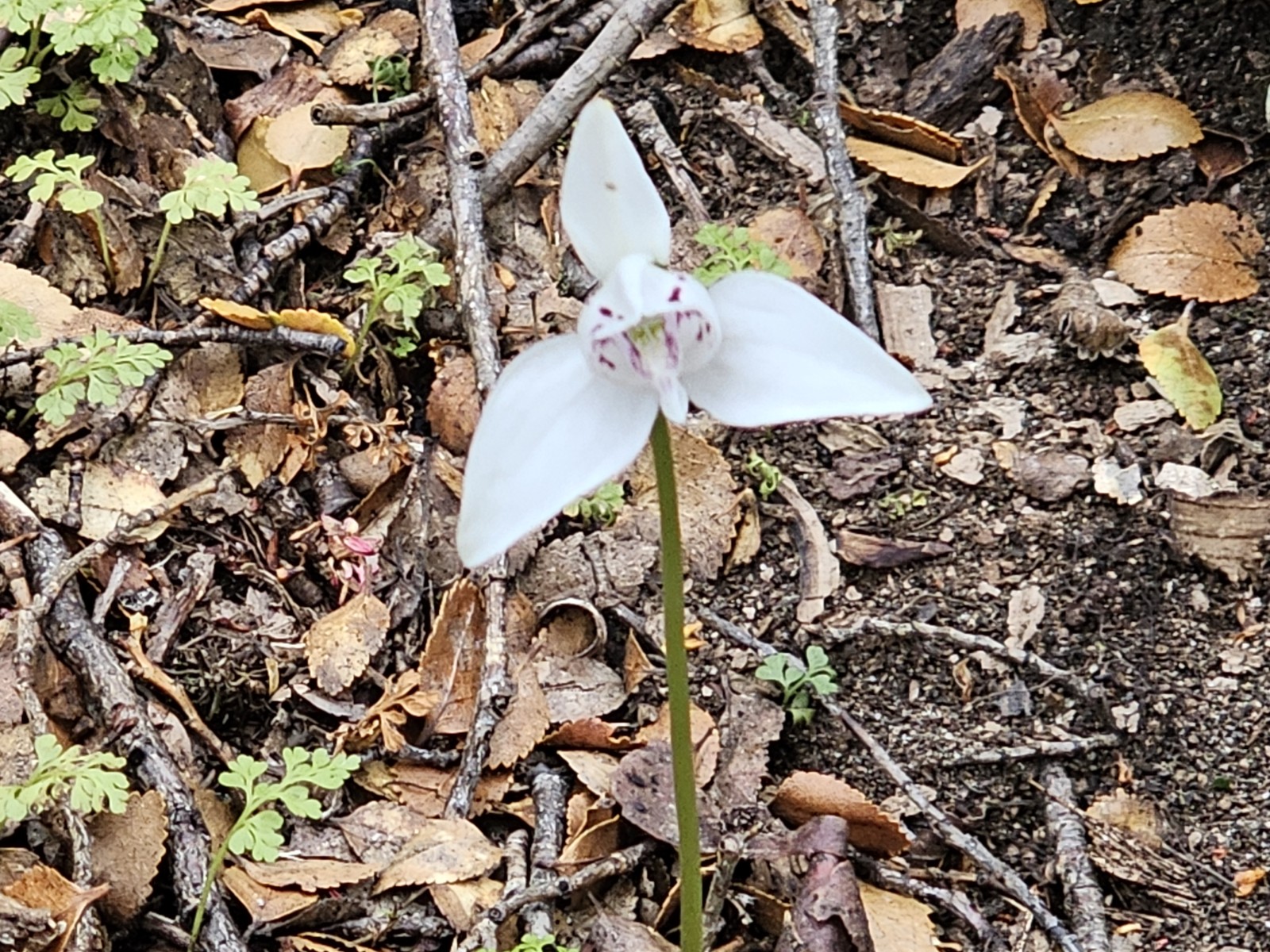
030. The dog orchids by the south end of the turba crossing.
After lunch we started to cross the “turba” , a 3 kilometre stretch of sphagnum bog. The path rose slowly across the soft soggy ground where the main trees were small cyprusses. It was easier than it sounds and it took us just an hour to cross over the bogland and make our way down to larger nothofagus trees and the beach on the other side.
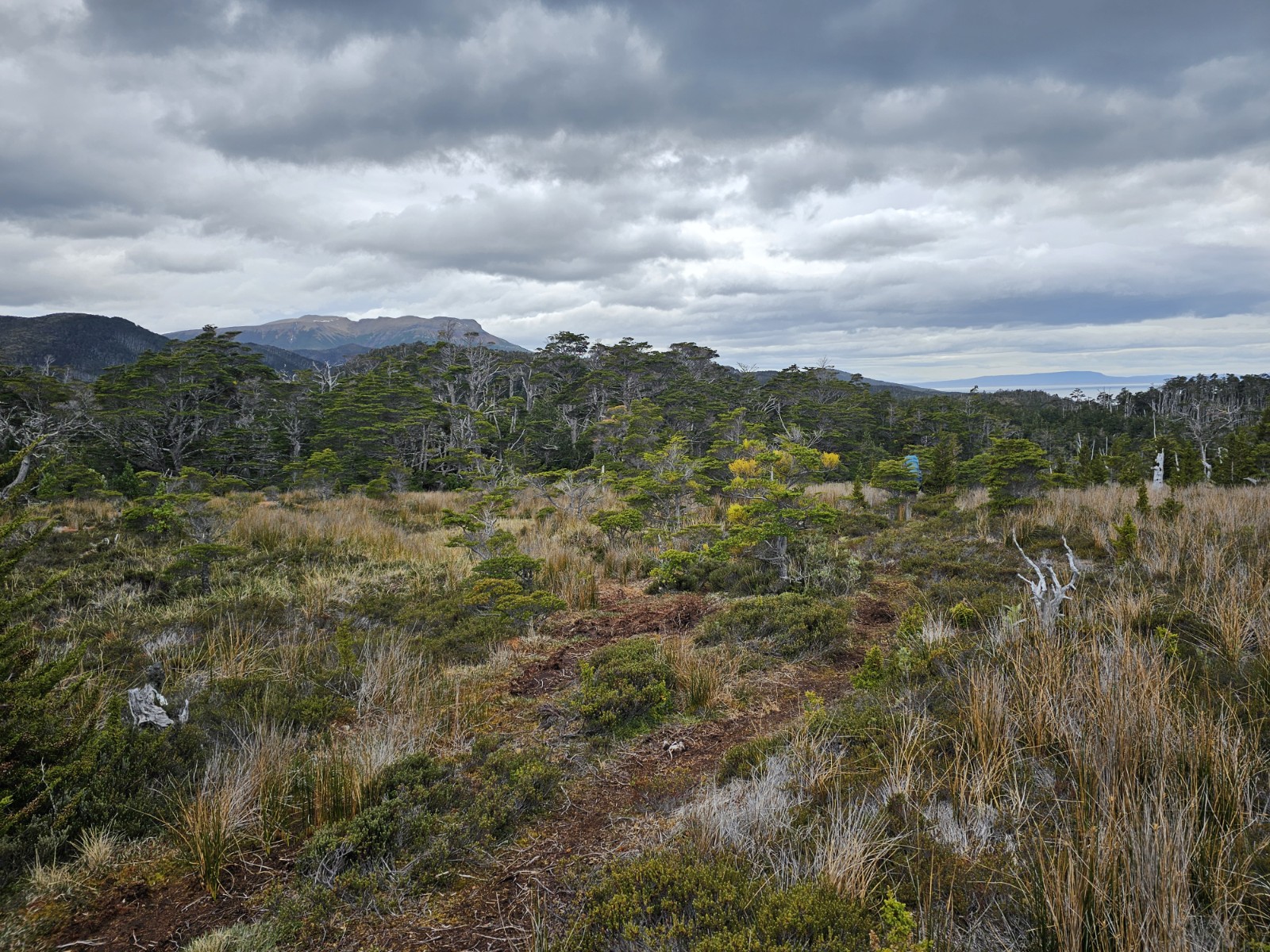
031. The turba with its soft soggy base and a scattering of small cypress trees
With the end in sight I got new wind in my sails and we strode off along the beach passing many geese and some ducks. We had such momentum we did not notice the ribbons on the trees and sail past onto a rocky headland again. However this time we turned back as it was just 200 metres and found the path. It was not like the paths further south but much wider and more used and the climb of 50 metres was soon over and we descended comfortably to the final beach. We could now see it curve round top the Rio Yumbel estuary under 2 km away. It was a leisurely plod to get there passing a forested island which had a shingle tombolo over to it at low tide, which was just getting covered as we passed by the rising tide. At the Rio Yumbel we went up stream to the log jam across the river. After carefully negotiating it, balancing on top of the jumble of trees we reached the other side and the camp soon after. We chose the same campspots as 3 nights ago and did not go and investigate the derelict puesta cabin.
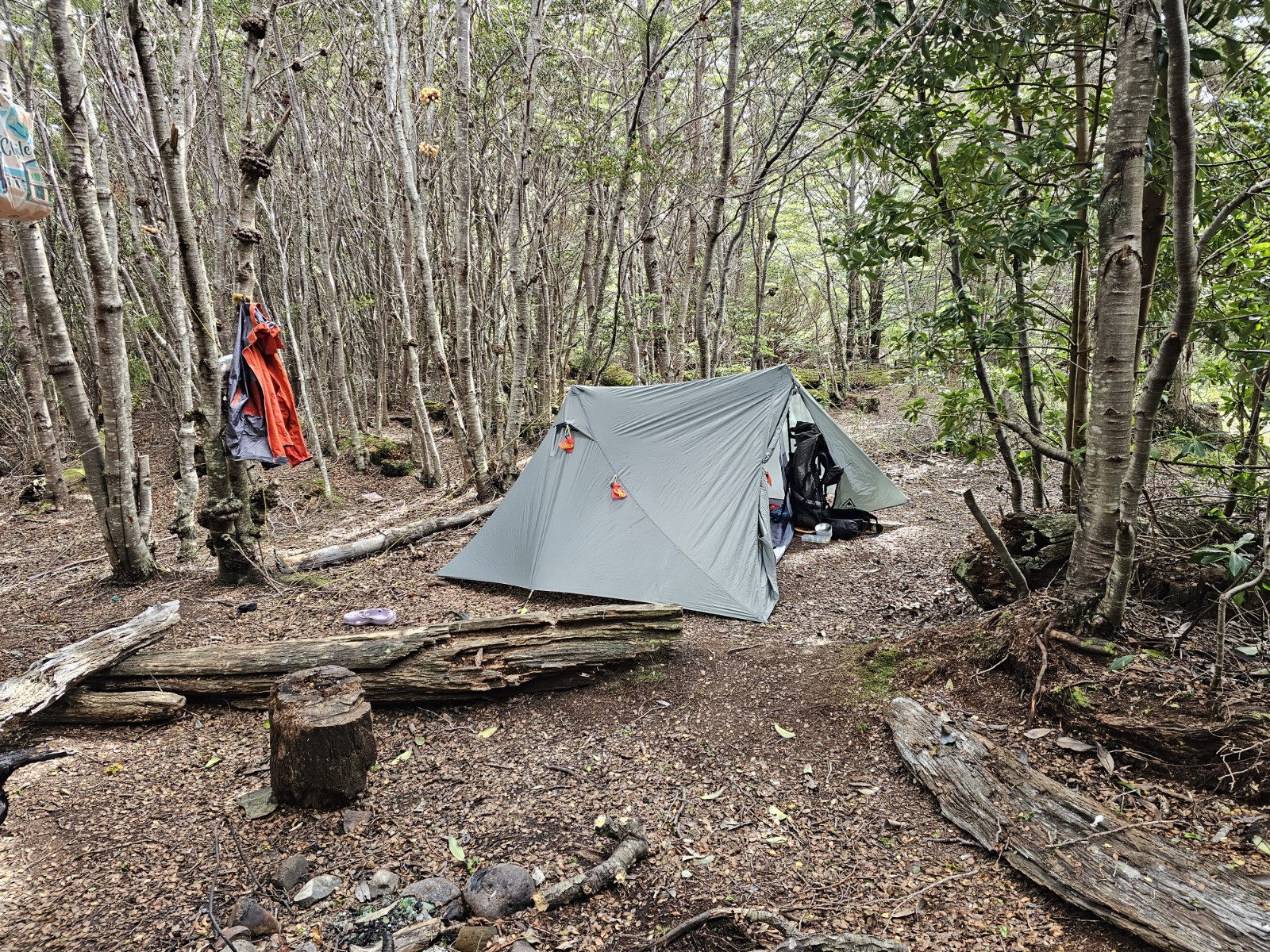
032. Our campsite, sheltered among the smaller coigue trees was lovely and exactly where we stayed after the first day.
It was just 1500 but by the time camp was set up it was 1600 and then we ate at 1700. With the long evening we lit a small campfire as the evening was dry and windstill and sat round the fire chatting for a couple of hours until I disappeared at 1900 to go and write the blog in my sleeping bag. Javier remained by the fire reading. He was an avid reader with a hungry mind. As I wrote there was a rising crescendo from the small islet in the bay as the returning sea lions jostled for their spaces. It had been an easy pleasant day and just what was needed after the rigours of yesterday.
Day 005. 15 Nov 26. Rio Yumbel to Rio de San Juan. 26 km. 210m up. 210m down. 9.5 hrs. We were up early at 0630. It had been light for a while and the chorus of bellowing sea lions was loud. We each had a quick breakfast and then set off at 0800. Javier had arranged to meet Oscar at 1300 at the end of the road and that gave us just 5 hours. The weather was overcast but still and in south Patagonia you would take that if offered. As we left camp we walked by the abandoned puesto cabin which we learnt was lived in until 1993. The area around it was covered in imported lush green grass and raspberry canes, also an introduced species.
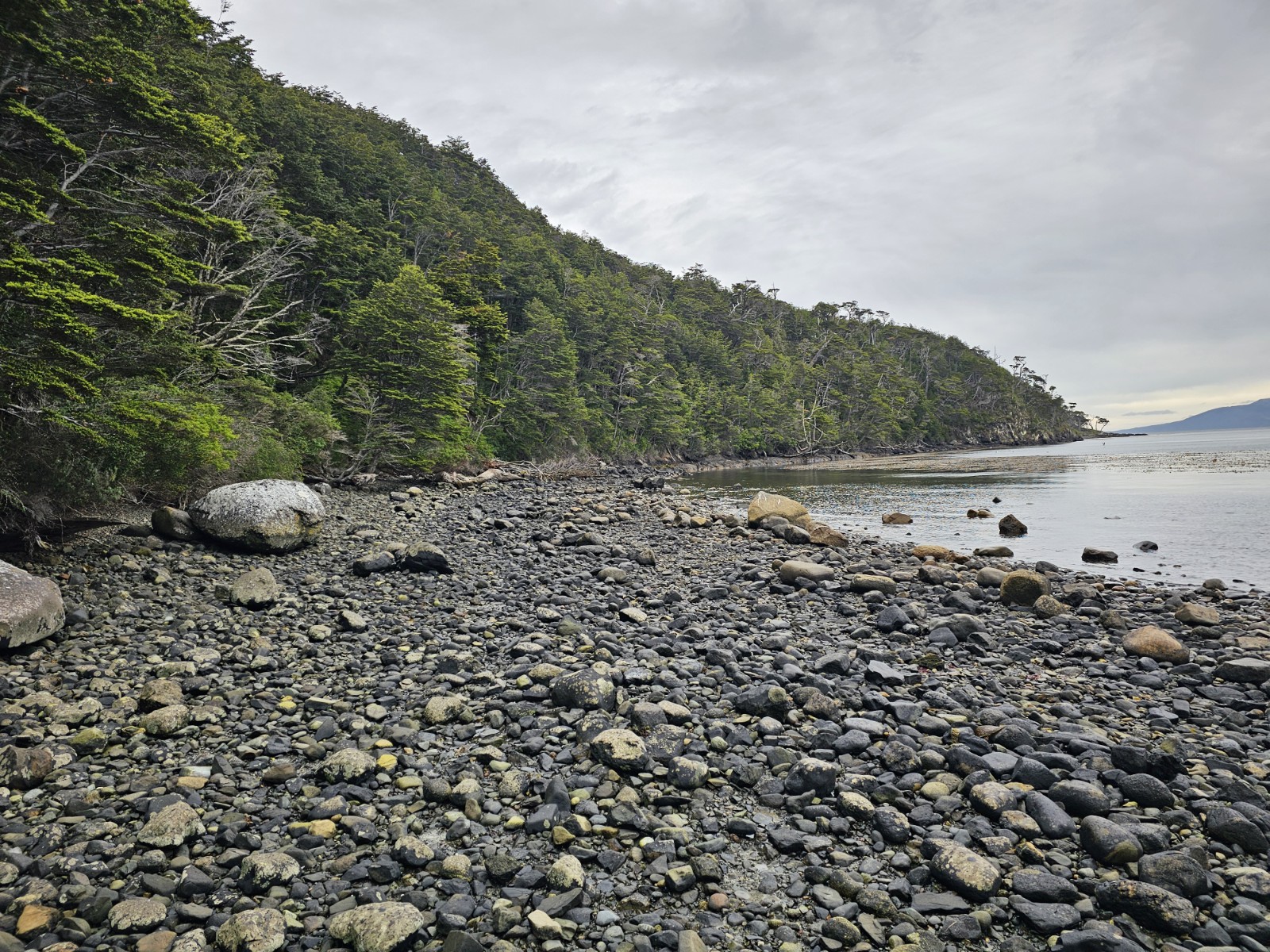
033. Leaving Rio Yumbel and the derelict puesto and heading north along the shingle beach.
We initially walked along the shingle beach trying to find the firmest stones, which were often near the water’s edge. I noticed at the two camps the coigue trees were covered in burrs caused by a fungus that grew on the branches but in this forest there was remarkably little of these small round orange growths which Javier said were edible. we made good time along the trouble free beach and passed a couple of rockier headlands before we reached the deep Bahai de Aguila just before the lighthouse of Faro de Isidro. On the north side of this bay the shoreline was quite craggy and impassable so the excellent path left the beach and cut a swathe through the forest for perhaps 500m before descending to the beach just at the lighthouse. There was none of the bushbashing we had on the forest paths near Cabo Froward. This was a much busier and more accessible hiking area and by the time we reached the lighthouse we had already passed some 30 day hikers.
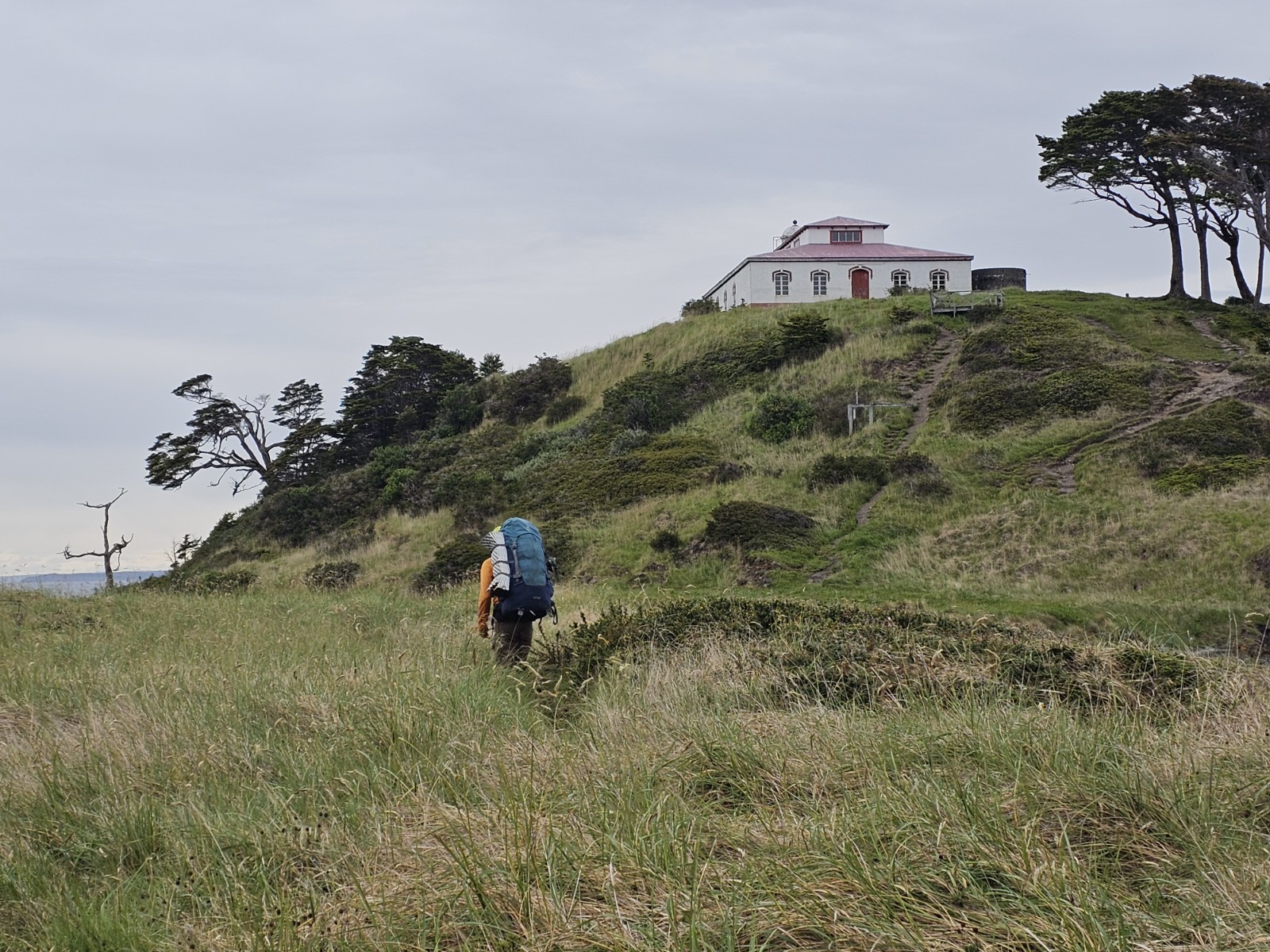
034. Approaching the lighthouse of Faro San Isidro again on its knoll on the Straits of Magellan
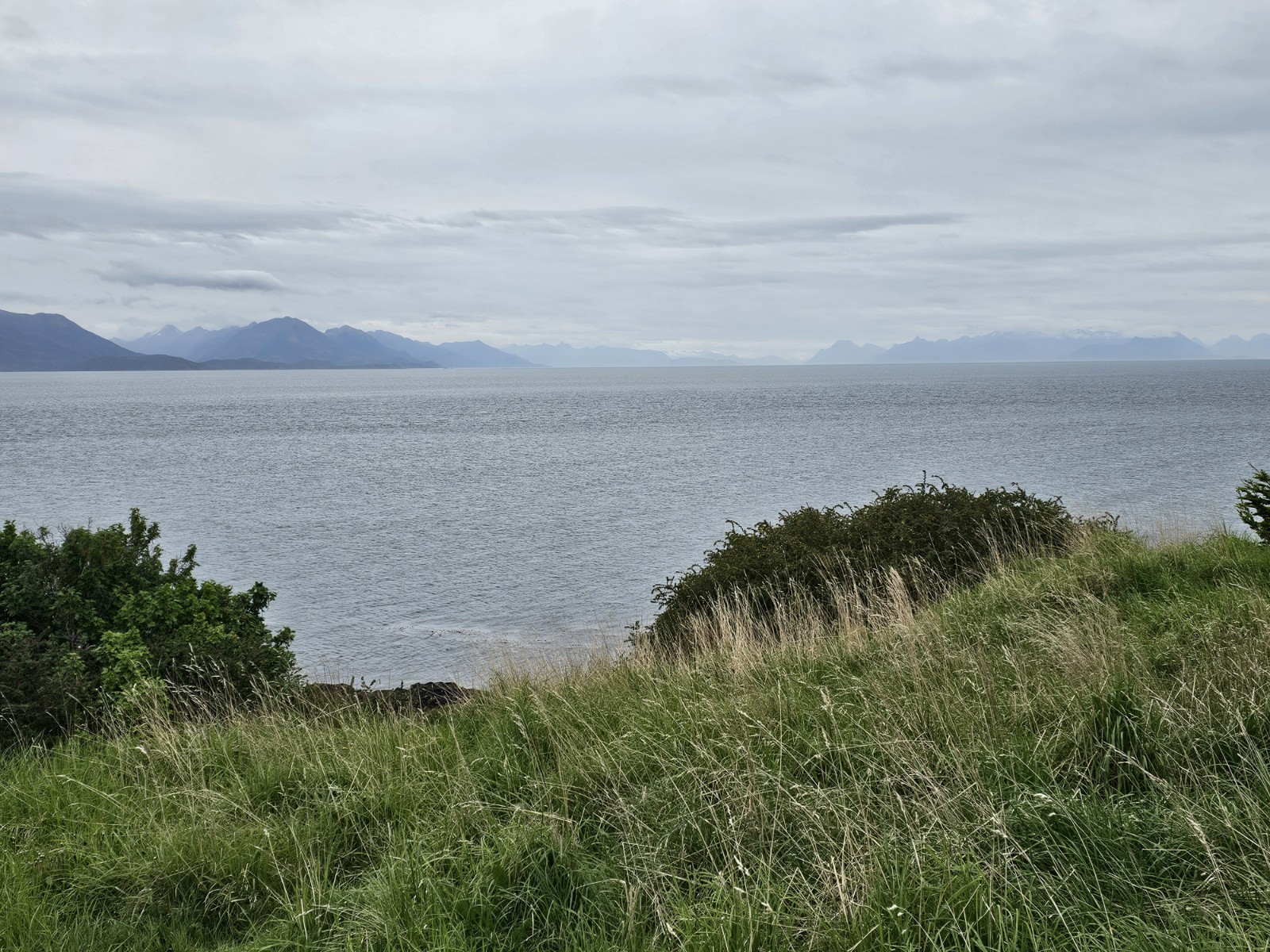
035. Looking across the Straits Magellan to the jagged archipelago to the SE.
Despite having been to the lighthouse before we decided to go up again. The last time 4 days ago the weather was foul and the views were poor. This time we peered into the windows again and could see the whale skeleton and also the replica native tribal canoes. The indigenous peoples who were here before were certainly admirable sea farers and hard as nails to survive in these harsh climes. From the lighthouse we could look south and SE towards an array of mountainous islands and wondered how they could cross these channels in their craft when the wind can just appear without warning and be up to 40 knots within 15 minutes. We had good time before meeting Oscar and lingered a bit here taking in the view and looking up the 6 km relative benign shoreline we still had to do.
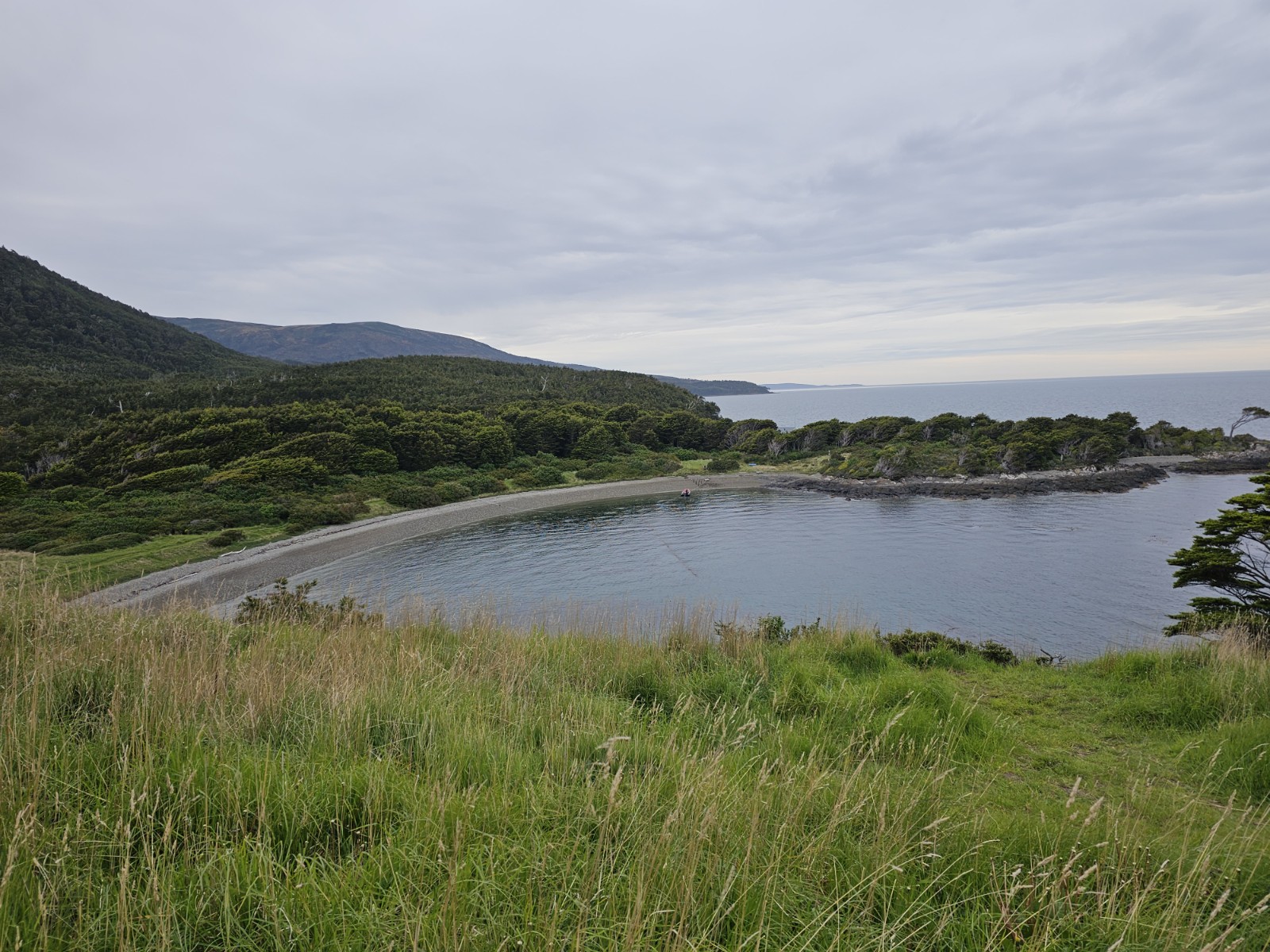
036. Looking north from the Faro San Isidro lighthouse up the coast to Punta Arbol and the road.
The last section was busy and we must have passed another 50 people who were heading to the lighthouse as a day trip. Everyone was good natured and friendly and always extended a short greeting and sometimes a chat. It was a Sunday and many people were out on an extended walk. The beach shingle here was especially loose and it crunched under our feet as we sunk in a few centimetres with each step. Virtually everyone turned round to see our large rucksacks and I am sure none were envious. We made it to the car park with ½ an hour to spare and were entertained by a large red fox which knew it could get a titbit or two from the hikers. It was quite confident and you could easily see how the first canines were domesticated.
Oscar arrived soon afterwards and came with sandwiches which was very thoughtful of him. I said my goodbyes to Javier with whom I got on very well. He was exactly the sort of well-brought up, well-educated, bright young man every parent would love their daughter to bring home. We had got on really well and I would consider him a friend for life. They headed off in Oscar’s car while I shouldered my pack and headed north on the dirt track.
The track was quite busy with returning day trippers in their cars and also tourists who were just driving to the end of the road. Some had come far and there were a few European number plates. I soon noticed that at virtually every parking place beside the road there was a Chilean family camping, with tables, chairs and a fire. I think most were from Punta Arenas and had been here for the whole weekend. It had a holiday vibe here on the Magellan Straits Riviera!
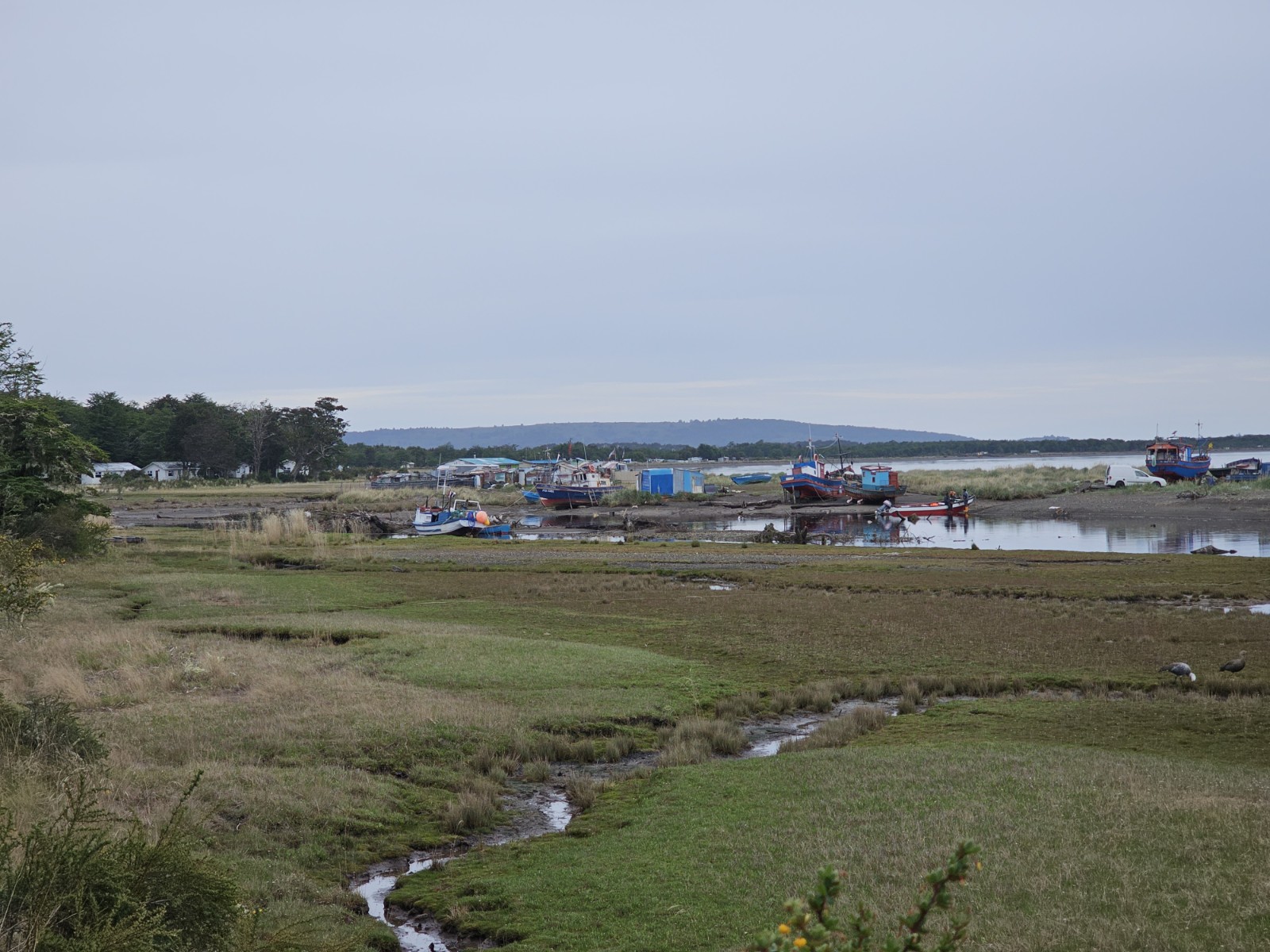
037. The small harbour in the estuary of Rio Santa Maria
After an hour I passed the Rio San Pedro over a bridge and then an hour later reached Rio San Pedro. There was a small community here and a large hall owned by the Indian Kawésqar community. Down by the mouth of the river was a small harbour in the estuary with about 5 fishing boats moored up in it. Beyond were some small white well kept houses which I assumed belonged to the fishermen. It was a hamlet really but after the 5 days of Cabo Froward hiking it felt like a metropolis. At the end of the hamlet I enquired about camping at a homestead which had camping written above it but I think it had closed and was directed further north.
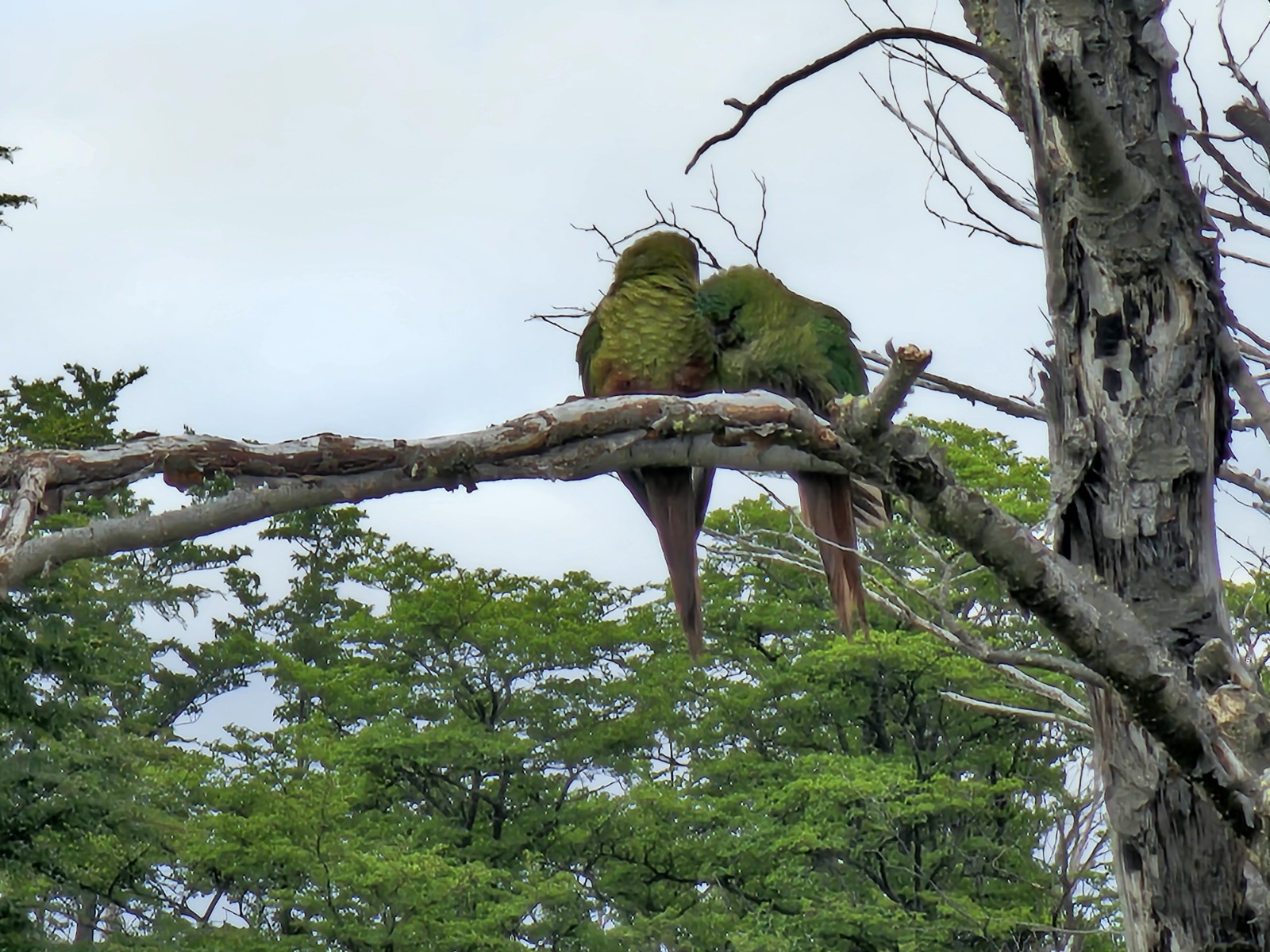
038. Parakeets in a dead tree. They were quite abundant
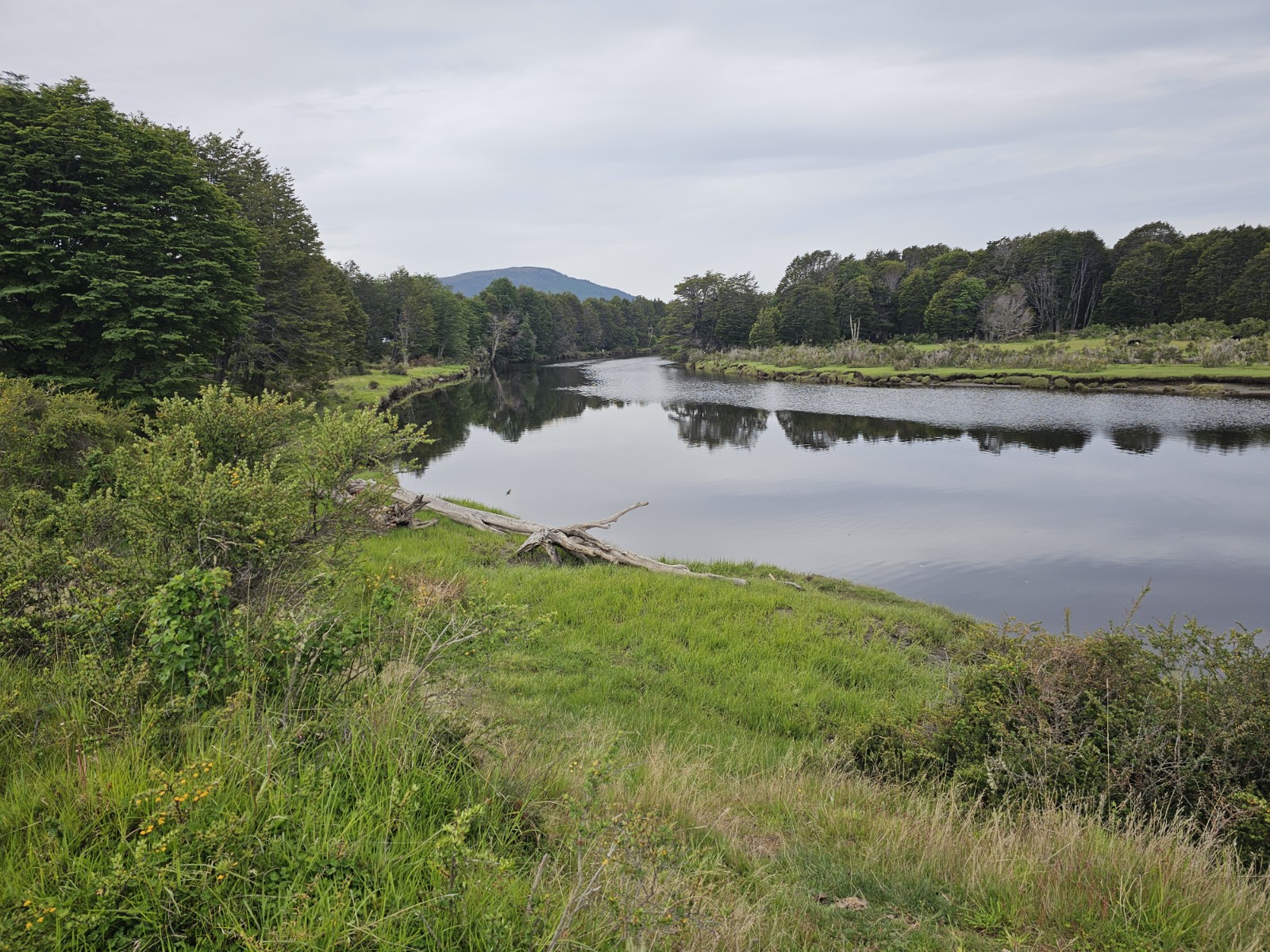
039. The large Rio San Juan gave a few meanders as it passed through the hamlet of the same name.
It was a barren 4 km between Rio Santa Maria and Rio San Juan as the road veered inland away from the beaches and into low scrubby forest. I saw a large number of parakeets here which surprised me as I thought it was too cold for them. As I approached Rio San Juan there were a lot of car campers again and all waved as I went past. There was an enviable smell coming from their barbecues. The dirt now followed the river past a number of meanders until just before the bridge I reached a compound with cabins. They were all for a workers cooperative, however the warden said in 200m on the right was camping Natybos. I found it immediately before the bridge and the Columbian lady who ran the place did indeed have a cabin. It looked great on the outside but inside it was a bit rough and had not been cleaned out since the last people went. She quickly got it ready and lit the stove. It did not take long to warm up but there was no hot water in the cabin. It was in a separate shipping container and looked to be too much trouble to be worth it so I skipped the shower and enjoyed the stove as I wrote the blog. It was still light at 2200 when I finished and went to bed.
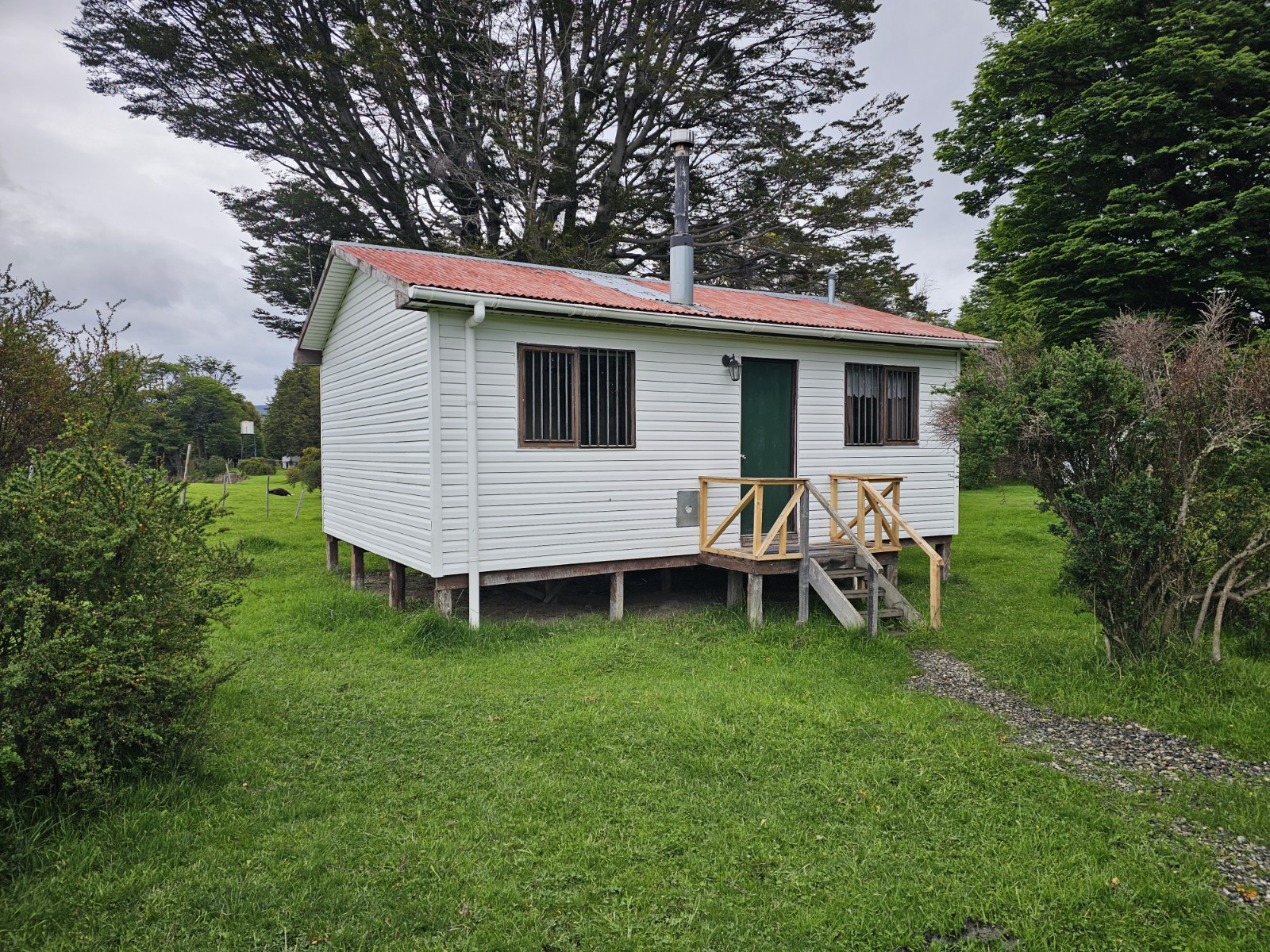
040. My cabin for the night. It had a wood burning stove, gas cooker, table and sink but no hot water.
Day 006. 16 Nov 26. Rio de San Juan to Rio Aqua Fresca. 32km. 260m up. 260m down. 10 hrs. I woke to bright sunshine coming through the windows and a large gaggle of geese grazing on the lawn outside. There must have been 50 of them and at least 2 of the 4 species. I had a large breakfast as I had too much food for the remaining journey to Punta Arenas. I paid Franny who ran the place and she came back with an apple. I set off at 0830 and ate the apple as I wandered over the bridge. There was much more cattle herding here now and some smaller estancias, but bigger than a homestead. Their cattle grazed behind barbed wire fences on the rolling grassland which was covered in thickets of scrub. The larger trees had long been removed to allow grass to grow. I passed one small estancia with a tall barn which must get battered in the storms. Its wooden walls were bleached by the sun. It stood at the end of a large paddock and looked out to sea.
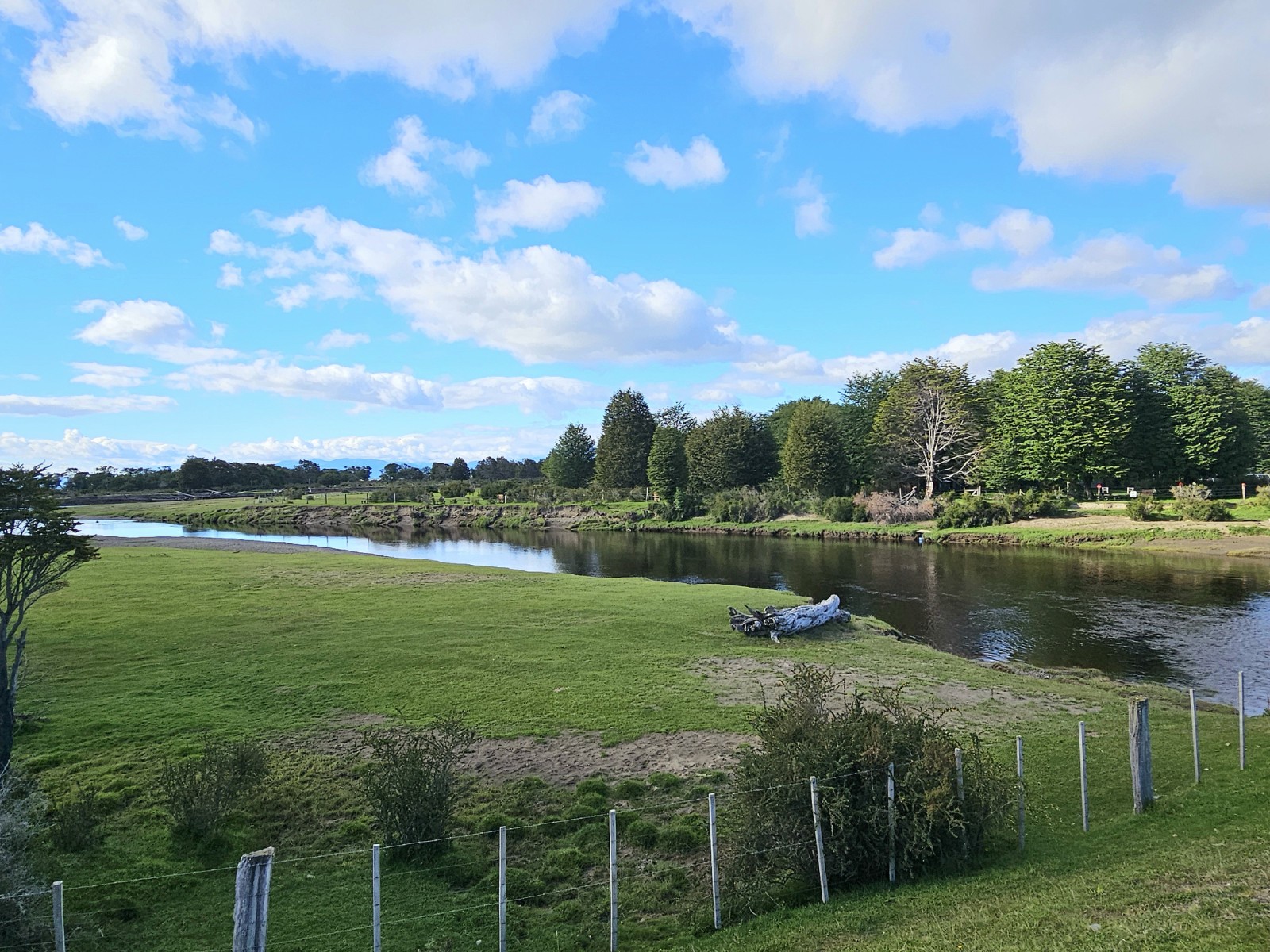
041. The Rio San Juan from the bridge and my cabin on the campsite in the geese filled field beyond.
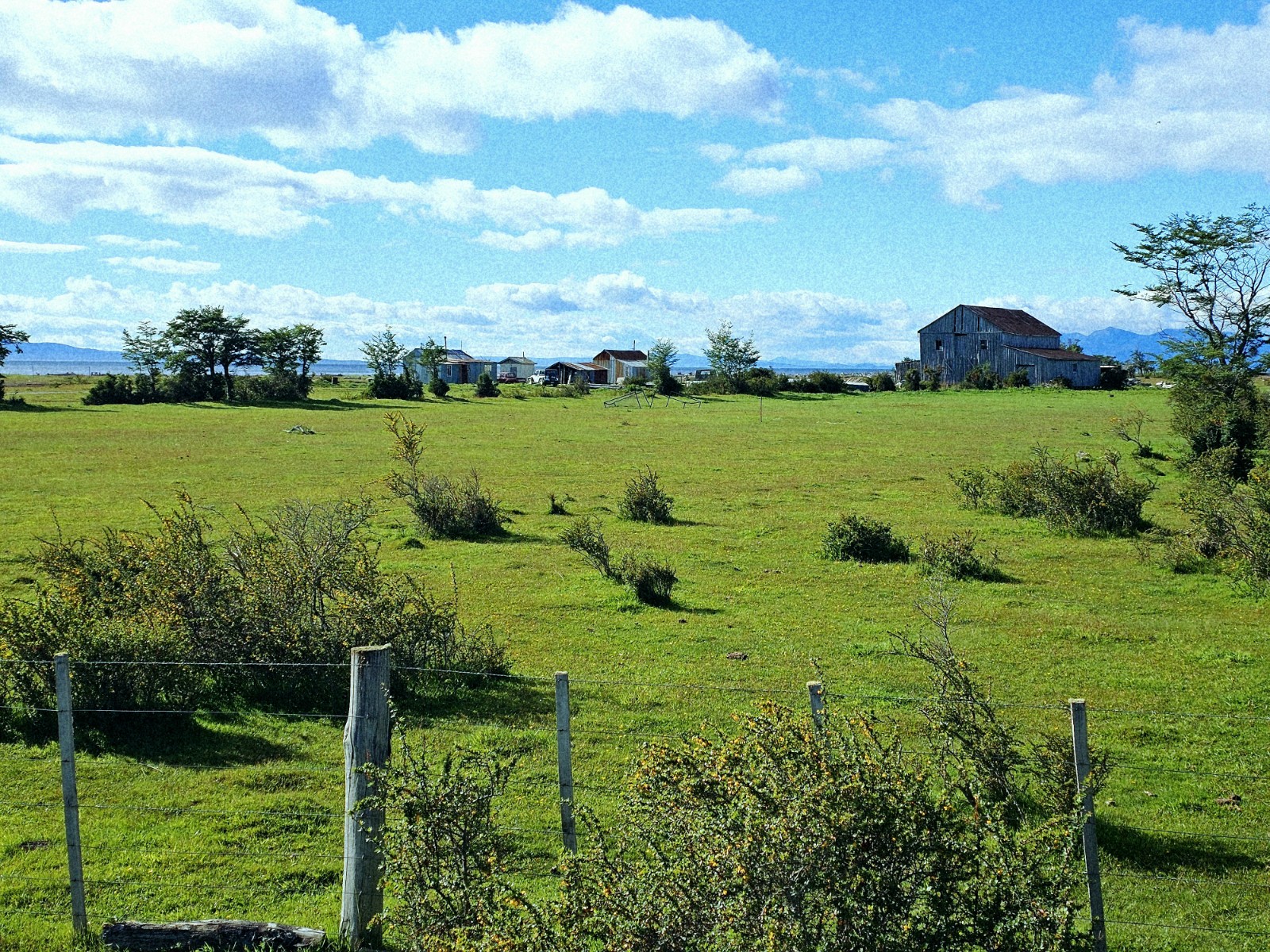
042. The farm by the shoreline with its old barn and wooden buildings. It had extensive grazing.
A little beyond I came to the “English Cemetery”. There were 10 graves in all. Nine were unmarked and I assume they were from crew members of the HMS Beagle who perished on the voyage. The tenth grave was well marked and was of Captain Stokes who was commander of the HMS Beagle but committed suicide when the ship was here with Darwin some 200 years ago. A little later there was a separate memorial to Admiral Philip King who made the first hydrographic surveys of the seas around Tierra del Fuego and the surrounding archipelagos which the Chilean Navy were very grateful for.
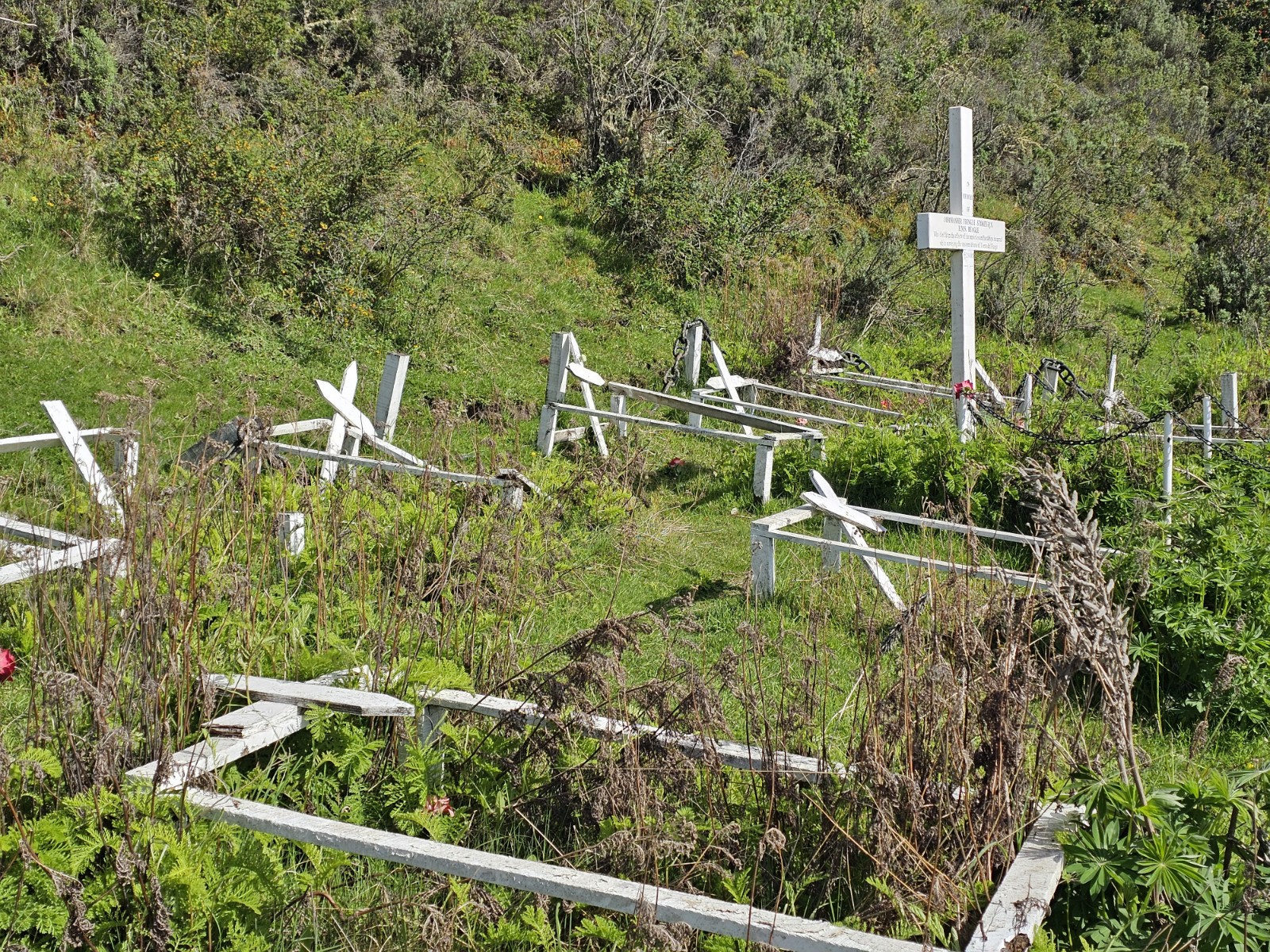
043. The English Cemetery with 9 unmarked graves and that of Captain Stokes.
The road was very quiet and there was perhaps one car every half hour now the weekend was over. It was largely just the geese and me with the occasional small herd of cattle in the scrub – which fled as I arrived. The weather was superb and for the first time on this trip I could take my woollen hat off and put on my cap and sunglasses. Soon I was also down to my shirt sleeves as I climbed up a gentle hill to a crest where I glanced over my shoulder to say goodbye to Monte Tarn and the remote southern tip of this Brunswick Peninsular. My focus was now on getting over the hill and down to a cafe which made infamous king crab and scallop empanadas, or pies. However as I feared, it was closed, no doubt resting after a busy weekend when it must have done the lion’s share of its trade.
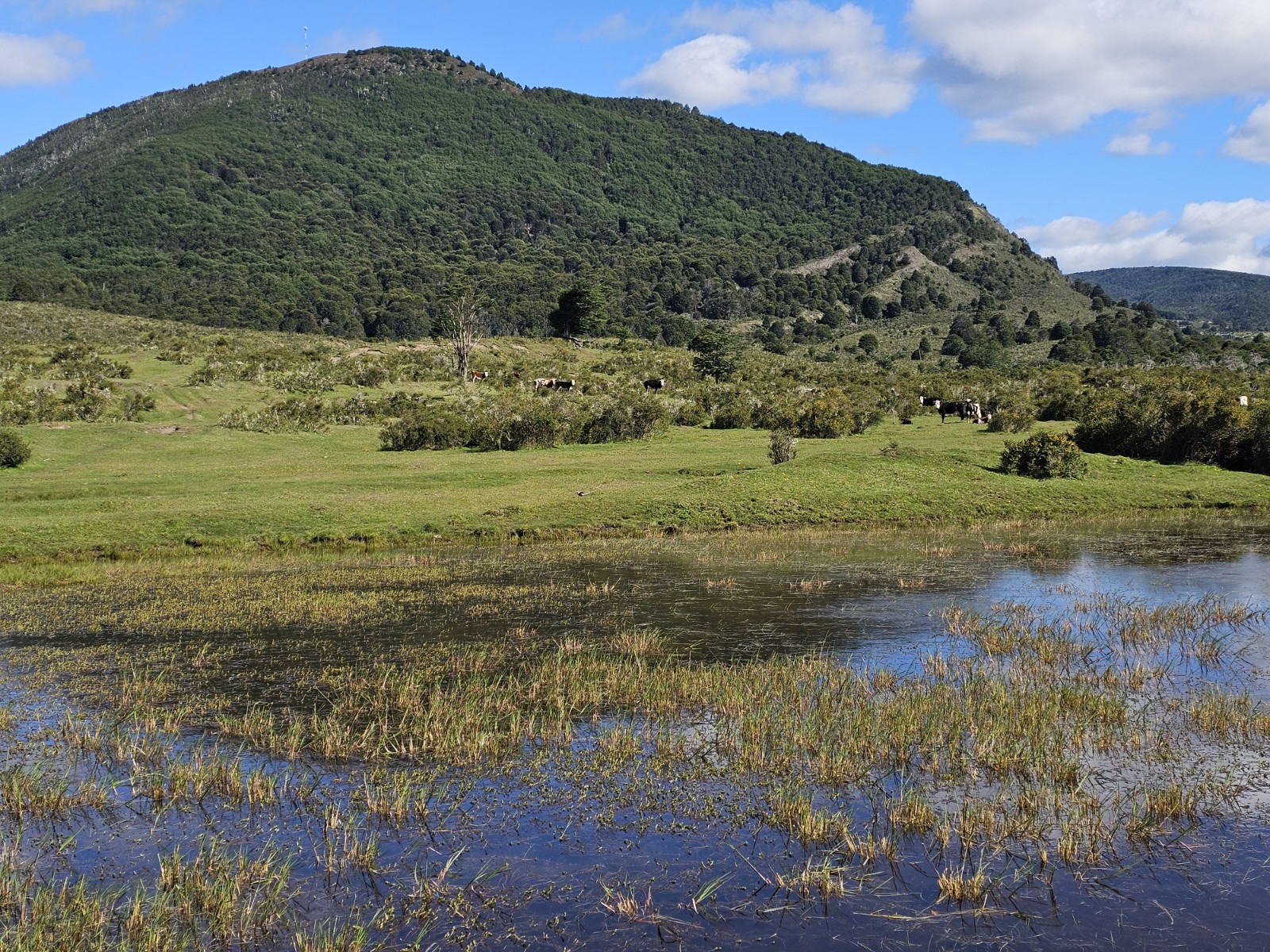
044. Some of the cleared farmland which belonged to the farm with the wooden barn.
A bit beyond there was a small hamlet and a shop at Bahai Carrera. It too was closed but I did meet Phillipe, a warden from an organisation called Rewilding Chile. They were involved as consultants in setting up the new National Park at Cabo Froward. I chatted to him for a good 20 minutes, He explained to me I had been wildly optimistic in recognizing the Colorado geese and when I showed him the photo he said they were the females of the common Upland Goose. So sorry for misleading readers in earlier posts. I could have gone to historic Fuerte Bulnes here but it was an extra 6 km in an already long day as Phillipe explained the next shop for lunch was 25 km to the north!
I set off towards this shop with no snacks or drink as I had been banking on a king crab empanada. It was a long stretch indeed along the road, which was paved now. To the east was the sea and to the west of the road was a scattering of old farms and rustic houses. I think all the farms were once homesteads with a small grazing around the house and extensive sparse grazing disappearing for miles into what was once forest but is now bush. These homesteads would also have had access to the sea to supplement their diet. They were not unlike a Scottish croft of the 20th century. Now the small-scale farming was largely abandoned and all the homesteads looked like they were leisure cabins probably owned by the children or even grandchildren of the original farmers. There were cart wheels adorning every fence and old farm machinery on display like an open air museum. Some of the cabins were quite scruffy and others looked cosy and delightful. There was no common building culture and it was an architectural free for all with some very eccentric constructions. Occasionally there was a cluster of shacks along the sea side of the road where space allowed and many of these were quite bohemian and small.
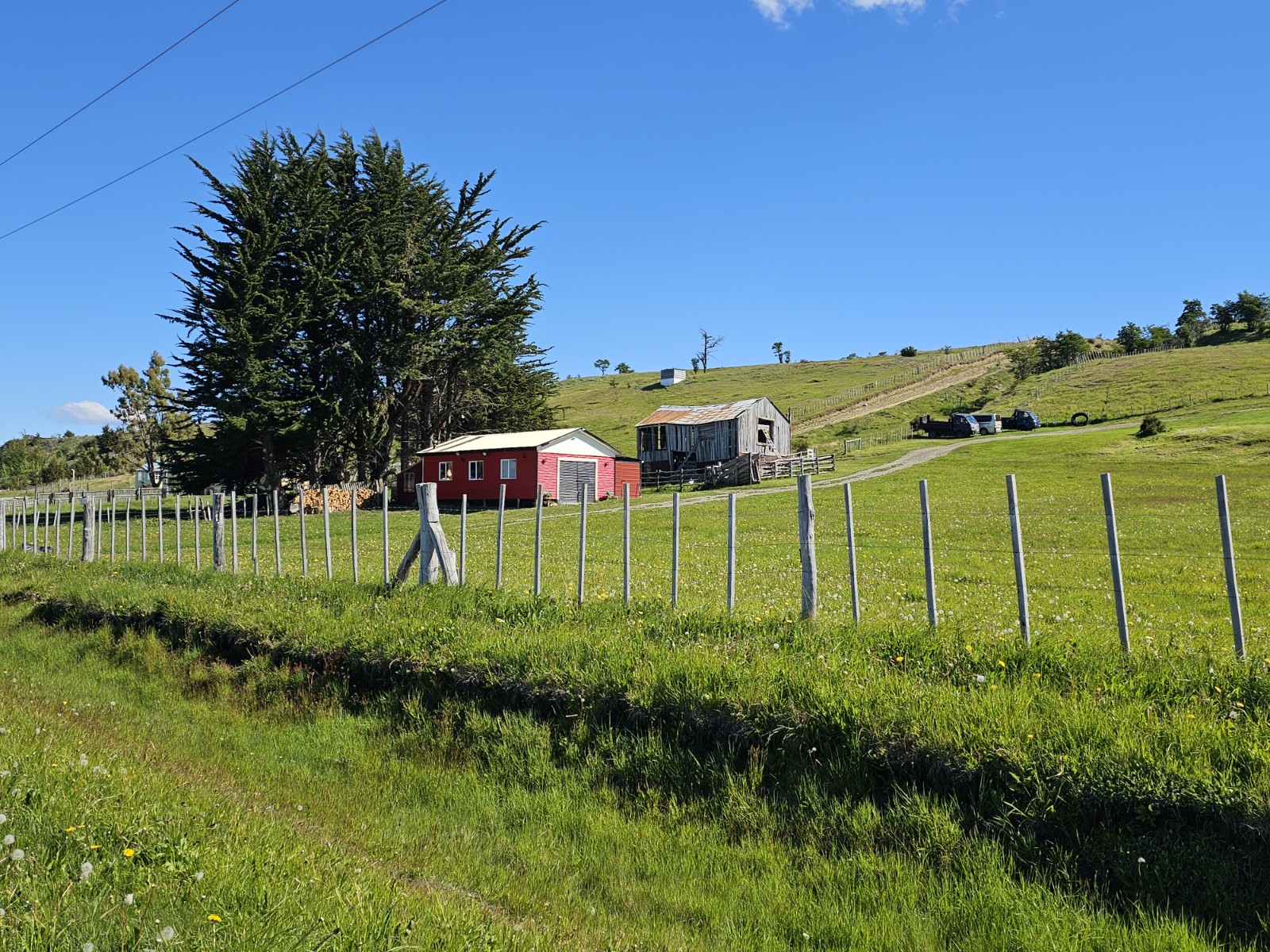
045. One of the many older homestead type farms which was now a leisure cabin – probably in the same family
On and on the road went. The cultural landscape kept me entertained otherwise it would have been long. About half way, I passed a family picnicking between the road and the sea. They beckoned me over and offered me water and then two hard boiled eggs and some bread and tomatoes. I chatted with them for about 5 minutes and told them my plans. They were very kind, but this generous and friendly trait is very common in Chile. Chileans are a very kind and thoughtful nation and I have always felt it on my 4 visits. I passed two lovely looking cafes which were both closed and then at last reached the shop I was aiming for at Rio Amarillo. It was 1630 and I was sure it would be open. I was relying on it for lunch and something to drink. However it was totally shut. I was disappointed but it looked like it had been shut all day. I rested by it to take stock. Looking at the map I saw there was another village in 6 km, and it had a hosteria. There was even a phone number. I gave it a try. At the other end an older Chilean lady understood enough of my garbled Spanish to offer me a room and a meal. I said I would be there in an hour and a half.
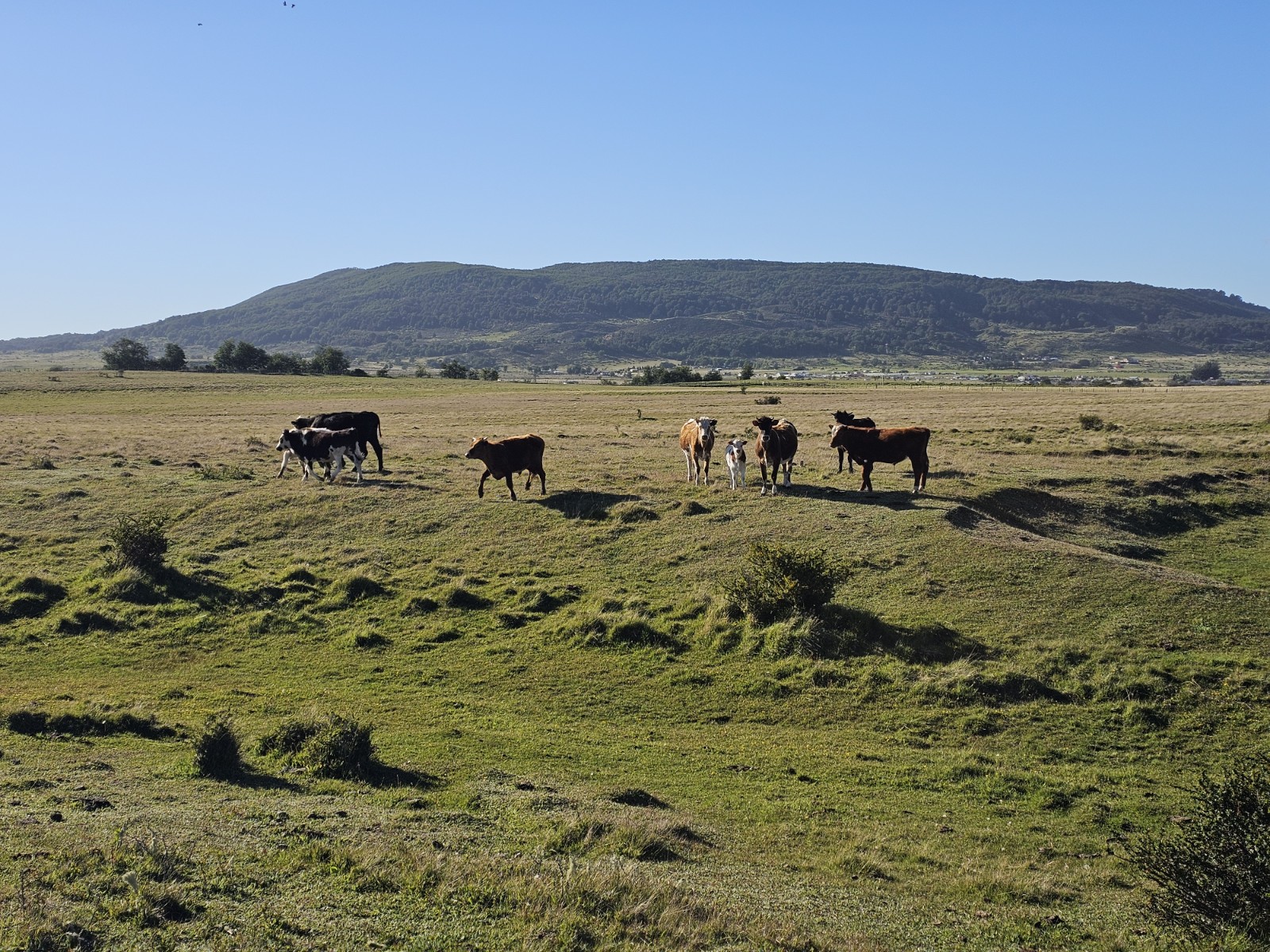
046. The extensive farmland around the plateau to the south of Rio Aqua Fresca village.
The last section of the day was quite hard for me and the pack weighed heavily. The road left the shoreline and went up onto the hillside. Here I could get a good view of the extensive farming to the west of the road where there were extensive cleared areas stretching far to the west across the peninsula which was much flatter here. At the top I saw the village of Rio Aqua Fresca some 3 km away and dared to dream of food. I was in the village an hour later and it was bigger than I thought. This was a permanent settlement unlike many of the weekend hamlets I had passed through. It had many fishing boats up on land ready to launch on a wharf and a large rodeo oval. Just after this oval was the Hosteria Aqua Fresca. It was a gorgeous place and run by a very lovely family. The dining room was like a museum and exceptionally characterful with very simple but classy furniture. The daughter showed me a lovely cabin with a hot shower. I showered for the first time in a week and then returned to the lovely dining room with its large wood burning stove. I was the only guest so I was seated beside the stove and served a vast salmon and potato dish. The hosteria was exactly what I hoped for. After my huge dinner I sat at the table and did the blog for a few hours. It had been a long day with a delightful ending.
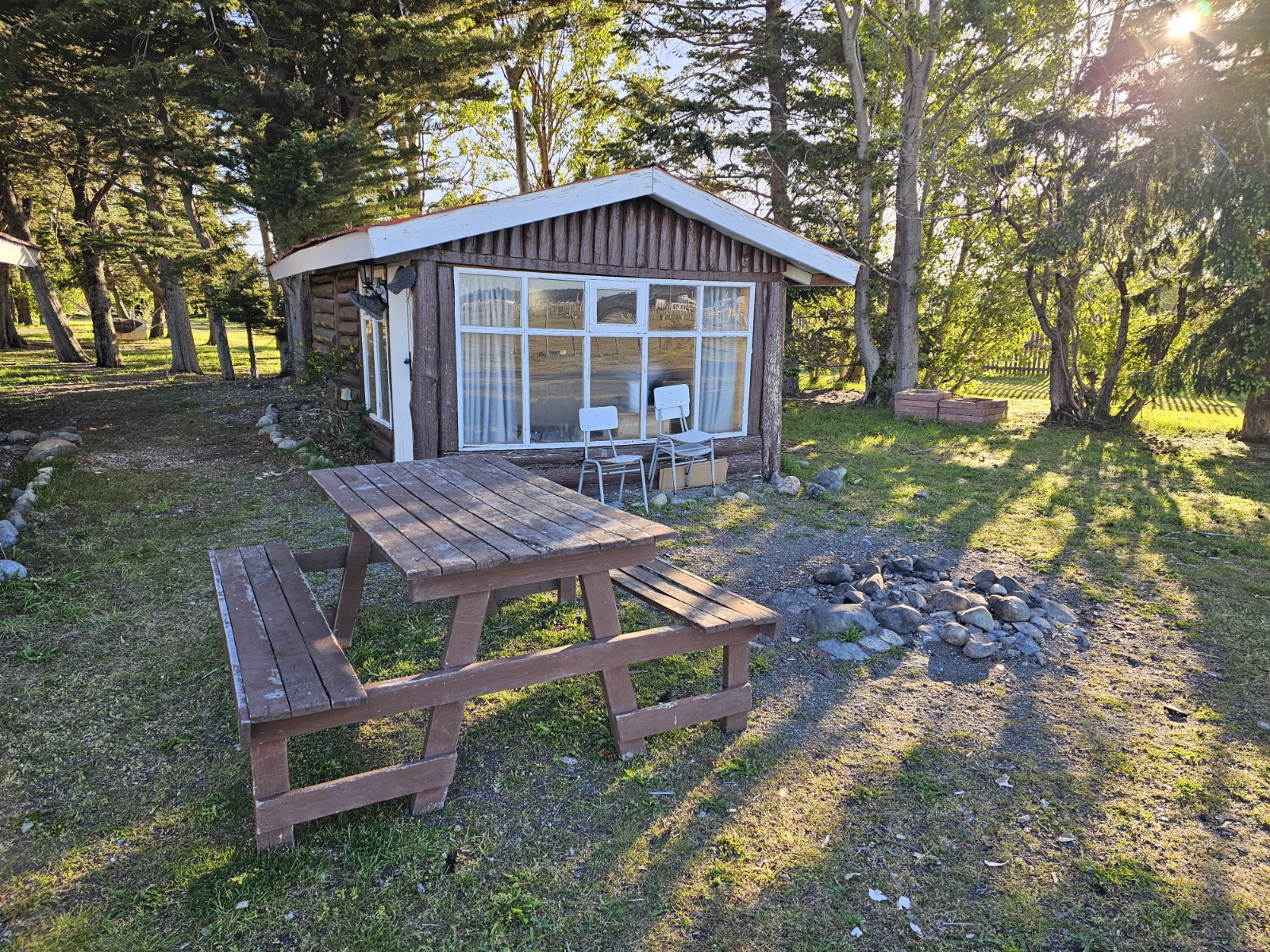
047. My cabin at the lovely Hosteria Aqua Fresca
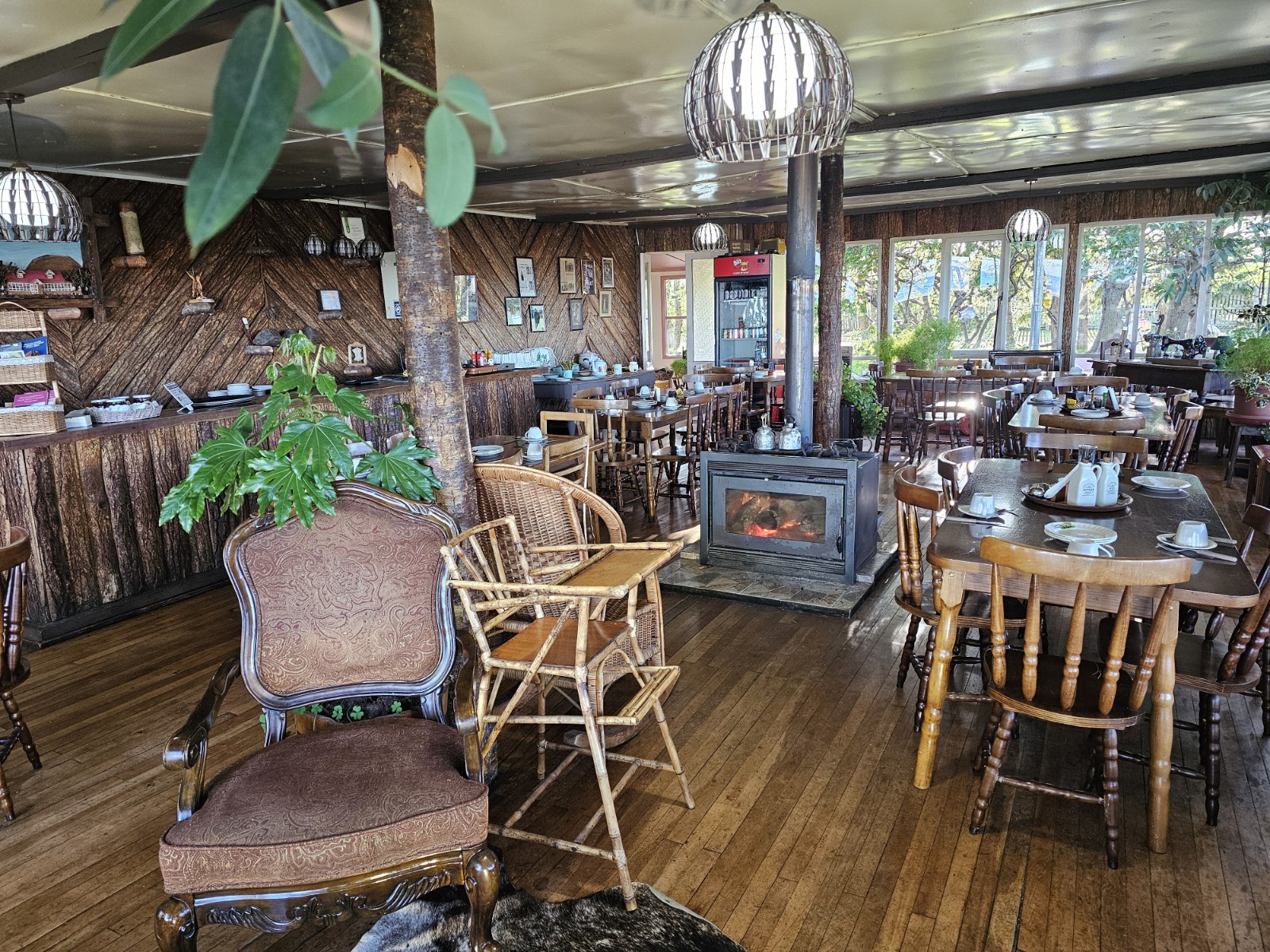
048. The characterful and classy dining room at Hosteria Aqua Fresca
Day 007. 17 Nov 26. Rio Aqua Fresca to Punta Arenas. 28km. 200m up. 200m down. 8 hrs. It was a beautiful day when I said goodbye to Carla and set off from the Hostaria Aqua Fresca after a really nice stay. Carla Boehrs was a very accomplished horsewoman and had won a few international rodeos. Initially the walk was through the rest of the village along the shoreline road. All the houses and cabins were surrounded by a large grassy well cropped plot and these plots were teeming with rabbits who had burrows everywhere. The quiet road curved round the shallow bay and then gently climbed over a shallow ridge. There was not much traffic on the road but there was a large yellow lorry. It peeped and I waved.
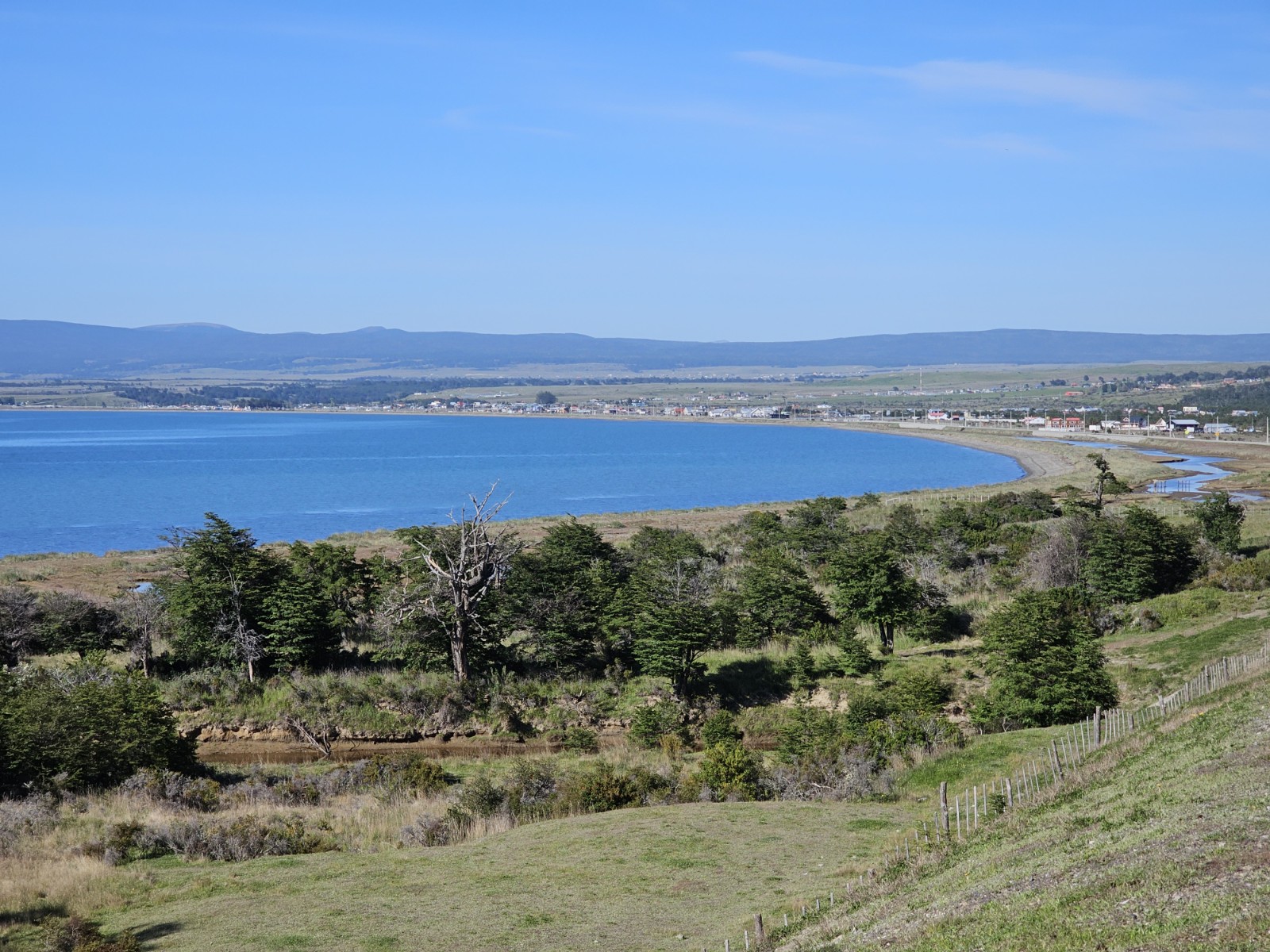
049. Looking back to the calm village of Aqua Fresca on the edge of the bay.
As I walked north the road dropped down to the shoreline again and followed it. There were geese and ducks along the shore, in the lagoons and ponds and beside the small rivers. The rivers were no longer the clear waters of further south but were small creeks muddied by the hooves of cattle further inland. On some of the ponds spring had fully unfolded and there were families of ducklings enjoying the warm day. The traffic was getting more plentiful as I headed north and the yellow lorry passed again with great fanfare and I waved again.
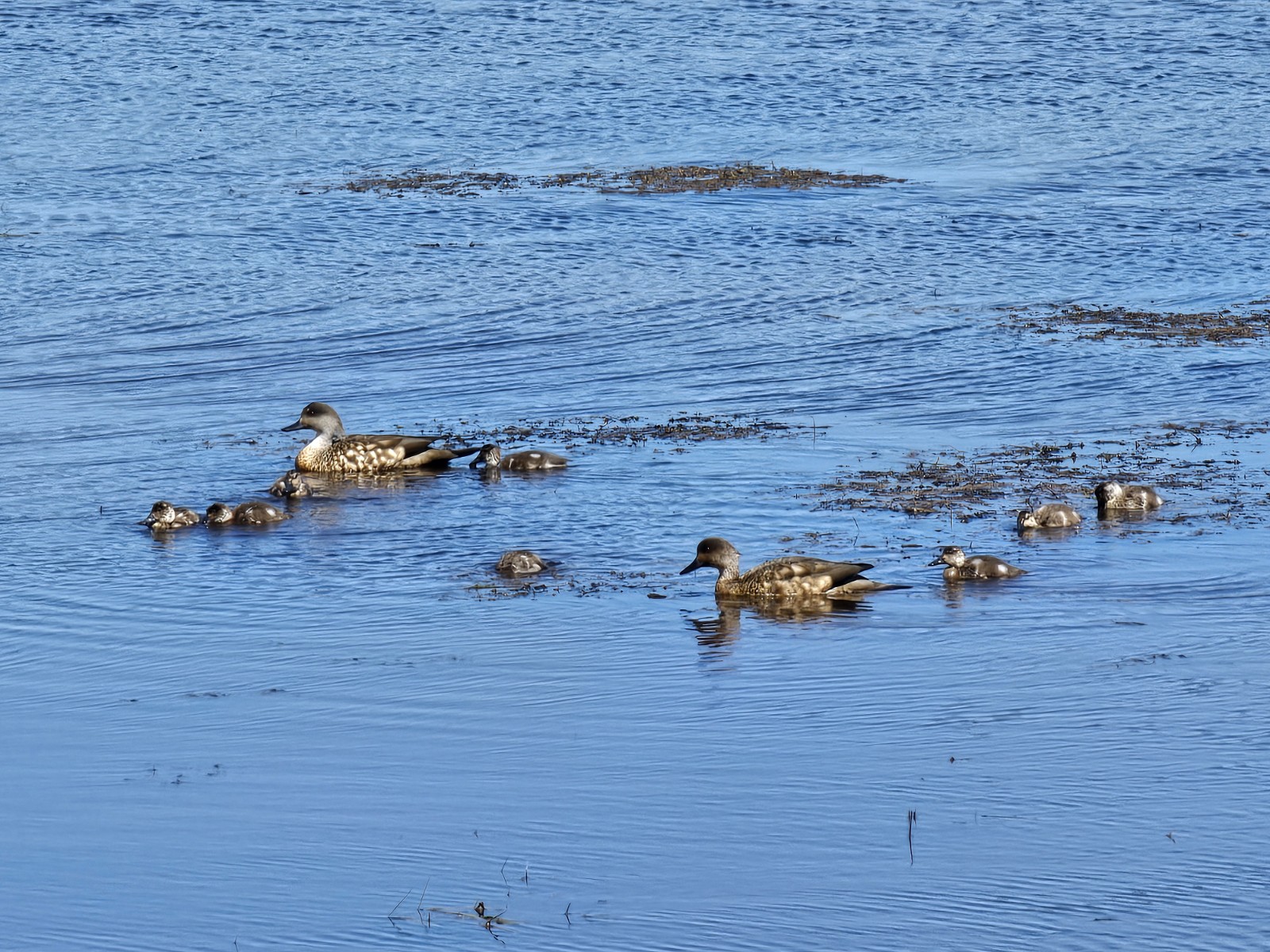
050. Many of the ponds near the road had families of ducklings now.
This was beef country now and there were plenty of farmers on horseback tending their herds all with a large Patagonian beret-style cap and many with the comical looking sheep dogs distinctive of the area called a “Ovejero Magallánico”, which looked like it had Old Grey Welsh Sheepdog heritage. The herds grazed on the cleared pastures, mostly devoid of trees on the lush imported grasses. They looked quite densely stocked and grazed around the old homesteads. There were many wooden corrals and loading ramps to get these beef cattle to market. I was making good time and the kilometres were ticking past. Every hour or so the yellow lorry passed and we greeted each other. There were no small roadside shops or cafes and if there were they would probably have been only open at the weekends.
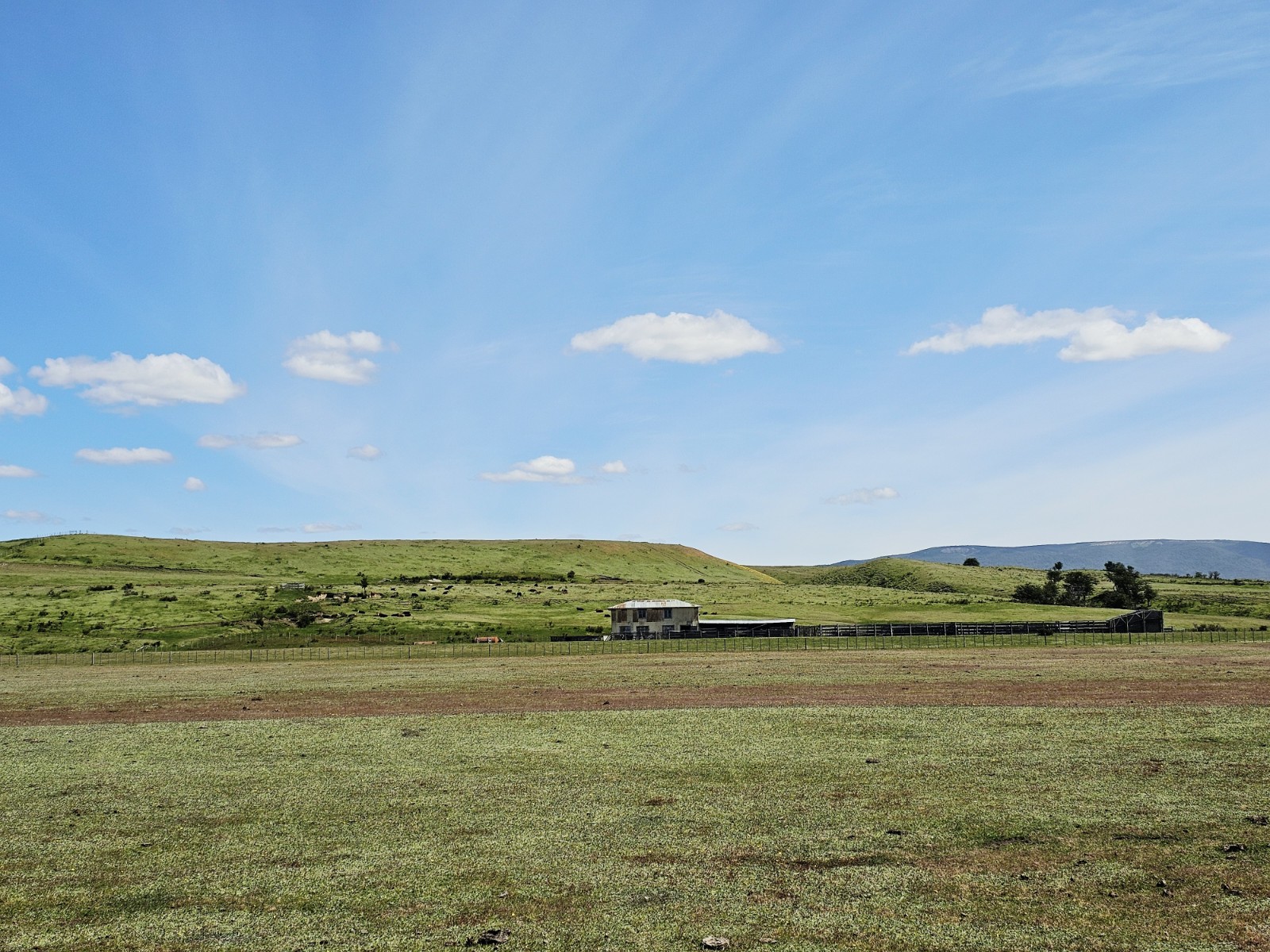
051. There were larger herds of beef cattle around the old homesteads with corals and loading ramps nearby.
As I reached Rio tres Brazos, and then especially Rio Lenadura, a bit later the character completely changed. Gone were the quaint rural scenes which could have been from the 1950s and these were replaced by a more industrial landscape of boat repair yards and motor garages. Each one had a scruffy security dog which barked as I went past, some persistently and angrily, though none were threatening enough for me to unsheathe my knife. There were row upon row of fishing boat repair wharfs and I must have passed well over 200 boats being repaired in these 5 kilometres. The yellow lorry passed again but this time the driver hopped out, shook my hand and gave me a bunch of bananas. Not long after the bananas I came across a shop which was open. It was mid afternoon and I went in and had 3 delicious steak empanadas. They were exactly what I craved.
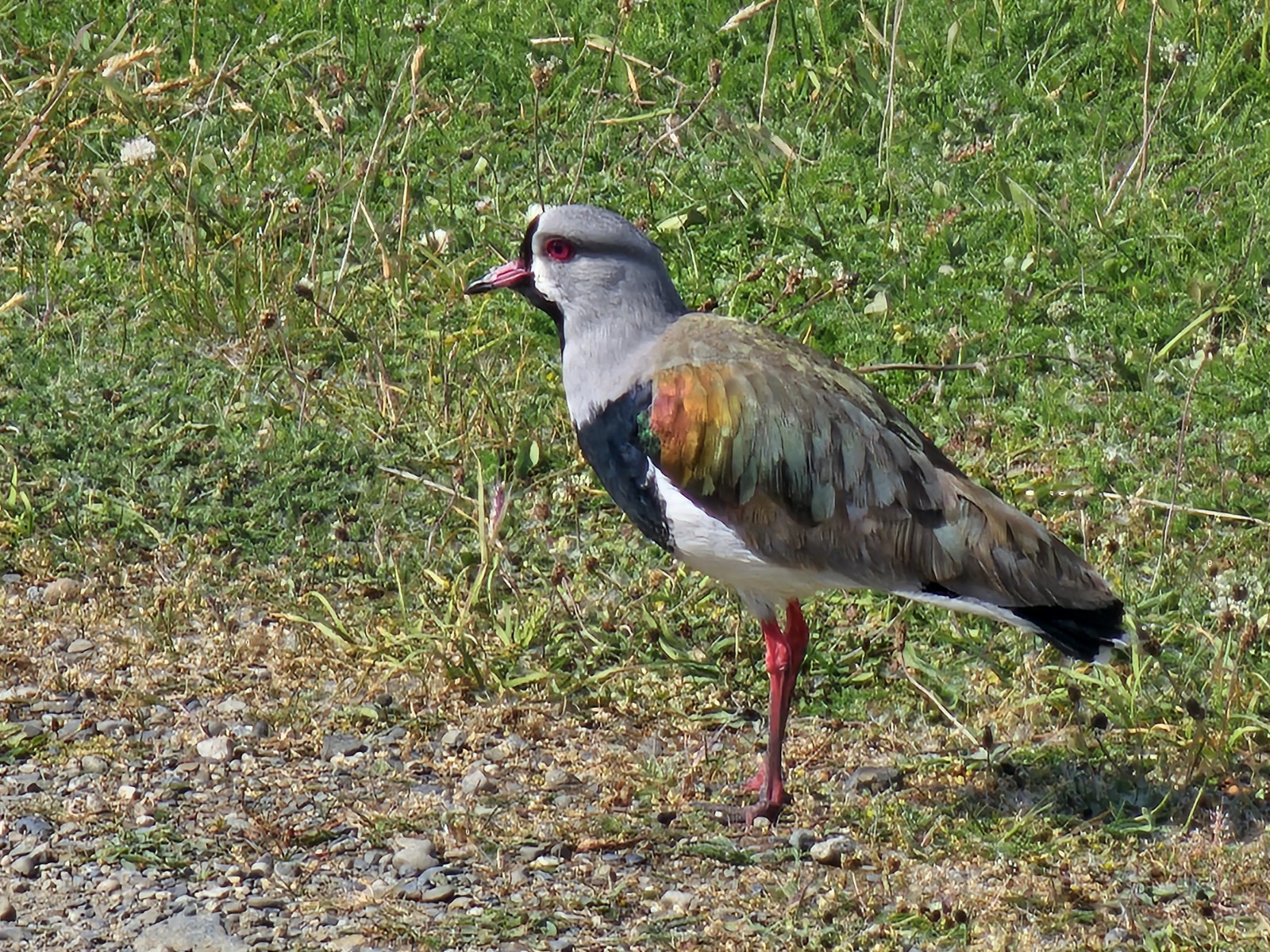
052. There were plenty of the Southern Lapwings all along the shoreline and in the fields beside the road.
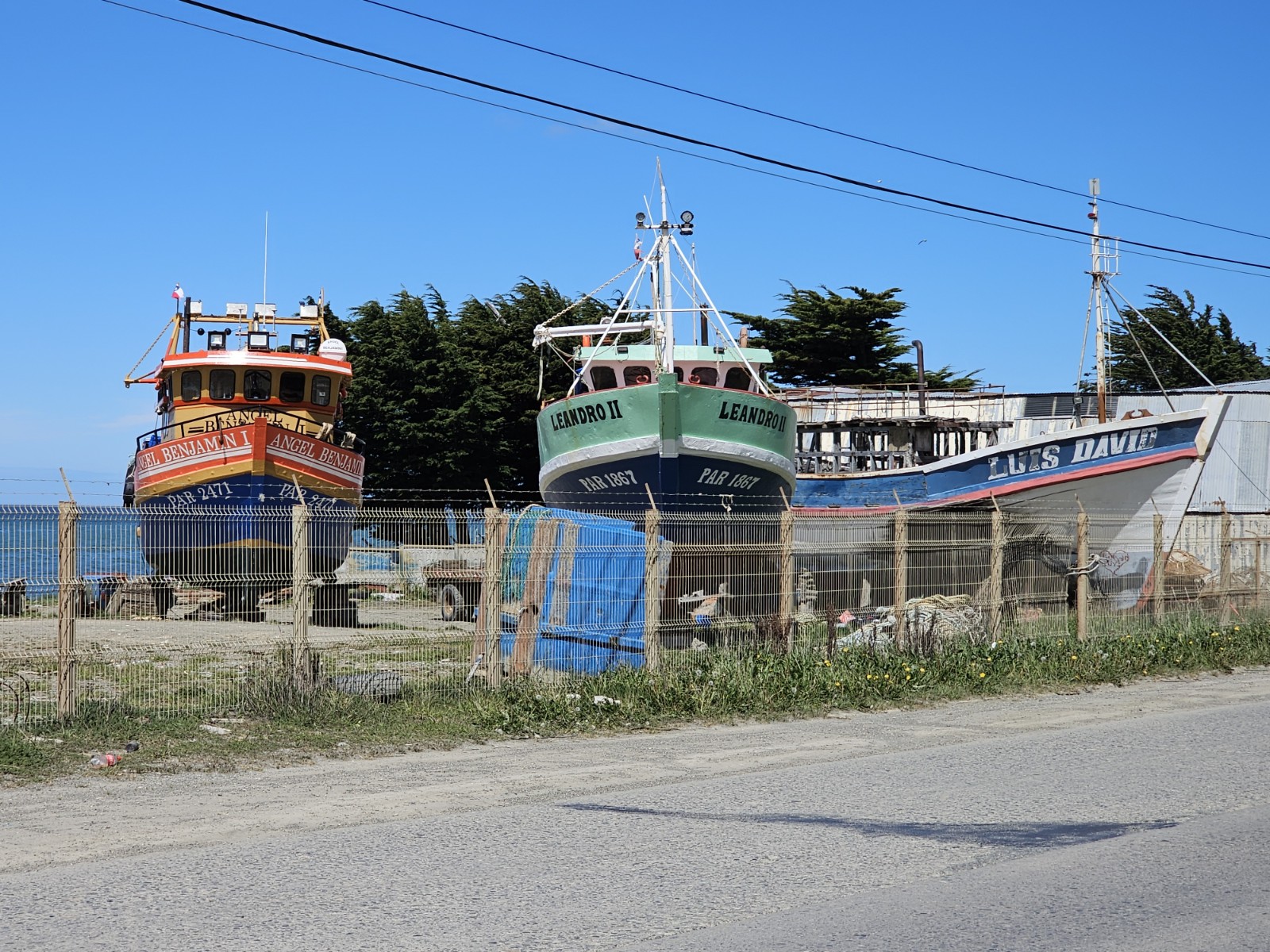
053. Each side of the industrial suburb of Lenadora there were boat yards with fishing boats under repair.
It was only 6 km to Central Square, the Plaza d’Armas, in Punta Arenas now and I sent the Hotel Endurance a message and they confirmed I had a room there. I then sent Steve Jones of ALE a message about dinner and he confirmed a location. The final kilometres to Punta Arenas downtown were busy but there were still a lot of Southern lapwings about, many of which tried to scare me away, so they must have been nesting on the foreshore. Just before the town proper I passed 4 large steel ships from a bygone era. One was the Lord Lonsdale and one the County of Peebles built in Belfast and Glasgow respectively over 100 years ago when half of all the steel ships afloat in the world at the time were built on the Clyde. Even as rusting broken hulks there were evocative.
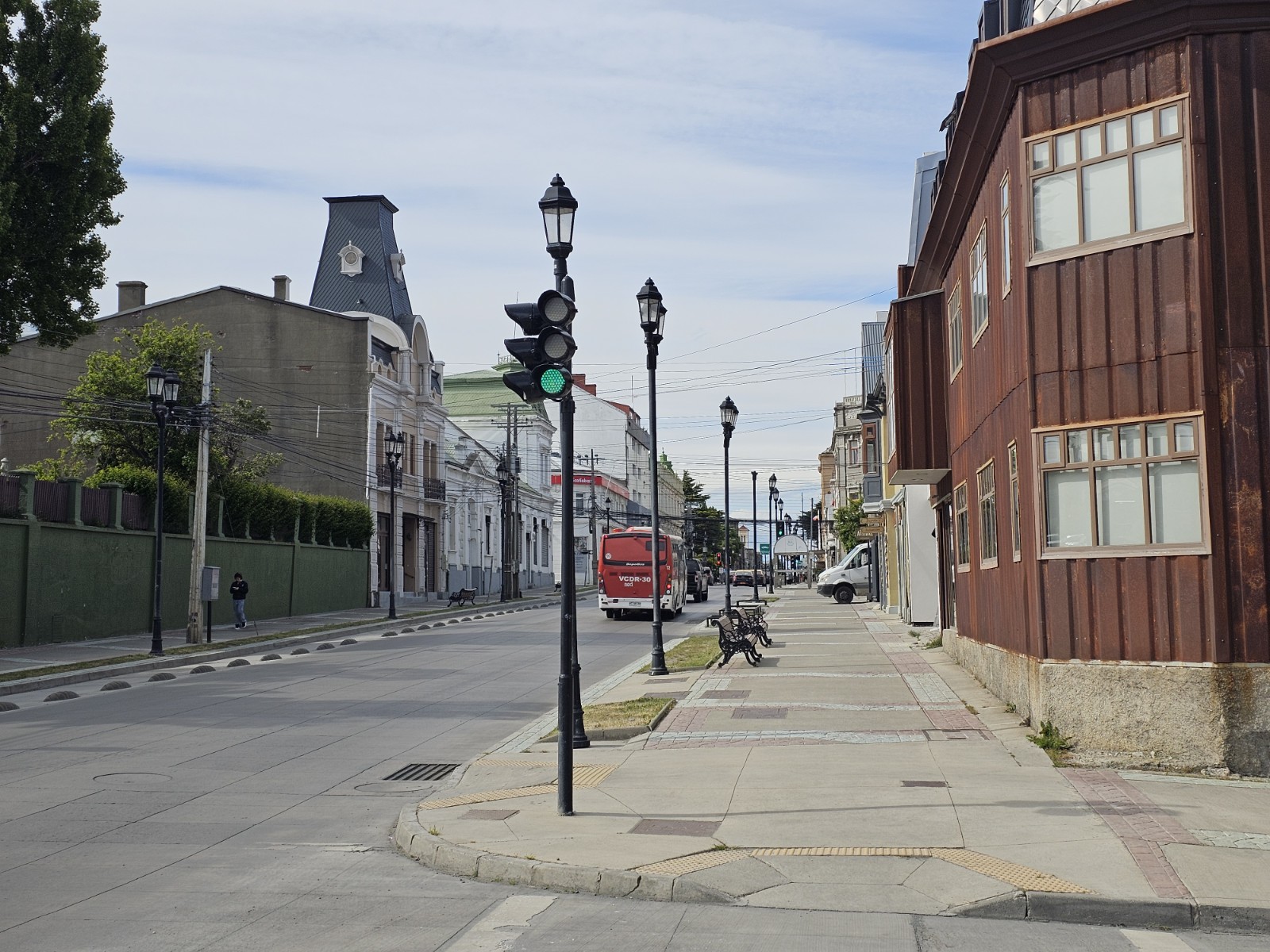
054. Just about to reach the Hotel Endurance on the right with the beautiful Plaza d’Armas two blocks straight ahead.
Just before the main Plaza d’Armas square I reached the hotel and got a warm welcome from the owner and staff. It was good to be back but I just had time for a shower and clothes wash before going down to meet Steve and some of his team. I also met Bjorn, who I knew from long ago in Norway, who was guiding a team of two ladies. One was Gulner, a very accomplished Turkish mountaineer who had climbed K2. She was fascinated by my travels in Eastern Turkey, specifically Kurdistan, in the mid 1980’s. It was a great evening but I was tired, partly because of the sun. The others were all getting up early to go to Antarctica.
Day 008. 18 Nov 26. Punta Arenas rest day. 9km. 0m up. 0m down. 0 hrs. I had a long lie and then went down to hand my clothes in at a proper laundry having got the worst out of them in the shower yesterday. It was nice to wander about Punta Arenas in the sun in what must have been nearly 25 degrees and no wind. I met Oscar in his shop to get a few items and went with him and Javier to a seafood market where we had king crab empanadas and chatted for a couple of hours.
After saying goodbye to them I went to buy food for the next section to Rio Cerde. It was only 100km but I ended up buying and portioning up 8 days of food altogether. It was the same granola and powdered milk for breakfast, a trail mix bag for snacks and then 220 grams of pasta and a packet of grated parmesan for dinner. The total day’s supply came to a bit less than a kilo. The town felt quiet without the ALE crowd here and I ate on my own. By the time evening came I was ready to move on and do the next section to Rio Verde.