Section 02. Breheimen
February 27, 2026

Day 05. Pollfoss to Sota Seter. 24 km. 8 hours. 440m up. 330 m down. It was bright and sunny when we woke in the somewhat overdesigned hotel room. After breakfast we set off down the track we had come up yesterday. It eventually led to a small hydropower station and the local farmer had spread grit on the snowy surface so we had to walk for 1.5 km until we reached a junction in the pine woods. Here we left the gritted track and immediately crossed the mostly frozen river on a bridge to the SE bank. There was a snow-covered track here where someone had been skiing a week or two ago and we followed their tracks which had been largely obscured by a few smaller snow falls.

17. The exceptionally characterful Pollfoss Hotel was a comfortable break. On account of a hot tub it was now called a boutique ans spa hotel.
Initially my skis and skins worked well and I got some glide, and Stuart got a great glide and shot off. However as the temperatures increased the snow started to ball on the thin mohair skin under my skis until it was impossible to ski. There were huge clods of snow compacted onto the underside of the skis some 5-10 centimetres deep. It was like walking on platform shoes. I stopped and took the skins off but even with bare skis there was still enough stickiness in the snow to stick to the residual glue of the skins and some old wax, and I had to scrape the skis to stop it compacting on the underside again. It was slow hard work and I was sweating just in a shirt in the plus 5 celcius temperatures.

18. Heading up the track on the SE side of the Framrusti river where my ski were clogged with warm wet snow.
After 4 km I caught Stuart up as he had stopped at Framrustiseter. It was a stunning collection of some 40 old wooden buildings, all made of logs, which had been used as summer farms for centuries. Their gnarly log walls shone golden against the white fields that surrounded them, and their turf roofs were covered in snow. It was here we were to leave the track and head up a much smaller snow covered track over the ridge to the Ostri Valley. This track was not long, perhaps 4 kilometres but it involved 100 metres of ascent and 150 descent over a saddle at Bråtååsen. The climb up was immensely difficult. The snow was rotten and the ski poles could go in half a metre. The skis luckily only went half that before the sugary snow was compressed enough to take out weight. We took it in turns to plough a furrow up here in the warm temperatures and blazing sun. Every step was a huge effort. Even without skins I was getting enough grip in the sticky snow to push my moving foot forwards. Soggy snow even stuck to the tops of the skis. It was like wading through treacle with diving fins on. After a good hour we reached the saddle just 1.5 km from the junction and started down the other side. It was much easier now and soon we came across someone else’s ski tracks. We followed a zig-zag of tracks leading to past working farms to the main road in the Ostri valley.

19. The immensely taxing climb over the Bråtååsen saddle between the Framrusti and Ostri Valleys. This 1.5 km climb took well over an hour of hard toil.
There were some 5-6 farms here in this rural hamlet. They smelt of sillage as humming machines kept the sheep inside the barns ventilated and provided them with fodder. I had hoped to also ski the road here, but it was bare wet asphalt for 2 km until the end of the public road and we had to walk to the turning place at the barrier where the private track continued up the valley. This track had not been salted and was still covered in a layer of compacted snow about 5 cm deep where the machine had cleared it. It was difficult to ski on as the skis just went sideways as easily as forwards. However initially there was a lovely kilometre descent where the track gently dropped SW into the valley, which came up to meet it. We kept our skis on here and flew down.

20. One of the beautiful old summer farms and cabins which were beside the track beside the Liavatnet lake and the valley below.
Once on the valley floor through there swift easy section was over and we still had some 12 km to go on this track to Sota seter. We tried various combinations of skins on and off, wax and even taking the ski off and walking. All seemed of equal speed. Occasionally there was a longer downhill section where it was worthwhile putting skis on for the effortless kilometre but by and large it was easiest to walk. When we reached the north end of Liavatnet, where the outlet of the lake was spanned by a beautiful old rustic wooden bridge I decided to walk while Stuart continued with skins on. He was only marginally faster than me. It was a long and somewhat tedious walk on the compacted snow road but there was enough interest in the small cabins along the road and the views over the frozen lake. Towards the end we were also rewarded with views up to the south where the giant monolith of Tverrådalskyrkja, 2088m, loomed above everything. After a tiring day we at last reached the cosy lodge at Sota Seter where we were to spend the night.
Sota Seter is one of the DNT flagship lodges and it is staffed. Its old buildings are arranged around a yard with about 10 buildings in all. It was once the biggest summer farm in a collection of summer farms and its outbuildings were the traditional collection of a stabbur (larder), fjosset (barn) as well as the bake house and blacksmith workshop which were always separate in case they caught fire. There was another group just arriving and they were sleeping in the stabbur. They were doing an avalanche awareness course. We were shown a more perfunctory, less traditional building with plenty of space and great bunks.

21. As we skied south along Liavatnet lake towards Sota Seter the massive monolith mountain of Tverrådalskyrkja loomed above us.
Later that evening 3 Norwegians arrived. They were all in their 60s and exceptionally strong, active sportsmen. They were a group of friends who often did tours together and they had a vast knowledge, great humour and were typically modest like many older Norwegians. They were a delight, and we and them shared an affinity as we sat together for dinner. The only thing worrying us was the weather forecast – it was just too warm and the snow would be melting for the next week or so, certainly below 1200 metres. However these 3 exceptionally experienced Norwegians also wanted to ski to Nørstedalseter. We would follow in their experienced footsteps after we all took a day off tomorrow. It was set to rain and finding a way out of the forest would just be too exhausting in the rotten sugar-snow.
Day 06. Sota Seter weather day. 0 km. 0 hours. 0m up. 0 m down. We had decided to have a day off at Sota Seter as it was forecast to rain. It was overcast and 5 so it was not unlikely. It was extraordinary weather. The last time I was here was also in March, 8 years ago, and then the temperature was minus 39. The three very experienced Norwegians were also taking a day off as one of them needed to repair a binding. However the 8 or so younger people on the avalanche awareness course also staying here decided to go up the hillside through the forest in the direction we would be going tomorrow. If nothing else they would make a great trail for us tomorrow, although in these temperatures the snow would still be wet and sugary.
Breakfast was not until 0800 and it was a large buffet type breakfast. I ate well knowing this would be lunch also. Thereafter Stuart, myself and the 3 Norwegians, Anders, Terje and Erik sat in the cosy smaller living room and chatted for a couple of hours. The three Norwegians were very accomplished but they were modest and you had to extract their achievements from them, but the also shone through. We had a good natured chat with the occasional look out of the window at the others breaking trail up the hill. It was poor weather and the expecterd rain was indeed gently falling in some of the most unseasonal weather I have ever seen.

22. The cosy artifact-filled “Peisestue” at Sota Seter lodge, where everyone gathered to chat.
In the afternoon Stuart went for a small ski while I did the blog and other office work and then we chatted with the 3 Norwegians again. It was a very convivial afternoon chatting infront of the birch logs burning quietly on the open fire. A few more people arrived in the evening just as the drizzle was turning to snow which was a good sign. I was still worried about the climb up to Fortuns Glacier tomorrow and the descend from the bottom of the glacier on the south side but we should be a few hundred metres higher and hopefully the snow was not so rotten up there. Dinner was again at 2000, which was relatively late, but it was woth waiting for. There were about 20 of us at the table now, most when to bed soon after but I stayed up to write a bit more.
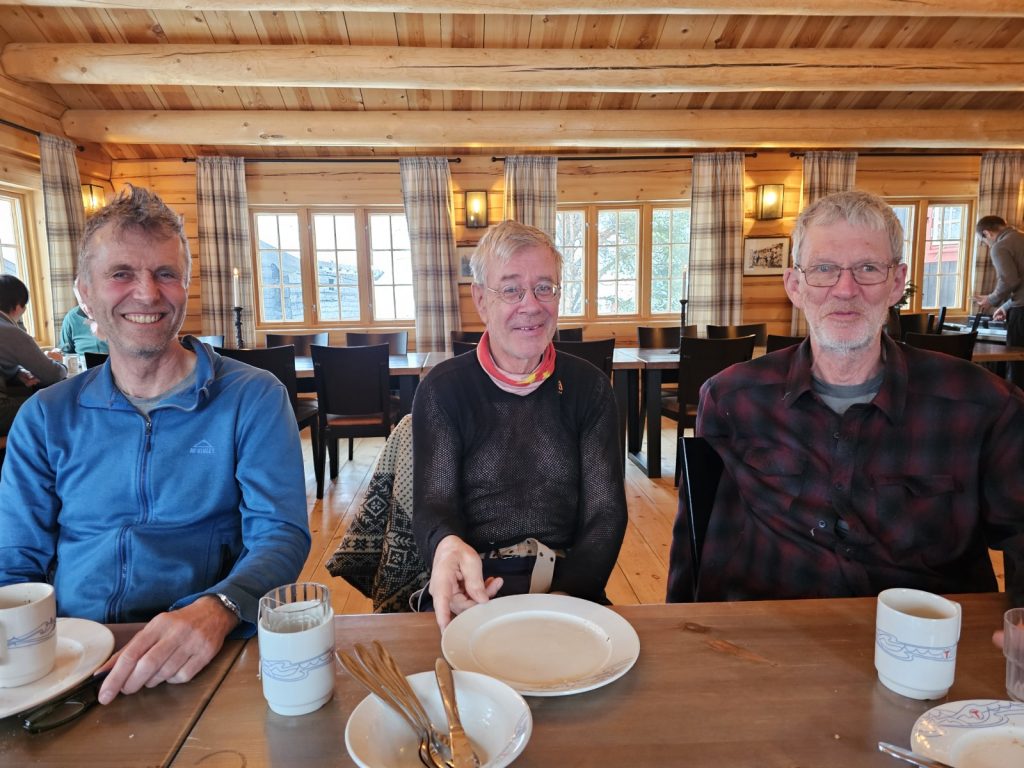
23. Our companions for a few days at Sota Seter and Nørdstedalseter. From left Terje, Anders and Erik. Extraordinary characters, accomplished outdoors men and exceptional skiers.
Day 07. Sota Seter to Nørdstedalseter. 23 km. 9.5 hours. 950m up. 900 m down. It had snowed a little in the night but it was still unseasonably warm at around plus 2. The roofs were dripping. However we were going up and it would not be long before we climbed to minus temperatures. Luckily we had the trails to follow from the avalanche group from yesterday and also the 3 Norwegian this morning. It went up the summer trail but it would just be too hard to follow the winter ski trail which was still deep virgin forest snow and probably sugary and rotten. We set off before 0900 and followed the route as it twisted in and out of the forest as it climbed up. The trees were dripping wet snow on us initially but as we climbed through the woods the wet snow had frozen onto them. It was hot work especially when the mist thinned and the sun came out.
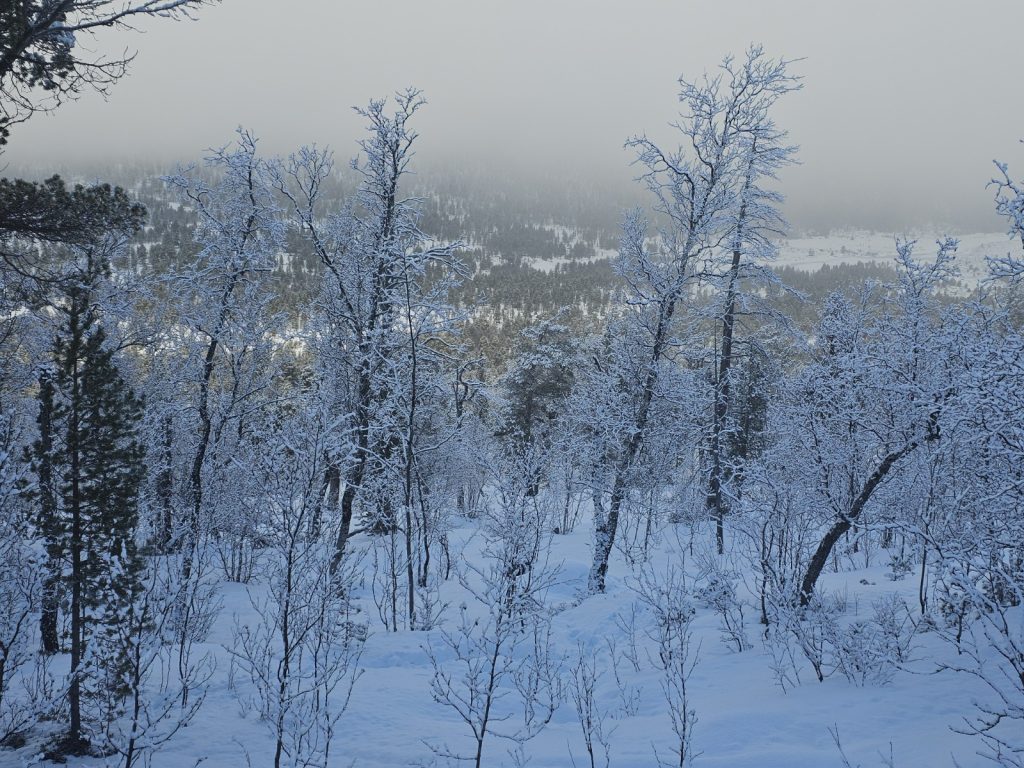
24. On the climb up through the difficult forest from Sota Seter the sun broke through the mist.
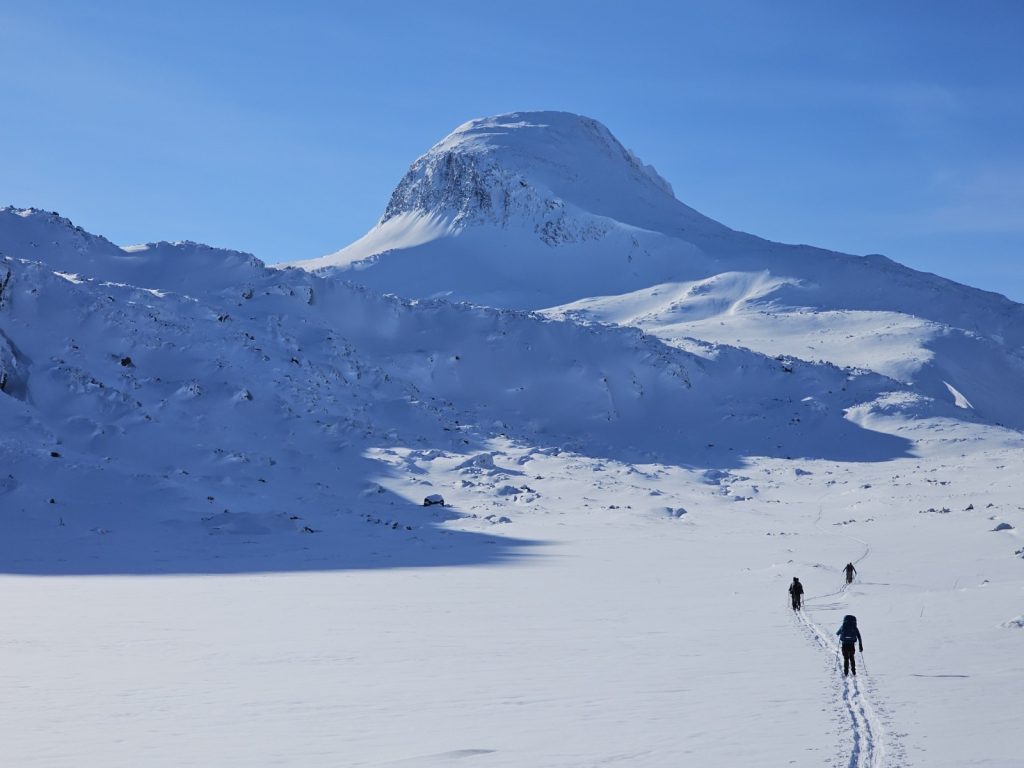
25. Heading up the high Tverrådalen valley towards the monolith of Tverrådalskyrkja, 2088m.
After an hour we climbed out of the treeline onto the bare hillside and got some atmospheric views up the main valley where the mist still lingered below us. The snow here was much better now with a firm base and last night’s new snow lying on top. It was as it should be. A quick traverse across the hillside took us further up into the slightly hanging valley of Tverrådalen. This side valley drained the north side of the huge block of mountain which was Tverrådalskyrkja and it dominated the landscape rising well above anything else. It was a flat valley full of frozen lakes and good snow and we made great progress. Further up the valley forked and we took the SE fork climbing steeply across boulders to reach Steindalen. I had been here before a few times and I can never remember so little snow. Previously I could ski where I wanted, but now we had to pick our way through boulder fields. We continued to follow the 3 Norwegians tracks keeping west of the hollows the small lakes lay in until we reached the snout of the glacier where we stopped for a snack just as the three Norwegians were departing. It was a great spot just beneath the mountain. I had been here 25 years ago and climbed the mountain and recognised the spot where I climbed off the glacier to gain the ridge. That spot was now 25 vertical meters above the glacier showing just how fast they were disappearing.
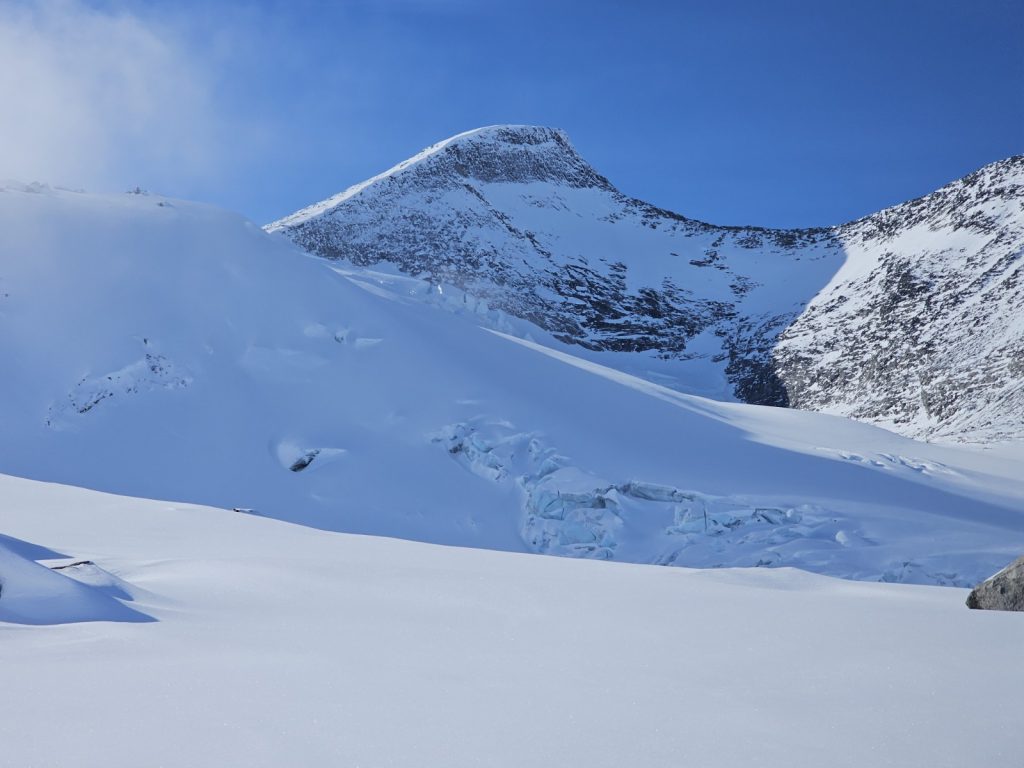
26. Looking up the steep crevassed glacier which tumbles down the east side of Tverrådalskyrkja mountain.
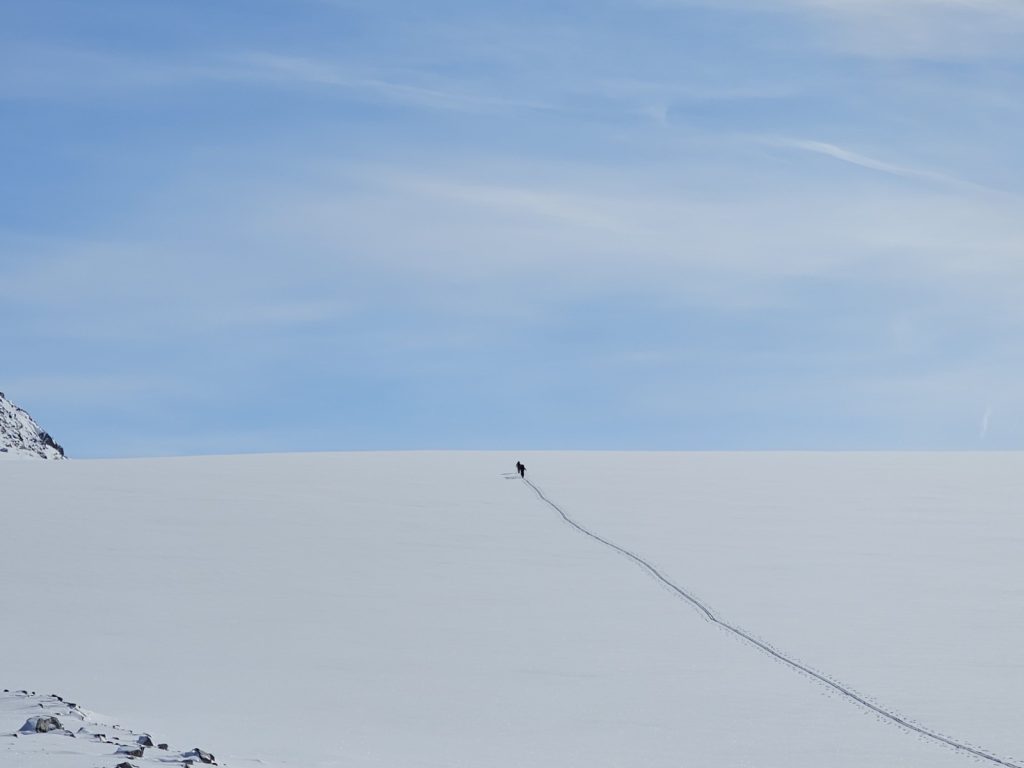
27. The three Norwegians, Terje, Erik and Anders heading up Fortundalsbreen glacier to cross over it. We followed in their tracks
The climb up the smooth convex slope of the glacier was wonderful. The sun shone on us out of a blue sky with just the odd mist swirling in the corries of the mountain. As we climbed to the west of a small hill called Sveinkollen I saw the ice walls of a wind carved bowl called Hekse Gryte. I remember these ice walls some 40-50 metres high years ago but now they just seemed 10 metres high as the height of the glacier reduced. At the crest of the glacier the view to the south slowly unfolded and the tops of the Hurrungane range, perhaps Norway’s most Alpine mountains appeared. With every step they got bigger and bigger with their jagged profile soon in full glory. They were a little lost in the mist but you could still make out all the features including the massive U between the mountains of Store Ringstind and Austanbotntind. Further to the east I could see Store Bjorn in the heart of Jotunheimen. We paused to admire it all before the long descent.
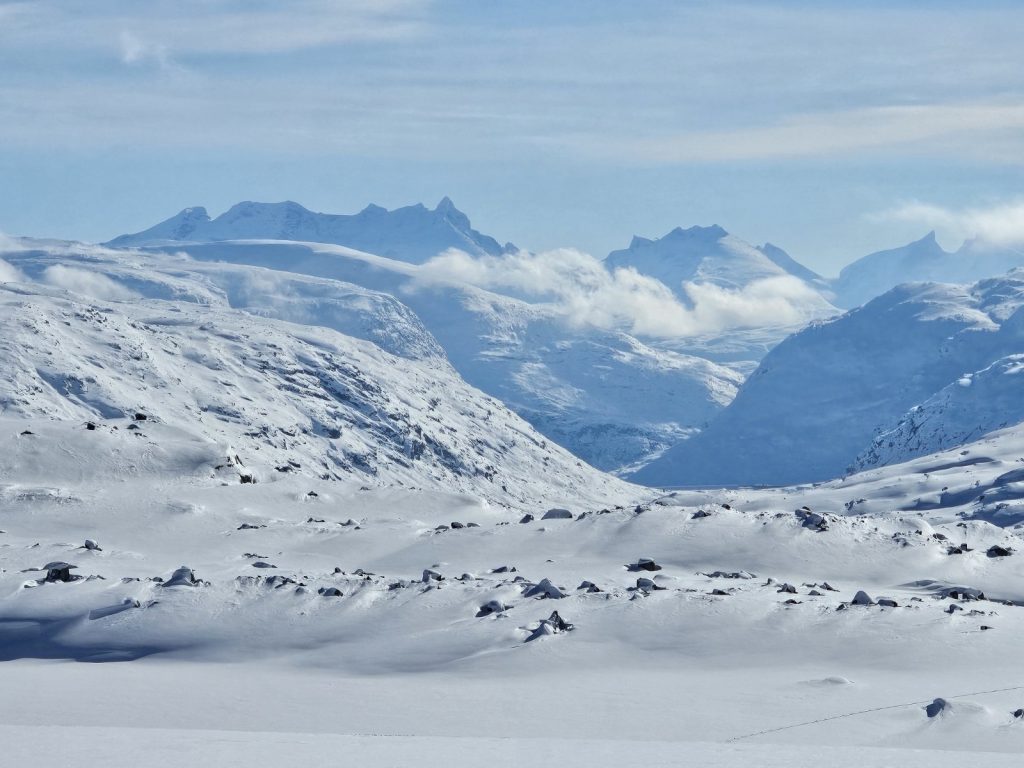
28. At the top of Fortundalsbreen glacier looking south to the giants of Hurrungane. The infamous Store Skagastølstind is the highest in the middle.
Initially the convex descent was slow but soon speeded up and we had to take wide swings. One of the Norwegians, Terje, had headed straight down doing the most graceful set of Telemark turns all the way to the bottom. The other two were also excellent. Stuart and myself on the other hand were much more cautious and took long diagonal runs across the glacier with a snow plough turn before starting the next diagonal descent. After half an hour we were at the snout and at the start of a long section of piles of moraine which the retreating glacier had left behind.
Skiing through these drumlins and small gullies was a real challenge. The three Norwegians made a route, and it was excellent, but we made heavy work of it. Stuart fell a fair bit in the heavy sugar snow which was rotting in the midday afternoon sun and it was exhausting getting up as there was no purchase to press up against other than your rucksack, which you have to take off. I skied very cautiously on the unpredictable surface and also fell at least 5 times. After a frustrating 3 hours we eventually made it to the lake and then across it more easily to reach the dam.
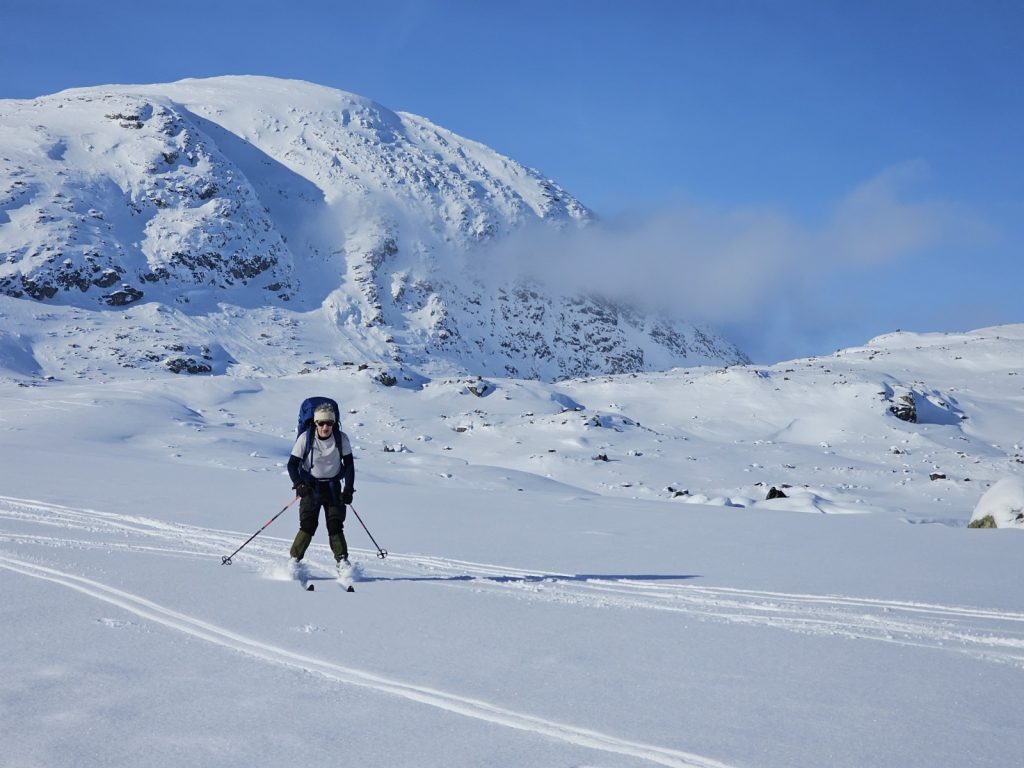
29. Stuart sking down the end of the glacier and reaching the morraine debris in Nørdstedalen which led down to the lake and cabin.
It was now 1700 and we still had 3 km of buried road to ski along to reach the cabin. Although all of the road was covered in large drifts and completely buried it was marked with poles and these allowed us to judge the gradients which otherwise would have been hidden in the flat light. It took us another hour to get near the cabin which lay on the far side of a tricky ravine. In a normal year we could have just skied straight across this on drifts but now we had to pick a crossing some 30 metres lower down and climb back up again.
The main cabin at Nørdstedalseter was serviced and it was closed. However there was a small self service cabin on a knoll beside it. The three Norwegians were already there and they warmly welcomed us. It had two bedrooms and a nice living space/kitchen area. They cooked pasta for us and we supplied the desert all from the provisions in the cabin. It was a very easy going and convivial evening in great company. The Norwegians were not only great skiers and able sportsmen but also very accomplished in life, and Terje was a professor in climate change at Oslo University.
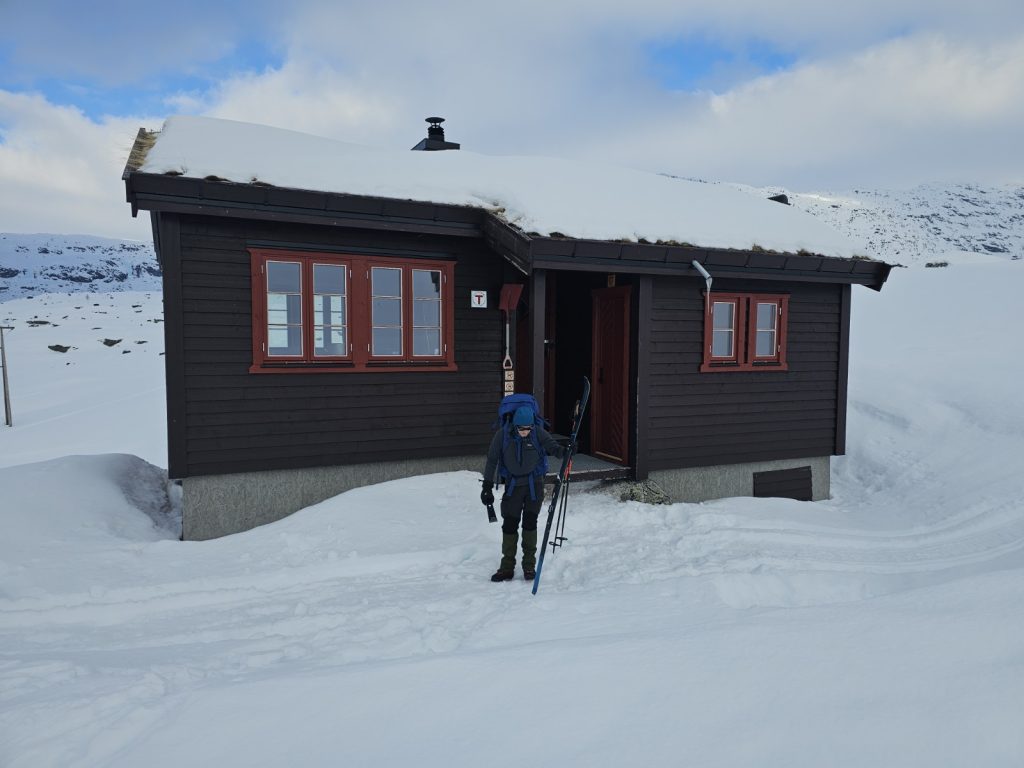
30. Leaving the small new self service cabin at Nørdsteddalseter in the morning.
Day 08. Nørdstedalseter to Prestesteinshytte. 25 km. 10 hours. 1030m up. 700 m down. The three Norwegians were up and away early. They had a monster day to Skogadalsboen; something we were splitting into two. I knew the day was longer than the touted 20 km to the main road, but was a bit blasé about it, so we set off relatively late at 0930 after cleaning the cabin. The rotten snow of yesterday was now frozen firm as the temperature was minus 5 in the night. It made for a fast climb away from the cabin with our thicker skins on. However, to counteract this there was not as much snow as I remembered twice previously and the normal way up the river was a little blocked with rocky ravines and steep drifts. We decided to follow the 3 Norwegians who went up some very steep and icy slopes. It was slow and exhausting as you were always tense. The Norwegians had full ski skins over the whole length and sauntered up the bits we struggled on due to our shorter skins. What should have taken an hour ended up taking 3.
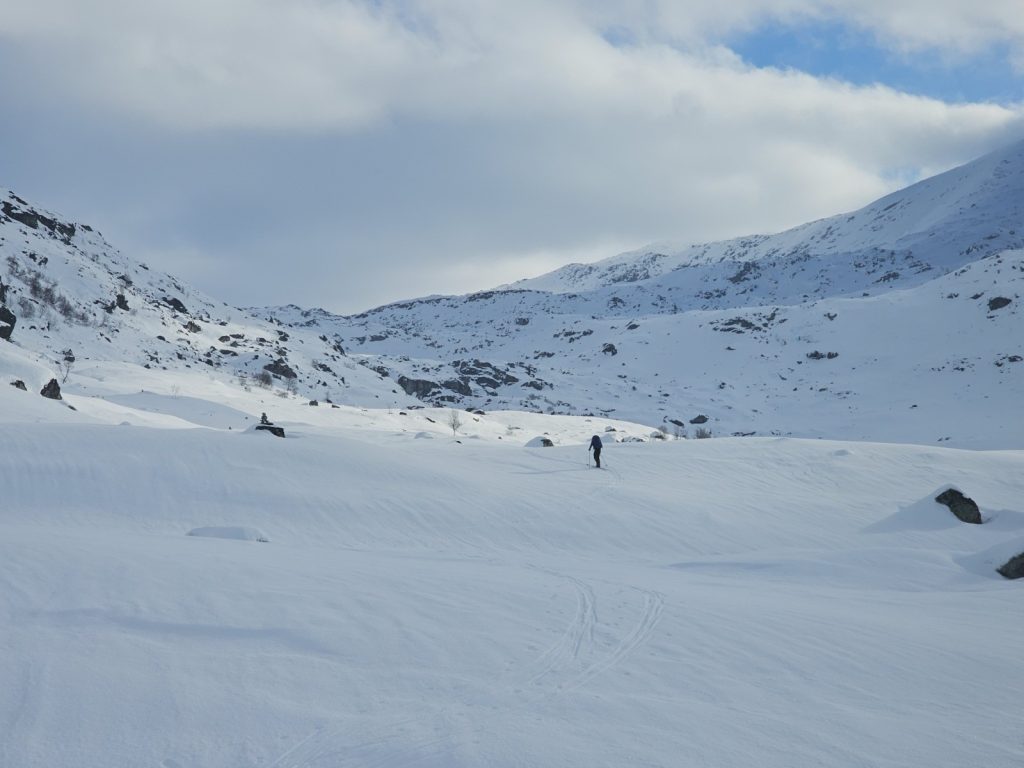
31. Heading up Vesldalen east of Nørdsteddalseter cabin in gnarly terrain.
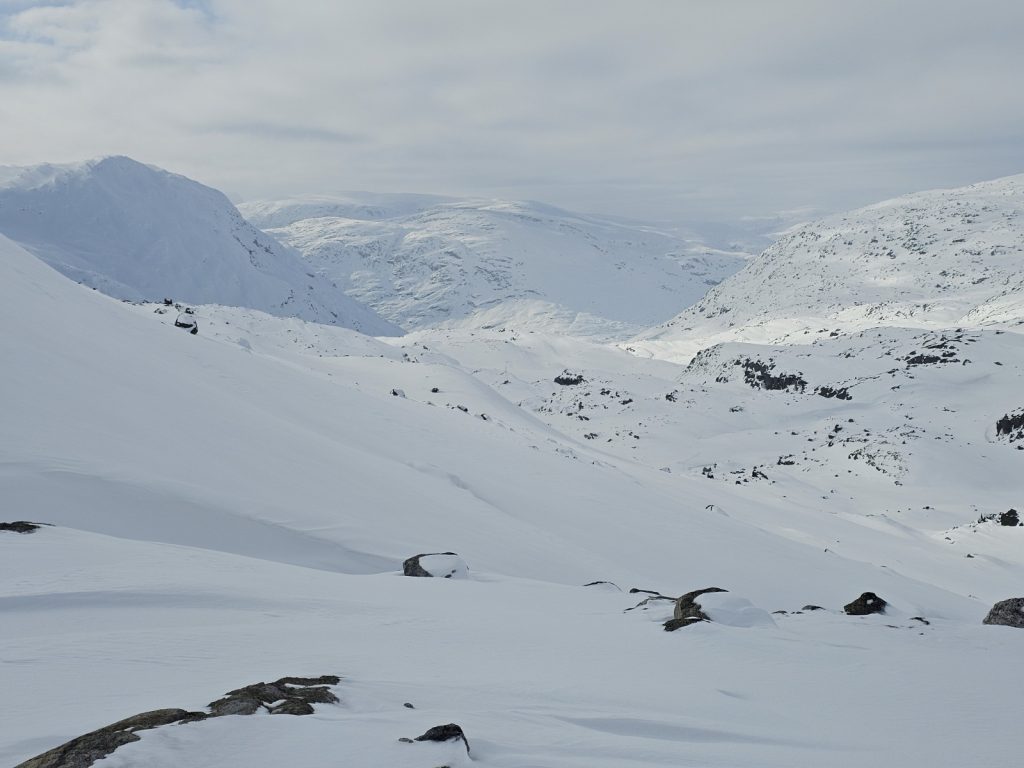
32. Looking back down Vesldalen after climbing past the more difficult area. Nørdsteddalseter is far below in the valley.
Eventually we made it out of the clutches of Vetledalen and reached the higher lakes of Grønevatnet. Here the ski became much easier and we climbed from basin to basin up great snow in sunnier weather with good light. When we reached Liabreenvatnet, with the much diminished Liabreen glacier flowing right into it, the snow was superb and Stuart shot off on his skis, getting a great glide. I had to change skins and lost half a kilometre on him. Two snow scooters came towards us and they were National Park Rangers looking for wolverine. They had not seen any that day. The left us great trails to follow beyond the lake and up to the highest pass of the day at about 1600 metres. From the top was another great view to the mountains around the two glaciated basins of Lierbreen and Smorstabbbreen. These mountains were not as dramatic as the Hurrungane mountains but were still very spectacular.
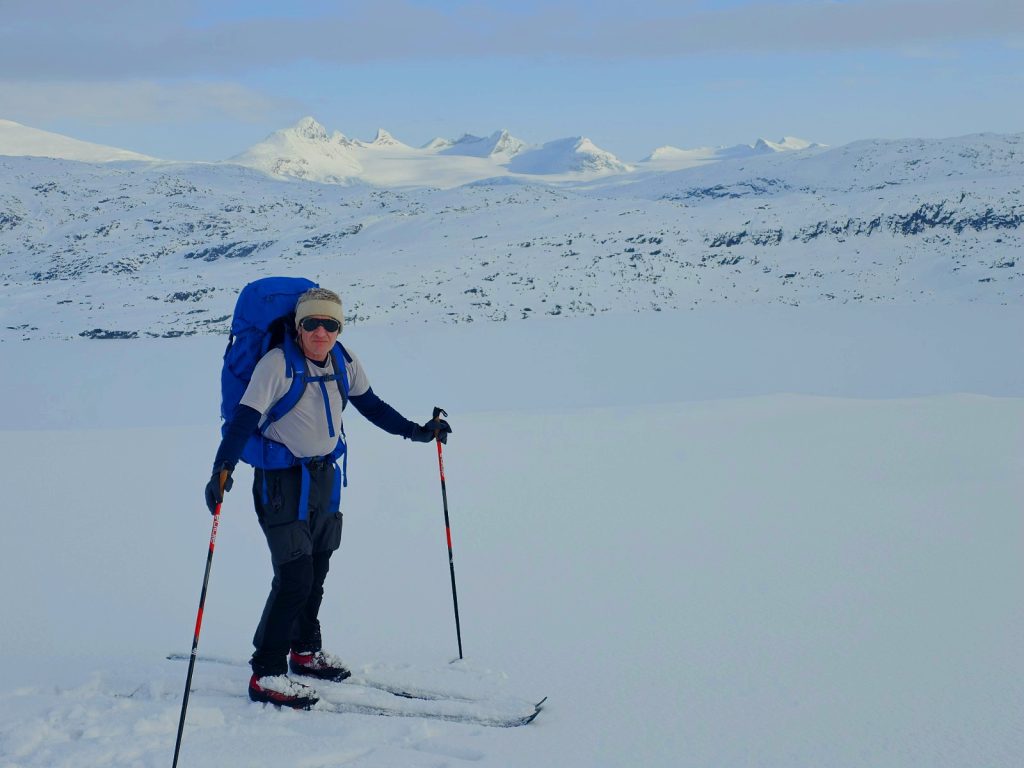
33. Stuart in front of the Smorstabb Massif on the descent to Storevatnet.
We now started what was to be the greatest challenge of the day, the descent to Storevatnet. We followed the snow scooter tracks down gentle slopes initially but they soon became steeper and we had to zig zag widely. The trouble was the light was going and it was overcast and the snow just had no definition to it. If there was a small drift or ridge you could not see it until you hit it. I fell some 5 times and Stuart a bit more. Once he went over a small unseen cornice and was airborne for a metre before crashing down in a heap. It was very tiring and frustrating and the nearer it got to the lake the worse the visibility became. It was with great relief when we were finally on the lake.
The lake itself was superb and we found the scooter tracks and followed them to the dam making great time. The skins we had on the bottom of the skis were perfect now and allowed a great glide. At the dam I went to the west end. Here I made a mistake and followed the route I previously used across the small lakes below to the dam and then up to a hydro electric hut. However this year that route was very undulating and the snow had not filled in all the obstacles. We should have gone to the east end of the dam and then along the snow covered road to the hydro electric hut. The mistake cost a good half hour – half an hour we could ill afford as it was already 1730 when we reached thIs hut.
It was now a more simple ski up the snow covered track for a good 5 kilometres to a shallow pass. Thank God there were the snow scooter tracks here to follow as they made travel across the snow’s surface much easier. It still took a good hour to reach the pass by which time dusk was upon us. The descent down the other side was relatively short and the large poles to mark the way guided us down across easier and shallow ground until at the last light we reached the Riksveg 55, the infamous Sognefjellsveien, one of the most scenic mountain roads in Norway on account its views. The road was completely closed and in places buried under drifts 5 metres high. We donned head torches and followed it west for 1.5 km keeping between the snow poles which defined the edge of the road for when the snow plough eventually clear it for the 1st of May.
After 1.5 kilometres on the road we headed down towards Prestesteinvatnet Lake where I had already arranged a private hut to stay in. It was a relief to see it appear in the torch light however we still had to dig extensively for 20 minutes to find the key box buried in the snow. However we were in by 2000 after an epic day. There was a small porch on the front of the hut and I had to shovel more snow from here to allow the main door to open. Unfortunately a fox had been using this drift as a sheltered toilet for much of the winter and the snow was filthy with its pee and faeces. It was the only spade we had and it was a little tarnished now. I could only plunge it into clean snow 50 times to clean it as this was the same spade we used to dig blocks of snow to melt water to drink. Once in the very cold hut we got the stove going and the gas on melting water and after 3 hours it was homely. We eventually went to bed at 2300, both shattered after the hardest day yet.