Section 04. NE Botswana
June 13, 2025
Day 046. 24 June. Kasane Rest Day. 0km. 0 Hours. 0m up. 0m down. I was up at 0500 to get picked up at 0545 for the Game Drive. The drive was arranged by the Thebe River Lodge so it was all easy and inhouse. Right on cue a specially adapted Toyota Land Cruiser arrived with seating for 9 on the back in three rows of tiered seats. We set off in the dark and I was hoping to see some animals at least. Before we got to the park entrance the driver took a turn down a sandy lane and drove fast across the sand. Someone in the back through we were heading off to see elephants. After a km of the sandy track the driver/guide, called OC, headed off into the bush for a little and wove between some shrubs and then manoeuvred the jeep so the lights shone upon something.
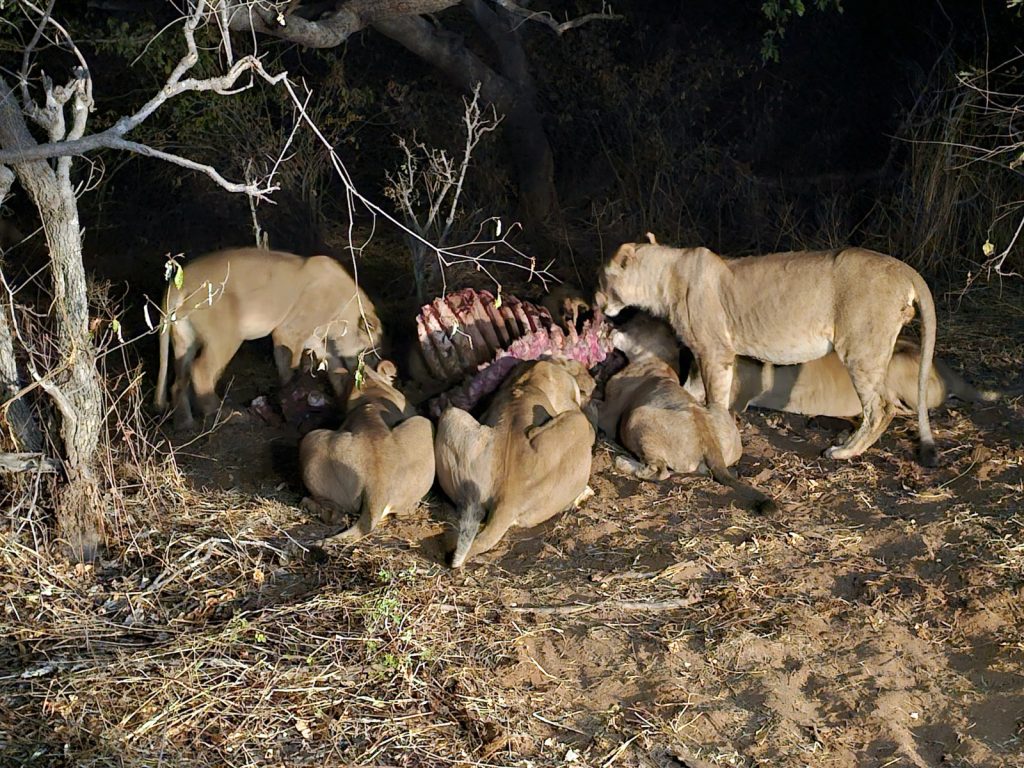
229. On the game drive in Chobe National Park the guide came across a very experienced pride of lions who had taken down a buffalo and feasted all night.
It took me a while to work out what it was, and it was only when OC and the others confirmed it, I knew I was not seeing things. There just 5 metres in front of us were perhaps 7 lionesses tucking into a buffalo carcass. There was not much left on the bones and most were still knawing on the large ribcage. It was quite a sensational find. OC said he had heard about this kill yesterday and had it confirmed the lions were still here this morning. It was quite a sensational view. There was a lot of snorting, grunting and posturing as the lionesses jostled for position. When they walked about you could see they were full of meat. We had the view pretty much to ourselves for 5 minutes before the news spread to the other drivers and soon there were about 5-6 jeeps jostling for position around us. It took OC quite a while to extricate himself from the gridlock and continue to the park gate.

230. Not long after the lion’s we came across a small herd of giraffes who were grazing the treetops as the sun came up.
At the gate we registered and then got back into the jeep and continued on the main A33 road for perhaps 15 km until we turned off down a very sandy track to the north. OC had got confirmation of another sight. He drove very fast, but well, and the large vehicle almost glided over the sand. We stopped to look at a herd of some 6-7 giraffes who were browsing the tree tops just as the sun was coming up behind them. After watching them for a while we continued down to the shallow wide river valley. Ahead the air was dusty and I assumed it was some low fog from the river. However it was the dust kicked up from the hooves of about 500 buffalo who were walking and grazing as they headed east along the river bank. OC thought they were a breeding herd which might have come from Namibia. There was a total variety of animals from giant bulls slowly striding with their massive heads adorned with huge horns swinging from side to side to young calves tottering along awkwardly on legs which looked like they were made of wood. We parked and they flowed around us like a river and we were a boulder. Apparently this breeding herd would be really difficult for a lion to attack as the bulls would attack the lions and could do some real damage to them. Lions were apparently more likely to attack a bachelor group of bulls where it was more everyone for themselves, rather than all rallying round to protect the calves.

231. We came across a large breeding herd of buffalo which the guide thought had come across the river from Namibia.
As soon as we left the buffalo we ran into another pride of lions. This one had killed an eland a couple of days ago and had devoured most of it. This group was a lot less experienced than the pride that killed the buffalo and consisted of a lot of larger cubs and a few lionesses. The cubs spent a lot of the time wrestling with each other, while a lioness ate. On the surrounding tree there were about 50 vultures waiting for the lions to move off so they could pick over the remains. It was an amazing start to the drive and well beyond anything I expected.

232. We came across a second pride of lions who were feasting on an eland. This pride were not so experienced and contained many cubs, like these two playing.
For the next hour or so we then went down to the edge of the Chobe River and slowly worked our way back east. I did not realize it at the time but this was just a southerly side channel and the main channel was further to the north over a very flat green island called Sedudu Island which gets covered when the floods arrive after the rainy season in the catchment area upstream in Angola. Here, we apparently just missed the lions who had been feasting in the eland coming down to the water’s edge to drink. However we did see a small herd of elephants in the water both drinking and splashing themselves and then they came up the bank to where we were parked and filed by us slowly. There were a number of very small young with them. As we left we passed the buffalo again who were still creating a large dust cloud, and then passed many impala.

233. There were many small herds of elephants scattered in the bush or drinking from the river

234. Looking across the southern channel of the Chobe River to the flat flood prone island of Sedudu.

235. This ekephant was nonchalantly eating the shrub just a few metres from the jeep
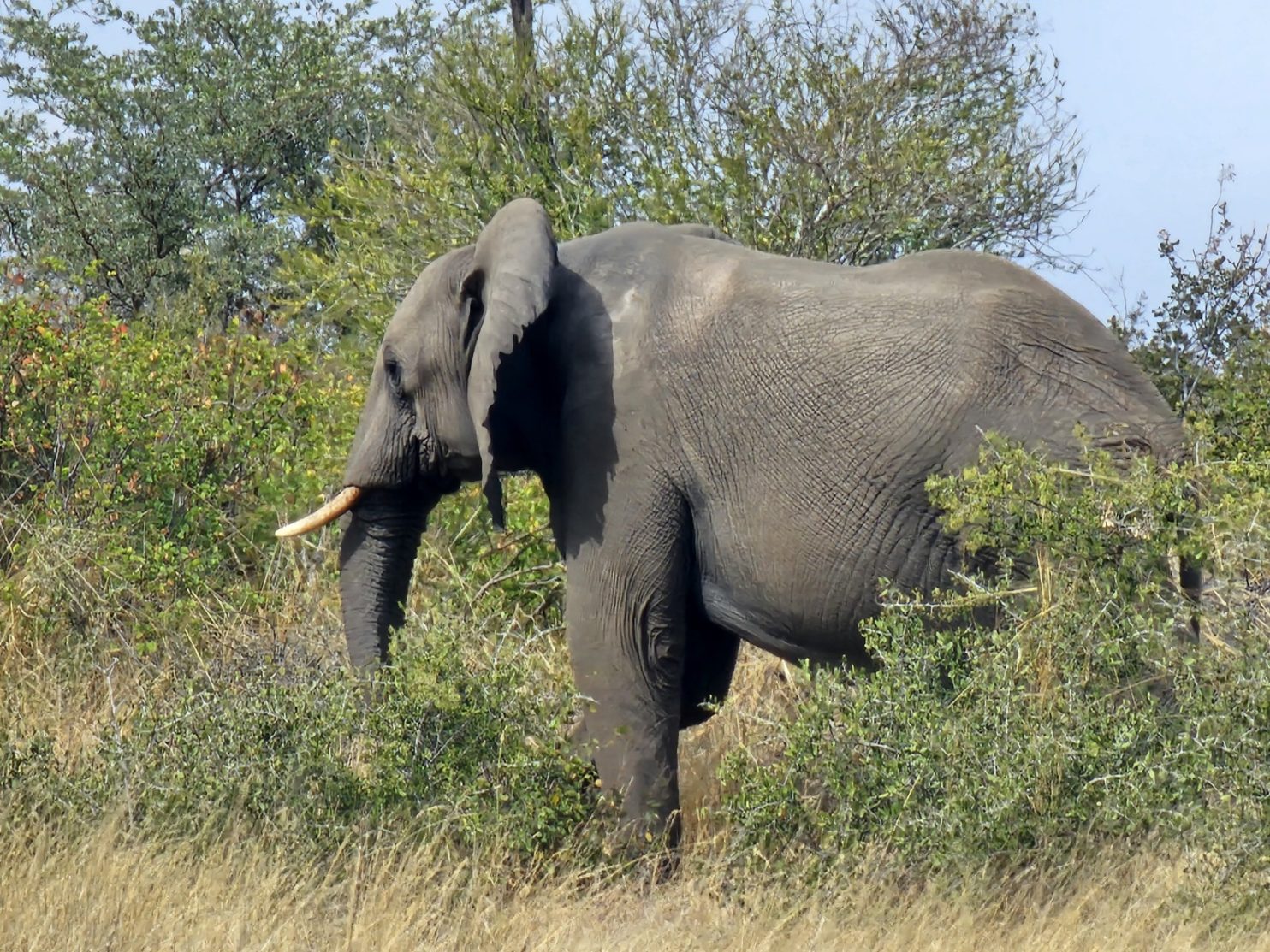
Just as we were about to leave the park we came across another cluster of wildlife including waterbuck, greater Kudu, a few more giraffes and an elephant right beside the track who was demolishing a small tree. I noticed he was stripping all the leaves off the twig and discarding them and then just ate the twigs. It was well after 0900 when we reached the tarmac road again after our sandy loop. Once on the tarmac we went back out of the gate and returned to the Thebe River Lodge. The excursion had been beyond my expectations.

236. We saw plenty of more giraffes on the game drive in Chobe National Park.

237. As we were leaving the park we passed a large male Greater Kudu with its distinctive spiral horns .
Back at the lodge I had breakfast which was still being served to those who did the early morning Game Drive and then I returned to my room for a snooze. It turned into a sleep and I did not get up until 1330, just an hour before the next excursion. I did not have lunch as I was still full from breakfast.
The second excursion was called something like the Chobe Sunset Cruise. Again I was picked up at 1445 and then driven some 15 minutes to a jetty area. Initially I was on my own but then a group of 20 arrived from one of the Overland Buses. There were a mix of nationalities but all spoke English. The boat was wide and stable at about 15 metres long and 6 metres wide with a roof and two outboard engines. I guessed this second tour would be hard pushed to match the spectacular of the morning but it tried.

238. On the Chobe River cruise in the late afternoon there were many crocodiles along the banks. This one was 3 metres.
Firstly we went up stream to where the Chobe River was a single channel again after it split to go round Sedudu Island. Here the guide took the southern channel and slowly went up stopping at the various wildlife we encountered. The first was a crocodile, its tail swollen with stored fat. The crocodile was about 3 metres long and would have lived off fish but I am sure it could already take an impala if it came too close to the water’s edge.
As we went up the channel I saw something in a patch of aquatic weeds and thought it was resting hippopotamus. However as we drew nearer I realized it was a large mother elephant, a smaller female elephant and two small baby elephants. The mother was almost fully submerged, and I am not sure if her feet were on the riverbed or if she was floating. She was sweeping the weed with her trunk and bringing large bunches of it into her mouth. The other three elephants, especially the two youngsters, must have been swimming. They occasionally disappeared underwater with just their trunks breaking the surface like a periscope. They looked a little like they were struggling and occasionally tried to clamber onto the large elephants back, but then became confident again and tried to feed themselves and stay afloat.

239. We also passed by a few elephants in deeper water eating aquatic reeds. The two babies were excellent swimmers and were frequently submerged.
We continued up this south channel passing many more elephants, hippopotamus and buffalo and a lot of birds, especially storks and geese. The guide explained that the older buffalo liked it on the island as they were safe from the lions, which would not swim out. The buffalo looked to be mostly old battle scared males who had limps and scratches and had no doubt had their fair share of lion encounters over the years.

240. As the sun began to near the horizon the hippopotamus emerged from the river. Here is a large bull male.
Eventually we got to the west end of the island where the south channel and the main channel initially split. There were a lot of hippopotamus here and they were just beginning to come up onto the land. They would get to the firm bank and then go and forage in the bush for the night. Some might venture 7 kilometres from the river in search of grazing before returning in the morning. In the group we were watching the bull male emerged from the water and scattered his dung around the waters edge marking his territory. He was also battle scared and looked like he had to defend his position and females from time to time. He then plunged into the water again roaring and with his mouth open and the great teeth ready to do some serious damage.

241. There were quite a few older buffalo on Sedudu Island where they could graze without fear of attack by lions.
The sun was now low on the horizon and we started to return. We passed a herd of buffalo on the island as we now went back down the main channel to circumnavigate Sedudu Island. The buffalo here looked content in the evening sun chewing their cud either standing or sitting down. There were a few birds gathering on the backs of the buffalo to pick at any parasite, like ticks, or just peck off the dead skin. The sun set as usual at 1800 in a blaze of colour but once the sun had crossed the horizon it did not take long for darkness to set in and already by 1815 it was too dark to read a paper. At the jetty the others boarded their tour bus while I was driven back in the dark to the lodge just in time for dinner. It had been a sensational wildlife day and I had totally underestimated the quality of the trips and what I might see. It was a fitting end to the 04 Section, NE Botswana as tomorrow I will leave and cross over to Zambia.

242. As usual there sun went down quickly and in a blaze of colour with returning from the Chole River Cruise on the small boat.
Day 045. 23 June. Pandamatenga to Kasane. 102 km. 6.5 Hours. 240m up. 380m down. I was up early for a 0700 breakfast. It was a hearty breakfast and it would have to do me until I reached Kasane in 100 km as there was nothing en route. I left at 0800 but the tail wind of the last couple of days had disappeared. Almost immediately I was into farming country again with vast fields on each side of the road. To the east was wheat and to the west was sorghum. The wheat was being harvested by a couple of combine harvesters side by side such was the pairie-like scale of the farming operation here. After the farm though the there was a slight rise and then I was back into the wilderness with signs saying “Caution Wild Animals”

223. The pairie-like farming operations just to the north of Pandamatenga.

224. A field of sorghum just north of Pandamatenga was completely incongruous with the wild bush of the last few days.
I did not see many animals at all really. Initially there was a large Tawny Eagle. I think they are opportunistic hunters and will take anything small and even scavenge carrion or road kill. Perhaps that is why it was perched on a tree beside the road. The scrub was reasonably scattered here and it would be difficult for an elephant to hide near the road. I saw plenty of signs and there were tracks everywhere but I think most were in the bush now foraging and would not cross the road until dusk approached. A bit further along the road I saw a small herd of zebras who were about to cross and then saw me coming and retreated back into the bush. They ran along beside me, about 100 metres parallel to the road, for about a kilometre.

225. A large Tawny Eagle perched on a tree beside the road looking for an opportunity to hunt or scavenge.
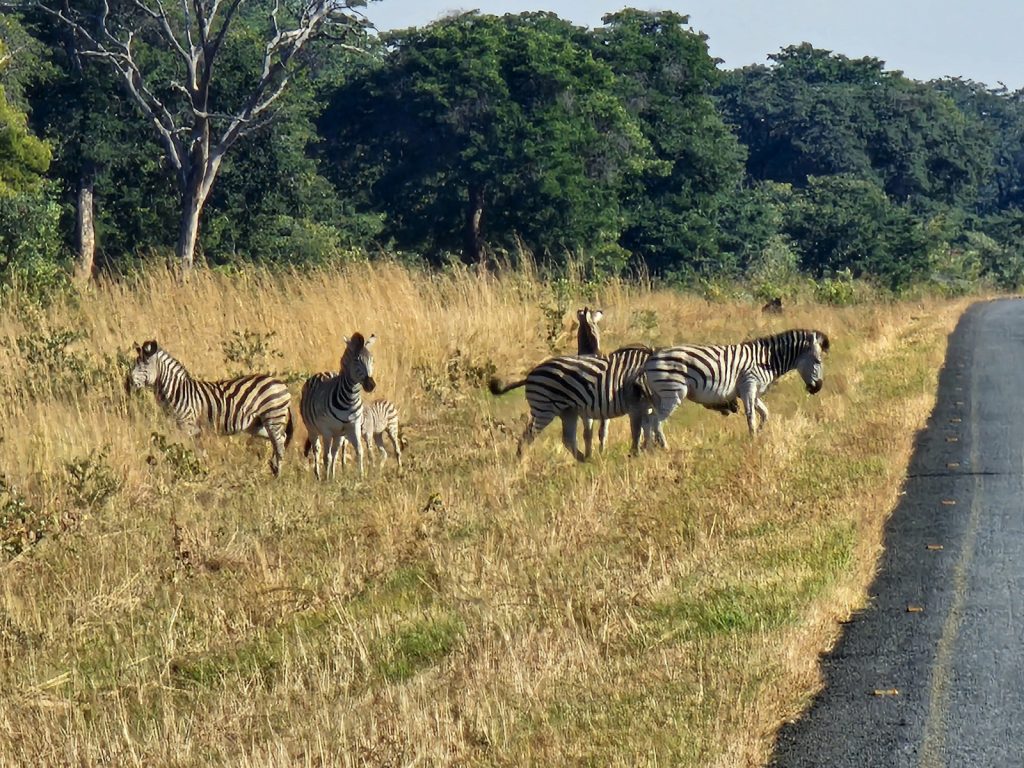
226. These zebra were the only game I saw all day on this 100 km stretch of road which is renowned for its wildlife.
Then the trees suddenly vanished and I was onto an open savannah plain. At last I saw an elephant but it was at least half a kilometre from the road. It was wandering across the savannah and was not eating, but en route to the distant forest or a waterhole. It is not far from the Zimbabwe border here, perhaps just 10 kilometres and the elephants are free to wander across there, where there are reserves and national parks. This savannah plain lasted for about 15 kilometres and then I was back into the scattered bush.

227. In the distance i saw a lone elephant making its way across the savannah towards a waterhole or the scrub forest.
The road was fast to cycle on although it was reasonably busy. The trucks came in convoys with about 4-5 in each and they all gave me plenty of room and often gave a friendly toot on their horns or a flash of their indicators. The verge I was used to for the last couple of days was now very small and I had to be careful when there was traffic coming in the opposite direction and the trucks could not pull over to the other carriage way as much as they would otherwise. All in all though I would commend truck drivers for their thoughtfulness.
The last 30 kilometres were generally fast but as I approached the Zambezi valley there were some long descents but then some vindictive small climbs. They took my momentum away completely and left me struggling to climb them with my legs aching and full of lead. However soon I was on the final run down into the border town of Kazungula. It was a busy town with lots of petrol stations and supermarkets. This was the town where 4 countries; Namibia, Botswana, Zimbabwe and Zambia all met. At the bottom of the hill and down onto the plain beside the Zambezi River was a turnoff to Kasane. It was about 10 kilometres along the road to the west on the south bank of the Chobe River, a tributary of the Zambezi which it joined in Kazungula. Most of the traffic and all of the trucks continued north here into Zambia but I wanted to go to Kasane for a couple of nights to make a touristic foray into Chobe National Park. Kasane was the gateway to Chobe as Maun was to the Okavango Delta.

228. In Kasane there are warning signs for hippopotamus crossing the road as they make their way from the river to graze each night. They can go up to 7 km to graze before returning at dawn.
Initially I wanted to go to the Elephant Trail Backpackers but I think it was all full except for their dormitory beds. When I passed the road up to it I could see it was all uphill for nearly 2 km and I just could not be bothered to enquire so went for plan B which was suggested to me by Franz and Mandy this morning.
Plan B was Thelbe River Lodge and it was a bit further along the south bank of the Chobe River on the road busy with small cars and taxis. I passed some fruit farms and banana plantations and then a road sign warning about crossing hippopotamus to reach the lodge. It was a large lodge which seemed to cater for the overland trucks with 10-15 people in each truck. There were about 4 parked here and their clients were milling around the reception area. The lady at the desk was not unfriendly, but not pleasant, and gave me a room which was really poor value for money. However after 100 km I was tired and wanted a shower and was not going to cycle off and look for somewhere else. They also did the two tours I wanted to take tomorrow from here so that added to the convenience. It was certainly a tourist tour and I am sure it would be quite tame compared to a self drive into the heart of the National Park, but that was not feasible at the moment.
I did meet the owner of the lodge later and asked him a few questions about my route to the Victoria Falls which were about 80 km to the east. He recommended I take the Zambian option rather than the Zimbabwean option as the latter went through the Zambezi National Park where he suggested there would be lots of elephants and possibly lions and leopards. He said if I wanted to go the Zimbabwe way I should really have an escort vehicle. Plus it would mean I would not have to deal with the Zimbabwe customs which are renowned for being eager. I wrote the blog in the evening before supper and then prepared for the 0500 alarm clock as I would be picked up soon after for my game drive early in the day, while the animals were on the move at dawn.
Day 044. 22 June. Pandamatenga Rest Day. 0km. 0 Hours. 0m up. 0m down. I was tired in the morning as I did not sleep well due to inadvertently drinking the caffeine laden drinks last night. However it did not matter as breakfast was when I wanted it so I slept in until 0830. The breakfast was good and the hosts Mandy and Franz looked after me well.
For the rest of the morning I sat in the dining room/bar area under the large cool thatched roof and caught up with the blog. Mandy and Franz went into town leaving me, the cook, the maintenance man, and Zeus the massive Boerboel, to man the fort. Zeus lay out at my feet in a confident relaxed posture as I wrote.

221. During the daytime a herd of about 20 impala wandered out of the bush to the vicinity of the cabins but did not go to the waterhole.
Once I had finished I went for a short walk near the cabins and down to the waterhole to see if I could spot anything. Hidden behind a copse of scrub was a small herd of about 20 impala. luckily they moved slightly into the open to graze on the parched grass as I watched.
I spent most of the afternoon sleeping on the bed in my cabin. It was cool and relaxing and I lay there in a stupor half awake and half asleep until the afternoon was done. I was certainly well rested now. As I went over to the dining room for dinner at sunset Franz pointed out 6 large Roan Antelope who had just emerged from the bush to drink. He explained that after the Eland they were the second biggest antelope and some might be 300 kilos. They did not stay long and looked nervous. I had an opulent dinner and then retired early as I had a long day tomorrow all the way to Kasane which was around 100 kilometres.

222. In the evening, just at sunset, some 6 large Roan Antelope came to drink at the Touch of Africa lodge waterhole
Day 043. 21 June. Telecom mast 85 km North to Pandamatenga. 120km. 8 Hours. 250m up. 170m down. I slept surprisingly well and no wild dogs or lions squeezed under the gate. In my tent most predators would think I was a giant tortoise and not worth investigating, as long they could not see in and providing the the flysheet was on. I slept right through from 2100 until 0600. It was easy to get an early start while camping and by 0730 I had finished breakfast which was an entire 400 gram packet of granola and powdered milk. It was cold in the night and my lukewarm water the evening before was now chilled and palatable. I was finally packed and ready to go by 0800. Unlocking the gate and pushing my bike over the elephant protection I made it back to the main road inspecting the track carefully for the omnipresent devil’s thorn seeds, which were a constant threat of puncture.

215. The elephants had previously pushed over some f the fence around the telecom mast compound, so now it was also protected by a ring of sharp rocks and spikes.
Back on the main road it was not as busy as I feared. The sound of the trucks could be heard a kilometre away and reality there was only one every 3-4 minutes. The road was wide with a good verge, and the trucks were relatively slow. The tarmac was smooth, my tyres were at 40 PSI still and firm and there was a tail wind. At last the planets were aligned so I would be able to average 20 km per hour. Within an hour I made it to the abandoned huts just on the west side of the road. They still looked in remarkable condition but I did not go the 100 metres to investigate for fear of rolling the wheels over thorns. On each side of the road was the endless bush and nothing else. The bush was a little parched and most of the watering holes were dry. There was lots of elephant dung but I did not see any all morning. I made great progress up the road climbing slightly and almost imperceptably until midday when I had already done some 64 km.

216. There were frequent elephant trails and tracks emerging out of the bush with fresh dung, but I did not see any all day.
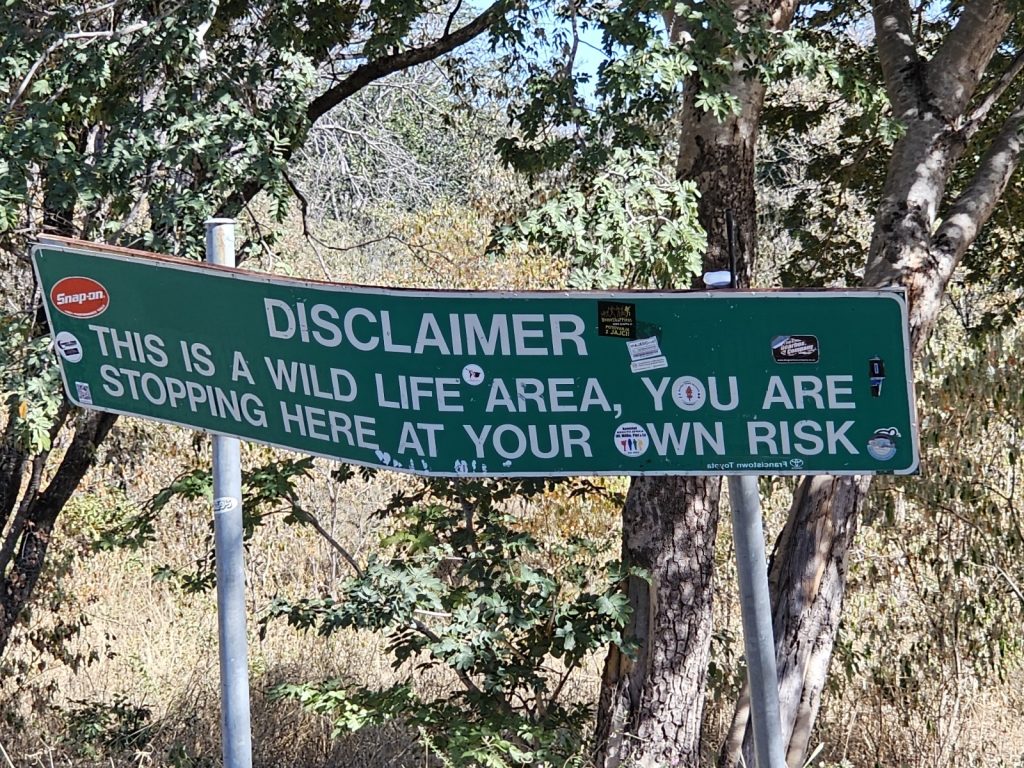
217. A gentle reminder at all the parking lay byes on the road that wild animals were about. This sign looks like it was used by elephants as a scratching post.
I kept my eyes out for wildlife but saw nothing. The road went past two or three watering holes, one like a small lake, but there was nothing at these either. Although round the perimeter of them there was a lot of dung and footprints. I can only assume that the animals were either away from the road in the bush foraging and would return in the evening to quench their thirst or that there were other watering holes far in the bush and away from the road, which were more preferable.

218. I passed a few watering holes and even this small lake but did not see a single animal all day.
Soon I was approaching 100 km and it was only 1430 in the afternoon. However it was taking its toll. My arms were sore, especially the wrist joints and elbow joints. I think my handle bars could have been 5 cm higher. In theory I could have put the seat down a bit, but it was just right for peddling and I would rather have sore arms than risk injury to my knees. I was also getting chaffed in my groin area and with the sweat it was starting to sting. About 20 km before Pandamatenga the road reached a large cattle grid and I cycled over it into a totally different landscape. There was no more bush with the threat of wild animals about to leap out of it, but now I was into farming land with huge flat fields full of sorghum. The fields were vast and this was farming on an industrial scale which one might find in the mid west of the USA or Ukraine.

219. About 20 km south of Pandamatenga I passed a large cattle grid separating the wild bush from organized farming where these large fields of sorghum flourished.
I also reached the section where the road was being widened. The road rollers had packed an earth and aggregate track beside the current carriageway and it was firm and great for cycling on. Occasionally it was covered in a thin layer of bitumen with rocks on it to prevent traffic going on it but I could weave between the rocks. I passed by a large army barracks and then entered Pandamatenga. It was a spread out town but had a tangible centre which was dominated by huge grain silos. This was where all the sorghum ended up before being transported south on the many grain carrier trucks passing me. There was also a large parking area here for all the trucks where many probably spent the night. Currently there were over 100 parked up along the wide dusty verge, 3 or 4 deep. My main interest in Pandamatenga though was the supermarket. I was parched when I arrived although I still had a bottle of old warm water with unpalatable bits suspended in it. It was no match for some cold sodas and an icecream though.

220. The bar and dining area of A Touch of Africa Lodge was a relaxing place to have a day off physically recovering and catching up with the blog.
There were a surprising amount of white farmers in the carpark and I asked one of them about a place to stay. They recommended a Touch of Africa, a lodge which had camping spaces some 6 km further north. It was the one I had already bookmarked so it was good to have the confirmation. It was a quick half hour cycle to get there and I reached it in the heat of the afternoon. It was run by Franz, a retired Austrian hunter and his wife Mandy, a South African. They gave me a lovely thatched lodge overlooking a waterhole where game was rumoured to come. There was the main restaurant and bar area which was also thatched. The only issue I had initially was the dog. I was the largest and most ferocious looking dog I had ever seen. It was a 90 kg Boerboel, which was extremely muscular and with an enormous head. The dog would have eaten a couple of drug dealers XL Bullies for breakfast and perhaps a lion for dinner. However, the gargantuan canine had been well socialized, knew its subordinate position and was well behaved. I had a great shower and then one of the infamous burgers before deciding to have an extra day here. I was tired and needed to rest and I also needed to catch up a bit with the blog tomorrow. I did not sleep that well as I made the mistake of buying two energy drinks at the supermarket which were loaded with caffeine.
Day 042. 20 June. Nata to Telecom mast 85 km North. 85 km. 6 Hours. 190m up. 120m down. My tyres were still good in the morning so it looked like the problem was solved for the time being and I would be able to move on up to Kasane and Livingstone. Rubert made me the usual sumptuous full breakfast and by the time I had that and said my goodbyes to the team and other guests it was already 0930. I did not really have a plan but there were a few options every 15 to 20 kilometres as I headed north. The one thing I did need was one of these options. It would have been foolhardy to camp beside the road, a little in the bush as there were quite a few wild animals about on this next stretch. Most notably there were elephants and they were abundant over the next 300 km. After all, the road between Nata and Kasane was called the “Elephant Highway”. However there were also rumoured to be wild dogs and lions. So a secure camp was necessary.

209. The open savannah just north of Nata was initially open until the scrub started to appear.
Once on the main road north, The A33, I was delighted to see that there were road works to widen the road. I knew there was a little from my last foray up here until the punctures forced me back, but now I could follow them on one side or the other of the road for the best part of 20 km without going on the main carriage way. The packed earth which had been steamrolled was as good as smooth tarmac and I made good time. Even if I had not been on the newly constructed verges the road was not that busy with trucks and vehicles.

208. Some of the termite mounds on the flat open savannah with limited bush were 3 metres high.
Eventually the packed earth verges finished and I was forced back on the main carriageway, but there was a wide verge of nearly 2 metres width and this was separated from the main carriageway with a yellow line and a row of cat’s eyes. The trucks were not that plentiful and they were not going that fast either. Perhaps they were wary of the elephants. Each side of the road there was initially wild open savannah stretching to the horizon, golden and shimmering in the heat. However after some 30 km since leaving Nata the bush slowly started to appear and then it became quite dense. I knew there were some elephant watering holes near the road along here and kept my eyes peeled for them but I did not see any. There were plenty of signs though, most notable the large tracks across the road and into the bush on each side and elephant dung everywhere. After about 45 km I got to the turn off to Elephant Sands Lodge and Campsite. However, it was down a very sandy track for 2 km and it was likely I would have to push the bike the whole way there and out again tomorrow. Despite the likelihood of seeing elephants come to the watering hole at Elephant Sands I decided to skip it, especially as it was just after midday.
My next option was another 10 km and it was the Veterinary Fence to keep foot and mouth out of Central and southern Botswana. I reached it at the same time as a large convoy of trucks but then overtook them all as they waited. I was flagged through as there were not real controls going north; however there were coming south. Just after this control were a number of shacks selling cold sodas and biscuits. I stopped at one and had something but there were no cooked snacks. It was still just 1330 when I finished so I decided on the next option which was a Telecoms mast in another 30-35 km.

210. My lunch stop at one of the small shacks by the veterinary fence which sold non perishable items only.

211. Just north of the Veterinery fence I started to see more wildlife animals like these zebras.
It seemed a bit wilder now on the north side of the Veterinery fence and it did not take long before I saw a few zebras in the scrub, but still no elephants despite all the signs. Then in about a kilometre I saw the unmistakable sight of one beside the road. It was huge even from here. There was very little traffic and I covered the distance in a few minutes and was suddenly 200 metres from the elephant who continued to graze right beside the road. There was no way I could get past without risking a charge so I waited and waited. Eventually after 5 minutes a convoy of 4×4 came the other way heading south. They slowed for the elephant but continued and the elephant was unmoved. Usually they are afraid of traffic and run back to the bush, but not this one.
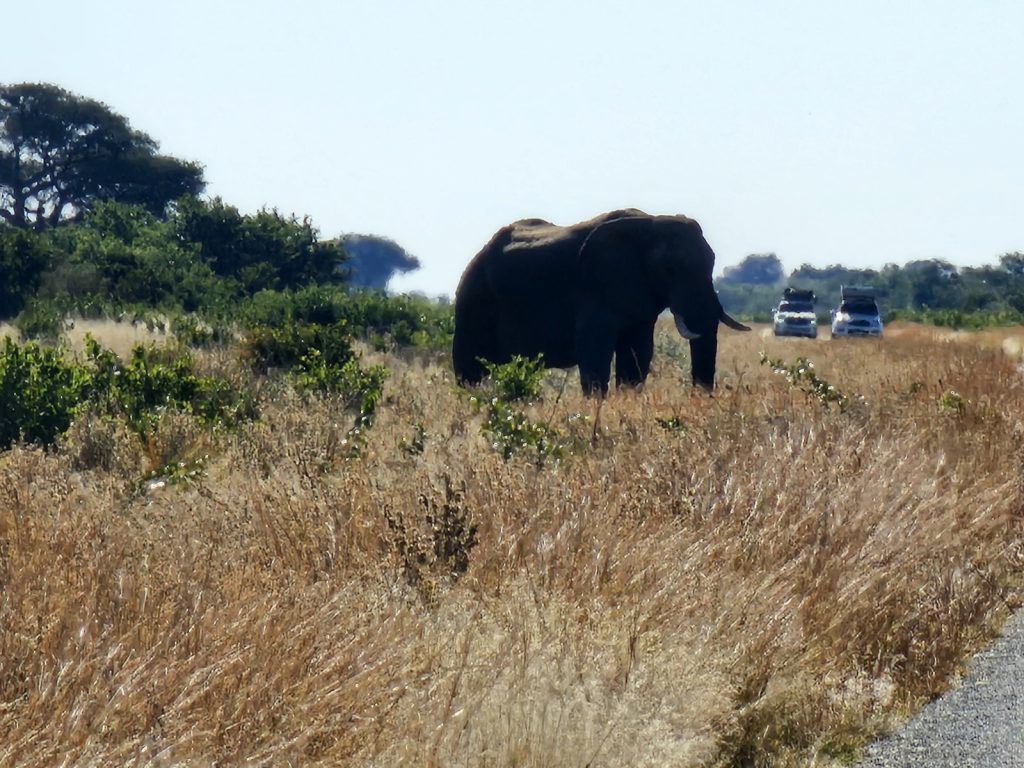
212. The first elephant of the day was grazing at the side of the road and was unperturbed by traffic. I had to have a 4×4 escort me past it.
At last a 4×4 came going my way and I flagged it down. The driver I think just wanted to blast past the elephant but agreed to drive between me and the beast. The road was quiet so we both crossed over to the other side. I could see the driver was nervous and had the elephant charged, I am sure he would have sped off leaving me in the lurch. It didn’t charge but there was a lot of ear waving. Soon we were both past. In the next 30 km I saw another two elephants attempting to cross the road but traffic came by just at the right time and they remained on the edge of the bush waiting for another chance, wary of the trucks. I don’t think they would have seen me as a threat but I was just 40 metres away as I passed.

213. The third elephant of the day was very wary of traffic and was about to cross in front of me when a 4×4 appeared and then it fled back into the bush.
The telecom tower I was aiming for soon appeared some 5 km away and it took no time to get there. The head wind of the last month was more of a neutral side wind now and the road surface was good and the tyres at 40 PSI rolled smoothly over it. It was just 1530 when I got there so I decided to check it out. I had heard the perimeter fence was damaged, according to my app called “ioverlander” I parked the bike at the edge of the road and walked the 100 metres up the sandy track checking for thorns as I went. The fence had been damaged but it was now repaired in a fashion. However, right round the perimeter of the compound was the most vicious elephant defence of concrete with sharp stone sticking out of it and also a grid work of iron with spikes in it. The latter was like an upside down agricultural harrow and it would not be possible for an elephant to cross it. I returned to my bike and wheeled it back to the compound. The only issue I noticed was there was a 50 cm gap under one of the gates which perhaps a predator might wiggle under, but it was unlikely I thought and they would still have to cross the harrow spikes.

214. My camp in the fenced compound 85 km north of Nata. The gate was open on arrival and I secured it with my bike lock once inside.
I had my tent up quite quickly and then ate cold dinner out of tins; pilchards, backed beans and fruit salad to be precise. I still had 3 litres of water for tomorrow which would hopefully take me the 115 km to the village of Pandamatenga where I hoped to stay. If I had not stayed at this telecom mast the next option was a cluster of abandoned cabins a further 20 km. Apparently they were still clean and with roofs but only one had a door and that was last year’s report. After the hermetic dinner I wrote the blog and finished around 2000.
Day 041. 19 June. Nata Rest Day. 0 km. 0 hours. 0m up. 0m down. I had a great lie in as I knew I had nothing to do today. After the usual tasty full breakfast Rupert got a phone call to say the package had arrived and was ready to pick up. Half an hour later I had everything I needed to get back on the road.
I took the wheels off the bike and then the tyres of the rims and cleaned everything up. I had already cleaned them a week ago in Gweta so there was not much to do. Once clean I put the rims back on and had great difficulty in getting a seal to pump the tyre up. Eventually it started to inflate using my electronic pump and soon I had enough pressure in them so the tyres pressed against the rims and they were “seated”. I then removed the core of the valves and injected the latex liquid, about 130ml, into each tyre and blew them up again to 30 PSI. There were a few leaks but as I spun the tyre the latex liquid found the leaks and bubbled out. As it bubbled out it reacted with the air and solidified in the leak, thereby sealing it. I let the tyres be all afternoon spinning them from time to time to distribute the latex liquid and was delighted to see they held their pressure. I then put them up to 40 PSI and they still held their pressure.
The punctures were solved for the short term and I should be able to get to Livingstone now. In the meantime Fiona had had great success at the main DHL Express depot on the outskirts of Edinburgh and the parcel with the new puncture resistant tyres was dispatched with all the customs forms in order and DHL promising to facilitate it through Zambian customs, which could still be a banana skin.
That evening more guests arrived and Rupert made another great meal. That he prepared this sensational rice and curried goat in a spinach sauce on a couple of gas rings is impressive. Two of the guests were Ricus and Pietro Delporte who were South Africans moving up to Malawi for 6 months until the weather at their other house in Knysna improved. They had worked and travelled all over Africa and were incredibly well informed and experienced. Ricus was articulate, assertive and knowledgeable but was not a know-all by any means and a joy to discuss things with and listen to. They were the most interesting people of many interesting people I met round Ruperts camp fire. They also invited me to stay in Malawi at their lodge, which I was planning to go past anyway. I had really enjoyed my stay at Eselbe Backpackers and was indebted to Rupert for his hospitality and help, but after 3 days here I was now ready to move on.
Day 040. 18 June. Nata 7 km up road and return. 14 km. 2 hours. 110m up. 110m down. After a very relaxing day at the bohemian and inspiring Eselbe Backpackers as the guest of Rupert I was ready to set off after a great breakfast which he made. I half cycled and half pushed the bike the half kilometre up the sandy lane from the rivers edge to the main road and then started the cycle up the road. The road was being widened and there was a long stretch of newly finished road with rocks on it to stop drivers going on it. However I could simply cycle between the rocks very easily, and did so.
However I noticed that my tyres were deflating and eventually stopped. I had inner tubes in them but I think both had thorns in them. It took me well over an hour to change the tube at the back and patch the tube at the front and I was ready to set off again when I noticed the tyre at the front was still deflating. I must have had two punctures. I thought this is a hopeless situation and I cannot limp up the road repairing punctures every 10-15 kilometres. I knew I was vulnerable to punctures as the tyres I had did not have any embedded protection in them and were primarily designed to be tubeless. I decided it best to return to Eselbe Backpackers and sort something out. I pumped up the tyre again and it just got me back. Everyone was surprised to see me.
I made a few phone calls back to the UK just to make sure the new tyres I ordered were in hand and to find out about freight. In the meantime Rupert made a call to Cycle Base in Gaberone to see what they had. Rupert discovered they had the latex liquid to put in the tubeless tires I had on and also that they had inner tubes with valves with removable cores so I could also put the latex liquid in the inner tube if need be. We ordered some and were assured it would be sent when the money transfer was made.
Rupert then spent hours on the phone to his bank to try and make the transfer. He had a frustrating fruitless time of it and we eventually had to go into his bank to sort it out. However, the transfer was done and the goods were put on the night bus. I was very indebted to Rupert for all the hassle he had on my behalf. Meanwhile back in Edinburgh Fiona had received all the new tyres and inner tubes to send and had researched the best way to get them to Zambia. There was not much more to do except wait.

207. The large communal dining table and fire pit beyond it were the social hub of Rupert’s backpackers.
As usual there was a great meal that night and then everyone sat round the fire discussing virtually every topic on Wikipedia. The ambience was superb. While Rupert’s Eselbe Backpackers is quite rustic and everything just about works, with his cooking and the evening’s conversation round the fire after the meal there is the potential for Eselbe Backpackers to become legendary.
Day 039. 17 June. Nata Rest Day. 0 km. 0 hours. 0m up. 0m down. I had a great lie in and got up when the sun had chased off the chilly morning. Rupert the host at Eselbe Backpackers made me a great breakfast with real coffee. Most of the guests were leaving including the very nice French couple. However I would probably see them again about Livingstone in a week’s time.
Once everyone had gone I went into the quiet bar area where there was a table and wrote for a couple of hours. It was very relaxing with virtually no disturbance or sounds save for the doves. By midday I was done so I then went for a snooze on the hammock. It was lovely to have nothing to do for the afternoon as previously virtually all my time was spent either cycling, camping or trying to keep up with the blog.

206. On my very relaxing day off at Eselbe Backpackers in went for a short paddle on the Nata River having been assured thw were no crocodiles in the remnant of the river which had no flow in this dry season.
Once I woke I went for a small paddle on the river in one of the old canoes Rupert had. This part of the Nata River still had about a kilometre of water in it and it was about 2 metres deep at the most. There was no inlet or outlet of this long channel at the moment but it would return in the rainy season when the river would form and flow south again. I was assured by Rupert there were no crocodiles in this long pond and he regularly paddled here.
In the evening he made another fine meal and there were only 5 of us at the meal. In the evening we sat round the fire again and chatted until it was quite late. Rupert had a wealth of knowledge about the area and the wild road north from here to Kasane so I picked his brains on it. I had really enjoyed the peace and quiet of his rustic lodge.
Day 038. 16 June. Zoronga to Nata. 45 km. 4 hours. 30m up. 40m down. I slept well and long, and was up at 0630, as the first glimmer of light was appearing in the east. The cockerels had long been awake but now the hens too started foraging nearby, clucking away as I packed. I was ready by 0730 and set off down a series of sandy tracks to the tarmac road which was the artery of the village. Many children were also emerging from the lanes and heading to school in the smart green uniforms. They were vibrant and lively in stark contrast to the younger women at the shop yesterday obsessing about their hair extensions. Once on the tarmac road in the village I cycled up past the shop and onto the main A3 road. It was just over 40 km to Nata now.
There was no breeze for a welcome change and I made quick time. It did not take long before I found a rhythm and was making good time on the empty road. I passed a sign saying “slow down severe potholes”. I thought nothing of it as I generally welcomed them as it slowed the vehicles to a crawl while I could weave in and out of them.

200. The road between Zoronga and Nata was usually fine but for 3-4 sections each of about kilometer the tarmac was destroyed and people preferred the verge
However in this case the entire road had disappeared. There were some thin strips of tarmac for a few tens of metres and then they ended in a lip before another strip started. Most drivers simply abandoned the road and moved onto the verge which was graded, but somewhat rutted. It was a difficult choice for me to either persevere on the destroyed tarmac road or risk the sometimes sandy ruts on the verge. The road was often the least of two evils. There were perhaps 4 sections of this destroyed road and each section was about a kilometre long. I think they were in the process of building a new road adjacent to this road I was on and they had pretty much given up with any maintenance of the original road, assuming the traffic would cope until the new road became operational in a year or five.

201. Near Zoronga the landscape was covered in a sparce forest with well cropped grass underneath. There were hamlets and homesteads hidden in these forests some 200 metres from the road.
Beside the road the landscape continued to vary with either sparse forest and exhausted grazing underneath and then homesteads just visible through the trees away from the road in the forest, or open savannah which stretched far into the distance beyond the curvature of the earth. There was some livestock grazing here but most I saw were clustered around a few water holes near the road. The livestock were again a mixture of cattle and horses with about half and half of each. At a few of these water holes there were flamingos, either resting on one leg or slowly wading through the shallow water while filtering with their beaks. I had heard from many people that the larger salt pans which were currently flooded were currently full of flamingos.

202. There were many salt pans which had dried out but a few still had water like this one with livestock and flamingos.
I stopped for a rest and to eat a snack of dried noodles and biltong. When I did this a 4×4 usually stopped to enquire if everything was OK. Before long one stopped with a charming young French couple. We chatted for about 10 minutes and they gave me a delicious packet of biscuits. We discovered we were both heading to the same backpackers in Nata. They told me they had just seen a large male lion crossing the road about 60 kilometers back towards Maun. It was exactly in the place where I had seen the large herds of unfenced livestock yesterday. They showed me a video and it was clear the lion had just fed as its stomach was full. I am sure this lion was living on borrowed time before the herding or grazing committee contracted a hunter to put it down as it would continue to kill livestock now.

203. Between the salt pans the landscape was open veldt with golden grasses flowing in the breezes
Once they left I had about another 20 kilometres to go to reach Nata and without the head wind it went quickly. As I entered the town I got to a T junction with a larger road which went up the east side of Botswana from south to north. It was the A33 and it was another route from Central Southern African countries like Zambia and Congo to the coast at Durban and Port Elizabeth. I would have to follow it for 300 km in the next week from Nata to Kasane up the so-called “Elephant Highway”. I followed the road for about 2 km to the north and then headed east down a sandy lane to Eselbe Backpackers.

204. The bar and dining area at Eselbe Backpackers was the meeting place for younger travellers on independent overland trips.
It was only about 400 metres down the lane but I had to push the bike half the distance due to the sand. When I reached the backpackers it was even more Bohemian and relaxed than I imagined. It was owned and run by Rupert, a Brit with a long family history in Botswana and Swaziland. There were perhaps 10 various buildings, all of wood and bamboo. Some were the bar and kitchen and others were the small huts which were bedrooms. There was a large outside table under a huge canvas awning. The French couple who gave me the wafers, Pauline and Damien, were already here and so were about another 8 overland travellers in their 20’s. It was outside of the cut and thrust of Nata but I suspect there was nothing to entice me into downtown Nata except the supermarket to stock up. Rupert showed me a bamboo hut with an attached bathroom and shower and I unpacked the bike. The room had everything I needed and outside there was plenty of chat with the relaxed group. Later in the afternoon Rupert ran Emelia, another French guest, and myself into the supermarket for some supplies. He also bought the ingredients for himself to make lasagne for us that evening.

205. One end of my room at Eselbe Backpackers in Nata with the semi outdoor bathroom.
The backpackers was right beside the Nata River which was still full of water but not really flowing anywhere. It was almost like a large long pool which still existed while the river had stopped flowing. Contrary to my intuition the river flowed from the north to the south through the town of Nata and onto the salt pans. There it spread out to form the seasonal lakes which then evaporated in the dry season.
In the evening Rupert made a large lasagne to feed about 6 people while a few of the others made their own dinner and we all sat around the large table and ate together. Once the meal was done the fire was lit and everybody gravitated towards it, sitting round it. Without the breeze the smoke went straight up so there was no one having to endure smoke in their eyes. I was a little distracted in the evening trying to get some replacement Schwalbe tyres with some puncture protection as the current tyres I have on the bike have none and I feel quite vulnerable especially when cycling near thorns or over broken glass.
Day 037. 15 June. Gweta to Zoronga. 64 km. 6 hours. 140m up. 150m down. In the morning the tyre was flat. The sealant had failed to seal the hole. I tried blowing it up again to no avail so decided to take it off and put a tube in the tyre. On inspection all the sealant was either dried up or had been expelled by various punctures. It did not take long to put the tube in as it was the front wheel and I pumped it up to 35 PSI and it was taut, but with enough flex to act as a shock absorber. I paid the bill and left at 0930. As I cycled through the village on this Sunday morning it seemed quite a few people were going to church. They were well dressed and seemed to be the friendliest in the community as all smiled and waved as I went past. I passed the giant baobab tree, which was perhaps 25-30 metres on second thoughts and then reached the main road by the petrol stations. I cycled along it for about 5 km until I reached the turn off for Planet Boabab, a 3 star lodge.

193. There were lots of large baobab trees around Gweta, especially near a lodge called Planet Baobab.
The lodge was a short kilometre down the track. Dotted amongst the savannah scrub here were more enormous Baobab trees. It was not so much their height which amazed me but their huge girth. However, at the lodge there were a few gigantic ones and one especially right at the lodge which must have been 7-8 metres in diameter. I guess this tree was at least 500 years old and probably a lot more. There were perhaps 20 giant trees here but this was the most impressive. The lodge had built a bar right under it thinking that would be cool, but I found it lacking taste and a bit disrespectful. I chatted with a very nice UK couple here before having a second look at the trees. If trees could talk they would have some story to tell. Possibly from a time when humans did not live in the area.

194. One of the largest was right beside the lodge and must have been 7 metres in diameter. It was a behemoth.
I did not return to the main road straight away but continued on a gravel road to the east for about 5 km. It was a lovely quiet cycle through scattered homesteads in the sparse forest. I have noticed that a lot of the homesteads are not beside the main road as one would expect but are perhaps 200-400 metres off the road and not visible from the road. Here surrounded by a perimeter fence of branches as posts and wire lies a large compound with maize growing in it and then the inner compound with 3 or 4 huts, often with thatched roofs and a corral where the livestock spend the night. On this small gravel road I was much closer to these homesteads and frequently passed people who were much more friendly than their counterparts in villages and frequently waved. It was not as quick as the tarmac road but much more interesting.

195. The were lots of subsistence homesteads beside the smaller road near Gweta. Many have maize fields.
Eventually the two roads merged and I was back on the tarmac but now I entered a region which was bereft of trees and was a vast area of savannah grass with extensive salt pans in between. These salt pans were quite natural and occurred because the rains of the last millennia collected in these barely discernible depressions on the landscape and then evaporated over the dry season leaving a mineral residue which has accumulated. They were bare areas of white deposits where nothing grew. I passed a few smaller ones of perhaps a square kilometre or two but I knew from the map there were much larger ones which were hundreds of square kilometres just beyond the horizon like the Ntwetwe Pan, The Nxai Pan and the Sowa Pan. My initial plan had been to cycle across one of these on 4×4 tracks, but because there was so much rain in the recent rainy season many of the pans were still covered in water or still marshy with a muddy clay like silt which would be a nightmare to push a bike through.

196. Half way between Gweta and Zoronga were huge salt pans which must now fill after a very wet rainy season. Perhaps once a decade in this climate era.
Between the small pans I passed beside the tarmac road were the extensive veldt-like grasslands with golden grasses. They were excellent grazing and there were large herds of cattle and horses scattered across them. There were no fences and the livestock were free to wander. I thought there can’t be lions here as they would have a field day with all this easy prey at their disposal.

197. Between the salt pans on each side of the road was savannah grasslands which was being grazed by large mixed herds of cattle and horse
As I cycled across this area of smaller salt pans and open savannah I realized I had little hope of reaching Nata that evening. It was mid afternoon and I still had 50 km to go, although the easterly headwind was diminishing as it did most afternoons. I had two options, one was a telecoms mast just before Zoronga and the other was Zoronga village itself just a bit further, leaving just 40 km to do the next day to reach Nata. I had enough water for the telecoms tower but they were quite soulless, perfunctory places to campsite so I decided to continue to the village where there was a small shop where I could buy something and ask about somewhere to pitch a tent as I have done in Phudukudu.

198. The neighbouring compound at Zoronga next to the absent policeman’s house where I was allowed to camp.
I reached the village and took the side road into it and soon found the shop. There were a few young women hanging around the shop and working in the shop and they all seemed totally disinterested, with a lot of shoulder shrugging to every question. Of the 5-6 of them, half were putting hair extensions in each other’s hair and they only said “give me money”. Eventually one woman said “try next door” but there was no next door. When I queried this she said “try the police at the end of the road”. So I set off into the spreadout heart of the village. Eventually after some 5 attempts and nearly at the point of giving up and returning to the tarmac road out of frustration, I found a grandmother who pointed me to a sandy track leading to a cluster of houses. There another grandmother found a neighbour of the policeman, who said he was away. However he made a call to the policeman who gave me permission to camp in his compound. It was perhaps 1700 now so I had the tent up beside his house and had eaten by nightfall. I went into the tent as all around me the evening fires in the compounds around me flickered and the evening air had the aroma of woodsmoke. I wrote a little but was asleep by 2000 and slept well.

199. My tent next to the policeman’s house in Zoronga. He was away but told a neighbour I could camp there.
Day 036. 14 June. Phuduhudu to Gweta. 81 km. 8 hours. 230m up. 230m down. I slept well on the verandah of the community hall and was content to be amongst the fire fighting crew who were all very helpful. After the indifference of the Botswanans I met on the first 3 days in the country I got a completely false impression of them and that has now completely changed. I now find them competent, helpful, good drivers and cheerful. I was up before anyone else and had a disgusting breakfast of corn beef out of a tin and some bread. I had forgotten just how putrid corned beef was as it was about 3 or 4 decades since I last had some. I was packed up and ready to go by 0800 as the others were rising. I went to see the foreman who sanctioned my stay yesterday and gave him 200 Pula, or about £10, to either buy the team some soft drinks that evening or give it to the Phuduhudu community as he felt fit. It was graciously received. They waved me off from the compound and I cycled through the empty lanes just coming to life and returned to the main road.
The headwind hit me with a vindictive force as soon as I was out of the shelter of the village trees. I guess it was a force 5 and right into my face. I was struggling to get much more than 10 km per hour and if I pushed harder I could feel my right knee ligaments straining. It was going to be a long day. After an hour or so I saw 4 zebras running down the road towards me. When they saw me they bolted into the bush. As I was looking for them I saw two giraffes some 200 metres away. They were both very alert and looking straight at me. Either they have very good senses and saw me on their own or were alerted by the zebra as I think the two animals have a symbiotic alert reciprocity.

187. I saw a couple of giraffes on the south side of the road about 10 east of Phuduhudu.
There was not much to say about the next hour as I ground into the wind. The grasses at the side of the road were being buffeted by it and I felt progress was slow and at a cost. About an hour later I passed a larger herd of zebras. They were grazing on the wide verge but when they saw me they became unnerved and started to run in the same direction I was going but just inside the edge of the bush. They ran for about a kilometer pausing just to let me catch up. I could hear their hoofs pounding the ground.

188. About 20 km east of Phuduhudu i came across another herd of zebra with About 50 animals in total.
Soon the vegetation changed and the taller scrub gave way to shorter scrub and then this too almost disappeared leaving just wide open grassland savannah. There was no hiding here and any zebras or giraffe would have been visible for a kilometre and an elephant 2 kilometres. But I could see nothing and all the animal tracks which came out of the bush on each side of the road disappeared. It was only after 20 km when the bush started to get a bit thicker again did I see a flock of about 40 ostriches, just before the end of the park. As I was watching them a police pick up appeared and wound down the window. “Do you remember me?” said the passenger with a bright smile and gleaming teeth. It was the police woman from 2 nights ago when I encountered the elephants. We chatted for 5 minutes before she headed off back to Maun.

189. As I cycled east further into the Makgadigadi National Park the bush almost dissapeared and there was just scattered scrub rising out of the endless savannah grasses.
?After the park I was suddenly back in cattle country and I was quite surprised to see them. There were rumoured to be lions in Makgadikgadi National Park and this did play on my mind a bit, but now there were cattle, goats and donkeys about I was off the menu. Their farms were small and almost subsistence level I think. The going was still slow despite the wind dropping as it often did in the afternoon. Then I noticed my front tire was very flat. I stopped to blow it up but it had a hole in it and the sealant was bubbling through and would not seal the gap. I pumped it to 35 PSI from the 10 it was at, and set off. I was going much faster now and perhaps I had been running this tire under pressure for a while and was blaming the laborious progress on the wind which had largely disappeared now, while it was actually the tire all along.

190. Just on the eastern edge of the Makgadikgadi National Park I saw a flock of about 40 ostriches.
My joy was short lived as I had to stop and blow the tire up again after 5 km. I could feel the air escaping as it blew onto my cheek as I operated the battery pump. I had to do this about 6-7 times in all and the hole was just simply not sealing. There was still sealant in the tire as it was bubbling out. I was starting to curse the idea of tubeless tires. When working they are great but in a crisis like this they are useless and inevitably I will have to put a tube in this front tire too. I will then have both front and back on tubes and only the outer tire to protect them from the thorns on the verge and the copious amount of broken glass along the road. A puncture resistant outer tire like a Schwalbe Marathon Plus would have been better as it had a 5mm thick strip of kevlar embedded in the tyre’s circumference. I limped down the road to the turn off to Gweta and then down the 2 km access road.

191. On the outskirts of the large village of Gweta i saw this enormous Boabab tree which was about 35 metres high and the biggest Boabab i have seen.
On the access road I passed a huge Boabab tree. Its swollen trunk must have had a diameter of 3-4 meters or so and the tree had a height of 35 metres. It was an enormous specimen and must have been very old and venerable. It has overseen many generations of humans. When I got into the larger village it was easy to find the lodge. They had space for me but were busy with a large group with about 20 Chinese. I got a small roundavel style round hut with a thatched roof. It was quite cramped inside but had all I needed. On the outside was an area enclosed with a 2.5 metre wall which was the bathroom, with toilet, sink and shower, and the trees above. I had a shower and washed my clothes and also washed the back tire I took off yesterday to get rid of all the water soluble latex on it. I did this as I would probably have to use it tomorrow morning if the front tyre did not seal overnight. After that I went over to the quite chaotic buffet which was dished out rather than self service. I had to be quite assertive to get a good portion and then get cutlery from the limited supply. The Gweta Lodge has potential to return to a former glory but at the moment most things were a bit haphazard or broken and it was almost the same price as the considerably better Maun Lodge. Still I was grateful for a bed after 2 nights camping.

192. The quirky but slightly chaotic and ramshackle Gweta lodge had a tiny rondavel type room for me with an outdoor bathroom behind the wall on the left.
Day 035. 13 June. Motopi Telecom Mast to Phuduhudu. 45 km. 5 hours. 110m up. 110m down. It rained a little in the night which was a surprise, however I slept well and woke early. In the morning the tyre was flat so I decided to change the tubeless to one with an inner tube. The whole procedure took about an hour. There was no liquid latex left in the tyre. It had all either leaked out or just dried up in the heat. It meant whenever I got a new puncture there was nothing to seal it. In retrospect I had no choice but to switch to an inner tube. In the next few days I will have to get a replacement organised. Elias left first heading towards Maun while I headed east into the land of the elephants and into the strong wind.

177. The large female was guarding the back left of the procession helping a matriarch bring up the rear.
Once I left the security compound and was back on the main road I was aghast at just how strong the wind was. Elias would have an easy day while I had to struggle at 10 km per hour. I retraced my route of last night past Leopard Plains Lodge and on to where the two elephants were last night. There were none now but I soon saw a single one in the bush on the south side.
A bit later I saw another, possibly a smaller female. Then behind here I saw a small procession of elephants heading east. There was a side road here up to a raised area and I took it to get a better view, I could now see there were at least 25 in the procession of all shapes and sizes. The smaller female was marking the back left of the procession while there was a large matriarch at the back. As the procession passed a dusty area they all stopped and flung an arc of dust over their backs. There must have also been a big matriarch at the front also but I did not see her. I watched for a good 20 minutes as the whole herd moved through the bush on the other side of the road. The younger female guarding the back nearest the road knew where I was and what cars were approaching the whole time. It was a tremendous privilege to watch them heading through the bush towards greener pastures.

178. I had already seen about 20 elephants that morning so expected to see even more now i was entering the National Park.
I left as the herd moved off and returned to the road. There were another two sightings of single elephants right on the verge. I think they were drinking from a leaking pipeline which went along the south side of the road. After these two I continued east for another couple of kilometres into the wind and then came across 4 large elephants near a leak in the water pipe. They were close to the road and had I cycled past they would have been just 30 metres away. Way too close to call. So I stopped some 100 metres away to wait for a vehicle. There were none for about 10 minutes. It was great watching these elephants as such close quarters for this time, completely alone with them. Then a 4×4 arrived and I flagged it down and explained to the Botswanian driver I needed him to drive slowly for 200 metres while I used his vehicle as a shield. He was very obliging. Once past he drove off and I observed the elephants for another few minutes. They were truly enormous.

179. I got to these 4 large elephants and thought it would be foolhardy to squeeze past so spent 10 minutes observing them until a car arrive to escort me past

180. Up close the 4 elephants were quite daunting and very large.
I was making heavy weather of the kilometres in this headwind and with the animal viewing breaks was doing less than 10 km per hour. I then decided to see if I could find somewhere in Phuduhudu village rather than go another 40 km after that to another telecoms mast. I did not want to get caught out in the dusk in elephant alley. I had heard that the area I was going into now, the Makgadikgadi National Park was full of zebras at this time of year and right on cue I ran into a herd of about 300 crossing the road. As I was watching them an elephant also crossed right in front of me. I think the elephants are generally quite passive, but if there are young, or a male is in musk then they can be unpredictable. I had to wait for about 10 minutes to allow for all the zebras to cross. I peddled on for another 10 minutes and then came across another large herd with 300 animals. They were unnerved by the bike and ran parallel to the road for a good kilometre with me cycling beside them.

182. Waiting for a large herd of about 300 zebra to cross the road. There was another herd of 300 just beyond

183. Some of the zebra. They were not wary of cars and lorries but very nervous of me and bolted soon afterwards.
Soon afterwards the road veered to the north near a telecoms mast and then reached the village of Phuduhudu. I knew there was a shop here but it was off the main road. I asked a few people and they directed me into a grid of wide dusty lanes. The houses here were well kept and there were some enormous parkland type trees dotted about. It had a nice ambience. The shop was closed for the afternoon but a team of kids soon discovered me and came over excitedly. They were easy and delightful and quite happy to practice English. There was a building next to the shop with perhaps 10 green tents outside it. I went over to ask if I could stay also. “Not a problem,” they said.

185. Some of the happy kids in the village of Phuduhudu. There welcome gave me the confidence to go and ask others if I could stay in the village.

184. One of the streets in Phuduhudu village with their big trees and well kept compounds with traditional buildings and huts
It was actually the village hall they were at and there was a building with a verandah. They said I should put the tent on the verandah. It was up and I was unpacked in half an hour. I was curious about the others here and asked them what they were doing. They were all firefighters from Maun and they were burning the verges so a fire could not jump the road. There were few females but they were mostly men. They had a lot of small equipment like leaf blowers to help drive the fire. They were a cheerful, generous and good natured lot. Once the shop opened I bought some supper and bread and then settled down to write the blog as the sun set in a blaze, as it was partially cloudy. It had been a really memorable day with the elephants and then the insight into the nice village and the travelling firefighters.

186. My tent on the verandah of the community hall, where the visiting fire fighters had said i could camp.
Day 034. 12 June. Maun to Motopi Telecom Mast. 96 km. 8 hours. 310m up. 310m down. I was slow in getting going and did not leave until nearly 1000. I was already on the SE side of town so I was soon on the main road, the A3, which led east to Nata nearly 300 km away. I passed a lot of the suburban warehouses one finds on the outskirts of town like builders merchants, petrol stations and workshops and also a few out of town tourist lodges, and then suddenly I was beyond the outskirts and in livestock country again. Sheep, goats, cattle and donkeys grazed the verges. There was very little change and if it kept up like this all day I would be struggling to find much to say. After 2 hours I passed the village of Chanoga where there were a couple of very basic roadside pit stops selling food from 3 or 4 large cauldrons. I am not sure if it would be freshly made or yesterday’s, but I am sure as I go deeper into Africa I will have to eat at these soon. Today I was still full from the large breakfast.

171. At many of the small villages along the road there were local cafes. It would nor be long before i was eating in them.
About an hour east of Chanoga I saw something unmistakable in the distance, namely bicycles with panniers. There were two of them so I crossed over the road to meet them. There were Marius and Simon from Germany and they looked cool and rough, cycling in sandals on bikes which looked like they had been well used. I was very enthusiastic to meet them. It was like a Man Friday moment. They were also eager to meet me. Very soon we realized we were both doing the exact opposite to each other. They had come from Dar-es Salam, about 3600 km away and were going to Swakopmund. with about another 1300 km to go. We chatted for nearly an hour beside the road exchanging tips and they added me to a Whatsapp group about cyclists in Africa. They said there were about 6-7 cyclists coming my way over the next week or so, including a Swiss guy not far behind them. It was a joyful chat, partly because of the coincidence, and partly because they were likable, happy, easy going people. One tip they gave me was that it was possible to sleep in the fenced off areas at the bottom of telecom masts as the gates were always open and it was then possible to close the gates and lock yourself in with the bike lock. They had used about 4 in the last week as it was out of the way of elephants. There were apparently many elephants in the next section to Kasane. After an hour we shook hands heartily again and then set off.

172. At last I saw some other cyclists after a month on the road. Marcus and Simon were doing the exact opposite to me and going from Dar es Salem to Swakopmund.
It did not take me long to get to a veterinary fence where I had to disinfect my shoes and ride through a puddle of disinfectant. Immediately after it was a selection of tuck shops and stalls and I bought 4 bananas at one stall for a late lunch. Once I set off I was in a totally different landscape. The verges were no longer dusty and covered with livestock, but were now tall, golden, flowing grasses, and they came right up to the road. I also noticed that there were no subsistence compounds here and the area was devoid of people. I think I had entered a Park but was not sure if it was National or Regional or even just a game reserve. The wind had died and I was making quite good time, but labouring a bit. Then I noticed my back tire was at a very low pressure.

174. After the veterinary fence I left the ranches of Ngamiland and entered a National Pak where there was no livestock and the grass could grow tall.
I stopped to blow the tyre up with a battery gadget and it was soon at 45 PSI again. However 5 km later I had to repeat the process as it fell to about 15 PSI again. I had to do this about 6-7 times and just managed 5 km before I had to top up the tyre pressure. It was not good as obviously I had a puncture which the latex goo inside the tube could not plug. I had inner tubes but once I switched from the tubeless system to the more standard inner tube I could not go back. The problem was there were so many thorns and glass fragments which the tubeless system had dealt with admirably so far, and had I used inner tubes instead I would constantly be stopping to repair punctures. I had a spare tyre and 3 inner tubes and I would need the former if I was to change over as the current tyre would have so many sharp protrusions embedded into it that it would puncture the inner tube immediately in multiple places. It was a quandar, but for now I would have to pump every 5 kilometres until I reached a destination.

175. As dusk fell the elephants came out of the bust to wander along the road.. I saw 6 in all lurking behind trees. Thw all fanned their ears when they saw me and watched me pass.
I did have my mind set on Leopard Plains but it was an expensive lodge. I had checked yesterday and it did have availability. It was still 20 km away, or 4 fills of the tyre. Suddenly something on my right caught my eye. It was a massive elephant some 40 metres away in the bush. It had large tusks so I assumed it was a bull. It did a quick U turn and went back into the bush before I could photograph it. Then half an hour later there was another but this time it just stood watching me flaring its ears. I was past it in a gif but then turned to get a photo, but the elephant was now partially obscured by trees. It was exciting. Not long after I passed the turn off to Motopi and the telecom mast at this T junction where Marius and Simon had spent the night locked in its compound. I cycled past it and on for another 5 km to reach Leopard Plains. Unfortunately the Lodge was now full and he was not going to open the gate for me.
I decided I would continue and find somewhere to camp nearby. It was already 1730 and dusk was imminent. I cycled for another 2-3 km but there were many elephants on the south side of the road on the edge of the bush waiting to come out as it got darker. They were like sheep in the Scottish highlands beside the road, except with considerably more menace. I got to one place where there were two drinking from a pond beside the road and it just seemed too close for comfort.
Fortuitously a police pickup came by and I cycled beside it keeping the pickup between me and gargantuan beasts. On the other side I had a discussion with the 3 policemen and they said I would be best going back as the next village was 40 km and the road was full of elephants now in the dusk and they would be wandering along paths on each side of the road where I intended to camp. They watched me cycle past the two elephants again and then continued east while I returned west. The police wanted me to go to Motopi but I knew I just wanted to go the 6-7 km back to the telecoms mast. It was an exciting cycle and a few times I passed an elephant lurking behind a tree just 30-40 metres away. I made it to the junction peddling with a sense of urgency and then headed up the sandy track for 200 metres to the tower. The gate was bound with cloth.

176. My camp under the telecom mast in the fenced compound with gates. We closed the gates to keep the elephants out.
Then Elias the Swiss cyclist appeared and opened the gate for me. He said “you’re leaving it late to finish” and I explained the previous 2 hours. He had been here since 1500. We chatted as I put up my tent right under the tower. By the time I had finished it was dark. I then had 2 cans of food for dinner, while talking more with Elias. He had cycled all the way from Switzerland to here. I noticed he did not have tubeless, but inner tubes, and the Swalbe puncture resistant tyres with a kevlar strip embedded in them. I pumped up my tyre before I ate in the hope it would reseal and hold its pressure overnight. If not I would have to put a new tyre and inner tube on tomorrow morning. After the meal we said good night and then I went into my tent to write the blog. I felt very secure locked into the compound with the locked gate. There was some distant lightning occasionally but too far away to hear the thunder.