Section 05. South Zambia
June 27, 2025

Day 069. 17 July. Rufensa to Luangwa Bridge. 79 km. 7 Hours. 660m up. 1080m down. I had already bought some milkshakes for breakfast so had them at 0630 and then left soon afterwards. I was glad to be leaving Rufunsa and could see no charm in the place at all. It was cold in the morning as the sun was just breaking over the horizon. I crossed to face the oncoming traffic again as I had done yesterday and also because the sun was directly into my eyes and therefore would also be in the drivers eyes, blinding them, if I stayed on the correct side. The road was never that flat and quite undulating; however I saw that there were some quite big hills on each side of the road especially to the north. It was very green here and the forest looked healthy. I climbed over one small ridge to freewheel down the other side into the next valley which was hazy with the smoke from the morning fires.

370. It was cold leaving Rufunsa in the early morning. Already by 0700 there were school children walking to school.
In the valleys between the ridges there were hamlets, some with a few shops but mostly old traditional homesteads with idyllic traditional buildings on them. It was a very pleasant cycle despite the hills and the occasional truck, which seemed to arrive in convoys of 3 or 5 vehicles. Eventually I reached the village of Kaloma, which was the start of the climb which my gadget had warned me was coming. It was a 300 meter ascent over 5 kilometres. I thought about stopping in Kaloma for something to eat but it looked quite scruffy and there was nowhere I thought I could eat without the bike on full display and attracting attention, so I carried on.

371. The homesteads were still very traditional between Rufunsa and Luangwa Bridge.
It was a serious hill and I was soon in the lowest year going up some steep inclines at 4 km per hour. At such a slow speed it was difficult to keep the bike in a straight line, especially if there were potholes about. I cycled up the conventional side as the trucks coming up behind me were barely moving faster than I was, while the trucks coming down were roaring as their engines in low gear prevented them running away and their brakes would have been hot with friction. I managed to cycle up the whole hill without getting off and pushing but I had to keep in a low gear. On and on I cycled past a dubious looking zip line and a boarding school in the middle of nowhere, slowly gaining ground. My thighs were pumping relentlessly and tired, but they were still coping and after a good hour I finally reached the top of the climb with green bush on each side.

373. All the way from Rufunsa to Luangwa Bridge the road was quite hilly and seldom flat. The verge was always quite dubious.
The descent down the east side was quite steep and I sped down for about 5 km passing charcoal sellers and then getting into more homesteads and maize fields. Again some of the homesteads here were very pretty. The hamlets of shops, every 5 km or so now, were not pretty at all and were quite scruffy, noisy and busy. I passed one after the other looking for somewhere to eat until I thought I was just being too picky and stopped at an older lady who advertised food. She had none but directed up a small side street where there was a simple clean restaurant which did the usual nshima and greens and with either fish or sausage. I had been going for nearly 5 hours and the tank was empty so this was a much needed pit stop. As I sat in the shaded concrete area in front of the restaurant I could see the village hand pump. It was constantly busy mostly with women coming to get water in large 20 litre buckets which they managed to place on top of their heads and walk home. Occasionally young boys or older men came also and they carried the buckets away more awkwardly with their handles while it bashing into their legs.

374. The village borehole and handpump was always a busy place. There must be tens of thousands of such pumps in Zambia enabling people to live where it was not possible before.
After the meal I felt much better but the roller coaster ride continued with some vicious short uphills which I was not expecting. After yesterday and then the monster climb this morning my legs were tired. At the top of a few of the hills the verge widened out a bit where people had stopped over the years, and now this served as a place to sell charcoal in bags. I must have passed perhaps 100 charcoal sellers today and the same yesterday. The bags were much larger here and went for 200 kwacha. There were small groups, perhaps families, involved in each venture and the whole area around them was blackened with dust. I did not see the fires burning to make the charcoal but assumed they were nearby in the bush. I don’t know if the charcoal sellers were local farmers who had branched out into this side line or whether they were displaced or opportunistic families from poorer areas who had moved here and this was the only way they could find to make a living. Either way it looked an unpleasant business and the people were often grubby with their clothes covered in soot.

372. The homesteads were also in the forest sections on a couple of the larger ridges I had to cross .
At last the hills eased off and it was now a more sustained descent down for 5 km to the Luangwa River. The roadside got a bit more built up as I approached the town called Luangwa Bridge. It looked as if it was worse than Rufunsa and I cycled right through it without stopping. There were a few lodges here apparently but judging from the rest of the town I guess they would be unsavoury and charmless. Just before I reached the large arterial Luangwa River I took a road to the south which led me down to the river bank and I followed this road for nearly 2 kilometres to Luangwa Bridge Camp. It was a campsite with chalets sometimes used by safari travellers going from one National Park to another. It was a well known rest place and in its hey day was quite cherished.

375. There was frequently charcoal for sale in 200 kwacha bags beside the road and this seemed one of the few ways farmers or villagers could get cash.
Bridge Camp was now run by Mulenga and her husband and had been for the last 3 years. It sat on a slight prow overlooking the Luangwa River which was one of Zambia’s largest rivers and drained the entire east side of the country. Sitting in its reception area I could relax in a slight cooling breeze while the river slowly flowed past beneath. Now it was quite low and the river bed was braided with the water flowing between large sandbanks. On the far (eastern) side was Mozambique and there were a few homesteads here and children were playing near the water while some fishermen were casting nets into the shallows to get small fish which were dried. It was a superb, quiet, peaceful location. The chalet was quite over priced, especially when compared to the chalets at Sinazongwe and Chirundu in the last 10 days, but looking at the alternatives here I had no quibble with it. The food was good and Mulenga was a delightful lady who was very knowledgeable, entertaining and had spent years working within hospitality in the UK. I will have a day off here to catch up with the blog and rest my legs before crossing the river and starting the next Section 06. South East Zambia.

376. Looking across the Luangwa River from Luangwa Bridge Camp. It is one of the major rivers of Zambia and drains the entire east side of the country. On the far bank is Mozambique.
The last Section 05. South Zambia which was essentially from the Livingstone area to here at Luangwa Bridge was probably the best of the 5 sections so far. It was the hardest and most challenging, both physically and also socially, but I had survived both and it was therefore the most rewarding. During this bicycle expedition I had wanted to experience Africa as unsullied by the all-encompassing commercial mono culture, from sophisticated coiture to grubby transactions, which is consuming all other culture before it, and my 2 weeks in the rural hamlets north of Lake Kariba had certainly done that and I will cherish it.
Day 068. 16 July. Chongwe to Rufunsa. 114 km. 9.5 Hours. 930m up. 1250m down. I was up early but waited a while for the breakfast, which was perfunctory but would save me stopping soon. I left just before 0800 and later than I wanted for this huge day. I weaved through the pedestrians in the side streets and then made it onto the chaotic main road with people, large wheelbarrows, cars and trucks everywhere as people were setting up their stalls. It was the most chaotic I had seen anywhere in Africa on this trip, but it was still a long way off Nepal or the rest of Asia for that matter. As all the traffic was going very slowly it was easy for me to sit behind a small truck and go the same speed as it.
Eventually the chaos started to thin as the market disappeared behind us and the traffic started to speed up a bit, but I could still keep up with it on the long downhill stretch out of town for 4 km, down to the Bridge over the Chongwe River. However, up from here it was different. The road was relatively narrow and the verges were dreadful. They were not really part of the road at all but were the stony base of what was the road before the tarmac was laid. It was essentially compacted rubble. To make matters worse there was a lip at the faded yellow line at the edge tarmac and this verge and it was between 5 and sometimes 30 centimetres depending on how eroded the gravel verge was. So it was either one or the other as I could not chop and change as required. It made sense to go on the verge as the road was narrow and when two vehicles met there was no room for them to give me any berth, let alone a wide one, especially if they were trucks. However, the verge was an unpleasant place. There was occasional rubbish, including broken bottles, the surface was bumpy and thorn bushes frequently encroached from the side. I could do a third of the speed that if I was on the road.

365. The Great East Road, the T4, heading east out of Chongwe. This arterial road connects Lusaka with Chipata and then Malawi. Note the typical verge.
Then I noticed that all the other local cyclists were using the other side of the road, the south side and so I crossed over. Here the verge was still packed rubble but it was smoother and much much wider and there was hardly any lip. As usual there were cyclists with large bags of charcoal and these were stacked horizontally across the luggage racks so the bike was well over a meter wide. They were all using the side I was on but as the kilometres started rolling by I noticed more and more heading into town on the other side of the road so they were facing the traffic. Indeed everyone on my side of the road was also heading east and facing the traffic. It was totally contrary to the rules of the road as I knew them from Europe. I then realized that there was almost an understanding between the truck drivers and cyclists as they approached each other. If the truckdriver could pull out he would, but if he could not then he would blow his horn and flash his lights and that was the signal to get off the road and onto the verge. The truck drivers were actually very able drivers but their trucks were large and heavy and if they had momentum, especially going up a hill, they were loath to lose it. Hence the flashing if they could not pull over. The one group of cars which were not accommodating were the 4×4’s either with Zambians driving one with the blue writing of an NGO on the side or White locals or tourists on their way to a game park. As a rule they always drove too fast. And so it continued all day with me riding into the oncoming traffic and occasionally having to drop down onto the verge and this seemed to work. I also had to be wary of 4×4’s overtaking a truck going in the same direction as me so I was always glancing at my mirror if I heard a truck coming.
The road was not a pleasant cycle though and I was always on alert and could not enjoy the countryside as I had done in the last 2 weeks. In the first 20 kilometres it seemed much more built up with small businesses and factories, and also houses behind concrete block walls. I am not sure if this was an extension of Chongwe, or even Lusaka, which was only 50-60 km behind me. However pretty soon these petered out and the maize fields of the plateau and small rural hamlets took their place. Despite being close to the road some of the hamlets were very traditional with all the buildings in the compound made of mud and under thatch.

367. Despite the road there was still many rural homesteads each side of it away from the towns
The road was very undulating with some significant climbs and descents and I was quickly racking up the meters I had ascended. The trouble was the ascents and the descents were too steep for a cyclist to enjoy and after labouring up a hill I had to freewheel down the other side frequently applying the brakes and wasting the momentum. Around Chinyunyu I passed quite a few signs for accommodation with the headman. I assumed this was the headman of the village or community and he was offering camping places or even simple rooms to Zambians and tourists alike, although the signs were old and faded. Also in this area there was a plethora of fringe denominations, perhaps all with a charismatic Pentecostal pastor. Some of the churches looked very rustic and others dilapidated, as the charisma of the pastor waned and the collections dried up. In one 20 kilometer stretch I must have passed 20 of these and that was in addition to the more accepted common denominations like the Seventh Day Adventists, The New Apostolic and Catholic. Some of the fringe ones had magnificent names.

366. On one 2 kilometre stretch there were perhaps 20 eccentric and unique churches in addition to the more established ones.
I passed through many homesteads and a few hamlets but I had my mind set on reaching Shingela where there was a restaurant. I had been going for about 4.5 hours now and the breakfast was long gone. The road was still very undulating so progress was slow and there was a head wind as usual but at last I reached the large village. The restaurant I wanted was closed so I found another and it had the usual: nshima, green stewed vegetables quite similar to mustard greens, and an interchangeable meat, in this case goat. I was beginning to accept this meal as it was all that is available and is the staple. I sat outside the restaurant and watched the vibrant trade of this commercial village unfold.

368. My lunch stop in Shingela where I had nshima (maize meal), spinach and goat, which is very much the staple.
I still had about 55 km to cycle and I could see that after a hill it was largely flat or even downhill. As I left Shingela the landscape got very green as if this area got more rain. To my south was the large Lower Zambezi National Park, a large park with many ecological zones from the river itself to these higher green hillocks. But what was flat on the apps and my map turned out to be more undulating hills and was very taxing. I cycled on and on all afternoon and was never that confident I would make Rufunsa by dusk. However there were places to stay enroute including one forestry camp with green chalets on the south side of the road which almost had me stopping to enquire. But my heart was set on Rufunsa as I wanted to reach the Luangwa Bridge the next day. Thankfully the downhill run into Rufunsa was just what I needed. It went on for almost 10 km and took me from the rolling green forested hills down to the flat plain where Rufunsa sat and I got there about 1730.

369. The descent down the long hill onto the plain where the town of Rufunsa lay. This descent was exactly what I needed after the long day.
I had read about the 4 places to stay and all seemed quite grim, with one in particular to avoid called JB’s. I cycled past the market, concrete shops and the truck stop to the one I had singled out called the Gambit. However when I got there it was dull and there was no one about so I went back to one I had noticed on the way in. They had a room. It was rough and scruffy with a concrete floor, a double bed as the only furniture, and an attached concrete outhouse with a toilet and bucket shower. There was no sink. But I took the room as I was so tired. After I handed the 250 Kwacha over I asked the lady what was the name of this lodging. She said “JB’s”.
The write ups about this lodge on google and Ioverlander were scathing about the place, but I still think they were far too generous. It was filthy, so filthy I didn’t go into the bathroom except to pee. I was not going to have a shower. The whole ceiling had collapsed leaving just the rafters and then the corrugated iron above that. Between the rafters and the roofing sheets were so many cobwebs you could barely see the corrugated iron sheets in some places. She did have the time to change the pillow case but not the sheets or covers. In addition to that there was extremely loud music coming from the attached bar.
The door was just a metal grate and curtain. As I did not bother with a cold bucket wash in the cold bathroom I went out to find something to eat. I passed through the large very noisy bar area which only had 3 bored customers sipping beer from a bottle. It was too loud to talk. In the main market area, where about 30 trucks were also parked, I found a restaurant which did nshima had a chicken, vegetable and maize meal, washed down by sugary drinks. Back at the room I took off my cycling shorts and put on long trousers and kept my cycling top on and crawled into bed. I was too tired to worry about the unwashed sheets and was grateful my head was on clean linen anyway. The music was incredibly loud and it was a good 100 metres away but I soon fell asleep. I woke at midnight and the music was still going but it was more melodic now. How I longed for the rural villages of the last fortnight instead of this low echelon commercialism.
Day 067. 15 July. Katoba to Chongwe. 53 km. 5.5 Hours. 320m up. 340m down. I had a breakfast of granola in the room and then left at 0830 cycling down to the shops and the T junction. Unfortunately the road I had to take was the only one which was not tarmac, as the other direction went to Lusaka. The road was not really gravel but powdered earth and small rocks. It was not pleasant to cycle on as the rocks made it very bumpy and occasionally the powdered dry earth was 5 centimetres deep and this made it almost as bad as sand. However there were always routes through the most rocky or dusty sections and these were usually at the side and this is where all the cycle tracks were. I could only average 10 km per hour at the most and this was despite the fact it was a very gentle downhill slope.

359. The road from Katoba to Lwiimba was about 20 kilometres and very bumpy due to embedded stones
There were homesteads pretty much the whole way here to Mulalika. They were better off than their equivalents on the arid plain beside the Zambesi I had cycled through last week and they had a mix of traditional and newer buildings in their compounds. Occasionally some of them must have had a bore hole because there were vegetable patches beside some of them with small fields under cabbage or mustard greens. I also noticed how a few had the red or purple bougainvillea trees near the huts and buildings, something I never saw in the Zambezi area on homesteads. There were also many more fences here, primarily to keep cattle and goats out I think but it also served to mark off a plot in this slightly more individual and commercial society up here.

360. I passed about 6 depots with hundreds of sacks of corn at each. Apparently the government was buying the maize kernels at 350 kwacha per 50 kg sack.
At Mulalika I saw a huge pile of sacks. I thought they were cotton and it was a cotton buyer. However I asked someone and they said it was maize. The government was buying maize and paying 350 kwacha (£10) for a 50 kilo sack. There must have been over 1000 sacks piled up waiting for lorries to take them off somewhere. In the photo you can just see a small part of the pile. I guess this area produces a surplus and other areas like the Copper Belt north west of Lusaka produces very little as everyone is involved in mining. During the course of today’s cycle I passed another 5 or 6 depots each with around 1000 sacks.

361. Near Lwiimba I spotted a perfect mutual hut or rondavel. It this area the traditional was giving way to modern.
From Mulalika to Lwiimba the road got slightly better but after the Lwiimba it improved significantly all the way to Chilyabale and at last I could go a bit faster across the virtually flat plateau. The closer I got to Chongwe the more built up the homesteads became with virtually every one having a 2-3 room brick or even concrete block house under a shiny corrugated roof. There were still the traditional buildings in the compound and some were very beautiful and well constructed. After some 25 odd kilometres on the earth road I reached the tarmac road at Chilyabale just at the primary school. It was break as I passed and perhaps 100 kids yelled and shouted as I passed which was quite rousing and I made sure I gave them a long wave.

362. The plateau was now expansive and undulating and virtually all of it was potentially good farming but only for a crop a year without irrigation.
I had forgotten just how easy good smooth tarmac is and soon I was flying along the very gentle downhill slope for nearly 20 kilometres to a dry riverbed. There was a steep drop into it and a climb up the other side to take me to Chalimbana which was really a small town with a University and a Government Training School. There were lots of students all over the road and many signs for lodgings, and quite a few fast food outlets. It was quite a vibrant town and it really marked the end of the rural countryside. There were still farms occasionally for the last 10 km but there was a lot of house building going on with many being built inside large gardens completely surrounded by a concrete block wall. The traffic increased also and I had to watch out for people walking 2 or 3 abreast at the side of the road until I reached the main Great East Road, the T4, which went from Lusaka to Malawi.

363. Chongwe market was in the centre of town and at least the size of a football fields. The vegetables section was the biggest but there was also, dried fish, metalwork and even various charcoals.
The T4 was busy and at this point it was narrow. There was a stony verge at the side but this was occasionally 20 centimeters below the tarmac so I had to decide where I was going to ride. As the traffic was going quite slowly I chose the road however after a kilometre or so when I reached the centre of Chongwe it was quite chaotic so I dropped down onto the stony verge with all the pedestrians and the other local cyclists with large sacks strapped to their bikes. Suddenly I burst into a large market area where there were hundreds and hundreds of stalls on the north side of the road. They were mostly selling vegetables and as I cycled past I saw there were lots of different sections, like dried fish and seaweed I think, another had metal work with welders fabricating window frames, wheelbarrows and stoves. Wherever I looked there was the flash of welders rods. There was also a large area of charcoal with huge bags for 300 kwacha right down to shopping bags for 15 kwacha. In amongst all this vibrant activity were the barrow boys with special wheelbarrows locally made at the market. They were very big with a car wheel as the fulcrum point and a large platform at least a meter long to the front of the wheel for carrying a few large sacks. I wove through here to reach the Backpackers.

364. In the metalwork section there were large wheelbarrow with a car tyre as wheels, window and door frames and these various sized charcoal stoves.
The Backpackers were in name only. I was a row of broken bedrooms in a dusty compound with not a bit of greenery or soul. I looked and then sat on the wall outside the reception to find something else. I did and it was three times the price but it had everything the backpackers did not, like hot water and electricity. It was called the Chimthunzi Executive Lodge, but executive it was not. However it was certainly comfortable enough. I settled in and then went for a wander round the market and finally went to the supermarket to get dinner. Choppies always had a counter of cooked food so I got chicken, chips and an aubergine stew and took it back to my room to eat it there and start writing.
That was pretty much the end of this rural deviation which I started in Zimba 14 days ago. It was not the easy option with 650 km and some 6000 metres of ascent and descent. I am sure I could have halved all those figures had I come up the T1 main road to Lusaka and then the T4 to Chongwe but I am sure it would not have been as pleasant or rewarding. This detour, shall we call it the “Lusaka Bypass” took me through the heart of Africa where old values still exist and they have not got eroded by the commercial culture which is now emanating out of the cities and towns, as it did in Europe 50-100 years ago. It was exactly the reason I came to Africa. If I wanted a comfortable and predictable journey I could have just hired a landcruiser and gone from one tourist hotspot to the next, but that would not be in the spirit of this bicycle expedition. I have a few more rural diversions planned but even with this one, The Lusaka Bypass, under my belt I feel my expedition has been a success.
Day 066. 14 July. Mufundeshi on D481 to Katoba. 23 km. 4.5 Hours. 670m up. 210m down. At 0400 the 3 cockerels, two in different tents and one in an elevated chicken house, started crowning. And they did not shut up until Joe let them out around 0630. The one in the tent beside me was especially tiresome. I was already up in my sleeping bag sitting up having granola and more milk when Joe got up to let the cockerels out and then started the fire. After my granola I got up and started to pack and Joe came over and we chatted. To me the farming up here made little sense as he was from the flatlands near Chirundu. I asked him about it and he said it was so dry down there it was not good for farming, whereas up here they get more rain. However I asked him specifically if he got 2 crops a year here and he said no just the one. I didn’t ask if he had livestock or not. Their granary was half full but the quality of the cobs was poor, and many had missing kernels. Soon his brother and the wives were up and they were making breakfast while I and Joe chatted. He was a nice guy and in the end I felt it right to give him 200 kwacha which was over the odds but of great significance to him and small for me. However the whole time I was wondering if the farming was a ruse and basically he and his brother were prospecting up here. There was certainly gold in the area and there was a Chinese gold mine somewhere. Over the course of the day after leaving them I came across a few small abandoned mines and also a couple of local prospectors with hammers and chisels.

350. At Mufundeshi stream I met Joe, his brother and their two wives. They were farming here and allowed me to camp in their compound.

351. They had been farming here for a couple of years and had dug a water source nearby. They lived in tents rather that mud huts and cooked and gathered under this shelter.
I left them at 0730 and immediately started up the next climb. Joe said it was not as bad as yesterday’s, and that was the case. There were a couple of sections where I had to really heave, but not to the extent of straining every sinew. As I climbed it got warm when the sun broke over the ridges and started to beat down on me. On the climb I passed perhaps 3-4 abandoned mines. They had been exploited with an excavator as the tooth marks of the bucket were still visible in the hard earth. There was also another farmer half way up the slope who was a tall lighter skinned man who I am sure was not from these parts or a Tongo of Soli tribeman and must have been a surreptitious prospector. I also passed another man with a large hammer and chisel hidden in a bag and he got very excited when I thought I might be a gold buyer. Eventually after an hour and a half I reached the top of the climb where there were some farms.
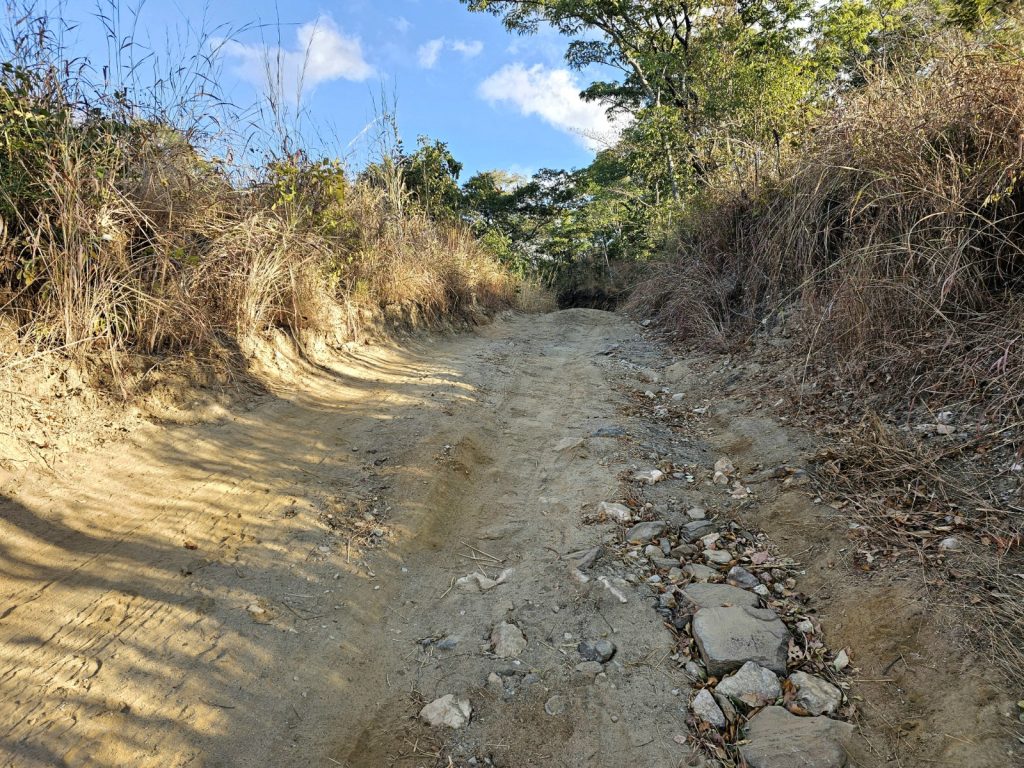
352. The climb up on the north side of Mufundeshi Stream was about 280 metres but although brutal was not as bad as yesterday’s climb.

353. At the top of the climb there was good views across the top of the Zambezi Escarpment to where the plateau started.
From here I was essentially at the top of the escarpment and about to reach the plateau above it. To the east the hills continued to rise and the land stretched away with wild forested ridge after the next where I should imagine humans rarely venture, even the hardiest prospector. Luckily I was going north where the landscape was more gentle and there were just a couple of smaller less steep climbs to reach the plateau and 3 hours after leaving Joe and his brother in the depths of the side valley I was finally on flatter ground and reaching villages and hamlets more continuously. This was the same type of farming I had seen around Zimba and Luyaba when I was last on the plateau before descending to the amethyst rich village of Mapatizya 10 days ago. The homesteads were now less traditional and in better shape than those down in the arid plains north of the Zambezi River. It was much more pleasant on the eye and most of the land was cultivated.

354. Just some 4-5 kilometres from the remote Mufundeshi Stream I started to reach the plateau and came across the first farms and a few abandoned exploratory mines. The road improved with every kilometre.

355. The top of the Zambezi Escarpment continued across wild remote hills to the east, but to the north it became gentler farmland.
I had about 5 kilometres of this on a much improved large gravel road until I reached a tarmac road. It was quiet and smooth and easy to cycle on. There were still some significant rolling ridges to climb but then there was often a wonderful run down the other side on the smooth tarmac without the bike rattling like hell over the stony gravel road. I was parched and stopped at a small shop for a drink and then learnt that it was just about 3 kilometres to the junction at Katoba beside Leopard Hill. I had already noticed there was accommodation here and after the difficult day yesterday and the hard morning decided I would throw in the towel here despite it just being midday. I cycled past a lovely simple thatched church and then up a slight hill to reach the junction and a sign for the Kankonongo Lodge.

356. Up on the plateau the farms looked less poor. Joe said it was because it rained more than the arid landscape I had been in for the last week.

357. The were all sorts of denominations in South Zambia, notably Pentecostal, Seventh Day Adventist and New Apostolic – which is pictured above.
The lady, who had hair extensions down to her knees, had a room. It was 300 Kwacha or £10 and it had a ramshackle bathroom but with hot water heated by solar pipes and a tank. These were the first I had seen in Zambia. The lodge also had a great view over Leopard Hill. There are 4 such rocky hills at Katoba and leopards used to have their lairs in them up to the 1960’s. However since then Zambia’s population has grown significantly and more and more land was taken up by agriculture around here and the leopards withdrew into the deeper forest and down to the Lower Zambezi National Park. I had a magnificent hot shower and washed all my stinking clothes, despite it just dribbling out of the roseless shower head. The lodge had no food so I went down to the row of shops at the junction and had chicken and nshima in a restaurant run by 3 characterful battleaxes. It was fun watching them chase a very drunk man out who had obviously come in because I was there. After that I went back to the lodge mid afternoon and wrote the blog for the last two days and then had a great sleep. Tomorrow I would cycle the 50-60 km to Chongwe where I would reach The Great Eastern Road, the T4, and follow it east for 2-3 days to the arterial Luangwa River and complete Section 05, South Zambia.

358. The view from my rustic lodge over to Leopard Hill. Leopards used to inhabit the hill until the 1960’s when the population significantly increased.
Day 065. 13 July. Chirundu to Mufundeshi on D481. 41 km. 8 Hours. 910m up. 610m down. The elephants did not come back in the night and I did not see any hippopotamus either when I heard a sound around 0400. The ladies made me a nice breakfast and even got bacon from the shop specially for me. I eventually left at 0900 and was sorry to leave this hidden gem. I cycled up the steep road, wary that I might encounter the elephants at the start near the forest beside the river. However there was none and after 20 minutes I made it to the main gravel road leading north. I looked for the house Harry and Hilary stayed in as directed by James to say goodbye but could not find it so headed north.
There were quite a few people on the road and many were well dressed. Then it dawned on me it was Sunday morning and many were off to church services. I passed a few and there were joyful gospel hymns coming out of the windows. There were many denominations here but Pentecostal, Seventh Day Adventist, Jehovah’s Witness, Catholic and New Apostilic were the most common. Not all were off to church though and at a few bottleshops/bars I saw younger men already with beer in hand at 1000 in the morning.
It was a bumpy dusty road for about 10 km passing hamlet after hamlet the whole way. It was almost a continuous homestead, cultivated land and occasional shops the whole way. The road was not busy but there were a few lorries taking villagers up to the flat agricultural lands between the Zambezi river and the start of the escarpment, but west of the Lower Zambezi National Park. This park blocked my way east and was a totally wild area full of animals. Just at the bridge over the Kafue River there was a rare section of smooth tarmac.

344. Some 10 km north of Chirundu I reached the Kafue River. It had a bream or tilapia farm on it near the bridge. I think it was Chinese owned.
The Kafue River is a major river in Zambia but it pales into insignificance next to the vast Zambezi just below the bridge, but out of sight round the corner. There was a large bream or tilapia fish farm here which seemed to be quite well organized. I think it was Chinese. On the other bank, the north bank there were also some ponds which had been dug, and water pumped up to them. I cycled on to the start of some vast irrigated crop circles again similar to the ones I saw in Sinazongwe, but I don’t know who operated these ones. If someone had said it was the Chinese I would not have been surprised. Interestingly there was also a Zambeef feedlot cattle farm here but I only saw the entrance. I turned off the larger gravel road to a minor one which went along the north side of the Kafue River to the village of Gota-Gota and beyond. Just here I got a puncture. The second on my new tyres since Livingstone 600 rough kilometres behind me.

345. The good people of Gota-Gota returning from church in their finest. I passed many churches this Sunday morning and most seemed to be singing gospel type hymns although I also passed a fire and brimstone sermon.
Gota-Gota was just 4 km up the road. When I got there people were just coming out of church. The Catholic one I think. People looked remarkably well dressed and tidy for a typical village with the women looking very smart and many of the men in suits with ties on. It was hot now and I needed a drink. I was sure it would be my last for a while so I found a small shop with a chest fridge full of them. Inevitably some young men came in and asked if I could buy them a drink. I again said I only give money to women as men just spend it on alcohol. This created raptures of laughter from the 3-4 women crowded into the shop and the men left almost as if admonished by the woman’s laughter.
At Gota-Gota I found the track I needed using the Tracks4Africa app, which is remarkably good for me on these smaller roads. It led north through the village and then down into rural hamlets near low lying stream beds. There must have been some irrigation holes dug here as there were green vegetable gardens occasionally. It was a fascinating area as between the stream beds was denser bush which was almost jungle-like. The only problem was the steam beds and the adjacent areas were very sandy and although I could still cycle it was hard work and difficult to keep the front wheel from skidding to one side. I was soon sweating a lot.

346. From Gota-Gota I headed north on a small, slow village road for about 20 km to meet the infamous D481 just before the start of the steep climb.
After a good 5 km of this, these rural hamlets stopped and the track, which was only used by infrequent motorbikes, rose up out of the sandy areas to a series of small ridges. It was steep down to one and then a hard climb up to the next. I was starting to question whether this short cut on the track was worth it, but it did save me about 30 kilometres going via Kiambi. I passed a sign for Headman Tigere and then the going got easier. It was now hard packed earth on a flatter surface and I could go from 5-6 km per hour to 8-10 km per hour and not work as hard doing so. This easier cycle continued for the second half of this track for about 10 km out of the total 20 km. There were two more larger hamlets to pass through until after about 3 hours on the track I reached the infamous D481 gravel road just as the flat lands met the foot of the escarpment and at the base of the climb.

347. The extremely steep 350 metre climb up the Zambezi Escarpment on the D481 was loose, rough and very taxing to push a 70 kg bike up for 2 hours
This climb was significant and I had been dreading it for a good week. It climbed steeply from here at about 550 metres altitude up the Zambezi Escarpment to about 1200 metres in the course of 20 kilometres. However there were two large climbs of 400 metres and 300 metres. My plan was to do the first today and camp, and then do the second tomorrow.
I set off up the very rough track on foot pushing the bike. There was no way I could cycle this, even in the lowest gear and not even if it was smooth tarmac let alone this rubble and bare rock. There were some extremely steep bits, perhaps 15 degrees occasionally, and I could just not get the purchase on my feet to heave the bike up. The bike itself was 20 kilos, with 40 kilos of baggage, with nearly another 10 kilos of water. So 70 kilos in all. At some sections I was straining with every sinew just to move it half a meter, then slam on the brakes to hold it while I took a step and repeated the process and thereby just make 100 horizontal metres in 15 minutes. Then there would be some respite where I could go at perhaps 2 km per hour before I was at another steep section heavy for all I could. It was very slow work and I was sweating profusely despite the fact it was overcast above the Escarpment. In all it took me well over 2 hours to do the 3 kilometres and climb the 400 metres by which time I was exhausted. It was probably the hardest I had worked all trip and on a par with the wrong turning I took a week ago. My arms were especially tired but my whole body had had a severe workout.

348. It was a joy to meet Blyth and John near the top of the climb when I was exhausted. They had set off from Chongwe at 0200 in the morning with a 50 kg sack of maize each and hoped to get to Chirundu. We applauded each other.
Just as I got to the top on this remote route I met Blythe and John. They were as surprised to see me as I was them. They both had 20 kilo bikes and each had a 50 kilo sack of maize kernel strapped to the back. They had just finished a climb as I had with a similar load. There was a fair bit of banter between us and we applauded each other. Then I learnt that they had actually started at 0200 in the morning from Chongwe and had been going for 14 hours already and still hoped to get to Chirundu that night. These were strong lads which any mother would be pleased if their daughter brought home, instead of the lacklustre dullards outside a bottleshop.
After a 10 minute chat we parted, with them trying to stop their bikes running away from them and me gingerly descending the rough track for 250 vertical metres. I stayed in the saddle most of the time but the brakes were constantly employed and must have gotten very hot. Frequently I had one leg out, off the pedal waiting for the inevitable skid and on the 5 odd occasions it came I was ready and just let the bike fall over once. I was descending into a side stream called the Mufundeshi, which drained this section of the Escarpment. Ahead of me on the other side of the valley I could see tomorrow’s climb up, which was only 300 metres and not 400 as today. It took the best part of an hour to make it down to the bottom bouncing slowly over the bare bedrock and the rubble. By the time I got to the bottom it was after 1700. I crossed the stream bed which was dry and went 200 metres further and saw some tents used by road gangs. There was a superb patch of bare earth to camp on here and no one was about except a small dog, so I started to put the tent up.

349. At the top of the climb there was a very steep 250 meter descent down to a side valley, with the Mufundeshi stream at the bottom. Tomorrow’s 280 metre climb up the other side can be seen ahead.
Just as I started, two men appeared after returning from a day in the fields. They said it was no problem to camp but insisted I come down to their tents. I did and they showed me a place between their 5 large tents and the granary, which was full of maize. They were two brothers of 38 and 50 and their wives. The elder brother was Joe and he spoke great English and was very intelligent and entrepreneurial. He had spent years working in a mine up in the copper belt north of Lusaka. They helped me put the tent up and then soon afterwards I said good night and went in. I was too shattered to chat with them under their thatched opensided cooking and chatting area. I had a cold dehydrated meal which was still a bit crunchy after 15 minutes and 3 litres of thick creamy powdered milk. I was too tired to even bother taking my clothes off let alone writing anything. It was a mistake as the sweaty cycling shorts meant my crotch area festered in a salty, moist environment all night and meant I got badly chaffed the next day.
Day 064. 12 July. Chirundu Rest Day. 0 km. 0 Hours. 0m up. 0m down. I was excited about seeing the hippopotamus grazing on the lawn last night. It was too dark to get a photo but I described it. James and the breakfast lady said it was very common and they came out most nights. After the cooked breakfast I went over to my chalet to write the blog and do some emails. There was a nice verandah with a table under it. It was perfect and I could look out across the parched lawn and see the Zambezi River gently flow past and even see Zimbabwe on the other side.
As soon as I started one of the gardeners/handymen came along and told me there were elephants just at the edge of the forest. I went down to have a look and there just 100 metres away were about 7 large elephants and no young. I asked where they came from and he said they had been in the forest here for a while but probably before that came from Zimbabwe. He said they would just wade across the river which was not that deep at just 1-2 meters. We stood looking at them for ages as they tentatively inched their way forwards reaching high up with their trunks to pull branches down and then stripping them of leaves, or breaking the small ones off and eating the whole lot. I was captivated by the spectacle and soon the other workers and Harry and Hilary and some of their grandchildren came to have a look. They seemed to think it happened every other day and that they would soon venture onto his lawn and start on some of the trees there.

338. In the morning a herd of 7 adult elephants emerged out of the forest along the riverbank next to Machembere Lodge.
There were plenty of branches with leaves hanging down for them to spend time where they were, but they kept looking in our direction, hesitant to come further. In the end the workers and Harry, Hilary and family eventually left as they had seen it all before and I slightly hid behind a tree. Sensing the humans had retreated, three of them started to wander into the trees at the edge of the lawn. One however was determined to get to a tree on the river bank at the edge of the lawn where I had seen the hippopotamus last night. I retreated back a bit and then went round to the bottom of the slope up to my chalet where there was a great escape up the slope and into the cabin. Another one joined it and they were now only 50 meters away. I watched them for a while but they were quite stationary.

339. The elephants stood on a clear bit of land on the border of Machembere Lodge before the ventured in.
So I went up the slope to the cabin and then went along it where I could see the other 5. One was a very large male. They carried on pulling tree branches down and devouring them but a couple seemed to have found some vegetation on the ground and were busy scooping that up with their trunks. They were only about 50 metres away and I was about 30 from the safety of my cabin, but there was a big slope they would have to climb up. I spent about half an hour watching them and noticed how trimmed the bottoms of the trees were becoming. I took loads of videos and photos as this was quite a bonus for a rest day to watch these magnificent beasts in such close quarters. I am sure they could see me and knew exactly what I was doing. The gardner did say that a couple of weeks ago an elephant had killed someone locally after she threw stones at it to try and chase it off her maize plantation. I could imagine a herd of 10 elephants could decimate a quarter hectare (half acre) of maize within half an hour.

340. Some of the 7 elephants started breaking palm fronds off on Machembere Lodge lawn and devoured them.
When I went back to the verandah the two by the riverbank had obviously spotted tastier trees on the lawn and one came up and was not about 40 metres away devouring the fronds from a palm. After it had eaten about 5, stripping all the leaves off the central stalk and cramming them into its mouth it started coming up towards me. I made sure the door of the chalet was open and watched it come to within 30 metres and then 25 metres until it got to the branches which drooped down. Up went its trunk and it brought the branch down and broke some off. It then started twisting bits of it and putting it on his pointed lower lip. before it disappeared between great sets of molars which reduced all the pulp – small branches and twigs along with the leaves.

341. One elephant came within 15 metres of where I sat on the verandah writing the blog as it pulled branches down right in front of me for half an hour.
As the canopy he was easting was devoured he had to move towards me, moving a metre with every step. I double checked the door was open and watched him until he was just 15 metres away. There was a significant slope still between us and he would not get up that in one bound. As he reached up, with one eye on me and the other on the next acacia branch he was intending to pull down, I could see right up into his mouth. We sat and watched each other for about 20 minutes until he left the acacia and moved on to a coconut tree which Harry had planted. He just broke one frond off that and started to devour it but then walked backwards leaving the frond hanging and half chewed and went round the side of another shrub. It is amazing how such a big animal could vanish behind a small shrub. When he reappeared he saw me again and this time was not happy. With ears flared he took a few steps towards me and stopped. I was already half way into the chalet but he stopped and turned and went quickly after the other 6 who had already left the lawn area and were heading away. And that was the end of quite an exciting and intense two hour encounter with this herd. It was perhaps the wildlife encounter of the trip so far, along with the surprise of seeing the lions feeding on the buffalo carcass in Chobe national park.

342. The verandah on my chalet where I was writing when the elephant came within 15 metres to eat the lighter green leaves hanging down.
By now it was midday and I still had all the blog and paperwork to do. So I sat on the verandah all afternoon typing away until 1700 when I managed to upload all the photos with the weak signal and then had just about finished typing when someone came over to the chalet and said have you seen the elephants. I said “Yes! I saw them this morning. Hopefully they will be back”.To which she replied “They are just over there now” and I looked where she was pointing and saw two large males. Then the whole show started again but this time all 7 elephants, all males, came onto the lawn. Everybody came to watch on my verandah as it was a safe spot. Harry and Hillary were there and a bit worried about their palms. 3 of them were attacking one of her cherished palms and another was sniffing around Harry’s coconut tree. They milled around just 30 metres away from us, but down on the lawn below us. One or two went along towards the swimming pool with the tan coloured Zambezi water where there were more acacia trees by the water and also more palms. We all left my verandah and went down to the pool area to monitor those down there. Harry was very philosophical about the potential carnage but Hilary was more concerned. “They were here before we were,” said Harry. It was getting dark now at 1800 and the carnage looked like it was in the early days and Harry thought they might settle here for the night. However I was not really comfortable going to my chalet and also did not want them on my door step all night. They might start on the roof. So I went back to my cabin the long way and went out with my powerful headtorch and airhorn. I let out a half second blast and they all turned to the forest and then let out another and they all walked quickly away. The security guard thought they might come back now they had seen the goodies on offer.

343. The inside of the chalet with the bathroom and storage room at the far end. It had a very high roof.
I then went in to finish off all the paperwork before returning to the bar area hoping to find Harry still there but he had gone. It had been a fascinating day, one of the most exciting days of the trip on what was essentially a rest day.
Day 063. 11 July. Changa to Chirundu. 67 km. 7 Hours. 430m up. 600m down. It was hot in the room in the early part of the night so I did not sleep well but eventually the cool of the night permeated through the corrugated roof and chilled the air. In the morning I was up early as I wanted to get to Chirundu early. I gave the sweet lady running the place a good tip and then left the dusty village and headed off on the tarmac road to the east. It was just 42 kilometres along the road to the T junction where this road, the D500, met the larger M15. Pretty much the whole time I cycled on this road there was a line of hills to the north. It was the Zambezi Escarpment, a ramp leading from the lower flat lands on each side of the Zambezi River up to the plateau. I am not sure if the escarpment was caused by the relentless erosive force of the Zambezi River over the last hundreds of millennia, or if it was a natural tectonic rift which the Zambezi River exploited on its course to the ocean. It was probably a mix of the two.

330. On the northside of the road after leaving Changa heading east I passed below the Zambezi Escarpment.
As usual there was a strong headwind and it was blowing dust up into the air and some of the shrubs were getting a little buffeted. The villages kept on coming and there were perhaps 5 of them in total between Changa and the T junction 42 km later at a place called Sikoongo. I had noticed in the last few days as I come further east a lot of the granaries now have the same structure as in they are elevated from the ground, are usually round and are constructed from sticks and then reeds. Not all seem to have a thatched grass roof any more. However the biggest change seemed to be that the walls were sealed with a layer of mud daubed on them. Rarely the mud was even painted. I could not work out the reason for this

331. Many of the graneries now seemed to be daubed with mud and some painted even. I could not work out whu this became more prevalent over the course of the last 10 days.
I had seen that more and more of the thatched houses now had a small overhang on them. It was perhaps too much to call it a verandah. I assumed this was to help keep the houses cool as the sun would shine less on the mud brick walls. There was no other shade to speak of really as this was back in charcoal production country and most things which could be made into charcoal had been chopped down. There were two sizes of sack now; the usual small one for 70 kwacha and then giant ones for 150. I think most of it was used, if not locally, certainly in the district as it seems everybody cooks on charcoal in the villages. Even at the guest room in Changa the lady cooked on charcoal on a small round stove about the size of a saucepan with holes in the side. As it was charcoal she could also cook inside with hardly any smoke being produced.

332. More and more of the houses had large overhangs on them and I assume it was to keep them cooler.
Occasionally, I would pass a cyclist on the road. Often a younger boy taking maize kernels to the flour mill. There were still no electricity poles beside the road so the kernels had to go to the electric blue shed flour mills, with the array of solar panels. I also saw a few men making charcoal and packing it into sacks and men driving the ox teams, pulling carts or logs. Perhaps it was the men who did the ploughing in a few months, before the planting started. However currently, these were the only men I ever saw working. While the women were constantly on the go. I frequently passed them on the way to or from the community borehole with buckets on their heads. The women were the only ones in the vegetable patches irrigating their tomatoes, they were the only ones at the market selling things, frequently they were the ones in the small shops. I am sure a lot of the agricultural work falls on their shoulders also. By far the majority of the work seems to fall to them. Perhaps I am just seeing a snapshot of the working year and that men in fact do the ploughing, tending, harvesting and transporting the produce home, and this takes up a lot of their time, and I am just seeing them during their annual break as it were.

333. The was plenty of charcoal production, on a cottage industry scale around Changa and further east, to the detriment of the scrub.
I am sure though I am being overly charitable towards them here because at the moment they seem to congregate around a couple of the small shops in every village and just hang out in their fashionably ripped jeans and cheap sunglasses. If they had the misfortune to have money in their pockets it is all spent on drink. I do not see anyone blind drunk and staggering as in a UK city during the weekend nights, but just enough to alleviate the boredom of hanging out. I am sure they are convinced they are as cool as one gets, and an indispensable mainstay of the community, but in reality they were a burden and a totally wasted resource. One of their highlights of the afternoon was probably spotting me cycling past, then waving in the hope I would join them and ply them with ethanol all afternoon. For them the loud music and alcohol was the opium of the bored. Although the women were always busy, they were always joking, chatting and laughing while the younger men are essentially predictable dullards. This dichotomy seems to become more pronounced the further east I travel since Livingstone.

334. Women seemed to do the lion’s share of the work in Tongo society, but were happier and more cheerful than the disenfranchised men.
There was not much wildlife around here, and what there was, was limited to birds. I think any larger animal would have been poached for the pot generations ago. Around the villages the goats and cattle would have foraged everything bare so there would be no food anyway. However, there were occasional doves and hornbills and a lot of smaller passerine type birds. I saw a flock of hornbills on one occasion but they all flew off bar one when I got the camera out.

335. Although there was little wildlife life on the ground birds seemed to survive. However eventually they has to be careful as there were always catapults about to help them into the cooking pot.
Eventually after about 3 hours battling into the decreasing wind I reached the village of Sikoongo and the T junction. I had 2 choices here: either go north to the large T2 main road, which would inevitably be full of trucks. Alternatively I could go south for a bit and then find the gravel road, R143, which would take me into Chirundu from the south. I chose the latter and was heading down towards it when people kept asking where I was going. I said “Chirundu” and they all seemed perplexed and tried to redirect me back north again onto the T2. Eventually I said “small roads” and then one knowledgeable older man on a bike said follow me and led me down a small track. After a few hundred metres he stopped at a junction and said “Follow that in a straight line all the way and you will reach Chirundu”. It was not quite as south as the gravel road I was wanting on the Tracks4Africa map but it looked like a short cut towards this gravel road.
As it turned out it was a path in itself and did not reach the road I wanted until just before Chirundu. However it took me through the most remarkable countryside and a couple of small villages where this was the only to reach them. The path generally went due east and was quite level and generally firm. It had been formed by generations of pedestrians and then later bicycles, so it was easy to follow. I could never go fast but then it was a great way to savour the landscape. In a little under an hour I reached a village which I think was called Matavista. It was an idyllic village with perhaps 50 homesteads all under thatched roofs. There was also a small row of solid mud built shops but they were all closed. In the middle of the village was a vast open area with a couple of large trees. All the homesteads were arranged around this bare open area, the size of two football fields. On the far side there was rhythmic music emanating from a house and drifting across the open area. It was more gentle than the high energy rap coming from the pubs where the disenfranchised youth gathered to drink. Under one of the large tree’s shade were about 20 women all gathered with their tiny market stalls, some with just 50 tomatoes. I asked them the way to Chirundu and then they all pointed in the same direction. One grandmother spotted a teenage boy and dispatched him to show me the way for a few kilometres. After weaving through the scattered bush and across large areas of sugar cane, which had all been harvested, for around 15 kilometres I came to the D road I wanted to be on. It was just a few kilometres south of Chirundu and I was there soon afterwards after following the vast Zambezi downstream. I had said to the guy 2 hours ago I wanted small roads and he certainly showed me them, but it was a delightful cycle.

336. The village of Matavista was only reachable by bicycle after a 6-7 kilometre journey on paths through fields.
Chirundu was large and busy and like nothing I had encountered since Livingstone. I found a shop with cold drinks and went in and sat in a chair in the shop. Here I spent half an hour on my phone searching for a place to stay. It seemed there were cheap perfunctory places to stay for visiting officials and Zambia travellers. Even cheaper places for truck drivers to overnight in as this was a major border point with a bridge over the Zambezi into Zimbabwe. Or finally very expensive safari lodges at $200 a night outside town on the banks of the Zambezi. Then at last I found Machembere Lodge which seemed like a high end tourist lodge without the superfluous luxuries and without the price. I cycled down the road north for 3 km to reach it passing a lot of elephant dung at the gate.

337. At the Machembere Lodge there was a great view across the 500 metre wide Zambezi to Zimbabwe. Apparently it was only a metre or two deep.
The lodge was very quiet but I met the characterful Harry who was the owner and James his softly spoken Zambian manager. They had a room and it was 850 kwacha or £25. It was an enormous chalet with a thatched roof looking across a shaded sparse lawn to the gently flowing Zambezi River just 50 metres away. The only problem was there was no power due to an outage. So it was dark inside and there was no hot water. There was also no wifi on the premises and the mobile signal was very poor. However the location and ambience were great. I spent the evening chatting to Harry and Hilary who owned the place. They had both grown up and gone to school in Southern Africa, mostly Rhodesia as it was then. The land was Harry’s old family land and he used to grow bananas on it until Hilary thought it possible to build a lodge here to cater for the aid workers, notably World Vision. However with covid and a change in NGO policy and internet conferences that market had diminished and this tranquil place was somewhat wasted. When the substation fault was rectified and the power came back on I could see how nice the chalet was and the water was soon hot for a shower. I slept well but woke at 0300 with a noise outside. Curious I went for a look and saw there was a large hippopotamus on the lawn just outside my thatched chalet.
Day 062. 10 July. Munyumbwe to Changa. 90 km. 8 Hours. 640m up. 730m down. I was ready to set off early when I noticed I had a puncture on the front wheel. After the amount of acacia thorns I had ridden through on the last day I was not at all surprised. I was grateful it did not happen on that day. After I changed that I went back to the bakery where I bought a loaf of bread and something like a cornish pastie. I had the latter for breakfast and kept the loaf for later. I said my goodbyes to the staff at the council guest house who were trying to look busy, like council workers all over the world. I set off on the tarmac road which people assured me would be quiet. At the eastern edge of the small town was a petrol station and just before it was a bed and breakfast behind big security gates.

323. These guys easily kept up with me for 2 km on their bike with no gears and no brakes. Zambians are strong and fit.
The road was surprisingly good and I was surprised it existed. In the course of the day perhaps 20 motorbikes, 10 cars and about 4 buses and 4 lorries passed me. So I could use the whole road and often needed to in the potholed sections. One thing I did notice on the first stretch to the village of Katete, after some 25 km, was how poor it was. There were no electricity poles and so no electricity anywhere. Also all the kids seemed to be barefoot. It seemed an odd juxtaposition to have this road and yet no electricity. The road was also full of ladies in groups going to or returning from the borehole pump with water for the household. There were plenty of pumps amongst the hamlets beside the road. I could have found plenty of water here and now cycle with all my water bottles empty, save for a litre. The landscape was very dry and quite rocky and not really great for agriculture. The only thing which thrived were the baobab trees.

324. None of the villages today had electricity and everyone had to fetch water from a borehole in this arid landscape.
After Katete the landscape became even more harsh and arid. it was almost sahel-like with nothing on the ground and just shrubs and trees growing from it. There were more and more cacti. I was still passing herds of goats and cows and I could just not see what the cattle could eat at the moment. Perhaps in the rainy season all this bursts into life, but there was just not the ground cover or the roots of grasses around to use any rain. I think this place is extremely vulnerable to climate change because if the rains don’t come it would easily become uninhabitable and all these thousands of people would be displaced.

325. There were a few irrigated experiment areas where an Irish charity was trying drought resistant maize.
In the last half of the day I did pass a few villages. They were the most traditional villages I had seen so far with about 50-100 households in small compounds, with virtually every house or hut under a thatched roof. However, I also noticed that the agriculture here was quite well organized as if it was a cooperative venture. The fields were large, perhaps too large for a single household to plough and harvest. There were also many small vegetable gardens beside the rivers where pools had been dug and the vegetables were then watered by bucket. An Irish charity had various projects in the valley growing drought resistant maize. But even drought resistant maize needs some rain.

326. Some of the villages today were exceptionally arid and almost Sahel-like. There was no ground cover whatsoever.
The kids here were the most excitable of the entire trip so far and spotted me a mile off and came running out of the compounds and often ran alongside the bike. Two young boys managed to keep up with me going very slightly uphill for a good kilometre running fast without becoming short of breath. The women here were also the most confident so far with all waving even single girls walking towards me, who are usually shy. If they were in groups they were shouting and waving. Most of the men were also friendly but on the two occasions I stopped I was plagued by middle aged men asking for money or to buy them a drink, meaning an alcoholic drink. I told the second lot I would only give money to women and never to men to buy drink with. I might make it sound worse than it is, as it was just a tiny fraction of men who are drink pests and the majority are upstanding and polite.

327. A large field of harvested sugar cane. I think this feild with its sentinel baobab trees was too big for one family to plough, sow, tend and harvest and must have been communal.
Towards the end of the day and in the last 15 kilometres I passed some small mines. There were no signs on the gates and this led me to believe they were Chinese operated. It seemed they were mining in an area with a lot of orange coloured rocks and much of what was produced seemed to be stored in the meter cube white industrial sacks waiting to be taken away by lorry to be processed. These mines, and there were about 6 of them, all seemed to be in the test or exploratory stage rather than full blown production.

328. There were many vegetable patches beside the dry stream beds where the vegetables were watered by bucket from holes dug in the sand. Note the animal exclusion fence.
As I neared Changa the landscape became even more arid and cactus was rife. There were not many trees save for the large baobab, as charcoal production was rife. I noticed large areas where anything bigger than an arm was cut down leaving a stump. I doubt this would have a benefit of clearing the land for agriculture. The prevailing crop now seemed to be sugarcane as a cash crop, with fields of maize also as the subsistence stable. A few kilometres before Changa I ran into a sports competition. There were perhaps 300 spectators and 200 competitors. It was mostly girls volleyball and boys football, someone told me there were scouts looking for talent to train professionally. I don’t think I saw one overweight person in the entire crowd of spectators or competitors. Indeed the only fat Africans I see are urban ones and there are usually merchants or those working for the government. I would have liked to have stayed and watched but it was just an hour before dusk. However, a few people said there were guest rooms in Changa and to ask at the market.

329. My room in Changa was perfectly adequate for what I wanted. The toilet was a long drop in a separate shed.
In 2 km I reached the market. It was basically 20 brightly dressed respectable ladies all sitting with stalls of vegetables and tomatoes. Some had sweet potatoes and a few had fish. I asked one about rooms and she beckoned a man over who led me to a building behind the stalls. He asked a gentle, older man in front of a longer concrete building. Yes they had a room and it was 100 kwacha (£3). Of course I took it as it was a great alternative to camping. The man’s daughters spoke good English and were very hospitable and welcoming. The room had just 4 bare walls and a double bed with sheets and blankets. I would use my sleeping bag again. For dinner a daughter gave me a litre of hot water for a dehydrated meal and I had the rest of the excellent bread from the morning. I wrote the blog as the sun set and rhythmic music drifted between the simple houses, most still thatched even in this village. About 1930 the sports competition spectators and competitors returned to the market and the whole place erupted into joyful singing. The massed voices of the girls and women easily drowning out the music from all the man caves.
Day 061. 09 July. Munyumbwe Rest Day. 0 km. 0 Hours. 0m up. 0m down. I was tired from the long day yesterday and I had work to do on the blog. These combined to make it sensible to take a day off. I could probably have cycled as I noticed how my legs can keep going all day now as long as the gears were low enough. Long distance hikers get something called “Hikers Legs” where they suddenly become fit enough they can hike all day, like a young spaniel dog, without feeling it too much. If there is a cycling equivalent then I must be on the threshold of it.
However the blog, that never ending deadline, needed a few hours of attention. If I did not do it today I would have to catch up sometime in the future and live under a black cloud until then. So it made sense to combine the two. I spent the entire morning doing it in the guesthouse’s perfunctory dining room and then returned to my room for a long siesta.

322. The Gwembe council guesthouse in Munyumbwe where I spent a rest day. It still worked but needed some maintenance.
In the late afternoon and early evening I returned to the dining room which was now full of Zambians cheering on their women’s football team in an African tournament. I went out to eat after dark to the simple bakery/restaurant across the street which did a take-it-or-leave-it sausage, greens and shima dish but could replace the nshima with macaroni. It was much nicer than last night’s and had a window. There were cheers outside from time to time as at least 20 people pressed their noses against the window of a pub which had a television showing the same Zambian ladies soccer team. They were passionate about football here. I had an early night and was in bed by 2000 after the lazy day.
Day 060. 08 July. River Njongola Estuary to Munyumbwe. 62 km. 10 Hours. 920m up. 770m down. I slept well in the yard beside the small mud brick house. If there were ticks on the ground they would have been short lived as there were chickens, guinea fowl and even doves patrolling the earth constantly scouring the ground. The doves lived in the rainy season kitchen which was shunned now in favour of a fire in the open. There were also three small pigs wandering about the yard who would head off soon into the bush to forage for the day. I took my own breakfast of granola over to the newly lit fire and ate it there. The day was well underway already at 0630 as the sun had already risen.
People were coming and going on the track and two younger men were already taking dried manure to the fields from Minister’s cattle corral where about 10 cattle spent the night. They were shovelling the pile into a large box sitting on a sled with wooden runners and then this sled was pulled by two oxen. I had seen more and more teams of oxen pulling carts, ploughs, trunks of trees and sledges, yesterday and this morning now I was in this relatively poor area without roads or electricity.

314. In the morning I managed to get a picture of my hosts. Minister is in the middle with the red and yellow shirt and his daughters to the right. The others were close neighbours.
I packed after my granola, with everyone turning to watch me, especially Minister. I was packed up quite quickly and by 0730 I was ready to go. I was not sure if Minister was the headman of this hamlet or not. He seemed to have a few daughters but no wife, and was 39 years old. I am guessing his wife had previously died. I thought if I gave him money he would use it wisely rather than drink it so I found a brand new 200 kwacha note and gave it to him. It was more than needed but his family had shown me kindness. He was delighted. It also meant I could get a photo of the whole homestead and the men who had come down to Minister’s morning fire before I finally set off.

315. The concrete causeway over the Njongola River was partially destroyed. It would have been unparalleled after a moderate amount of rain. The ox team were pulling a heavy log.
I cycled through the rest of the village passing fields with piles of manure and then reached the bridge. It was a concrete weir which had been laid across the river to allow traffic. However it was maybe 10-15 years old and without any maintenance, like the road through the village, it had fallen into disrepair and a few floods had washed sections away. As I cycled down to it a pair of oxen were pulling a couple of large logs up the hill. I had to push the bike over the river, which I guess would have been nearly impossible in the rainy season, especially when in spate. Once over I had to continue pushing the bike up a steeper hill for nearly half an hour as the road was essentially now just a footpath. I climbed some 100 metres, toiling hard pushing the bike, sometimes over very stony ground or bare rock. Eventually I reached the top and the footpath turned into a track again and levelled off passing through a small hamlet where children ran out to meet me.

316. The long steep footpath on the east side of the Njongola River. It was also impassable to 4X4 vehicles.
When I plan a route I usually do it on Strava, a mapping app, and confirm it with google maps. I then plot the route so it follows the way I want to go along the roads shown on Strava and Google maps, especially the satellite view, which shows the roads. I then create a GPX of the intended route and send it to my gadgets. When I am cycling I simply follow the gadget which indicates all the twists and turns of the route and also all the ups and downs. The route I was following now was created months ago in the comfort of my study. The trouble is sometimes the view of Google maps satellite view and the information on roads on Strava can be very out of date, rarely by as much as a decade, and often new roads are not shown. But this system has always worked well for me and I had no reason to suspect any difference now. I don’t even remember passing a junction about 4-5 km after the river crossing but there must have been one.

317. After the first hamlet on the north side of the Njongola River I should have gone down into the flat valley but by mistake did not see the junction and my preplanned route went to the right.
Instead I just followed the route on my gadgets and it directed me on the right fork of the unnoticed junction on a narrowing track which eventually became a footpath. However there were bike tracks here so all was well. As predicted by my gadgets the route now started to climb and I had to climb another 100 metres over a ridge in the Sikolqinzala Hills which is where I was cycling. The track however became worse and worse, and it was frequently steep, rocky and totally overgrown. The previous bike tracks had also completely disappeared. It was a bloodsome slog going up the hills and I was frequently getting scratched by the small acacia bushes. Occasionally I passed a section where I recognized a road had been and another where a culvert had been washed away leaving a couple of concrete pipes in the forest. I thought Googlemaps and Strava had just not updated for a decade when this road was abandoned and the village I passed through used the road to the south through Ministers hamlet to get to the rest of the world.

318. My preplanned route took me up through some horrendous, overgrown terrain where the old road was destroyed by torrents and abandoned. It took a while for me to work my mistake out.
At the top of the hill after the very taxing push which left me tired and scratched there was at last a nice run down the NE side. I thought I was free and it would now be a nice coast down the other side of the hill. But the relief was short lived as soon the track became very overgrown and destroyed by floods of water leaving rocks and bedrock. This just could not be right even through I was still on my pre planned GPX route. I had my drone so I launched it and flew down over the preplanned route but it just seemed to get worse and then dissapear. I then flew higher and panned around and I could see a large area of cultivated fields about 2 kilometres to the north around a village. The village lay in an open valley within the Sikolquinzala Hills. There seemed to be footpaths leading from my position through the bush to this village. I then remembered I had downloaded another map app called Tracks4Africa, which showed all the 4 wheel drive tracks in Southern Africa. I checked with this and saw I was on a small track which went nowhere and there was a track 5 km to the north which went from the broken concrete sill across the Njongola River I crossed previously to the road up to Munyumbwe. It was definately the road I wanted to be on. I must have been on it but at the junction I could not recognize or see I must have left it to follow this godforsaken dead end road by slavishly following the GPX route on my gadgets. This GPX route I created 3-4 months ago contained the error.
Now I knew my predicament I had two ways to solve it, either return the way I had come or go down through the bush for 2 km on one of the footpaths to the vicinity of the village and its fields. I chose the latter as I knew the way I came was hellish. The footpath was not really a path leading like a twig from the top of a tree down the small branches and then bigger branches to the trunk and then finally the bole of the tree, which is where the village was, but rather a criss-cross network of footpaths across the bush. The ones I took were always small and there were numerous junctions where I always had to pick the one I thought went to the village. Generally they were OK but I was getting scratched pushing through bushes. However, once I got to a steeper boulder field and had to negotiate the heavy bike through this which took half an hour for 200 metres and a lot of heaving.

319. After my descent through the bush I came across this gorgeous, traditional and remote hamlet with perhaps 10 households which was 4-5 km south of the gravel road on a footpath.
At last I came to a long since harvested maize field and I could now follow the access paths to the fields which were now like the branches of a tree leading to the trunk and bole of the village. Occasionally I caught sight of it. It was gorgeous with the pointed roofs of perhaps 25 small huts emerging from the the low scrub which surrounded it. I knew If I got to the village there would be an access path from the village to the gravel road I wanted to be on. Slowly I twisted my way down to the base of the village which was raised up on a shallow knoll. I did not go up to the village. I would certainly have been the first Musungo on a bicycle to arrive there, but found the access path below the knoll. It was at least a meter wide, well trodden and had numerous bike tracks on it. I started following it to the north crossing two deep sandy river beds. In the second one I came across a boy on a bike taking a sack of maize kernels to the mill. It was about 3-4 km along this path until at last I reached the gravel road just at the village of Siabbamba. This was the road I should have been on all along and should never have left for my inadvertent detour which cost me perhaps 3 hours in total and a lot of effort. It was already 1230 and I had been on the go for 5 hours. I still had a demanding 45 km to go to Munyumbwe.

320. The gravel road from Siabbamba village to the T junction with the bigger road was about 30 km and passed a few villages. It was quite hilly.
I started North East along the road which was quite stony as it did not get the traffic here to pack it down. I think the road was destroyed in places in the direction I was going and this cut these villages off. There was also no electricity anywhere here. Virtually all the buildings were the round mud huts under a straw roof and there were very few of the newer style mud brick buildings under a corrugated tin roof. These very traditional villagers had immense simplicity and charm, and the villagers all waved and then put their hands together in a single clapping motion indicating a respectful greeting. I cycled here for a couple of hours climbing steeply and dropping down into a dry stream bed only to climb again. Most of the track was firm but there were frequent shorter sandy bits in the dips. I passed a few motorbikes and cycles but no vehicles. I also passed an ox drawn cart with biscuits, drinks, provisions and some hardware for a shop in Siabbamba, which must have been up a lane in that village, as I heard it but did not see it.
Eventually I reached Sinayala. I was tired, thirsty and hot. Here there were two rustic shops, electricity and although I did not see any vehicles there were tyre tracks. I stopped here for biscuits and some sugar water and felt my energy surge. It needed to be as I still had a way to go. The next stretch was relatively short and it took me past arid homesteads with the new style mud brick 2 room houses and many baobab trees. I noticed a few had been cut down, and cut with an axe. I can only imagine this is for firewood, but I am sure it would be a huge effort for relatively little reward as the trees were massive and to get them into firewood would have taken considerable chopping. The road was now smoother, but still with its ups and downs and at 1600 I arrived at the T junction with the larger gravel road. There was still 15 km to go north on it to Munyumbwe.

321. As the road approached the larger gravel road it became very arid again with dusty bare hamlets and large baobab trees.
The last 15 km was hard. There were 3 sustained climbs, each of about 60 metres and quite steep. It does not sound much but with tired legs, and 60 kg of bike and baggage it was taxing. I thought I had good time to make it but suddenly I noticed the sun was dipping below the ridgeline illuminating the Sikolqinzala Hills with a warm orange glow. Since I left Namibia I have been in the same timezone although I have travelled some 1800 kilometres due east, so the sun sets much earlier here than Namibia and it takes me by surprise. By the same token it rises much earlier. I did not stop for photos now but just pressed on with set determination grinding up the hills in the lowest gear. At last with dusk approaching I reached the T junction in Munyumbwe.
Just to the east of the junction was a council run guesthouse I had hoped to stay at. They had room and even one with an attached bathroom. Everything was a bit ramshackle with broken tiles on the floor and the bathroom due to them being laid on an uneven floor. I was tired and would invariably spend tomorrow here recuperating but just took it for a night. It was dark now but I was hungry. The maintenance man at the guesthouse showed me where I could eat nshima and took me to the “restaurant” at the junction. It was pitch dark inside but with a torch I could see she had chicken pieces, greens, gravy and the maize meal or shima. I had a plate of it, bought some drinks in a shop and returned to the guesthouse room. I was tempted just to have a dirty dive and head to bed at once but forced myself to have a shower. I took 2 sets of dirty clothes into the bathroom with me with the intention of washing them one at a time until the water ran out but 40 minutes later it was all washed and rinsed and I was sparkling. I at last went to bed at 2100 and slept well. The blog would wait until tomorrow.
Day 059. 07 July. Sinazongwe to River Njongola Estuary. 61 km. 8 Hours. 450m up. 440m down. I was up for breakfast and was packed and away by 0830. Before I went I wrote a favourable review of the Lake View Lodge and especially the two ladies who worked there. I then cycled back up the rough track to a cluster of shops which might have even been the centre of Sinazongwe, but it was a very expansive village, if not town, and there could have been another centre. Just here I should have taken a road to the east but it was being dug up for the new road. I asked a grader driver who I thought would know the way but he directed me back the way I came and told me to go east. I did that but ended up on a cul de sac to a couple of other lodges. He must have misunderstood me. I asked someone with good English this time and he directed me back to the grader driver and beyond until I could go back onto the new road. As I passed the grader driver again he looked perplexed but I was on a sandy patch and did not wave or stop. I went round the detour and then back onto the road which was blocked off with tape but was hard packed earth beyond the tape. It was too good to resist so I went under the tape and cycled fast on the beautiful smooth earth for a few kilometres until the detour and the new road merged again.

304. Hollowing out a large log with an adze to make a dugout canoe to be used for fishing on Lake Kariba.
I was now joined by a young man who was going to the electric mill up the road to turn his sack of maize into flour. We chatted and he told me a bit about the huge irrigation circles which we were passing. He said it was a Chinese farm and they had 24 such circles and each one was at least a kilometer in diameter. The one we were passing was paprikas and it was all destined for the Chinese market and none was sold locally. The water for the irrigation was pumped from the lake. I saw workers in a field and they looked like they were harvesting a vegetable crop. The whole operation reminded me of East European workers on a giant vegetable farm in East Anglia. We got to his electric mill and we parted at a cluster of shops, which could also have been the centre of Sinazongwe. A bit further I reached the Zambian Cattle Company. It was a feed lot where cattle were raised in dry dusty pens and fed soya or perhaps even the waste from the vegetables. It was a vast site and there must have been about 40 pens each with about 50 cattle. I got the impression it was not Chinese owned as there were no signs, but it just seemed too much of a coincidence this industrial beef factory was right next to the Chinese vegetable fields. The whole place stunck of manure and I was glad to be past it.

305. The road to Sinamalima was generally quite good with a few sandy patches. There was fields on each side and these ones were cotton.
Just at my turn off to the east on a small D road I came across a man with a makeshift adze swinging it into a log. He was making a dugout canoe and the amount of work involved to hollow out the entire log was phenomenal. Just after him I turned off to the east and cycled along a rural road for almost 2 hours passing a few villages with markets and also the small row of dingy concrete shops. For much of the start of this rural D road I was passing along the north side of the vast irrigation circles which were on my south. However the land to the north was also partially irrigated and entrepreneurial local farmers were growing maize and other vegetables like squash and beans. The homesteads here looked better off with a solid 3 room house in every compound. Near Sikaputa I passed a small welding yard where a team of welders were fabricating pontoons and then joining 2 pontoons together to make a frame for a boat. I think they were houseboats, which are popular on the lake with tourists. I now turned northwest for about 5-7 km to head up to get the gravel D499 to the east. It was warm now as I cruised along on the stony road. Virtually the whole time since my turn off by the cattle lots I had been going through subsistence farming except for the huge irrigation circles at the start. There was also a large scale fish farm here, also Chinese owned, but it was down a road with no exit near the lake shore.

306. Where a dry river bed crossed the road holes were dug in the bed to for a pool of water which was pumped up to the adjacent field to irrigate.
Once I was on the D499 very little changed except it was now subsistence farming on both sides, and there seemed to be some small scale irrigation at the start from the Nangobe River, which although was dry had some deep machine dug pools in the middle and a petrol pump beside these pools to draw the water into the fields. I passed a few clusters of shops, one perhaps every 5 kilometres and there was plenty of scope for a snack. I was going to wait until the larger village of Sinamalima to stop for a drink, but passed a nice hamlet of shops and called in at one of these for some cold sugar soda. The kids all clustered round and were excitable so I took a photo of them all in their joyful mood.

307. Just before Sinamalima I came across a hamlet of shops where I stopped for a drink and was surrounded by excited children.
Sinamalima was quite a big village and definitely the biggest on this road. It had barbers and shoe shops along with the rows of dingy grocers. It also had its fair share of pubs who were already blasting out loud music for the benefit of a small handful of clients who were starting to drink. There was nothing of interest for me in this village at all except for the health clinic which was quite big and well maintained.There was also a Pilgrim Wesleyan church here as there had been in a number of smaller villages. They are certainly the most prolific missionaries in this area. As I cycled further west the road got more and more sandy but I could still skid through the worst bits. It also got a bit hillier in contrast to the very flat morning. To the south it was flat fields, some now with cotton bushes and then the plains leading down to the lake, while to the north were fields and then a line of forested hills which rose up at least 500 metres above me. The villages now started to get sparse and poorer again until I got to a fork in the now track near a pond.

308. After Sinamalima the homesteads became more traditional and slightly poorer as I headed east.
I did not know which way to take. The obvious way led down to a village and stopped, while the way on my map and GPS say the left fork was the road through to Munyunbwe but it had no tire tracks and was only used by cycles. I took the one to the left as my GPS indicated and soon realized it might once have been a road but was now destroyed by heavy rains which had rutted the track. It was also overgrown. I thought perhaps a new road was built and that was the right fork and it would eventually come round and meet the left fork. I persevered and found myself on a small twisting track, almost a footpath in places going through thicker jungle which was encroaching on the track in many places. I don’t know if a Toyota Landcruiser could have made it through this section. I think not. In the end I climbed over a ridge with the lake below me and no sign of a village below and then started the descent down the other side. The whole time I was on my preplanned route which was a comfort. As I descended down the other side I came across a young boy leading a young blind man.

309. As I neared the Njongola River the rough gravel road quickly deteriorated into a track and then a footpath where rainy season torrents had rendered parts impassable in a 4X4.
A bit further I came to a very small hamlet of just 2 homesteads. No one spoke English at the first homestead so I went to the second. There was a grandmother and about 5 young women there and again no-one spoke English. I asked about the way but got little response. I was going to ask if I could camp with them but decided to go on a bit as I understood they said there were more houses later. I cycled about 500 metres over a small hill and was coasting down the other side when someone shouted Hello as I went past. I glanced in that direction but only saw a bit of collapsed road where a small landslide had occurred. Then something caught my eye. It was a man with blood over his head. I stopped and realized that this man was also blind and had been walking along the road and had fallen off the edge. He could not get up as it was 3 metres down and steep on all sides. I stopped the bike and spoke to him. “Musungo” I said which meant white person. He put his arms out but I could not reach him. Then he extended his cane and I managed to heave him up on that until I could grab his arm. It was then easy to haul him out as he was a lot lighter than I thought. I gave him some water to drink and wash the blood off his head. I could not leave him as he was a bit shaken so I decided to walk him back to the homestead I had just left. The chances were he was related to the other blind person I had seen. I pushed the bike holding one end of the cane against the handle bars while he held the other. In 10 minutes we were at the homesteads and he indicated which one to go to and it was the one with the grandmother.

310. The treacherous eroded edge of the track the poor young blind man fell down 3 metres and hit his head on the concrete pipe. He could not climb back out so I helped him.
When we walked in there was a bit of indifference. Until I explained a tumbling motion and pointed to the gash on his head, now bloody again. They brought a chair for him and I think he told them what had happened. I thought this is great, I will now be their hero for rescuing him and can stay at this idyllic homestead after all. When I suggested it there was again indifference and puzzlement. Then one of the young girls managed to get enough English together to say in 10 minutes there is a better place. I did not feel unwelcome but I felt there was little gratitude. Perhaps it was a cultural misunderstanding.
I said goodbye and they all cheerily waved me off and I cycled past the landslip that claimed the blind man and went on another 10 minutes until the track climbed more steeply. En route I passed a couple of homesteads but they were empty. As I pushed up the hill and neared the top I passed another. They waved me over. I needed no further invitation and came into their compound with my bike and noticed a great place to put the tent.

311. My tent beside Minister’s house in his compound in the hamlet just before the Njongola River. I think Minister might have been the hamlet’s headman.
They were very welcoming. His name was Minister and his daughter brought me a cup of water. I suspected it was river water but drank it anyway from the dirty cup, trusting my cast iron constitution from 6 decades of travel in the tropics. He said I could stay and soon a few men arrived and the tent was up in a jiff. Then the women all went to get more water from the river in buckets and Minister brought me a big bucket of water and a cup. Then all the men left to bring in the animals leaving me on my own at the homestead. I used the cup to fill 2 containers of water and put some purification tablets in them and then photographed the place.

312. The three legged cooking pot on the three stone fireplace. It was around this everybody gathered and all the cooking was done.
When Minister returned he put a chair beside the fire and beckoned me over. His English was as bad as my Tongo, but other men came and went and spoke a smattering of English. His daughter gave me some hot water for a dehydrated meal and 2 packets of noodles and that was my supper. It got dark as I finished and before they had eaten. There were about 4 men, a daughter and 3 small kids around the fire. In the end I thought I was making them a bit uneasy as I think Minister was quite shy. So I thanked them and retreated to my tent to write the blog. They went to bed at 2030 just as I finished. It had been a very interesting day and I was delighted to at last have spent a night in a compound in Zambia and also to have helped the poor blind teenager. I don’t think a 4×4 could ever make it to this hamlet so it is still very traditional.

313. One of Minister’s neighbours had a charming son who was very interested in the phone and camera on it.
Day 058. 06 July. Sinazongwe Rest Day. 0 km. 0 Hours. 0m up. 0m down. It was nice not having to rush off from this beautiful spot in the morning now I decided to stay an extra day. After a surprisingly good breakfast I went out to a table on the verandah of the lodge’s dining and reception area. It was a cool shaded spot and I could see the lake through the trees. There was a troop of the small vervet monkeys which sauntered around the complex occasionally wandering along the tops of the railings. Had I been eating and left the table they would have cleared the plate in a flash. It was very peaceful sitting there looking over the water from time to time. It took me about 4 hours to collate everything but at last I was done by midday.

301. The reception and dining area of the Lake View Lodge where I sat on the verandah all morning and wrote the blog for the last few days.
Just as I finished a group of 5 Indians turned up to spend Sunday afternoon here. I chatted with them and learnt that they all worked in Maamba at the only coal fired power station in Zambia. They said most of the power went up to the Copper Belt via Lusaka. The power station was managed by an Indian Company and its Indian workers spent 5 months here and then 1 month in India. They told me the Chinese were constructing another two power stations in Maamba to use the coal they were mining. They also told me the road to Sinazongwe which I cycled on yesterday is being funded by the Zambian Government but it is Chinese engineers overseeing the construction. They had brought a picnic with them and gave me a large plate of food which their Indian chefs had prepared in the canteen at Maamba. It was delicious, very flavoursome and spicy.

302. There was a slight beach below the lodge amongst boulders. In areas with much more reeds than this the Bilharzia snail can be found around Lake Kariba.
In the afternoon I went for a small stroll down by the lake. There were a few small beaches but above them were boulders. The level goes up and down considerably depending on rainfall. In recent years the level has been low. So low Zambia had to have power shedding to distribute the power around, as a significant proportion of Zambia’s power came from this dam and power station. However after this recent very wet rainy season in the Zambezi’s catchment area the level has risen recently.
There are crocodiles, hippopotamus and bilharzia snails in the lake. They all like shallow reeded areas but can travel about. I think the crocodiles and snails also like the reeded areas around the estuaries which flow into the lake and the hippopotamus need grazing areas nearby and return to the water by morning to wallow in it and to protect their skin from the sun. There were some subsistence fishermen in dugouts and canoes on the lake but they would have local knowledge of where the crocodiles are and would avoid them. They might have even referred to them by name and discussed with themselves when one moved. I am sure they are hated and young ones are killed if caught, as in Indonesia.

303. Despite warnings of crocodiles there were a few small dugouts and canoes on the lake fishing with nets. The fishermen knew where the crocodiles were likely to be.
I returned just as the jolly Indians were leaving after their picnic and frolic in the small pool. They all shook my hand and wished me luck. That evening I was on my own again for dinner and then spent the evening clarifying my route Chirundu about 300 km to the east and the next big place. It seemed straightforward enough.
Day 057. 05 July. Siabaswi to Sinazongwe. 45 km. 6 Hours. 260m up. 260m down. I fell asleep before the music stopped and it did not disturb me. However given the simple room, the dining facilities and especially the toilet, it scored very low. But they did make a breakfast of raw shredded cabbage, sliced tomato, a fried egg and 8 pieces of white bread, and they spared me nshima and they served it with kindness. As I set off up the small lane I saw it was the welders quarter with about 3-4 workshops fabricating large round pipes to put under the road as culverts. The welders were very skillful and were doing it all squatting on the ground, welding rod in one hand and mask in the other.

290. The main cluster of shops beside the main road in Siabeswi. The lane with the welders quarter was on my right.
I was soon on the main street which was a collection of shops, mostly grocers and general merchants, all pretty much stocking the same stuff. I passed it quickly and then went onto a good gravel road which was flat and fast. I made good time passing villagers coming and going on the road with loads leaving to go to market, others heading home from the communal bore hole with buckets of water and a few driving small herds of animals up the road. It was already warm when I set off.

291. In the early morning people flocked onto the road to start the day some with enormous loads on their heads.
There were perhaps 2 or 3 large coal lorries who passed me in the 20 kilometres and 2 hours it took me to get to the main tarred road, the D775. However they were slow and I could hear them half a kilometer away. I noticed how much greener everything was here and I don’t know if that was because of the proximity to Lake Kariba or that it was near the ground water. The road was occasionally bumpy but nothing like it had been yesterday. After two hours I rode over a small ridge of hills and then descended down to the junction. To the left (west) about 5 km away was the town of Maamba and luckily I did not need to go there. I was going to the east and towards Sinazeze. There were a few shops at the junction and I stopped at the largest which called itself a “mall”. It was much larger than the dingy shops and sold a wide range of hardware and also food. There was a freezer with cool drinks and I had one on the bench outside while the owner came and chatted to me while his mother cooked a large pot of nshima beside us, throwing in handfuls of maize flour to thicken it up. The owner said there were nice lodges at Sinazongwe which is where I was heading in just 30 kilometres.

292. Where the gravel road from Siabaswi met the tarmac road near Maamba was a larger shop. Here the owner’s mother made up some nshima from maize flour on a charcoal stove.

293. The tarmac road out of Maamba was busy with people heading between hamlets. We all had ro dodge the occasional slow coal truck.
When I left the junction I felt elated, it was a great temperature, the road was tarmac and pretty empty and there were lots of cyclists and pedestrians on the road and they all greeted me as I went past. I was waving back so much I virtually had one hand on the handlebar. Although the tarmac road was more of an imposition through the landscape, as opposed to the dirt roads which probably followed ancient paths, it still felt rural. I passed a coal mine just after the junction but it was well hidden by trees despite its large piles of coal. I cycled along this vibrant road for about 15 kilometres in all until I got to two bridges over two rivers, they were still flowing and there were pools of water in them. I think the first river was the Kenzine River and the second larger one was the Zongwe River. They both merged just after the second one in a wide open sandy braided river bed. On each side of the river any flat land was green with maize and here with the help of irrigation they could get two crops a year. This green fertile valley was in complete contrast to the dry parched landscape elsewhere. There were many potholers on the road and this forced the cars and lorries to slow down often to a crawl. At these areas there was a thriving business of road side ladies selling fresh boiled maize to the slow traffic. I stopped and bought one, but it was full of starch and not that sweet. A little further I reached a junction where there were road works. The main branch went up to Sinazeze and the arterial T1 road at Batoka and the other went down to Sinazongwe where I wanted to go.

294. The Kenzinze and Zongwe Rivers met in a wide sandy valley. On each side water was used to irrigate a second harvest of corn.

295. Where the traffic had to slow down to negotiate the large pot holes younger women sold boiled maize to the almost stationary traffic and passers-by.
Curiously, they were building a new road to this small town and it was going to be a superb road for a relatively small community. It did not make sense and I thought there must be more to it; like a yet unpublished grand Chinese plan to transport minerals. At the junction was a small covered market with perhaps 30 women sitting at small stalls selling vegetables and lengths of sugar cane. I had noticed a few of these lately. I went over to them to confirm it was the way to Sinazongwe and they all pointed and confirmed in unison. I should imagine nothing happens in the community around here without these market trading ladies knowing about it first. As I set off down the road I was delighted to see it was hard packed earth which had been rollered so it was very smooth. I sped along at well over 30 km per hour, the fastest I had been for a week. However it was not to last as I soon met the construction team where the road deteriorated into piles of loose materials and I was diverted onto the old road which was narrow and sandy.
However the old road went through villages and it was full of interest. The houses here were much more substantial with many homesteads having a 2 room mud brick building and a couple of other brick buildings on the compound and most under a tin roof. The soil here did not look more fertile and it was still a parched landscape with many baobab trees, so I guessed the slight increase in wealth was due to cultural reasons where people were more industrious in the fallow dry season. It could also be that when the Tonga tribe which inhabited the area now underwater on the Zambian side of Lake Kariba and also the lands around Sinazongwe were given a lot of financial help and agricultural expertise 3 generations ago when they were displaced by the flooding of Lake Kariba and this has increased their productivity.

296. The avenue of baobab trees leading down to a cluster of shops and the load bottle store/pub near Sinazongwe.
I passed one village through an avenue of baobab trees leading to a neat row of shops and a junction. Across the road from the shops was a building with large portable solar panels strewn about but all connected to the building which had an enormous speaker pumping out very loud music. There were about 5-6 young men here already dancing and gesticulating, some with bottle in hand. It was only about 1300 in the day. The other shops across the road looked relatively clean and were recently whitewashed and were small grocers. I should imagine the shop keepers were quite conservative and upstanding and would have looked down on the bottleshop owner and wastrels whose music dominated the whole junction like Americans view crystal meth addicts.

297. On the sandy tracks through the dispersed village of Sinazongwe there were frequently cattle and goats on the road.
I continued down small roads for another 5 km through the spread out Sinazongwe passing many nurses in blue uniforms almost looking like nuns with their heads covered. There was a lot going on with cows and children all over the road. Although I did not go past a centre or market, there still seemed to be a lot going on. Curiously the roads here were also a bit wet. It was either water seeping out of the high ground water or it was a truck which had filled up from the lake and was spreading it on the sandy mud to keep the dust down. I passed the turn off to the Zambian Special Forces Marine Division, who must patrol Lake Kariba and its long border with Zimbabwe which ran down the middle of the lake for 200 km and then took a small rocky track to two lodges which were right on the edge of the lake. I had already noted the Lake View Lodge which was at the end of the stony track.

298. The tracks of Sinazongwe where also busy with people, from nurses returning from clinics and health posts to excited children.
The lodge was very quiet with two older ladies who ran the place sitting in the reception. There was no one else around. I think it had the main reception area and then 4 chalets under thatched roofs. 3 were large “executive” chalets and 1 “standard” The whole place was very photogenic and the chalets looked great but two of the “executive” chalets I could see were out of action due to maintained issues like a broken water heater and the other was occupied, So I got the standard. It was like a hobbit’s house but was much larger inside and with a functioning bathroom. It was a considerable step up from Enedge’s in Siabeswi last night.

299. My small chalet at Lake View Lodge. It was deceptively big with a attached bathroom at the back.
I went for a short stroll in the late afternoon along the shore of the lodge, which was a 2 star hotel. It was rocky with big boulders and the occasional pocket of sand and grassy area. I noticed the signs “Beware of Crocodiles” but there were a few fishermen in small craft cruising just off shore. The lake itself is huge, about 200 km long and 20-40 wide. It is the biggest man made lake in the world and was formed in the 1950’s when the Zambezi River was dammed at the Kariba Gorge. The ladies at the lodge said it was much lower a few months ago but has been rising since the heavy rainfall in this recent rainy season in its catchment area in the Angolan Highlands 4-5 months ago has swollen the river. It was the same river I was rafting on a week ago and the water on those waves and rapids would now be in the lake. The ladies made me a great dinner but there was no sign of anyone else at all here except for a team of gardeners who lived in two perfunctory bungalows and were perhaps part of the ladies families. I don’t know who owns the place but it seems like a wasted resource. I made a start on the blog but had already decided to spend a rest day here tomorrow so postponed the effort.

300. The view from Lake View Lodge looking across the lake which was about 20 km wide here to Zimbabwe on the other side.
Day 056. 04 July. Mapatizya to Siabaswi. 64 km. 8 Hours. 550m up. 1090m down. Again I slept long and well in the simple room. I got up at 0630 as the village was coming to life and the sun was about to rise. There was nothing to eat so early in town so I sat outside my room and had another large helping of granola and powdered milk. It was my staple at the moment. I was finished and packed by 0800 and set off after Corbett, a stone buyer, came for a chat. I met him yesterday and he showed me the restaurant. He was setting off round all the small artisanal mines, legal and illegal, to buy amethyst.

282. From Mapatizya the road deteriorated and descended quite steeply in places for a good 5-6 km to reach the village of Siwaza.
Once I left it did not take long to leave the village and descend into quite green bush. It did not last and soon it was brown and parched. The track climbed up past a mast and then descended steeply. Before me I could see the landscape stretching out to the south with ridges getting more hazy and blue as then went down to the vast Lake Kariba, which I could just see perhaps 30-40 kilometres away. The descent was very steep and my brakes were working hard on the very rough road. I could see it would be a real struggle for lorries to get up here to supply Mapatizya. It was not just down, there were some vindictive short steep climbs too. There was even poor quality amythyst lying on the road, used to fill in some of the potholes. It was too steep and I think too dry for any farming and there weren’t even goats on this stretch. In 5 km I dropped some 300 metres and then came across the first homesteads. One was particularly idyllic on a small saddle on a minor ridge. It looked like an extended family stayed there as there were a few huts on stilts packed with maize and about 5 round huts for sleeping in. I have noticed a lot of daily socialising seems to take place under the shade of the maize stores.

283. The idyllic homestead, probably for and extended family on the steep descent from Mapatizya to Siwaza.
After a few more homesteads I came to a junction near the village of Siwaza. There was an army checkpost here but the female soldier barely looked up as I cycled past. In complete contrast I also passed a gang working on the road. There were about 40 of them and most were women. There was lots of banter when I cycled past them with confident greetings and much gleeful shouting. I would have loved to have photographed them but am sure this would have spoiled the mood. They were filling in potholes and I am sure they were being paid by the Chinese as many further down the road near a Chinese coal mine were.
From Siwaza the road was a bit better but it was rough on the cycle with many stones and some severe washboarding. It continued to descend but more gently, however with the rough surface it was completely wasted and I could not release the brakes and let fly. It seemed a bit poorer down here than up on the plateau where I had been for the last couple of days on each side of Luyaba. However down here people seemed very cheerful and the women more confident. After a good 15 km from Mapatizya I came across the side road to the Chinese mine but there seemed little to indicate there was anything up the road, which looked small and rough. Somebody told me they had a few mines in the area and they were all coal mines and the lorries took the coal up to the copper belt north of Lusaka on the Congo border, where it was used to smelt the copper.

284. By the time I had descended even further to Siameja village the landscape had become very arid and baobab trees were becoming common.
I carried on along the bumpy road with its ups and mostly downs until I reached the market village of Siameja. By now the landscape was very arid and the baobab trees were abundant again. On the ground were parched shrubs and scant grasses. I did not see cattle in this area as it was mostly goats. However there were fields of maize which had long since been harvested and all the cobs stored in the granaries. I noticed Siameja had a Chinese funded milling shed. It was powered by a large array of solar panels and a battery bank. The bank then powered the 2 milling machines to make flour for nshima. A clever form of colonialism to win hearts and minds rather than the British “divide and conquer” or the Belgium brutal oppression. The mill was busy with women with bundles of kernels or flour in sacks.

285. Well after Siameja village and just before Muunku village I reached a large river bed which still had a few pools. I think it was called the Zhimu River.
After Siameja the road got a little easier to cycle on but I could still not go fast. It was getting very arid now and the farms looked even poorer. There were cactus all over the scrub floor and very little for even the goats to eat. The baobab trees grew well here. Someone once told me it looked like a tree which was planted upside down with the roots in the air and the crown buried in the ground. Now they had shed their leaves for the dry season I could easily see how that description came about. I passed a large dry river with a few pools of water in it and some thirsty cattle in the river bed. A few kilometres further I came to a small village called Muunka. I was tired, hot and thirsty as I had been in the saddle for about 6 hours non stop. I saw the only shop here and despite the music blaring outside it went in. It was both a grocers with biscuits, cold drinks and bike parts, but also a pub with about 4 younger men in it. I bought some biscuits and cold drinks and then retreated outside where some primary school children were playing draughts on a board made from cardboard and different coloured bottle tops as pieces. Two older men approached who had obviously been at a political rally as they both had T-shirts with a candidate on. They were quite charming and well spoken and said it was still 40 km to Maamba town and I would not make it before dark. It would be better to go 20 km to Siabaswi and ask for Enedge who had a lodge. It was a great plan and I set off eagerly. It was only 1400 so I had good time.

286. Between Muunka and Siabaswi the road became quite sandy as it went over a arid sand strewn shallow ridge for 20 km.
The road climbed slowly up a gentle hill for 10 km through dry scrub. There were some homesteads here but not many. It was just inhospitable and arid and the growing season must be very short for maize. The few small subsistence farms that were here probably relied on goats to provide a living. At the highest point the road got very sandy but still just manageable to cycle on. I noticed now there was nothing on the ground which was bare sand with scrub growing out of it. Anything a metre from the ground was eaten by goats so uniformly it almost had a manicured look. I struggled through the sand noticing the other cyclists kept veering off the road onto harder parts which they cruised along. I joined them and it was much easier on these bike paths. The Zambians of this area belonged to a certain tribe but I forgot the name and they spoke a Bantu language. They were very dark and seemed very strong and lean. They powered those heavy gearless steel bikes up hills with large loads with ease.

288. Enedge’s restaurant had just a single chicken drumstick sitting in the plastic container and some sweet buns when I arrived.

287. The meal at Enedge’s restaurant with drumstick, some cabbage and the ubiquitous nshima.
At last I reached a village. I thought it was Siabaswi but it was the one before. Luckily I wrote the name of Siabaswi village and Enedge, the lodge owner, down so I could ask later. I was directed down to a junction and then left to the north over a river, which was now a trickle. Here I asked a large group of women directions and they came over and teased me with good humour about me cycling. They pointed out where I should go. It was only 300 metres and then down a lane. Enedge was there when I arrived. He also had a restaurant. Unfortunately the only thing in it was a single chicken drumstick which had been sitting all day and was the only one left, and nshima. I took it and ate it at once. Enedge then took me down to show me a simple room with an outdoor toilet. It was only £5, or 150 kwacha, and it had power to recharge my batteries. Just beside the rooms was a bar which I went too to see around. It was empty but could seat perhaps 50 on a payday or weekend. I went to my room while Enedge got a bucket of cool water from me to have an invigorating bucket shower. I then wrote the blog listening to the array of Zambian music coming from the bar. Some was aggressive, like a type of rap, and others were melodic anthems. By 2000 I was done with the blog and ready for bed.

289. My room and the bathroom and toilets at Enedge’s Lodge in Siabeswi. I was grateful for the accommodation otherwise I would have been in a tent somewhere.
Day 055. 03 July. Luyaba to Mapatizya. 57 km. 7 Hours. 380m up. 670m down. I slept extremely well and got up at 0630. There was a lot going on and the morning fires were already lit in the compound next door and the cockerels were showing off as the sun came up. I had a breakfast of granola and powdered milk. I had a lot of it, perhaps 4 kilos of both together and needed to start getting through it to gain some place in the paniers. I set off at 0800 and cycled up through the market village of Luyaba. The title market village makes it sound more quaint than it was. On each side of the street were small solid shops with heavily locked doors. Inside the shops that were open was a dingy blackened interior with sacks of staples, hardware and groceries. The facade of the shops were a lot grander than what was inside. There were about 15 shops on each side and then the countryside slowly returned. Within a kilometer I was back between the fields and the homesteads.

274. Leaving Luyaba in the morning with the sun shining on the small collection of shops in the heart of the village.
Cattle and goats wandered across the road having just got released from their corrals of log posts or thicket piles stacked in a circle. There seemed to be more cattle here now and slightly less maize although it was still prevalent. I found out what the other mystery crop was and that was sunflowers. The heads must have been pressed for oil. It was a joyous easy cycle on a good firm road which was descending slightly. Occasionally there were some pot-holed areas but largely the road was great. What really made it great for me was the homesteads and especially the round granaries and the small round kitchen huts. Initially I thought they were dilapidated mud huts for sleeping in but I saw a few in use in the morning with a fire within and the smoke coming out of the roof. It meant the family could gather round in the rainy season while the fire was going. There were some larger oval ones where the extended family might gather and eat. Many had brick patterns to let the air in at the lower levels.

275. One of the graneries at a homestead which was packed full of maize from this year’s harvest. The 3 small shelters are for chickens to roost in.
After about 24 km I reached Kabanga which was similar to Luyaba. It was also a market village with a large secondary school. I cycled the last stretch to Kabanga with a retired policeman on an old bike. His English was good enough to tell me they were building an earth dam nearby so they could keep the cattle watered through the dry season. At Kabanga itself I had intended to stop and perhaps even eat at a local restaurant but there was nothing which I liked the look of. All the shops were small, dingy and unappealing and there were men hanging around most of them. I did not want to stop amongst them to find a drunk might come over and make life difficult so I cycled on through the large village knowing I would find a hamlet with a couple of shops soon. These hamlets with a few shops were every 10 km at the most.

276. One on the many covered outdoor kitchen designs were the morning and evening meals are prepared and the family gather.
About 10 km past Kabanga I came across some large buildings and a guarded compound with trucks. There was no sign to say what it was but I knew there was a small mine here. A bit later I came to a hamlet of shops and stopped at one to buy a drink and a packet of biscuits. The owner was Ibrahim and he was a lively character. He was fascinated by my journey but thought it was just a ruse and I was really here to buy minerals. He showed me some amethyst and said I could have it. I explained I did not want to take it to Dar es Salam. He then took me round the back of his house where his wife was winnowing her way through a large pile of gravel and was sifting the chunks of tungsten out. It transpired there was a lot of tungsten in the area and that is what the previous mine was recently built for. It was owned by a Chinese company. He said a lot of people in the area produced tungsten which was sold in Lusaka by the sack load to supplement the farming.
After leaving Ibrahim’s I continued south on a deteriorating road passing fewer and fewer homestrads and more bush. There were a lot of small short climbs and then gradual descents as I traveled over a series of gentle ridges. Occasionally there were far reaching views to the south. The short climbs were quite taxing and I had to creep up in the lowest gear. After two hours of this I reached a hamlet in the almost forest like bush. There has been no charcoal production since I left Zimba otherwise I suspect these trees would be gone. I passed one homestead right on the edge of a long descent where there were many people gathered, perhaps 40 and they were all in a good mood with everyone waving at me. Perhaps it was a wedding.

277. The steep section of road leading off the rolling plateau where Kabanga lay and heading down through the bush to Mapatitzya.
From here I started a long descent on a terrible road. I think the homestead with the party was the end of one road and where I was going in 25 km was the end of another road and the next 25 km was just a track to link them up. In my favour most of it was downhill and I think I dropped about 300 metres in this section, some quite steeply with the brakes working hard. There were some good views to the south but I could not see Lake Kariba in the distance. As I dropped down the rough road it got warmer and drier and there was no habitation or farming for about 15 km. It was a wild bush area too rough for farming and perhaps too dry also as all the rain would run off quickly. It was not all down and there were a few hard climbs where I often pushed. I saw no one on this track at all for nearly an hour until I saw the first of the homesteads which were creeping up the slope. Then I got to a hamlet where there was a school. Here I met a man who said there was a market village 10 km away and he was sure there was a lodge there. He himself worked in a nearby small mine owned by an Indian.

278. Mapatizya village with the traditional homesteads on the photo’s left and then the newer commercial street with shops.
The 10 kilometres to Mapatitzya were mostly down and I was back into the rural harming homesteads again with lots of interest for me. They were still all subsistence farms, but one or two had a small old tractor and I heard a generator at another. After a demanding undulating section I reached a busy and well maintained health care clinic on the edge of the village. Here someone confirmed there was a lodge which was great news. It’s not that I mind camping but a lodge means comfort and company. At the Catholic church I finally got a view of Mapatizya on the next ridge. It was a mix of the old mud huts and homestead type buildings next to the small, dingy shops. I pushed the bike up the hill into the large thriving village.

279. The simple accommodation at the Deep Purple Lodge was adequate and had a hot water bucket shower in the yellow bathroom. The name is from amythyst rather than Rock and Roll.
A few people offered me amethyst and took me for a mineral trader as I wandered up the main street past the shops. I then saw the sign for the Deep Purple Lodge and went down to it. It was nicer than last night in Luyaba but double the price at 300 kwacha (£9). I took it and after unpacking realised I had to eat. The lady directed me to a restaurant and I was surprised when I got there just how simple and dingy it was. There was a pot of meat, a pot of greens and a bucket of nshima. I ordered and then drank a litre as the food was brought over. The meat and vegetables were surprisingly good but the nshima was tasteless and dull. The meal was exactly what I needed and it broke my fear of going into the dark gloomy shops.

280. The restaurant in Mapatizya. The pot on the left contained chunks of beef in a gravy and the one next to it salty green vegetables. The nshima was in a bucket.

281. The very tasty meat and vegetables were needed to make the bland nshima tasty.
Back at the lodge I had a bucket shower, with a huge tub of hot water the host had prepared on the fire. It was ideal and I managed to wash my cycling clothes. As I wrote the blog 2 Zambians came over to chat. They also thought I was a mineral trader. They explained that there were lots of high quality amethyst in the area and they had come down to buy some. Good quality was £30 a kilo and ordinary was £2 a kilo. They said the village was flourishing because of the amethyst found in the vicinity and there were lots of illegal and also legal mines. The illegal mines were all on a small scale. Indeed I had noticed much talk in the village was about amethyst.
Day 054. 02 July. Zimba to Luyaba. 72 km. 7 Hours. 360m up. 290m down. After the poor, but well meaning, breakfast I learnt there was a bike shop right behind the lodge. I went round to it and was surprised how good it was. It was a bit ridiculous for me to carry 5 tires and 11 inner tubes so I asked him if he wanted some. Which he surely did. An assistant helped me change the old tubeless tire at the front to a new Schwalbe with a tube. So I now had the new tyres with tubes on both wheels. I gave the assistant both the old tyres and also about 4 inner tubes and the liquid latex to put in the tubeless set up should he wish. All in n all it was about 2 kg which I managed to shed and it went to a good home. I returned to the lodge and loaded up the bike and said my goodbyes to Diana and the staff, all of whom were very nice, despite the poor food.
I cycled up the busy side street to the main road and then turned north towards Lusaka, still about 350 km away. However I only had to follow this ghastly road for 2 km until I turned off. As I left the town I saw the Pilgrim Wesleyan Mission were responsible for some of the hospital and that they were also building a “university” next to it. So this Wesleyan mission is having quite an impact on the well-being of Zimba. It did not take long to get to the turn off for the road to Kasikilis. I crossed over the main T1 road and then heard the crunch of gravel as I started east on the newly graded dirt road.

266. It was a joy to be back on the gravel roads. This one was just outside Zimba heading towards the villages of Chuundwe, Mankubu and eventually Kasikilis
It was a relief to be able to cycle with abandon all over the road. It took about half an hour before a car overtook me and all day I only saw about 3 lorries crammed with people, 4-5 cars and about 25 motorbikes, but a few hundred cyclists. So it was an exceptionally quiet road. I could stop to take photos again and wave to people when they waved. Initially there was scrub on each side of the road but that soon changed and I was into cattle stations. There were two on each side of the road and it looked like they were run by Zambian workers who all lived in the same style of house with small vegetable plots beside them. later a cyclist returning from Zimba caught up with me and confirmed they were owned by white farmers who lived somewhere else, but he did not know where. At one station they had rounded up about 200 cattle to inoculate or mark them. The cyclist was returning from Zimba where he had sold some aqua stones he had mined. I assume he meant aquamarine stones. Just before the bridge over the Kalomo river he left me and cycled off on his simple bike which had no brakes. The bridge over the river was quite new, as was the road I think they were built in the last 5 years. There was still a trickle of water in the Kalomo River and this kept its pools topped up.

267. After about 25 kilometres i reached the River Kaloma which was still just running.
After the bridge the larger farms stopped and it seemed to be much more traditional African farming with subsistence homesteads. The actual homestead houses were small but there were a few to each compound. They all had a new small rectangular house under a corrugated tin roof. These were so alike I thought it must have been part of a government initiative. There were still quite a few round thatched mud huts in the compound also and also one or two storage huts in stilts and also under a thatched roof. The storage huts were essentially for the maize and I could see most were still packed with maize, still in its sheat, and waiting to be de-cobbed and then pounded into flour for the nshima staple.

268. There were plenty of homesteads each side of the road. They all had a new square brick house with a tin roof as it were a free government issue.
The homesteads were pretty much continuous for 50 kilometres all the way to Luyaba. Around the homesteads were large fields usually of maize but there was another crop, perhaps sorghum, which I could not identify. It looked like the fields had been ploughed with oxen as the rows were often uneven. However, occasionally it looked like a tractor had been used and I saw some small older ones parked near a few of the homesteads. There were also small herds of cattle and goats foraging in the parched undergrowth between the fields. It looked like a quiet time of year in the agricultural calendar as there was no one in the fields and there was no sign anything had been ploughed recently. Most fields still had the stalks of the crops standing after they were stripped for harvest. I am sure everything will have to be ploughed before the rains start in November. The road was generally good and it was a delight to cycle through this pastoral landscape which has probably not changed for hundreds of years.

269. Often the water source or hand pump wasn’t near the homesteads and it was common to see women carrying water in buckets on their heads or transporting drums on ox carts
Occasionally there were some villages and there were lots of schools. The three villages I remember were Chuundwe, Mankubu and Kasikilis but there were a few more. Each village had a rustic primary school and a Mankubu had a secondary school, the pupils of which waved and shouted as I went past. I think education is taken seriously here but then there will be times of the year when the pupils are helping in the fields, like at harvest time. At each village there are also a row of roadside shops stocking general groceries and some hardware. In this row there is also a bottleshop, or pub, where 5-10 men seem to hang out and chat or drink. They would always call me over but I would wave and carry on. If I needed to ask a question or buy something I would head for the grocers where there were women, especially schoolgirls, outside because they spoke the best English.

270. There were occasional hamlets of shops. Usually one would be a bottle store/pub with men sitting chatting. The other shops were ofter run by or had women at them but not the bottle shop.

272. On the last 20 kilometres before Kasikilis the road became narrow and much more potholed and washboarded., but it remained a firm surface.
Between Mankubu and Kasikilis the road got narrower and more uneven. It was still easy to cycle on but slower. The surface was a bit sandy but it was large grains of sand, like sand from granite, and it was easily packed and my wheels did not cut in. Just before Kasikilis I met another gravel road which came south from the town of Kaloma and I would follow for the next two days. There was no change in the land use beside the road with lots of homesteads still, but here and there I noticed some NGOs had been developing various projects with arid tolerant seeds for maize. I thought about asking one of the prettier homesteads if I could camp in their compound, especially as I had topped up my water bottles from a communal bore hole hand pump, but soon I was approaching Luyaba.

271. All the homesteads had somewhere to store maize so rodents didn’t eat it. There were usually round and on stilts like these two – which were full of maize.
It was a larger village and certainly something of a rural hub which had a goverment secondary school and a health clinic. It looked 3-5 times bigger than anything else I had cycled past today. The problem about coming into a busier place and asking about accomodation is it is easy to be overwhelmed by information and opinions. I had intended to head to the secondary school and see if I could ask someone there who might be connected with the school for permission. However just as I entered the village I saw a sign for a lodge. I suspected there might be one as there were visiting teachers, health workers and merchants who would need somewhere when visiting Luyaba I went down the lane and at the end of it was a simple lodge with about 12 rooms in many seperate buildings. Opposite them were toilets and a wash room in concrete shed. It was all very simple and rustic. She had a room free and it was just 150 Kwacha or £6. It was easier than the tent so I took it. I sorted my pictures for the day on the concrete verandah as the sun went down in its usual blaze of orange and then went inside to write and have a cold dinner of biltong and some cans I wanted to get rid of. I finished the blog by 2030 and then got into my sleeping bag and slept on the bed as I was not sure when the sheets were last changed.

273. At Luyaba I fully expected to camp somewhere but found this small basic lodge for 150 Kwacha (£6). It had toilets in a separate rustic shed
Day 053. 01 July. Zimba Rest Day. 0 km. 0 Hours. 0m up. 0m down. I was up for the breakfast at 0730 and then wrote the blog for the rest of the morning sitting in the small reception area. People came and went but generally it was very quiet as I typed away. I was finished by midday and thought it best go for a walk round town. I assumed it would take a few hours.
I left the guesthouse and walked up the rough track to one of the side streets. It was a dirt road, as all roads were in Zimba except for the T1 main road which went through the town. It was just a 2 block walk to the main road but there was not much of interest other than the small shops. There were 3 types, general grocers, butchers and material shops. All were small and the general grocers had very limited supplies of the same non-perishable items like biscuits or hermetic food in tins. There were a few stalls of vegetable sellers and most of them slowly sold tomatoes. The town was busy though with people everywhere.
On the main road it was pretty much the same but now there were many many small booths, only about a metre by a metre and 2 metres high and they were selling sim cards, telecom money services and top up charge cards. There must have been over 100 booths in the town in all but only a third were occupied. I could not understand how there was such a demand for them. There were also a few bottle shops which doubled as pubs and they looked small and unsavoury. I don’t suppose drunks are that discerning though.
There were a few local restaurants. It seems most cooked batches of their food in the morning and then it sat in metal trays with a lid. Customers were then served chicken, goat or fish from the tray. To this was added greens and nshima, a dish found all over Africa. Nshima is made from maize flour and is quite firm and filling although it lacks much nutrition. It is known as ugali in East Africa and fufu on West Africa. It was something I was going to get used to now as it is the main carbohydrate staple in rural areas. I went into a few restaurants but most had run out of food as it was 1400. However I found one with some and had a local sausage with greens and nshima.
There was not much else of interest so I walked past the Pilgrim Wesleyan Mission where I have seen the lorry with the young white people in the back of it. But there was not much going on in the compound. There was quite a large hospital, The Zimba Mission Hospital, with perhaps 100 beds and I think the Pilgrim Wesleyan Mission had a lot to do with the funding of it.
I was back at the guesthouse in an hour and there was little to do except have a long siesta. Diana offered a steak for dinner but then when it came it was the toughest 3 chunks of rib one could imagine, full of gristle and cartilage. The rice was nice though. She said it was all she could find in the market but after seeing all the butcher shops I could not believe here. The Floating Attic Executive Lodge had comfortable accommodation but the food was poor. By the end of the day I was eager to get onto the smaller roads through the rural villages from tomorrow for 10 days, where I am sure I will have greater affinity than this small commercial town.
Day 052. 30 June. Livingstone to Zimba. 77km. 8 Hours. 660m up. 350m down. I was up early but spent a far amount of time packing. I now had 6 tyres and 11 inner tubes in all. I had the tubeless set up still on the bike and was reluctant to change it. However when they failed I would change over to the new Schwalbe Mondial tyres. It was a luxurious abundance of tyres and inner tubes but I had to pay for it in weight. I put my spare tubeless aside to give away to a local cyclist I liked. I set off around 0930 and went to the ATM again just to get a final top up for the next month or so. Then I started up the hill. The bike was very heavy with perhaps 20 large servings of granola and milk, the extra tyres and all the ready meals. However, I just put it in a lower gear than usual and slowly ground away.
There was a reasonably wide road with a clear and bright yellow line down each side of it. Outside the yellow line on each side was a good meter and often a metre and a half of rougher tarmac which was for cyclists and pedestrians. I felt quite comfortable on it. The only problem was that it occasionally had scatterings of broken glass on it and they were often difficult to avoid. I passed one older cyclist who gave me a cheery wave so I stopped and gave the spare tyre to him. It was too big for his bike but he would be able to trade it. The road was quite busy with cyclists as in Zambia many people have bikes, usually old solid steel built Chinese built bikes. On the other side of the road there were a few of these going into Livingstone piled with sacks of charcoal. On one bike I counted 7 in all. The sacks of charcoal I later learnt sell for about 60-70 Zambiam Kwacha, or about £2 or US$ 2.5. I guess a large portion of the population, perhaps 5-10% of the rural population, is connected with producing and selling charcoal.

259. As I left Livingstone cycling up the road to the north there were a few cyclists heading down with bags of charcoal to sell in the town.
As I cycled up the hills there was a considerable headwind against me and my progress was painfully slow. Meanwhile the trucks continued to go past at about 15 an hour just 1.5 metres away from me. There were also some large buses and more frequent cars. Many were slow and overloaded but there were some newer Toyota pick ups and Landscruisers which went speeding past in a hissing blur. I would be glad to get off the tarmac roads soon. I had been on them virtually since entering Botswana, and though I was being spoiled for ease of cycling it was not the slow, easy-going, rural experience I was hoping for. Although on this particular road there was also a dirt track running about 30 metres to the west of it through the bush. It was mostly for villagers on foot, small herds of goats and cattle, and also the donkey or ox carts which were made from a car’s axle and wheels with a wooden frame on top. It would have been much slower to travel on though and I was already cutting it fine to reach Zimba in the daylight with this headwind.

260. The scrub extended each side of the road for an eternity but there were not many larger trees. Occasionally goats and cattle foraged on the parched floor.
There were charcoal stalls all along the road side. They mostly all waved but a few, mostly run by women, just stared even when I waved. I think I must have passed 100 stalls during the course of the day and maybe as many as 200. In places there were so many stalls small hamlets had formed, and there were even a couple of shacks at these hamlets selling biscuits and warm sodas. After 4 hours I stopped at one of them and had a packet of biscuits, but of all of them I picked I managed to find the most indifferent and everybody pretty much ignored me. While if I stopped at others I often got overwhelmed with excited boys and young men who wanted to know everything about my trip and swap Whatsapp numbers.

261. There were also quite a lot of charcoal sellers along the roadside in the 78 km today I guess there were more than 100. 1 bag was 60-70 Kwacha (£2).
As I was going down a rare hill there was suddenly a rhythmic hissing sound and after a while I realized it was me and not a passing truck. I looked down to see the back tyre was gushing out the white latex liquid I had put in at Nata some 10 days ago at Rupert’s Eselbe Backpackers. The tyre had a catastrophic gash in it which the tubeless liquid would not fix. It was about 5-8 mm long. There was no option other than to change tyres to the new Schwalbe Marathon’s with an inner tube, so I wheeled the bike right off the road and took the paniers off. Just then a local villager, Terrance, came past on his bike. He was off with his catapult hunting birds for dinner but stopped to help. If anyone is adept at changing tyres, fixing punctures and removing wheels it is a Zambian villager. We had the wheel off and old tubeless off in no time, and then put on the inner tube and new tyre in an instant. On my own it would have taken an hour but we did it in just half that time. He was easy going, calm and helpful the whole time so I gave him a good tip which he was clearly not expecting. At the end his wife and daughter came down the road looking to see how his dinner hunting with the catapult was going and were overjoyed to find him with some crisp green kwacha notes in his hand. It meant little to me but a lot to him and I felt his kindness should be rewarded. I waved good bye to his family and started up the road again and immediately noticed how much better the rolling resistance of the new tyre was and I was going some 10 % faster with the less knobbly tyre. I would probably give the old tyre away in Zimba, but in retrospect should have given it to Terrance but his bike had 26 inch tyres.

262. When I got a catastrophic puncture and had to change the tyre Terrance, who was cycling past stopped to help.

263. Many of the charcoal makers lived in traditional mud huts near the road. It was very much a cottage industry but a prevalent one.
As I neared Zimba the climbs levelled off and the head wind eased off too so I was suddenly up to 20 km per hour after a day of 10 km per hour. It was just as well dusk was only an hour away when I reached the town. It was busy even in the evening with the main road widening out to a broad tarmac area which was lined with small shops and stalls. There were a few rustic lodges here, a mission hospital and churches of many denominations. I saw a truck of young white youth in the back, sitting on the bed, going into one church, maybe returning after a day of construction at a small development project or joining in at one of the many schools. I cycled past the stalls and shops and then went down a side street which was also busy with stalls selling vegetables, rolls of materials and sim cards. It seemed Zimba was something of a market town for the surrounding rural villages in the countryside. I at last found the guesthouse which google maps had indicated was the best in Zimba. It was called the Floating Attic Executive Lodge. I was greeted by the friendly Diana who worked here. She led me up the steep ramp where I could hardly push the heavy bike. It was a small guest house with a nice entrance and sitting area and then a small inner courtyard with 6 rooms arranged round it. The courtyard had a deep, tiny, drained pool which was surrounded by tall plants which crammed the whole courtyard filling like a postage stamp size rain forest. It was as quirky as it was friendly. I settled into the room and Diana helped me carry the panniers and bike through the congested courtyard to the room by which time it was getting dark.

264. As the main road went through Zimba it widened out with market stalls and small shops lining each side of the road.
In the entrance area I spoke to one dapper man who had the fabulous name of Pass Well. It turned out Pass Well was the owner of the lodge. He knew the district around here well and all the roads. When I quizzed him on my route to Maamba he said I would best be going on up the big road to Choma, 100 km away. This was something I was very reluctant to do. I was done with big arterial roads for the time being. There was little interest, glass strewn verges, 38 ton lorries passing just a metre away occasionally and with little to commend it other than friendly local cyclists and my curiosity of the charcoal enterprises. When I showed him my route on the map I had, passing through the villages of Ruyala and Kabanga to reach Lake Kariba, he said that it was not only possible but a nice way to go and the dirt roads were firm with no sand. He said I would be able to sleep at the local schools. It was all music to my ears and exactly what I wanted to hear. I would have 2 more km on the main road and then turn off.

265. Even the side streets leading down to thr Floating Attic Guesthouse where busy with stalls. Zimba was a market town for the surrounding rural districts.
I was tired as I sat on my bed before the dinner and realised I would want a day off here tomorrow to catch up with the blog, look around the bustling town and rest my legs after the strenuous cycle today so arranged it with the competent young Diana who seemed to run the place. She cooked a dinner which was a little dubious with grilled chicken which had come out of the freezer and while the outside was well cooked the inside was not so well done so I only ate the outer bits. After that I slept well.
Day 051. 29 June. Livingstone Rest Day. 17km. 3 Hours. 200m up. 200m down. I was up at 0600 and the backpackers had breakfast ready soon after. However, it turned out I was getting picked up at 0830 not 0720 so I had plenty of time after all. When I was picked up I was driven to a large lodge right on the edge of the river called The Waterfront. I am sure the place could sleep 200 comfortably in the large complex. Here I met the rest of the team who were some 15 younger travellers on a group overland tour, with Con-Tiki. Most were from the US but there were a few Australians too. There were also about 10 Zambians who were either river guides, drivers or porters. The Zambians were a vibrant bunch, full of jokes, which they must have told every day.
It transpired that the river was too high after all to do some of the upper rapids and they were grade 6 at the moment. Number 9 Rapid down from the Bridge was especially dangerous at this water level, and even when the river was low it was portaged round by the commercial rafting companies. There were immensely strong eddies, boils and whirlpools on this upper stretch at the moment apparently, which would suck you down, even with our extra buoyant life jackets. So we would start at Rapid 14 and go down to Rapid 25, which were mostly grade 3 or 4.
The 15 Con-Tiki overland truck clients, the 10 rafting staff and myself then set off in a couple of converted lorries with seats in the back to Rapid Number 14. It was a fascinating journey as we passed a couple of interesting villages, one of which was from where our raft guide, Melvin, hailed from. After a good half hour we then had a long descent down concrete steps to the rivers edge where the 3 raft boats were already set up and waiting for us. The Zambezi River looked considerably smaller and less violent here than it did a couple of days ago at the Boiling Pot just under the Bridge. Perhaps it was just deeper here. We then had another safety brief, met the safety kayakers who would rescue anyone who took an inadvertent swim and launched our boats just below a big drop which was either Rapid 13 or the first half of Rapid 14.
The swirls and upwellings and the whirlpools at the edge of the eddies were considerable, and while the whirlpools would not suck the raft down they would hold it for a while, spinning us round until we drifted down out of the eddy line into more stable water. The rapids were mostly big wave trains. A curved tongue of smoother water led down in a V shape to a series of large waves, all with a white crest which curled over us like a Hokusai Wave until we crashed through it and climbed up the next. Each rapid had perhaps 10-15 large waves in it. The waves were generally quite predictable and straight forward and there were no stoppers, or holes to complicate things. A stopper or hole is where the water plunges over a lip into depression but which usually has water circulating back upstream on the surface just after this depression. If the raft went into one of these it would stop and possibly flip over. One of the other rafts went over a lip caused by a submerged boulder and did in fact flip over. We all saw it in slow motion and everybody got thrown out. Their boat guide, Choogmo, managed to right the boat eventually and all but one of the rafters who were holding onto the edge of it managed to get in. But one, Jess, went for a very long swim of about 5 minutes in which she was carried down over 2 rapids hanging onto the front of the safety paddlers kayak. She was eventually pulled into our raft and looked quite shaken.

258. On my day off in Livingstone i joined a raft crew for a 15 km trip down the Zambezi River past 12 named rapids, all about class 3.
As we went down the rapids we passed the corpse of a hippopotamus which had been washed up onto the rocks when the river was a bit higher 6 weeks ago. Melvin, our boat guide, thought it had probably had a fight with a larger male above the falls. It had lost and had either been killed or injured and had been washed over the Victoria Falls and then down about 20 rapids to end up here. Apparently there were crocodiles in the river too and we saw about 3 small ones, a metre long. They also get swept over the falls and the really small ones can survive the drop and then get washed down the river where they can survive. However as they grow there is not enough food to sustain them and they slowly migrate downstream to the end of the gorge and the Kariba dam area where they can thrive.
From about Rapid 20 all the rapids were grade 3 and it became quite tame, but there were still some violent eddies and boils and large waves trains. On one I thought we might flip over also as the raft could not climb up over the wave and was stuck there surfing with the bottom of the wave threatening to catch the lower edge and push it under while the breaking water at the top kept it in place, but it did just not happen and after a few seconds we were released. After Rapid 25 we pulled over to the side and then landed. There was a steep path with log ladders in a few places out of the deep Batoka Gorge and back onto the lip of the plain. It took a good 20 minutes to climb back out. At the top we had a packed lunch and then drove back to the Waterfront lodge past all the fascinating villages again.
I now had an hour to wait until the cruise on the Upper Zambezi with the same company, Safpar. This cruise was thrown in with the rafting. It was onboard a boat called the Makundi which had two decks. When I boarded I went upstairs and grabbed a table on the top deck with a large group of middle aged and elderly Germans. Pretty soon the Con Tiki crew arrived and most of them were still buzzing with the adrenaline of the rafting. There were about 20 of them and they flocked around the free bar like vultures on a carcass. The cruise went round the biggest island in the river which must have been about 3 kilometres long and 1 kilometer wide. En route we saw some elephants, hippopotamus and some smaller crocodiles. It was interesting but nothing like the cruise on Chobe which was rich in wildlife. As the evening progressed we were served some food and the Con Tiki party got rowdier and noisier with each drink. I think the Germans were fed up with them, but because I felt I knew some of them by now I was not so bothered. But I had sympathy for the Germans who were wanting a sedate, meditative, sunset experience. After the cruise I said my goodbyes to the mostly American and Australian Con Tiki crew and was driven back to Jollyboys Backpackers. My sojourn amongst the flesh pots of Livingstone was over and I was going to be back in the saddle tomorrow on my cycle journey.
Day 050. 28 June. Livingstone Rest Day. 0km. 0 Hours. 0m up. 0m down. Because of my early nights I am always awake by 0600 and up at 0700. And this was the case today despite its being a blank day. The only thing I had to do was extend my stay for 2 nights and book the rafting for tomorrow. I did them before breakfast.
I still had to stock up on cash for the next month as I guessed I would not pass a town like Livingstone again as I was avoiding Lusaka. I also went to the supermarket to stock up on granola and powdered milk. I aimed to have about 3 kilos of it and along with 8 dehydrated meals I had been carrying since Swakopmund they would be my main food as I navigated the smaller roads and villages on the north side of Lake Kariba from Zimba to Chirundu, via Maamba. It is only some 300 km on this deviation but I think it could take 7-9 days depending on the firmness of the dirt roads.
In the afternoon I went to the Livingstone Museum which was about 100 metres from Jollyboys. It had exhibitions on the cradle and spread of man, traditional ethnography of Zambia, the current transition from rural to urban, post independence politics and a section devoted to David Livingstone and his travels. I think the exhibitions were all put together by enthusiastic and knowledgeable students some 20 or 30 years ago and have not been updated since. All the notices and captions were on curled cardboard and the writings all very faded. Still I found the ethnography section and everything about David Livingstone quite fascinating and this alone was worth the modest entry fee. On returning to my room I had another snooze and then dinner before preparing for the rafting pickup tomorrow at 0720 in the morning.
Day 049. 27 June. Livingstone Rest Day. 0km. 0 Hours. 0m up. 0m down. Having been down at Victorian Falls yesterday and suffering a technical malfunction with my camera I came back to Livingstone disappointed. However I managed to fix it so returned after breakfast. I took a taxi down this time not wanting to have my bicycle to worry about. The taxi dropped me off at the entrance to the Avani Resort and then I walked to my chosen location. I spent the next hour taking photos and was very pleased with the results. Packing everything up I managed to flag down a taxi returning to town. The driver, Rainbow, was a Pentecostal Christian, and even by Zambia’s happy, friendly standards Rainbow stood out. In the 20 minutes he took to return he explained a lot about Zambian culture to me. Apparently there are 73 tribes in Zambia each with its own language, although many are similar. So it was decided to make English the National Language. Consequently both the younger and middle generations are not only linguistically adept at English but are also agile in puns, nuances and jokes. In fact I would say Zambians in Livingstone probably speak better English than the English. En route back to the hotel we ran into a traffic jam of cyclists. There were about 25 waiting on the road in each direction. The reason was there was a large herd of Elephants crossing from the riverside up to the bush on the east side. We drove through slowly and there were at least 20 on each side of the road. Those on the river side were tentatively still waiting in the scrub to cross.

257. The Victoria Falls are 1.7 km wide and fall into a 100m deep slot. This slot has a opening on the downstream side leading into a gorge. The falls thunder into this T shaped gash on the plain.
In the afternoon I sat at Jollyboys under the cooler verandah looking onto the pool and caught up with the last two days’ blog. I also had a few perfunctory things to do like get a haircut at a local barbers, have lunch in the local restaurant next to the barbers and take money out of the ATM. Zambia is developing fast and does not have enough electricity to go round so there are frequent power cuts, so less people here use cards for payment and ATMs are few and far between. Cash is king and in the rural areas I would soon be going cash would be the only option.
All in all I had a relaxing, if not lazy afternoon. It was the first time since Rupert’s Eselbe Backpackers in Nata that I had nothing to do and was quite happy to relax. I even had a snooze in the afternoon. One decision I had to make was whether to go rafting or not on the Middle Zambezi River. It is one of the classic rafting rivers of the world and it would be a shame to miss it and have regrets about not doing it, as I had about not cycling through Zimbabwe 2 days ago. So I made the decision to extend my stay here for 2 days and go rafting. The trouble was the river was so high that instead of putting the rafts in at the Boiling Pot below the bridge I think we have to drive down to Rapid Number 14 and put in the deep in the gorge. From rapid 14 I think we go down to number 25 or higher before we climb back out of the gorge for an evening cruise on the Upper Zambezi above the falls.
Day 048. 26 June. Livingstone Rest Day. 30km. 5.5 Hours. 340m up. 340m down. My main aim for today was to see the Victoria Falls, reputed to be the biggest waterfall in the world. After breakfast at Jollyboys I got on my bike and cycled down the road for about 10 kilometres to just before the bridge at the Victoria Falls. The road went through the Mosi-oa-Tunya National Park and there were many warnings about wild animals. I did not see any elephants although there were signs of them everywhere from footprints, trails, broken trees and piles of dung. However, I did come round a corner and was face to face with a large giraffe which would not move. In the end a pick-up came and shielded me as we went past it, but I am sure it could have almost stepped over the pick up truck. I bought my ticket for $20 US and then went into a complex of restaurants and gift shops. At the far end was the entrance to the Avani Resort with a security guard. I gave him a dollar to park my bike inside the resort grounds and next to his booth. I then went through another booth to visit the falls.

248. The large giraffe in the middle of the road would not move and I had to ask a pickup truck to shield me as we passed it.
I had heard there was a lot of spray and when I saw ponchos for hire I thought about it and then thought just how bad can the spray be to warrant a poncho. I was sure it was overkill but hired one anyway. I donned it and walked towards the falls. The falls themselves are 1.7 kilometres wide and in high water form a continuous veil of water crashing down a 100 metre drop into a slot. The slot is also 1.7 kilometres long and 100 metres deep, and is an average of 100 meters wide from the veil of water to the rock wall forming the far side of the slot. Obviously this slot would rapidly fill with water if there was not an exit, which there is, on the downstream side of the slot where the deep Batoka Gorge starts and leads downstream to the east. So viewed from space the waterfall and gorge would look like a T shaped gash on the flat plain. The Zambezi plunges over the top of the T into the slot and then drains down the stem of the T.

249. My first view of the Victoria Falls was the Eastern Cataract. It was quite awesome inspiring and moving to suddenly be face to face with it.
I had already seen some of the spray when cycling down the road and I could hear the falls from a kilometre away but as I followed the path in my poncho I rounded a corner and suddenly saw the eastern edge of them as they poured in a huge white veil into the slot at a place called the Eastern cataract. The water was completely white here, having already gone over small rapids just before this 100 metre drop. It was a phenomenal sight and very moving to see such a truly awe inspiring spectacle. The scale and power of the waterfall was bigger than anything I could have imagined and yet this was just the very eastern edge of it. It was simply enormous.

250. Another view of the Eastern Cataract as it plunged over the precipice for 100 metres into the slot.
In June the river was in its high flow so there was nearly the maximum amount of water cascading over the falls. While this meant the veil of water pouring over the falls was nearly continuous for the whole of the 1.7 kilometre width of the falls it meant there was a lot of spray and mist, and this swirled round the bottom of the slot and then rose up in a huge plume. It was so thick and dense in many places it obscured any view of the falling water just 100 metres away.
As I walked west along the rocky path to other viewpoints I soon came to the Knife Edge Bridge, a walkway across two rocky knolls on the downstream side of the slot. Here the spray and mist was obscuring the powerful section of the cascade on the falls. This mist was rising up into the air like a plume, condensing and then the huge drops were plummeting back to earth in large dense drops which was 2 or 3 times heavier than the heaviest monsoon rain I have ever experienced. Without the poncho I would have been soaked to my underpants in seconds. I kept somewhat dry but my feet and shoes were drenched. After this walkway the path continued westwards with some parts dry and sunny with a great view to the veil of water on the other side, and other parts with heavy mist which rapidly condensed into rain and came crashing down onto the path. Meanwhile unseen in the bottom of the slot was a chaos of spray and foaming water at the bottom of falls which must have been growing rapidly in size as I went west and more cascades joined it. After about 500 metres I got to the end of the path which was where the stem of the T joined the top of the T and could not go any further. Across the other side of the stem of the T the slot continued but I could not reach it from this side. It continued for perhaps another 900 metres and it was all on the Zimbabwe side of the falls. There was a good view of the Victoria Fall Bridge over the Batoka Gorge, just a few hundred metres down the stem of the T. I retraced my steps back past the visible cascades and the drenching showers and returned my essential poncho to the stall.

251. A statue of David Livingstone at the Victoria Falls. He was a much revered person in these parts.
I then went past a statue of David Livingstone, who seemed to be a revered person here in south Zambia, and went to the top of the falls just upstream of where the water crashed over. You could get a good impression of the scale from here too but only for 200 metres until the mist and spray obscured it.

252. Looking at the top of the falls by the Eastern Cataract as the Zambezi was just about to plunge over.
There was one last walk I wanted to do and that was down to the bottom of the Batoka Gorge, just under the bridge and below where the two currents from the top of the T shaped slot met. It was the first pool of the Middle Zambezi (as the river was now known below the falls). The 200 meter descent down to it on some 600 polished and wet stems was quite fascinating as it went through a troop of baboons. They were quite brazen and did not move off the path. I was warned if I had food on display they would accost me for it. Eventually I reached the bottom of the path in a dripping rain forest jungle where it was always wet. Here the trees finished at the waters edge and revealed the Boiling Pot, a huge turbulent cauldron of whirlpools and boils where the enormous Zambezi River flowed into a rockface and changed direction. The eddy it formed was probably the largest and most violent eddy I have ever seen and it was shocking to see the angry chaos of the turbulent water here. I returned past the gauntlet of baboons to the booth and then got my bike from the security guard.

253. One of the brazen baboons on the path who would accost tourists if it suspected the tourist was carrying food.

254. Looking across the Boiling Pot pool which was a violent eddy under the bridge.
I wanted to see if I could get to the Zimbabwe side of the falls and that meant going over the bridge. It was not far to cycle to the immigration who gave me a bridge pass when I said I was going to do a bungee jump. It was just an ink stamp on a scrap of paper. Armed with this I went to the adjacent border post who let me pass onto the bridge. It was 150 years old and built in the UK as part of Cecil Rhodes’ plan to build a railway from Capetown to Cairo. It was still used as a railway bridge and also as a single carriage way for cars and trucks going over one at a time. Occasionally a train went also, either a small freight train or the steam tourist train. I cycled over to the Zimbabwe side and on up the hill to the border post but there was no way I could see the falls from here without getting a $30 visa and paying a $50 entrance fee for their National Park. I returned via the pedestrian walkway on the bridge where half way across was the Bungee jump. I watched as someone hurled themselves off the 100 metre drop over the river and then bounced up and down until they were hauled back up.

255. On the bridge looking south and downstream over the Batoka Gorge where the middle Zambezi flowed in a series of some 30 named rapids
I had seen pretty much all I could but wanted to find somewhere to get some aerial shots. It had to be hidden and surreptitious. I found somewhere but would have to come back tomorrow due to technical problems. So I then returned to Livingstone up through the National Park keeping an eye out for wildlife going down to the river in the early evening. Back at Jollyboys I had a great meal, sorted out the technical problems and went to bed early as I always do now by 2100.

256. There are lots of cyclists in Zambia who use their bikes for work. Their loads made my paniers look paltry.
Day 047. 25 June. Kasane to Livingstone. 79km. 5 Hours. 400m up. 400m down. I was later for breakfast than I would have wanted. Partly my fault for sleeping in and partly the Thebe River Lodge for not being that organised even at 0800. However I ate as much as I could as I did not know when the next meal would be and then eventually set off at 0900. I agonised about which way to take as I had 2 choices both about 80 km with 400 metres of ascent. The first option was the route through Zimbabwe. It was much quieter and went through a National Park where animals, including lions, leopards and elephants could be a hazard. It also involved a border crossing into Zimbabwe which would cost $30 at the minimum and perhaps more if they dug into their barrel of reasons, like carrying pepper spray, a large knife or even a drone. It would be a much nicer way. The other route was through Zambia but it would involve much more traffic, especially trucks and was rumoured to be rather dull. After some 7 km when I reached Kazungula I had already made the decision and turned left instead of right and headed up the ramp towards the large new bridge over the Zambezi River and into Zambia. It felt like it was the weaker option but then in the very, very unlikely circumstances where I found myself surrounded by a pride of lions on the Zimbabwe road with traffic every 15 minutes I would have severely regretted not taking my chances with the trucks instead.

243. The new bridge over the Zambezi River just at the confluence of the Chobe and Zambezi Rivers and the meeting of Namibia, Botswana, Zimbabwe and Zambia.

244. Looking upstream from the bridge to the confluence of the Chobe on the left and the Zambezi on the right
The ramp up to the bridge was easy as there was a pavement at the side. At the top of the curved bridge I could look down and see the forlorn and rusting ferry moored up by the loading jetty. I doubt it would ever be used again now the bridge was here. On the bridge I could look upstream and see the confluence of the Chobe and the Zambezi Rivers. They were both absolutely enormous and virtually went from horizon to horizon. I guess each was 7-800 metres wide where they met. They were not sluggish either with plenty of gentle upwellings as their waters moved downstream under the bridge. On the downstream side of the bridge the combined river was perhaps a kilometre wide and it stretched down to the east until it disappeared beyond the curvature of the earth. This river was the 4th largest in Africa after the Nile, Congo and Niger and it rose in the highlands of Angola. In complete contrast to the scale of the river and the bridge there were a couple of small mokoro, or dugout canoes, fishing off a reed covered island on the Zambian side. About half way across the bridge was the meeting point of 4 countries; Namibia (by virtue of the Caprivi Strip), Botswana, Zambia and Zimbabwe.

245. Despite the modern construction of the bridge and surrounding area there were still some traditional fishermen by the bridge across the Zambezi
I freewheeled down the northside of the bridge and followed the road to a large, clean, well organized customs and immigration complex. It was like a small empty airport. On one side of the hall was the Botswana immigration where I got stamped out of Botswana and then I crossed the hall to the Zambian immigration who stamped me in. It was a quick and easy process, with no visa required and I was out of the hall and back on my bike in 10 minutes. I already noticed how genuinely friendly all the Zambians were here. I cycled north through the small town, also called Kazungula, and then met the larger road, the M10, which went east-west. Livingstone was about 65 km to the east.
It became rural very quickly with much simpler hamlets and compounds than I had seen in Namibia, and nearly all of Botswana. It was much more the Africa I imagined with simple round huts made of sticks and mud blocks and then daubed in mud all under a thatched roof. I don’t suppose the design of this home has changed much in many millennia. There were quite a few huts to one compound, and some smaller ones on posts which were used for food storage. The compounds were also much closer to the road than they had been in Botswana, as if this was a more ancient lane. Virtually every compound had a small stand beside the road where 2-4 sacks of charcoal were stacked up. The sacks were all the same size and were a simple used nylon thread sack with 6-7 sticks around the inside perimeter which extended well beyond the top of the sack. In the space inside the sticks were lumps of charcoal, each the side of a fist. The sacks were bulging with charcoal. Villagers were making more charcopal beside the road in a cottage industry type of way and I guess for many households this was their main form of income. The villagers looked poor and many shouted a greeting and then “give me food, we are hungry”. However, there were lots of waves and warm smiles.

246. The road between Kazungula and Livingstone was narrow as it went through hamlets which had used the adjacent scrun for charcoal. The water ahead is the Zambezi River.
Frequently the hamlets became more concentrated and there was a school. Each school was well advertised with a faded sign and had a school motto. The ideal of the motto was incongruous to the somewhat dilapidated building which formed the school, which looked like it had been built by a worthy NGO, Mission group, or even a Rotary or Lions club and then abandoned. In a few of them there were some children and one at Nakama looked busy and vibrant. The charcoal industry had extracted a heavy price on the forest and bush, and it looked like much of the bush had been cut down and the landscape was now parched and dusty. This might have been because it was the dry season but I think even in the wet season it would not have been lush.
The road was reasonably busy with trucks as it had been in Botswana, however the main carriage way was a bit narrower between the yellow lines and then outside the yellow lines was a narrow tarmac verge, less than a meter wide. Beyond this was a lip and weed covered gravel. It was not a nice road to cycle on and at times I thought I would have been better off taking my chances with the lions on the Zimbabwe side. The truck drivers, and the car drivers to a large extent, thought that they had sole right to the road between the yellow lines and the cyclists, of which there were many now, should stick to the verge. Many did not even bother to pull out and give some space even if there was nothing coming on the other side.

247. The Catholic church in Livingstone is one of many churches from a huge variety of denominations.
After a few ups and downs, one large village I eventually reached the outskirts of Livingstone. There were schools here but they were busy with children in tidy uniforms. There were also churches of every denomination, many with unique names like “The Tabernacle of the Savior Shepherd” After a few kilometres of it getting busier I reached a crossroads which I knew to be the centre of town. I turned right down the quieter road where I could look at my phone. It was quite a good location as I could buy an airtel sim card for my phone and get money out of an ATM. I then found a recommended hotel/hostel/camping place, called Jollyboys. It was just up the street and I was there in 5 minutes and checked in. It was quite a vibrant place and I think it was probably once a favoured overlander backpackers which had now gone slightly upmarket, (as overlanders have done) and morphed into a social meeting point. I met quite a few people that evening who lived and worked in Livingstone, especially in the tourist industry, like microlight pilots or people arranging Zambezi cruises, and they congregated here for a drink at the end of the day. It was interesting, comfortable, not too expensive and was right in the centre of town next to the things I needed like a barbers, the DHL office, an ATM and the David Livingstone Museum. I checked in for 3 nights.