Section 09. West Central Tanzania
August 15, 2025
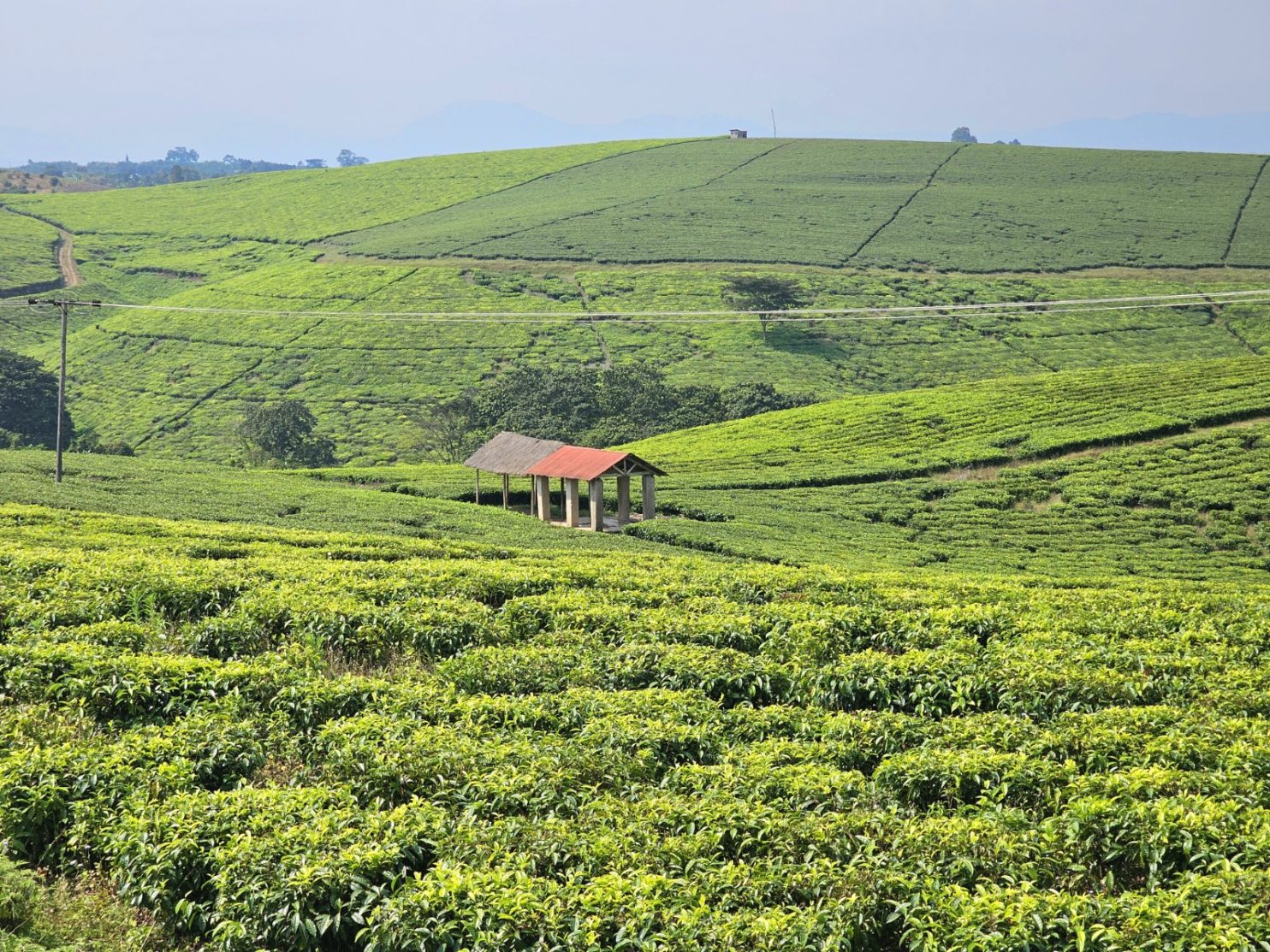
Day 113. 30 August. Mbingu to Ifakara. 62 km. 6 Hours. 210m up. 220m down. I was up at 0700 and then went for breakfast. Today the Sisters gave me two pancakes, a large omelette, a bowl of fried plantains and as much milky coffee as I wanted. It was exactly what I wished for. I packed up soon afterwards and then left at 0830. Initially I went to see if I could see anything of the large convent next door but it was all behind closed gates. There was not even a sign on the gates to indicate there was a convent here. Not being able to see much I turned round and headed for Mbingu and the main track which was an easy 2 kilometres away. I had let some of the air out of my tyres, and instead of 40 psi I was running them at 30 psi and it made all the difference to smoothing out the stony surface, and I glided along with a spring in my step. The rest day at the retreat had done me the world of good.

687. The unnamed river which drained an arc of the Udzungwa Mountains a little to the north. It crossed the road some 5 km east of Mbingu.
I crossed a bridge over a stagnant stream and then entered Mbingu again. It was quite a scruffy town and it was difficult to imagine that the refined Convent and Retreat was just down the lane. There was another guesthouse in this small town but I did not see it and I don’t think it could have given the Retreat any competition. Before long I was leaving the last of the stalls and heading out into the countryside again. I had only gone about 5 kilometres before I crossed a small girder bridge over a brown river which drained an arc of the Udzungwa Mountains to the north. Just after it was a stretch of irrigated fields, mostly with maize. The maize was planted in many places and a lot of farmers were in these fields weeding their crops. Most were using the digging hoe with the long handle and it was by far the most common form of implement in farming. The next was a slasher which was a curved machete on a sturdy stick which was swung from a height and would go through a 3 centimeter diameter log. Everybody also carried a normal machete and this was used for everything like collecting firewood, harvesting bananas and plantains, and I am sure as some sort of defence but there were no threats here, neither human or animal.

688. The digging hoe is the main farm implement I have seen in the Central and East Southern Africa. The next most popular is the slasher for clearing land.
As I continued east there was a bit of traffic on the road and it was very dusty. The motorbikes kicked a bit up but the larger vehicles were the main culprits. The dust coated all the vegetation beside the road with a reddish brown hue. There was a correlation between how fast a vehicle was going and how much dust it produced and the infrequent 4X4 were the worst. Suddenly I saw one coming towards me going really fast, well over 100 km per hour, which on this road was extreme. There were clouds of dust behind it. I gestured for him to slow down. It was a white Toyota landcruiser, without a roof rack and without letters on the side. I pulled my hoodie up over my mouth and cycled into the cloud. As I cycled through it and it cleared I noticed there was another girder bridge 100 meters ahead.
There was something on the bridge and it seemed strange. As I got closer I realized it was a person lying down. As I approached him he sat up, but seemed totally bewildered. Then I noticed there was a motorbike on its side and jammed into the girders which stopped it going off the edge into the stream below. Then I noticed there was another person at the east end of the bridge and she was an older lady perhaps in her 50 or 60 and she was groaning and on her back. It did not take long to work out what had happened. The landcruiser and motorbike were both travelling in the same direction towards Mbingu and they got to the narrow bridge at the same time. The landcruiser was going much faster and overtook the motorbike and hit it, and as it did so knocked the bike over. It must have known it hit the motorbike and caused the crash but rather than hang around and help as he was morally and legally obliged to do he decided to bolt and hope the motorbike rider and passenger did not recognize the vehicle. It was a hit and run essentially and that is the reason he was going so fast when passed me; to escape the scene.
Within a minute there were a few more motorbikes around and we blocked off each end of the bridge. The motorbike riders went to the two injured people while I and another pulled the motorbike from the girders, got it upright and wheeled it off the bridge. There was soon a bus at each end of the bridge and the passengers went to help. The young man who was the motorbike driver looked like a really strong tough guy but he was a bit bloody on a bare foot and his leg. A few men got him standing and then escorted him over to a motorbike and sat him behind the rider while another passenger got behind him so he could not fall off backwards. He was pinned between two people and then the bike drove off, presumably to the nearby health clinic.
I tried to explain what happened to one man who was early on the scene and was quite involved in the rescue. He was on the phone to someone and I could hear him say “cruiser” a few times. Hopefully he was asking people further west to stop, or at least get the number plate, of the escaping culprit. Google translate did not seem to work that well but I think he had already grasped what had happened. In the meantime they managed to get the older lady onto the back of another motorbike and pinned her between the driver and a passenger. There was a lot of groaning though and she was in pain as if she had broken a limb. I was surprised they did not commandeer one of the minibuses for half an hour to help her to the health clinic. When she had gone there were a few people milling around, but there was little I could do. In fact I had not done that much at all despite being first on the scene. Those who arrived just after me were so efficient, responsible and helpful, and knew Swahilli, that it made me redundant. The only person who acted shamefully was the culprit who fled in his landcruiser.

689. The homesteads here were not so sheltered from the sun and where not so overhung by large trees.
The whole scenario played on my mind a bit for the next hour and I could think of little else as I went through a few villages. In one of them I saw one of the main helpers and we greeted each other. Soon though it started to recede from the forefront of my mind and I began to observe the landscape again. The Udzungwa Mountains were now a long way to the north and I was well onto the floodplain and in the middle of an intensive rice growing area. There was no rice at the moment but there were plenty of ponds of water beside the road and tiny trickles in the stream but not enough to irrigate rice. Its cultivation here would obviously have to wait until the rainy season was in full swing to soak the fields. Here and there some Maasai herdsmen were tending their cattle which were grazing on the stubble. The Maasai cattle had absolutely huge horns, some almost a meter long on each side. It was very tempting to photograph the Maasai but I did not want to intrude or get into a discussion about payment.

690. The Maasai cattle had huge horns with some bulls having a tip to tip span of over two metres.
I passed rice mills and threshing plants frequently as I passed through villages heading to Ifakara. In one of them an ambulance came up behind me with its siren blazing and lights flashing. It was the same as the speeding Landcruiser I had seen earlier but this one had the light on the roof, while the other had nothing, not even a roof rack. I then passed a barrier and was approaching Ifakara when I noticed a policewoman under a tree sitting on a chair. As I approached she got up and walked to the edge of the road and flagged me down. She said something but I did not understand so I got the phone out and she spoke Swahili into it which the phone then translated. She said “I want you to tell me about the accident”. Obviously the news had travelled fast and the authorities were on the ball and investigating already. I used Google to translate what I thought had happened but I don’t think it translated well as she looked unconvinced. Perhaps it was when I said ”I arrived 30 seconds after the accident” she thought I was no use as a witness. But the driver of the white landcruiser was a marked man now. She explained that the ambulance which passed me was taking the older lady passenger from the health clinic near the accident to the hospital for further treatment.
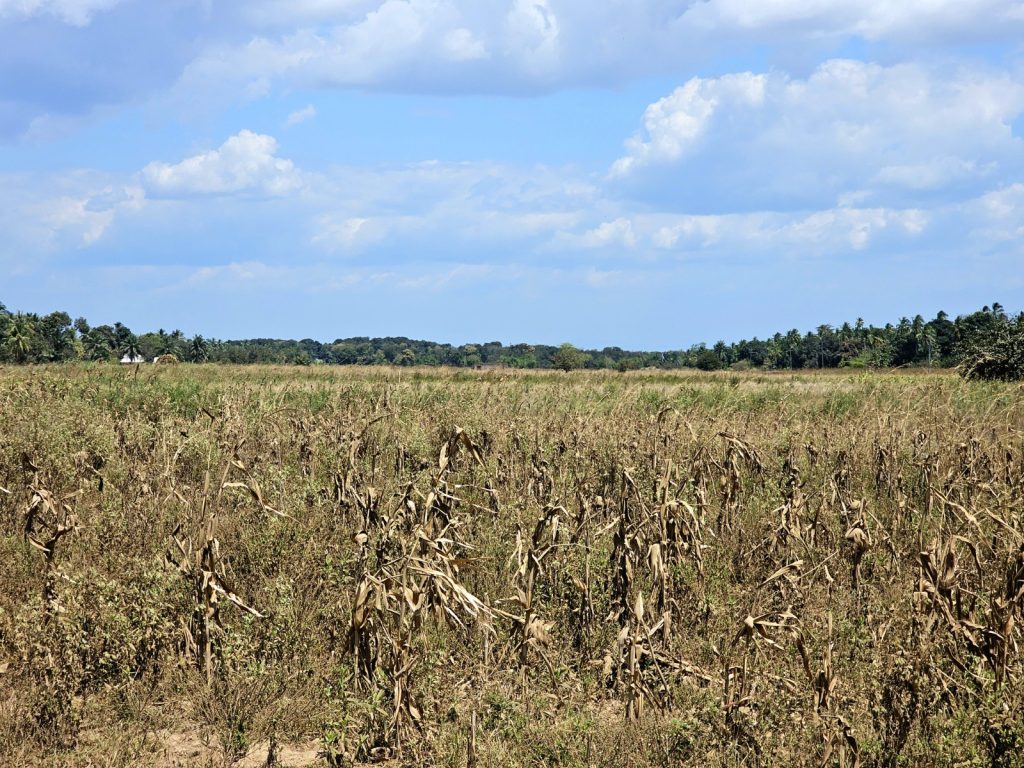
691. As I got closer to the regional capital of Ifakara the landscape got drier and the maize and rice crops were not irrigated and would only thrive in the rainy season.
After the police interview I crossed a few more rice growing areas in the increasingly brown and dried landscape and then entered the outskirts of Ifakara. It was a larger town, a district capital, with a population of around 200,000 I guess. It was not hectic and chaotic as I feared but quite calm, with plenty of small lanes and trees. I cycled through a few of them to get to the Ifakara Health Institute Main House, which was a lodge and restaurant for the Health Institute. However the lodge was busy and quite noisy and the room opened onto the bar area. So I left and went past the St Francis Regional Referral Hospital where I guess the older lady on the motorbike was now. It looked like a very new, well organised and up to date hospital. I think it shares links with the convent and retreat I was at this morning. I am also sure both the convent and hospital here have links with a Catholic order in Switzerland and have had for nearly a century. Next to it was the main Catholic church in Ifakara and I am sure I met the priest or even bishop from this church yesterday at the retreat. I tried one more lodge, The Cliften, which looked like it was an office, and then settled on the Mountain Peak Hotel which ticked all the boxes. I had intended to spend an extra day here but have now abandoned that idea and will split the 130 kilometres to Mikumi town on the T1 highway into two days instead.

692. St Andrew Catholic Church in Ifakara seemed to be the main Catholic church in the region and had connections to the Mbingu Convent and Retreat and also the St Francis Hospital in Ikafara.
That brings to an end the penultimate Section 09. West Central Tanzania. It has been one of the best but also one of the hardest. What I really liked about it were the kind, straight-forward, hard-working people all of whom made me feel welcome but without going over the top or with a hidden agenda. I also loved the countryside and the very varied agriculture and land use from the fruit orchards, timber and tea to the rice and potato fields. However it was hard with over 10,000 metres of ascent and descent in a little over two weeks, and much of that was on dirt roads. It was one of the most rewarding sections.
Day 112. 29 August. Mbingu Rest Day. 0 km. 0 Hours. 0m up. 0m down. I initially slept very well but woke in the night with some coughing. This turned into a bit of a fit and I was awake for a good hour coughing. I am sure it is from the dust on the roads and I will have to find some sort of filter or mask. After that I slept again and did not wake until 0730 when the receptionist was knocking on the door to say breakfast was ready. It was a hearty meal with a large portion of chicken and potato stew, a pancake, an omelette and a lot of milky coffee. The Mbingu Sisters certainly don’t skip on portion sizes. I was joined at breakfast by Nestor and two other priests. At the other tables there was plenty of laughter and leg pulling. It was almost as if this was a group of lads on holiday rather than the spiritual elite of the Catholic Church in Kilombero Region. They were all a very good natured group and typical of all Tanzanians I have met so far who are very straightforward, more serious than their Malawian and Zambian brothers, but as friendly if not more so. If a couple had three sons the Tanzanians would be the eldest, reliable and steadfast, the Zambians the middle son, also dependable, and the Malawians would be the happy go lucky, slightly mischievous, but the most fun youngest son.

685. One one the quiet peaceful verandahs in the Mbingu Sister’s Spiritual Centre where I spent the rest day writing.
Unfortunately the priests and higher clergy were leaving today as their retreat had come to an end and they were going back to the parishes for the services on Sunday. I had enjoyed their company. When they had all got into their very expensive 4×4 vehicles and departed the place felt deserted and I was the only customer. There was the receptionist, who was a man, and then a few of the Sisters who worked in the kitchen preparing the meals. However, it did not matter as I had one task today and that was to catch up with the long overdue blog. I had written 4 of the 6 days I had to publish but I had to write another two and then caption about 50 photographs and publish them also. I knew it would take the rest of the day and I was not looking forward to applying myself to the relatively tedious task. In the meantime my legs would have a rest. I did about half of the writing when the receptionist called me for lunch.
The sisters had cooked me fish, perhaps on account of it being Friday. I am sure it was tilapia and it was whole in a tomato paste sauce. I derive little enjoyment from fish on account of the bones and not being able to shovel it in without getting a mouth full of soft mushy flesh and toothpicks, and the tilapia was the epitome of what I don’t like about fish. When I tried to debone it I only managed to get about half out and spent the rest of lunch picking the others from between my teeth. I am sure a more skillful fish affectionado would have dealt with it in a more refined way. The sauce, the rice and the green vegetables were much more to my taste.

686. The central building in the Mbingu Sister’s Spiritual Centre had been commandeered as a prayer room by the Catholic priests and clergy who left in the morning after a few days retreat.
After lunch I returned and did half the captions and loaded the photos before a small stroll round the tranquil grounds and a peek into the main conference room which the clergy had commandeered for the prayer room. I then went back to the photos and managed to finish them all before having a small snooze. After dinner, which was chicken and chips, which I could wolf down, I tidied up the last of the blog and then did some emails. Tomorrow would be the last day of this Section 09. West Central Tanzania when I reach Ifakara, where I will have another day off.
It will primarily be to investigate the route further. Of the 400 kilometres remaining on this Section 10. East Central Tanzania about 300 are on the infamous T1 Highway. It is the main road from perhaps the biggest port on the East coast of Africa into Tanzania and Central Africa beyond that, and is not really an option. However, I have got some feedback that there are dirt roads beside the main T1 and they are a tolerable solution. There is also the option of crossing the T1 at Mikumi and heading north on the B127 for 3-4 days to Mziha and then heading west to Bagomoyo on the Indian Ocean and the journeys end.
Day 111. 28 August. Chita to Mbingu. 56 km. 6 Hours. 250m up. 260m down. There was no breakfast at the Flying Sparrow Lodge so I was packed and ready to go by 0830 after a great night’s sleep. I could have gone the short kilometre back into Chita to find breakfast but decided to head north and find something enroute. After a couple of kilometres I came to a small hamlet with a couple of road side stalls. At one of them a man was selling small ripe yellow bananas and large green plantains. I stopped and bought 12 bananas for 1000 shillings. I ate half straight away, and half beside a stream 15 minutes later. I was wary about keeping them in the front pannier on this bumpy road as they soon turn to mush and burst out of their skins after bouncing about.

678. Leaving Chita in the morning and heading NE along the edge of the Kilombero Plain with the Uzungwa Scarp Nature Forest Reserve rising steeply to the NW.
As I cycled north the escarpment of the Udzungwa Mountains rose steeply on my left (the north west). These jungle clad slopes were very imposing and wild, although they have suffered from human encroachment, particularly from poaching. To combat this the Uzungwa Scarp Nature Forest Reserve was created in 2016 to try and protect some of the endemic species that are found here, like the Red Colobus Monkey and rare small deer called duikers. As I cycled along here I could see waterfalls coming down the slopes, cascading over rare patches of bare rock. On my right (the south east) was the huge Kilombero flood plain. I said yesterday it was riven by channels which flood and threaten crops but these channels are along the central axis of the plains and between the mountains on each side and these central channels are barely perceptible slopes which are 5-10 kilometres wide and they are agricultural land. They are well watered from the streams which come down from the mountains, but apparently the soil is not that fertile, as the minerals which are washed down from the mountains lack nutrients. Nonetheless it is a prime rice growing area. As I continued north I passed hamlets and small villages where numerous tracks led off at right angles and headed onto this floodplain to the fields where the crops, primarily rice, were grown.

679. At Ikule I was spotted taking a photograph by these kids who burst into an excited run and followed me for about 2 kilometres all the way to their school.
After a good hour I reached the village of Ikule with its rows of grocers, bike repair shops and small food stalls. It was well shaded by tall trees on each side and in the compounds of the homesteads, so much so that photography was almost futile as everything was in the dark shade. At the north end of the village I stopped to take a photo looking back up the track. Just then I was spotted by a group of younger children of about 6-8 years old who burst with excitement and started to chase me. They soon caught up as I cycled more slowly over the stony road. Initially there were about 6 but their numbers grew to about 20 as we caught up with others. I was amazed how easily they ran and even after 2 kilometres the original ones were not breaking sweat or puffing but jogging along quite easily at 10 kilometres per hour. I suppose this is what comes of living and playing outdoors all day without phones or digital games. These kids were not only supremely fit, but also happy and were joking with each other as they ran abreast of me. I left them at the gates of the school and continued north.

680. North of Ikule I passed these three characterless ladies selling bananas and ripen payaya by the roadside and stopped to buy some.
After another few kilometres I passed a group of ladies selling bananas and papaya. I had looked at a few papayas but they were always green, however these were ripe and quite yellow. I bought some bananas and a papaya. They cut it into quarters for me and gave me a spoon to scoop out the seeds and eat the flesh. It was delicious and exactly as a papaya should be. My hands were covered in juice but they had water and a cup to rinse them. I think they were primarily selling to the occasional bus which came this way. They were so cheerful I asked for a photo but as always people then lose their joy and become more serious so I could not capture their joy and laughter.

681. Around Mngeta village the dusty road veered onto the flat Kilombero Plain and away from the mountains but the streams from the mountains still flowed and irrigated large areas of vegetables like the pictured tomatoes.
As I continued past the larger villages of Mngeta and Njagi the traffic started to get busier. It was still very little but what there was created clouds of dust. There was the occasional large lorry with a big trailer and these were very slow due to the rough road and created some dust. The 4X4 vehicles, particularly those belonging to aid organisations and private people, were quite fast and kicked up loads of dust. Many of the locals on motorbikes had scarves or masks on but I tended to hold my breath until I was clear of the worst of it. Nonetheless I was inhaling quite a bit of dust and had noticed over the last few days I was getting a cough because of it.

682. At the village of Njagi the homesteads where lush with irrigation and idyllicly situated at the foot of the mountains. The palms here are oil palms.
The homesteads on each side of the road were continuous, as was the farming and gardening. There were enough streams coming down from the escarpment to keep this place irrigated even in the dry season. As I approached Njagi and Mbingu the road veered away from the base of the escarpment and onto the flat lands on the floodplain but the streams continued to flow and sustain vegetable gardens of tomatoes and greens, and also fields of ripening maize. There were lots of mango, papaya and banana about, and also palms, many with coconuts. There was sometimes a putrid smell from some of the palms and I thought nothing of it. However in both Mngeta and Njagi I passed filthy yards full of the large blue plastic drums which were blackened with dirt. I could not work out what they were and initially I thought it was a local brewery or even distillery making alcohol that would surely make you blind. In the end outside Mbingu I saw another and was curious so asked someone. He said it was palm oil and went over to get me a spoonful. It was clear with a red hue. The putrid palms I had been passing had already harvested and pressed their cluster of trees and these places with the blue barrels were collection depots.

683. Starting to enter the edge of Mbingu which was a thriving market town and it seemed this was where the lorries dropped their loads which were then redistributed to smaller lorries by traders serving the villages on and along the Kilombero Plain.
I reached Mbingu as the heat of the afternoon was at its most intense. I did not really go into the town but turned off to the north just before the centre. I headed out on a small road to Mbingu Sister’s Spiritual Centre. It was a large cross shaped building with 4 arms leading from a round central block. The round central block housed a conference room now commandeered as a prayer room. In the 4 arms were accommodations, dining rooms and more prayer rooms for guests. The whole place mainly operated as a spiritual retreat but was also open to visitors to stay at. Next to this centre was a larger complex where something like 1000 sisters or nuns stayed at or were based there while they worked in the community. It was the sisters from this large complex which ran the retreat and guesthouse. This large complex was home to the Fransciacan Sisters of Charity who had many worthy projects in the area.

684. Just outside Mbingu was a Spritual Retreat run by the Fransciacan Sisters who lived and were based in a large adjacent complex housing 1000 nuns.
I was given a lovely cool room and then sat near the central area. It seemed the centre was holding a retreat at the moment and there were about 20 Catholic priests here at the moment. They were milling about in their cassocks and sandals waiting to go into the prayer room for their afternoon prayers. I am sure some of them were very senior members of the Catholic church from this region and some of the older ones looked very calm, confident, learned and warm as if they were highly intelligent and well educated. I chatted to a few of them and they were exceptionally welcoming. Later at dinner I sat next to a few, including Nestor, who was from Mlimba originally and now worked in his parish of Ifakara. When I mentioned I was from Edinburgh a few exclaimed that Julius Nyerere,the so-called “Father of Tanzania” and the first president had done his degree there at Edinburgh University from 1949 to 1952. I tried to write that evening but was just too tired so decided to take a day off and catch up with everything and let my body relax as I was still tired from the climbs 3-4 days ago.
Day 110. 27 August. Mlimba to Chita. 44 km. 6.5 Hours. 330m up. 330m down. I left the nice hotel quite early after an easy stay. They didn’t have breakfast so I had more granola, finishing my penultimate packet. The hotel was at the southern end of the town and I had to cycle through most of it to get to the northside where the road to Ifakara led out. I passed all sorts of shops, some very specialized, like electricians or phone shops and also a few tailors and seamstresses. I had the most comfortable cycling shorts I had used from the start accessible in the front pannier should I need to change into them later in the day. The trouble was they were ripped at the crotch and were slightly embarrassing to wear in this prudish society. Instead I wore my cycling hotpants which were more obscene as they were so short and I had to wear shorts over the top of them to cover them up. The trouble was the shorts made the set up too restrictive and hot. It seemed ridiculous to pass all these tailors without asking one if they could repair my favourite shorts. The trouble was there was a pad in the inside of these cycling shorts which they might think is a nappy. I passed one and it looked promising, but continued. After a 100 meters I plucked up the courage to turn round and go and ask one. The man I asked was in a tailor shop with about 5 other men all making clothes. He said he could patch it and it would be 3000 shillings (£1). All the others came over to peer at this strange garment and discussed it while I buried myself in the BBC news on the phone. 20 minutes later it was done and I returned them to the panier and cycled off through town in the uncomfortable pair.
It did not take long to leave town on the asphalt road which was a godsend to cycle on. It was quick and smooth. To my south and east I had the huge floodplain of the Kilombero River. This flood plain was about 150 kilometres long from south of Mlimba to Ifakara, and an average of 25 kilometres wide. It is contained by the Mahenge Mountains to the South East and the Udzungwa Mountains to the North West. 4 main rivers flow into it, including the two I cycled over yesterday. These rivers meet at the south west end of the flood plain in a braided splay of channels and they then start their journey over the floodplain, flowing in up to 10 different channels. It is one of Africa’s largest wetlands and can measure up to 6000 square kilometres. At the town of Ifakara the sides of the valley come together for a while and the Kilombero River forms into a single channel again, before leaving this pinch point and splitting into more channels again to cross a smaller flood plain. When it leaves this smaller floodplain to the east the river flows through the huge Nyerere National Park and joins the Rufiji River to flow to the Indian Ocean.

671. Leaving Mlimba and looking north west to the start of the Udzungwa Mountains which quickly approached the road and formed the NW boundary of the large Kilombero Plain and wetlands.
The Kilembero floodplain is an internationally important environment area with a huge variety of birds, naturally wetland birds especially, but it also borders on key areas for Africa’s major animals, like elephant, lion hippopotamus buffalo and puku and it hosts them also. The trouble with the area is there is also a growing human population as the more and more smallholders move in to try the risky business of rice farming on the floodplain. It is risky because the rains can be erratic and if there is too much the rice fields completely flood and the harvest is lost and this can happen more often than not.
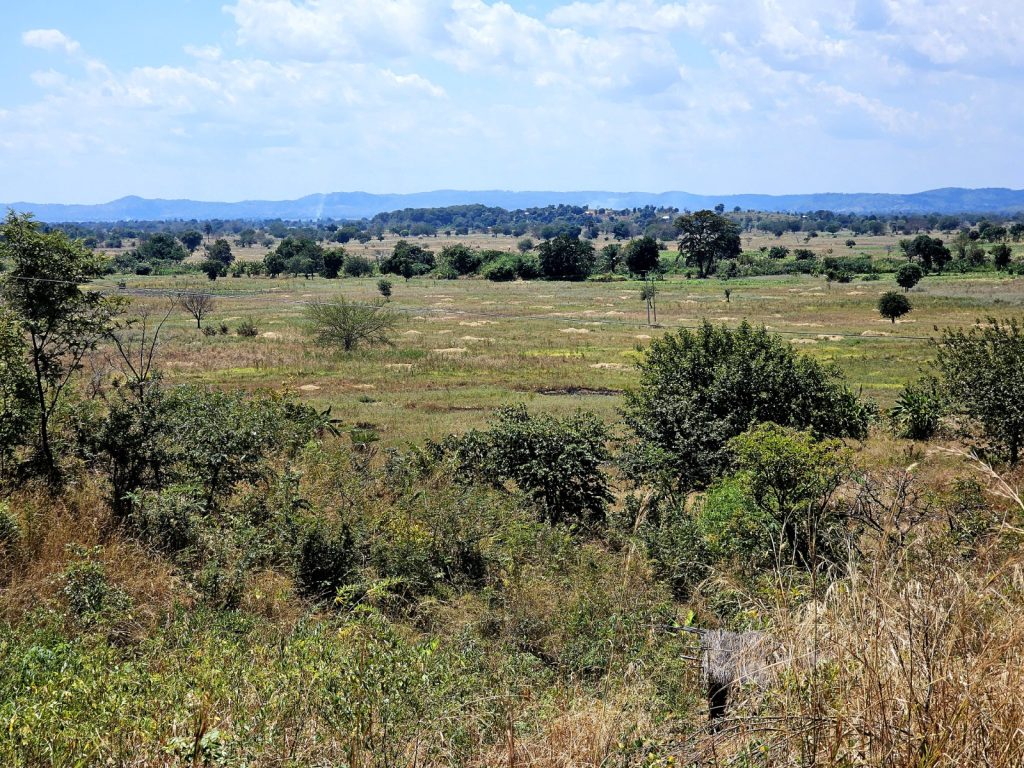
672. Looking east on the road leaving Mlimba across the start of the vast Kilombero Plain and wetlands which was about 200 kilometres long and 40 wide and hemmed in by mountains on each side.
On my other side to the north and west I had an escarpment which led up to the Udzungwa Mountains. This range was about 150 kilometres long and pretty much coincided with the north west side of the Kilombero Floodplain. The mountains rose steeply from the plain which was at about 300 metres altitude right up to well above 2000 metres. The mountains were thickly clad in forest. Down here it was tropical forest but I think up at 2000 metres to the highest peaks at 2500 metres it is montane type forest. The road I was on went from Mlimba to Ifakara round the edge of this vast floodplain and along the base of the Udzungwa Mountains. It promised to be generally flat as it went from village to village for 150 kilometres.
The first 20 odd kilometres were on a tarmac road and I was quite spoiled by it. It was a lovely cycle on a quiet road with little traffic except local tractors, both 4 wheeled and the 2 wheeled engine block with a trailer. There were quite a few tuk tuks and this seemed to be the main way of getting around if you did not have a motorbike or bicycle. Occasionally I managed to get a good look into the tuk tuk and there were about 6-8 people in each one. They were crammed in like sardines. There were also smaller lorries and motorbikes. The tractors and the lorries were full of larger sacks which I am sure were rice still in the ear and they were going off to mills along the road which dehusked them. The Udzungwa Mountains were not that big here, but I could see them starting soon and even in these smaller foothills there were plenty of small streams flowing down from them and onto the plain. They were used for irrigation and there were quite a few fields with green maize.

673. As I approached the Kihansi Dam offices and social club 20 kilometres NE of Mlimba the Udzungwa Mountains were now right beside the road and covered in jungle.
After 20 kilometres I reached the Kihansi Social Club. It was up a tarmac road on the hill and was essentially complex for the workers who operated the Kihansi Dam up on top of the escarpment. The dam was for a hydroelectric scheme which provides some 180 MW of electricity. It is not much in today’s world but when it was commissioned in 2000 it provided 13% of Tanzania’s electricity. The complex had all the workers’ housing and also a guest house for visiting workers which was open to the public. It was supposed to be a nice place to stay but there was 100 metres of ascent up to it and I really wanted to do a bit more today so the journey tomorrow to Mbinga was shorter. So reluctantly I cycled past the hydroplant offices and a small wildlife centre where they bred the endemic toad which was displaced by the dam and would be extinct now were it not for this. The toad was called the Kihansi Spray Toad which thrived in the spray of the once magnificent 800 metre waterfall. Right after these hydroplant offices the lovely tarmac road came to an end and it was a gravel track again.
The gravel track was not in good shape. It was full of rocks which the sand and dust coating them did little to smooth off. The tractors, lorries, motorbikes and even tuk tuks bounced along with their suspension smoothing out all but the worst bumps but the cyclists had to endure them. I thought of letting my tyre pressure down so the tyres are wider and more shock absorbant. A few times the track crossed the TAZARA railway line which looked small gauge. There were rarely trains on it, perhaps once a day, and people were using it as a path to collect firewood. There were also old iron bridges over streams coming down from the forest-clad Udzungwa Mountains escarpment which were now looming above me. These streams were clear as they tumbled down over small waterfalls from high above.

674. Approaching the village of Udagaji whose main street and adjacent homestead compounds where heavily shaded by large trees, mostly mango.

675. There were frequent rice mills where the rice was dehusked by machine all the way along the road every two kilometres or so showing how much rice was grown on this part of the Kilombero Plain.
After about 10 kilometres I reached Udagaji village. It was hidden from the sun by a canopy of trees, many mangoes. The village was long and went on for about three kilometres with a row of houses on each side hidden in the dark. The houses were brick with corrugated roofs mostly and were quite quiet with hardly any kids playing at them. I even wondered if some were seasonal homes for the rice season. However there were also shops and a couple of pubs with men hanging round on motorbikes. I think it was a normal village but I could barely see some of the compounds because it was so shaded. I took a photo of a few homesteads but they didn’t really come out. Towards the end I spotted a rice mill in the sun and took a photo of it. Nearby kids came running up and wanted me to take their photo. These were some of the more confident open kids I have seen so far in Tanzania. There were rice mills everywhere and for the next 10 kilometres to Chita there was one every couple of kilometres. The tractors were also towing portable ones. Rice was obviously the main business here.
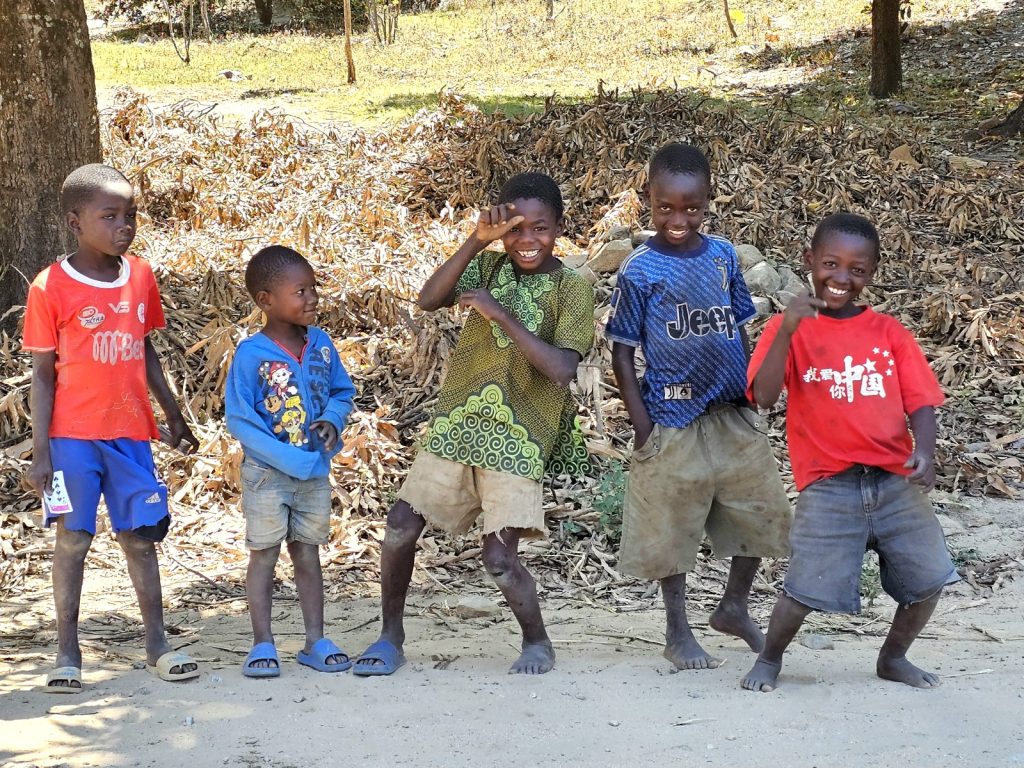
676. At Udagaji the kids were much more forthcoming and wanted to be photographed.
Eventually I got to Chita at around 1500. I passed a couple of guesthouses which boasted they had attached rooms, pool table and bar. But this means the bar is their mainstay and the music is guaranteed to be loud. In the centre of the small dusty town there was the White Lodge and I went in. The rooms were OK but when I looked out of the window there was the lodge’s bar already with 15 customers right outside. So I explained to them that I could not stay. Outside I asked someone working nearby in the restaurant attached to the White Lodge and he explained there was a lodge at the other end of town which was nice. A group of men started to explain it to me but then the cook got on his bike and offered to show me. We cycled north past about 10 large sheds where lorries and tractors were coming and going with bags of unhusked rice and hundreds of people were outside. There were many ladies winnowing the husks hoping to get enough rice from this supposed waste, and in a day they might get half a bag. After nearly a kilometer we turned off down a small road to the Flying Sparrow Lodge. He rang the bell and someone came to the gate and he explained I was looking for somewhere to stay. They did have a room so I gave the chef a tip and he left.

677. The homesteads continued all the way from Udagaji to Chita with many shaded by trees and palms. Here are coconut and palm oil palms (the shorter) and a mango trees. There were banana groves everywhere. The main farming was done on the adjacent Kilombero Plain.
The lodge was new and exceptionally clean. The hot water was limitless, as there was an electric heater in the bathroom. I think it was essentially a couple who had good jobs and they saved and put all their money into this property, half of which was a guesthouse, and half were their own rooms. It was quite a dull place but it would be quiet. They had no kitchen so there was no dinner and I went back to the White Lodge and the chef in the later afternoon for the usual beans, stew and rice. I was finished before dark as I wanted to get home before it was dark and avoid the gauntlet of lorries and motorbikes driving in the dark. I just managed to write the blog before a wave of tiredness swept over me.
Day 109. 26 August. Taweta to Mlimba. 56 km. 6.5 Hours. 320m up. 490m down. I had a large bowl of granola for breakfast as the lodge did not do breakfast, and I needed to get rid of some of it. It was quick and I was finished and packed up by 0800. As usual for the last few days it was very overcast and the sky was dark and threatening in places. I cycled back through town and over a simple steel latticework bridge crossing the Mynera River to the north bank. I then quickly left town but cycled past a series of homesteads which looked like they grew rice on the valley floor and bananas around their homestead. The homesteads here continued to be poor and along with the road into Taweta yesterday, the poorest I have seen in Tanzania. As I was about 5 km from Taweta I noticed a few large raindrops. A few minutes later it was raining heavily and I parked the bike and took shelter under a large arc of bamboo stems. The rain lasted for about five minutes and the air smelt musty as the earth got wet. Just as the drips were starting to come through the bamboo leaves it stopped and I got back on the bike. I did not have a rain jacket as I thought it never rained in the dry season. Had I got wet it would have made little difference as it was warm rain and I would have soon dried off.

651. After leaving Taweta I immediately crossed over the Mnyera River which drained the northside of the ridges I had been on for the last three days.
For the next hour or so I cycled through a string of poor homesteads whose mud and grass roof shacks were generally hidden in the banana groves which surrounded them. There were rice growing areas in the valley just to the side of the road but it did not look well farmed and the fields were ill defined. Here and there I passed couples working in these fields and it was as if they were trying to establish a farm. I passed three couples and all of them were making bricks beside their rustic house. I think this area was just being opened up by younger people who were encouraged to try their hand because of the road. Eventually I got to the village of Ipinde about 6-7 kilometres from Taweta. It was small and poor with many of its buildings looking quite rustic.
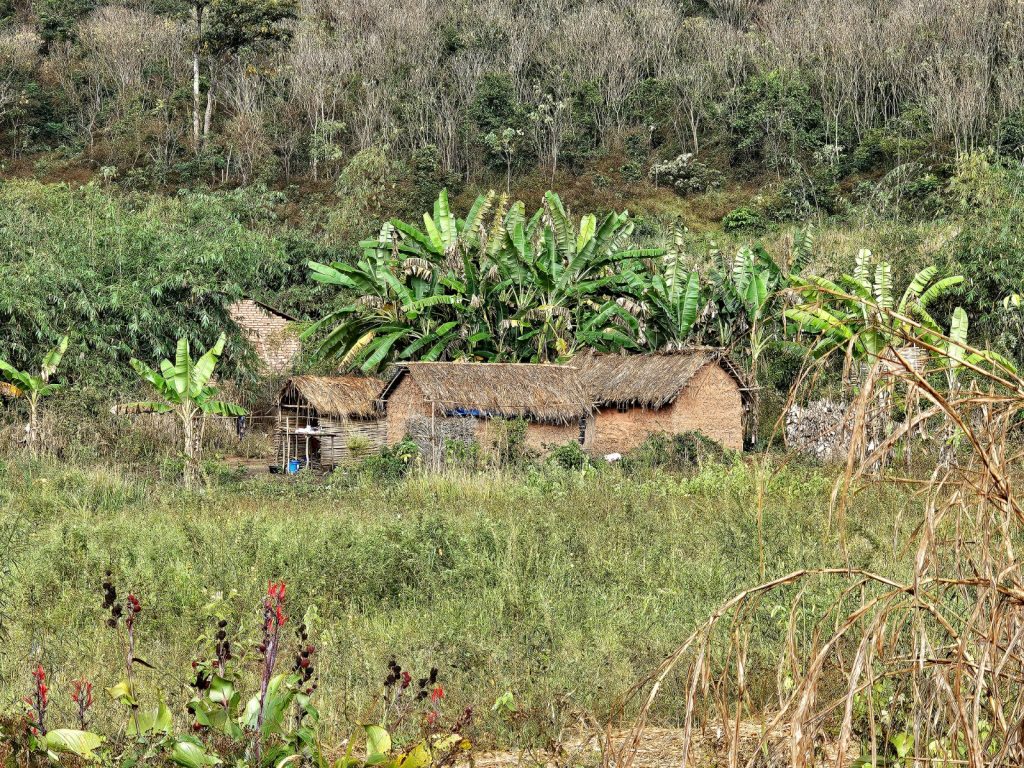
652. Between Taweta and Ipinde the track went alongside valleys where the were some poorer homesteads with banana groves and some maize and rivers plots being reclaimed from the encroaching jungle.
After Ipinde the road deteriorated a bit and there were plenty of muddy sections. In this dry season it must be a challenge to the lorries but in the wet season it must be very challenging and I am sure many don’t bother as the conditions are so muddy there is a danger of getting stuck for a while. The homesteads stopped for at least 5 kilometers while the road went into deeper tropical jungle. It was dense on each side and virtually impenetrable. I passed a few groups of the small green vervet monkeys who seemed to thrive in the forest here. Perhaps they occasionally raid the adjacent farmers but they are in danger of being hit by a catapult and they know this. Just at the end of this forest section I came across a lorry with its back wheels off. The crew had taken it off as the bearings were shattered. The greasy parts all lay on sacks to keep them off the dirt. The driver then appeared. It was Mr Fistbump from yesterday and he spoke OK English. We had a small chat and he said “Mlimba is now near”. I said “it was still 45 kilometres away” and we laughed. His situation looked dire but he said he had already asked a motorbike rider to get the parts and was waiting for them.

653. After Impinde track went through some thicker areas of jungle where the track was very rutted and near impassable in the rainy season I should imagine.

654. After the jungle section following the village of Ipinde the track crossed a few ford which flowed over the track on concrete ramps.
The jungle ended with a ford over a stream. It was murky and I could not see the bottom so I took off my shoes and socks and walked the bike over while a large crab watched from the shallows at the side. Had I cycled over I would have got wet feet as it was well over the pedals. On the other side the rice farming continued but this time it was more organized. The fields were clearly marked out and they were already planted or in the process of being planted with almost luminous green shoots being taken from a nursery paddy field and transplanted. In these rice areas the houses looked more substantial and their farming looked like it had been here for at least a generation.

655. As I approached the village of Mpanga the rice fields became more organised and established as if they had been there for a generation or two.

656. In most rice areas the farmers have a nursery where the rice shoots are planted and nourished before being uprooted and taken the the prepared main paddy fields where they are planted much further apart and in rows to mature
There were also a few cattle. Not the usual scrawny local cattle but larger cattle with huge horns. I was sure they were watched over by Maasai tribesmen as they were dressed in that way. There were about 5 herds with 20 cattle in each herd, with a few sheep clustered together in the heat also. Each herd was watched by a Maasai. Obviously the Maasi and local farmers must have an agreement about grazing rights here. Pastoralists are always more assertive than farmers who they often view with disdain and this is throughout the world, especially in the Old World nomadic groups like the Kurds or the Fulani. Where the road veered away from the flat valley floor the farmers became poorer again as they had to eke out a living from maize and bananas. I am sure the Maasai cattle could cause havoc amongst these farmers if unsupervised and these poorer remote farmers would not have the same collective voice as the rice farmers. Just before the large village of Mpanga I crossed a bridge over the Mpenga River and stopped to take a photo of the ingenious irrigation system. It was a huge wheel bolted onto the side of the bridge some 10 metres in diameter and made from steel, plastic barrels and black industrial pipes. As the current flowed into the scoop of the plastic barrels it turned the wheels which pumped the water into the pipe and forced it up 10 meters where it could flow. As I was admiring it, 3 men approached me selling sandals. I said “you guys look like Maasai” and they said they were.

657. Before Mpanga the rice paddy fields disappeared as the track left the flat valley for shallow hillsides and the homesteads became poorer as they relied on maize and cassava.

658. The dusty town of Mpanga was thr main market town for about 10 kilometres in each direction.
Mpanga was the most vibrant small town I had seen since Lupembe nearly 100 kilometres back. It had shops and groceries down each side of the street which was shaded with large mango trees. If it were not for the red dirt road and the mud built buildings it could almost have been a French style boulevard. The small town was cool and pleasant and I thought about stopping here but suddenly I was on the far side of it and heading out having procrastinated too long. The track now became more and more sandy as it crossed a few small stream beds. Most of these were dry but they would have washed sand onto the road in the rainy season. There were also a few rutted areas and some more fords, which were much shallower and I cycled through them, after watching the motorbikes negotiate them first. On one sandy stretch where I was struggling to keep the bike in a straight line a Maasai passed me on an old bike. That would be unremarkable except he was only holding onto the handle bars with one hand while the other hand was clamping the legs of a sheep he had over his shoulders. It must have taken great strength and skill to do this and he cycled as if he owned the road not giving way to the motorbikes at all.

659. I was passing more and more Maasai herdsmen with small herds of cows. This herdsmen passed me on the bike carrying a live sheep across his shoulders.
It got very hot in the afternoon now the skies had cleared and I was at about 300 meters altitude. As I crossed the sandy open areas the sun beat down on me. At least it was generally flat with just a few rises and descents. The road got busier and busier with all sorts of vehicles, there were the 3 wheeled motorbikes with the tipping trailer and also a few of their predecessors. This was an engine with a front wheel, behind which was a trailer. The driver sat on the back of the engine and steered the contraption with two handles which manoeuvred the engine from side to side. I was always wary around them as I was not sure how much control the driver had. There were many motorbikes and more and more tuk-tuks. There was always peeping to warm me something was coming from behind. One series of beeps was quite cheerful. It was Mr Fistbump who had somehow received the new bearing and refitted it. He carried on, negotiating a muddy rutted section just in front.

670. Entering the town of Mlimba which was the largest town with the most amenities since leaving Njombe four days ago.
After half an hour the mayhem of the motorbikes and the sand suddenly came to an abrupt end with a section of tarmac. Suddenly I did not have to vie for a position on the firmer bit of track and now I could go right over to the side as I entered town. I stopped at the first petrol station to ask about hotels and he said Njema or Shelaton. However I could find neither on googlemaps which after 2 days of no signal was now working. I carried on and met Mr Fistbump again. This time I said “ now it is near” and he laughed. He suggested the Lugelele Lodge which was nearby. After we parted I cycled about 300 metres and found the sign. It was down a side street and looked secure. She had a room but she spoke no English so I downloaded the Swahili part of Google Translate and we started to have a disjointed conversation via the phone. The room was 25000 shillings ((£8) and it supposedly had hot water. It was a large room and she demonstrated the shower and it was indeed hot. I took the room and enjoyed a long hot shower and washed my clothes. There was no food or drink at the lodge so just before the sun went down I went out and found a nice local restaurant in the busy streets. I had chicken, beans, rice and green vegetables. While eating I was surprised to see a train stop at the end of the street. It was at Mlimba station which was on the Tazara line between Dar-es-Salem and Zambia. I walked back to the lodge in the dark amazed at how little traffic used their lights at all, with at least half the motorbikes were in complete darkness, except for the puny streetlights. Back at the lodge I wrote for 3 hours.
Day 108. 25 August. Madeke to Taweta. 44 km. 7.5 Hours. 940m up. 1660m down. I was awake early and got up at 0630 as I was keen to do as much as possible before the heat of the day. I was surprised to see that there was a mist about and the base of the cloud was just at Madeke. All the surrounding hills which were a bit higher were obscured and the valleys below were dull without the sun. Rather than go into the village for breakfast I just had some granola and powdered milk on the bench outside the lodge. I thought Branson had already gone to work but he was doing a large laundry wash and then was going to the market to get food for the helpers on the farm. We chatted a bit but we were both busy and I left at 0800 by which time the mist had burnt off but it was overcast and still.

641. Looking back towards Madeke after leaving it in the morning for the arduous journey to Taweta. You can see fields of pineapples here and there.
Initially the road descended a bit but I was prepared for a real roller coaster today having been warned by Sam and Will that it was very hilly and very few of the hills showed up in the phone apps. There were no real settlements after Madeke but plenty of small farms and homesteads. They were not just beside the road but on the side ridges. Initially they were mostly avocado and pineapple, especially pineapple. There were large cleared areas too with nothing except bracken which seemed rampant and at least 1.5 metres high. I think the pineapple farmers had a constant battle with it and passed many plots where it had been cut with a slasher, otherwise it would overpower the pineapple bushes. A lot of these homesteads looked very romantic perched on their ridges surrounded by well kept plots but I am sure the reality is much harsher and the farmers are at the mercy of both the weather and also the markets.

642. Looking east along the ridge leading out from Madeke with the taxing track running along its apex from knoll to knoll through fields of pineapples.
Pretty soon the road started to drop steeply only to climb again. The drops were very steep and the climbs equally so. As the earth was not smooth I had to go down using the brakes to keep myself at walking speed. On the ascents I was always at walking speed. Sometimes it was so steep it was easier to get off and push. I think a lot of these farmers, Branson included, were hoping the promised tarmac road would arrive. This would really make farming easier for them, especially getting the fruits to market. However, I could not see how even the Chinese could build a tarmac road here without huge expense as the ridges were so convoluted. The yo-yo nature of the road was starting to tax me and I spared a thought for Sam and Will who came up this way. At least for me the descents were bigger than the ascents but it was the opposite for them.

643. There were also orchards of mango and avacado beside the ridge top road leading east from Madeke to Taweta.
As I continued to drop down the avocados seemed to be replaced by mangos. However, the pineapples still were the most abundant crop here. There were some large fields of 2 hectares or so full of the plants. It was not pineapple harvesting season just yet but there were a few that were ready and they were being collected from the fields. There were some ladies beside the track selling the fruits but I did not pass any lorries which could take them to market. I would have liked to buy one but would have ended up a sticky mess with no water to rinse my hands afterwards. After 10 km or so I reached a larger pineapple farm of about 20 hectares of well looked after bushes. There was also a mango orchard here with 100 trees and a larger plantation style bungalow. There were workers in the fields carrying large white sacks of fruit up to the track. There must have been a few tonnes already collected this morning. I guess this was a resident landowning farmer in the larger bungalow who employed some 10 men to run the farm.

644. Most of the pineapple groves were small and manageable by a family. However, there were some farms like this one with a larger farmhouse where the owner employed labourers to work on the larger farms.
I climbed beyond this farm and then started a more continuous descent. The avocados had long gone, but now the mangos and pineapples also disappeared as I dropped below 900 metres. There were some great views over the ridges which were now largely covered in jungle. Frequently it had been cleared of trees, but most of the time this land was abandoned once the trees had gone. Rarely there was a homestead growing maize or cassava on the steep hillsides while they also grew vegetables on the rich black earth on the valley floors, which were irrigated. However these homesteads were rare and it was usually the jungle which prevailed.

645. The pineapple crop on the road between Madeke and Taweta was just starting to ripen but there were some bushes already producing mature fruits.

646. The track between Madeke and Taweta was very convoluted with plenty of steep descents and climbs but generally it dropped down the ridges to the flatter lands in the distant east.
In one large dip I crossed a larger stream. I was half way over the small bridge when a lorry appeared. I got off the bike and reversed it back as there was not room for two. As he passed he rolled down the window and gave me a fist bump as a gesture of friendly gratitude. After he passed I had a very steep push up through the jungle. I was getting quite tired with all the climbs but knew I was just about half way. As usual at the top there was a ridiculously steep descent down to a very small village. It was totally different to anything I had seen in Tanzania and was very poor. The houses were brick and thatch and the fields looked like it was a constant battle to stop the jungle claiming them. The village must have had a school as there were kids just spilling out of it onto the road. Most people in the village gave me a small half hearted wave if I waved at them, but most just stared and must have wondered what on earth I was doing. The village had a good variety of crops with rice on the valley floor, maize and cassava on the sloping fields and banana groves around the houses. There were a few mango trees too but it was too low for avocado and pineapple. I passed one house where an animal, a goat I think, was getting butchered after it was slaughtered. I guess this village had to be quite self-sufficient as it was really isolated in the jungle with only this narrow steep seasonal track as its connection with the world. There was no electricity in the village but there were power lines being put in nearby.

647. Before it reached the flatter lands to the east around Taweta it passed through a very poor village lost in jungle and only connected to the outside world by this rough track.
As I left the village 4 kids from school followed me. They were transfixed by me and the bike, but said nothing. They followed me for about 3 kilometres, sprinting after me when I went down hill and then easily catching me when I had two arduous pushes up very steep hills. I tried to communicate with them and gave one an empty bottle of water and another empty bottle of soda. They eagerly took them but there was no smile or acknowledgement. I think they just didn’t know what to make of me. Occasionally a motorbike came the other way and waved and tooted at me and seeing the adults greet and accept me put them a little at ease but they were still cautious and never really took their eyes off me. When the older sister stopped her brother walked straight into the back of her as he was looking at me. Eventually they were gone and I looked round to see them heading up a path to a cluster of simple brick and thatch cottages.

648. Once the track had descended out of the hills it passed a couple of small hamlets in the flatter valleys before reaching the Mnyera River and the very small town of Taweta.
From leaving them the climbs had just about finished and I initially had a steep run down to a valley. The floor of the valley was flat and there was a small stream running through it. Frequently the stream was diverted across the valley floor to irrigate some rice fields before the channels merged again and it flowed as one down to the next widening. There was another village here but it was much more developed and the houses had corrugated iron roofs and were arranged down each side of the street. There were even a few small grocers but still no electricity. I followed the track down alternating between rice and maize fields and then sections of jungle for a good hour. It was predominantly a gentle downhill cruise for which I was thankful as it had been a strenuous day so far. Suddenly I came to a large river. It was the Mnyera River and it seemed to drain the area to the north of where I had cycled for the last 3 days. It eventually joins the Kilombero which I will follow to Ifakara town. I followed the muddy waters of this sluggish but determined river for a few kilometres over a final thigh-killing rise to descend into Taweta.

649. The Mnyera River drained the area to the north of the ridges i had been following for the last 3 days since Njombe. It was one of 4 large rivers which flowed onto the flat Kilombero flood plain where I would be for the next 4 days.
I did not go all the way in because I found the lodge which Sam and Will had stayed at. It was run by a characterful young wife and her husband. Their rooms were just 12000 (£3) but there was no hot water or furniture in the room except the bed. However the water was lukewarm and it was warm down here at about 400 metres altitude so the shower, although invigorating, was refreshing. There was no food here so I went the half kilometre into town to find a small local restaurant. There was one run by a strong lady. I asked for a meal and she gave me boiled beef stew, cooked beans in a sauce, rice and the green vegetables. It is the standard fare at all the restaurants and this is the menu, take it or leave it. Occasionally there is fish or chicken instead of the beef but the meat or fish dish is the smallest of all the bowls. It filled me up even after having skipped lunch. I walked back to the JS lodge just as the secondary school was released at about 1800 in the evening. The teenagers were eager to see me and walked fast to catch up or those in front lingered so I caught up but very few engaged in conversation other than how are you. I think Tanzanians so far are very respectful and quite shy. It is perhaps the most traditional and polite of all the countries I have been to so far in Africa. Nobody asks for money or sweeties and the greetings are calm and respectful. Back at the lodge I tried to write but the day had been a long one and I was too tired.

650. The very small town of Taweta had a couple of local restaurants on the main street, a secondary school and two lodges, one being attached to the mission station. One restaurant is on the extreme left.
Day 107. 24 August. Lupembe to Madeke. 33 km. 5.5 Hours. 600m up. 1020m down. I woke early, did the blog and then packed up and left the lodge at 0900. They did not have break fast and I could not do today without a meal first so went back a few hundred metres into town where there were some rustic restaurants. I found one with the sweet fried rolls which also served tea and had 6 rolls and enough black sweet teas to wash them down. It was now about 1000 and I was ready to go out on this overcast morning. However, unlike yesterday, there was no wind.

633. Looking back up the hill to Lupembe after leaving it on the way to Madeke.
There were lots of people going to church. Even the youngest in the families were dressed up and there were toddlers who could barely walk in suits and small girls in meringue dresses. The small girls looked at me with great fear and then quickly ran to their parents and grabbed their hands. I think many of the people I met were going to a splendid church which had a great tower. It looked like it was from the colonial era and when I looked it up I found out it was the ELCT Lutheran Church bilt by missionaries in 1890. It was apparently the oldest church in Njombe Region. With no aesthetic thought there was a large telecoms mast built just 100 metres from it.

634. The Lutheran Church at Lupembe was built in 1890 and is the oldest church in the whole Njombe Region.
I passed the church and then descended past tea plots owned by local farmers to the village of Igombola where there was another church, a Catholic one above the small village. On the other side was a large tea factory called The Lupembe Tea Factory. It was surrounded by large tea fields which looked like they were professionally managed by the Factory. The tea factory was long and quite squat and not like the tall 5 story tea factories of India or Sri Lanka. In those factories the fresh tea leaf entered the top floor to wither and then descended floors to ferment before it reached the ground floor where it was crushed and then fired. Here it seemed the withering must be done in one building and then it is taken over to an adjacent one for further processing. The factory did not look that well maintained and the corrugated iron sheets were quite rusty. I wonder if this was a legacy of the German colonial period or whether it was planted in the last 80 years.

635. The village of Igombola with the Lupembe Tea Factory located on the hill above it.

636. Passing a small cash-croppers tea garden and a recently harvested and planked in situation eucalyptus patch between Igombola and Mfrika.
There were lots of small farms beside the road especially near the tea factory where there were many vegetable plots on the damp valley floor. As I left Igombola on a steeper track I saw other large areas of tea growing. I am sure these are individuals who then sell there plucked leaves to the Lupembe Tea Factory to process. There were also more and more maize fields on these steeper slopes. The forests of eucalyptus were plentiful here also but they were mainly just isolated copses as large areas had already been felled. At the end of the longish climb up from Igombola village was the village of Mfrika. It looked quite idyllic perched on a hilltop where a few ridges met. Its neat steep fields where radiant in the sun and its buildings looked well made and possiblily from the colonial era also. Unfortunatelty I had to turn off before I got into the heart of the village.

637. Looking north down one of the side valleys from the ridgetop between Igombola and Mfrika which the track tries to follow.

638. Some of the individually owner tea garden plots at Mfrika which are grown as a cash crop to sell to the Lupembe Tea Factory. These buildings looked like they were from the colonial era.
I now followed the track to the NE for nearly 20 kilometres. It was quite wild with very few homesteads en route. Those that were there had a pioneer feel to them and were clearing the land to plant maize and tea. I also saw a few avacado trees planted in plots some with a hundred trees of so. The road followed the crest of the ridges, which were a confused jumble and not really running in any particular direction. On each side of these ridges were deep valleys. Occasionally the track dropped down into a saddle and then climbed up another ridge. It was frequently steep, both up and down, and I pushed on a few ascents. As I neared Madeke I saw more and more avocado plots and also a few steep fields of pineapple. They were far too many for local consumption and I wondered how they could get them out to market on this track without them being bashed to a pulp in the back of a lorry.

639. Looking back down to a hamlet beside Mfrika with the track winding along the hilltop ridge back to Igombola and Lupembe.
After a couple of hours climbing and descending knolls and hilltops on this network of ridges I finally saw the village of Madeke on a hilltop in the distance with its corrugated iron roofs shining in the sun. There were still a few saddles I could see I would have to drop into and climb back out of. There were at least 2 signs in English for “Avacado Farms” and they were signposted at 4 and 5 kilometres away so they must be significant operations. I climbed the final hill and entered the mayhem at Madeke. In the main square was a crowd and a man on a loudspeaker. He was shouting into a microphone giving some sort of Pentacostal service. The volume of the speakers was at the maximum and his shouting sounded like a madman’s rant. I cycled through the crowd and past him and on to where I heard there was a guesthouse.

640. On the ridgetop track between Mfrika and Madeke. Virtually none of this track was flat. It was either steep up or steep down.
There was a guesthouse but it was very simnple. It was only 7000 schillings (£2) but for that all you got was a concrete room with a bed with a bottom sheet and a well used nylon blanket. There was a washroom with a bucket of cold water, and another cubicle with a cracked squat toilet and a large container of water and a small jug. It was marginally better than a tent because there was a table I could use to write on so I took the room and would sleep in my sleeping bag.
As I was settling in Branson appeared. He was a long term boarder in another adjacent building and he spoke good English. He was a young, upstanding, likable man initially from Dar es Salem and had finished high school. His father had bought an avocado farm here and sent Branson up here to develop it and make it profitable. Branson was dutifully doing this and had been here for a year now. He was working in cahoots with another white avacado farmer, who had transport, in getting his fruits out to market. He offered to walk me back to the village and show me where I could get some food, soft drinks and oil for my chain. En route he pointed out his farm a couple of kilometres away on a ridge. He has something like 60 acres but just a fraction of that was planted. Just 5 acres in all but that had over 600 avocado trees on it. In town he seemed to know everyone and he was warmly greeted by all. We walked past the Pentecostalist ranter who was still going strong now with beads of sweat running down his face and went to a simple resturant where I had beans and rice, and Branson had chips. I noticed he said grace and later I asked him which of the three churches here he went to and he said the Catholic one. Back at the lodge I felt exhausted and collapsed onto the bed. I dont know if it was the altitude or the heat but I needed to lie down. I woke at 1900 and then went and found the table in the other building and wrote for 2 hours until I was done. I went to bed afterwards as tomorrow is a long day with no water, and no villages or hamlets, as I go over more isolated ridges for 45 kilometres to Taweta but with over 1300 metres of ascent and 1900 of descent.
Day 106. 23 August. Njombe to Lupembe. 72 km. 8 Hours. 780m up. 1040m down. I had a huge breakfast again at the Hillside Hotel as I knew it would be a long day. I set off at 0900 on a slightly overcast morning. Initially I had to freewheel back down the steep hill to the river on the north side of town where the Ruhuji Waterfalls are. I crossed the top of the falls, now small in the dry season, and then started the steep climb up the other side of this small valley. The road here was very steep and the verge non-existent, and there were quite a few vehicles so after cycling some of it I decided to push. About 5 trucks passed me barely going any faster as they were fully loaded and this slope was their limit in first gear. It took about 15 minutes to get to the top. Here I noticed that with the torque I had put on the back sprocket the wheel had moved forwards and the chain had come off. It was because I had not done the axle nuts up as much as I liked, as one had slipped the thread. I thought about going back into town and taking a day off while a metal worker tried to fix it for me. As a last resort I swapped the nuts over and tightened them up again and they seemed to bite on the thread. Hopefully that has fixed the problem for the time being.
Soon afterwards I left this busy road, which went to Iringa on the very busy T1 road which I was avoiding, and headed off to the east on a smaller quiet earth and gravel road. It was initially busy with small tuk-tuks which are the shape of taxis and local buses here. These corrugated boxes could take about 4 people and they bounced along this dusty road with their small wheels trying to cushion the bumps. After a few kilometres though most had dropped off their passengers in the small villages which crowded the road at the start and were heading back into Njombe again and the road quickly emptied. It was a bumpy, washboarded road and not great for bikes. I then noticed a few other cyclists on a small path beside the earth track and went over and looked at it. It was a perfect and and quite smooth and it went parallel to the earth track for a good 15 kilometers. It was narrow and when a cyclist came the other way someone would have to give way but it was much easier in all.

627. Passing the large tree plantation after leaving Njombe on the road to Lupembe. The trees were mainly eucalyptus like this dense stand, but also Bhutan Pines and Grevillia
Much of these first 15 kilometres were through a huge tree plantation. It was a limited company which had probably taken over running a state owned project from long ago. The trees grown here were eucalyptus, grevellia and Bhutan pine, with eucalyptus being the most popular. There were some tall stands of it which looked ready for harvest soon. It was very dense with large straight trunks packing the forest and many smaller shoots coming from the base so it was almost impenetrable. Various parts of this estate were continually being harvested and I noticed that even the eucalyptus were being turned into planks and building lumber. There were a few loggers camps beside the road where the cutters stayed in simple shacks with their families. I could hear chairsaws in the forest as the trees were felled. As I cycled I passed a few lorries loading up with planks to take them off to a merchant to stack and dry out.
The trouble with this forest was it was on a flat landscape, quite dusty and totally uninspiring. It was not for some 20 kilometres or so that small hills started to appear again and there was something to look at. There was no farming or even villages in the forest plantation at all. However it was fast to cycle through given the lack of hills. When I did eventually get to a village it was dusty and windswept. The red dust from the road coated all the houses, and their yards if they were near the road, and I am sure the insides of the houses would have a coating to this fine dust over everything. It looked like a very uninviting place to stay, especially on this overcast morning with a strong wind which was lifting the dust and blowing it in clouds down the road.

629. The road was packed red earth with a lot of rubble type stones embein it. It was quite dusty and not as smooth as it looks.
Soon I got to the small town of Kidegembe. It had some large buildings in it which must have been for local government business. I was also surprised to see quite a few guesthouses and lodges here and some looked quite new. In fact the whole town looked like it was having something of a boom and I was surprised to see brighter grocery shops and even a petrol station. I later learnt that there were many Njombe district council offices here. It was far too early to stop at though so I freewheeled out of the east side of town and continued towards Matembwe where I hoped to stay in another 20-25 kilometres.

628. After the dull plantation on the flat plain east of Njombe the landscape started to have a bit of character from Kidegembe village eastwards.
The road to Matembwe was the same with stones and rubble mixed with red dust and then graded into the road and packed with rollers and hundreds of lorry tyres. The trouble was much of the red earth had turned to dust and got blown away or washed away in the rainy season leaving the stones protruding. It was a bumpy ride and even on the downhill sections I could not let the brakes go otherwise the bike and I would have rattled to destruction. There were some larger hills where I thought it easier to push, especially as I did not want to stress the back sprocket and chain. From the tops of these hills I often then followed a ridge before dropping down into another valley and starting over again. The landscape here was more pleasant and the villages nicer but the overcast day and wind sucked the light and joy out of it. The landscape was also heavily logged and there were large patches of brown brash where trees had been felled in the last 5 years and nothing had yet replaced them. It was only around the villages where there were some maize fields but the rest of the area would take a decade to recover and even then it would not look pretty, but probably a mono tree forest, probably of eucalyptus. I also passed some rough looking large sheds which I think were a plywood factory where pallets of veneer were stacked up waiting to be taken somewhere and glued together to form sheets. A few lorries were heading towards this factory with round logs 2 metres long. These logs were destined to go onto a spindle and be spun round while a sharp blade shaved off a millimetre thick layer like a sheet of paper. This would be folded and stacked on the pallets.

630. The large village of Matembwe was where I intended to stay but I could not see and I liked so decided to carry on to Lupembe.
After some 5 hours I reached a rise and could see the town of Matembwe across the valley. There was a drop down into it and then a steep climb up the other side which I pushed up. The town itself was very scruffy with plenty of dirty shops, mechanics garages spilling onto the street and blackened restaurants. I did not see any lodges or signs for them. The wind was lifting rubbish and dust and I found the whole place unappealing. To be fair to Matembwe it was a T shaped town I just cycled across the top of the T which was its more working side beside the road and I think the nicer part was the stem of the T which I missed. Suddenly I was out of the town near a large outdoor bar. I went in to ask if there was a lodge and the owner, who was called Bryson and had a perfect English accent, said there were no lodges but a few rustic guesthouses. I did not want to go back up the hill so I asked him about the next town, Lupembe in about 10 kilometres. He said there was a lodge there, the Macash lodge. It was only 1600 so I cycled off to Lupembe.

631. Between Matembwe and Lupembe the road passed quite a few small tea fields which the farmers grew as a cash crop. The trees are grevillia and are for shade.
The road was much nicer now. I think largely on account of it being sunny and the wind having diminished. It was perhaps even hillier but there was now more rural farming and less harvested forest, although I did pass another veneer factory. On some of the ridges after the climbs I came across small plots of tea bushes and looked at the map to see there was a tea estate near Lupembe. These farmers must have grown tea as a cash crop to sell to the estate. It took me nearly 2 hours to cover the 12 kilometres but at last I had climbed the final hill and was following the twisted ridgetop road past houses and homesteads which lined the road. There were a few churches here and I had not seen any mosques for a while now. One church had a belltower which was almost in miniature and was only perhaps 3-4 metres high. As I reached the centre of the small town the road became tarmac, presumably to keep the mud and dust down for the residents. I asked a man, who was dressed as a muslim, about the guesthouse and he gave me clear, helpful directions on how to get there. Some 5 minutes later I was there. It was 12000 shillings for the night (£3) and the room even had a hot shower. The water was heated in a large tank outside covered in soot and tar from the logs which burnt under it. They had no food but the owner offered to get me some. An hour later it was dark and I was showered and eating cold chicken and chips from a plastic bag. It was what I needed as I had not had lunch. I tried to do the blog but fell asleep on the comfortable clean bed at about 2030 promising myself to get up early and do it then.

632. One of the many churches in Lupembe. This simple one will no doubt be a beacon of happy singing on Sundays.
Day 105. 22 August. Njombe Rest Day. 0 km. 0 Hours. 0m up. 0m down. I slept well in the comfortable bed and had a late breakfast at 0830. It was a buffet breakfast and I fell upon it like a hungry labrador. I should have felt embarrassed by the amount of times I went up to help myself to another plate or glass of juice, but I was not. After an hour I was replete and knew I could skip lunch. I then went up to the room to write a bit of the blog and that took most of the morning.
By early afternoon I had a pause as I needed to go into the city to do a few errands. It was a short half hour walk to the bustling market place which I had cycled through late yesterday afternoon looking for a lodge. The first thing I did was to go to a Vodacom shop where I could top up my data package for my phone with another 30 GB which should easily see me through Tanzania. It is always stressful running out so I perhaps over bought the amount I needed but I would rather pay extra and not have the stress of running out when I needed google maps to find my way about. The guy in the shop was extremely helpful as I am finding most Tanzanians are. They are friendly, easy going, not at all pushy or inflating their price because I am a tourist. I am finding them as warm hearted as the Zambians.

624. In Njombe I saw a few saws like this one which are attached to a diesel engine with a belt to turn a circular saw blade. It was undoubtedly similar to the portable sawmilIs heard in the forest making the lumber.
The next thing was a haircut. I was unkept with a ring of wild hair and a bald patch poking out of the top of it. The guy at the phone shop pointed to a barber and within 10 minutes I had very short hair and a tidy head again.
I also needed to buy some soap and toothpaste, two things I am constantly running out of. The main street was just wall to wall hardware shops with no groceries even. I have never seen such a concentration of hardware shops and it would have been very easy to buy a spanner or spade on the main street but there was no soap. In the end I found a small household shop in a side street and bought soap and toothpaste.

625. Njombe had a few covered markets. This one was selling a large variety of vegetables and dried beans. There misy have been 5-7 different type of fresh vegetable in this dry season.
There was a covered market nearby and I went into it just to see what they had. It was a bustling atmosphere with traders, men and women, at their stalls selling vegetables, dried fish, and beans. There was not that much variety in the way of vegetable and I suppose that was because it was the dry season and not much was growing. There were fruits like bananas, papaya and oranges, and then the usual tomatoes, aubergines, potatoes, okra and peas. However there were many bags of beans and other pulses like lentils. There were sacks and sacks of beans of all sizes and colours.

626. In the same covered vegetable market there were many different types of beans and pulses. There were perhaps 15-20 different varieties of beans.
I returned to the hotel where I noticed I had yet another puncture on my back tyre. This time I decided to put on the new spare tyre and also a new inner tube just in case there was something embedded in the old tyre which I could not feel. When I tested the old inner tube in my basin in the room I discovered that I was at fault and the patch I put on yesterday had not entirely sealed the previous puncture. When I put the back wheel back on I noticed that the thread on the axle bolt was not gripping that well, as if the thread on the both or the nut was stripped. This was a bit worrying as I could not tighten the wheel up on that side as much as I would like for fear of completely stripping it. I agonised about spending another day here as this would be the place to get another nut or rethread the bolt, but thought it would be OK for a while until I got through the next remote stretch which would take 3-4 days. That evening after the meal I finished the blog and sent a few emails before returning well rested to my comfortable bed.
Day 104. 21 August. Ikonda to Njombe. 84 km. 9 Hours. 1400m up. 1470m down. I had another small breakfast quite early at 0700 as I had potentially a long day. The lodge was now empty as all the Germans had left in the very early morning. I was just about to pack up the bike when I noticed I had a rear wheel puncture. This time however I could not find anything on the inside of the wheel. I then repaired the inner tube hoping whatever caused the puncture was not still there. I eventually left around 0900. Initially I cycled up the track to reach the road where I joined the climb I had paused yesterday.

614. The guesthouse at Udiakonia was arranged around a lovely internal courtyard with all the rooms facing off it. This is a view in the early morning.
It was 500 meters of ascent I had to make in all and it took me up to just below 2500 meters. It was all on the superb new road which the Chinese had built with the wide verges – but it was steep. It was so steep in places that I really thought it was easier to push rather than risk hurting myself cycling up. It was not significantly slower pushing. On and on I climbed and it took nearly two hours from leaving the lodge when at last the gradient eased a bit and I could get on the bike and cycle to the top. It was something of a pass, like a saddle on the ridge and it was distinctly colder up here. I noticed a few of the giant lobelia growing beside the road and many more on each side of the ridge I was crossing. These giant lobelia are slow growing but once in a while they produce a large spike or flowers. They are found in a few higher almost sub alpine places in Africa and I have previously seen them in Ethiopian Mountains, the Ruwenzori Mountains, My Kenya and on the slopes of Kilimanjaro. These isolated vegetative areas on mountains are sometimes called Sky Islands.

615. The giant lobelia were a seldom seen sight today at some of the higher passes. The two in the foreground with purple tinged leaves are ready to flower while the tall spike is the flower.
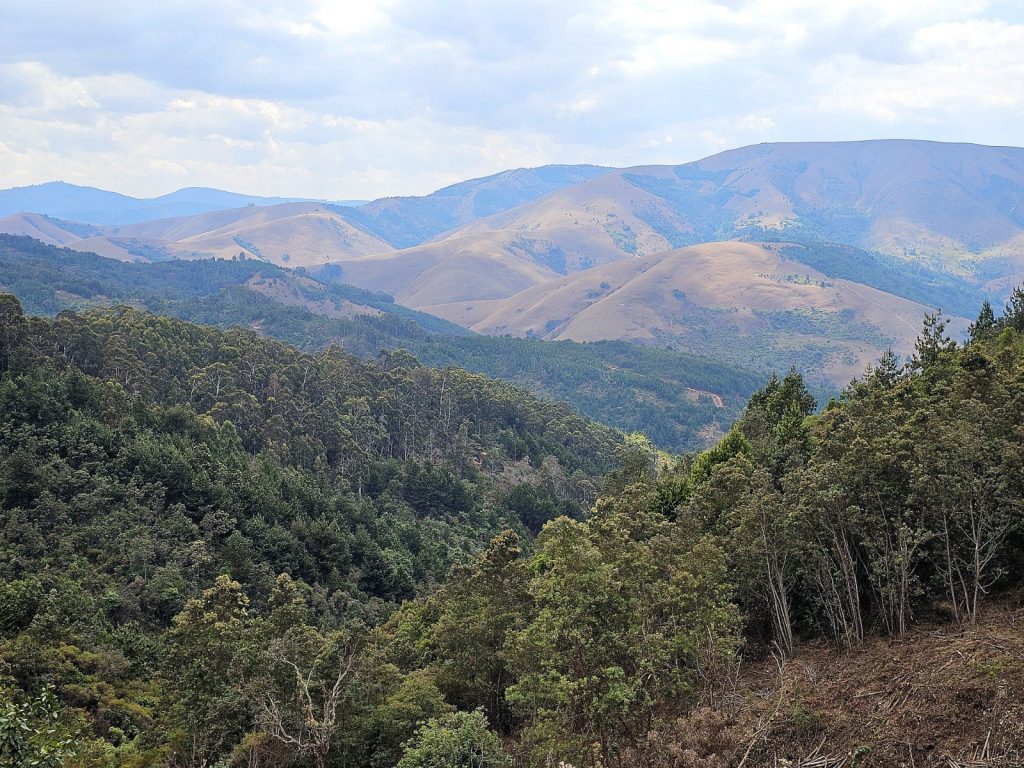
616. A view down one of the valleys from one of the passes near Ikonda. A lot of the hillsides here were covered in forestry plantations of Bhutan Pine.
From here there were some great views down the valleys to distant hills. They were not alpine in nature but there were certainly montane and the imported Bhutan Pines seemed to thrive on their slopes. It was really quite extraordinary that I was in the middle of Africa and not really that far from the Equator. Certainly the mountains here were similar looking in size and nature to the mountains of Central Scotland. From this lofty pass which I had struggled to climb I now had a descent. Unfortunately the descent was equally steep and it was completely wasted as I had to go down with the brakes on for most of the time except when it levelled out. I dropped a good few hundred meters until I reached a lower ridge which the road followed along its apex. Each side of the road here were a string of hamlets and homesteads who farmed the upper slopes of the ridge. The main crop now seemed to be the maize again and I saw little sign of potatoes which had been so dominant just a few hundred metres higher in altitude. There were also fields of wheat which were starting to ripen into a golden grass with a heavy seed head. The fields were too steep for machinery and I doubt the farmers could afford them, so the few wheat fields which were harvested were all done by hand. Many of the homesteads here had the purple blossom of apricot trees. They were in flower now and the fruit would soon start to form and they would become juicy when the rains arrived in a few months time.

617. Between the higher passes were saddles and ridges were the was a lot of farming. It was mostly maize but there were also many fields of wheat.

618. Nearly every homestead had a tree in blossom. I think they were apricot trees, but there are also apples in the area
As I got closer to Njombe there was more and more lumber stacked up on frames drying in the wind. There were some very large yards with perhaps a million dollars worth of planks stacked up. I noticed the forests here were more exploited and indeed at least half of them had been harvested and were being replanted. It was not sustainable forestry and it seemed there was a bit of a frenzied plunder of the forest and in the near future it would run out and the newly planted trees would not be available for another 25 years or so. I passed a couple of portable sawmills and they were operating. They were a small diesel engine which would drive a wheel with belts attached to it. There was a wheel on the saw table also and these belts would drive this and spin the wheel which had a circular saw attached to it. The logs were fed onto the table and the 4 sides with bark were taken off leaving a square log. This was then passed through the saw multiple times and each time a plank or bit of construction timber was produced. The sides were discarded beside the saw and the cut planks were stacked waiting to be taken to the road. From here they would go to the lumber yards to be stacked. Once the sawmill had done all the logs in a 30 meter radius it would be dismantled and taken 60 meters or so and then reassembled to create another pile of offcuts and sawdust on one side and a neat stack of cut lumber on the other. I spoke to a couple of the men stacking lumber once a lorry had dropped it off and they said that the price of lumber fluctuated throughout the year and it was more expensive in the rainy season as the sawmills were not operating then. I guess the businessmen in the villages would buy the timber now when it was cheap and would try and sell it in 6 months when they could get a good price and handsome profit for it.

619. Throughout the day there were many yards of lumber drying and the hillsides nearer Njombe I felt were in danger of being over harvested.

620. At many of the lumber yards men were restacking and loading or unloading lorries. The price of the lumber rises in the rainy season as harvesting is minimal then.
I had done the more significant climbs and was starting to feel quite drained by early afternoon. I had already done 1000 metres of ascent and not much less in descent and needed something to eat. I passed a couple of villages with what could have been restaurants but decided to cycle on. At last with hunger starting to gnaw at my stomach I could procrastinate no more and at the village of Kipengele I saw another restaurant. I crossed the road and parked outside and went into the kitchen to see what the lady was cooking. She had a large pot of rice, some green vegetables, bean stew and a little beef stew. It was perfect for me so I asked her to plate it up and sat on the bench inside. It was a simple but tasty and healthy meal and by the time I was finished I felt well nourished again. I had not gone very far at all and still had about 40-50 kilometres left but I had done most of the climbing. From here it was an undulating descent.

621. At the larger roadside village of Kepengele I stopped in a local restaurant for rice, vegetables and a bean stew. It usually costs about 3000 shillings or £1 and is simple and healthy.
There were so many lumber yards on the road now, and there were some very large houses getting built here and there. I guess these were for the new timber and grain merchants who had struck gold in the last decade. The rate of change along here now was quite significant and everyone was busy with the lumber and farming. There were no ox carts here but 3 wheeled motorbikes with a tipping trailer. They looked like they were from China and I am sure there are millions there doing the same job as here, and that was being the means by which to move lumber and farm produce around from the farmer to the merchant. They looked very suitable for the task and looked like they could carry half a ton or so. As I neared Njombe there were more and more of them.

622. The 3 wheeled motorbikes with a tipping trailer behind the driver are a common form of transport and are frequently moving sacks and goods around. Here is one having the tipping trailer cleaned
Just before I reached Njombe I was stopped at a police roadblock. The police only wanted to hear my story and were keen to know where I had been and where I was going. I then remembered that Sam and Will, who I met at the Mushroom Farm, had been this way too and had also been stopped at a police road block here. Their policeman was so interested that Sam even let him have a shot on his bike. My policeman could have been the same as theirs and he was very good natured. We chatted for about 10 minutes in all. A bit beyond him I started the final descent to Njombe which was now visible. It was much larger than I anticipated and I later found out it had a population of about 200,000. Large enough to be a city really. It was a steep descent into a small deep valley and then a thigh bursting climb up the other side into the heart of the city.

623. The town of Njombe was capital of the region with the same name. It was much bigger than I expected with a population of about 200,000.
I went straight for the Princess Hotel which was a budget option 1 star hotel favoured by the bikers and overland backpackers. However it was full. I tried a few others but they all looked very tired and some did not have hot water. One said they did but there was no pressure in the system so no hot water flowed. I was getting more and more frustrated so I went a bit more upmarket, but both of those were full. In the end I decided just to go to the best hotel in Njombe which was the Hillside. They had a room for US$35 which had everything I needed and as it was now dusk I decided to stay there. I checked in, had a shower with copious amounts of hot water, washed my clothes and then ate in their restaurant downstairs. I did a little blog in the evening but I was quite tired and had all of tomorrow to do it as I would have a day off.
Day 103. 20 August. Iwawa to Ikondo. 29 km. 3.5 Hours. 500m up. 740m down. I had the small breakfast and then packed up and left by 0900. It was still 110 km with at least 1600 metres of ascent to Njombe, which was too far for me to go in a day even on the tarmac road. I say at least 1600 metres of ascent because that is what the apps say, but in reality it is more as the apps do not account for every up and down and miss a lot out. I returned 500 metres to the main road and then turned east, or right, and cruised down to a large but empty roundabout going round 270 degrees to start the descent to Ikonda. The road was superb with a wide verge on each side and a line of yellow dots separating the empty main carriage way from the verge. These yellow dots would cause the car tyre to vibrate if a car strayed into the area. The tarmac was smooth from the edge of one verge and right across the road to the edge of the other verge. Even without the wide verge the road was very safe as there were hardly any vehicles on it.

605. The view to the hills around Iwawa. The land is cultivated right up the hillside and between the stands of pines grown for lumber.
I started to freewheel down the hill and picked up quite a bit of pace and was doing well over 60 km per hour. The only problem with the road were the rumble strips and the road builders were obsessed with them and I passed at least 50 of them today. They were not high at all and if I went over them at speed they seemed much less. There were about 5 on this first descent which was long. At the bottom there was a bridge over the stream and then a steep climb. The descents and the climbs were quite steep and each was at least a kilometre long. There was virtually no flat cycling all day. Whenever I did a freewheeling descent I knew, and could often see, that there was an equal climb coming up. I would have much rather just had a flat cycle without the wasted descent with brakes on and then the slow laborious climb which tested my thighs and knees. In the course of the day there were about 6-8 of these drops and climbs and it made for slow progress as my momentum, even at 60 km per hour only carried me a fraction of the way up the climb, and then it was into the lowest gear.

606. A good view of some of the homesteads showing the house architecture and how the homes are surrounded by maize fields.
While descending it was all eyes on the road just to make sure there were no surprises coming. On the climbs however I was going slowly and could look around. It was a very nice landscape indeed. There were rolling hills, some of which rose up into small angular mountains. All the higher slopes were planted up in Bhutan Pines, which might even be self seeding now. I noticed many growing on the steeper road cuttings which were self seeded. Occasionally a patch of pines had been harvested. The areas were obvious as the cut area had regular patches of narrow off cut planks with the bark on, lying in a heap and then an adjacent area of sawdust where perhaps 30-50 trees had been cut into planks on a portable saw mill. All the cut planks were removed and taken down to the track side and then on the villages to dry. Sometimes I saw people collecting the lengths of off cuts, which were no use as lumber, and taking it back to their homesteads for firewood. The harvested areas actually made up very little of the total planted areas and one had to look for them. They were a slight blemish but all in all the landscape here was very beautiful. It was like the foothills of the Alps and not at all what I was expecting. If someone told me these valleys were called the Switzerland of Tanzania I would not have been surprised.

607. Looking down the valley from below Iwawa towards Ikonda where I was heading. You can see how much lumber is grown here.
The lumber industry here must be a big employer. Apart from the portable saw mills, which might be owned by local contractors, there was a lot of work in getting the timber to the road. I suspect the planks were bundled up and then sent down on a wire but they might have been carried out also. They then had to be transported from the forest track to the roadside. This was done in small lorries. Once they were at the road side they were either stacked in a square with overlapping corners and this would have prevented the wood from warping as it dried. The other method was to lay them against a high rail with a plank coming from alternate sides so it formed a V shaped arch. There were frequently men unloading small lorries, stacking wood or loading large lorries which would take them away. There were very few pubs and bottleshops here with aimless men listening to loud music as in Zambia, or Malawi to an extent. Here all the men had found themselves something to do.

608. At Kisinga there were large stacks of lumber. Every roadside village had huge stacks of lumber drying. None was locked and secured showing how Tanzania is relatively crime free.
I passed hundreds of homesteads, all with the distinctive architecture of 3 or 4 rooms under a tall pointed roof covered in corrugated iron. In many places the houses looked new and it was as if this area of Tanzania, and the one around Tukuyu north of Lake Malawi, were enjoying something of a boom. I think it is often the case that society moves from one level of development to another in stages rather than in a gradual climb. In this area of Tanzania the culture has moved from peasant, subsistence farmer of say 20 years ago living from hand to mouth and living in mud huts, to a more professional commercially savvy farmer who sells his surplus and invests their money in lumber or trades. Certainly the areas I have passed through seem very egalitarian and there seem to be very few mansions, or hovels, in these rural areas.

609. As I descended below 2000 metres potatoes pretty much vanished and maize returned as the staple crop.
I continued to drop and climb from valley to ridge. It was largely on the flatter ridges where the hamlets and villages were and this is where the lumber was also. Usually outside people’s houses or homesteads. I noticed there was very little security around the stacks of timber. I am sure they would be difficult to surreptitiously load into a lorry and disappear without being noticed, but there must be a lot of wealth stacked up here. In the UK and Europe this would all be locked up in merchants yards with CCTV. I think crime in rural Tanzania, and indeed Malawi and Zambia, is quite rare. They are old fashioned and conservative societies and crime is really frowned upon. Shoplifters are usually dealt with by the locals who will beat the culprit. No doubt this will change as the old values diminish in a generation or three but at the moment rural society in Southern Central Africa is blessed.

610. It is difficult to overestimate just how much lumber is stacked up in the villages. This was one of many piles in the village of Lupalilo near Ikonda. It was all plantation grown.
Eventually this roller coaster of a road dropped down into Ikonda after some 25 kilometres. Here a huge 650 meter climb started but I had decided to stay here as there was not much afterwards and I would probably need to camp and it was still above 2000 metres and cold at night. I cycled up through the small town noticing a few scruffy lodges. However I had read that all of them are plagued by exceptionally loud music from a couple of pubs until midnight at least. All the reviews pointed towards a lodge on the edge of the town called the Udiakonia Lodge which had a Christian influence, but was considered expensive. I found some quiet roads which meant I did not have to continue to climb the hill and drop down the other side. It was the long flat side of a triangle basically. There were a few schools here as there were hundreds of primary school children, all in their distinctive red jerseys, on the road. They were not as excitable as the Malawi kids and some were even wary of me and moved to the side. If I waved or gave a thumbs up they reciprocated but they would never initiate it and would just stare as I cycled past.

611. The view from the peaceful garden of the Udiakonia Lodge. It was part of a Lutheran charity which helped disabled people to aquire skills to practice in the villages around here.
The lodge was nice and there were about 20 Germans staying here too. The manageress showed me a small room for 25,000 shillings (£8) and assured me there was hot water. We tested it and there was a lukewarm dribble, but I was not going somewhere else. When I came back to the bike quite a few of the Germans were admiring it, especially the Rohloff gear hub. Especially one called Fidus. It turned out Fidus had done a lot of cycle touring and once cycled from Germany to Togo as a young man with his then girlfriend now wife and had also cycled a lot in Africa, especially Tanzania and Malawi. They were a very friendly and gregarious crowd and they invited me for super which was generous of them. I thought little more of it, and wrote my blog in the afternoon while they went into Ikondo to look at a project. Later some of the Germans explained the lodge and the adjacent buildings to me. The lodge and the buildings were all run by the Lutheran Church. It was essentially a charity that helped the local disabled people. Some, about 10, were here full time and others came to get trained in various crafts like carpentry or sewing and then they could take those skills back to their village and earn a living from it.
As dinner approached I chatted to more of the Germans and was quite in awe of what I learnt. It turned out that Fidus was a quite extraordinary character. After his cycle touring trip to Africa, which involved crossing the Sahara, Fidus had worked with handicapped people in South Germany. Initially he was part of a very small team but as his career unfolded he became quite senior until he was responsible for 500 staff and 1000 disabled clients. At the same time he was a member of the Lutheran Church in Neuhausen near Stuttgart. With his love for Africa and his experience and competence he was able to establish a small charity in Ikonda helping the disabled people in the community here. This charity was called Udiakonia. This has grown over the last 25 years into what it is now. It has trained hundreds of disabled people in the area to learn skills which means they can return to their villages and become an active member. It has a small residential unit here where some disabled people live and participate in the running of the organization. It has this guesthouse where most European visitors to the region stay and the accommodation charge goes some way to help fund the project. It has a 440 kilowatt hour hydro electric plant to help develop the region. It also sponsors 500 children to go to school and have their meals with sponsorship from Germany. It really was making a huge difference to the community here. And all of this can be attributed to Fidus and his vision and service and also the Lutheran congregation of Neuhausen for fundraising. It was a remarkable success story.

612. The brass band and the choir at the Udiakonia Centre at Ikonda at the celebratory meal I was invited to.
The meal that evening was in the main hall of the organization and it was a way that the local people involved in the project in Tanzania could thank the visiting people from Neuhausen, all of whom belonged to the Neuhausen congregation. Many had been here quite a few times and I think Fidus had been here 25 times. Some of the Tanzanian side of the operation had also visited Germany through the years. The celebration in the hall started with the local brass band and then a choir. The brass band was pretty good but the choir was exceptional and their singing made my arms tingle. Then there was a long series of speeches in Swahili and German where people were thanked and prayers said. The local deacon at the church also gave a talk and you could see she was an exceptionally warm and kind person. After an hour we all had the meal, which was something of a communal feast as the 50 people in the hall all lined up to serve themselves to the simple but healthy dishes. I was sitting next to one of the German congregation, a lady called Heike, who explained everything to me as the celebration unfolded. After the meal there was more singing and then a long series of heartfelt goodbyes as the German congregation were all leaving at 0400 in the morning for a week’s hiking. It was quite a privilege to be invited to the celebration and be part of it. Back at the adjacent lodge I had a chat with Fidus and was quite in awe of what he had achieved here. Many people have a dream to establish a charity like this but few have the social entrepreneurship and acumen and warmth to actually create it and make a real difference to peoples lives, and Fidus had these skills in abundance.

613. The whole Udiakonia Centre and project was due to the warm-hearted Fidus, with help from the congregation of the Neuhausen Lutheran church near Stuttgart.
Day 102. 19 August. Iwawa Rest Day. 0 km. 0 Hours. 0m up. 0m down. I was tired in the morning. My legs had peddled my 20 kg bike, 40 kg of luggage and 100 kg of me up some 4000 metres in the last 3 days and needed a rest. Especially as there was a lot more to come on this hilly section in West Tanzania. So it was some relief to wake up with stiff legs, see the sun was already shining through the window and then roll over and go back to sleep for another hour. I eventually got up at 0800 and went down for breakfast. It was just 4 slices of bread, an omelette and a thermos of ginger tea. I saw the accountant had potatoes, so I asked for two of them also.

604. The town of Iwawa was pleasant with wide, clean streets and a variety of shops for many trades. It had a planned feel to it.
After breakfast I moved a table to the window so I could have a view and then brought a chair up from the restaurant as there was none in the room. I then spent the entire morning and early afternoon writing the blog. By mid afternoon I was nearly finished but thought I better have another shower and wash my clothes while there was still some time and sun to dry them. In the shower I heard some really loud bass music and hoped they were not going to have a party for the rest of the day in the function room.
Once out of the shower I looked out of the window and saw a small lorry full of loudspeakers playing some nice music but very, very loudly. I have seen a few of these in the last 10 days and it is usually a wedding and this one also seemed to be. There were about 50 people, all well dressed and with the women all in one dress or another as if they belonged either to the brides or the groom’s family. They looked happy and relaxed and either chatted of danced to the music. The music was very good, a gospel type singer with a chorus and some instruments like a synthesizer or slide guitar. I looked a few of the songs up and a couple were sung by Atosha Kissava, a well loved Tanzanian singer. The DJ hopped through a list of artists for an hour. Then the music stopped and the small truck drove away and everybody got into two waiting buses and drove off leaving the place quiet and deserted again.
In the evening I just relaxed, read some news and did a bit of research on the route ahead. My next goal is Njombe where I will have a day off. It is just 110 km away, but involves a further 1700 metres up and 2000 metres down. However the accountant at breakfast told me it was tarmac all the way so this will make the descents much faster and easier.
Day 101. 18 August. Kikondo to Iwawa. 60 km. 9 Hours. 920m up. 1470m down. I slept well and was warm in my sleeping bag under an enormously thick blanket. I was woken in the night twice with severe cramps in my thighs which were painful. But in the morning I was hungry and the younger brother showed me a tea shop where I could get some fried buns and a mug of tea. It seemed many people in this village came to these tea shops and the 3 or 4 in a row were very busy. The village was shrouded in mist on the way to the tea shop and it was cold and damp. Everyone else were dressed in thick jackets but I had shipped my home months ago. Everywhere in the village were huge sacks of potatoes. Every shop, tea shop, and the yards of house had piles of 100 kilo sacks piled up waiting to be sold or stored. This village was built on potatoes with huge terraces around the entire hilltop so it looked like an iron age fort. On each terrace there were no fields or demarcations, the whole terrace was cultivated as one and now with the harvest done the entire rings of terraces were turned over and bare earth waiting for another crop to be planted. It was one of the friendliest and liveliest villages I had stopped in and there was a lot of banter in the tea shop with me and each other.

596. Looking south of the main ridge on the lip of the Kitulo Plateau down the escarpment slope to the Rift Valley some 2500 metres below.
By the time I came out the mist had burnt off and it was bright sunshine. It was still cold though and as I set off in a single shirt and cycling shorts I worried I was unnderdressed. However pretty soon I was climbing again and warming up as I entered the Kitulo Plateau National Park. This park covers the large plateau and I was going to cycle along the southern edge of it along the top of the escarpment before it dropped off to the south down the steep slope into the Rift Valley. As I cycled up the warm moist air from the Rift Valley was rising and condensing and the whole section was in the mist. It was cold again and quite eerie and I could easily imagine I was in some sub alpine temperate climate like Scandinavia or New Zealand and not in the heart of Africa. The Kitolu National Park is known primarily for its flowers and it is sometimes called the Serengeti of Flowers. I saw quite a few including a Giant Groundsel, Dendrosenico, some proteas, and lots of ericacious ground plants. There were not a lot of other flowers at the moment but in the rainy season from December to March, Kitolu is a kaleidoscope of colour apparently.I cycled across this predominantly treeless plateau for a couple of hours reaching nearly 3000 meters at one point, twice the height of anywhere else on the tour so far. The road was poor and it was very stony but it was quiet and peaceful.

597. The Giant Groundsel, Dendrosenecio, spieces I saw at about 3000 metres in the mist. They are prolific on the bigger mountains of East Africa like Mt Kenya, Kilimanjaro and Ruwenzori.
By midmorning I started to descend slightly and entered into extensive eucalyptus forests. It was alarming to see how prolifically they were spreading, and in places there was a red hue to the hillside where their new leaves were emerging from buds. As I descended more they were the dominant tree with some large specimens and I would say there will be little stopping their spread. They are an invasive species, an Australian weed, in this environment and one can only hope they do not blanket the whole of the flower-filled plateau in 30-50 years. As I descended further I crossed a few small streams and then came across a large dairy farm. It was spread out along each side of the road for about 5 kilometres and there must have been about 500-1000 Holstein-Friesian cattle, which are primarily milking cows. I was surprised to see them and with the open plains, rolling hills, large eucalyptus trees and these dairy cattle I could easily have thought I was in Australia.

598. A protea species on the top of the Kitulo Plateau. This Plateau is sometimes called the Serrengetti of Flowers and is ablaze with 350 types in the rainy season from November to March.
Beyond the grazing fields on the lower slopes of the hills surrounding the plain I saw hundreds of white dots on brown areas. It took me a while to realize these were potato bags, either with a harvest or with seed potatos for an upcoming planting. As I dropped down the ridge more and more the cultivated areas of potatoes covered everything. There were fields as far as the eye could see and white bags everywhere. There must have been thousands of hectares of potato fields up here and every bit of land was cultivated except for the higher slopes. As I came down into a valley which was completely covered in potato fields I noticed that some farmers were already planting. The farmers here had the same digging hoe as I have seen since Zambia but with a much longer handle, almost 1.5 metres long. With these they make troughs and ridges. In one field I saw 4 men in a diagonal line with furrows full of potatoes every 10 centimetres. The 4 men were busy pulling the ridge of earth on the other side of the potatoes from where they stood onto the potatoes burying them. They were staggered each pulling a ridge so they were covering 4 lines of potato at once. The whole operation looked very organized.

599. On the way down the east side from the Kitulo Plateau I came a Ross a large ranch with 500-1000 Holstein-Fresian cows. In the distance are white potato bags on the hillsides.
The bumpy track then reached a section of tarmac at the village of Ujuni and I sped down the road loving the silence from the rattling panniers. There were some very simple cafes in Ujuni so I had a meal here. The only thing the lady had was rice, a bean stew and a beef stew for I had a portion of all for 3000 shilling and then continued down the tarmac road, past the other villages of Kitulo and Nkenja. The houses here were all the typical brick houses with the tall corrugated iron roofs but there were also larger timber sheds with corrugated iron roofs and I think this would be where they stored the potatoes. I have never seen such an all encompassing potato growing area. There were no other crops, it was just potatoes and if there was a disease like blight there were no other crops to eke the farmers out over for a year. Eventually this lovely tarmac stretch came to an end and then it was back to the bumpy stony road as I descended steeply to a junction.

600. On the hillsides and valley floor around the villages of Ujeni, Kitulo and Nkenga every piece of land was devoted to the potato.
Here I had a choice of ways. The preplanned route which went up a steep stony road to Makete village and then on to Iwana in 20 kilometres, or up a less steep hill on a rocky road which I thought would have less up and down for 20 kilometers. I abandoned the preplanned route and threw caution to the wind and took the latter, which was the left fork. It was a mistake and it turned out to be much hillier as it went through extensive Bhutan pine plantations. It seemed to be a well managed forest with lots of different growth ages. Between the patches of forestry were maize fields still full of dried standing maize with the cobs still on. It looked a poor harvest unless most of the cobs had already been picked and what was left were the ones left to ripen a bit more. This forest and maize went on for about 10 kilometers until I got to the village of Ivalali. It was thriving with potatoes, the maize I had just past and timber.

601. Looking across the segmented Bhutan Pine plantations interspersed with maize fields to the distant village of Makete, where I should have been.
In the forest the timber was cut and turned into lumber as where it was felled I presume by a small portable sawmill. There were planks along the road before Ivalili waiting to be picked up by truck and then transported back in a lorry to be stacked at Ivalali and also at Iwawa where I was going. There were huge racks of the timber curing in both places and the main use for them seemed to be roof trusses for the tall roofs. It must have taken considerable effort by the lorry drivers to bring the timber down to Njombe and out to Iringa and then to the rest of Tanzania and onto Malawi.

602. The trees are cut where the grow and then are planted into lumber where the fell before being carried to transported to the roadside for a small lorry to collect them.
From Ivalali there was a bumpy descent for 5-6 kilometres down to Iwawa past small hamlets which were really just a part of that town. The tracks here were steep and it was really just suitable for motorbikes. It took a good half hour to negotiate my way down with the brakes frequently applied until I got to the bottom of the valley, where there were extensive stacks of lumber drying. I then had a exhausting steep push up roads to meet another segment of tarmac road and merge back with my preplanned route. I think my detour cost me at least an hour and prossibily and extra 200 metres of climbing.

603. One a small lorry picks up the lumber and planks it is taken to a village like Ivalali or town like Iwawa and stacked as part of the curing and drying process.
Iwawa was not like any other town I had seen on my trip. The main street was very wide and the shops were back from that again. There were stationary shops, electrical shops, plumbing shops and even a couple of 2 story shopping centres. It was also clean and tidy and not at all chaotic. It felt as if were planned and the planners had sought to create a feeling of space and openness. I cycled down through the town on the main street passing a couple of rough looking lodges hoping the one I earmarked had a room and I would not have to return. I then took a side road to the Madihani Villas Lodge some 500 metres away. When I got there it was very quiet and I feared it had closed when I heard someone shout ‘You are Welcome”. They had a room but no food or even drinks. She showed me a cardboard box with various bottles of spirit jumbled in it, but I explained soft drinks and she had none. There was one other guest, an accountant from Njombe, and he helped translate and he said I could order a takeway which I asked the manageress to do and she did. I arrived quickly and after I ate it I went up to the room to have a shower. However there was no hotwater so I went into the clean sheets with 2 days of sweat on. I woke in the night and tried the water again but still none, so I tried the neighbouring room, which still had the key in the lock. There was hot water here so I took a shower in the middle of the night. Such are the foibles of plumbing and maintenance in most lodges.
Day 100. 17 August. Kiwira to Kikondo. 47 km. 8.5 Hours. 1740m up. 300m down. Peter, one of the lodge managers, gave me a great breakfast with eggs and coffee. I needed it as today was just an ascent as far as I managed to go up towards the Kitulo Plateau. I had been aware of this climb for months and anticipated it. I set off at 0930, a little late, and cycled the 200 meters to the T junction and turned right north up through the rest of the town and then into the countryside again. The climbing started straight away and the road was a bit busier than I would have liked given the pitiful size and state of the verge. However I could stay on the road and move on the verge when traffic came up behind me and I could usually hear it as it was roaring up in a low gear. There were many motorbikes on the road and very few cycles. In fact I hardly see any bikes at all. The motorbikes are the beasts of burden and they frequently are loaded down with sacks of agricultural produce or 2-3 passengers in addition to the rider. Most of the bikes were extremely noisy and I am sure a lot of them had special mufflers on their exhausts to enhance their noise, and supposed masculinity. In addition to the motorbikes were the buses which could seat about 20 at a push, and a few returning petrol tankers heading back to the terminal from dropping their load in Malawi. As I cycled out of the town the noise seemed to ease a bit and the climb was never desperately steep.

587. On the way up the endless climb from Kiwira to Isyonje i passed many banana groves at the beginning some with a lower tier of crop like coffee here.
It was Sunday morning as I climbed up through the series of villages with one following as soon as the previous one ended. There was some great singing coming from the churches I passed. Some were exceptionally happy and powerful gospel anthems with choirs of women belting out songs. I would have loved to have peeked inside them as some of the singing almost gave me goosebumps. I also passed one church, The Evangelistics Assemblies of God, where the pastor was berating the congregation, shouting fire, brimstone and pools of burning sulphur at them. I had a pause from the climb outside this church and he was still going some 10 minutes later, bellowing until his voice was coarse. I wondered why anyone would go to him and not one of the jolly services with the ladies choirs. His audience must be the religious masochists who believe everyone is born into sin and wearing a hairy shirt, cold bathing and his sermons are the only redemption.

588. The homesteads were all surrounded by banana groves, potatoes plots and bean fields. Beyond the homesteads was green forest on the hillsides
As I climbed, the farming and vegetation changed. Bananas were everywhere and all of the homestead houses were smothered by them with just the tops of the tall pointed roofs poking out. I even saw a few plantations where bananas were the overstory crop and beans and coffee grew on the ground. However the banana leaves were so large that they blotted most of the light and the beans and coffee grew slowly in the shade. There were also many avocado trees appearing, and some homesteads were covered in them while others just had a few trees. Beside the road I also saw the first of the potato fields and soon they were everywhere with small fields full of them and many were now being harvested. There were large white sacks of potatoes, probably 100 kilo sacks, everywhere in the fields. They were also on the backs of motorbikes as they were getting driven from the fields to the homestead. There were more and more beside the road for sale and they were soon as common a sight as tomatoes in Malawi.

589. Halfway between Kiwira and Isgonje there were more and more farmers with potatoes and many were harvesting them.
The trees changed too and soon there was eucalyptus everywhere and the air was full of the aroma of their resin. I am not sure if they are used for their their wood or used as firewood. Many people beside the road were selling bundles of sticks which would be used for firewood. I think these replaced the sacks of charcoal which lie along the road in Malawi, and Zambia especially. There were more and more pines appearing too. However what really stuck me was outside this farmed strip on each side of the road were green forests which covered the hillsides and stretched away into the distance. To my east the distant hills were big and their great rounded shapes loomed large over the forest from which they gently rose from. Their rounded summits were often covered in mists as the warm air in the Rift Valley rose up in the winds cooling and condensing

590. The village of Idweli was just before Isyonje and you can see the roof designs clearly with the tall roofs
As I was on the verge for much of the time I was vulnerable to get a puncture from either from the copious amounts of broken glass or other fragments. I had not had one since Zambia with these new Schawalbe Mondial tyres so I was overdue and got one at Ntokela. I pulled over into the forecourt area of a few shops well off the road, and started to take the paniers off. The shopkeepers looked up and knew what was happening and went back to their work but soon the kids in the neighbourhood found out and they all came to watch. There were about 20 of them in the end all sitting about 10 meters away watching respectfully and calmly. It was a piece of wire from the reinforcing from a tyre which had gone right through the Schwable’s. I managed to find it and pull it out with the pliers and then patch the inner and refit it. It took about 20 minutes, as it was the back wheels and that is always more fiddly. Once I finished I felt I should give a bow to the kids, but gave them a wave and they all waved back in unison as I headed up the hill.

591. On the climb between Kiwara and Isgonje the road had a small verge. Motorbikes are the common mode of transport, here with two baskets of chickens.
After many hours and having climbed from 1350 to 2350 I at last reached the Isyonje. I was tired and stopped here for some biscuits and sugar water. The shop keeper said they did not have a fridge because they did not need one as the nights were so cold. I had been looking forward to leaving this road which I had essentially been on since coming down from Livingstonia a week ago. It was not unpleasant but the culture along it was not that rural and veered towards commercial. This was where I would turn off from it and go across country on small roads for a good 2 weeks until I got to Mikumi 650 kilometres to the east. However as soon as I turned it off my heart sank as instead of a beautiful packed earth road which I could cruise along I found myself on an incredibly stony road. It was like cycling over rubble and the bike was bouncing every 20 cm as it had to go over a dust covered rock.

592. As I cycled up to Isyonje potatoes became not only the dominant crop but the only crop.
It was a bumpy 10 kilometres to the high village of Ngoma. On each side of me were extensive views, especially to the south where the land stretched away down to the Rift Valley and the end of Lake Malawi now some 2000 metres below me. The road was very rough though but the motorbikes still managed it well with their suspension and bounced along with large sacks of potatoes or 3 people on each one. There were fields of potatoes everywhere now and it seemed nothing else was grown.

593. After the T junction at Isyonje I took the small bumpy dirt road up the crest only the ridge to Igoma (pictured) and beyond onto the Kitulo Plateau.
I had set my sights on Ngoma and when I climbed the last steep section to the town I was hoping for a lodge or somewhere to fill my water bottles so I could camp. The town was bigger than I thought with perhaps 20,000 inhabitants and it did have a lodge. Some ladies directed me to it and I met the manager. From the outside it looked promising. But the manager was the most apathetic young man I had seen in a long time and seemed to think being extremely slow at everything, walking and talking, was cool, so much so I began to wonder if he was 100%. He showed me a room for 15,000 shillings. I would not have stayed in it if it was free. The room was filthy, the unmade bed looked like the sheets had not been changed for months and the pillows looked like they were impregnated with human grease. There was an attached bathroom and it smelled like the urinals in a working man’s pub in the north of England. I left the town and continued east along the ridge top looking for somewhere to fill my bottles so I could camp.

594. The penultimate climb from Igoma to Kikondo was about 400m of ascent on a rough dirt road in the forest.
After another hour I bounced my way along to Kimondo. It was now about 1500 and I thought I would go through this hamlet and into the forest a bit and then find water at a pump or someone’s house. However, just after the hamlet was a steep hill. I knew it was coming but was thinking it can’t be that bad. However, it was worse than I feared. The road climbed a further 400 metres on the stony, bumpy track which was so steep I had to get off and push. It took me about 2 hours to heave the bike up. There were a few lorries and many motorbikes on this climb and some of the bikes were making their passengers walk. One lorry was in the middle of the road up on jacks and chocked up on stones with a broken leaf spring. It was having major surgery and I guess it would be there for a few days.
On and on the track climbed with a few discarded motorbike passengers chatting to me as we walked up to the waiting bikes. I kept hoping for a hamlet but there were none and no water source either. One person told me the next place “was far”. This was alarming as usually “it is near” translates to less than 10 km. I checked my maps and there was a village called Kikondo in 10 km. It was further along the ridge with a fair bit of up and down before I got to it. At last I reached the top and could get back on the bike and bounce along for another hour until Kikondo appeared beyond the next deep dip some 4 km away. I gingerly descended into the dip passing two more broken down cars and then started the 2 km climb up to the village. I was now shattered and there was no way I could cycle even in lowest gear so I just pushed the bike. It was getting cold now the sun was on the horizon to the west and I was at about 2750m.

595. The final push up the last hill at the end of the day to reach the potato fields and village of Kikondo where I spent the night.
I was parched and hungry so I went into the first shop. It was run by a large cheerful lady. I had two packets of biscuits and some soda water and asked her about somewhere to stay. This prompted a flurry of phone calls from the other 3-4 middle-aged ladies outside. I guess these were some of the matriarchs of the village. Pretty soon a younger man appeared in overalls and spoke great English. He had been to university and studied engineering. He and his brother had a guesthouse, mechanic workshop and flour mill, and although just 25 was quite an entrepreneur. We walked over to his large guesthouse and he showed me a small clean room with new sheets. It was perfect. There was just a bucket shower in a communal washroom but there was no hot water. He could get his brother to boil some while he went back to the mill but it was dark now and getting very cold and the thought of drip drying in a freezing bathroom did not entice me so I skipped any form of hygiene and went to bed at 1930.
Day 99. 16 August. Kasumulu to Kiwira. 58 km. 7 Hours. 1220m up. 420m down. The hotel gave me a great breakfast and I was ready to go at 0900. I had decided to go straight up the main road, The B345, to Tukuyu instead of taking the longer, smaller way, as it looked very steep towards the end. The traffic also did not look that bad after all as I watched it while having breakfast. As soon as I left I started to climb but it was quite gentle. There was a verge to the road but it was really quite narrow and often destroyed by erosion. I cycled on it and frequently made the jump up the 5 cm tarmac lip when I got to bad potholes or where it simply vanished.

580. Climbing up the ridge towards Tukuyu on the main road quickly took me out of the valleys below and I got great views of the distant forested hills.
As I climbed I was astounded at how green and forested it was. After the arid time in Zambia and the treeless slopes of Malawi this was lush forest. The homesteads were surrounded by trees and the fields were full of them. Beyond the homesteads were forest clad ridges with almost a jungle like cover with vines growing up the tall trees. I noticed that some of the homesteads were growing 10 or 20 teak trees, easily identifiable by their huge leaves. The houses here on the homesteads were much more substantial than their Malawi counterparts and virtually all had tin roofs. The tin roofs were quite striking as they had a very steep pitch which made them very tall. I don’t know if there was a practical reason or whether it was simply to make the houses look more grand and imposing. Certainly it would have cost more as there was perhaps 50% more corrugated iron used and there had to be many more roof trusses. I don’t think the roof space was used to store any produce and I don’t think it was used as a living space either.

581. The homesteads were much more substantial here with high corrugated iron roofs and productive vegetable gardens around the house.
After a few hours where I climbed gently I was really starting to gain some height and I could see down the tree-clad slopes to the valleys on each side. They were covered in fields at the bottom but at the moment they were fallow. Beyond them the ridges rose up again and were covered in forest as far as the eye could see. Had I gone the other way this morning, further to the east, I would be on the other side of these ridges and in a valley which continued north from Lake Malawi. In this valley were a number of crater lakes as this was part of the rift valley where Africa is splitting in two. At this split there is sometimes volcanic activity every 1000 or 10,000 years and craters are formed and then when redundant they fill with water.
As I climbed I reached a tea estate. I think it was called the Chivanjee Estate. It was quite large but it was the scruffiest and most neglected tea estate I have ever seen – and I have seen a few. The bushes were all at the same height and were being plucked but the fields were full of weeds and creeping vines and these were smothering the bushes. I don’t think there was any weeding done by the estate owners. It seemed though they did give permission for locals to go into the fields and collect fodder by collecting the weeds and I saw many farmers carrying sacks of weeds along the road returning home. The company running this estate was called “Mohamed Enterprises” and it looked like they were running it into the ground. I did not see the factory but there was a sign for one. There were also many homesteads which grew tea and these looked in much better shape with vibrant green bushes all neatly plucked and no weeds coming through at all. I think Mohamed Enterprises would have bought this tea from the local farmers to supplement their own production and process both at the Chivanjee Tea Factory.

582. Many of the homesteads also grew tea in addition to cassava, maize beans and bananas. They would sell the tea to the tea factory supplement their income.
There was little let up in the climb and as soon as one finished there was a small downhill run and then the next slope started. One of these slopes involved a 500 meter ascent on its own. As I climbed I saw the homesteads were all well organised and productive. There was quite a bit of tea grown on them but the main crop now seemed to be beans and they were in many of the fields. Sometimes there were nets over young seedlings which were being propagated in small plastic tubes before being taken to the prepared fields and planted out. There were thousands of seedlings under each net. There was also a bit of cassava and some maize, but tea, beans and bananas were the main crop. I stopped and bought some 20 small bananas for 1000 shillings (£0.30p). For the first time I also saw that the farmers had planted some ornamental shrubs and flowers around their houses and some looked quite vivid.
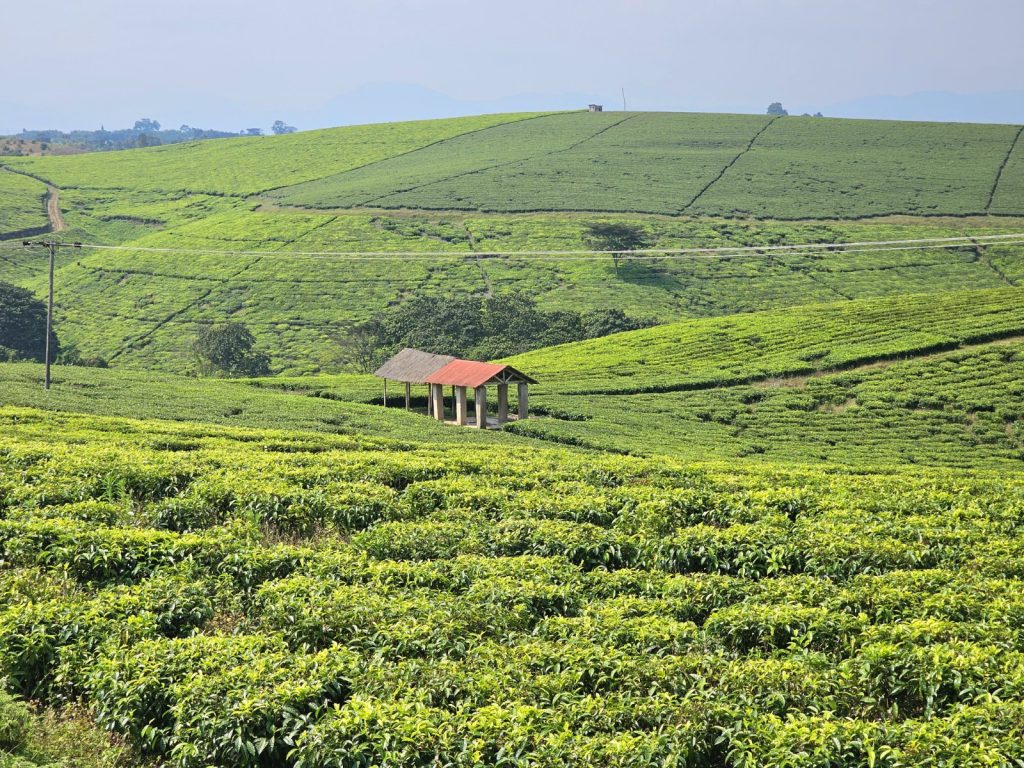
583. Near Tukuyu was the Kyimbila Tea Estate which looked like it was well managed, especially compared to the neighbouring Chivanjee Estate.
Towards the top of this long 500 metre climb I came across another tea estate. This one was called the Kyimbila Estate and it was managed by the Wakulima Tea Company. It was in complete contrast to the previous one and the fields were bright green with new growth on the well ordered bushes which were all the same size. I think the Wakulima Tea Company was in it for the long term and were probably fertilizing their fields to increase their yield and profit. Their tea factory was near Tukuyu and looked relatively small compared to the Sri Lanka ones. There was no one in the fields at all but then it was a Saturday and perhaps this was a workers day off.

584. Between Tukuyu and Kiwira there were near continuous homesteads and clusters of hamlets. This is the scene just leaving the outskirts of Tukuyu.
I reached Tukuyu but could not see anywhere nice to stay. I had only done 40 kilometres and it was just 1430. I looked at the map and saw there was another small town 18 kilometres away, and it had a couple of simple guest houses. The road to it was flat so I decided to continue to it. Up to Tukuyu the hamlets had been quite spread out and it was not that densely populated, but after this town it was very busy with an almost continuous suburban spread of homesteads crammed together. They were all surrounded by banana plants which almost enveloped them and just the tip on the tall corrugated clad roofs stuck out. Beneath the bananas were beans. It was still very lush and green on this stretch but all the big trees had gone from around the farms, but they still clad the hillsides. There were many timber merchants here and even house builders putting the roofing frames together for the tall roof structures. It was a busy, vibrant active community and everyone seemed busy. There were no ox carts now but a curious 3 wheeled motorbike with a large trailer on the back which even had a hydraulic tipping function. The trailers were easily big enough for two cows.

585. Many homesteads also grew tea between Tukuyu and Kiwira but there were larger areas growing bananas and beans.
Tired and hot I eventually reached the bustling large village of Kiwira which was at a T junction and right at the foot of the first climb tomorrow which was 650 metres. Here there was a simple lodge which cyclists used and I checked it out. The caretaker was called Peter and he showed me a room with a large bed with clean sheets. There was a bathroom with a squat toilet which I am well used to from Asia. It even had hot water. With Peter’s help we rigged up a table from 4 stools and a sheet of plastic so I could write and I was all set. I wasted a bit of time as I fell onto the bed and snoozed a bit before the shower which is always a fatal thing to do. After the shower I went out to eat but there was nothing except for a local bar which just did grilled kebabs and plantains. There was no rice or nshima or vegetables. I had a few small kebabs and plantains and then went back to my room to write just as a power cut started. I was done by 2100 and was tired after the climb. Unfortunately it is the same tomorrow and the day after too, as I continue to climb out of the rift valley.

586. The beans which seemed to grow everywhere were similar to kidney beans.