Section 07. Central Malawi.
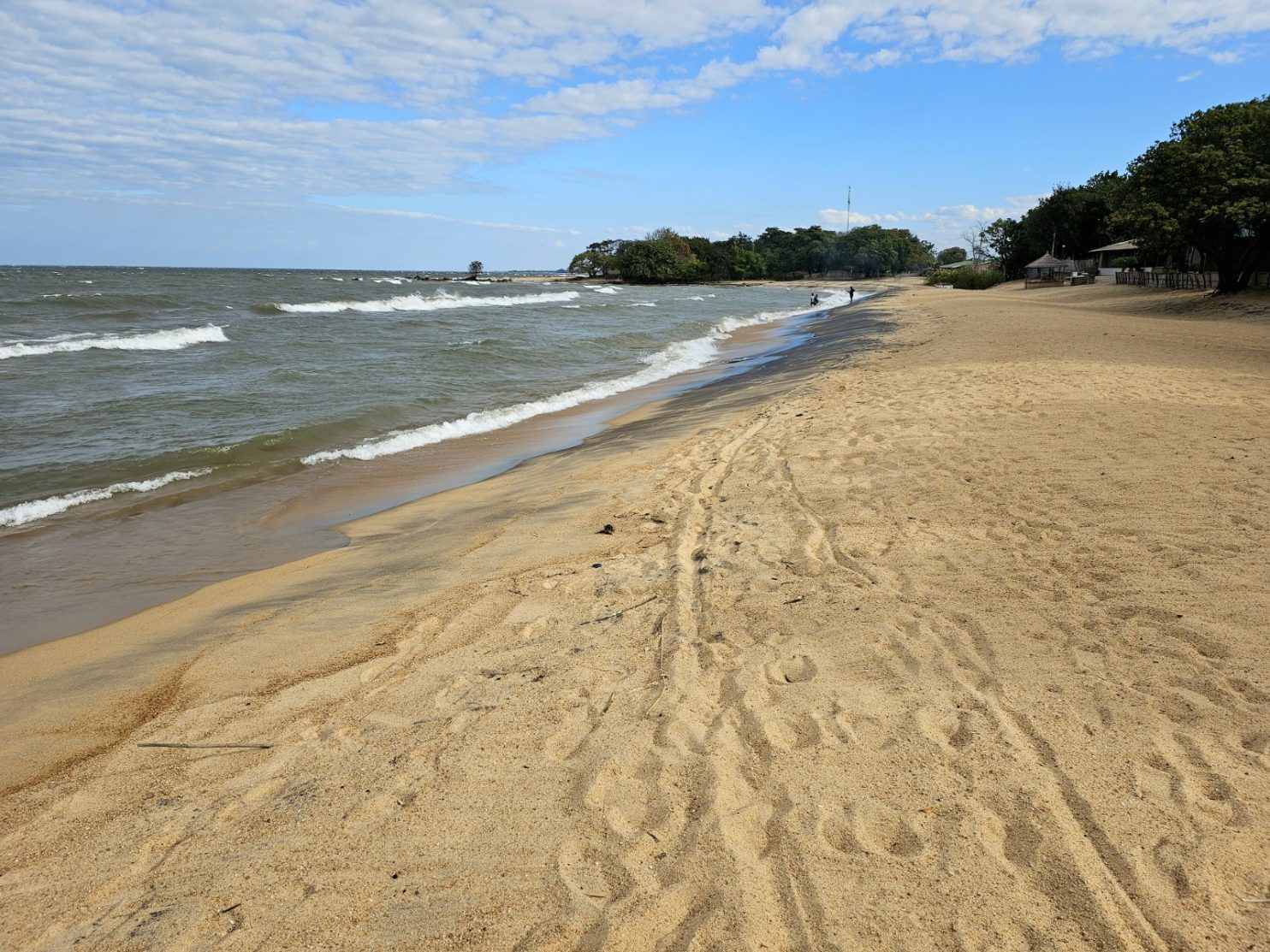
Day 91. 08 August. Nkhata Bay Rest Day. 0 km. 0 Hours. 0m up. 0m down. Again I did not sleep well in the cabin and kept waking up tangled in the mosquito net. However in the morning I had a lie in and then slowly got up and had a leisurely breakfast. I had set today aside for some kayaking and snorkelling. After breakfast I started to get the equipment ready and that took a while. The kayaks were just Sit-On-Tops and the backrests were all pretty much broken but the rest of the kayak was intact. It took me a while to get a life jacket adjusted and then tie my camera on. My plan was to go out of the bay to the next bay to the south. It was just a few hundred meters really. Then I would tie the kayak to my life jacket and plop into the water with the mask and snorkel. I would then swim back towing the kayak behind me while looking at the fish and trying to photograph them.

529. A view of Mayoka Village Lodge with the cabins on the photo’s leftvand the bar/restaurant/relaxing area bottom right.
I eventually set off at 1100 by which time the wind had increased slightly. The Sit-on-Top was a cumbersome thing and with the broken backrest I found it quite hard work. However, I only had to go round the slightly choppy headland and into the next bay which was less than a kilometre. Here the water was flat and it was easy to tie myself to the kayak, spit in my mask and roll off into the warm water. Once the mask was on I realized it was a bit deep and the bottom was sandy so I let the wind and waves carry me towards the shore. I still had the life jacket on so I was extremely buoyant and could not dive. As I got closer to the shore some rocks appeared and it was only a few meters deep now.
The sun was shining onto the nearly crystal clear waters and soon I could make out the fish. They were not in great shoals but drifted around as individuals. It was easy to see the fish as they even had shadows. Most of them were close to the rocks and they seemed to be nibbling the algae which was growing on them. I think all the fish I saw were cichlids. There are apparently some 800 species of cichlid in Lake Malawi with many endemic. The ones I saw were all quite small and less than 10 km but they do get up to 25 cm. I don’t know how many species I saw, perhaps 20 in all with a few blue ones and a few orange ones, but the majority of them were brown. They seemed remarkably untroubled by me but they were 2 meters deep and I could not dive down that far with my life jacket on to photograph them. I must have seen well over 1000 fish in all, just off the peninsula where Mayoka Village Lodge was located.

523. Lake Malawi is home to some 800 species of cichlid fish and they are found round its shores. It is possible to spot many while snorkelling.
As I was swimming past towing the kayak I noticed a man in a dugout ahead. I had to go within 10 meters of him to avoid rocks. I did not realize he was fishing until I was past him and then nearly swam into his net. He was going along the net taking the very cichlids I was photographing out and dumping their limp bodies into a bucket. Perhaps he would get 30-50 per net and then move on to the next. It was perhaps naive of me to think this did not happen. All the fish I had seen landed by the fishing boats over the last few days were all cichlids or aquarium fish. I continued past the net and then swam back to the small jetty at Mayoka Village Lodge. I then had a great hot show as I was now the only guest and washed all my clothes.

524. Unfortunately all cichlids and any other fish are caught by net from dugouts and fishing boats and then sold at market or consumed by the thousands of fishermen.
In the afternoon I went into town which was about a kilometre away. There were lots of tourist shops on the way there all with a Reggae Vibe and most were selling carvings or paintings. In town however the markets were in full swing. The first thing I noticed were about 8 ladies all in a row selling fresh small cichlids- exactly the one I had been admiring just an hour earlier. They were all silver now as they lay spread out in a winnowing basket for sale. There must have been hundreds of them.

525. The markets are full of fish and here are some of the medium size spieces caught by the fishing boats.
A little later I came across a many with 3 tables of larger cichlids. I had not seen any of them when snorkeling and assumed they would be a bit further out in the lake and caught by the traditional 5-6 meter fishing boats. I passed hundreds of these on the way up from Nkhotakota. There must have been at least 100 fish on display and they were all 15-20 centimetres and perhaps enough as a meal for one.

526. Every market is dominated by tomatoes at this time of year. Sweet potato, greens, cassava, potatoes and onions are also sold now but tomatoes outnumber everything else put together.
There was a large political rally in town with loudspeakers and about 200 supporters of one politician. As I returned there was now a party atmosphere and everyone was dancing. Most of the supporters were women and I noticed the politician was a man so he must have been quite charismatic. As I continued the return I passed the covered market which was now winding down. The tomato section was the largest with mounds of the crop around. For all the tomatoes there are about at the moment I seem to be eating remarkably little of them. There was even a section for burst or overripe tomatoes which I imagine will go to animal feed. There were smaller sections for other vegetables and even clothes but they were scant as I think most traders had packed up and left.

527. There are vegetable plots wherever the land is flat and there is a stream or the lake nearby so they can be watered. Cabbage and greens are the main vegetables at the moment.
As I crossed over the stream flowing into the bay I passed a large vegetable garden. All the gardeners were in white and there was an armed guard watching over them. I had noticed that there was a small prison just across the road from the covered market and I assume these were inmates doing their gardening duty. They waved and I waved back and the guard was not bothered at all. The whole gardening gang seemed very good natured and I am guessing that Nkhata Bay Prison must be a very lenient one for white collar crime or those reaching the end of a more serious sentence.

528. A view of Nkhata Bay with the first peninsula dividing the bay, and the town in two. Mayoka Village Lodge is at the end of the second peninsula.
Once back at Moyoka Village Lodge the sun was starting to get low. I decided to take a few aerial shots of the town and also the lovely location of the lodge itself. It was near enough town to be able to walk and far enough away so you could not hear the bar or the political rally. As the sun went down so had my time in Central Malawi. Tomorrow I cycle up into North Malawi with a gruesome ascent initially up to the town of Mzuzu which is only 45 kilometres away but that involves a 1000+ meter climb back onto the plateau again. I will be back at the lake in 5 days or so.

530. The sun setting over Nkhata Bay and the sun also setting on Section 07. Central Malawi for tomorrow I start Section 08. North Malawi.
Day 90. 07 August. Nkhata Bay Rest Day. 0 km. 0 Hours. 0m up. 0m down. Surprisingly, I did not sleep well. I think it was the 4 bottles of cider which was a rare event nowadays. Hugh and Hattie had already left for a long drive to mountains in the far south near the Mozambique border. I took everything I needed for the day and went down to the dining area where I found a table and had an omelette for breakfast. After breakfast I started to write some of the blog while looking out across the calm clear waters of the bay.

520. One of the dugout canoes on Nkhata Bay which were usually paddled by one as they fished in a more subsistence way.
Mayoka Village Lodge was on a very steep hillside. It was built on the side of a spur and it faced north overlooking Nkhata Bay. On the hillside was a warren of rough steps which led down through quirky cabins, most with straw and bamboo roofs, to the waters edge. There were about 15 cabins and nearly every one was unique. Most were not ensuite as there were composting toilets and urinals which both needed special instructions. There were also a few showers dotted about the hillside between the chalets and toilets. At the bottom of the complex was a larger bar/dining room and chill out area which were covered in tables and loungers. Below this was the jetty with more lounges and chairs and also a selection of kayaks, SUPs and snorkelling masks which could be borrowed free of charge for the residents. I was planning to use them all tomorrow but today I wanted to relax and get up to date with the blog.

521. The jetty at Mayoka Village Lodge, a reasonably priced lodge with a bohemian vibe made up from many rustic cabins and a central bar/dining/relaxing area.
I sat at the table occasionally looking across the bay to see the other people using the kayaks and SUP’s and also watching the fishermen in their dugouts and fishing boats coming and going in and out of the bay. In the depths of the bay was a small port and loads of restaurants where their catch was landed. Nkhata Bay is something of a tourist mecca both for tourists on overland trips in their own transport or backpackers using public transport, and also for many Malawians, especially for those who live in the city of Mzuzu just some 50 kilometres to the NW up the escarpment.

522. The dining and relaxing area of Mayoka Village Lodge was very quiet and relaxing and right beside Lake Malawi.
Mayoka Village Lodge was very quiet and peaceful as it lay outside the main hub of the small town. It was the perfect setting for me and the decking of the restaurant was a great place to write. With the odd break it took me all day but I was finished and completely up to date but the time the sun set at 1750 in the evening. I could look forward to messing about on the water tomorrow.
Day 089. 06 August. Ngala to Nkhata Bay. 124 km. 9 Hours. 810m up. 810m down. I left early and managed to get away before 0700 and then cycled through the small village which was coming to life. The sun was already well above the horizon. In the fields people were already at work tilling their plots which were mostly rice and cassava. The road was busy with people. Women were walking with bundles on their head or going to get water, and both men and women were sauntering along the road with their digging hoes slung over their shoulder heading off to the fields. Those already in the fields were busy tilling. They would swing their primitive digging hoes high above their head and then swing it into the earth detaching a chunk of it and which they would pull towards them turning it over. It looked hard work but with 3 or 4 members of the same family progress was fast even on the hard baked rice paddy fields, which were dry.

513. Around Ngala and Kasitu the field to West of the road where well watered by streams and rivers and were ideal for rice cultivation.
When I got to the fishing village of Kasitu, the fishermen had already landed, bringing in the catch. I am sure they went out in the very early morning either to retrieve their nets they put out the previous evening or to cast their nets as the dawn was breaking. Around each boat there was a small crowd of perhaps 15 people and they were all holding small bowls waiting for a share of the catch. I am not sure how the distribution works and whether it was shared out among the families, immediate and cousins, of the fisherman or whether it was a straightforward commercial transaction with cash for fish. There were many locals already on the road, of all ages, who were returning home with small fish in bowls and slightly larger fish, about the size of a small banana, threaded on string. One man had two larger fish about the size of an arm and he proudly held them up and shouted Mcheni, a much favoured meal. From this beach at Kasitu I then climbed a small sharp hill to the market of Kasitu, just beyond the fishing village. Here there were many market stalls and large racks for drying the smaller fish, which I had seen in markets all over Malawi and even Zambia, and cassava. Like all the villages it was over in a flash and I was soon free wheeling down the other side back into the homesteads which were lining the road in a continuous row.
On the way out of Kasitu, I bought bananas from an old lady heading into the market with a basket of bananas on her head. I would have bought a lot more, but she didn’t have change for 5000 Mal Kwacha, which is 2 pounds. So I only bought the remaining change I had, which was five bananas. They were small but very flavoursome and sweet and perhaps the best I have had yet. I stopped soon afterwards and ate them all. They do not fare well if kept for too long bouncing around in my warm basket panier.
I continued heading north passing village after village. Most started on a beach where there was a small fishing hamlet and then stretched up a gentle hill to a ridge where there were market stalls selling vegetables, always featuring the omnipresent tomato. Between the small ridges were streams and the occasional rivers. I must have passed over a small bridge every 3-5 kilometres as the water courses made their way down from the mountains and plateau to the west and flowed to the lake. The rivers were not big at the moment and some were barely flowing in this dry season but I think many were fed by springs which leaked their water stored in aquifers along the base of the mountains. The waters were diverted into fields and used for extensive irrigation, especially in the rice fields.

514. One of the larger rivers and streams flowing from the mountains into the lake. I think this was the River Dwambazi
On land that was not suitable for rice then cassava dominated the cultivation. They were grown on high ridges or mounds. Once the mound was made, and they were sometimes nearly a meter high and a good meter across, cassava sticks were pushed into the raised soil, with 8-12 per mound. These took root and then sprouted and grew into small bushes some 2 metres high. As they grew they produced tubers which were then harvested about a year after planting. They were very drought tolerant and were an important part of the diet here it seems.

515. Looking west from the road to a cassava field. Note the huge mounds where sticks of cassava are taking root and which eventually grow into tuber bearing shrubs like those at the back of the field.
As I travelled along the side of the lake it seemed like something of a Garden of Eden. Its flat lands between the small ridges were perfect for rice, the lake provided small fishes and some larger fishes for protein. The green mountains to the west provided a reliable supply of water for irrigation. It was no wonder the area was quite densely populated compared to the more spartan highlands. The homesteads along here were slightly more wealthy with larger bungalows, mostly with tin roofs and goof verandahs. Nearly every village also had a small mill and they were all working as I went past with a diesel engine pulsing away turning the mill which was dehusking rice or turning maize kernels into flour. It seemed a very egalitarian society with each household similar to the next and the only difference being the work that the members input.
However as I travelled north I also passed a lot of large sugar fields. They were too large for individual farmers and were owned by a corporation. There were some smaller fields and in some of the villages I passed “cane farmers association” signs on buildings where local smaller farmers could band together and negotiate a better price to sell and transport their produce to the large corporation who had vast fields of cane. I did not see where the sugar mill was but presume it was nearby and would process all its own cane and that of the local farmers.
After a good few hours the mountains to the west got closer and closer, squeezing the large plain between them and Lake Malawi into a narrower and narrower strip until there was little land for rice. Here cassava was the main crop and there were plots of it everywhere. There were still many streams but they were steeper now and the land on each side was not irrigated anymore for vegetable plots. The fishing villages were still plentiful here. There seemed to be a near continual beach the whole way up the coast here and a few more upmarket resorts and many downmarket guesthouses and lodges. It had a tropical feel and it was difficult to remember that this was freshwater of a large inland lake.

516. A field of maturing cassava in front of a homestead house surrounded my large mango trees. Behind are the green forest clad hills of the South Viphya Forest Reserve
After the small town of Chintheche the road, which was in much better condition and slightly busier headed inland and started to climb. I had been going for about 5-6 hours by now and my legs were getting tired and it was hot and humid. There were a few significant climbs which tested me. Here the homestreads were far less frequent and there were occasional gaps. As I climbed it got greener and greener. The homes were not so substantial now and many had grass roofs again. They were often surrounded by large mango trees which were not trimmed or coppiced at all. I think they were there partly for the shade they provided in addition to the fruit. The fruit they provided would have completely overwhelmed a homestead and I am sure in season the markets are as full of mango as there are of tomatoes` now.

517. After Chintheche the road climbed into the Ngazi Hills and was covered in a thick jungle like forest which was impenetrable.
At one stage the homesteads stopped altogether and I was into thick jungle. It was very dense and covered in vines. I don’t think it would have been possible to have walked through it without a machete as it was so dense. The canopy here was high and thick also, so thick it covered over above the road so I was now in a green tunnel. It continued like this for a few kilometres and it was so dark I considered switching on my back bike light so the infrequent traffic would see it. It was the first bit of proper jungle I had been in all trip and it must rain here more frequently, or the land was moist with springs.
It suddenly ended in a rubber plantation. There were tens of thousands of rubber trees planted in neat rows and they were all quite mature and many were being tapped. This rubber plantation went on for nearly 10 kilometres with a large factory towards the northern end. I am not sure if the factory was processing the collected latex or also milling timber from the rubber trees which had come to the end of their sap supplying days and were harvested as the area was replanted. The plantation was very efficiently run and the trees were planted in long straight rows and each sector was numbered with the size, planting date and other data.

518. After the thick forest around the Ngazi Hills but before Nkhata Bay the land had been cleared for and extensive rubber plantation with secondary timber production.
Not long after the rubber plantation there was a gentle downhill to the junction at Nkhata Bay. One branch, the main road, continued NW up to Mzuzu, while the other branch headed down to the bay itself which was a glorious 4 kilometre descent, peppered with bone shaking rumble strips in the tarmac road. It took me about 15 minutes to freewheel down this, thinking what a slog it will be to return in a few days time. I soon got to the first of a few lodges I considered to recoup at and do some admin work. It was called Soul Rebel Backpackers but it had a false Reggae Vibe and was not that cheap and a bit noisy. The next was Mayoka Village which was further on and it involved a descent into the bustling town itself which was a thriving tourist hub getting soiled by its own popularity and then a killer climb up a short steep hill. Mayoka Village Lodge was nice and full of overlanders in 4×4’s spending time chilling after a national park, or after a few days driving, but the rooms were not that great. I then tried the adjacent Butterly Lodge and it was much the same but only slightly cheaper and more ramshackle and chaotic and was a locally run not-for-profit concern. In the end I returned to Mayoka Village and took a room there with 4 bunk beds, being assured I would be the only one in the room. The shower was down a steep slope and the toilet up a steep slope.

519. The busy junction above Nhkata Bay was a bustling market town. Lake Malawi was just 4 km to the east here down a steep road to the bay itself.
I was just moving all my bags in when I heard “Hello James” it was Hattie and Hugh whom I met on the disappointing game drive at South Luangwe a good 10 days ago. They were a very switched on English couple with their own 4×4 camper they had prepared and shipped from the UK to Durban. It was great to see them and compare notes over the last 10 days. They were completely bowled over by Malawi and were absolutely raving about their time here and vastly preferred it to Zambia. I had a much needed shower in a cubicle with an open air view down to the lake and washed my clothes in the wonderful hot water as the sun went down and it got dark as there was a power cut. After that I joined Hugh and Hattie for dinner for a great end to the day. I was tired though and barely perky enough to keep up with the bright conversation.
Day 088. 05 August. Nkhotakota to Ngala. 92 km. 7.5 Hours. 550m up. 540m down. I slept well and went for breakfast at 0700. Frank had already raked the entire beach as the sun was coming up. After the great breakfast the wind had dropped sufficiently for me to take some aerial photos. After that, I packed and then I was ready to go by 9 o’clock. By this stage two fishing boats had returned just round the corner from the beach and they were surrounded by locals as the catch was getting distributed.

504. Two fishing boats having just landed in the morning near Nkhotakota Safari Lodge. They are quickly surrounded by people with small bowls taking away the smallest fish.
My first task was to cycle up the 4 km of sandy track to the main road again. The large pile of bricks that had been ready to be fired previously was actually being fired as I passed. When I cycled past it and there were 2 guys monitoring it making sure there was a big flame at the bottom and that all the channels were full of wood and burning well. They had a big pile of wood beside them which they could feed into the channels when it started to burn down a bit. I noticed that there was only one side that they were putting the wood into and the other side was totally sealed up. I supposed the worst thing for them was to only partially fire the bricks and having to do it all again, wasting huge amounts of hard to come by firewood.
Once back on the main road I turned north and headed up the main town of Khotakota. There were few churches on the 10 or so kilometres I passed but quite a few mosques and this culminated in a huge mosque on the southern fringe of the town. It was in a large fenced compound of green well watered grass. There was not only the mosque which I reckon could probably seat 1000 but a few other buildings and a madrasa or religious school. and even a nice play park for children with swings and slides. The whole complex looked enticing and for kids it would have been a highlight.
As I went through Nkhotakota I had to be alert. It was almost chaotic. There were a few vehicles but it was mostly motorbikes, bicycles and pedestrians all over the road. There was no danger as everything was moving slowly and everyone was polite and considerate and I had to strive to be also. One large lorry went past with a 20 metre flat trailer. The first half was full of people sitting on sacks and the second half had three cows whose feet were bound together lying on the wooden boards as if they were asleep. There were about 5 goats standing beside them. I thought they were off to market. However, at the north edge of town I got to a police road block and as usual had a quick chat with the police who were always curious about my journey. The lorry was just ahead taking on more passengers and I asked him if the cows were dead or not. He said he had just questioned them and they were new farmers who had just got some land and were taking these animals up to the farm to start breeding them.

505. The large flatbed lorry with the 3 cows and 5 goats tied up as the new farmers travelled with these purchases to a new farm they were setting up.
The road north of Nkhotakota was very potholed with a very ragged edge down to the verge. Sometimes the strip of tarmac was just a meter wide. As the road was so quiet I could go from side to side trying to keep on the tarmac strips. Cars had to go slowly, especially the crammed small estate cars which were so overloaded their clearance even on the best sections was only 10 centimeters. They often bashed their spoilers. When a larger lorry came I moved right over onto the verge to give them as much space to avoid potholes as possible. The road continued like this for most of the day with small single track bridges over the frequent streams which must have been tested by some of the lorries.

506. Following the undulating ridge as it dropped down to cross a river before climbing again. This is looking east to the lake as I headed north.
The road went up and down as it followed a long shallow mound or ridge. It just undulated along the top of the ridge and on one side I had the lake and on the other side I had a plain. There was a lot of farming across this vast expansive plain. The churches started to return a bit and soon there were as many churches as mosques again adjacent to the villages on this ridge. After a few hours my breakfast was used up and I stopped at a roadside shack. I had fried cassava. It was 100 Mal kwacha (£0.05) for a small portion of it. I had 4 pieces. It was nice but a bit dry compared to the sweet potato. Soon there were extensive rice fields to my west on the plain and at the same time I noticed that there were more houses with corrugated iron on the roofs as opposed to grass thatch. The rice farmers here obviously got a better return than the maize farmers of the highlands or the cassava farmers here. On the east side though I could see the mantle between the shallow ridge I was on and the lake was covered in large fields of sugar cane. There were even security guards to some of the fields which were run by a corporation called Iisovo. Some of the farmers also seemed to grow sugar cane on a much smaller scale and they obviously sold it to Ilsovo for them to process.

507. I stopped at one village mid morning for some fried cassava which seems to mostly be cooked by men and boys. The cassava was dried than the sweet potatoes.

508. To the east of the road there were some large fields of sugar cane owned by a company called Ilsovo. I did nor see cane crush factory but there must be one.
Sometimes the road went closer to the base of the mountains to the west where the Nhkotakota Wildlife Reserve was. This was the reserve I could not cycle through last week due to elephants. It was very green with the rolling hills covered in large tall green trees and the landscape looked very lush and quite empty from afar. That was in stark contrast to the road which eventually got very busy with lots of pedestrians and lots of motorcycles and bicycles on it. There were not so many cars or lorries, but many people with some of the more dense populations I have seen outside towns and cities. I saw about 6 set ups with compounds with about 10 oil drums, some cut in half with pipes coming off them. It did not look dirty enough to be charcoal operations. I wondered if they could be spirit stills and in the end I was so curious I asked. The men working there said they were brewers. However I cant imagine they needed this set up to make maize beer and perhaps it was spirit they were distilling after all but it looked so unregulated and haphazard that the spirits produced must be highly suspect. On the other hand I cannot imagine the authorities allowing distillation like this and it was in full view of the road so perhaps it was a softer spirit like Nepali raksi they were making, which still has its dangers with methanol.

509. On the other side of the road with the sugar cane plantation was a plain were there was rice and cassava plots and fields.

510. As I neared Dwangwa I passed about 5 operations like this. I later found out they were brewing and distilling a spirit. The primitive set up with oil drums looks very suspect but apparently.
I did get “Give me my manny” a few times today. But it wasn’t anything like the last days. As soon as kids saw me there was an explosion of excitement and they came running shouting muzungu. It was mostly the 3-10 year olds and it was as if Father Christmas had suddenly appeared and they were full of joy and having seen me. Most waved and I waved back but some who made it to the road when I went past tried to high five and I tried to meet their hands as I flew past. A lot of the youth sitting in stalls and shacks whistled as I went past and tried to get me to stop but I ignored them as there was little use in stopping. All in all it was a very social day and similar to a day in rural Zambia.

511. If the homesteads did not have rice or sugar cane they grew cassava, which is seen growing in front of the simple houses which are overshadowed by mango trees.
Eventually, I made it to the town Dwangwa, which was very busy and it lasted for about 3 or 4 km before it thinned out again to return to the near continual hamlets. A bit later I reached Njala where there was a guesthouse I had earmarked beside the road called the Ngala Lake View Lodge. It was very simple and rustic but it surpassed my expectations and I managed to have a hot shower in the otherwise breaking bathroom, and the bed was comfortable. It was 15000 Mal kwacha (£6) and another 6000 (£2) for a chicken and rice dinner which was reasonable. I was now really starting to enjoy Malawi, as I had Zambia, and found the people becoming more and more friendly and welcoming in contrast to the first few days here.

512. Just before Ngala was a fishing village on the beach with racks for repairing nets and drying fish.
Day 087. 04 August. Nkhotakota Rest Day. 0 km. 0 Hours. 0m up. 0m down. As the Americans were having early breakfast I also had an early breakfast. I chatted with them for a while, but they were often in prayer or talking about their projects and I did not want to intrude. I then went back to my chalet and sat at the table on the veranda with a coffee facing the waves crashing onto the beach. It was windy but the verandah protected me against the worst of it and the wind kept me fresh. I did a lot of writing, pretty much for the rest of the morning and by the early afternoon when I had done what I wanted to do. I was now free to enjoy the rest of the day.

503. A typical Lake Malawi fishing boat. These boats have 3-4 paddlers powering it or a small sail similar to a show, as pictured in the background.
The Americans had gone and now a group of teachers from Birmingham in the UK had taken their place. The 5 of them were on a short 10 day trip volunteering in some schools. They had finished that and were now spending a couple of days relaxing here before returning. When I told them I had not seen many pupils they said that was because the schools had just finished and would not reopen until after the elections on the 16 of September.
Despite the wind and waves I thought I must go for a swim in the lake. It was a duty. The water was warm but the effect of the wind was cold when I got out. However there was a lot of hot water in the wood fired barrel stove so I had a hot shower and then washed my remaining clothes. In the mid afternoon I sat on the verandah a bit and then went for a snooze. After dinner I spent much of the time planning on where to go next as there were two possibilities when I get to Mzuzu; 1 is on smaller roads NE to Livingstonia then the busy M1 to Karonga, and 2 NW up and up through the Nyika National Park and down to Karonga. I asked the Cairo to Capetown Whatsapp group with its 200 active members and many people said I could now not go through the Nyika National Park on a bicycle as the authorities had forbidden it recently after an elephant killed someone. So Livingstonia it would be which was not as exciting but would save me some huge climbs and would also involve a visit to the fabled Mushroom Farm. I also worked out the route for the next two days to Nkhata Bay which was still 210 kilometres away to the north. I had really enjoyed my stay at the Nhkotakota Safari Camp and it was exactly what I needed to recoup after the last week of cycling from South Luangwe National Park, now some 500 kilometres behind me.
Day 086. 03 August. Salima to Nkhotakota. 99 km. 7.5 Hours. 450m up. 500m down. The lodge gave me a great breakfast and he also let me off a considerable part of the overnight accommodation charge due to the vagaries of the plumbing. I left at 0730 as I had potentially a long day and 100 km to cycle. I wove my way up through the small sandy lanes between shacks to the large church where I had seen 20 women all in white clothes with blue fringes emerging from yesterday. They looked like district nurses or nuns. At the church now there was a service starting and there was singing from inside. It was powerful and simply beautiful singing, something like “Amazing Grace” with a gospel choir. Outside the church I saw some men in white hanging about and I cycled up to them and asked which denomination it was. They said it was the CCAP. I commented on the singing and said it was wonderful and they were all joyful at this comment and invited me to join the service. I would have loved to have done so just to hear more of the choir but was conscious of the 100 km I had to do. I later looked up CCAP and found out it was the Church of Central Africa Presbyterian and grew out of Livingstonia and Blantyre in Malawi and had its roots in the Scottish Presbyterian Church.

491. There were quite a few ponds and rivers on each side of the road between Salima and Nkhotakota. The rivers drained the plateau and flowed from springs to the west.
I made my way quickly back to the bustling junction some 3 km to the west and then took the M5 road heading north. After half a kilometre or so the market stalls started to peter out and I was on the quieter narrow tarmac road with frequent potholes. There were continual homesteads here beside the road as I have seen nearly everywhere so far in Malawi. There were also people walking on the road somewhere too. I usually found it difficult to find a place to have a pee without being overlooked. There were some larger natural ponds, even small lakes, beside the road which must have been formed by the high water table. Here on the plains the hills and valleys leading up the escarpment to the plateau were clearly visible to the west just 10 kilometres away and there must have been a few springs in the region as water stored in these natural aquifers leaked out. Around many of the lily covered ponds were vegetable gardens which must have been watered by hand.

492. Some of the fields in the flatlands between the plateau and the lake were big enough to plough with a tractor which was hired from a cooperative.
While most of the homesteads were tilled by hand I came across one farmer with a larger field who had hired a tractor for the day from an agricultural collective in the village to the north. It was ploughing 3 furrows at a time. I chatted with the farmer while his adult son was operating the tractor and he explained he was going to plant maize here which seemed to be the norm. The road now was wide gravel and had been upgraded in preparation for tarmac. Pretty soon I about 20 kilometres from Salima I met the tarmac and it was a dream to cycle on. It was smooth, flat and the wind was now behind me and I was flying along. I noticed a huge building to the east. I could not work out what it was and asked someone. It was a sugar cane crush plant and not long afterwards I came across large sugar cane fields with crops which were quite tall and I think ready for harvest. At nearly all the 6-7 rivers I crossed which still had a small amount of water flowing in them there were ladies doing their washing and vegetable gardens along the side where they could be watered easily. The plots all looked very organized.

493. I crossed a number of rivers between Salima and Nkhotakota, perhaps 7 in all, which flowed down from the plateau and were fed by springs as they flowed east into the lake
I had seen many roadside signs for ‘doctors’ since arriving in Malawi. The signs always looked magical with fumes and potions escaping from bottles or people flying on broomsticks. They were often outside small shacks and I tried to peer into their yards. These were obviously witch doctors to which some of the population would turn to when they had problems or ailments. The tradition still seemed quite strong despite well over 100 years of missionary re-education.

494. Since coming into Malawi I have seen quite a few signs for ‘doctors’. I would not hesitate to guess Dr Chiwanda is a traditional doctor specialising in witchcraft.
As it was Sunday there were many people going to church. Everyone was very well dressed and the women looked very fine in their best garments all with nice bags or baskets. Their dresses were often quite voluminous with puffy shoulders and elaborate twists and twirls. Even the hats and headdresses were magnificent. They had obviously gone to great lengths to create their costumes. In many of the churches I passed there was joyous singing but nothing compared to the choir of the CCAP church as I left the lodge in Salima. Most of the singing I heard now was more ‘hallejulah’ type songs.

496. I stopped to have some fried sweet potato for lunch, dipped salt (top right) and flavoured with chilli sauce (top left).
By midday I was hungry and stopped at a quiet homestead to try the fried sweet potato I had seen everywhere. It was cooked in a bowl of oil over a fire and when ready placed at the side to drain and keep warm. It was delicious, especially with some salt and chili relish. As usual a group of kids quickly arrived and were jumping with excitement. They all wanted me to take their photo. I did one and showed it to them and this sent them into a frenzy of acting and posturing. I had heard far less “Give me my manny” today amidst the many excited shrieks of “Muzungo” which they would shout, with one homestead alerting the next as I cycled past.

495. Whenever I stop kids come running up chanting ‘Muzungo’ and ‘give me my manny’. As a rule I dont photograph them but I already had the camera out and they insisted.
Well over half way I started to see rice fields and suddenly this was the dominant crop with large areas of the flat plain set aside for it. I assume that there was plenty of water coming down the streams and rivers to irrigate the area in the rainy season. Pretty much at the same time I noticed more and more men in long gowns with circular caps on and women with headscaves. The mosques soon started to outnumber the churches and there were lots of them before long. I guess each could seat about 100 people and they were at least every kilometre and sometimes half that. I don’t know if the rice growing and the increase in Islam were related or not. I don’t think so. It is more likely that as I moved closer to the lake so there was a greater influence of Islam as it would have spread down the lake in historical times from traders with boats.
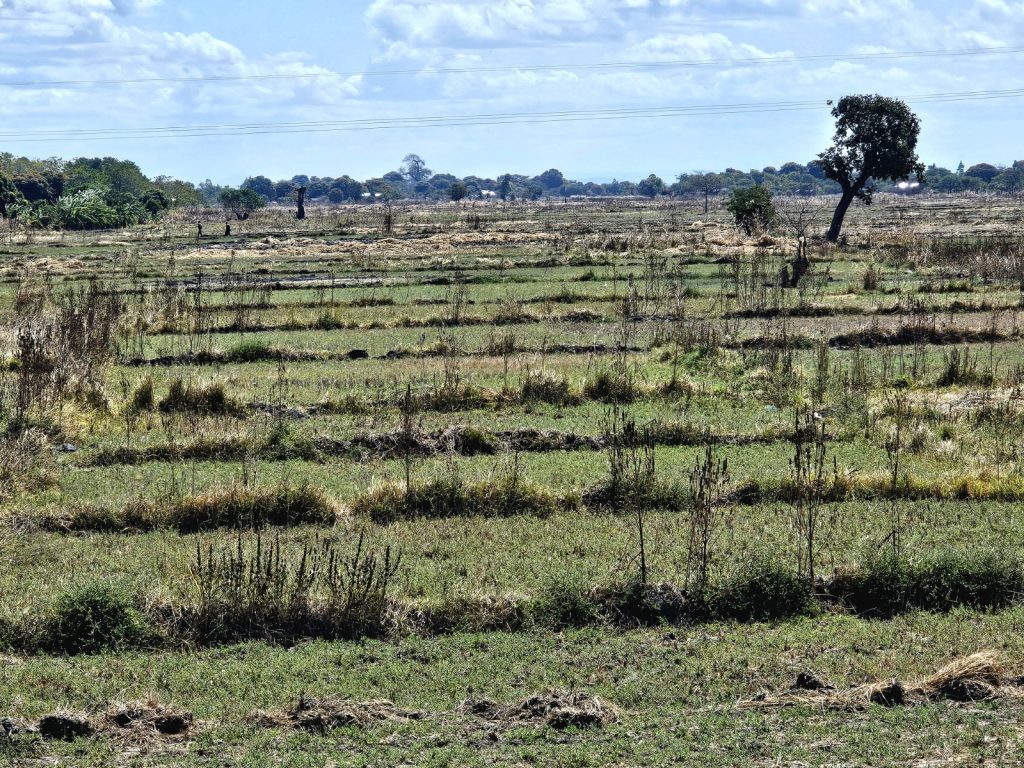
497. As I passed the large village of Benga there were some large areas which were used to cultivated rice. The population was denser here with a strong Muslim presence.
Virtually all the houses I had seen in Malawi have some sort of porch by the entrance. Some were quite elaborate where people could sit under but others were just over the door. I see people often take their shoes off to go inside a room or house as they do all over the world except for the UK. I think the porch was a kind of half way house where you could leave your muddy shoes and continue barefoot. In many of the poorest areas at least half of the people were already barefoot, especially the children and the older ladies.

499. Nearly all the houses in Malawi had a balcony or verandah similar to this one at the least. I think shoes are not really allowed in the house and are left outside.

498. The road was very variable between Salima and Nkhotakota with long good wide gravel sections waiting to be tarmacked and some excellent new tarmac. However there was also some pot-holed old road as seen here yet to be upgraded.
As I neared Nkhotakota I reached a large brown lake on my west side to the north of the small town of Benga, where there were some very simple lodges. It was the Chia Lagoon and its waters were very brown. There were some fishing boats on it so there must have been fish in it. I cycled past it for about half an hour crossing a bridge where there was a river connecting it to the much bluer waters of Lake Malawi which I was now seeing for the first time. In this wind it was full of white horses. There was still rice here but there was now also a lot of cassava growing on small mounds. They were tubers which developed in the roots of small shrub type plants.

500. The closer I got to Nkhotakota the more mosques there were sometimes every 500 metres and they completely outnumbered the churches.
At last after some 95 kilometres I reached the turnoff to the Nkhotakota Pottery, which is a more expensive campsite and lodge on the shores of the lake. It was too salubrious for me but there was a much touted alternative just a bit further called the Nkhotakota Safari Lodge and it was my earmarked destination. At the sign for it there was a phone number so I gave it a call as it was 4 km away down an earth lane. They had a cabin and it was £25 so I cycled down. It was a bumpy ride and I was realising I would have to come back in 2 days. I passed a couple of hamlets, one with a brick making homesteader who was just about to fire an enormous pile of bricks, with wood already placed in the channels under the pile which was also insulated. Just beyond was the lodge

501. A tall pile of bricks covered in straw and mud insulation ready to fire with wood already in place in the channels at the bottom and more wood stacked outside to feed in once the first lot was burnt.
I went in and pushed the bike across the sandy yard to the reception. Just beyond were the waves crashing onto a long sandy beach. Frank was at the bar/dining room/ reception area and was one of those people every employer dreams of having. He was affable and tried to please everyone and was hardworking. I think he was the heart and soul of the staff and would be difficult to replace. He showed me a room which had a verandah and looked straight onto the beach and waves. There was quite a breeze and it whistled through the cabin. Frank said the wind was predictable every year and was called the “Mwela”. It was exactly as I had hoped for. I settled in and then went for a late lunch. I wrote a bit of the blog but as I was here tomorrow also on a day off I postponed most of it. After dinner I returned down the dark beach with stars filling the sky and had an early night

502. The beach just outside my cabin on the shores of Lake Malawi at Nkhotakota. It was windy in the afternoon so the waves were quite big.
There were about 10 Americans staying here who were from an organisation called Y-Malawi. They were so well dressed and discussed everything in such an earnest manner I thought they were Mormons initially. They were not, but they were Christian volunteers who have come here to spread the word of Jesus and work with the existing Christian denominations here to empower and protect women and enable sustainable development. A well meaning Christian NGO essentially acting as a modern day missionary, which I am sure in the long term does more good than harm especially if helping women and halting child marriage.
Day 085. 02 August. Chankhungu to Salima. 53 km. 4 Hours. 310m up. 990m down. I got up at 0630 and packed and was away by 0700 hoping to get some breakfast on the way. Chankhungu was already busy with stalls already set up. I guess having a stall here is a very social job and the stallholders were always chatting to each other and customers. However I had no time to chat with anyone as I still had the rest of the climb. It was another 100 metres of ascent over a couple of kilometres. The sun was quite low still but where it shone on the homesteads it lit them up with an orange glow and was quite photogenic. In fact I noticed yesterday how clear the air is up here compared to lower down in the valleys. There was a brighter light to the day and everything was well illuminated. It was also easy to see the homesteads and the fields as there were so few trees about.

485. Even at 0700 in the morning the market in Chankhungu starting to bustle with vegetable saleswomen and a few men.
Almost immediately I got to a police checkpoint. This was the first of about 6 today. One every 10 kilometres or so, as yesterday. The police seemed to pull taxi type cars, crammed minibuses and lorries over. I don’t know what they were looking for specifically as everything was overcrowded and the vehicles were generally all in bad shape. I don’t think there was an objective scale to measure such things and it was perhaps up to the policeman’s discretion if something had been violated or not. Certainly none of the policemen seemed malnourished.

486. The hamlets and homesteads even beside the road are very poor and few have corrugated iron roofs with most having to make do with grass thrown on in an untidy manner.
The children were out in force again and as I slogged up a hill they rushed to greet me. “Manny” “Give” and “Give me my Manny” had now completely replaced the Zambia “How are you”. It meant I did not have to take my hand off the handlebar to wave which always made me wobble at slow speeds. Then I realized something. I had not seen a single child in uniform going to school. I had passed signs for schools but they were all very faded and in disrepair. None were newly whitewashed with the school mission statement and motto proudly written at the bottom. It dawned on me that it was a Saturday but for the last two days since Chipata the only Schoolchildren I saw on the roads were in Zambia. I will make a point of looking for them on Monday.

487. Where the land was steeper the furrows were cut so they contoured the hillside to prevent erosion in heavy rain. Every 10 furrows or so there was also a large drainage bank to lead water off the hill if it overwhelmed the furrows above it.

488. Wherever there was water available the farmers planted neat vegetable gardens with tomatoes, potatoes, casava, onions, pepper and eggplants. Often it was watered by hand.
The day’s cycle was really something of a luxury as after the initial hill there were just a few more climbs and huge amounts of downhill. I sped down these at speeds of up to 50 km per hour looking for potholes 100 metres ahead. Generally the road was good and at these speeds I could go in the main carriage way rather than creep along the damaged verge. I would look at the day’s odometer and then check it 15 minutes later and it was a good 5 kilometres more. In some of the villages I could speed through at 30 km per hour and I was passing the stalls and shops so quickly no one noticed until I was well past, and only then I heard whistles and shouts to attract my attention. I freewheeled for at least half the day’s distance until the descent petered out on the plain beside the lake, which was still a good distance away and I did not see it.

489. The beginnings of a brick. The homesteaders would start by digging piles of loose red earth and then wet it and stamp it into a paste as seen here. It would then go into forms and which would be tipped out to sun dry before being fired to harden.
Once on the plain the wind increased and it was strong. It was largely a headwind but it was also coming from the south. If it was like this tomorrow it would be marvellous but today I had to fight into it. I was not on my own as there were many cyclists on the road and most of them did not have gears. As I neared Salima there were more and more cycle taxis on the road, many with women as passengers and these women often had a child on their lap.

490. The M14 road between Lilongwe and Salima with an excellent section of verge as it makes the final descent from the plateau to the plains beside Lake Malawi.
Down here on the floor of the rift valley essentially and beneath the plateau I had just come down from it was much warmer. Banana trees were rife and every homestead had a few. There were a few more trees also but there was also quite a lot of charcoal for sale and I noticed that around the homesteads the mango trees were heavily pruned. I even saw people attacking the vast stump of a baobab tree in the hope they might be able to shave enough slithers of it to cook on. It was also busier down here in the valley as I approached Salima. I don’t know if that was because it was the outskirts of a town or that the soil was better here and water more abundant so it could support a greater density of population. I had a lodge already looked out, It was the Blissful Lily Guesthouse and it was a bit beyond the turnoff to Nkhotakota I would take tomorrow so I cycled on
The lodge was down a warren of small lanes, so much so I am surprised anyone finds it. It was the usual disappointment and my hopes of chatting in a shady garden with expats or other travellers was soon crushed as I saw the dusty yard. The last time I had seen a Muzungo was at South Luangwe National Park a week ago. The room was not cheap at £25 and the shower did not work. However it was good enough for me to spend the afternoon at, as it was just 1100 in the morning, and for me to catch up with the blog and rest my legs for the 100 km tomorrow to Nhkotakota. I spent all afternoon writing the blog while the hapless plumber was in and out of the room trying to sort the shower out. By the time I finished all my admin work the shower was still not working so I asked for a bucket of hot water. I also earmarked a place to stay in Nkhotakota tomorrow for at least 2 nights. It was the Nkhotakota Safari Lodge and apparently it was right on a beach on the fringe of the lake. It was great having the backlog of the blog and admin duties up to date for a change
Day 084. 01 August. Chitedze to Chankhungu. 59 km. 6 Hours. 620m up. 560m down. I left the very pretentious Shed Hotel at 1000 after writing for a couple of hours. My immediate task was to cycle the remaining 10 or 15 kilometers into Lilongwe and then emerge from it on the other side on the arterial M1 which I would then follow north for about 10 km before I headed east out of the city and towards the lake on the M14. I was not looking forward to navigating through Lilongwe. I cycled largely on the earthen mantle beside the road as the tarmac verge was largely destroyed. It was a little slower and I had to watch out for other cyclists, pedestrians and even donkey carts however it was so much less stressful than riding on the road. Had I ridden on the road I would have had to have leapt down from it from time to time when it got too congested and a lorry came along. There was no real start to Lilongwe and it was just that there were more and more huge sheds and some large compounds behind brick or cement walls where a company would have its administration offices. There was quite a plant business with many horticulturalists selling ornamental plants in bags. Some had been here for a while and the roots were through the bag and into the soil it sat on.
There were a number of checkpoints by different authorities like military, police, revenue and the council ones. I stopped and chatted at some and just cycled through others with a thumbs up. The road became congested towards the centre but was moving slowly. I noticed a few lorries heading out of town with perhaps 20 bicycles and riders on the back. The bikes all had frames and I think these lorries were heading west specifically to carry the bikes which had come to drop off the sacks of charcoal. The charcoal sells for about 30,000 Mal Kwacha (£12) a sack and I am sure a lot more in the markets of Lilongwe allowing the cyclists enough profit to have a leisurely uphill journey home to pick up the next load of 4 sacks. I at last got onto the M1 which I was delighted to see had an excellent verge and a cycle/pedestrian way outside that. I followed it north for about 10 kilometres until I was past various numbered sectors of the city. The M1 road was not as bad as I feared it would be. After 10 km I waited at traffic lights and then turned east onto the M14. It was a steep climb up from the arterial M1, which continued to Tanzania, but eventually I was at the top and heading east. This M14 was busier than I expected but I was through Lilongwe.
I did not want to linger in the city. It was essentially just a day to link up two more rural sections on smaller tarmacked roads. I had expected Lilongwe to be unappealing but it was far less than that. It lacked any charm whatsoever. It was devoid of any joy and happiness and people just seemed to be concentrating on earning a living so they could eat or the lucky ones pay for a mortgage. It was very sad that the poorer Malawians who live here have to endure this hand to mouth lifestyle to survive and I am sure many long for the villages where they grew up. I was concentrating hard on getting through the traffic and was so uninspired by everything I saw I did not take any photos until I was well past the sprawl. I think like many cities that are created to be a capital city where there was just a small town before never gels into a thriving organic city and just becomes a soulless administrative hub. Dull Ankara in Turkey over the thriving Istanbul is a great example and I am sure it is the same with Lilongwe and Blantyre. Except for large warehouses I did not see any buildings over 2 stories.
Once I was through the city and off the busy M1 I could breathe a sigh of relief. It was after midday now and I was hungry so I stopped at a row of local restaurants at the start of the M14 for some nshima, greens and chicken. It was good to sit and relax in the plastic seat and table in the very basic restaurant after having negotiated Lilongwe. As I watched the road from the restaurant I was disappointed to see just how busy the road to Salima was. People had told me this was a quiet road but it did not look it, but perhaps it was still too close to Lilongwe. After the usual nshima, greens and chicken I set off east.

479. After the totally charmless urban sprawl of the uninspiring Lilongwe, the capital city of Malawi, it was nice to be back in the countryside on the east side of it.
The road did quieten down marginally as I travelled east. There were lots of small minibuses which were crammed to the maximum with luggage hanging out of the bag from the tailgate which could not close properly. These minibuses were slow as they ground their way up the hill with their maximum load. There were also lorries with a flatbed at the back and small sides which were often crammed full of people and their goods. I am not sure if these are lorries returning with an empty load or lorries which operate like buses on a rough timetable and take a fare per passenger. It seemed to be the cheapest way to get to the local markets with your produce.
As I was freewhelling down a hill I noticed someone unusual run across the road to a well dressed man on the other side who was walking up the hill. Initially I thought it was a mad man. Then I noticed he was virtually naked except for a loincloth, head dress and ankle bells. He was painted in ash and was grey. On his arms and legs were various symbols and in one hand he carried a tambourine type instrument and a small sack of things in the other. I would have still thought he was a mad man until I saw another coming over the road to the well dressed man and then I realized these were witch doctors and had come to put a spell on the man or exercise some demons he might have previously told them he had. It was an extraordinary scene and as I was flying down the hill I did not stop and get a photo which I was sorry about. I was surprised that witchcraft still existed in such a public place so close to a capital city.

480. It was quite undulating on the farmed plateau with distant villages lost to the fast pace of change in the Western World and China.
The further I got from Lilongwe the less busy the road got but it was never quiet. As I travelled east the homesteads returned also and there was almost a permanent line of them beside the road. Occasionally they were a bit denser and a hamlet existed and every 5 kilometres there was a market village with stalls beside the road. They were selling tomatoes, onions, cabbage, potatoes, cassava and sugar cane. In each village there were also young men frying chips and cassava on large steel plates with a bowl in the middle which was heated over a fire. They smelt tasty and I am sure I will try some soon.

482. On the hard climb from the Lumbadzi River to the village of Chankhungu I passed a near continual line of homesteads.
The homesteads were very poor generally with mud brick houses under a grass roof. Some had a corrugated roof but most just had grass and were not neatly thatched so I am sure many leaked in the rainy season. There were many more vegetable plots about now compared to Zambia and they looked well tended. Many were not fenced off from the goats so I am not sure if they are guarded or whether the goatherd has to pay compensation if a herd of goats destroys someone’s tomato crop. I also saw many tarpaulins beside the road with a white powder drying in the sun. When I asked what it was they said nshima, which I thought was maize flour. However it seemed strange it was drying as I would have thought the maize kernels were dry as they were milled.
In every village, hamlet or even just the line of homesteads children swarmed out to meet me. Even some younger teenagers. They all said the same thing “Give me my manny”. Sometimes they just said “give” or “manny”. It was very predictable and sometimes I wondered if their mothers at the homesteads told their children “Here comes a Muzungu, quick go and ask him for money” I could see them running out of the homesteads desperate to intercept me before I passed. I always disappointed them by saying “no Money” and cycling on. The women, especially the younger ones, also asked for “manny” quite frequently but the men seldom did. But for the children it was the only contact I had with them. It was sometimes quite sad to see their sheer excitement and expectation when I approached, because they all really seemed to think I would stop and give them all money like a fabled Father Christmas, but I couldn’t.

481. The Lumbadzi River was one of many rivers which drained the plateau and flowed into Lake Malawi. It was still running with clear water in this dry season but you can see the raging torrent it must be in the rainy season.
The road was not easy with plenty of ups and downs. The verge continued to be very erratic and where it did exist it was quite potholed. For a cyclist it was virtually unusable and the locals either went on the yellow line and just moved over if they were tooted at by an impatient lorry or they went on the bumpy earthen path beside the road if there was one. Some of the ups were quite steep and the last one was a killer with nearly 300 metres of ascent up from the Lumbadzi River, which still had a trickle of clear water. Luckily the only lodging in the area was just over half way up this climb at the small town of Chankhungu. I made it there for about 1700 and found the lodge. It was very basic with 7 rooms around a courtyard. Each room was just big enough for a rough double bed and that was all that was in it. Outside there were two toilets in the yard. One for men and one for women and both were just a deep pit with a concrete slab with a hole in it covering the top. There did not seem to be any running water anywhere. However she did change the sheet for me when I arrived and the price of the room was 7000 kwacha (£2.50). The alternative was camping but I think it would be quite difficult to find a secluded place and if anyone spotted me I would be surrounded by kids in no time and have to put up with endless pleas for “manny”

483. The village of Chankhungu where I spent the night in a rustic lodge. There was a vibrant market here as most roadside villages in Malawi.
As it was getting dark I wandered into the large village. The market place was thriving with perhaps 200 women still selling their vegetables, many displayed on small upturned buckets or laid out on pieces of cloth. It was vibrant but I knew if I took photos I would attract even more attention. I crossed the road and walked back down a small street parallel to the main road and this seemed to be the street of grocers, material shops, hardware, barbers, outdoor street food and a single rustic restaurant. I went in and the very friendly owner served me some goat, greens and nshima. She kept loading my plate with the greens. It cost me 2500 kwacha, or £1 for the meal. After wandering through the village again I noticed all the teenage boys pointing at my legs and saying Muzungo. I dont think it is an insult, like nigger, just a exclamation of surprise and it was said without malice. Back at the lodge it was dark and I squeezed the bike into the room and then plugged in everything to charge in the only socket. I tried to write but was asleep by 2000.

484. The standard Malawi fare. Green vegetables called rep. The white maize meal called nshima and the goat stew which can be changed for chicken or fish, whatever is available that day. I often eat this twice a day and skip breakfast.
Day 083. 31 July. Mchinji to Chitedze. 92 km. 7 Hours. 370m up. 420m down. After a good breakfast I set off at 0900 after saying goodbye to the helpful manager who was setting up for a conference. I sneaked through the bumpy earth lanes of Mchinji to reach the main road, the M12 which would take me to Lilongwe some 110 km away. The main area of the town was already busy with market stalls set up and a throng of people starting their day. I set off down the road out of town and was in the countryside after 10 minutes.
The road was not good. It was narrow and had a yellow line on each side to mark the edge of the carriage way. Outside this was a verge but it was badly potholed and eroded. Rarely the verge was a meter wide and often it has disappeared entirely all the way to the yellow line. Usually this variable verge was a potholed strip with a ragged edge. From the edge there was often a drop of 20 centimetres to the eroded earth mantle along the road with the occasional ramp to go up and down. It was either the earth mantle or the road and you could not chop and change, or escape in the case of two trucks meeting at will. However there were a lot of cyclists on the road with their bikes loaded with goods and they were often much wider than I was and the traffic was reasonably light so I took the road. Without much headwind and with the gentle downhill gradient the road was fast and I was making good time.

467. On both sides of the road were the fields of the homesteads. A few were getting tilled by the farmers, male and female, who were forming furrows with 90 bent spades.
The earth was now an orange red. Almost brick coloured and I have only really seen this red soil in proliferation in Africa. The fallow fields were still littered with the debris of the last harvest and even under this the red earth shone through. However in a few places it had been tilled and then it was striking in its colour. Where the fields were still untilled there were cattle and goats feeding on the stalks and leaves left from the harvest. I did see a few households tilling their fields and it seemed to be the whole family; father, mother and any of the children if they were old enough. I did not see any oxen ploughing but did see people with digging hoes, (or mommaty) which was a heavy spade at right angles to the shaft. With this they would dig each side of the row and scoop the earth up onto the top of the row leaving a furrow. Some of the rows were 100 metres long and they were perhaps 30-80 across a field yet the rows were remarkably uniform, neat and straight.

472. This field was one of a few which had already been tilled by the men and women of the homestead with a digging hoe or mommaty.
Brick making seemed to be prolific here too. All the houses were made of brick and perhaps every 20th homestead was covered in bricks drying in the sun or stacked up waiting to be fired, so they harden and are more weather resistant. Although the houses were brick few seemed to have corrugated iron on the roof and many had grass. The homesteads and the fields were devoid of larger trees and there seemed to be little firewood to fire the bricks. Every tree that did exist was heavily coppiced. I passed a few people attacking large knotty stumps with axes in the hope they could shear off a few shards to burn. Even the mango trees were coppiced, some to the extreme where there was just a tuft of leaves and flowers and which would bear minimal fruit.

468. Virtually every tree was living under threat of being made into charcoal to sell or burnt on the homestead kitchen hearth. Even this benevolent mango had been butchered.
As I cycled I passed a few people selling mice on sticks. I think these mice are caught in the fields in traps, but some in the houses and storage rooms too. The sellers had split open a bamboo, placed the dead mice between the two halves and bound it together again. I passed one man with about 25 he was selling. I don’t know how long ago the first one was caught but I am sure they would go off soon. The price seemed to be 600 for the small ones and 700 for the larger ones. Apparently they are a delicacy here and best grilled, but some enjoy them boiled. I don’t know if this food is born of desperation or is a cultural treat, like a prawn. Certainly the people of Malawi I had seen so far were not malnourished and many of the ladies looked chunkier than their Zambian counterparts, especially the older ones.

469. An increasingly common sight as I cycled east was to come across younger men selling mice which you could buy for 600 kwacha (£0.25). Apparently they are best grilled.
The hamlets continued almost continuously down each side of the road and every now and again, perhaps 10 kilometers or so, there was a market town. These small towns had a few hardware shops and the ubiquitous small groceries but there were also many bike and motorbike repair places beside the road in small rustic stalls made from bamboo. Mostly these market towns were dominated by women with their small stalls selling tomatoes, sweet potatoes and bananas and cabbages. I am sure in the wet season they are full of other produce. There are also many stalls selling sticks of sugar cane and piles of discarded off cuts which the free roaming goats seemed to love. They were quite vibrant and chaotic places. One thing I did notice was that there were far fewer bars with lacklustre men hanging around outside them hoping for a drink.

471. The homesteads were now all made from bricks with some having a grass roof and others a corrugated roof, often covered with grass and bricks to keep it in place.
It was the homesteads which fascinated me the most and many looked quite idyllic surrounded by the vegetable garden and small banana groves. As I went further from Mchinji there were more and more trees appearing. Outside the immediate vicinity of the homestead were the fields and these were becoming more and more tilled. I saw men and women in the fields. Beside many of the homesteads were large poorly built thatched open sided buildings which were very long. It took me a while to figure out this was for drying tobacco and that was only after I saw other large commercial tobacco drying sheds on the north side of the road where tobacco must have been grown in large fields by a landowning company. The smaller farmers on the homesteads must have also grown it and sold it to this larger company.

473. Around the town of Namitete there were many tobacco drying sheds where homesteaders dried their produce before selling it to a dealer.
As I reached Namitete I also saw a huge orchard. I could not work out what this fruit was initially. I thought it was olives. There were hundreds of hectares under cultivation with thousands of trees. In the end I had to ask and I was told it was macadamia nuts. These are very high in oil content so I don’t know if they were pressed or exported to the wholefood shops of Europe and the US. There was a considerable fence round the whole complex so it must have been a valuable commodity.

474. At Namitete there was a huge concern with many hectares and thousands of trees growing macadamia nuts in a vast orchard
One disappointing thing was the interactions with the kids. It usually started with them running up to me shouting what is your name. When I told them the usual reaction would be “My name is so and so” swiftly followed by “give me your money”. It was not only the kids but the women too. If there was a group of more than 4 at least one would shout “give me your money”. I hope this is something lost in translation and what they intended to say was “please can I have some money”. However having heard it at least 100 times today it is starting to go in one ear and out of the other and I cycle on without a wave or even acknowledgement. One man also cycled past me and said “give me your bicycle”. I think this was just a clumsy way of saying “That is a nice bike, I would really like it”. It is not a vibe I was expecting and it might make me feel Malawians are not as proud or self-reliant as the Zambians. The jury is still out on this until I can find out more about it as it is maybe just a greeting which I misinterpreted. I prefer the Zambian “how are you” approach though.

470. The M12 road through Malawi went from the border by Mchinji to Lilongwe, the capital. There were quite a few smaller towns along its 120 km length.
As I neared Msundwe I noticed a few more charcoal sellers. There were trees here and there which farmers must have sold branches off, or made it into charcoal themselves. Apparently a big bag costs about 30,000 Mal Kwacha (£12) beside the road here. It must be more in Lilongwe as I also started to pass more and more cyclists who had 3 or 4 bags strapped to their bike heading east into the capital. These looked enormous loads, so much so it was impossible to cycle uphill with them and the cyclists were pushing their bikes. It looked like hard work and they were straining to do so. On the down hill sections they somehow managed to mount their bikes and cycled down maintaining a balance and occasionally weaving around potholes. The drivers could see this was a difficult task and they were generous with these charcoal bearing cyclists giving them plenty of space and not tooting them to get off the road onto the bumpy verge.

475. As I neared Lilongwe i passed more and more cyclists with huge stacks of charcoal. All were heading to the capital to sell their wares.
I saw a lot of signs for eccentric churches and places of worship. Some were quite amusing as a local pastor with an entrepreneurial twist created a church and hoped for a generous congregation. In a few places it had not worked and all that remained was the faded sign and the church lay in ruins with the grass roof collapsing and the brick walls being weathered back into earth. There were still a lot of the more established types of church and also more and more mosques, each with a crescent on a small tower. I have yet to hear an iman or loudspeaker chant from these short minarets but I am sure as I near Dar es Salam I will hear their evocative and beautiful voices.

477. There were quite a few of the more eccentric denominations on the road between Mchinji and Lilongwe. This was over and above the usual ones and the mosques.
At Msundwe there was a lodge hidden in the back lanes called the Flame Lodge. It was not easy to find it in the maze of small brick lined backstreets. They were so narrow it was like an Arabic souk. As it was getting late in the day people were bringing their cattle and goats back to their yards after a day of grazing. I had to hide in some doorways as herds came past filling the whole lane with horns and hooves. I found the lodge which did look what I was after but all the rooms were already full. The owner suggested I continue for another 16 km to somewhere called “The Shed Hotel”. Google maps said it was a boutique hotel which was worrying but that a room there was £20.

476. The Flame Lodge was in in the brick lined backstreets of Msundwe which were busy with women carrying water and livestock returning home after a day’s grazing.
It was all a gentle downhill to The Shed and I managed it in well under an hour and got there before dusk. They wanted to charge double the Booking.com price and were very reluctant to match it until I said I would just book a room online instead of them directly. The room was large and well designed but badly executed. It was a year old and a lot of the aluminium frames were already jamming and twisting and there were cracked windows everywhere. However the shower worked well and the bed was extremely comfortable. It was a long day but much of it was downhill. It was inevitable I would make comparisons with Zambia and the jury is still out on this, but Zambia as I said will be a hard act to follow.

478. The market town of Msundwe had small shops and stalls lining the main street. I hoped to stay here but the rustic Flame Lodge was full so had to continue.
Day 082. 30 July. Chipata to Mchinji. 32 km. 3 Hours. 220m up. 400m down. As I went to bed early I woke early and was up at 0530 to do the blog. I finished well before 0800 and went down for breakfast which was salad, eggs and white bread. I had two small mechanical issues with the bike which were resolved by tightening up bolts and then I was off at 1030 for the short journey to the border. It was a great run down hill for a couple of kilometres but then I had a long slow climb up gaining some 250 metres as I gained on the border.
As I neared the border the hills got bigger and there were some craggy outcrops about. However the flat valley floor was quite green and well cultivated with fields, now fallow, covering virtually everything flat. The houses here were all brick and there were a lot of artisanal brick making enterprises on many of the homesteads. Although most of the houses had corrugated iron on the roofs there were sometimes large piles of roofing grass bundles stacked up in the compounds, as if these were to be sold.

462. The craggy outcrops on the border with Malawi. The border was on the watershed of the tributaries of the Luangwa River in Zambia and Shire River in Malawi. Ultimately both flow into the Zambezi River.
As I neared the border it got busier and there were a lot of children returning from school. They all seemed very cool and most never returned a wave or greeting. Perhaps I looked like a workman in my high school-visibility top. Many were eating sugar cane stalks, pulling the hard skin from around it with their teeth and spitting it on the road which was covered in the cellulose strips. This exposed the core where the sugary sap was. It probably was not a health food but it is surely better than toffee or cake, and it is the only sweet item in an otherwise frugal, or even spartan, diet which is generally healthy.
Near the border there were many money changers and they all chased me. One younger clean cut man was the first to approach. I told him I would exchange money with him if he sent the others away. If they did not go I would cycle off. He told them and the chattering throng of 10 others all retreated and left us in peace. I had heard that the official rate for Malawi currency is much less than the street rate. For example a US dollar, Euro or Pound can be exchanged for 2.5 times that of the official rate. This man offered me 1,6 times the official rate for Zambian kwacha. I gave him 4000 zambian and he gave me 500,000 Malawi, while the official rate was 300,000. It was a huge pile and I could barely fit the half million in my wallet.
Thereafter I went to the border post and had an incredibly easy exit from Zambia and entrance into Malawi. It was done in two adjacent booths in the same building and the whole procedure took just 10 minutes. After that I was back on the bike and I just rode past all the queuing cars to the front where the customs lady waved me through. Just beyond was a row of small shops and booths selling sim cards for my phone. I went with Airtel again as they were so good in Zambia and everyone said they were the best for Malawi. I chose a proper building rather than one of the plastic booths so there was a counter to place all the sim cards and bits on and a crowd could not form around me. It took almost half an hour to register and set up but in the end I had 65 GB for a month for the price of £10. With that done all my administration chores were done here and I set off down the hill.
I was still not sure which way to go after Mchinji in 12 km. I noticed there were some lodges there and apparently some ATM’s also. I though I would have a short day and stop in Mchinji and try and get a paper map and confirm a route. It was a beautiful run down the gentle slope and it took me well under an hour of easy cycling. The road was quite busy and there were a lot of cyclists. There was no verge at all except for an earthen fringe to the road, but it was often 20-30 centimetres below the road surface with a sharp drop down. It was not a bail out option if two larger vehicles would meet at the point.

464. In Malawi brick manufacture was at least as prolific and artisanal as it was in Zambia with many homesteads involved in it.
There was no noticeable difference from Zambia. The houses were still all made of brick, the fields were mostly unploughed and fallow, although a few in Malawi had been ploughed recently. Perhaps Malawi was slightly more vibrant but I did not really notice this until I was in Mchinji itself and could see the market. Just before Mchinji I crossed a river bed and then climbed up quite steeply to the town itself. There was a market in the centre. Initially there were clothes sellers who had their wares on tarpaulins to stop the dust soiling them. Then a bit further all the banana and tomato sales women who had both small stalls or just a basket on their head. I tried to photograph the scene but was conscious the ladies would not like it.

465. The earth was much redder organised anything I had seen in Zambia and the land was extensively farmed with farmers living in simple brick houses.
I had picked out a lodge, The Green Hill Lodge, probably called that on account it sat at the foot of a green hill. However it was very cheap but very simple. The manager assured me there was hot water but when I tested it there was no water at all, hot or cold. Adjacent to it was another lodge, The MMK Lodge. It was at the opposite end of the spectrum and was very expensive at $60 but it was new and everything worked as it should. I took the room because I did not want to waste time looking for the middle ground in Mchinji. The manager was also extremely helpful and phoned the tourist office to see if they had a paper map of Malawi, which they did. I cycled down to the tiny office to get it and spoke to the lady about my route. One thing I was not sure of was cycling the 35 km through the Nkhotakota National Reserve. She phoned them and relayed the bad news that I could not. Apparently not even motorbikes were allowed as there were elephants there. Other cyclists apparently wait for a lorry to pass and then pay the driver to strap the bike and paniers onto the back and hitch a lift, and the authorities allow this. I also went to the ATM here to get more money out. In the end I had over a million Malawi kwacha in 5000 kwacha (£2) notes and it was a pile some 5 centimeters high when squashed down.

466. The market town of Mchinji was a thriving and vibrant place even in the afternoon. I was able to get everything I needed here.
Not being allowed to cycle through the Nkhotakota National Reserve had huge ramifications on my route choice as I needed a continuous route without resorting to lifts. It meant I had to go to the south or north of this National Reserve. The former meant going the 100 km to Lilongwe, the capital, on a busier narrow tar road and then on more cycle friendly quieter roads for 100 km to reach Lake Malawi. The latter meant small hilly gravel roads to Kasungu and then 100 km on the busy main road connecting Malawi with the rest of the world, and then another 100 km on hilly gravel roads to reach Lake Malawi. I opted for the former and this was probably the easier option but it would not take me through the really remote rural areas of Malawi.
Back at the lodge I probably had the best shower I have had in Africa yet. I noticed everything was high quality and the sheets were expensive cotton with a high thread count. I settled in and wrote the blog finishing it before dinner and then agonised about my route choice again and spoke with the manager. He said I could be in Lilongwe tomorrow and then after that I was on quiet roads and he advised that. It clinched it. Although the lodge was high quality, the food tried but did not match it and it was disappointing. I might have been better eating nshima at the market in a dingy restaurant. I now felt ready to cycle into Malawi and had everything sorted out.