Section 01. Reinheimen
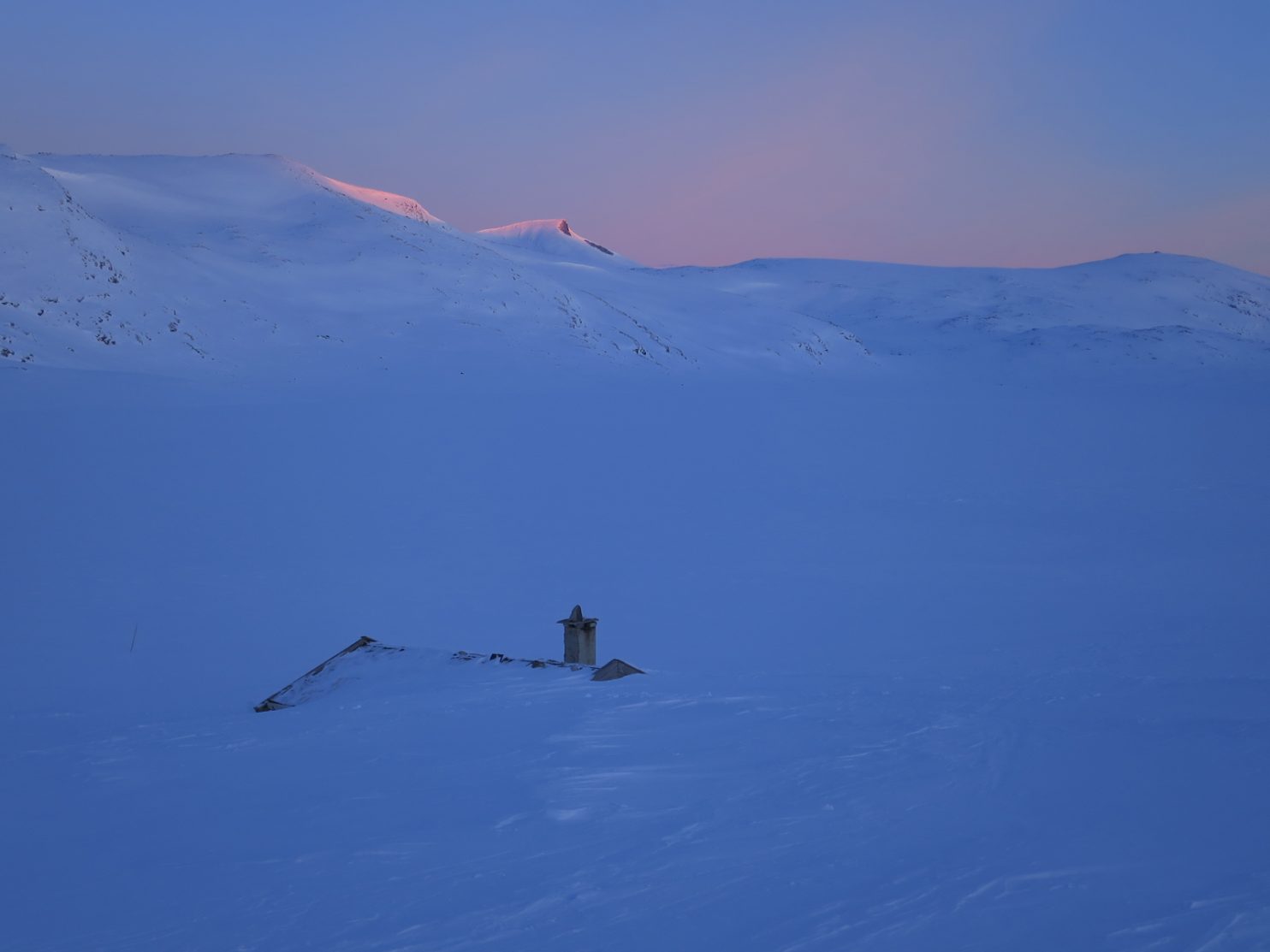
Day 01. Brøstdalen to Pyttbua. 18 km. 5.5 hours. 520m up. 80 m down. The previous day every thing had gone according to plan. The flight from Edinburgh with Norwegian Airlines was prompt and gave us plenty of time to catch the train from the airport heading north. We took two trains, one to Donbås where we changed to get the second down to Bjorli. It was a beautiful train ride and the weather was perfect. We reached Bjorli after dark at 1900 and walked the kilometre or so to the Bjorliheimen Fjellhotel. It was a Christian Hotel and did not serve alcohol. Here we met Arild who was the manager. A kinder and more welcoming man would be difficult to find. He agreed to post a package for us to my friend, Hartmut in Oslo and also offered to drive us down the road and up Brøstdalen tomorrow, meaning we would avoid the difficult untracked ski through the forest to the old sawmill at the bottom where Brøstdalen met Romsdalen.
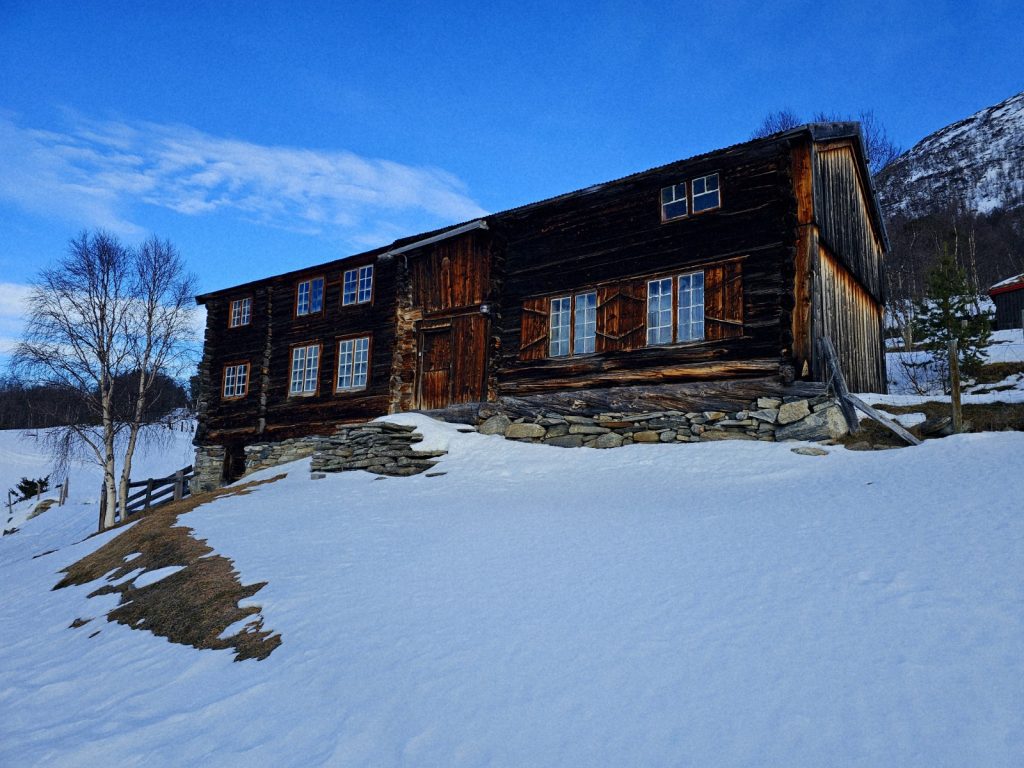
01. The beautiful old farm in Brøstdalen where Arild dropped us off at the start of our trip.
After a good nights sleep we had an enourmous buffet Norwegian style buffet breakfast, where we were allowed to make up some lunch rolls, we loaded the rucksacks and skis into Arild’s car and set off at 0900. He drove us 5 km down to the turnoff and then up the snow covered road up Brøstdalen for another 5 km. We passed the historic sawmill which is now a museum in the summer, and then some venerable old farms which were still operating up the pine clad valley. In some of these more remote valleys the farms have been here since the Black Death in the 14 Century, but although these two were very old I don’t think they were that old. Arild drove us to the carpark at the top beyond which the track was still covered in snow. There was a beautiful farm here with it barn and a cluster of traditional buildings all made of logs and blackened from centuries of the sun beating down on it. We said goodbye to the bright and cheerful Arild and set off down a small slope.
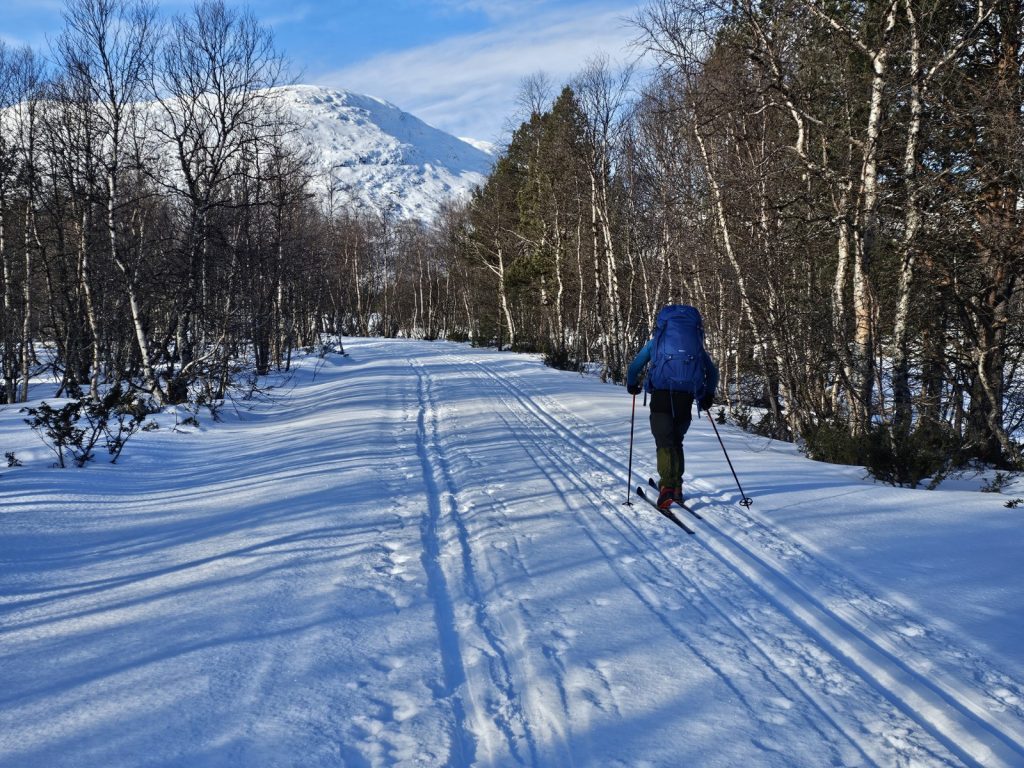
02. Skiing up the forest track in upper Brøstdalen a few kilometres into the trip.
The slope was compacted snow covered in a soft layer of powder. Within 100 meters we both misjudged a corner and fell, sharing the humiliation. However after that the track levelled off crossed the completely frozen riven and started up the south side on a nearly level ski track. It was a wonderful calm peaceful ski for about two hours passing some summer farms and haylofts in fields, Their roofs were covered in snow as were all the fields. Frequently we crossed the tracks of ptarmigan, who had been waddling in the snow looking for buds andf hares bounding over the soft forest snow. There were also the tracks of foxes who were stakling both the ptarmigan and hare.It was like skiing through a fairytale. After a quick 2 hours we reached a fork with the northerly path going to Kabbe where there were some summer farms and newer cabins. We took the southern fork up the track through the forest, which had deep snow lying in it and would have been hard work and very slow to venture through had we left the track. It had a compacted area where other skiers had been and it was a delight to ski along on our skis, which were gliding beautifully. The route then reached Tunga where there was a another fork at the bridge. This whole area was covered in pine trees which stood out against the snow and looked proud in the glourious sun.
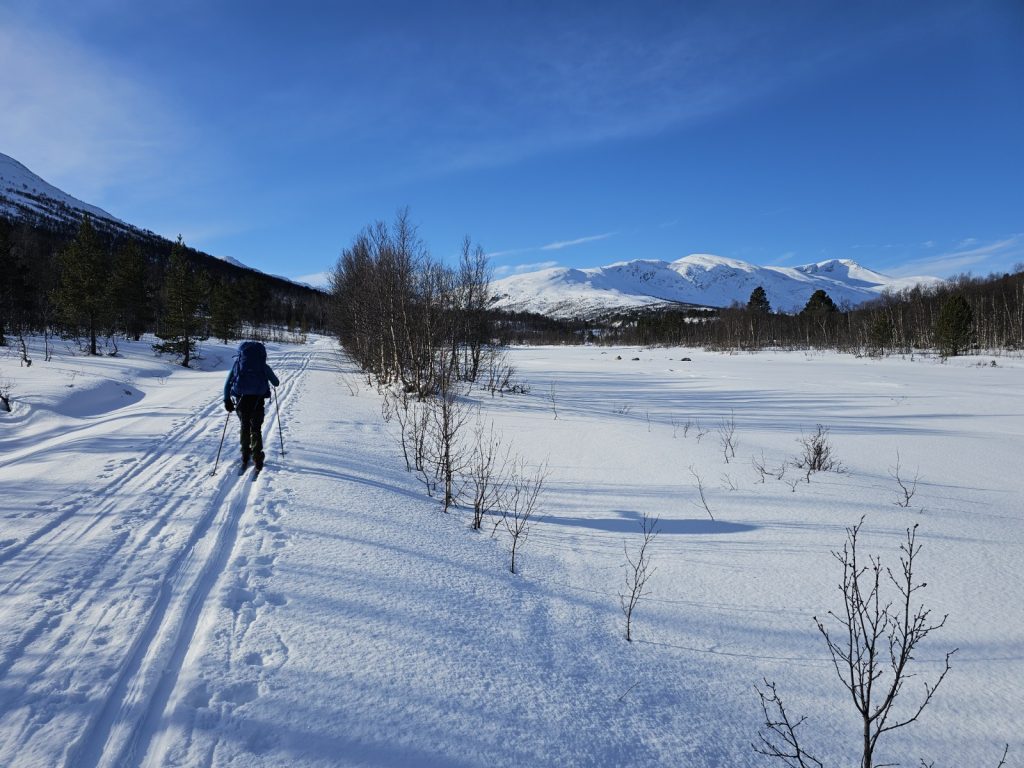
03. Skiing beside the frozen Pyttlåa River headinf towards Tunga before the climb to Pyttbua cabin.
We took niether fork but ventured onto the river which was completely frozen over. We met a party of 4 Norwegian skiers who were comig down and said that the way they had taken to descend from Pyttbua cabin was perfect. For the next hour we followed their tracks as they wove up the river which twisted down the gentle valley between spurs and boulders. It was a gentle and delightful ski in the hot sun and we made easy progress. Very rarely was the river open and it was easy to avoid these areas. Further up the valley loomed the massive peaks of Høgtunga and Karitinden, both about 1900 metrers and covered in small glaciers. By 1300 we had been going for about 3 hours and we stopped for lunch were a rock on the rivers edge gave us a dry seat. We basked in the sun eating the breakfast rolls commenting how lucky we were and what a great start to the trip it had been with the easy fluent travel yesterday and the perfect sunny windstill day today.
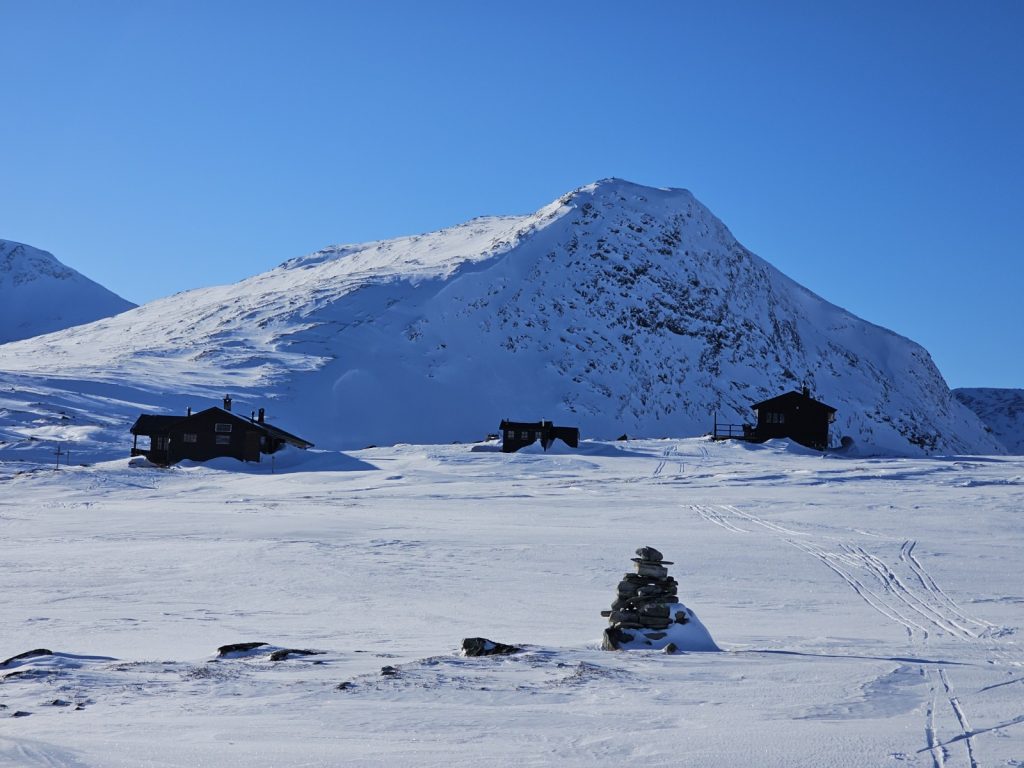
04. The cabins at Pyttbua lie under 1900 metre mounains in a high valley.
After lunch we continued up the frozen river until the gradient got steeper, We now both changed from our thin mohair skins, which offer some grip but a great glide, to wider nylon skins which offer great grip for climbing, but little glide. We could now start the final climb up up out of the treeline at about 950 metres, where the birch trees diminished in stature and became scattered. For the next three kilometres the surface was difficult with small sastrugi like formations and plenty of sections with bare wind polished snow and adjacent areas of deeper powder. I stop frequently to take some photos while Stuart pushed on. I looked up a one stage and he was perhaps 500 metres in front and on a mission to reach Pyttbua cabin. Given the weather I was in no hurry and I did not was to overheat. With a little tiredness I crested the rise and saw the cluster of cabins about 500 metres away. Stuart was already there relaxing on a bench in front of the door with the sun beating down on him. He was also a little tired.
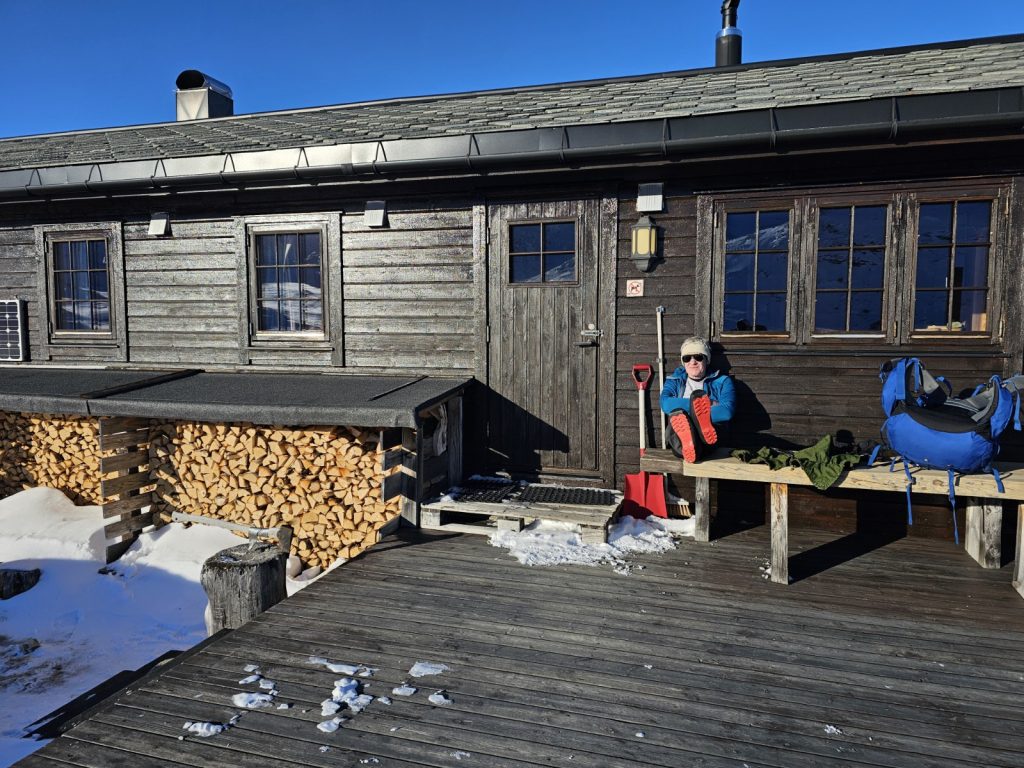
05. Stuart relaxing on the balcony of the Pyttbua cabin in the sun waiting for me to arrive and open up.
We took the smaller, most southerly, cabin as it was already warm from the 4 Norwegians. Inside it was perfect. The ambience of the timber living room was warm and cosy. There were cooking appliances here, and the stove. There was a well stocked kitchen, tables and a cosy seated area. Off the living room was a small room with 4 beds which we unpacked into, There was another bedroom in an unheated area also. Within the cabin in the unheated area there was a store with provisions. It was well stocked and we chose a tin of Bacaloa cod and mashed potatoes for supper and then settled down for the evening with the stove gently burning and warming the well insulated hut. It was idyllic. That evening the stars were out but there was a fuller moon and it did not allow the lesser stars to shine. I wrote the blog while Stuart read and by 2200 we were done aned ready for our beds. It had been a great start to the trip and I felt fully vindicated for encouraging Stuart to join me on a ski tour as he had last done 40 years ago through Sarek in Sweden. Stuart said if all the other days are terrible the trip would still be worth it on account of today alone.
Day 02. Pyttbua to Tordsbu. 12 km. 5 hours. 450m up. 290 m down. It had been a beautiful night with the moon shining bright when we went to bed. However in the morning the sky had completely clouded over and even the tops of the small hills were lost in the mist. There was also a wind from the south which was strong enough to lift the spindrift. The temperature had shot up from minus 16 to an unseasonal, and worrying minus 1. We lingered about the hut taking it relatively easy as it was only 12 km today. We set off at 1000 and into the wind.
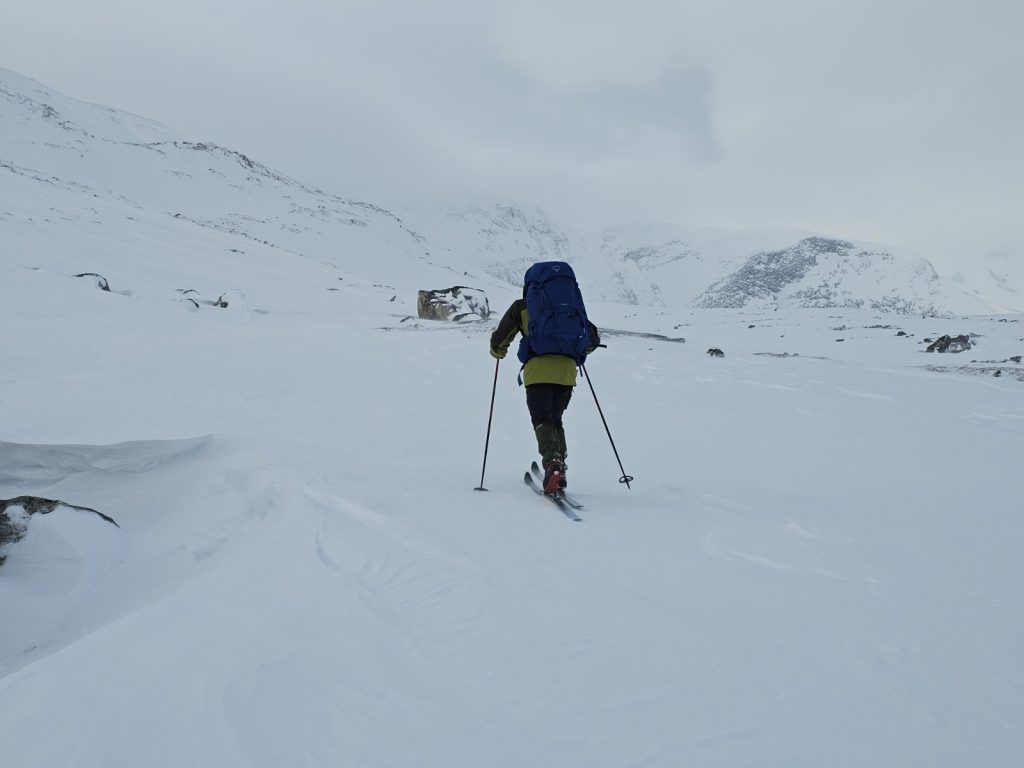
06. Heading south from Pyttbua cabin towards the small side valley where there is the steep pass over to Tordsvatnet lake
Initially the going was a little difficult as the lack of previous snowfall and winter’s winds had scoured the hillsides and polished the exposed icier snow and blown the rest into drifts and ridges. It was very unpredicable and in the poor flat light we could not see the changes in surface. We skied very gingerly down the shallow slope to the open valley floor. This was made more difficult with the rounded piles of moraine, called drumlins, which the long-retreated glacier had left behind. Once on the valley floor we headed south west up a smaller side valley, not quite a hanging valley, to the east of Karihøa. It was a steep climb and we had to zig-zag up the slope to reach the lip of this side valley and gain its flat boulder strewn bottom. I was shocked at the lack of snow in this side valley with only half of the area covered and extensive areas of bare boulders, rock and heathery hillside. We wove a route through the bare areas passing over a small frozen tarn to reach the bottom of a ramp heading south.
This ramp was beneath a row of crags and slowly climbed above crags as it went. It was the only way up the ramparts to the south without a long detour to the east. I had been up it 8 years ago and remember it being very steep for about 10 metres on a drift of firm snow. We zig-zagged up to get as high as possible on easier ground before venturing onto the steeper bit. It was as steep as I remembered but this time the snow was much softer and diffilcult to side step up. It took a taxing 15 minutes just to gain the steepest 10 metres but then we were free of its clutches and into the small narrow open valley beyond.
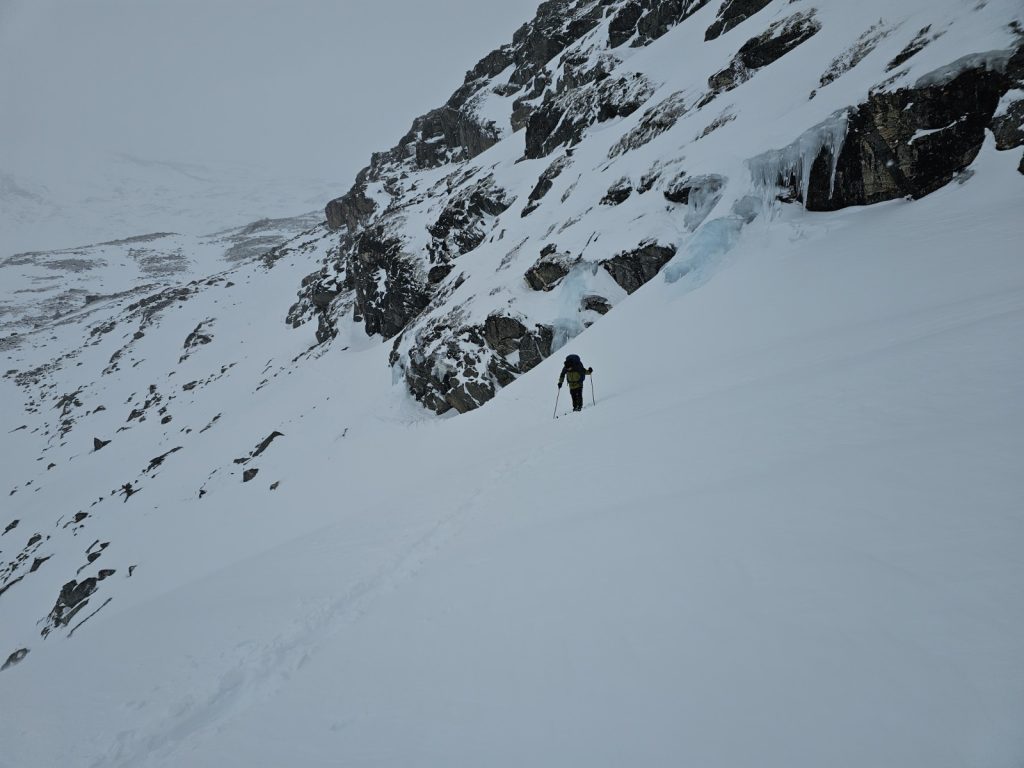
07. Stuart coming up the steep section where deep loose snow made climbing very difficult.
By now the wind had increased and it was snowing. The increase in the wind was no doubt due to a funnel effect as we neared the shallow pass hemmed in by outcrops on each side. The spindrift was flying everywhere and we were soon coated in a layer of snow but I felt comfortable peering out from behind my goggles into the oncoming snow. However at the pass the wind soon dropped off, and with it the intensity of the spindrift and we were into a calmer area. There was very little view up to the mountains and even the hills below them. However the valley floor was clear and we could ski easily.
The next 3 kilometres were wonderful as we crossed a lake, Radiovatnet, 1453m, and then started a gentle descent diagonally down the side of the valley towards Tordsvatnet, 1336m. In complete contrast to the otherside, the northern side of the pass, this southern side was covered in snow and it was uniform and smooth without any bare patches of polished ice. It took less than an hour and only one fall by me to reach the lake where we stopped for snack, backs to the wind. We could see the cabins at Tordsbu on a knoll in the white haze occasionally.
Skiing down a long lake is quite a meditative journey especially when the conditions are good. There was about 10 cm of loose snow to plough through but it is not hamper us that much, especially Stuart who shot off into the distance and towards the cabins. The sun was trying to break through and occasionally appeared with a great yellow halo round it, but the sky was still overcast and dropping snow. I should have changed into my thiner mohair skins to get some glide but was too lazy to stop and change and the price I had to pay was gentle plod rather than an easy stride. After a good hour on the lake Tordsvatnet, we covered the flat 5 km and reached the cabin on a small knoll beside the frozen lake.
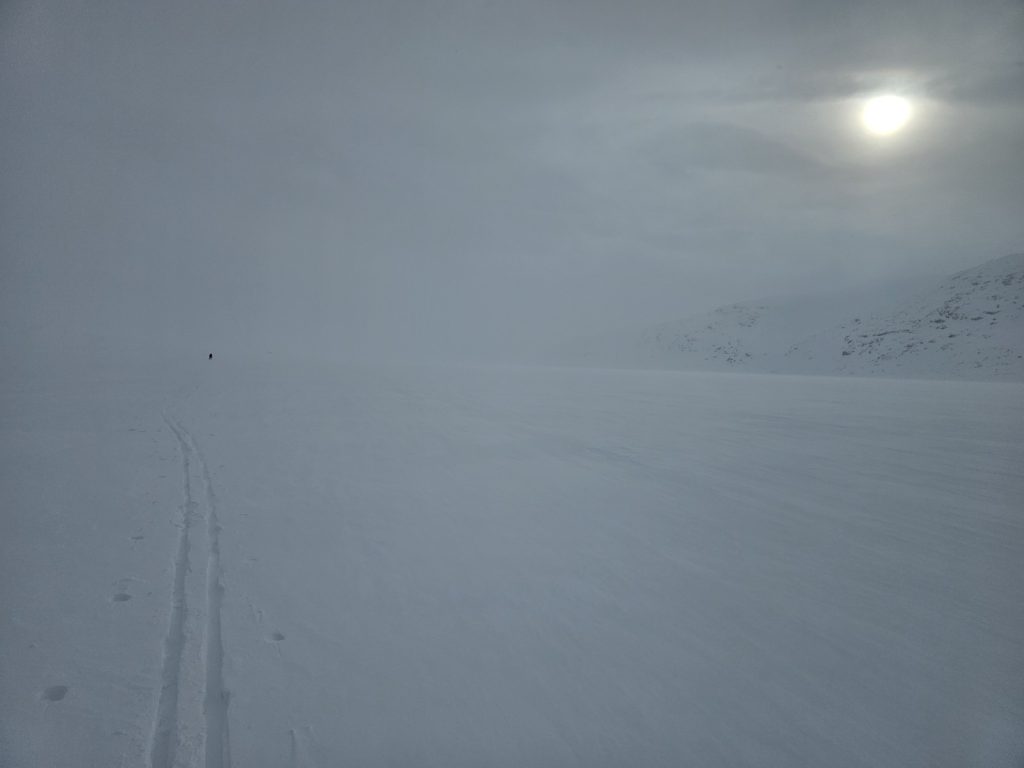
08. Skiing down Tordsvatnet Lake towards Tordsbu cabins with the sun trying to break through.
There was already one other person here as I suspected from the occasional wiff of woodsmoke down the lake. He welcomed us in and we introduced ourselves. His name was Steiner and he was from Ålesund. He worked offshore on the oil rigs in the Norwegian Sector and had plently of time off which he used wisely in the mountains at every one of his shoretime periods off. We immeadiatly felt an affinity with him, and because his English was better than many Brits it was easy. The provisions were in the other cabin so I made a foray across the spindrift covered gap to get some tins and powders for dinner and breakfast. It would be stew and mashed potatoes for dinner and porridge and canned fruit for breakfast. Looking back to the hut we were staying in looked like the stage set for filming Ice Station Zebra. We had a very convivial evening with Steiner about Norwegian nature, of which he was a keen enthusiast, polar trips and explorers and working offshore. It was warm and cosy in the cabin as the wind peppered the south wall with spindrift and snow and huge ridges of snow formed around the cabin. According to Steiner it was too be like this tomorrow also which was fortutious as I had planned a weather day here because we need to lose a day before the bookings at Pollfoss and Sota Seter.
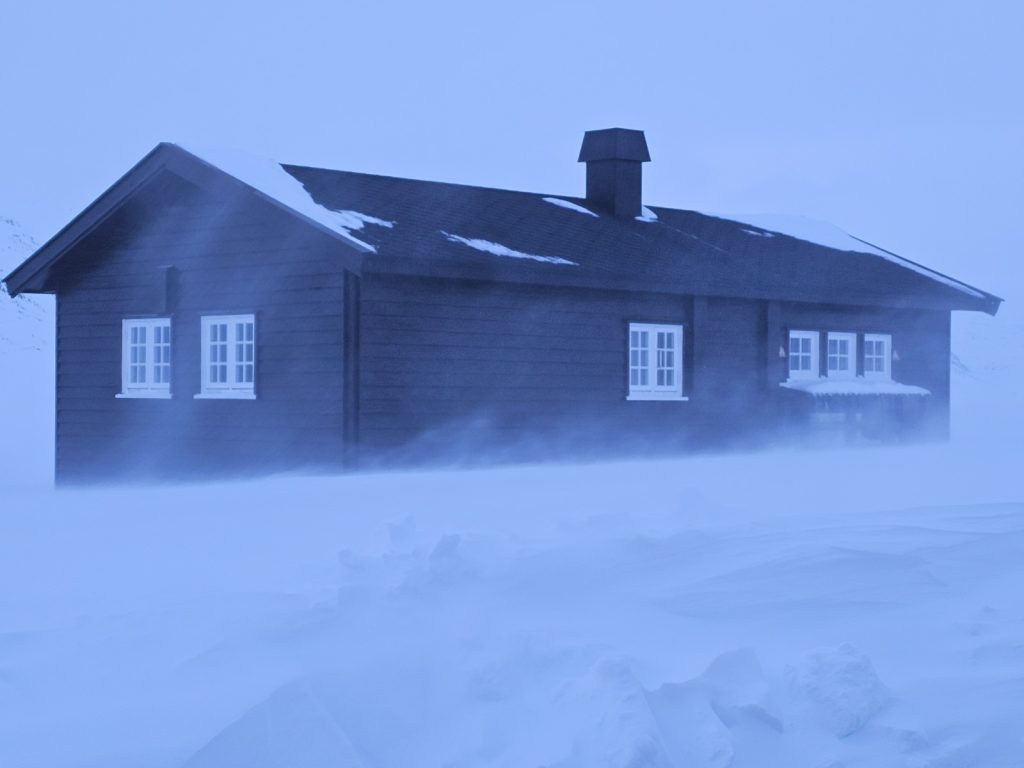
09. The gale whipping up spindrift between the cabins at Tordsbu. It was perhaps force 6 or 7 all evening and the entire next day.
Day 03. Tordsbu weather day. 0 km. 0 hours. 0m up. 0 m down. When I woke at 0630 in the morning it was just getting light. I could hear the wind roaring outside and rattling the vents. Looking out of the window was spectacular as the spindrift was hurling itself at the cabins walls. The other cabin was perhaps 10 metres away but it was opaque behind a river of ice particles. I felt especially smug we had a day off planned for here and with great delight went back to bed until 0900. Stuart did one better and did not get up until 0930 when I brought him a coffee.
There was nothing else to do except relax. The 3 of us sat round the table and chatted away for hours drinking coffee and peering out of the window. It was not a storm by any means but it was a gale, perhaps 25 knots on occasion. However, because it was snowing and because of the huge volumes of spindrift it would have been difficult skiing into it, but not impossible. Luckily we did not have to.
At midday the cheerful Stienar suggested pancakes for lunch. He had brought many things in his pulk including a non stick frying pan so set about cooking them. He spent half an hour making about 20 which were soon demolished with the various jams the hut kept in its provisions. We spent the next few hours telling outdoor tales, with Stuart and Stienar also swapping stories about life offshore on the oil rigs. It was a relaxed, jovial chatter with no one-up-manship. Meanwhile the gale raged outside and the spindrift continue to flow acoss the surface of the snow.
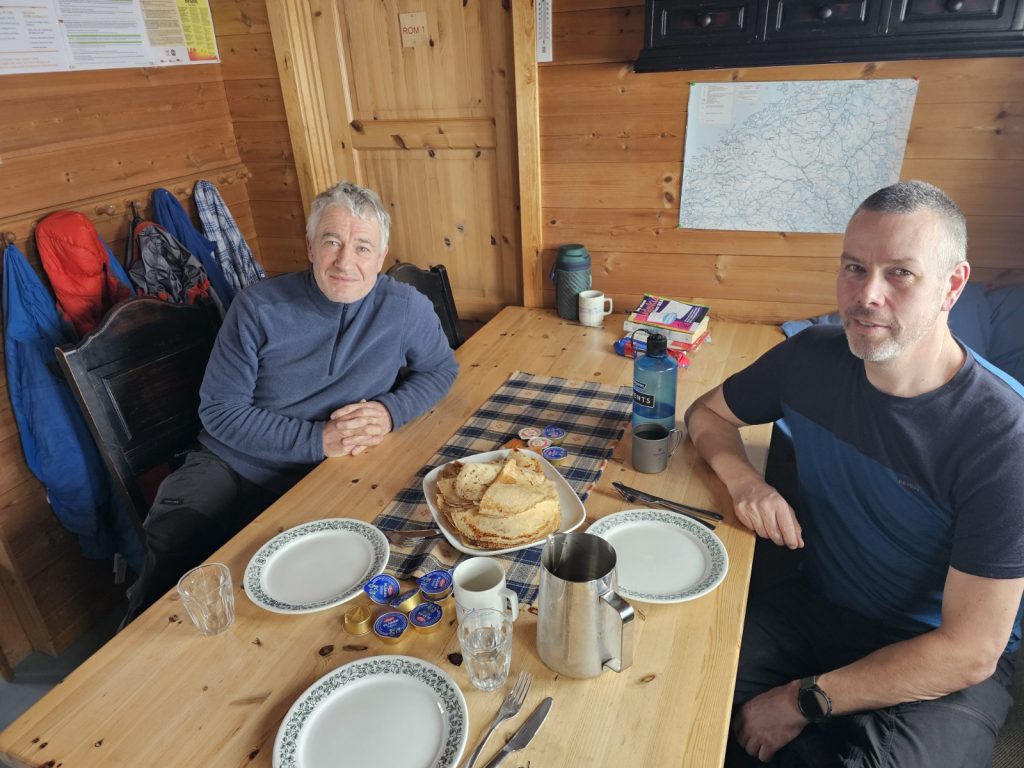
10. Stienar and Stuart with the mound of pancakes Steinar had cooked.
Before dinner we all had a small siesta before cooking. We had bacaloa cod and mashed potatoes again. The bacaloa was far superior to yesterday’s stew and it was a rare find in a cabin’s provisions, while the stew was in every cabin. Steinar gave us a beer each from the never ending supplies in his sledge and we chatted well into the night. It was exactly the type of evening you hope for in a Norwegian mountain hut with a warm fire and great company. By the time we went to bed at 2230 the wind showed little sign of abating which it was supposed to do by mid morning tomorrow. Whatever happens we have to reach Pollfoss tomorrow after our restful, easy recovery and weather day.
Day 04. Tordsbu to Pollfoss. 23 km. 7.5 hours. 150m up. 900 m down. The wind had died down considerably in the night but it was still overcast and the light was very flat. After the large breakfast of porridge and tinned fruit we were ready to go at 0930. We said goodbye to our new found friend in Steinar, who was heading west later in the morning and set off south west. The snow was now quite deep and the person making the trail, usually Stuart, was slogging away up to their shins. We made reasonable time to the small hut at the end of the lake and then started down the slope.
We kept high traversing across the large bowl as I knew there were some tricky gullies further down towards the river. In the end we strayed too high and could well have been lower as the gullies were small and did not extend onto the shelf much. The snow was tricky, sometimes it was 30 cm deep and 2 metres later it was hard. Without the good light of the sun it was difficult to see the changes and twice it took me unaware and I went face first into deep drifts. Stuart fared no better. After descending from the end of the lake for a good half hour we reached the steeper descent to the small locked Tverråhytta cabin. The descent was carnage and I fell twice again as I could just not read the snow in front. We were both tired at the bottom when we reached this cabin in the main Torddalen Valley. We stopped for a break and changed ski skins as it was now so warm, probably above zero, that the snow was sticking to the nylon skin and it was like skiing on sandpaper.
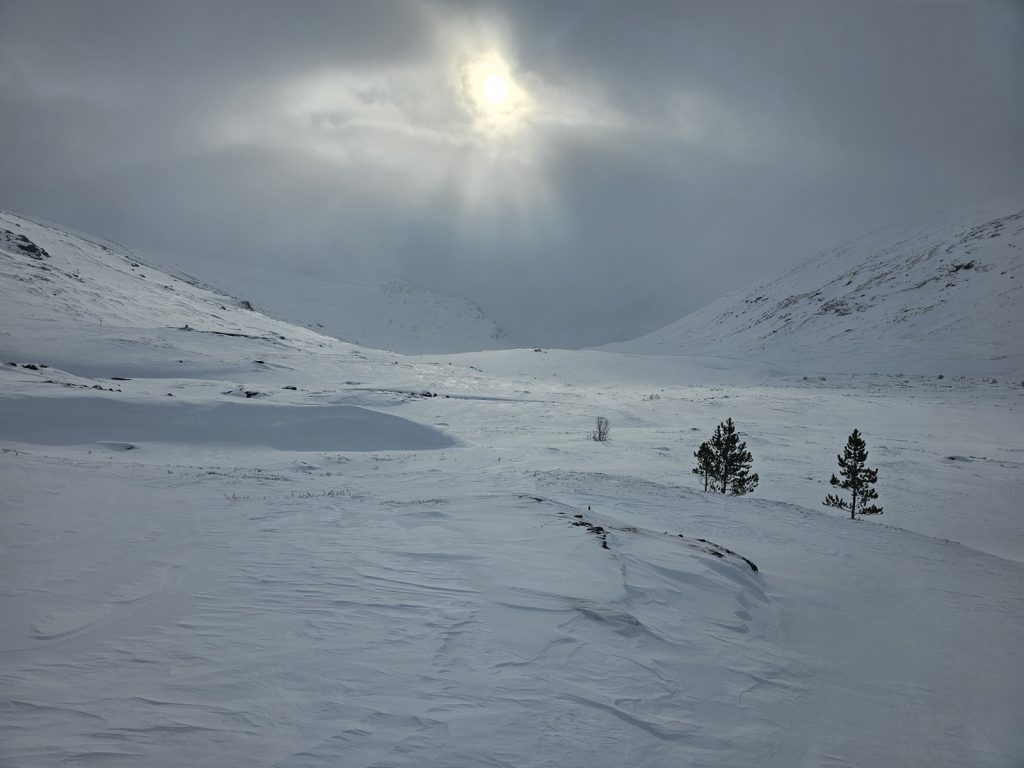
11. Looking down Torddalen valley near Tverråhytta cabin with the sun about to break through.
After the break the main valley was much more pleasant. The sun was out and this made a huge difference to the light on the snow and the general well being. Although the snow was deep and the top 15 centimetres were wet and sugary the new mohair skins coped well and we got a good rhythm going with each of us taking turns to plough a furrow. It took a good two hours to ski down Torddalen Valley until we reached a small fence. Steinar had warned us that at this point we should climb out of the valley up the west bank to gain a shelf here, as the main valley went into a gorge which would be impossible to ski down.
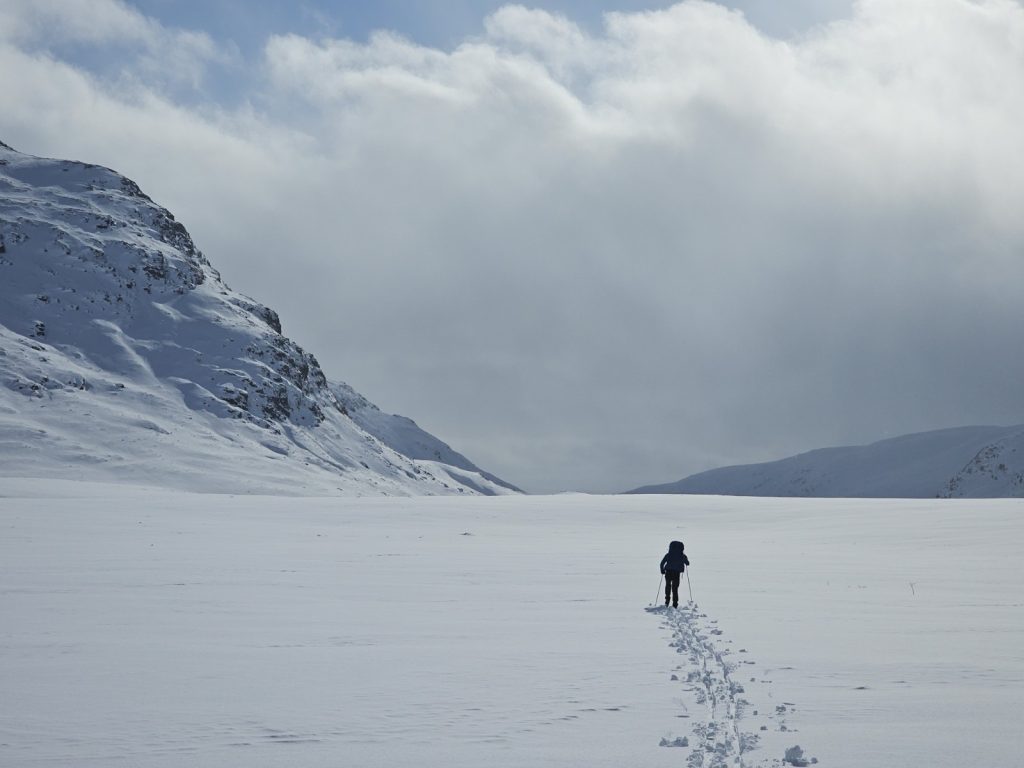
12. Heading down Torddalen on the mohair skins in the deep snow.
It was difficult to traverse up but we were lucky to meet the warden from the hut we had just stayed at. He was on a snow scooter and was having great trouble also trying to get up the slope with his scooter bogged down in wet snow. He eventually made it and we met at the top and had a chat. He was an older Norwegian and a farmer from Bismo down the valley. Although he was 70-75 he was a powerful man with hands like shovels. He said we could just follow his tracks down to Billingen but I knew it was too steep for this as the tracks were too narrow to ski on.
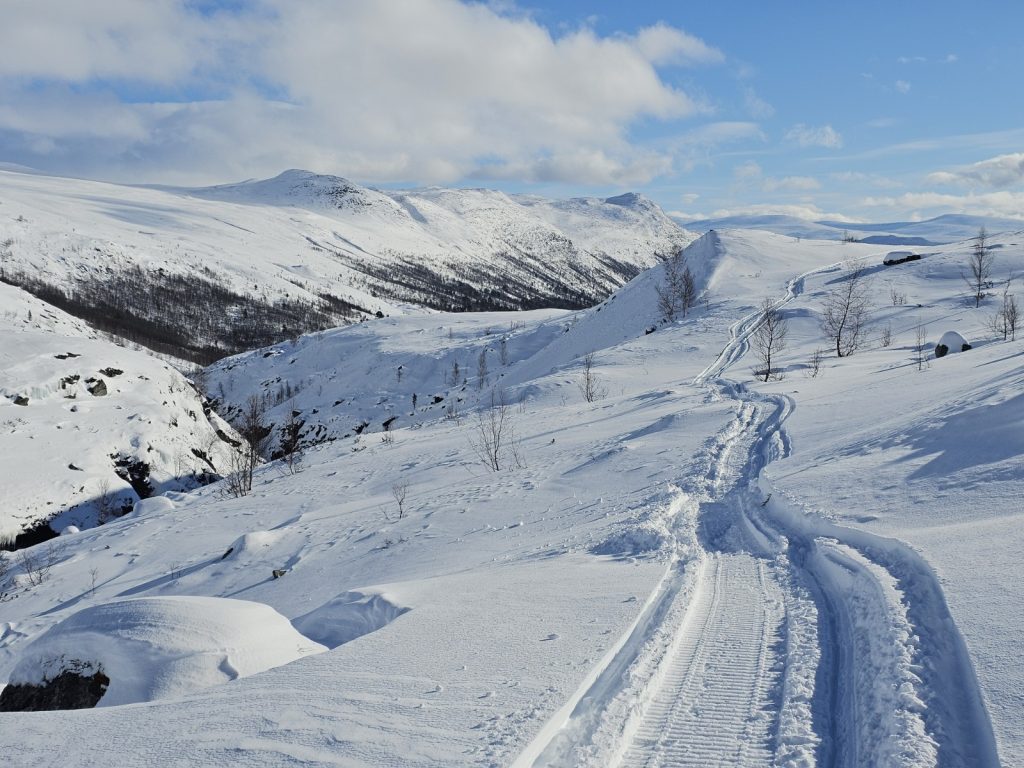
13. Having climbed out of Torddalen with the gorge we avoided on the left. The snow scooter tracks were from the cabin wardens scooter restocking Tordsbu with gas cannisters.
At the top we got a great view down to Pollfoss and the mountains beyond Sota Seter where we were going tomorrow. We could look down to the valley we had just left and it was indeed in a deep gorge and virtually impassable. Only a wolverine could venture there. We tried to traverse down across the hillside but it was just too difficult in this deep wet fast unpredictable snow. When you fell there was no purchase in the snow below and your arm just disappeared into a snow void. In the end we decided to accept defeat and take our skis off and walk down the scooter tracks. It was very easy and pleasant and we did not have the risk of breaking some equipment or injuring a knee. It took us just half an hour to saunter down the track through the increasingly mature pine forest to reach the cluster of summer farms here. Most of the farms were well kept and cared for as they had been for the last 200 years, but a few small barns had been abandoned and their roofs collapsed. It was sad to see this once thriving and environmentally sustainable way of life, which was hundreds of years old starting to wither. Just beyond the cabins and farms, most of which were golden brown with age and glowed in the sun, was the road.
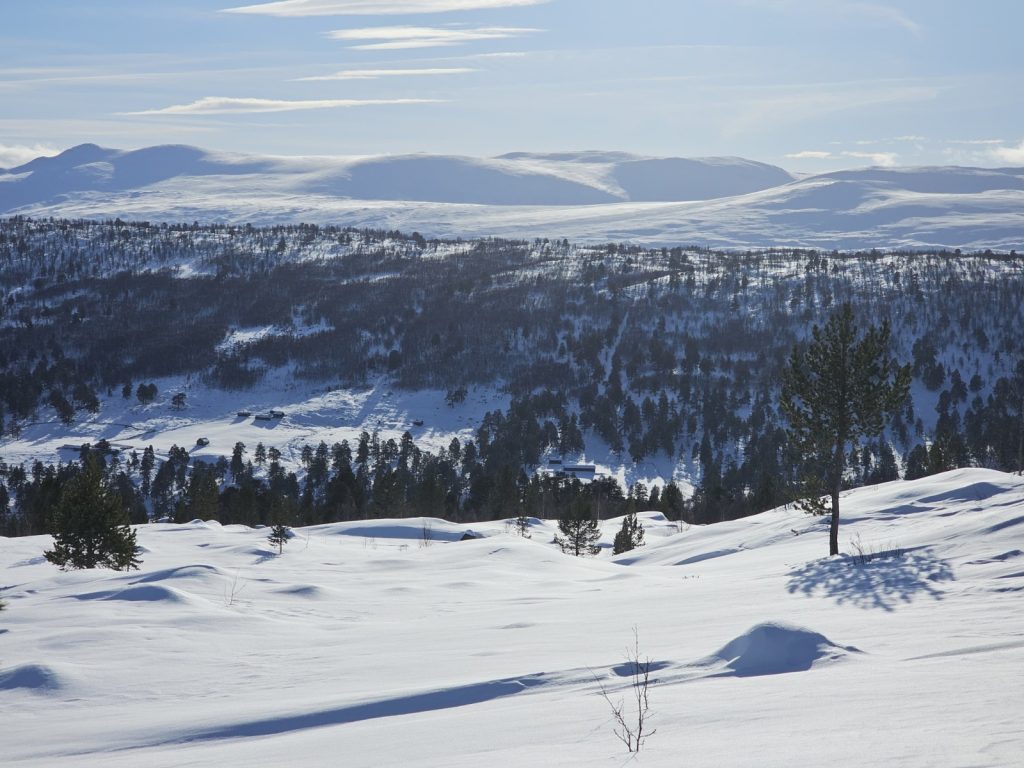
14. Looking across the Otta river valley above Billingen towards the foothills of Breheimen, our next section.
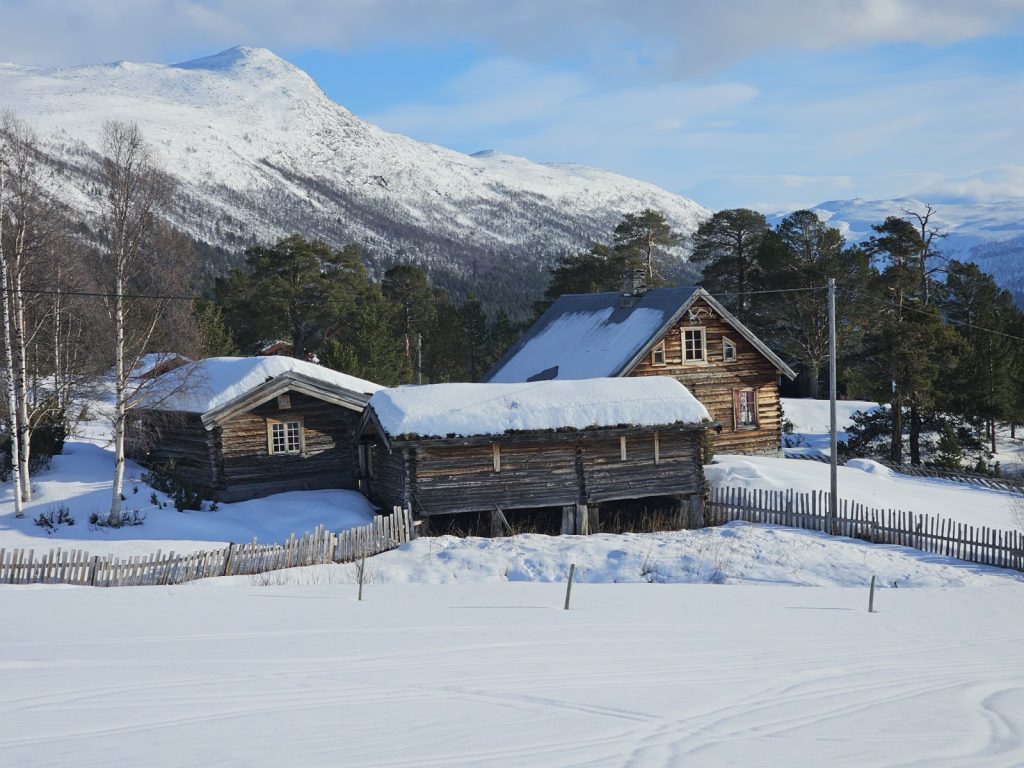
15. One of the sun blackened 200 year old summer farms at Billingham near the main valley road.
We crossed the road, which was a main road across the Norwegian Mountains from the forests of the east to the fjords of the west. After some 400 metres heading west we found the snow covered forest road we were looking for and put our skis on again. We skied down to a wooden bridge over the frozen Otta river, climbed past some more lovely old summer farms and then started down a lovely forest track for 7 km on the west side of the Otta river. The track was a delight after the hardships of the morning. It was firm with a frozen compact base and a cover of wet snow on top. In addition there had been a machine down here maybe a week ago to make ski tracks for locals to practice on and it was still useful. The track was generally level or sloping downhill slightly and it was fast and easy to ski. It did not take long, perhaps 90 minutes to cover the entire 7 kilometres and reach a larger forest track. Pollfoss Hotel was just across the river on an older bridge and we were there in no time.
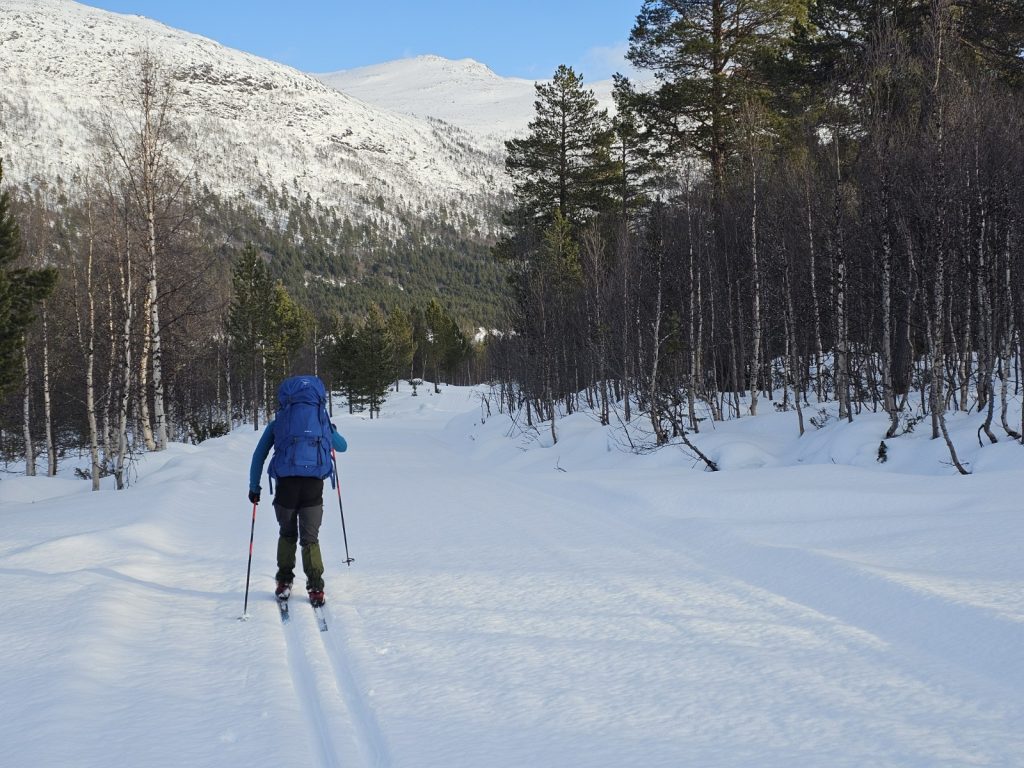
16. The final stretch of the Reinheimen section was a gentle descent on a forest track for 7 km to Pollfoss Hotel.
I had stayed here before when it was a more simple hotel. It now had new owners and had been done up and was now termed a boutique hotel. A word which rings alarm bells, as practicality is sacrificed for design and speciality soap. However, we had a nice room and a great shower. Afterwards we went down to the exceptionally characterful dining room which had artifacts from throughout the hotel’s 150 year old history. Everywhere you looked was a dairy or hay making artifact, There was even a complete haycart by the reception. We had a burger and then I wrote the blog while Stuart had to do his own office work. It had been a long hard day and it had delivered us to Pollfoss and the end of the Reinheimen section.