June 27, 2025

Day 069. 17 July. Rufensa to Luangwa Bridge. 79 km. 7 Hours. 660m up. 1080m down. I had already bought some milkshakes for breakfast so had them at 0630 and then left soon afterwards. I was glad to be leaving Rufunsa and could see no charm in the place at all. It was cold in the morning as the sun was just breaking over the horizon. I crossed to face the oncoming traffic again as I had done yesterday and also because the sun was directly into my eyes and therefore would also be in the drivers eyes, blinding them, if I stayed on the correct side. The road was never that flat and quite undulating; however I saw that there were some quite big hills on each side of the road especially to the north. It was very green here and the forest looked healthy. I climbed over one small ridge to freewheel down the other side into the next valley which was hazy with the smoke from the morning fires.

370. It was cold leaving Rufunsa in the early morning. Already by 0700 there were school children walking to school.

In the valleys between the ridges there were hamlets, some with a few shops but mostly old traditional homesteads with idyllic traditional buildings on them. It was a very pleasant cycle despite the hills and the occasional truck, which seemed to arrive in convoys of 3 or 5 vehicles. Eventually I reached the village of Kaloma, which was the start of the climb which my gadget had warned me was coming. It was a 300 meter ascent over 5 kilometres. I thought about stopping in Kaloma for something to eat but it looked quite scruffy and there was nowhere I thought I could eat without the bike on full display and attracting attention, so I carried on.

371. The homesteads were still very traditional between Rufunsa and Luangwa Bridge.

It was a serious hill and I was soon in the lowest year going up some steep inclines at 4 km per hour. At such a slow speed it was difficult to keep the bike in a straight line, especially if there were potholes about. I cycled up the conventional side as the trucks coming up behind me were barely moving faster than I was, while the trucks coming down were roaring as their engines in low gear prevented them running away and their brakes would have been hot with friction. I managed to cycle up the whole hill without getting off and pushing but I had to keep in a low gear. On and on I cycled past a dubious looking zip line and a boarding school in the middle of nowhere, slowly gaining ground. My thighs were pumping relentlessly and tired, but they were still coping and after a good hour I finally reached the top of the climb with green bush on each side.

373. All the way from Rufunsa to Luangwa Bridge the road was quite hilly and seldom flat. The verge was always quite dubious.

The descent down the east side was quite steep and I sped down for about 5 km passing charcoal sellers and then getting into more homesteads and maize fields. Again some of the homesteads here were very pretty. The hamlets of shops, every 5 km or so now, were not pretty at all and were quite scruffy, noisy and busy. I passed one after the other looking for somewhere to eat until I thought I was just being too picky and stopped at an older lady who advertised food. She had none but directed up a small side street where there was a simple clean restaurant which did the usual nshima and greens and with either fish or sausage. I had been going for nearly 5 hours and the tank was empty so this was a much needed pit stop. As I sat in the shaded concrete area in front of the restaurant I could see the village hand pump. It was constantly busy mostly with women coming to get water in large 20 litre buckets which they managed to place on top of their heads and walk home. Occasionally young boys or older men came also and they carried the buckets away more awkwardly with their handles while it bashing into their legs.

374. The village borehole and handpump was always a busy place. There must be tens of thousands of such pumps in Zambia enabling people to live where it was not possible before.

After the meal I felt much better but the roller coaster ride continued with some vicious short uphills which I was not expecting. After yesterday and then the monster climb this morning my legs were tired. At the top of a few of the hills the verge widened out a bit where people had stopped over the years, and now this served as a place to sell charcoal in bags. I must have passed perhaps 100 charcoal sellers today and the same yesterday. The bags were much larger here and went for 200 kwacha. There were small groups, perhaps families, involved in each venture and the whole area around them was blackened with dust. I did not see the fires burning to make the charcoal but assumed they were nearby in the bush. I don’t know if the charcoal sellers were local farmers who had branched out into this side line or whether they were displaced or opportunistic families from poorer areas who had moved here and this was the only way they could find to make a living. Either way it looked an unpleasant business and the people were often grubby with their clothes covered in soot.

372. The homesteads were also in the forest sections on a couple of the larger ridges I had to cross .

At last the hills eased off and it was now a more sustained descent down for 5 km to the Luangwa River. The roadside got a bit more built up as I approached the town called Luangwa Bridge. It looked as if it was worse than Rufunsa and I cycled right through it without stopping. There were a few lodges here apparently but judging from the rest of the town I guess they would be unsavoury and charmless. Just before I reached the large arterial Luangwa River I took a road to the south which led me down to the river bank and I followed this road for nearly 2 kilometres to Luangwa Bridge Camp. It was a campsite with chalets sometimes used by safari travellers going from one National Park to another. It was a well known rest place and in its hey day was quite cherished.

375. There was frequently charcoal for sale in 200 kwacha bags beside the road and this seemed one of the few ways farmers or villagers could get cash.

Bridge Camp was now run by Mulenga and her husband and had been for the last 3 years. It sat on a slight prow overlooking the Luangwa River which was one of Zambia’s largest rivers and drained the entire east side of the country. Sitting in its reception area I could relax in a slight cooling breeze while the river slowly flowed past beneath. Now it was quite low and the river bed was braided with the water flowing between large sandbanks. On the far (eastern) side was Mozambique and there were a few homesteads here and children were playing near the water while some fishermen were casting nets into the shallows to get small fish which were dried. It was a superb, quiet, peaceful location. The chalet was quite over priced, especially when compared to the chalets at Sinazongwe and Chirundu in the last 10 days, but looking at the alternatives here I had no quibble with it. The food was good and Mulenga was a delightful lady who was very knowledgeable, entertaining and had spent years working within hospitality in the UK. I will have a day off here to catch up with the blog and rest my legs before crossing the river and starting the next Section 06. South East Zambia.

376. Looking across the Luangwa River from Luangwa Bridge Camp. It is one of the major rivers of Zambia and drains the entire east side of the country. On the far bank is Mozambique.

The last Section 05. South Zambia which was essentially from the Livingstone area to here at Luangwa Bridge was probably the best of the 5 sections so far. It was the hardest and most challenging, both physically and also socially, but I had survived both and it was therefore the most rewarding. During this bicycle expedition I had wanted to experience Africa as unsullied by the all-encompassing commercial mono culture, from sophisticated coiture to grubby transactions, which is consuming all other culture before it, and my 2 weeks in the rural hamlets north of Lake Kariba had certainly done that and I will cherish it.

Day 068. 16 July. Chongwe to Rufunsa. 114 km. 9.5 Hours. 930m up. 1250m down. I was up early but waited a while for the breakfast, which was perfunctory but would save me stopping soon. I left just before 0800 and later than I wanted for this huge day. I weaved through the pedestrians in the side streets and then made it onto the chaotic main road with people, large wheelbarrows, cars and trucks everywhere as people were setting up their stalls. It was the most chaotic I had seen anywhere in Africa on this trip, but it was still a long way off Nepal or the rest of Asia for that matter. As all the traffic was going very slowly it was easy for me to sit behind a small truck and go the same speed as it.

Eventually the chaos started to thin as the market disappeared behind us and the traffic started to speed up a bit, but I could still keep up with it on the long downhill stretch out of town for 4 km, down to the Bridge over the Chongwe River. However, up from here it was different. The road was relatively narrow and the verges were dreadful. They were not really part of the road at all but were the stony base of what was the road before the tarmac was laid. It was essentially compacted rubble. To make matters worse there was a lip at the faded yellow line at the edge tarmac and this verge and it was between 5 and sometimes 30 centimetres depending on how eroded the gravel verge was. So it was either one or the other as I could not chop and change as required. It made sense to go on the verge as the road was narrow and when two vehicles met there was no room for them to give me any berth, let alone a wide one, especially if they were trucks. However, the verge was an unpleasant place. There was occasional rubbish, including broken bottles, the surface was bumpy and thorn bushes frequently encroached from the side. I could do a third of the speed that if I was on the road.

365. The Great East Road, the T4, heading east out of Chongwe. This arterial road connects Lusaka with Chipata and then Malawi. Note the typical verge.

Then I noticed that all the other local cyclists were using the other side of the road, the south side and so I crossed over. Here the verge was still packed rubble but it was smoother and much much wider and there was hardly any lip. As usual there were cyclists with large bags of charcoal and these were stacked horizontally across the luggage racks so the bike was well over a meter wide. They were all using the side I was on but as the kilometres started rolling by I noticed more and more heading into town on the other side of the road so they were facing the traffic. Indeed everyone on my side of the road was also heading east and facing the traffic. It was totally contrary to the rules of the road as I knew them from Europe. I then realized that there was almost an understanding between the truck drivers and cyclists as they approached each other. If the truckdriver could pull out he would, but if he could not then he would blow his horn and flash his lights and that was the signal to get off the road and onto the verge. The truck drivers were actually very able drivers but their trucks were large and heavy and if they had momentum, especially going up a hill, they were loath to lose it. Hence the flashing if they could not pull over. The one group of cars which were not accommodating were the 4×4’s either with Zambians driving one with the blue writing of an NGO on the side or White locals or tourists on their way to a game park. As a rule they always drove too fast. And so it continued all day with me riding into the oncoming traffic and occasionally having to drop down onto the verge and this seemed to work. I also had to be wary of 4×4’s overtaking a truck going in the same direction as me so I was always glancing at my mirror if I heard a truck coming.

The road was not a pleasant cycle though and I was always on alert and could not enjoy the countryside as I had done in the last 2 weeks. In the first 20 kilometres it seemed much more built up with small businesses and factories, and also houses behind concrete block walls. I am not sure if this was an extension of Chongwe, or even Lusaka, which was only 50-60 km behind me. However pretty soon these petered out and the maize fields of the plateau and small rural hamlets took their place. Despite being close to the road some of the hamlets were very traditional with all the buildings in the compound made of mud and under thatch.

367. Despite the road there was still many rural homesteads each side of it away from the towns

The road was very undulating with some significant climbs and descents and I was quickly racking up the meters I had ascended. The trouble was the ascents and the descents were too steep for a cyclist to enjoy and after labouring up a hill I had to freewheel down the other side frequently applying the brakes and wasting the momentum. Around Chinyunyu I passed quite a few signs for accommodation with the headman. I assumed this was the headman of the village or community and he was offering camping places or even simple rooms to Zambians and tourists alike, although the signs were old and faded. Also in this area there was a plethora of fringe denominations, perhaps all with a charismatic Pentecostal pastor. Some of the churches looked very rustic and others dilapidated, as the charisma of the pastor waned and the collections dried up. In one 20 kilometer stretch I must have passed 20 of these and that was in addition to the more accepted common denominations like the Seventh Day Adventists, The New Apostolic and Catholic. Some of the fringe ones had magnificent names.

366. On one 2 kilometre stretch there were perhaps 20 eccentric and unique churches in addition to the more established ones.

I passed through many homesteads and a few hamlets but I had my mind set on reaching Shingela where there was a restaurant. I had been going for about 4.5 hours now and the breakfast was long gone. The road was still very undulating so progress was slow and there was a head wind as usual but at last I reached the large village. The restaurant I wanted was closed so I found another and it had the usual: nshima, green stewed vegetables quite similar to mustard greens, and an interchangeable meat, in this case goat. I was beginning to accept this meal as it was all that is available and is the staple. I sat outside the restaurant and watched the vibrant trade of this commercial village unfold.

368. My lunch stop in Shingela where I had nshima (maize meal), spinach and goat, which is very much the staple.

I still had about 55 km to cycle and I could see that after a hill it was largely flat or even downhill. As I left Shingela the landscape got very green as if this area got more rain. To my south was the large Lower Zambezi National Park, a large park with many ecological zones from the river itself to these higher green hillocks. But what was flat on the apps and my map turned out to be more undulating hills and was very taxing. I cycled on and on all afternoon and was never that confident I would make Rufunsa by dusk. However there were places to stay enroute including one forestry camp with green chalets on the south side of the road which almost had me stopping to enquire. But my heart was set on Rufunsa as I wanted to reach the Luangwa Bridge the next day. Thankfully the downhill run into Rufunsa was just what I needed. It went on for almost 10 km and took me from the rolling green forested hills down to the flat plain where Rufunsa sat and I got there about 1730.

369. The descent down the long hill onto the plain where the town of Rufunsa lay. This descent was exactly what I needed after the long day.

I had read about the 4 places to stay and all seemed quite grim, with one in particular to avoid called JB’s. I cycled past the market, concrete shops and the truck stop to the one I had singled out called the Gambit. However when I got there it was dull and there was no one about so I went back to one I had noticed on the way in. They had a room. It was rough and scruffy with a concrete floor, a double bed as the only furniture, and an attached concrete outhouse with a toilet and bucket shower. There was no sink. But I took the room as I was so tired. After I handed the 250 Kwacha over I asked the lady what was the name of this lodging. She said “JB’s”.

The write ups about this lodge on google and Ioverlander were scathing about the place, but I still think they were far too generous. It was filthy, so filthy I didn’t go into the bathroom except to pee. I was not going to have a shower. The whole ceiling had collapsed leaving just the rafters and then the corrugated iron above that. Between the rafters and the roofing sheets were so many cobwebs you could barely see the corrugated iron sheets in some places. She did have the time to change the pillow case but not the sheets or covers. In addition to that there was extremely loud music coming from the attached bar.

The door was just a metal grate and curtain. As I did not bother with a cold bucket wash in the cold bathroom I went out to find something to eat. I passed through the large very noisy bar area which only had 3 bored customers sipping beer from a bottle. It was too loud to talk. In the main market area, where about 30 trucks were also parked, I found a restaurant which did nshima had a chicken, vegetable and maize meal, washed down by sugary drinks. Back at the room I took off my cycling shorts and put on long trousers and kept my cycling top on and crawled into bed. I was too tired to worry about the unwashed sheets and was grateful my head was on clean linen anyway. The music was incredibly loud and it was a good 100 metres away but I soon fell asleep. I woke at midnight and the music was still going but it was more melodic now. How I longed for the rural villages of the last fortnight instead of this low echelon commercialism.

Day 067. 15 July. Katoba to Chongwe. 53 km. 5.5 Hours. 320m up. 340m down. I had a breakfast of granola in the room and then left at 0830 cycling down to the shops and the T junction. Unfortunately the road I had to take was the only one which was not tarmac, as the other direction went to Lusaka. The road was not really gravel but powdered earth and small rocks. It was not pleasant to cycle on as the rocks made it very bumpy and occasionally the powdered dry earth was 5 centimetres deep and this made it almost as bad as sand. However there were always routes through the most rocky or dusty sections and these were usually at the side and this is where all the cycle tracks were. I could only average 10 km per hour at the most and this was despite the fact it was a very gentle downhill slope.

359. The road from Katoba to Lwiimba was about 20 kilometres and very bumpy due to embedded stones

There were homesteads pretty much the whole way here to Mulalika. They were better off than their equivalents on the arid plain beside the Zambesi I had cycled through last week and they had a mix of traditional and newer buildings in their compounds. Occasionally some of them must have had a bore hole because there were vegetable patches beside some of them with small fields under cabbage or mustard greens. I also noticed how a few had the red or purple bougainvillea trees near the huts and buildings, something I never saw in the Zambezi area on homesteads. There were also many more fences here, primarily to keep cattle and goats out I think but it also served to mark off a plot in this slightly more individual and commercial society up here.

360. I passed about 6 depots with hundreds of sacks of corn at each. Apparently the government was buying the maize kernels at 350 kwacha per 50 kg sack.

At Mulalika I saw a huge pile of sacks. I thought they were cotton and it was a cotton buyer. However I asked someone and they said it was maize. The government was buying maize and paying 350 kwacha (£10) for a 50 kilo sack. There must have been over 1000 sacks piled up waiting for lorries to take them off somewhere. In the photo you can just see a small part of the pile. I guess this area produces a surplus and other areas like the Copper Belt north west of Lusaka produces very little as everyone is involved in mining. During the course of today’s cycle I passed another 5 or 6 depots each with around 1000 sacks.

361. Near Lwiimba I spotted a perfect mutual hut or rondavel. It this area the traditional was giving way to modern.

From Mulalika to Lwiimba the road got slightly better but after the Lwiimba it improved significantly all the way to Chilyabale and at last I could go a bit faster across the virtually flat plateau. The closer I got to Chongwe the more built up the homesteads became with virtually every one having a 2-3 room brick or even concrete block house under a shiny corrugated roof. There were still the traditional buildings in the compound and some were very beautiful and well constructed. After some 25 odd kilometres on the earth road I reached the tarmac road at Chilyabale just at the primary school. It was break as I passed and perhaps 100 kids yelled and shouted as I passed which was quite rousing and I made sure I gave them a long wave.

362. The plateau was now expansive and undulating and virtually all of it was potentially good farming but only for a crop a year without irrigation.

I had forgotten just how easy good smooth tarmac is and soon I was flying along the very gentle downhill slope for nearly 20 kilometres to a dry riverbed. There was a steep drop into it and a climb up the other side to take me to Chalimbana which was really a small town with a University and a Government Training School. There were lots of students all over the road and many signs for lodgings, and quite a few fast food outlets. It was quite a vibrant town and it really marked the end of the rural countryside. There were still farms occasionally for the last 10 km but there was a lot of house building going on with many being built inside large gardens completely surrounded by a concrete block wall. The traffic increased also and I had to watch out for people walking 2 or 3 abreast at the side of the road until I reached the main Great East Road, the T4, which went from Lusaka to Malawi.

363. Chongwe market was in the centre of town and at least the size of a football fields. The vegetables section was the biggest but there was also, dried fish, metalwork and even various charcoals.

The T4 was busy and at this point it was narrow. There was a stony verge at the side but this was occasionally 20 centimeters below the tarmac so I had to decide where I was going to ride. As the traffic was going quite slowly I chose the road however after a kilometre or so when I reached the centre of Chongwe it was quite chaotic so I dropped down onto the stony verge with all the pedestrians and the other local cyclists with large sacks strapped to their bikes. Suddenly I burst into a large market area where there were hundreds and hundreds of stalls on the north side of the road. They were mostly selling vegetables and as I cycled past I saw there were lots of different sections, like dried fish and seaweed I think, another had metal work with welders fabricating window frames, wheelbarrows and stoves. Wherever I looked there was the flash of welders rods. There was also a large area of charcoal with huge bags for 300 kwacha right down to shopping bags for 15 kwacha. In amongst all this vibrant activity were the barrow boys with special wheelbarrows locally made at the market. They were very big with a car wheel as the fulcrum point and a large platform at least a meter long to the front of the wheel for carrying a few large sacks. I wove through here to reach the Backpackers.

364. In the metalwork section there were large wheelbarrow with a car tyre as wheels, window and door frames and these various sized charcoal stoves.

The Backpackers were in name only. I was a row of broken bedrooms in a dusty compound with not a bit of greenery or soul. I looked and then sat on the wall outside the reception to find something else. I did and it was three times the price but it had everything the backpackers did not, like hot water and electricity. It was called the Chimthunzi Executive Lodge, but executive it was not. However it was certainly comfortable enough. I settled in and then went for a wander round the market and finally went to the supermarket to get dinner. Choppies always had a counter of cooked food so I got chicken, chips and an aubergine stew and took it back to my room to eat it there and start writing.

That was pretty much the end of this rural deviation which I started in Zimba 14 days ago. It was not the easy option with 650 km and some 6000 metres of ascent and descent. I am sure I could have halved all those figures had I come up the T1 main road to Lusaka and then the T4 to Chongwe but I am sure it would not have been as pleasant or rewarding. This detour, shall we call it the “Lusaka Bypass” took me through the heart of Africa where old values still exist and they have not got eroded by the commercial culture which is now emanating out of the cities and towns, as it did in Europe 50-100 years ago. It was exactly the reason I came to Africa. If I wanted a comfortable and predictable journey I could have just hired a landcruiser and gone from one tourist hotspot to the next, but that would not be in the spirit of this bicycle expedition. I have a few more rural diversions planned but even with this one, The Lusaka Bypass, under my belt I feel my expedition has been a success.

Day 066. 14 July. Mufundeshi on D481 to Katoba. 23 km. 4.5 Hours. 670m up. 210m down. At 0400 the 3 cockerels, two in different tents and one in an elevated chicken house, started crowning. And they did not shut up until Joe let them out around 0630. The one in the tent beside me was especially tiresome. I was already up in my sleeping bag sitting up having granola and more milk when Joe got up to let the cockerels out and then started the fire. After my granola I got up and started to pack and Joe came over and we chatted. To me the farming up here made little sense as he was from the flatlands near Chirundu. I asked him about it and he said it was so dry down there it was not good for farming, whereas up here they get more rain. However I asked him specifically if he got 2 crops a year here and he said no just the one. I didn’t ask if he had livestock or not. Their granary was half full but the quality of the cobs was poor, and many had missing kernels. Soon his brother and the wives were up and they were making breakfast while I and Joe chatted. He was a nice guy and in the end I felt it right to give him 200 kwacha which was over the odds but of great significance to him and small for me. However the whole time I was wondering if the farming was a ruse and basically he and his brother were prospecting up here. There was certainly gold in the area and there was a Chinese gold mine somewhere. Over the course of the day after leaving them I came across a few small abandoned mines and also a couple of local prospectors with hammers and chisels.

350. At Mufundeshi stream I met Joe, his brother and their two wives. They were farming here and allowed me to camp in their compound.

351. They had been farming here for a couple of years and had dug a water source nearby. They lived in tents rather that mud huts and cooked and gathered under this shelter.

I left them at 0730 and immediately started up the next climb. Joe said it was not as bad as yesterday’s, and that was the case. There were a couple of sections where I had to really heave, but not to the extent of straining every sinew. As I climbed it got warm when the sun broke over the ridges and started to beat down on me. On the climb I passed perhaps 3-4 abandoned mines. They had been exploited with an excavator as the tooth marks of the bucket were still visible in the hard earth. There was also another farmer half way up the slope who was a tall lighter skinned man who I am sure was not from these parts or a Tongo of Soli tribeman and must have been a surreptitious prospector. I also passed another man with a large hammer and chisel hidden in a bag and he got very excited when I thought I might be a gold buyer. Eventually after an hour and a half I reached the top of the climb where there were some farms.
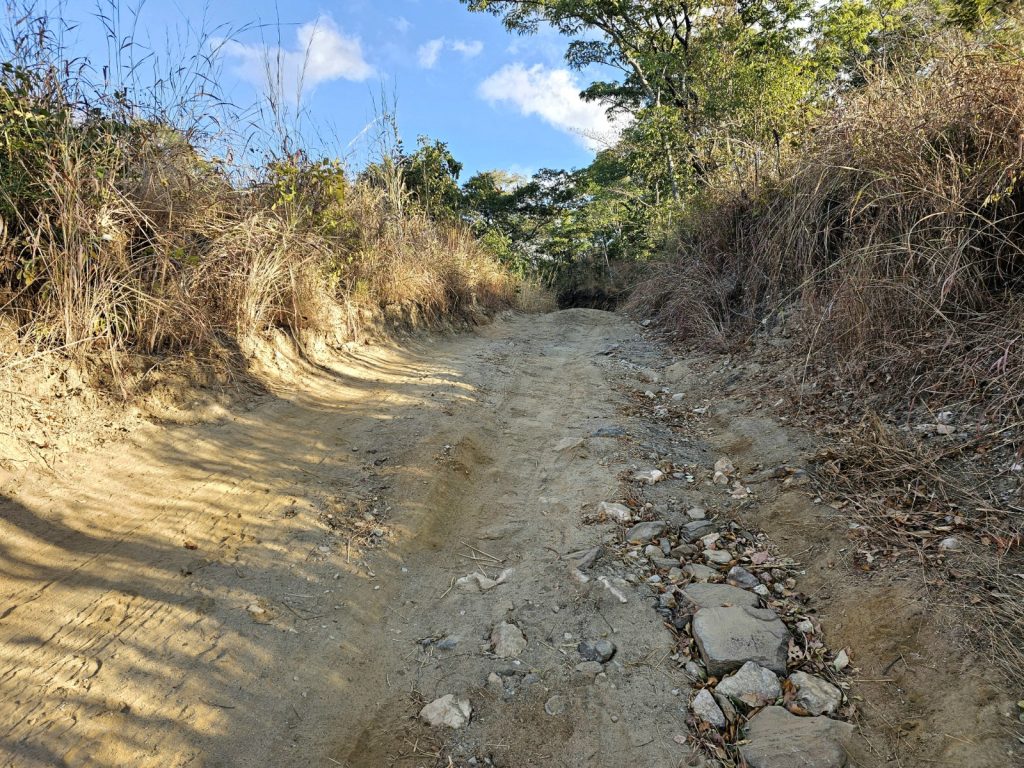
352. The climb up on the north side of Mufundeshi Stream was about 280 metres but although brutal was not as bad as yesterday’s climb.

353. At the top of the climb there was good views across the top of the Zambezi Escarpment to where the plateau started.

From here I was essentially at the top of the escarpment and about to reach the plateau above it. To the east the hills continued to rise and the land stretched away with wild forested ridge after the next where I should imagine humans rarely venture, even the hardiest prospector. Luckily I was going north where the landscape was more gentle and there were just a couple of smaller less steep climbs to reach the plateau and 3 hours after leaving Joe and his brother in the depths of the side valley I was finally on flatter ground and reaching villages and hamlets more continuously. This was the same type of farming I had seen around Zimba and Luyaba when I was last on the plateau before descending to the amethyst rich village of Mapatizya 10 days ago. The homesteads were now less traditional and in better shape than those down in the arid plains north of the Zambezi River. It was much more pleasant on the eye and most of the land was cultivated.

354. Just some 4-5 kilometres from the remote Mufundeshi Stream I started to reach the plateau and came across the first farms and a few abandoned exploratory mines. The road improved with every kilometre.

355. The top of the Zambezi Escarpment continued across wild remote hills to the east, but to the north it became gentler farmland.

I had about 5 kilometres of this on a much improved large gravel road until I reached a tarmac road. It was quiet and smooth and easy to cycle on. There were still some significant rolling ridges to climb but then there was often a wonderful run down the other side on the smooth tarmac without the bike rattling like hell over the stony gravel road. I was parched and stopped at a small shop for a drink and then learnt that it was just about 3 kilometres to the junction at Katoba beside Leopard Hill. I had already noticed there was accommodation here and after the difficult day yesterday and the hard morning decided I would throw in the towel here despite it just being midday. I cycled past a lovely simple thatched church and then up a slight hill to reach the junction and a sign for the Kankonongo Lodge.

356. Up on the plateau the farms looked less poor. Joe said it was because it rained more than the arid landscape I had been in for the last week.

357. The were all sorts of denominations in South Zambia, notably Pentecostal, Seventh Day Adventist and New Apostolic – which is pictured above.

The lady, who had hair extensions down to her knees, had a room. It was 300 Kwacha or £10 and it had a ramshackle bathroom but with hot water heated by solar pipes and a tank. These were the first I had seen in Zambia. The lodge also had a great view over Leopard Hill. There are 4 such rocky hills at Katoba and leopards used to have their lairs in them up to the 1960’s. However since then Zambia’s population has grown significantly and more and more land was taken up by agriculture around here and the leopards withdrew into the deeper forest and down to the Lower Zambezi National Park. I had a magnificent hot shower and washed all my stinking clothes, despite it just dribbling out of the roseless shower head. The lodge had no food so I went down to the row of shops at the junction and had chicken and nshima in a restaurant run by 3 characterful battleaxes. It was fun watching them chase a very drunk man out who had obviously come in because I was there. After that I went back to the lodge mid afternoon and wrote the blog for the last two days and then had a great sleep. Tomorrow I would cycle the 50-60 km to Chongwe where I would reach The Great Eastern Road, the T4, and follow it east for 2-3 days to the arterial Luangwa River and complete Section 05, South Zambia.

358. The view from my rustic lodge over to Leopard Hill. Leopards used to inhabit the hill until the 1960’s when the population significantly increased.

Day 065. 13 July. Chirundu to Mufundeshi on D481. 41 km. 8 Hours. 910m up. 610m down. The elephants did not come back in the night and I did not see any hippopotamus either when I heard a sound around 0400. The ladies made me a nice breakfast and even got bacon from the shop specially for me. I eventually left at 0900 and was sorry to leave this hidden gem. I cycled up the steep road, wary that I might encounter the elephants at the start near the forest beside the river. However there was none and after 20 minutes I made it to the main gravel road leading north. I looked for the house Harry and Hilary stayed in as directed by James to say goodbye but could not find it so headed north.

There were quite a few people on the road and many were well dressed. Then it dawned on me it was Sunday morning and many were off to church services. I passed a few and there were joyful gospel hymns coming out of the windows. There were many denominations here but Pentecostal, Seventh Day Adventist, Jehovah’s Witness, Catholic and New Apostilic were the most common. Not all were off to church though and at a few bottleshops/bars I saw younger men already with beer in hand at 1000 in the morning.

It was a bumpy dusty road for about 10 km passing hamlet after hamlet the whole way. It was almost a continuous homestead, cultivated land and occasional shops the whole way. The road was not busy but there were a few lorries taking villagers up to the flat agricultural lands between the Zambezi river and the start of the escarpment, but west of the Lower Zambezi National Park. This park blocked my way east and was a totally wild area full of animals. Just at the bridge over the Kafue River there was a rare section of smooth tarmac.

344. Some 10 km north of Chirundu I reached the Kafue River. It had a bream or tilapia farm on it near the bridge. I think it was Chinese owned.

The Kafue River is a major river in Zambia but it pales into insignificance next to the vast Zambezi just below the bridge, but out of sight round the corner. There was a large bream or tilapia fish farm here which seemed to be quite well organized. I think it was Chinese. On the other bank, the north bank there were also some ponds which had been dug, and water pumped up to them. I cycled on to the start of some vast irrigated crop circles again similar to the ones I saw in Sinazongwe, but I don’t know who operated these ones. If someone had said it was the Chinese I would not have been surprised. Interestingly there was also a Zambeef feedlot cattle farm here but I only saw the entrance. I turned off the larger gravel road to a minor one which went along the north side of the Kafue River to the village of Gota-Gota and beyond. Just here I got a puncture. The second on my new tyres since Livingstone 600 rough kilometres behind me.

345. The good people of Gota-Gota returning from church in their finest. I passed many churches this Sunday morning and most seemed to be singing gospel type hymns although I also passed a fire and brimstone sermon.

Gota-Gota was just 4 km up the road. When I got there people were just coming out of church. The Catholic one I think. People looked remarkably well dressed and tidy for a typical village with the women looking very smart and many of the men in suits with ties on. It was hot now and I needed a drink. I was sure it would be my last for a while so I found a small shop with a chest fridge full of them. Inevitably some young men came in and asked if I could buy them a drink. I again said I only give money to women as men just spend it on alcohol. This created raptures of laughter from the 3-4 women crowded into the shop and the men left almost as if admonished by the woman’s laughter.

At Gota-Gota I found the track I needed using the Tracks4Africa app, which is remarkably good for me on these smaller roads. It led north through the village and then down into rural hamlets near low lying stream beds. There must have been some irrigation holes dug here as there were green vegetable gardens occasionally. It was a fascinating area as between the stream beds was denser bush which was almost jungle-like. The only problem was the steam beds and the adjacent areas were very sandy and although I could still cycle it was hard work and difficult to keep the front wheel from skidding to one side. I was soon sweating a lot.

346. From Gota-Gota I headed north on a small, slow village road for about 20 km to meet the infamous D481 just before the start of the steep climb.

After a good 5 km of this, these rural hamlets stopped and the track, which was only used by infrequent motorbikes, rose up out of the sandy areas to a series of small ridges. It was steep down to one and then a hard climb up to the next. I was starting to question whether this short cut on the track was worth it, but it did save me about 30 kilometres going via Kiambi. I passed a sign for Headman Tigere and then the going got easier. It was now hard packed earth on a flatter surface and I could go from 5-6 km per hour to 8-10 km per hour and not work as hard doing so. This easier cycle continued for the second half of this track for about 10 km out of the total 20 km. There were two more larger hamlets to pass through until after about 3 hours on the track I reached the infamous D481 gravel road just as the flat lands met the foot of the escarpment and at the base of the climb.

347. The extremely steep 350 metre climb up the Zambezi Escarpment on the D481 was loose, rough and very taxing to push a 70 kg bike up for 2 hours

This climb was significant and I had been dreading it for a good week. It climbed steeply from here at about 550 metres altitude up the Zambezi Escarpment to about 1200 metres in the course of 20 kilometres. However there were two large climbs of 400 metres and 300 metres. My plan was to do the first today and camp, and then do the second tomorrow.

I set off up the very rough track on foot pushing the bike. There was no way I could cycle this, even in the lowest gear and not even if it was smooth tarmac let alone this rubble and bare rock. There were some extremely steep bits, perhaps 15 degrees occasionally, and I could just not get the purchase on my feet to heave the bike up. The bike itself was 20 kilos, with 40 kilos of baggage, with nearly another 10 kilos of water. So 70 kilos in all. At some sections I was straining with every sinew just to move it half a meter, then slam on the brakes to hold it while I took a step and repeated the process and thereby just make 100 horizontal metres in 15 minutes. Then there would be some respite where I could go at perhaps 2 km per hour before I was at another steep section heavy for all I could. It was very slow work and I was sweating profusely despite the fact it was overcast above the Escarpment. In all it took me well over 2 hours to do the 3 kilometres and climb the 400 metres by which time I was exhausted. It was probably the hardest I had worked all trip and on a par with the wrong turning I took a week ago. My arms were especially tired but my whole body had had a severe workout.

348. It was a joy to meet Blyth and John near the top of the climb when I was exhausted. They had set off from Chongwe at 0200 in the morning with a 50 kg sack of maize each and hoped to get to Chirundu. We applauded each other.

Just as I got to the top on this remote route I met Blythe and John. They were as surprised to see me as I was them. They both had 20 kilo bikes and each had a 50 kilo sack of maize kernel strapped to the back. They had just finished a climb as I had with a similar load. There was a fair bit of banter between us and we applauded each other. Then I learnt that they had actually started at 0200 in the morning from Chongwe and had been going for 14 hours already and still hoped to get to Chirundu that night. These were strong lads which any mother would be pleased if their daughter brought home, instead of the lacklustre dullards outside a bottleshop.

After a 10 minute chat we parted, with them trying to stop their bikes running away from them and me gingerly descending the rough track for 250 vertical metres. I stayed in the saddle most of the time but the brakes were constantly employed and must have gotten very hot. Frequently I had one leg out, off the pedal waiting for the inevitable skid and on the 5 odd occasions it came I was ready and just let the bike fall over once. I was descending into a side stream called the Mufundeshi, which drained this section of the Escarpment. Ahead of me on the other side of the valley I could see tomorrow’s climb up, which was only 300 metres and not 400 as today. It took the best part of an hour to make it down to the bottom bouncing slowly over the bare bedrock and the rubble. By the time I got to the bottom it was after 1700. I crossed the stream bed which was dry and went 200 metres further and saw some tents used by road gangs. There was a superb patch of bare earth to camp on here and no one was about except a small dog, so I started to put the tent up.

349. At the top of the climb there was a very steep 250 meter descent down to a side valley, with the Mufundeshi stream at the bottom. Tomorrow’s 280 metre climb up the other side can be seen ahead.

Just as I started, two men appeared after returning from a day in the fields. They said it was no problem to camp but insisted I come down to their tents. I did and they showed me a place between their 5 large tents and the granary, which was full of maize. They were two brothers of 38 and 50 and their wives. The elder brother was Joe and he spoke great English and was very intelligent and entrepreneurial. He had spent years working in a mine up in the copper belt north of Lusaka. They helped me put the tent up and then soon afterwards I said good night and went in. I was too shattered to chat with them under their thatched opensided cooking and chatting area. I had a cold dehydrated meal which was still a bit crunchy after 15 minutes and 3 litres of thick creamy powdered milk. I was too tired to even bother taking my clothes off let alone writing anything. It was a mistake as the sweaty cycling shorts meant my crotch area festered in a salty, moist environment all night and meant I got badly chaffed the next day.

Day 064. 12 July. Chirundu Rest Day. 0 km. 0 Hours. 0m up. 0m down. I was excited about seeing the hippopotamus grazing on the lawn last night. It was too dark to get a photo but I described it. James and the breakfast lady said it was very common and they came out most nights. After the cooked breakfast I went over to my chalet to write the blog and do some emails. There was a nice verandah with a table under it. It was perfect and I could look out across the parched lawn and see the Zambezi River gently flow past and even see Zimbabwe on the other side.

As soon as I started one of the gardeners/handymen came along and told me there were elephants just at the edge of the forest. I went down to have a look and there just 100 metres away were about 7 large elephants and no young. I asked where they came from and he said they had been in the forest here for a while but probably before that came from Zimbabwe. He said they would just wade across the river which was not that deep at just 1-2 meters. We stood looking at them for ages as they tentatively inched their way forwards reaching high up with their trunks to pull branches down and then stripping them of leaves, or breaking the small ones off and eating the whole lot. I was captivated by the spectacle and soon the other workers and Harry and Hilary and some of their grandchildren came to have a look. They seemed to think it happened every other day and that they would soon venture onto his lawn and start on some of the trees there.

338. In the morning a herd of 7 adult elephants emerged out of the forest along the riverbank next to Machembere Lodge.

There were plenty of branches with leaves hanging down for them to spend time where they were, but they kept looking in our direction, hesitant to come further. In the end the workers and Harry, Hilary and family eventually left as they had seen it all before and I slightly hid behind a tree. Sensing the humans had retreated, three of them started to wander into the trees at the edge of the lawn. One however was determined to get to a tree on the river bank at the edge of the lawn where I had seen the hippopotamus last night. I retreated back a bit and then went round to the bottom of the slope up to my chalet where there was a great escape up the slope and into the cabin. Another one joined it and they were now only 50 meters away. I watched them for a while but they were quite stationary.

339. The elephants stood on a clear bit of land on the border of Machembere Lodge before the ventured in.

So I went up the slope to the cabin and then went along it where I could see the other 5. One was a very large male. They carried on pulling tree branches down and devouring them but a couple seemed to have found some vegetation on the ground and were busy scooping that up with their trunks. They were only about 50 metres away and I was about 30 from the safety of my cabin, but there was a big slope they would have to climb up. I spent about half an hour watching them and noticed how trimmed the bottoms of the trees were becoming. I took loads of videos and photos as this was quite a bonus for a rest day to watch these magnificent beasts in such close quarters. I am sure they could see me and knew exactly what I was doing. The gardner did say that a couple of weeks ago an elephant had killed someone locally after she threw stones at it to try and chase it off her maize plantation. I could imagine a herd of 10 elephants could decimate a quarter hectare (half acre) of maize within half an hour.

340. Some of the 7 elephants started breaking palm fronds off on Machembere Lodge lawn and devoured them.

When I went back to the verandah the two by the riverbank had obviously spotted tastier trees on the lawn and one came up and was not about 40 metres away devouring the fronds from a palm. After it had eaten about 5, stripping all the leaves off the central stalk and cramming them into its mouth it started coming up towards me. I made sure the door of the chalet was open and watched it come to within 30 metres and then 25 metres until it got to the branches which drooped down. Up went its trunk and it brought the branch down and broke some off. It then started twisting bits of it and putting it on his pointed lower lip. before it disappeared between great sets of molars which reduced all the pulp – small branches and twigs along with the leaves.

341. One elephant came within 15 metres of where I sat on the verandah writing the blog as it pulled branches down right in front of me for half an hour.

As the canopy he was easting was devoured he had to move towards me, moving a metre with every step. I double checked the door was open and watched him until he was just 15 metres away. There was a significant slope still between us and he would not get up that in one bound. As he reached up, with one eye on me and the other on the next acacia branch he was intending to pull down, I could see right up into his mouth. We sat and watched each other for about 20 minutes until he left the acacia and moved on to a coconut tree which Harry had planted. He just broke one frond off that and started to devour it but then walked backwards leaving the frond hanging and half chewed and went round the side of another shrub. It is amazing how such a big animal could vanish behind a small shrub. When he reappeared he saw me again and this time was not happy. With ears flared he took a few steps towards me and stopped. I was already half way into the chalet but he stopped and turned and went quickly after the other 6 who had already left the lawn area and were heading away. And that was the end of quite an exciting and intense two hour encounter with this herd. It was perhaps the wildlife encounter of the trip so far, along with the surprise of seeing the lions feeding on the buffalo carcass in Chobe national park.

342. The verandah on my chalet where I was writing when the elephant came within 15 metres to eat the lighter green leaves hanging down.

By now it was midday and I still had all the blog and paperwork to do. So I sat on the verandah all afternoon typing away until 1700 when I managed to upload all the photos with the weak signal and then had just about finished typing when someone came over to the chalet and said have you seen the elephants. I said “Yes! I saw them this morning. Hopefully they will be back”.To which she replied “They are just over there now” and I looked where she was pointing and saw two large males. Then the whole show started again but this time all 7 elephants, all males, came onto the lawn. Everybody came to watch on my verandah as it was a safe spot. Harry and Hillary were there and a bit worried about their palms. 3 of them were attacking one of her cherished palms and another was sniffing around Harry’s coconut tree. They milled around just 30 metres away from us, but down on the lawn below us. One or two went along towards the swimming pool with the tan coloured Zambezi water where there were more acacia trees by the water and also more palms. We all left my verandah and went down to the pool area to monitor those down there. Harry was very philosophical about the potential carnage but Hilary was more concerned. “They were here before we were,” said Harry. It was getting dark now at 1800 and the carnage looked like it was in the early days and Harry thought they might settle here for the night. However I was not really comfortable going to my chalet and also did not want them on my door step all night. They might start on the roof. So I went back to my cabin the long way and went out with my powerful headtorch and airhorn. I let out a half second blast and they all turned to the forest and then let out another and they all walked quickly away. The security guard thought they might come back now they had seen the goodies on offer.

343. The inside of the chalet with the bathroom and storage room at the far end. It had a very high roof.

I then went in to finish off all the paperwork before returning to the bar area hoping to find Harry still there but he had gone. It had been a fascinating day, one of the most exciting days of the trip on what was essentially a rest day.

Day 063. 11 July. Changa to Chirundu. 67 km. 7 Hours. 430m up. 600m down. It was hot in the room in the early part of the night so I did not sleep well but eventually the cool of the night permeated through the corrugated roof and chilled the air. In the morning I was up early as I wanted to get to Chirundu early. I gave the sweet lady running the place a good tip and then left the dusty village and headed off on the tarmac road to the east. It was just 42 kilometres along the road to the T junction where this road, the D500, met the larger M15. Pretty much the whole time I cycled on this road there was a line of hills to the north. It was the Zambezi Escarpment, a ramp leading from the lower flat lands on each side of the Zambezi River up to the plateau. I am not sure if the escarpment was caused by the relentless erosive force of the Zambezi River over the last hundreds of millennia, or if it was a natural tectonic rift which the Zambezi River exploited on its course to the ocean. It was probably a mix of the two.

330. On the northside of the road after leaving Changa heading east I passed below the Zambezi Escarpment.

As usual there was a strong headwind and it was blowing dust up into the air and some of the shrubs were getting a little buffeted. The villages kept on coming and there were perhaps 5 of them in total between Changa and the T junction 42 km later at a place called Sikoongo. I had noticed in the last few days as I come further east a lot of the granaries now have the same structure as in they are elevated from the ground, are usually round and are constructed from sticks and then reeds. Not all seem to have a thatched grass roof any more. However the biggest change seemed to be that the walls were sealed with a layer of mud daubed on them. Rarely the mud was even painted. I could not work out the reason for this

331. Many of the graneries now seemed to be daubed with mud and some painted even. I could not work out whu this became more prevalent over the course of the last 10 days.

I had seen that more and more of the thatched houses now had a small overhang on them. It was perhaps too much to call it a verandah. I assumed this was to help keep the houses cool as the sun would shine less on the mud brick walls. There was no other shade to speak of really as this was back in charcoal production country and most things which could be made into charcoal had been chopped down. There were two sizes of sack now; the usual small one for 70 kwacha and then giant ones for 150. I think most of it was used, if not locally, certainly in the district as it seems everybody cooks on charcoal in the villages. Even at the guest room in Changa the lady cooked on charcoal on a small round stove about the size of a saucepan with holes in the side. As it was charcoal she could also cook inside with hardly any smoke being produced.

332. More and more of the houses had large overhangs on them and I assume it was to keep them cooler.

Occasionally, I would pass a cyclist on the road. Often a younger boy taking maize kernels to the flour mill. There were still no electricity poles beside the road so the kernels had to go to the electric blue shed flour mills, with the array of solar panels. I also saw a few men making charcoal and packing it into sacks and men driving the ox teams, pulling carts or logs. Perhaps it was the men who did the ploughing in a few months, before the planting started. However currently, these were the only men I ever saw working. While the women were constantly on the go. I frequently passed them on the way to or from the community borehole with buckets on their heads. The women were the only ones in the vegetable patches irrigating their tomatoes, they were the only ones at the market selling things, frequently they were the ones in the small shops. I am sure a lot of the agricultural work falls on their shoulders also. By far the majority of the work seems to fall to them. Perhaps I am just seeing a snapshot of the working year and that men in fact do the ploughing, tending, harvesting and transporting the produce home, and this takes up a lot of their time, and I am just seeing them during their annual break as it were.

333. The was plenty of charcoal production, on a cottage industry scale around Changa and further east, to the detriment of the scrub.

I am sure though I am being overly charitable towards them here because at the moment they seem to congregate around a couple of the small shops in every village and just hang out in their fashionably ripped jeans and cheap sunglasses. If they had the misfortune to have money in their pockets it is all spent on drink. I do not see anyone blind drunk and staggering as in a UK city during the weekend nights, but just enough to alleviate the boredom of hanging out. I am sure they are convinced they are as cool as one gets, and an indispensable mainstay of the community, but in reality they were a burden and a totally wasted resource. One of their highlights of the afternoon was probably spotting me cycling past, then waving in the hope I would join them and ply them with ethanol all afternoon. For them the loud music and alcohol was the opium of the bored. Although the women were always busy, they were always joking, chatting and laughing while the younger men are essentially predictable dullards. This dichotomy seems to become more pronounced the further east I travel since Livingstone.

334. Women seemed to do the lion’s share of the work in Tongo society, but were happier and more cheerful than the disenfranchised men.

There was not much wildlife around here, and what there was, was limited to birds. I think any larger animal would have been poached for the pot generations ago. Around the villages the goats and cattle would have foraged everything bare so there would be no food anyway. However, there were occasional doves and hornbills and a lot of smaller passerine type birds. I saw a flock of hornbills on one occasion but they all flew off bar one when I got the camera out.

335. Although there was little wildlife life on the ground birds seemed to survive. However eventually they has to be careful as there were always catapults about to help them into the cooking pot.

Eventually after about 3 hours battling into the decreasing wind I reached the village of Sikoongo and the T junction. I had 2 choices here: either go north to the large T2 main road, which would inevitably be full of trucks. Alternatively I could go south for a bit and then find the gravel road, R143, which would take me into Chirundu from the south. I chose the latter and was heading down towards it when people kept asking where I was going. I said “Chirundu” and they all seemed perplexed and tried to redirect me back north again onto the T2. Eventually I said “small roads” and then one knowledgeable older man on a bike said follow me and led me down a small track. After a few hundred metres he stopped at a junction and said “Follow that in a straight line all the way and you will reach Chirundu”. It was not quite as south as the gravel road I was wanting on the Tracks4Africa map but it looked like a short cut towards this gravel road.

As it turned out it was a path in itself and did not reach the road I wanted until just before Chirundu. However it took me through the most remarkable countryside and a couple of small villages where this was the only to reach them. The path generally went due east and was quite level and generally firm. It had been formed by generations of pedestrians and then later bicycles, so it was easy to follow. I could never go fast but then it was a great way to savour the landscape. In a little under an hour I reached a village which I think was called Matavista. It was an idyllic village with perhaps 50 homesteads all under thatched roofs. There was also a small row of solid mud built shops but they were all closed. In the middle of the village was a vast open area with a couple of large trees. All the homesteads were arranged around this bare open area, the size of two football fields. On the far side there was rhythmic music emanating from a house and drifting across the open area. It was more gentle than the high energy rap coming from the pubs where the disenfranchised youth gathered to drink. Under one of the large tree’s shade were about 20 women all gathered with their tiny market stalls, some with just 50 tomatoes. I asked them the way to Chirundu and then they all pointed in the same direction. One grandmother spotted a teenage boy and dispatched him to show me the way for a few kilometres. After weaving through the scattered bush and across large areas of sugar cane, which had all been harvested, for around 15 kilometres I came to the D road I wanted to be on. It was just a few kilometres south of Chirundu and I was there soon afterwards after following the vast Zambezi downstream. I had said to the guy 2 hours ago I wanted small roads and he certainly showed me them, but it was a delightful cycle.

336. The village of Matavista was only reachable by bicycle after a 6-7 kilometre journey on paths through fields.

Chirundu was large and busy and like nothing I had encountered since Livingstone. I found a shop with cold drinks and went in and sat in a chair in the shop. Here I spent half an hour on my phone searching for a place to stay. It seemed there were cheap perfunctory places to stay for visiting officials and Zambia travellers. Even cheaper places for truck drivers to overnight in as this was a major border point with a bridge over the Zambezi into Zimbabwe. Or finally very expensive safari lodges at $200 a night outside town on the banks of the Zambezi. Then at last I found Machembere Lodge which seemed like a high end tourist lodge without the superfluous luxuries and without the price. I cycled down the road north for 3 km to reach it passing a lot of elephant dung at the gate.

337. At the Machembere Lodge there was a great view across the 500 metre wide Zambezi to Zimbabwe. Apparently it was only a metre or two deep.

The lodge was very quiet but I met the characterful Harry who was the owner and James his softly spoken Zambian manager. They had a room and it was 850 kwacha or £25. It was an enormous chalet with a thatched roof looking across a shaded sparse lawn to the gently flowing Zambezi River just 50 metres away. The only problem was there was no power due to an outage. So it was dark inside and there was no hot water. There was also no wifi on the premises and the mobile signal was very poor. However the location and ambience were great. I spent the evening chatting to Harry and Hilary who owned the place. They had both grown up and gone to school in Southern Africa, mostly Rhodesia as it was then. The land was Harry’s old family land and he used to grow bananas on it until Hilary thought it possible to build a lodge here to cater for the aid workers, notably World Vision. However with covid and a change in NGO policy and internet conferences that market had diminished and this tranquil place was somewhat wasted. When the substation fault was rectified and the power came back on I could see how nice the chalet was and the water was soon hot for a shower. I slept well but woke at 0300 with a noise outside. Curious I went for a look and saw there was a large hippopotamus on the lawn just outside my thatched chalet.

Day 062. 10 July. Munyumbwe to Changa. 90 km. 8 Hours. 640m up. 730m down. I was ready to set off early when I noticed I had a puncture on the front wheel. After the amount of acacia thorns I had ridden through on the last day I was not at all surprised. I was grateful it did not happen on that day. After I changed that I went back to the bakery where I bought a loaf of bread and something like a cornish pastie. I had the latter for breakfast and kept the loaf for later. I said my goodbyes to the staff at the council guest house who were trying to look busy, like council workers all over the world. I set off on the tarmac road which people assured me would be quiet. At the eastern edge of the small town was a petrol station and just before it was a bed and breakfast behind big security gates.

323. These guys easily kept up with me for 2 km on their bike with no gears and no brakes. Zambians are strong and fit.

The road was surprisingly good and I was surprised it existed. In the course of the day perhaps 20 motorbikes, 10 cars and about 4 buses and 4 lorries passed me. So I could use the whole road and often needed to in the potholed sections. One thing I did notice on the first stretch to the village of Katete, after some 25 km, was how poor it was. There were no electricity poles and so no electricity anywhere. Also all the kids seemed to be barefoot. It seemed an odd juxtaposition to have this road and yet no electricity. The road was also full of ladies in groups going to or returning from the borehole pump with water for the household. There were plenty of pumps amongst the hamlets beside the road. I could have found plenty of water here and now cycle with all my water bottles empty, save for a litre. The landscape was very dry and quite rocky and not really great for agriculture. The only thing which thrived were the baobab trees.

324. None of the villages today had electricity and everyone had to fetch water from a borehole in this arid landscape.

After Katete the landscape became even more harsh and arid. it was almost sahel-like with nothing on the ground and just shrubs and trees growing from it. There were more and more cacti. I was still passing herds of goats and cows and I could just not see what the cattle could eat at the moment. Perhaps in the rainy season all this bursts into life, but there was just not the ground cover or the roots of grasses around to use any rain. I think this place is extremely vulnerable to climate change because if the rains don’t come it would easily become uninhabitable and all these thousands of people would be displaced.

325. There were a few irrigated experiment areas where an Irish charity was trying drought resistant maize.

In the last half of the day I did pass a few villages. They were the most traditional villages I had seen so far with about 50-100 households in small compounds, with virtually every house or hut under a thatched roof. However, I also noticed that the agriculture here was quite well organized as if it was a cooperative venture. The fields were large, perhaps too large for a single household to plough and harvest. There were also many small vegetable gardens beside the rivers where pools had been dug and the vegetables were then watered by bucket. An Irish charity had various projects in the valley growing drought resistant maize. But even drought resistant maize needs some rain.

326. Some of the villages today were exceptionally arid and almost Sahel-like. There was no ground cover whatsoever.

The kids here were the most excitable of the entire trip so far and spotted me a mile off and came running out of the compounds and often ran alongside the bike. Two young boys managed to keep up with me going very slightly uphill for a good kilometre running fast without becoming short of breath. The women here were also the most confident so far with all waving even single girls walking towards me, who are usually shy. If they were in groups they were shouting and waving. Most of the men were also friendly but on the two occasions I stopped I was plagued by middle aged men asking for money or to buy them a drink, meaning an alcoholic drink. I told the second lot I would only give money to women and never to men to buy drink with. I might make it sound worse than it is, as it was just a tiny fraction of men who are drink pests and the majority are upstanding and polite.

327. A large field of harvested sugar cane. I think this feild with its sentinel baobab trees was too big for one family to plough, sow, tend and harvest and must have been communal.

Towards the end of the day and in the last 15 kilometres I passed some small mines. There were no signs on the gates and this led me to believe they were Chinese operated. It seemed they were mining in an area with a lot of orange coloured rocks and much of what was produced seemed to be stored in the meter cube white industrial sacks waiting to be taken away by lorry to be processed. These mines, and there were about 6 of them, all seemed to be in the test or exploratory stage rather than full blown production.

328. There were many vegetable patches beside the dry stream beds where the vegetables were watered by bucket from holes dug in the sand. Note the animal exclusion fence.

As I neared Changa the landscape became even more arid and cactus was rife. There were not many trees save for the large baobab, as charcoal production was rife. I noticed large areas where anything bigger than an arm was cut down leaving a stump. I doubt this would have a benefit of clearing the land for agriculture. The prevailing crop now seemed to be sugarcane as a cash crop, with fields of maize also as the subsistence stable. A few kilometres before Changa I ran into a sports competition. There were perhaps 300 spectators and 200 competitors. It was mostly girls volleyball and boys football, someone told me there were scouts looking for talent to train professionally. I don’t think I saw one overweight person in the entire crowd of spectators or competitors. Indeed the only fat Africans I see are urban ones and there are usually merchants or those working for the government. I would have liked to have stayed and watched but it was just an hour before dusk. However, a few people said there were guest rooms in Changa and to ask at the market.

329. My room in Changa was perfectly adequate for what I wanted. The toilet was a long drop in a separate shed.

In 2 km I reached the market. It was basically 20 brightly dressed respectable ladies all sitting with stalls of vegetables and tomatoes. Some had sweet potatoes and a few had fish. I asked one about rooms and she beckoned a man over who led me to a building behind the stalls. He asked a gentle, older man in front of a longer concrete building. Yes they had a room and it was 100 kwacha (£3). Of course I took it as it was a great alternative to camping. The man’s daughters spoke good English and were very hospitable and welcoming. The room had just 4 bare walls and a double bed with sheets and blankets. I would use my sleeping bag again. For dinner a daughter gave me a litre of hot water for a dehydrated meal and I had the rest of the excellent bread from the morning. I wrote the blog as the sun set and rhythmic music drifted between the simple houses, most still thatched even in this village. About 1930 the sports competition spectators and competitors returned to the market and the whole place erupted into joyful singing. The massed voices of the girls and women easily drowning out the music from all the man caves.

Day 061. 09 July. Munyumbwe Rest Day. 0 km. 0 Hours. 0m up. 0m down. I was tired from the long day yesterday and I had work to do on the blog. These combined to make it sensible to take a day off. I could probably have cycled as I noticed how my legs can keep going all day now as long as the gears were low enough. Long distance hikers get something called “Hikers Legs” where they suddenly become fit enough they can hike all day, like a young spaniel dog, without feeling it too much. If there is a cycling equivalent then I must be on the threshold of it.

However the blog, that never ending deadline, needed a few hours of attention. If I did not do it today I would have to catch up sometime in the future and live under a black cloud until then. So it made sense to combine the two. I spent the entire morning doing it in the guesthouse’s perfunctory dining room and then returned to my room for a long siesta.

322. The Gwembe council guesthouse in Munyumbwe where I spent a rest day. It still worked but needed some maintenance.

In the late afternoon and early evening I returned to the dining room which was now full of Zambians cheering on their women’s football team in an African tournament. I went out to eat after dark to the simple bakery/restaurant across the street which did a take-it-or-leave-it sausage, greens and shima dish but could replace the nshima with macaroni. It was much nicer than last night’s and had a window. There were cheers outside from time to time as at least 20 people pressed their noses against the window of a pub which had a television showing the same Zambian ladies soccer team. They were passionate about football here. I had an early night and was in bed by 2000 after the lazy day.

Day 060. 08 July. River Njongola Estuary to Munyumbwe. 62 km. 10 Hours. 920m up. 770m down. I slept well in the yard beside the small mud brick house. If there were ticks on the ground they would have been short lived as there were chickens, guinea fowl and even doves patrolling the earth constantly scouring the ground. The doves lived in the rainy season kitchen which was shunned now in favour of a fire in the open. There were also three small pigs wandering about the yard who would head off soon into the bush to forage for the day. I took my own breakfast of granola over to the newly lit fire and ate it there. The day was well underway already at 0630 as the sun had already risen.

People were coming and going on the track and two younger men were already taking dried manure to the fields from Minister’s cattle corral where about 10 cattle spent the night. They were shovelling the pile into a large box sitting on a sled with wooden runners and then this sled was pulled by two oxen. I had seen more and more teams of oxen pulling carts, ploughs, trunks of trees and sledges, yesterday and this morning now I was in this relatively poor area without roads or electricity.

314. In the morning I managed to get a picture of my hosts. Minister is in the middle with the red and yellow shirt and his daughters to the right. The others were close neighbours.

I packed after my granola, with everyone turning to watch me, especially Minister. I was packed up quite quickly and by 0730 I was ready to go. I was not sure if Minister was the headman of this hamlet or not. He seemed to have a few daughters but no wife, and was 39 years old. I am guessing his wife had previously died. I thought if I gave him money he would use it wisely rather than drink it so I found a brand new 200 kwacha note and gave it to him. It was more than needed but his family had shown me kindness. He was delighted. It also meant I could get a photo of the whole homestead and the men who had come down to Minister’s morning fire before I finally set off.

315. The concrete causeway over the Njongola River was partially destroyed. It would have been unparalleled after a moderate amount of rain. The ox team were pulling a heavy log.

I cycled through the rest of the village passing fields with piles of manure and then reached the bridge. It was a concrete weir which had been laid across the river to allow traffic. However it was maybe 10-15 years old and without any maintenance, like the road through the village, it had fallen into disrepair and a few floods had washed sections away. As I cycled down to it a pair of oxen were pulling a couple of large logs up the hill. I had to push the bike over the river, which I guess would have been nearly impossible in the rainy season, especially when in spate. Once over I had to continue pushing the bike up a steeper hill for nearly half an hour as the road was essentially now just a footpath. I climbed some 100 metres, toiling hard pushing the bike, sometimes over very stony ground or bare rock. Eventually I reached the top and the footpath turned into a track again and levelled off passing through a small hamlet where children ran out to meet me.

316. The long steep footpath on the east side of the Njongola River. It was also impassable to 4X4 vehicles.

When I plan a route I usually do it on Strava, a mapping app, and confirm it with google maps. I then plot the route so it follows the way I want to go along the roads shown on Strava and Google maps, especially the satellite view, which shows the roads. I then create a GPX of the intended route and send it to my gadgets. When I am cycling I simply follow the gadget which indicates all the twists and turns of the route and also all the ups and downs. The route I was following now was created months ago in the comfort of my study. The trouble is sometimes the view of Google maps satellite view and the information on roads on Strava can be very out of date, rarely by as much as a decade, and often new roads are not shown. But this system has always worked well for me and I had no reason to suspect any difference now. I don’t even remember passing a junction about 4-5 km after the river crossing but there must have been one.

317. After the first hamlet on the north side of the Njongola River I should have gone down into the flat valley but by mistake did not see the junction and my preplanned route went to the right.

Instead I just followed the route on my gadgets and it directed me on the right fork of the unnoticed junction on a narrowing track which eventually became a footpath. However there were bike tracks here so all was well. As predicted by my gadgets the route now started to climb and I had to climb another 100 metres over a ridge in the Sikolqinzala Hills which is where I was cycling. The track however became worse and worse, and it was frequently steep, rocky and totally overgrown. The previous bike tracks had also completely disappeared. It was a bloodsome slog going up the hills and I was frequently getting scratched by the small acacia bushes. Occasionally I passed a section where I recognized a road had been and another where a culvert had been washed away leaving a couple of concrete pipes in the forest. I thought Googlemaps and Strava had just not updated for a decade when this road was abandoned and the village I passed through used the road to the south through Ministers hamlet to get to the rest of the world.

318. My preplanned route took me up through some horrendous, overgrown terrain where the old road was destroyed by torrents and abandoned. It took a while for me to work my mistake out.

At the top of the hill after the very taxing push which left me tired and scratched there was at last a nice run down the NE side. I thought I was free and it would now be a nice coast down the other side of the hill. But the relief was short lived as soon the track became very overgrown and destroyed by floods of water leaving rocks and bedrock. This just could not be right even through I was still on my pre planned GPX route. I had my drone so I launched it and flew down over the preplanned route but it just seemed to get worse and then dissapear. I then flew higher and panned around and I could see a large area of cultivated fields about 2 kilometres to the north around a village. The village lay in an open valley within the Sikolquinzala Hills. There seemed to be footpaths leading from my position through the bush to this village. I then remembered I had downloaded another map app called Tracks4Africa, which showed all the 4 wheel drive tracks in Southern Africa. I checked with this and saw I was on a small track which went nowhere and there was a track 5 km to the north which went from the broken concrete sill across the Njongola River I crossed previously to the road up to Munyumbwe. It was definately the road I wanted to be on. I must have been on it but at the junction I could not recognize or see I must have left it to follow this godforsaken dead end road by slavishly following the GPX route on my gadgets. This GPX route I created 3-4 months ago contained the error.

Now I knew my predicament I had two ways to solve it, either return the way I had come or go down through the bush for 2 km on one of the footpaths to the vicinity of the village and its fields. I chose the latter as I knew the way I came was hellish. The footpath was not really a path leading like a twig from the top of a tree down the small branches and then bigger branches to the trunk and then finally the bole of the tree, which is where the village was, but rather a criss-cross network of footpaths across the bush. The ones I took were always small and there were numerous junctions where I always had to pick the one I thought went to the village. Generally they were OK but I was getting scratched pushing through bushes. However, once I got to a steeper boulder field and had to negotiate the heavy bike through this which took half an hour for 200 metres and a lot of heaving.

319. After my descent through the bush I came across this gorgeous, traditional and remote hamlet with perhaps 10 households which was 4-5 km south of the gravel road on a footpath.

At last I came to a long since harvested maize field and I could now follow the access paths to the fields which were now like the branches of a tree leading to the trunk and bole of the village. Occasionally I caught sight of it. It was gorgeous with the pointed roofs of perhaps 25 small huts emerging from the the low scrub which surrounded it. I knew If I got to the village there would be an access path from the village to the gravel road I wanted to be on. Slowly I twisted my way down to the base of the village which was raised up on a shallow knoll. I did not go up to the village. I would certainly have been the first Musungo on a bicycle to arrive there, but found the access path below the knoll. It was at least a meter wide, well trodden and had numerous bike tracks on it. I started following it to the north crossing two deep sandy river beds. In the second one I came across a boy on a bike taking a sack of maize kernels to the mill. It was about 3-4 km along this path until at last I reached the gravel road just at the village of Siabbamba. This was the road I should have been on all along and should never have left for my inadvertent detour which cost me perhaps 3 hours in total and a lot of effort. It was already 1230 and I had been on the go for 5 hours. I still had a demanding 45 km to go to Munyumbwe.

320. The gravel road from Siabbamba village to the T junction with the bigger road was about 30 km and passed a few villages. It was quite hilly.

I started North East along the road which was quite stony as it did not get the traffic here to pack it down. I think the road was destroyed in places in the direction I was going and this cut these villages off. There was also no electricity anywhere here. Virtually all the buildings were the round mud huts under a straw roof and there were very few of the newer style mud brick buildings under a corrugated tin roof. These very traditional villagers had immense simplicity and charm, and the villagers all waved and then put their hands together in a single clapping motion indicating a respectful greeting. I cycled here for a couple of hours climbing steeply and dropping down into a dry stream bed only to climb again. Most of the track was firm but there were frequent shorter sandy bits in the dips. I passed a few motorbikes and cycles but no vehicles. I also passed an ox drawn cart with biscuits, drinks, provisions and some hardware for a shop in Siabbamba, which must have been up a lane in that village, as I heard it but did not see it.

Eventually I reached Sinayala. I was tired, thirsty and hot. Here there were two rustic shops, electricity and although I did not see any vehicles there were tyre tracks. I stopped here for biscuits and some sugar water and felt my energy surge. It needed to be as I still had a way to go. The next stretch was relatively short and it took me past arid homesteads with the new style mud brick 2 room houses and many baobab trees. I noticed a few had been cut down, and cut with an axe. I can only imagine this is for firewood, but I am sure it would be a huge effort for relatively little reward as the trees were massive and to get them into firewood would have taken considerable chopping. The road was now smoother, but still with its ups and downs and at 1600 I arrived at the T junction with the larger gravel road. There was still 15 km to go north on it to Munyumbwe.

321. As the road approached the larger gravel road it became very arid again with dusty bare hamlets and large baobab trees.

The last 15 km was hard. There were 3 sustained climbs, each of about 60 metres and quite steep. It does not sound much but with tired legs, and 60 kg of bike and baggage it was taxing. I thought I had good time to make it but suddenly I noticed the sun was dipping below the ridgeline illuminating the Sikolqinzala Hills with a warm orange glow. Since I left Namibia I have been in the same timezone although I have travelled some 1800 kilometres due east, so the sun sets much earlier here than Namibia and it takes me by surprise. By the same token it rises much earlier. I did not stop for photos now but just pressed on with set determination grinding up the hills in the lowest gear. At last with dusk approaching I reached the T junction in Munyumbwe.

Just to the east of the junction was a council run guesthouse I had hoped to stay at. They had room and even one with an attached bathroom. Everything was a bit ramshackle with broken tiles on the floor and the bathroom due to them being laid on an uneven floor. I was tired and would invariably spend tomorrow here recuperating but just took it for a night. It was dark now but I was hungry. The maintenance man at the guesthouse showed me where I could eat nshima and took me to the “restaurant” at the junction. It was pitch dark inside but with a torch I could see she had chicken pieces, greens, gravy and the maize meal or shima. I had a plate of it, bought some drinks in a shop and returned to the guesthouse room. I was tempted just to have a dirty dive and head to bed at once but forced myself to have a shower. I took 2 sets of dirty clothes into the bathroom with me with the intention of washing them one at a time until the water ran out but 40 minutes later it was all washed and rinsed and I was sparkling. I at last went to bed at 2100 and slept well. The blog would wait until tomorrow.

Day 059. 07 July. Sinazongwe to River Njongola Estuary. 61 km. 8 Hours. 450m up. 440m down. I was up for breakfast and was packed and away by 0830. Before I went I wrote a favourable review of the Lake View Lodge and especially the two ladies who worked there. I then cycled back up the rough track to a cluster of shops which might have even been the centre of Sinazongwe, but it was a very expansive village, if not town, and there could have been another centre. Just here I should have taken a road to the east but it was being dug up for the new road. I asked a grader driver who I thought would know the way but he directed me back the way I came and told me to go east. I did that but ended up on a cul de sac to a couple of other lodges. He must have misunderstood me. I asked someone with good English this time and he directed me back to the grader driver and beyond until I could go back onto the new road. As I passed the grader driver again he looked perplexed but I was on a sandy patch and did not wave or stop. I went round the detour and then back onto the road which was blocked off with tape but was hard packed earth beyond the tape. It was too good to resist so I went under the tape and cycled fast on the beautiful smooth earth for a few kilometres until the detour and the new road merged again.

304. Hollowing out a large log with an adze to make a dugout canoe to be used for fishing on Lake Kariba.

I was now joined by a young man who was going to the electric mill up the road to turn his sack of maize into flour. We chatted and he told me a bit about the huge irrigation circles which we were passing. He said it was a Chinese farm and they had 24 such circles and each one was at least a kilometer in diameter. The one we were passing was paprikas and it was all destined for the Chinese market and none was sold locally. The water for the irrigation was pumped from the lake. I saw workers in a field and they looked like they were harvesting a vegetable crop. The whole operation reminded me of East European workers on a giant vegetable farm in East Anglia. We got to his electric mill and we parted at a cluster of shops, which could also have been the centre of Sinazongwe. A bit further I reached the Zambian Cattle Company. It was a feed lot where cattle were raised in dry dusty pens and fed soya or perhaps even the waste from the vegetables. It was a vast site and there must have been about 40 pens each with about 50 cattle. I got the impression it was not Chinese owned as there were no signs, but it just seemed too much of a coincidence this industrial beef factory was right next to the Chinese vegetable fields. The whole place stunck of manure and I was glad to be past it.

305. The road to Sinamalima was generally quite good with a few sandy patches. There was fields on each side and these ones were cotton.

Just at my turn off to the east on a small D road I came across a man with a makeshift adze swinging it into a log. He was making a dugout canoe and the amount of work involved to hollow out the entire log was phenomenal. Just after him I turned off to the east and cycled along a rural road for almost 2 hours passing a few villages with markets and also the small row of dingy concrete shops. For much of the start of this rural D road I was passing along the north side of the vast irrigation circles which were on my south. However the land to the north was also partially irrigated and entrepreneurial local farmers were growing maize and other vegetables like squash and beans. The homesteads here looked better off with a solid 3 room house in every compound. Near Sikaputa I passed a small welding yard where a team of welders were fabricating pontoons and then joining 2 pontoons together to make a frame for a boat. I think they were houseboats, which are popular on the lake with tourists. I now turned northwest for about 5-7 km to head up to get the gravel D499 to the east. It was warm now as I cruised along on the stony road. Virtually the whole time since my turn off by the cattle lots I had been going through subsistence farming except for the huge irrigation circles at the start. There was also a large scale fish farm here, also Chinese owned, but it was down a road with no exit near the lake shore.

306. Where a dry river bed crossed the road holes were dug in the bed to for a pool of water which was pumped up to the adjacent field to irrigate.

Once I was on the D499 very little changed except it was now subsistence farming on both sides, and there seemed to be some small scale irrigation at the start from the Nangobe River, which although was dry had some deep machine dug pools in the middle and a petrol pump beside these pools to draw the water into the fields. I passed a few clusters of shops, one perhaps every 5 kilometres and there was plenty of scope for a snack. I was going to wait until the larger village of Sinamalima to stop for a drink, but passed a nice hamlet of shops and called in at one of these for some cold sugar soda. The kids all clustered round and were excitable so I took a photo of them all in their joyful mood.

307. Just before Sinamalima I came across a hamlet of shops where I stopped for a drink and was surrounded by excited children.

Sinamalima was quite a big village and definitely the biggest on this road. It had barbers and shoe shops along with the rows of dingy grocers. It also had its fair share of pubs who were already blasting out loud music for the benefit of a small handful of clients who were starting to drink. There was nothing of interest for me in this village at all except for the health clinic which was quite big and well maintained.There was also a Pilgrim Wesleyan church here as there had been in a number of smaller villages. They are certainly the most prolific missionaries in this area. As I cycled further west the road got more and more sandy but I could still skid through the worst bits. It also got a bit hillier in contrast to the very flat morning. To the south it was flat fields, some now with cotton bushes and then the plains leading down to the lake, while to the north were fields and then a line of forested hills which rose up at least 500 metres above me. The villages now started to get sparse and poorer again until I got to a fork in the now track near a pond.

308. After Sinamalima the homesteads became more traditional and slightly poorer as I headed east.

I did not know which way to take. The obvious way led down to a village and stopped, while the way on my map and GPS say the left fork was the road through to Munyunbwe but it had no tire tracks and was only used by cycles. I took the one to the left as my GPS indicated and soon realized it might once have been a road but was now destroyed by heavy rains which had rutted the track. It was also overgrown. I thought perhaps a new road was built and that was the right fork and it would eventually come round and meet the left fork. I persevered and found myself on a small twisting track, almost a footpath in places going through thicker jungle which was encroaching on the track in many places. I don’t know if a Toyota Landcruiser could have made it through this section. I think not. In the end I climbed over a ridge with the lake below me and no sign of a village below and then started the descent down the other side. The whole time I was on my preplanned route which was a comfort. As I descended down the other side I came across a young boy leading a young blind man.

309. As I neared the Njongola River the rough gravel road quickly deteriorated into a track and then a footpath where rainy season torrents had rendered parts impassable in a 4X4.

A bit further I came to a very small hamlet of just 2 homesteads. No one spoke English at the first homestead so I went to the second. There was a grandmother and about 5 young women there and again no-one spoke English. I asked about the way but got little response. I was going to ask if I could camp with them but decided to go on a bit as I understood they said there were more houses later. I cycled about 500 metres over a small hill and was coasting down the other side when someone shouted Hello as I went past. I glanced in that direction but only saw a bit of collapsed road where a small landslide had occurred. Then something caught my eye. It was a man with blood over his head. I stopped and realized that this man was also blind and had been walking along the road and had fallen off the edge. He could not get up as it was 3 metres down and steep on all sides. I stopped the bike and spoke to him. “Musungo” I said which meant white person. He put his arms out but I could not reach him. Then he extended his cane and I managed to heave him up on that until I could grab his arm. It was then easy to haul him out as he was a lot lighter than I thought. I gave him some water to drink and wash the blood off his head. I could not leave him as he was a bit shaken so I decided to walk him back to the homestead I had just left. The chances were he was related to the other blind person I had seen. I pushed the bike holding one end of the cane against the handle bars while he held the other. In 10 minutes we were at the homesteads and he indicated which one to go to and it was the one with the grandmother.

310. The treacherous eroded edge of the track the poor young blind man fell down 3 metres and hit his head on the concrete pipe. He could not climb back out so I helped him.

When we walked in there was a bit of indifference. Until I explained a tumbling motion and pointed to the gash on his head, now bloody again. They brought a chair for him and I think he told them what had happened. I thought this is great, I will now be their hero for rescuing him and can stay at this idyllic homestead after all. When I suggested it there was again indifference and puzzlement. Then one of the young girls managed to get enough English together to say in 10 minutes there is a better place. I did not feel unwelcome but I felt there was little gratitude. Perhaps it was a cultural misunderstanding.

I said goodbye and they all cheerily waved me off and I cycled past the landslip that claimed the blind man and went on another 10 minutes until the track climbed more steeply. En route I passed a couple of homesteads but they were empty. As I pushed up the hill and neared the top I passed another. They waved me over. I needed no further invitation and came into their compound with my bike and noticed a great place to put the tent.

311. My tent beside Minister’s house in his compound in the hamlet just before the Njongola River. I think Minister might have been the hamlet’s headman.

They were very welcoming. His name was Minister and his daughter brought me a cup of water. I suspected it was river water but drank it anyway from the dirty cup, trusting my cast iron constitution from 6 decades of travel in the tropics. He said I could stay and soon a few men arrived and the tent was up in a jiff. Then the women all went to get more water from the river in buckets and Minister brought me a big bucket of water and a cup. Then all the men left to bring in the animals leaving me on my own at the homestead. I used the cup to fill 2 containers of water and put some purification tablets in them and then photographed the place.

312. The three legged cooking pot on the three stone fireplace. It was around this everybody gathered and all the cooking was done.

When Minister returned he put a chair beside the fire and beckoned me over. His English was as bad as my Tongo, but other men came and went and spoke a smattering of English. His daughter gave me some hot water for a dehydrated meal and 2 packets of noodles and that was my supper. It got dark as I finished and before they had eaten. There were about 4 men, a daughter and 3 small kids around the fire. In the end I thought I was making them a bit uneasy as I think Minister was quite shy. So I thanked them and retreated to my tent to write the blog. They went to bed at 2030 just as I finished. It had been a very interesting day and I was delighted to at last have spent a night in a compound in Zambia and also to have helped the poor blind teenager. I don’t think a 4×4 could ever make it to this hamlet so it is still very traditional.

313. One of Minister’s neighbours had a charming son who was very interested in the phone and camera on it.

Day 058. 06 July. Sinazongwe Rest Day. 0 km. 0 Hours. 0m up. 0m down. It was nice not having to rush off from this beautiful spot in the morning now I decided to stay an extra day. After a surprisingly good breakfast I went out to a table on the verandah of the lodge’s dining and reception area. It was a cool shaded spot and I could see the lake through the trees. There was a troop of the small vervet monkeys which sauntered around the complex occasionally wandering along the tops of the railings. Had I been eating and left the table they would have cleared the plate in a flash. It was very peaceful sitting there looking over the water from time to time. It took me about 4 hours to collate everything but at last I was done by midday.

301. The reception and dining area of the Lake View Lodge where I sat on the verandah all morning and wrote the blog for the last few days.

Just as I finished a group of 5 Indians turned up to spend Sunday afternoon here. I chatted with them and learnt that they all worked in Maamba at the only coal fired power station in Zambia. They said most of the power went up to the Copper Belt via Lusaka. The power station was managed by an Indian Company and its Indian workers spent 5 months here and then 1 month in India. They told me the Chinese were constructing another two power stations in Maamba to use the coal they were mining. They also told me the road to Sinazongwe which I cycled on yesterday is being funded by the Zambian Government but it is Chinese engineers overseeing the construction. They had brought a picnic with them and gave me a large plate of food which their Indian chefs had prepared in the canteen at Maamba. It was delicious, very flavoursome and spicy.

302. There was a slight beach below the lodge amongst boulders. In areas with much more reeds than this the Bilharzia snail can be found around Lake Kariba.

In the afternoon I went for a small stroll down by the lake. There were a few small beaches but above them were boulders. The level goes up and down considerably depending on rainfall. In recent years the level has been low. So low Zambia had to have power shedding to distribute the power around, as a significant proportion of Zambia’s power came from this dam and power station. However after this recent very wet rainy season in the Zambezi’s catchment area the level has risen recently.

There are crocodiles, hippopotamus and bilharzia snails in the lake. They all like shallow reeded areas but can travel about. I think the crocodiles and snails also like the reeded areas around the estuaries which flow into the lake and the hippopotamus need grazing areas nearby and return to the water by morning to wallow in it and to protect their skin from the sun. There were some subsistence fishermen in dugouts and canoes on the lake but they would have local knowledge of where the crocodiles are and would avoid them. They might have even referred to them by name and discussed with themselves when one moved. I am sure they are hated and young ones are killed if caught, as in Indonesia.

303. Despite warnings of crocodiles there were a few small dugouts and canoes on the lake fishing with nets. The fishermen knew where the crocodiles were likely to be.

I returned just as the jolly Indians were leaving after their picnic and frolic in the small pool. They all shook my hand and wished me luck. That evening I was on my own again for dinner and then spent the evening clarifying my route Chirundu about 300 km to the east and the next big place. It seemed straightforward enough.

Day 057. 05 July. Siabaswi to Sinazongwe. 45 km. 6 Hours. 260m up. 260m down. I fell asleep before the music stopped and it did not disturb me. However given the simple room, the dining facilities and especially the toilet, it scored very low. But they did make a breakfast of raw shredded cabbage, sliced tomato, a fried egg and 8 pieces of white bread, and they spared me nshima and they served it with kindness. As I set off up the small lane I saw it was the welders quarter with about 3-4 workshops fabricating large round pipes to put under the road as culverts. The welders were very skillful and were doing it all squatting on the ground, welding rod in one hand and mask in the other.

290. The main cluster of shops beside the main road in Siabeswi. The lane with the welders quarter was on my right.

I was soon on the main street which was a collection of shops, mostly grocers and general merchants, all pretty much stocking the same stuff. I passed it quickly and then went onto a good gravel road which was flat and fast. I made good time passing villagers coming and going on the road with loads leaving to go to market, others heading home from the communal bore hole with buckets of water and a few driving small herds of animals up the road. It was already warm when I set off.

291. In the early morning people flocked onto the road to start the day some with enormous loads on their heads.

There were perhaps 2 or 3 large coal lorries who passed me in the 20 kilometres and 2 hours it took me to get to the main tarred road, the D775. However they were slow and I could hear them half a kilometer away. I noticed how much greener everything was here and I don’t know if that was because of the proximity to Lake Kariba or that it was near the ground water. The road was occasionally bumpy but nothing like it had been yesterday. After two hours I rode over a small ridge of hills and then descended down to the junction. To the left (west) about 5 km away was the town of Maamba and luckily I did not need to go there. I was going to the east and towards Sinazeze. There were a few shops at the junction and I stopped at the largest which called itself a “mall”. It was much larger than the dingy shops and sold a wide range of hardware and also food. There was a freezer with cool drinks and I had one on the bench outside while the owner came and chatted to me while his mother cooked a large pot of nshima beside us, throwing in handfuls of maize flour to thicken it up. The owner said there were nice lodges at Sinazongwe which is where I was heading in just 30 kilometres.

292. Where the gravel road from Siabaswi met the tarmac road near Maamba was a larger shop. Here the owner’s mother made up some nshima from maize flour on a charcoal stove.

293. The tarmac road out of Maamba was busy with people heading between hamlets. We all had ro dodge the occasional slow coal truck.

When I left the junction I felt elated, it was a great temperature, the road was tarmac and pretty empty and there were lots of cyclists and pedestrians on the road and they all greeted me as I went past. I was waving back so much I virtually had one hand on the handlebar. Although the tarmac road was more of an imposition through the landscape, as opposed to the dirt roads which probably followed ancient paths, it still felt rural. I passed a coal mine just after the junction but it was well hidden by trees despite its large piles of coal. I cycled along this vibrant road for about 15 kilometres in all until I got to two bridges over two rivers, they were still flowing and there were pools of water in them. I think the first river was the Kenzine River and the second larger one was the Zongwe River. They both merged just after the second one in a wide open sandy braided river bed. On each side of the river any flat land was green with maize and here with the help of irrigation they could get two crops a year. This green fertile valley was in complete contrast to the dry parched landscape elsewhere. There were many potholers on the road and this forced the cars and lorries to slow down often to a crawl. At these areas there was a thriving business of road side ladies selling fresh boiled maize to the slow traffic. I stopped and bought one, but it was full of starch and not that sweet. A little further I reached a junction where there were road works. The main branch went up to Sinazeze and the arterial T1 road at Batoka and the other went down to Sinazongwe where I wanted to go.

294. The Kenzinze and Zongwe Rivers met in a wide sandy valley. On each side water was used to irrigate a second harvest of corn.

295. Where the traffic had to slow down to negotiate the large pot holes younger women sold boiled maize to the almost stationary traffic and passers-by.

Curiously, they were building a new road to this small town and it was going to be a superb road for a relatively small community. It did not make sense and I thought there must be more to it; like a yet unpublished grand Chinese plan to transport minerals. At the junction was a small covered market with perhaps 30 women sitting at small stalls selling vegetables and lengths of sugar cane. I had noticed a few of these lately. I went over to them to confirm it was the way to Sinazongwe and they all pointed and confirmed in unison. I should imagine nothing happens in the community around here without these market trading ladies knowing about it first. As I set off down the road I was delighted to see it was hard packed earth which had been rollered so it was very smooth. I sped along at well over 30 km per hour, the fastest I had been for a week. However it was not to last as I soon met the construction team where the road deteriorated into piles of loose materials and I was diverted onto the old road which was narrow and sandy.

However the old road went through villages and it was full of interest. The houses here were much more substantial with many homesteads having a 2 room mud brick building and a couple of other brick buildings on the compound and most under a tin roof. The soil here did not look more fertile and it was still a parched landscape with many baobab trees, so I guessed the slight increase in wealth was due to cultural reasons where people were more industrious in the fallow dry season. It could also be that when the Tonga tribe which inhabited the area now underwater on the Zambian side of Lake Kariba and also the lands around Sinazongwe were given a lot of financial help and agricultural expertise 3 generations ago when they were displaced by the flooding of Lake Kariba and this has increased their productivity.

296. The avenue of baobab trees leading down to a cluster of shops and the load bottle store/pub near Sinazongwe.

I passed one village through an avenue of baobab trees leading to a neat row of shops and a junction. Across the road from the shops was a building with large portable solar panels strewn about but all connected to the building which had an enormous speaker pumping out very loud music. There were about 5-6 young men here already dancing and gesticulating, some with bottle in hand. It was only about 1300 in the day. The other shops across the road looked relatively clean and were recently whitewashed and were small grocers. I should imagine the shop keepers were quite conservative and upstanding and would have looked down on the bottleshop owner and wastrels whose music dominated the whole junction like Americans view crystal meth addicts.

297. On the sandy tracks through the dispersed village of Sinazongwe there were frequently cattle and goats on the road.

I continued down small roads for another 5 km through the spread out Sinazongwe passing many nurses in blue uniforms almost looking like nuns with their heads covered. There was a lot going on with cows and children all over the road. Although I did not go past a centre or market, there still seemed to be a lot going on. Curiously the roads here were also a bit wet. It was either water seeping out of the high ground water or it was a truck which had filled up from the lake and was spreading it on the sandy mud to keep the dust down. I passed the turn off to the Zambian Special Forces Marine Division, who must patrol Lake Kariba and its long border with Zimbabwe which ran down the middle of the lake for 200 km and then took a small rocky track to two lodges which were right on the edge of the lake. I had already noted the Lake View Lodge which was at the end of the stony track.

298. The tracks of Sinazongwe where also busy with people, from nurses returning from clinics and health posts to excited children.

The lodge was very quiet with two older ladies who ran the place sitting in the reception. There was no one else around. I think it had the main reception area and then 4 chalets under thatched roofs. 3 were large “executive” chalets and 1 “standard” The whole place was very photogenic and the chalets looked great but two of the “executive” chalets I could see were out of action due to maintained issues like a broken water heater and the other was occupied, So I got the standard. It was like a hobbit’s house but was much larger inside and with a functioning bathroom. It was a considerable step up from Enedge’s in Siabeswi last night.

299. My small chalet at Lake View Lodge. It was deceptively big with a attached bathroom at the back.

I went for a short stroll in the late afternoon along the shore of the lodge, which was a 2 star hotel. It was rocky with big boulders and the occasional pocket of sand and grassy area. I noticed the signs “Beware of Crocodiles” but there were a few fishermen in small craft cruising just off shore. The lake itself is huge, about 200 km long and 20-40 wide. It is the biggest man made lake in the world and was formed in the 1950’s when the Zambezi River was dammed at the Kariba Gorge. The ladies at the lodge said it was much lower a few months ago but has been rising since the heavy rainfall in this recent rainy season in its catchment area in the Angolan Highlands 4-5 months ago has swollen the river. It was the same river I was rafting on a week ago and the water on those waves and rapids would now be in the lake. The ladies made me a great dinner but there was no sign of anyone else at all here except for a team of gardeners who lived in two perfunctory bungalows and were perhaps part of the ladies families. I don’t know who owns the place but it seems like a wasted resource. I made a start on the blog but had already decided to spend a rest day here tomorrow so postponed the effort.

300. The view from Lake View Lodge looking across the lake which was about 20 km wide here to Zimbabwe on the other side.

Day 056. 04 July. Mapatizya to Siabaswi. 64 km. 8 Hours. 550m up. 1090m down. Again I slept long and well in the simple room. I got up at 0630 as the village was coming to life and the sun was about to rise. There was nothing to eat so early in town so I sat outside my room and had another large helping of granola and powdered milk. It was my staple at the moment. I was finished and packed by 0800 and set off after Corbett, a stone buyer, came for a chat. I met him yesterday and he showed me the restaurant. He was setting off round all the small artisanal mines, legal and illegal, to buy amethyst.

282. From Mapatizya the road deteriorated and descended quite steeply in places for a good 5-6 km to reach the village of Siwaza.

Once I left it did not take long to leave the village and descend into quite green bush. It did not last and soon it was brown and parched. The track climbed up past a mast and then descended steeply. Before me I could see the landscape stretching out to the south with ridges getting more hazy and blue as then went down to the vast Lake Kariba, which I could just see perhaps 30-40 kilometres away. The descent was very steep and my brakes were working hard on the very rough road. I could see it would be a real struggle for lorries to get up here to supply Mapatizya. It was not just down, there were some vindictive short steep climbs too. There was even poor quality amythyst lying on the road, used to fill in some of the potholes. It was too steep and I think too dry for any farming and there weren’t even goats on this stretch. In 5 km I dropped some 300 metres and then came across the first homesteads. One was particularly idyllic on a small saddle on a minor ridge. It looked like an extended family stayed there as there were a few huts on stilts packed with maize and about 5 round huts for sleeping in. I have noticed a lot of daily socialising seems to take place under the shade of the maize stores.

283. The idyllic homestead, probably for and extended family on the steep descent from Mapatizya to Siwaza.

After a few more homesteads I came to a junction near the village of Siwaza. There was an army checkpost here but the female soldier barely looked up as I cycled past. In complete contrast I also passed a gang working on the road. There were about 40 of them and most were women. There was lots of banter when I cycled past them with confident greetings and much gleeful shouting. I would have loved to have photographed them but am sure this would have spoiled the mood. They were filling in potholes and I am sure they were being paid by the Chinese as many further down the road near a Chinese coal mine were.

From Siwaza the road was a bit better but it was rough on the cycle with many stones and some severe washboarding. It continued to descend but more gently, however with the rough surface it was completely wasted and I could not release the brakes and let fly. It seemed a bit poorer down here than up on the plateau where I had been for the last couple of days on each side of Luyaba. However down here people seemed very cheerful and the women more confident. After a good 15 km from Mapatizya I came across the side road to the Chinese mine but there seemed little to indicate there was anything up the road, which looked small and rough. Somebody told me they had a few mines in the area and they were all coal mines and the lorries took the coal up to the copper belt north of Lusaka on the Congo border, where it was used to smelt the copper.

284. By the time I had descended even further to Siameja village the landscape had become very arid and baobab trees were becoming common.

I carried on along the bumpy road with its ups and mostly downs until I reached the market village of Siameja. By now the landscape was very arid and the baobab trees were abundant again. On the ground were parched shrubs and scant grasses. I did not see cattle in this area as it was mostly goats. However there were fields of maize which had long since been harvested and all the cobs stored in the granaries. I noticed Siameja had a Chinese funded milling shed. It was powered by a large array of solar panels and a battery bank. The bank then powered the 2 milling machines to make flour for nshima. A clever form of colonialism to win hearts and minds rather than the British “divide and conquer” or the Belgium brutal oppression. The mill was busy with women with bundles of kernels or flour in sacks.

285. Well after Siameja village and just before Muunku village I reached a large river bed which still had a few pools. I think it was called the Zhimu River.

After Siameja the road got a little easier to cycle on but I could still not go fast. It was getting very arid now and the farms looked even poorer. There were cactus all over the scrub floor and very little for even the goats to eat. The baobab trees grew well here. Someone once told me it looked like a tree which was planted upside down with the roots in the air and the crown buried in the ground. Now they had shed their leaves for the dry season I could easily see how that description came about. I passed a large dry river with a few pools of water in it and some thirsty cattle in the river bed. A few kilometres further I came to a small village called Muunka. I was tired, hot and thirsty as I had been in the saddle for about 6 hours non stop. I saw the only shop here and despite the music blaring outside it went in. It was both a grocers with biscuits, cold drinks and bike parts, but also a pub with about 4 younger men in it. I bought some biscuits and cold drinks and then retreated outside where some primary school children were playing draughts on a board made from cardboard and different coloured bottle tops as pieces. Two older men approached who had obviously been at a political rally as they both had T-shirts with a candidate on. They were quite charming and well spoken and said it was still 40 km to Maamba town and I would not make it before dark. It would be better to go 20 km to Siabaswi and ask for Enedge who had a lodge. It was a great plan and I set off eagerly. It was only 1400 so I had good time.

286. Between Muunka and Siabaswi the road became quite sandy as it went over a arid sand strewn shallow ridge for 20 km.

The road climbed slowly up a gentle hill for 10 km through dry scrub. There were some homesteads here but not many. It was just inhospitable and arid and the growing season must be very short for maize. The few small subsistence farms that were here probably relied on goats to provide a living. At the highest point the road got very sandy but still just manageable to cycle on. I noticed now there was nothing on the ground which was bare sand with scrub growing out of it. Anything a metre from the ground was eaten by goats so uniformly it almost had a manicured look. I struggled through the sand noticing the other cyclists kept veering off the road onto harder parts which they cruised along. I joined them and it was much easier on these bike paths. The Zambians of this area belonged to a certain tribe but I forgot the name and they spoke a Bantu language. They were very dark and seemed very strong and lean. They powered those heavy gearless steel bikes up hills with large loads with ease.

288. Enedge’s restaurant had just a single chicken drumstick sitting in the plastic container and some sweet buns when I arrived.

287. The meal at Enedge’s restaurant with drumstick, some cabbage and the ubiquitous nshima.

At last I reached a village. I thought it was Siabaswi but it was the one before. Luckily I wrote the name of Siabaswi village and Enedge, the lodge owner, down so I could ask later. I was directed down to a junction and then left to the north over a river, which was now a trickle. Here I asked a large group of women directions and they came over and teased me with good humour about me cycling. They pointed out where I should go. It was only 300 metres and then down a lane. Enedge was there when I arrived. He also had a restaurant. Unfortunately the only thing in it was a single chicken drumstick which had been sitting all day and was the only one left, and nshima. I took it and ate it at once. Enedge then took me down to show me a simple room with an outdoor toilet. It was only £5, or 150 kwacha, and it had power to recharge my batteries. Just beside the rooms was a bar which I went too to see around. It was empty but could seat perhaps 50 on a payday or weekend. I went to my room while Enedge got a bucket of cool water from me to have an invigorating bucket shower. I then wrote the blog listening to the array of Zambian music coming from the bar. Some was aggressive, like a type of rap, and others were melodic anthems. By 2000 I was done with the blog and ready for bed.

289. My room and the bathroom and toilets at Enedge’s Lodge in Siabeswi. I was grateful for the accommodation otherwise I would have been in a tent somewhere.

Day 055. 03 July. Luyaba to Mapatizya. 57 km. 7 Hours. 380m up. 670m down. I slept extremely well and got up at 0630. There was a lot going on and the morning fires were already lit in the compound next door and the cockerels were showing off as the sun came up. I had a breakfast of granola and powdered milk. I had a lot of it, perhaps 4 kilos of both together and needed to start getting through it to gain some place in the paniers. I set off at 0800 and cycled up through the market village of Luyaba. The title market village makes it sound more quaint than it was. On each side of the street were small solid shops with heavily locked doors. Inside the shops that were open was a dingy blackened interior with sacks of staples, hardware and groceries. The facade of the shops were a lot grander than what was inside. There were about 15 shops on each side and then the countryside slowly returned. Within a kilometer I was back between the fields and the homesteads.

274. Leaving Luyaba in the morning with the sun shining on the small collection of shops in the heart of the village.

Cattle and goats wandered across the road having just got released from their corrals of log posts or thicket piles stacked in a circle. There seemed to be more cattle here now and slightly less maize although it was still prevalent. I found out what the other mystery crop was and that was sunflowers. The heads must have been pressed for oil. It was a joyous easy cycle on a good firm road which was descending slightly. Occasionally there were some pot-holed areas but largely the road was great. What really made it great for me was the homesteads and especially the round granaries and the small round kitchen huts. Initially I thought they were dilapidated mud huts for sleeping in but I saw a few in use in the morning with a fire within and the smoke coming out of the roof. It meant the family could gather round in the rainy season while the fire was going. There were some larger oval ones where the extended family might gather and eat. Many had brick patterns to let the air in at the lower levels.

275. One of the graneries at a homestead which was packed full of maize from this year’s harvest. The 3 small shelters are for chickens to roost in.

After about 24 km I reached Kabanga which was similar to Luyaba. It was also a market village with a large secondary school. I cycled the last stretch to Kabanga with a retired policeman on an old bike. His English was good enough to tell me they were building an earth dam nearby so they could keep the cattle watered through the dry season. At Kabanga itself I had intended to stop and perhaps even eat at a local restaurant but there was nothing which I liked the look of. All the shops were small, dingy and unappealing and there were men hanging around most of them. I did not want to stop amongst them to find a drunk might come over and make life difficult so I cycled on through the large village knowing I would find a hamlet with a couple of shops soon. These hamlets with a few shops were every 10 km at the most.

276. One on the many covered outdoor kitchen designs were the morning and evening meals are prepared and the family gather.

About 10 km past Kabanga I came across some large buildings and a guarded compound with trucks. There was no sign to say what it was but I knew there was a small mine here. A bit later I came to a hamlet of shops and stopped at one to buy a drink and a packet of biscuits. The owner was Ibrahim and he was a lively character. He was fascinated by my journey but thought it was just a ruse and I was really here to buy minerals. He showed me some amethyst and said I could have it. I explained I did not want to take it to Dar es Salam. He then took me round the back of his house where his wife was winnowing her way through a large pile of gravel and was sifting the chunks of tungsten out. It transpired there was a lot of tungsten in the area and that is what the previous mine was recently built for. It was owned by a Chinese company. He said a lot of people in the area produced tungsten which was sold in Lusaka by the sack load to supplement the farming.

After leaving Ibrahim’s I continued south on a deteriorating road passing fewer and fewer homestrads and more bush. There were a lot of small short climbs and then gradual descents as I traveled over a series of gentle ridges. Occasionally there were far reaching views to the south. The short climbs were quite taxing and I had to creep up in the lowest gear. After two hours of this I reached a hamlet in the almost forest like bush. There has been no charcoal production since I left Zimba otherwise I suspect these trees would be gone. I passed one homestead right on the edge of a long descent where there were many people gathered, perhaps 40 and they were all in a good mood with everyone waving at me. Perhaps it was a wedding.

277. The steep section of road leading off the rolling plateau where Kabanga lay and heading down through the bush to Mapatitzya.

From here I started a long descent on a terrible road. I think the homestead with the party was the end of one road and where I was going in 25 km was the end of another road and the next 25 km was just a track to link them up. In my favour most of it was downhill and I think I dropped about 300 metres in this section, some quite steeply with the brakes working hard. There were some good views to the south but I could not see Lake Kariba in the distance. As I dropped down the rough road it got warmer and drier and there was no habitation or farming for about 15 km. It was a wild bush area too rough for farming and perhaps too dry also as all the rain would run off quickly. It was not all down and there were a few hard climbs where I often pushed. I saw no one on this track at all for nearly an hour until I saw the first of the homesteads which were creeping up the slope. Then I got to a hamlet where there was a school. Here I met a man who said there was a market village 10 km away and he was sure there was a lodge there. He himself worked in a nearby small mine owned by an Indian.

278. Mapatizya village with the traditional homesteads on the photo’s left and then the newer commercial street with shops.

The 10 kilometres to Mapatitzya were mostly down and I was back into the rural harming homesteads again with lots of interest for me. They were still all subsistence farms, but one or two had a small old tractor and I heard a generator at another. After a demanding undulating section I reached a busy and well maintained health care clinic on the edge of the village. Here someone confirmed there was a lodge which was great news. It’s not that I mind camping but a lodge means comfort and company. At the Catholic church I finally got a view of Mapatizya on the next ridge. It was a mix of the old mud huts and homestead type buildings next to the small, dingy shops. I pushed the bike up the hill into the large thriving village.

279. The simple accommodation at the Deep Purple Lodge was adequate and had a hot water bucket shower in the yellow bathroom. The name is from amythyst rather than Rock and Roll.

A few people offered me amethyst and took me for a mineral trader as I wandered up the main street past the shops. I then saw the sign for the Deep Purple Lodge and went down to it. It was nicer than last night in Luyaba but double the price at 300 kwacha (£9). I took it and after unpacking realised I had to eat. The lady directed me to a restaurant and I was surprised when I got there just how simple and dingy it was. There was a pot of meat, a pot of greens and a bucket of nshima. I ordered and then drank a litre as the food was brought over. The meat and vegetables were surprisingly good but the nshima was tasteless and dull. The meal was exactly what I needed and it broke my fear of going into the dark gloomy shops.

280. The restaurant in Mapatizya. The pot on the left contained chunks of beef in a gravy and the one next to it salty green vegetables. The nshima was in a bucket.

281. The very tasty meat and vegetables were needed to make the bland nshima tasty.

Back at the lodge I had a bucket shower, with a huge tub of hot water the host had prepared on the fire. It was ideal and I managed to wash my cycling clothes. As I wrote the blog 2 Zambians came over to chat. They also thought I was a mineral trader. They explained that there were lots of high quality amethyst in the area and they had come down to buy some. Good quality was £30 a kilo and ordinary was £2 a kilo. They said the village was flourishing because of the amethyst found in the vicinity and there were lots of illegal and also legal mines. The illegal mines were all on a small scale. Indeed I had noticed much talk in the village was about amethyst.

Day 054. 02 July. Zimba to Luyaba. 72 km. 7 Hours. 360m up. 290m down. After the poor, but well meaning, breakfast I learnt there was a bike shop right behind the lodge. I went round to it and was surprised how good it was. It was a bit ridiculous for me to carry 5 tires and 11 inner tubes so I asked him if he wanted some. Which he surely did. An assistant helped me change the old tubeless tire at the front to a new Schwalbe with a tube. So I now had the new tyres with tubes on both wheels. I gave the assistant both the old tyres and also about 4 inner tubes and the liquid latex to put in the tubeless set up should he wish. All in n all it was about 2 kg which I managed to shed and it went to a good home. I returned to the lodge and loaded up the bike and said my goodbyes to Diana and the staff, all of whom were very nice, despite the poor food.

I cycled up the busy side street to the main road and then turned north towards Lusaka, still about 350 km away. However I only had to follow this ghastly road for 2 km until I turned off. As I left the town I saw the Pilgrim Wesleyan Mission were responsible for some of the hospital and that they were also building a “university” next to it. So this Wesleyan mission is having quite an impact on the well-being of Zimba. It did not take long to get to the turn off for the road to Kasikilis. I crossed over the main T1 road and then heard the crunch of gravel as I started east on the newly graded dirt road.

266. It was a joy to be back on the gravel roads. This one was just outside Zimba heading towards the villages of Chuundwe, Mankubu and eventually Kasikilis

It was a relief to be able to cycle with abandon all over the road. It took about half an hour before a car overtook me and all day I only saw about 3 lorries crammed with people, 4-5 cars and about 25 motorbikes, but a few hundred cyclists. So it was an exceptionally quiet road. I could stop to take photos again and wave to people when they waved. Initially there was scrub on each side of the road but that soon changed and I was into cattle stations. There were two on each side of the road and it looked like they were run by Zambian workers who all lived in the same style of house with small vegetable plots beside them. later a cyclist returning from Zimba caught up with me and confirmed they were owned by white farmers who lived somewhere else, but he did not know where. At one station they had rounded up about 200 cattle to inoculate or mark them. The cyclist was returning from Zimba where he had sold some aqua stones he had mined. I assume he meant aquamarine stones. Just before the bridge over the Kalomo river he left me and cycled off on his simple bike which had no brakes. The bridge over the river was quite new, as was the road I think they were built in the last 5 years. There was still a trickle of water in the Kalomo River and this kept its pools topped up.

267. After about 25 kilometres i reached the River Kaloma which was still just running.

After the bridge the larger farms stopped and it seemed to be much more traditional African farming with subsistence homesteads. The actual homestead houses were small but there were a few to each compound. They all had a new small rectangular house under a corrugated tin roof. These were so alike I thought it must have been part of a government initiative. There were still quite a few round thatched mud huts in the compound also and also one or two storage huts in stilts and also under a thatched roof. The storage huts were essentially for the maize and I could see most were still packed with maize, still in its sheat, and waiting to be de-cobbed and then pounded into flour for the nshima staple.

268. There were plenty of homesteads each side of the road. They all had a new square brick house with a tin roof as it were a free government issue.

The homesteads were pretty much continuous for 50 kilometres all the way to Luyaba. Around the homesteads were large fields usually of maize but there was another crop, perhaps sorghum, which I could not identify. It looked like the fields had been ploughed with oxen as the rows were often uneven. However, occasionally it looked like a tractor had been used and I saw some small older ones parked near a few of the homesteads. There were also small herds of cattle and goats foraging in the parched undergrowth between the fields. It looked like a quiet time of year in the agricultural calendar as there was no one in the fields and there was no sign anything had been ploughed recently. Most fields still had the stalks of the crops standing after they were stripped for harvest. I am sure everything will have to be ploughed before the rains start in November. The road was generally good and it was a delight to cycle through this pastoral landscape which has probably not changed for hundreds of years.

269. Often the water source or hand pump wasn’t near the homesteads and it was common to see women carrying water in buckets on their heads or transporting drums on ox carts

Occasionally there were some villages and there were lots of schools. The three villages I remember were Chuundwe, Mankubu and Kasikilis but there were a few more. Each village had a rustic primary school and a Mankubu had a secondary school, the pupils of which waved and shouted as I went past. I think education is taken seriously here but then there will be times of the year when the pupils are helping in the fields, like at harvest time. At each village there are also a row of roadside shops stocking general groceries and some hardware. In this row there is also a bottleshop, or pub, where 5-10 men seem to hang out and chat or drink. They would always call me over but I would wave and carry on. If I needed to ask a question or buy something I would head for the grocers where there were women, especially schoolgirls, outside because they spoke the best English.

270. There were occasional hamlets of shops. Usually one would be a bottle store/pub with men sitting chatting. The other shops were ofter run by or had women at them but not the bottle shop.

272. On the last 20 kilometres before Kasikilis the road became narrow and much more potholed and washboarded., but it remained a firm surface.

Between Mankubu and Kasikilis the road got narrower and more uneven. It was still easy to cycle on but slower. The surface was a bit sandy but it was large grains of sand, like sand from granite, and it was easily packed and my wheels did not cut in. Just before Kasikilis I met another gravel road which came south from the town of Kaloma and I would follow for the next two days. There was no change in the land use beside the road with lots of homesteads still, but here and there I noticed some NGOs had been developing various projects with arid tolerant seeds for maize. I thought about asking one of the prettier homesteads if I could camp in their compound, especially as I had topped up my water bottles from a communal bore hole hand pump, but soon I was approaching Luyaba.

271. All the homesteads had somewhere to store maize so rodents didn’t eat it. There were usually round and on stilts like these two – which were full of maize.

It was a larger village and certainly something of a rural hub which had a goverment secondary school and a health clinic. It looked 3-5 times bigger than anything else I had cycled past today. The problem about coming into a busier place and asking about accomodation is it is easy to be overwhelmed by information and opinions. I had intended to head to the secondary school and see if I could ask someone there who might be connected with the school for permission. However just as I entered the village I saw a sign for a lodge. I suspected there might be one as there were visiting teachers, health workers and merchants who would need somewhere when visiting Luyaba I went down the lane and at the end of it was a simple lodge with about 12 rooms in many seperate buildings. Opposite them were toilets and a wash room in concrete shed. It was all very simple and rustic. She had a room free and it was just 150 Kwacha or £6. It was easier than the tent so I took it. I sorted my pictures for the day on the concrete verandah as the sun went down in its usual blaze of orange and then went inside to write and have a cold dinner of biltong and some cans I wanted to get rid of. I finished the blog by 2030 and then got into my sleeping bag and slept on the bed as I was not sure when the sheets were last changed.

273. At Luyaba I fully expected to camp somewhere but found this small basic lodge for 150 Kwacha (£6). It had toilets in a separate rustic shed

Day 053. 01 July. Zimba Rest Day. 0 km. 0 Hours. 0m up. 0m down. I was up for the breakfast at 0730 and then wrote the blog for the rest of the morning sitting in the small reception area. People came and went but generally it was very quiet as I typed away. I was finished by midday and thought it best go for a walk round town. I assumed it would take a few hours.

I left the guesthouse and walked up the rough track to one of the side streets. It was a dirt road, as all roads were in Zimba except for the T1 main road which went through the town. It was just a 2 block walk to the main road but there was not much of interest other than the small shops. There were 3 types, general grocers, butchers and material shops. All were small and the general grocers had very limited supplies of the same non-perishable items like biscuits or hermetic food in tins. There were a few stalls of vegetable sellers and most of them slowly sold tomatoes. The town was busy though with people everywhere.

On the main road it was pretty much the same but now there were many many small booths, only about a metre by a metre and 2 metres high and they were selling sim cards, telecom money services and top up charge cards. There must have been over 100 booths in the town in all but only a third were occupied. I could not understand how there was such a demand for them. There were also a few bottle shops which doubled as pubs and they looked small and unsavoury. I don’t suppose drunks are that discerning though.

There were a few local restaurants. It seems most cooked batches of their food in the morning and then it sat in metal trays with a lid. Customers were then served chicken, goat or fish from the tray. To this was added greens and nshima, a dish found all over Africa. Nshima is made from maize flour and is quite firm and filling although it lacks much nutrition. It is known as ugali in East Africa and fufu on West Africa. It was something I was going to get used to now as it is the main carbohydrate staple in rural areas. I went into a few restaurants but most had run out of food as it was 1400. However I found one with some and had a local sausage with greens and nshima.

There was not much else of interest so I walked past the Pilgrim Wesleyan Mission where I have seen the lorry with the young white people in the back of it. But there was not much going on in the compound. There was quite a large hospital, The Zimba Mission Hospital, with perhaps 100 beds and I think the Pilgrim Wesleyan Mission had a lot to do with the funding of it.

I was back at the guesthouse in an hour and there was little to do except have a long siesta. Diana offered a steak for dinner but then when it came it was the toughest 3 chunks of rib one could imagine, full of gristle and cartilage. The rice was nice though. She said it was all she could find in the market but after seeing all the butcher shops I could not believe here. The Floating Attic Executive Lodge had comfortable accommodation but the food was poor. By the end of the day I was eager to get onto the smaller roads through the rural villages from tomorrow for 10 days, where I am sure I will have greater affinity than this small commercial town.

Day 052. 30 June. Livingstone to Zimba. 77km. 8 Hours. 660m up. 350m down. I was up early but spent a far amount of time packing. I now had 6 tyres and 11 inner tubes in all. I had the tubeless set up still on the bike and was reluctant to change it. However when they failed I would change over to the new Schwalbe Mondial tyres. It was a luxurious abundance of tyres and inner tubes but I had to pay for it in weight. I put my spare tubeless aside to give away to a local cyclist I liked. I set off around 0930 and went to the ATM again just to get a final top up for the next month or so. Then I started up the hill. The bike was very heavy with perhaps 20 large servings of granola and milk, the extra tyres and all the ready meals. However, I just put it in a lower gear than usual and slowly ground away.

There was a reasonably wide road with a clear and bright yellow line down each side of it. Outside the yellow line on each side was a good meter and often a metre and a half of rougher tarmac which was for cyclists and pedestrians. I felt quite comfortable on it. The only problem was that it occasionally had scatterings of broken glass on it and they were often difficult to avoid. I passed one older cyclist who gave me a cheery wave so I stopped and gave the spare tyre to him. It was too big for his bike but he would be able to trade it. The road was quite busy with cyclists as in Zambia many people have bikes, usually old solid steel built Chinese built bikes. On the other side of the road there were a few of these going into Livingstone piled with sacks of charcoal. On one bike I counted 7 in all. The sacks of charcoal I later learnt sell for about 60-70 Zambiam Kwacha, or about £2 or US$ 2.5. I guess a large portion of the population, perhaps 5-10% of the rural population, is connected with producing and selling charcoal.

259. As I left Livingstone cycling up the road to the north there were a few cyclists heading down with bags of charcoal to sell in the town.

As I cycled up the hills there was a considerable headwind against me and my progress was painfully slow. Meanwhile the trucks continued to go past at about 15 an hour just 1.5 metres away from me. There were also some large buses and more frequent cars. Many were slow and overloaded but there were some newer Toyota pick ups and Landscruisers which went speeding past in a hissing blur. I would be glad to get off the tarmac roads soon. I had been on them virtually since entering Botswana, and though I was being spoiled for ease of cycling it was not the slow, easy-going, rural experience I was hoping for. Although on this particular road there was also a dirt track running about 30 metres to the west of it through the bush. It was mostly for villagers on foot, small herds of goats and cattle, and also the donkey or ox carts which were made from a car’s axle and wheels with a wooden frame on top. It would have been much slower to travel on though and I was already cutting it fine to reach Zimba in the daylight with this headwind.

260. The scrub extended each side of the road for an eternity but there were not many larger trees. Occasionally goats and cattle foraged on the parched floor.

There were charcoal stalls all along the road side. They mostly all waved but a few, mostly run by women, just stared even when I waved. I think I must have passed 100 stalls during the course of the day and maybe as many as 200. In places there were so many stalls small hamlets had formed, and there were even a couple of shacks at these hamlets selling biscuits and warm sodas. After 4 hours I stopped at one of them and had a packet of biscuits, but of all of them I picked I managed to find the most indifferent and everybody pretty much ignored me. While if I stopped at others I often got overwhelmed with excited boys and young men who wanted to know everything about my trip and swap Whatsapp numbers.

261. There were also quite a lot of charcoal sellers along the roadside in the 78 km today I guess there were more than 100. 1 bag was 60-70 Kwacha (£2).

As I was going down a rare hill there was suddenly a rhythmic hissing sound and after a while I realized it was me and not a passing truck. I looked down to see the back tyre was gushing out the white latex liquid I had put in at Nata some 10 days ago at Rupert’s Eselbe Backpackers. The tyre had a catastrophic gash in it which the tubeless liquid would not fix. It was about 5-8 mm long. There was no option other than to change tyres to the new Schwalbe Marathon’s with an inner tube, so I wheeled the bike right off the road and took the paniers off. Just then a local villager, Terrance, came past on his bike. He was off with his catapult hunting birds for dinner but stopped to help. If anyone is adept at changing tyres, fixing punctures and removing wheels it is a Zambian villager. We had the wheel off and old tubeless off in no time, and then put on the inner tube and new tyre in an instant. On my own it would have taken an hour but we did it in just half that time. He was easy going, calm and helpful the whole time so I gave him a good tip which he was clearly not expecting. At the end his wife and daughter came down the road looking to see how his dinner hunting with the catapult was going and were overjoyed to find him with some crisp green kwacha notes in his hand. It meant little to me but a lot to him and I felt his kindness should be rewarded. I waved good bye to his family and started up the road again and immediately noticed how much better the rolling resistance of the new tyre was and I was going some 10 % faster with the less knobbly tyre. I would probably give the old tyre away in Zimba, but in retrospect should have given it to Terrance but his bike had 26 inch tyres.

262. When I got a catastrophic puncture and had to change the tyre Terrance, who was cycling past stopped to help.

263. Many of the charcoal makers lived in traditional mud huts near the road. It was very much a cottage industry but a prevalent one.

As I neared Zimba the climbs levelled off and the head wind eased off too so I was suddenly up to 20 km per hour after a day of 10 km per hour. It was just as well dusk was only an hour away when I reached the town. It was busy even in the evening with the main road widening out to a broad tarmac area which was lined with small shops and stalls. There were a few rustic lodges here, a mission hospital and churches of many denominations. I saw a truck of young white youth in the back, sitting on the bed, going into one church, maybe returning after a day of construction at a small development project or joining in at one of the many schools. I cycled past the stalls and shops and then went down a side street which was also busy with stalls selling vegetables, rolls of materials and sim cards. It seemed Zimba was something of a market town for the surrounding rural villages in the countryside. I at last found the guesthouse which google maps had indicated was the best in Zimba. It was called the Floating Attic Executive Lodge. I was greeted by the friendly Diana who worked here. She led me up the steep ramp where I could hardly push the heavy bike. It was a small guest house with a nice entrance and sitting area and then a small inner courtyard with 6 rooms arranged round it. The courtyard had a deep, tiny, drained pool which was surrounded by tall plants which crammed the whole courtyard filling like a postage stamp size rain forest. It was as quirky as it was friendly. I settled into the room and Diana helped me carry the panniers and bike through the congested courtyard to the room by which time it was getting dark.

264. As the main road went through Zimba it widened out with market stalls and small shops lining each side of the road.

In the entrance area I spoke to one dapper man who had the fabulous name of Pass Well. It turned out Pass Well was the owner of the lodge. He knew the district around here well and all the roads. When I quizzed him on my route to Maamba he said I would best be going on up the big road to Choma, 100 km away. This was something I was very reluctant to do. I was done with big arterial roads for the time being. There was little interest, glass strewn verges, 38 ton lorries passing just a metre away occasionally and with little to commend it other than friendly local cyclists and my curiosity of the charcoal enterprises. When I showed him my route on the map I had, passing through the villages of Ruyala and Kabanga to reach Lake Kariba, he said that it was not only possible but a nice way to go and the dirt roads were firm with no sand. He said I would be able to sleep at the local schools. It was all music to my ears and exactly what I wanted to hear. I would have 2 more km on the main road and then turn off.

265. Even the side streets leading down to thr Floating Attic Guesthouse where busy with stalls. Zimba was a market town for the surrounding rural districts.

I was tired as I sat on my bed before the dinner and realised I would want a day off here tomorrow to catch up with the blog, look around the bustling town and rest my legs after the strenuous cycle today so arranged it with the competent young Diana who seemed to run the place. She cooked a dinner which was a little dubious with grilled chicken which had come out of the freezer and while the outside was well cooked the inside was not so well done so I only ate the outer bits. After that I slept well.

Day 051. 29 June. Livingstone Rest Day. 17km. 3 Hours. 200m up. 200m down. I was up at 0600 and the backpackers had breakfast ready soon after. However, it turned out I was getting picked up at 0830 not 0720 so I had plenty of time after all. When I was picked up I was driven to a large lodge right on the edge of the river called The Waterfront. I am sure the place could sleep 200 comfortably in the large complex. Here I met the rest of the team who were some 15 younger travellers on a group overland tour, with Con-Tiki. Most were from the US but there were a few Australians too. There were also about 10 Zambians who were either river guides, drivers or porters. The Zambians were a vibrant bunch, full of jokes, which they must have told every day.

It transpired that the river was too high after all to do some of the upper rapids and they were grade 6 at the moment. Number 9 Rapid down from the Bridge was especially dangerous at this water level, and even when the river was low it was portaged round by the commercial rafting companies. There were immensely strong eddies, boils and whirlpools on this upper stretch at the moment apparently, which would suck you down, even with our extra buoyant life jackets. So we would start at Rapid 14 and go down to Rapid 25, which were mostly grade 3 or 4.

The 15 Con-Tiki overland truck clients, the 10 rafting staff and myself then set off in a couple of converted lorries with seats in the back to Rapid Number 14. It was a fascinating journey as we passed a couple of interesting villages, one of which was from where our raft guide, Melvin, hailed from. After a good half hour we then had a long descent down concrete steps to the rivers edge where the 3 raft boats were already set up and waiting for us. The Zambezi River looked considerably smaller and less violent here than it did a couple of days ago at the Boiling Pot just under the Bridge. Perhaps it was just deeper here. We then had another safety brief, met the safety kayakers who would rescue anyone who took an inadvertent swim and launched our boats just below a big drop which was either Rapid 13 or the first half of Rapid 14.

The swirls and upwellings and the whirlpools at the edge of the eddies were considerable, and while the whirlpools would not suck the raft down they would hold it for a while, spinning us round until we drifted down out of the eddy line into more stable water. The rapids were mostly big wave trains. A curved tongue of smoother water led down in a V shape to a series of large waves, all with a white crest which curled over us like a Hokusai Wave until we crashed through it and climbed up the next. Each rapid had perhaps 10-15 large waves in it. The waves were generally quite predictable and straight forward and there were no stoppers, or holes to complicate things. A stopper or hole is where the water plunges over a lip into depression but which usually has water circulating back upstream on the surface just after this depression. If the raft went into one of these it would stop and possibly flip over. One of the other rafts went over a lip caused by a submerged boulder and did in fact flip over. We all saw it in slow motion and everybody got thrown out. Their boat guide, Choogmo, managed to right the boat eventually and all but one of the rafters who were holding onto the edge of it managed to get in. But one, Jess, went for a very long swim of about 5 minutes in which she was carried down over 2 rapids hanging onto the front of the safety paddlers kayak. She was eventually pulled into our raft and looked quite shaken.

258. On my day off in Livingstone i joined a raft crew for a 15 km trip down the Zambezi River past 12 named rapids, all about class 3.

As we went down the rapids we passed the corpse of a hippopotamus which had been washed up onto the rocks when the river was a bit higher 6 weeks ago. Melvin, our boat guide, thought it had probably had a fight with a larger male above the falls. It had lost and had either been killed or injured and had been washed over the Victoria Falls and then down about 20 rapids to end up here. Apparently there were crocodiles in the river too and we saw about 3 small ones, a metre long. They also get swept over the falls and the really small ones can survive the drop and then get washed down the river where they can survive. However as they grow there is not enough food to sustain them and they slowly migrate downstream to the end of the gorge and the Kariba dam area where they can thrive.

From about Rapid 20 all the rapids were grade 3 and it became quite tame, but there were still some violent eddies and boils and large waves trains. On one I thought we might flip over also as the raft could not climb up over the wave and was stuck there surfing with the bottom of the wave threatening to catch the lower edge and push it under while the breaking water at the top kept it in place, but it did just not happen and after a few seconds we were released. After Rapid 25 we pulled over to the side and then landed. There was a steep path with log ladders in a few places out of the deep Batoka Gorge and back onto the lip of the plain. It took a good 20 minutes to climb back out. At the top we had a packed lunch and then drove back to the Waterfront lodge past all the fascinating villages again.

I now had an hour to wait until the cruise on the Upper Zambezi with the same company, Safpar. This cruise was thrown in with the rafting. It was onboard a boat called the Makundi which had two decks. When I boarded I went upstairs and grabbed a table on the top deck with a large group of middle aged and elderly Germans. Pretty soon the Con Tiki crew arrived and most of them were still buzzing with the adrenaline of the rafting. There were about 20 of them and they flocked around the free bar like vultures on a carcass. The cruise went round the biggest island in the river which must have been about 3 kilometres long and 1 kilometer wide. En route we saw some elephants, hippopotamus and some smaller crocodiles. It was interesting but nothing like the cruise on Chobe which was rich in wildlife. As the evening progressed we were served some food and the Con Tiki party got rowdier and noisier with each drink. I think the Germans were fed up with them, but because I felt I knew some of them by now I was not so bothered. But I had sympathy for the Germans who were wanting a sedate, meditative, sunset experience. After the cruise I said my goodbyes to the mostly American and Australian Con Tiki crew and was driven back to Jollyboys Backpackers. My sojourn amongst the flesh pots of Livingstone was over and I was going to be back in the saddle tomorrow on my cycle journey.

Day 050. 28 June. Livingstone Rest Day. 0km. 0 Hours. 0m up. 0m down. Because of my early nights I am always awake by 0600 and up at 0700. And this was the case today despite its being a blank day. The only thing I had to do was extend my stay for 2 nights and book the rafting for tomorrow. I did them before breakfast.

I still had to stock up on cash for the next month as I guessed I would not pass a town like Livingstone again as I was avoiding Lusaka. I also went to the supermarket to stock up on granola and powdered milk. I aimed to have about 3 kilos of it and along with 8 dehydrated meals I had been carrying since Swakopmund they would be my main food as I navigated the smaller roads and villages on the north side of Lake Kariba from Zimba to Chirundu, via Maamba. It is only some 300 km on this deviation but I think it could take 7-9 days depending on the firmness of the dirt roads.

In the afternoon I went to the Livingstone Museum which was about 100 metres from Jollyboys. It had exhibitions on the cradle and spread of man, traditional ethnography of Zambia, the current transition from rural to urban, post independence politics and a section devoted to David Livingstone and his travels. I think the exhibitions were all put together by enthusiastic and knowledgeable students some 20 or 30 years ago and have not been updated since. All the notices and captions were on curled cardboard and the writings all very faded. Still I found the ethnography section and everything about David Livingstone quite fascinating and this alone was worth the modest entry fee. On returning to my room I had another snooze and then dinner before preparing for the rafting pickup tomorrow at 0720 in the morning.

Day 049. 27 June. Livingstone Rest Day. 0km. 0 Hours. 0m up. 0m down. Having been down at Victorian Falls yesterday and suffering a technical malfunction with my camera I came back to Livingstone disappointed. However I managed to fix it so returned after breakfast. I took a taxi down this time not wanting to have my bicycle to worry about. The taxi dropped me off at the entrance to the Avani Resort and then I walked to my chosen location. I spent the next hour taking photos and was very pleased with the results. Packing everything up I managed to flag down a taxi returning to town. The driver, Rainbow, was a Pentecostal Christian, and even by Zambia’s happy, friendly standards Rainbow stood out. In the 20 minutes he took to return he explained a lot about Zambian culture to me. Apparently there are 73 tribes in Zambia each with its own language, although many are similar. So it was decided to make English the National Language. Consequently both the younger and middle generations are not only linguistically adept at English but are also agile in puns, nuances and jokes. In fact I would say Zambians in Livingstone probably speak better English than the English. En route back to the hotel we ran into a traffic jam of cyclists. There were about 25 waiting on the road in each direction. The reason was there was a large herd of Elephants crossing from the riverside up to the bush on the east side. We drove through slowly and there were at least 20 on each side of the road. Those on the river side were tentatively still waiting in the scrub to cross.

257. The Victoria Falls are 1.7 km wide and fall into a 100m deep slot. This slot has a opening on the downstream side leading into a gorge. The falls thunder into this T shaped gash on the plain.

In the afternoon I sat at Jollyboys under the cooler verandah looking onto the pool and caught up with the last two days’ blog. I also had a few perfunctory things to do like get a haircut at a local barbers, have lunch in the local restaurant next to the barbers and take money out of the ATM. Zambia is developing fast and does not have enough electricity to go round so there are frequent power cuts, so less people here use cards for payment and ATMs are few and far between. Cash is king and in the rural areas I would soon be going cash would be the only option.

All in all I had a relaxing, if not lazy afternoon. It was the first time since Rupert’s Eselbe Backpackers in Nata that I had nothing to do and was quite happy to relax. I even had a snooze in the afternoon. One decision I had to make was whether to go rafting or not on the Middle Zambezi River. It is one of the classic rafting rivers of the world and it would be a shame to miss it and have regrets about not doing it, as I had about not cycling through Zimbabwe 2 days ago. So I made the decision to extend my stay here for 2 days and go rafting. The trouble was the river was so high that instead of putting the rafts in at the Boiling Pot below the bridge I think we have to drive down to Rapid Number 14 and put in the deep in the gorge. From rapid 14 I think we go down to number 25 or higher before we climb back out of the gorge for an evening cruise on the Upper Zambezi above the falls.

Day 048. 26 June. Livingstone Rest Day. 30km. 5.5 Hours. 340m up. 340m down. My main aim for today was to see the Victoria Falls, reputed to be the biggest waterfall in the world. After breakfast at Jollyboys I got on my bike and cycled down the road for about 10 kilometres to just before the bridge at the Victoria Falls. The road went through the Mosi-oa-Tunya National Park and there were many warnings about wild animals. I did not see any elephants although there were signs of them everywhere from footprints, trails, broken trees and piles of dung. However, I did come round a corner and was face to face with a large giraffe which would not move. In the end a pick-up came and shielded me as we went past it, but I am sure it could have almost stepped over the pick up truck. I bought my ticket for $20 US and then went into a complex of restaurants and gift shops. At the far end was the entrance to the Avani Resort with a security guard. I gave him a dollar to park my bike inside the resort grounds and next to his booth. I then went through another booth to visit the falls.

248. The large giraffe in the middle of the road would not move and I had to ask a pickup truck to shield me as we passed it.

I had heard there was a lot of spray and when I saw ponchos for hire I thought about it and then thought just how bad can the spray be to warrant a poncho. I was sure it was overkill but hired one anyway. I donned it and walked towards the falls. The falls themselves are 1.7 kilometres wide and in high water form a continuous veil of water crashing down a 100 metre drop into a slot. The slot is also 1.7 kilometres long and 100 metres deep, and is an average of 100 meters wide from the veil of water to the rock wall forming the far side of the slot. Obviously this slot would rapidly fill with water if there was not an exit, which there is, on the downstream side of the slot where the deep Batoka Gorge starts and leads downstream to the east. So viewed from space the waterfall and gorge would look like a T shaped gash on the flat plain. The Zambezi plunges over the top of the T into the slot and then drains down the stem of the T.

249. My first view of the Victoria Falls was the Eastern Cataract. It was quite awesome inspiring and moving to suddenly be face to face with it.

I had already seen some of the spray when cycling down the road and I could hear the falls from a kilometre away but as I followed the path in my poncho I rounded a corner and suddenly saw the eastern edge of them as they poured in a huge white veil into the slot at a place called the Eastern cataract. The water was completely white here, having already gone over small rapids just before this 100 metre drop. It was a phenomenal sight and very moving to see such a truly awe inspiring spectacle. The scale and power of the waterfall was bigger than anything I could have imagined and yet this was just the very eastern edge of it. It was simply enormous.

250. Another view of the Eastern Cataract as it plunged over the precipice for 100 metres into the slot.

In June the river was in its high flow so there was nearly the maximum amount of water cascading over the falls. While this meant the veil of water pouring over the falls was nearly continuous for the whole of the 1.7 kilometre width of the falls it meant there was a lot of spray and mist, and this swirled round the bottom of the slot and then rose up in a huge plume. It was so thick and dense in many places it obscured any view of the falling water just 100 metres away.

As I walked west along the rocky path to other viewpoints I soon came to the Knife Edge Bridge, a walkway across two rocky knolls on the downstream side of the slot. Here the spray and mist was obscuring the powerful section of the cascade on the falls. This mist was rising up into the air like a plume, condensing and then the huge drops were plummeting back to earth in large dense drops which was 2 or 3 times heavier than the heaviest monsoon rain I have ever experienced. Without the poncho I would have been soaked to my underpants in seconds. I kept somewhat dry but my feet and shoes were drenched. After this walkway the path continued westwards with some parts dry and sunny with a great view to the veil of water on the other side, and other parts with heavy mist which rapidly condensed into rain and came crashing down onto the path. Meanwhile unseen in the bottom of the slot was a chaos of spray and foaming water at the bottom of falls which must have been growing rapidly in size as I went west and more cascades joined it. After about 500 metres I got to the end of the path which was where the stem of the T joined the top of the T and could not go any further. Across the other side of the stem of the T the slot continued but I could not reach it from this side. It continued for perhaps another 900 metres and it was all on the Zimbabwe side of the falls. There was a good view of the Victoria Fall Bridge over the Batoka Gorge, just a few hundred metres down the stem of the T. I retraced my steps back past the visible cascades and the drenching showers and returned my essential poncho to the stall.

251. A statue of David Livingstone at the Victoria Falls. He was a much revered person in these parts.

I then went past a statue of David Livingstone, who seemed to be a revered person here in south Zambia, and went to the top of the falls just upstream of where the water crashed over. You could get a good impression of the scale from here too but only for 200 metres until the mist and spray obscured it.

252. Looking at the top of the falls by the Eastern Cataract as the Zambezi was just about to plunge over.

There was one last walk I wanted to do and that was down to the bottom of the Batoka Gorge, just under the bridge and below where the two currents from the top of the T shaped slot met. It was the first pool of the Middle Zambezi (as the river was now known below the falls). The 200 meter descent down to it on some 600 polished and wet stems was quite fascinating as it went through a troop of baboons. They were quite brazen and did not move off the path. I was warned if I had food on display they would accost me for it. Eventually I reached the bottom of the path in a dripping rain forest jungle where it was always wet. Here the trees finished at the waters edge and revealed the Boiling Pot, a huge turbulent cauldron of whirlpools and boils where the enormous Zambezi River flowed into a rockface and changed direction. The eddy it formed was probably the largest and most violent eddy I have ever seen and it was shocking to see the angry chaos of the turbulent water here. I returned past the gauntlet of baboons to the booth and then got my bike from the security guard.

253. One of the brazen baboons on the path who would accost tourists if it suspected the tourist was carrying food.

254. Looking across the Boiling Pot pool which was a violent eddy under the bridge.

I wanted to see if I could get to the Zimbabwe side of the falls and that meant going over the bridge. It was not far to cycle to the immigration who gave me a bridge pass when I said I was going to do a bungee jump. It was just an ink stamp on a scrap of paper. Armed with this I went to the adjacent border post who let me pass onto the bridge. It was 150 years old and built in the UK as part of Cecil Rhodes’ plan to build a railway from Capetown to Cairo. It was still used as a railway bridge and also as a single carriage way for cars and trucks going over one at a time. Occasionally a train went also, either a small freight train or the steam tourist train. I cycled over to the Zimbabwe side and on up the hill to the border post but there was no way I could see the falls from here without getting a $30 visa and paying a $50 entrance fee for their National Park. I returned via the pedestrian walkway on the bridge where half way across was the Bungee jump. I watched as someone hurled themselves off the 100 metre drop over the river and then bounced up and down until they were hauled back up.

255. On the bridge looking south and downstream over the Batoka Gorge where the middle Zambezi flowed in a series of some 30 named rapids

I had seen pretty much all I could but wanted to find somewhere to get some aerial shots. It had to be hidden and surreptitious. I found somewhere but would have to come back tomorrow due to technical problems. So I then returned to Livingstone up through the National Park keeping an eye out for wildlife going down to the river in the early evening. Back at Jollyboys I had a great meal, sorted out the technical problems and went to bed early as I always do now by 2100.

256. There are lots of cyclists in Zambia who use their bikes for work. Their loads made my paniers look paltry.

Day 047. 25 June. Kasane to Livingstone. 79km. 5 Hours. 400m up. 400m down. I was later for breakfast than I would have wanted. Partly my fault for sleeping in and partly the Thebe River Lodge for not being that organised even at 0800. However I ate as much as I could as I did not know when the next meal would be and then eventually set off at 0900. I agonised about which way to take as I had 2 choices both about 80 km with 400 metres of ascent. The first option was the route through Zimbabwe. It was much quieter and went through a National Park where animals, including lions, leopards and elephants could be a hazard. It also involved a border crossing into Zimbabwe which would cost $30 at the minimum and perhaps more if they dug into their barrel of reasons, like carrying pepper spray, a large knife or even a drone. It would be a much nicer way. The other route was through Zambia but it would involve much more traffic, especially trucks and was rumoured to be rather dull. After some 7 km when I reached Kazungula I had already made the decision and turned left instead of right and headed up the ramp towards the large new bridge over the Zambezi River and into Zambia. It felt like it was the weaker option but then in the very, very unlikely circumstances where I found myself surrounded by a pride of lions on the Zimbabwe road with traffic every 15 minutes I would have severely regretted not taking my chances with the trucks instead.

243. The new bridge over the Zambezi River just at the confluence of the Chobe and Zambezi Rivers and the meeting of Namibia, Botswana, Zimbabwe and Zambia.

244. Looking upstream from the bridge to the confluence of the Chobe on the left and the Zambezi on the right

The ramp up to the bridge was easy as there was a pavement at the side. At the top of the curved bridge I could look down and see the forlorn and rusting ferry moored up by the loading jetty. I doubt it would ever be used again now the bridge was here. On the bridge I could look upstream and see the confluence of the Chobe and the Zambezi Rivers. They were both absolutely enormous and virtually went from horizon to horizon. I guess each was 7-800 metres wide where they met. They were not sluggish either with plenty of gentle upwellings as their waters moved downstream under the bridge. On the downstream side of the bridge the combined river was perhaps a kilometre wide and it stretched down to the east until it disappeared beyond the curvature of the earth. This river was the 4th largest in Africa after the Nile, Congo and Niger and it rose in the highlands of Angola. In complete contrast to the scale of the river and the bridge there were a couple of small mokoro, or dugout canoes, fishing off a reed covered island on the Zambian side. About half way across the bridge was the meeting point of 4 countries; Namibia (by virtue of the Caprivi Strip), Botswana, Zambia and Zimbabwe.

245. Despite the modern construction of the bridge and surrounding area there were still some traditional fishermen by the bridge across the Zambezi

I freewheeled down the northside of the bridge and followed the road to a large, clean, well organized customs and immigration complex. It was like a small empty airport. On one side of the hall was the Botswana immigration where I got stamped out of Botswana and then I crossed the hall to the Zambian immigration who stamped me in. It was a quick and easy process, with no visa required and I was out of the hall and back on my bike in 10 minutes. I already noticed how genuinely friendly all the Zambians were here. I cycled north through the small town, also called Kazungula, and then met the larger road, the M10, which went east-west. Livingstone was about 65 km to the east.

It became rural very quickly with much simpler hamlets and compounds than I had seen in Namibia, and nearly all of Botswana. It was much more the Africa I imagined with simple round huts made of sticks and mud blocks and then daubed in mud all under a thatched roof. I don’t suppose the design of this home has changed much in many millennia. There were quite a few huts to one compound, and some smaller ones on posts which were used for food storage. The compounds were also much closer to the road than they had been in Botswana, as if this was a more ancient lane. Virtually every compound had a small stand beside the road where 2-4 sacks of charcoal were stacked up. The sacks were all the same size and were a simple used nylon thread sack with 6-7 sticks around the inside perimeter which extended well beyond the top of the sack. In the space inside the sticks were lumps of charcoal, each the side of a fist. The sacks were bulging with charcoal. Villagers were making more charcopal beside the road in a cottage industry type of way and I guess for many households this was their main form of income. The villagers looked poor and many shouted a greeting and then “give me food, we are hungry”. However, there were lots of waves and warm smiles.

246. The road between Kazungula and Livingstone was narrow as it went through hamlets which had used the adjacent scrun for charcoal. The water ahead is the Zambezi River.

Frequently the hamlets became more concentrated and there was a school. Each school was well advertised with a faded sign and had a school motto. The ideal of the motto was incongruous to the somewhat dilapidated building which formed the school, which looked like it had been built by a worthy NGO, Mission group, or even a Rotary or Lions club and then abandoned. In a few of them there were some children and one at Nakama looked busy and vibrant. The charcoal industry had extracted a heavy price on the forest and bush, and it looked like much of the bush had been cut down and the landscape was now parched and dusty. This might have been because it was the dry season but I think even in the wet season it would not have been lush.

The road was reasonably busy with trucks as it had been in Botswana, however the main carriage way was a bit narrower between the yellow lines and then outside the yellow lines was a narrow tarmac verge, less than a meter wide. Beyond this was a lip and weed covered gravel. It was not a nice road to cycle on and at times I thought I would have been better off taking my chances with the lions on the Zimbabwe side. The truck drivers, and the car drivers to a large extent, thought that they had sole right to the road between the yellow lines and the cyclists, of which there were many now, should stick to the verge. Many did not even bother to pull out and give some space even if there was nothing coming on the other side.

247. The Catholic church in Livingstone is one of many churches from a huge variety of denominations.

After a few ups and downs, one large village I eventually reached the outskirts of Livingstone. There were schools here but they were busy with children in tidy uniforms. There were also churches of every denomination, many with unique names like “The Tabernacle of the Savior Shepherd” After a few kilometres of it getting busier I reached a crossroads which I knew to be the centre of town. I turned right down the quieter road where I could look at my phone. It was quite a good location as I could buy an airtel sim card for my phone and get money out of an ATM. I then found a recommended hotel/hostel/camping place, called Jollyboys. It was just up the street and I was there in 5 minutes and checked in. It was quite a vibrant place and I think it was probably once a favoured overlander backpackers which had now gone slightly upmarket, (as overlanders have done) and morphed into a social meeting point. I met quite a few people that evening who lived and worked in Livingstone, especially in the tourist industry, like microlight pilots or people arranging Zambezi cruises, and they congregated here for a drink at the end of the day. It was interesting, comfortable, not too expensive and was right in the centre of town next to the things I needed like a barbers, the DHL office, an ATM and the David Livingstone Museum. I checked in for 3 nights.
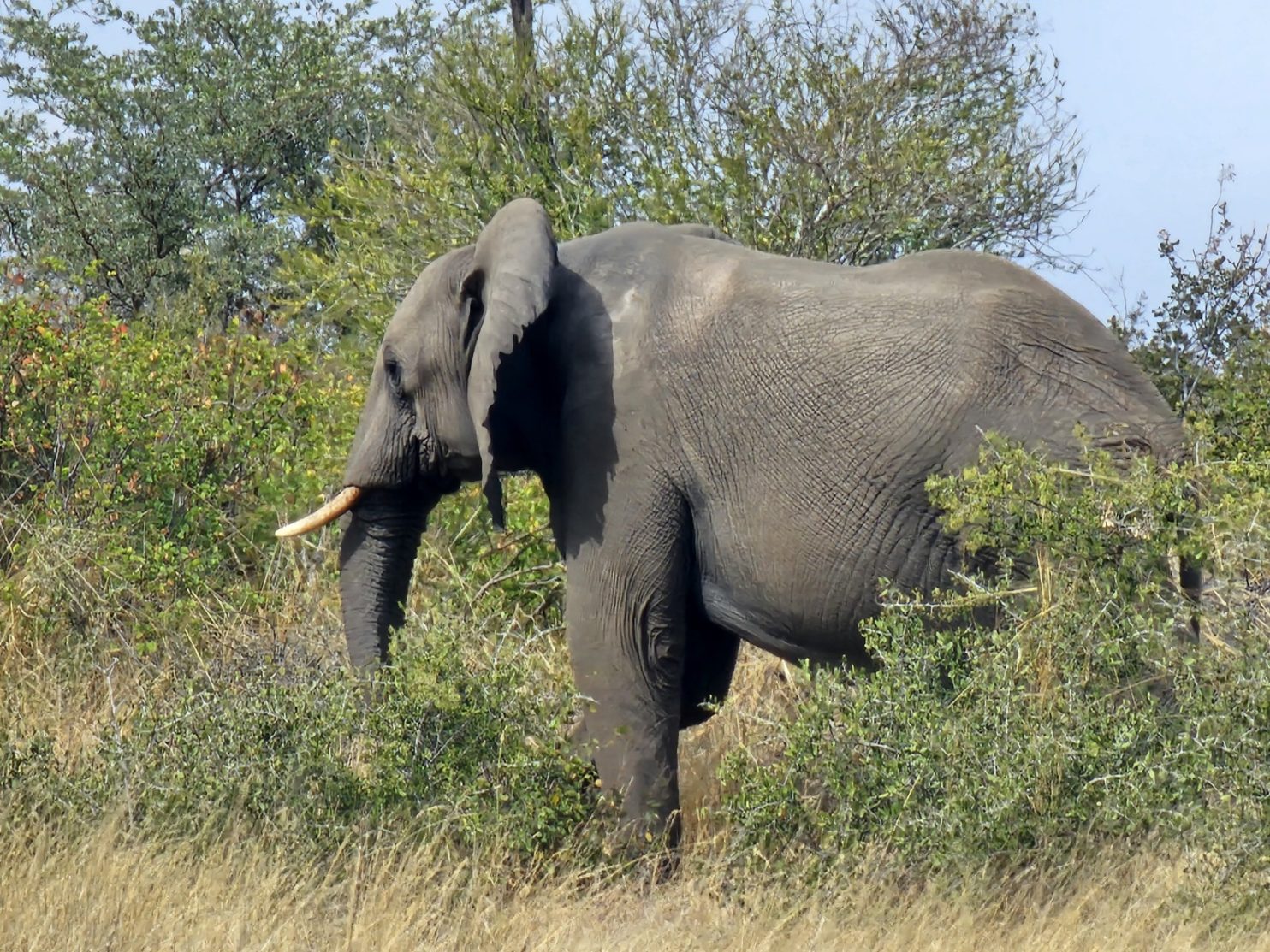
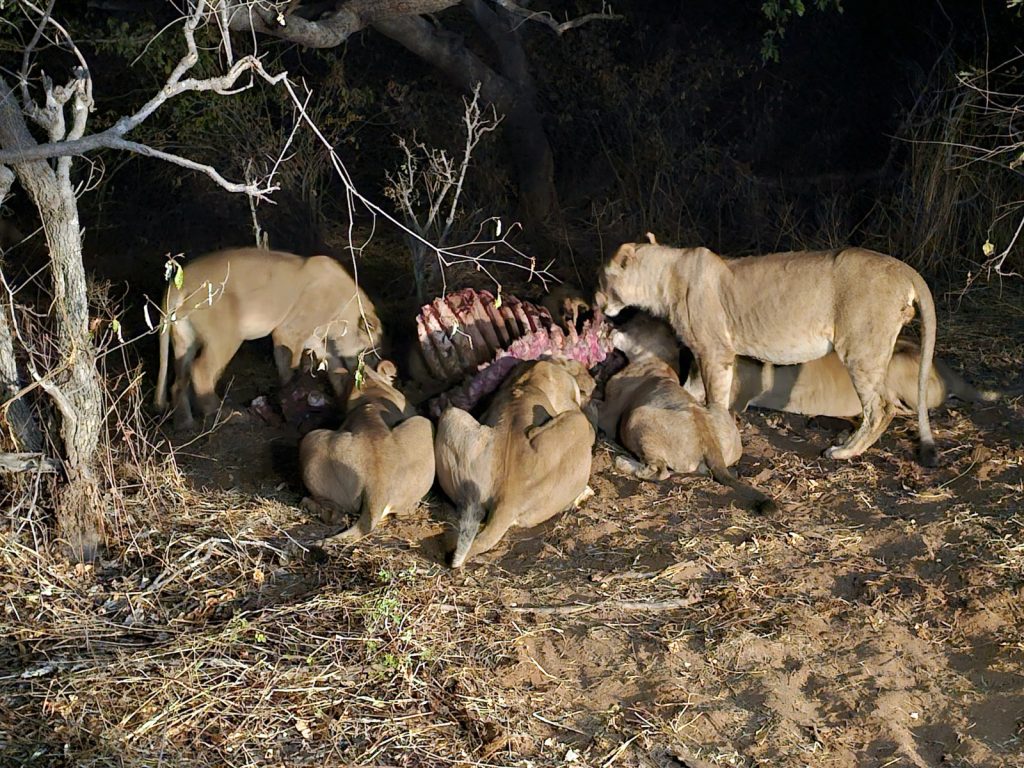
 

Back

June 13, 2025

Day 046. 24 June. Kasane Rest Day. 0km. 0 Hours. 0m up. 0m down. I was up at 0500 to get picked up at 0545 for the Game Drive. The drive was arranged by the Thebe River Lodge so it was all easy and inhouse. Right on cue a specially adapted Toyota Land Cruiser arrived with seating for 9 on the back in three rows of tiered seats. We set off in the dark and I was hoping to see some animals at least. Before we got to the park entrance the driver took a turn down a sandy lane and drove fast across the sand. Someone in the back through we were heading off to see elephants. After a km of the sandy track the driver/guide, called OC, headed off into the bush for a little and wove between some shrubs and then manoeuvred the jeep so the lights shone upon something.

229. On the game drive in Chobe National Park the guide came across a very experienced pride of lions who had taken down a buffalo and feasted all night.

It took me a while to work out what it was, and it was only when OC and the others confirmed it, I knew I was not seeing things. There just 5 metres in front of us were perhaps 7 lionesses tucking into a  buffalo carcass. There was not much left on the bones and most were still knawing on the large ribcage. It was quite a sensational find. OC said he had heard about this kill yesterday and had it confirmed the lions were still here this morning. It was quite a sensational view. There was a lot of snorting, grunting and posturing as the lionesses jostled for position. When they walked about you could see they were full of meat. We had the view pretty much to ourselves for 5 minutes before the news spread to the other drivers and soon there were about 5-6 jeeps jostling for position around us. It took OC quite a while to extricate himself from the gridlock and continue to the park gate.

230. Not long after the lion’s we came across a small herd of giraffes who were grazing the treetops as the sun came up.

At the gate we registered and then got back into the jeep and continued on the main A33 road for perhaps 15 km until we turned off down a very sandy track to the north. OC had got confirmation of another sight. He drove very fast, but well, and the large vehicle almost glided over the sand. We stopped to look at a herd of some 6-7 giraffes who were browsing the tree tops just as the sun was coming up behind them. After watching them for a while we continued down to the shallow wide river valley. Ahead the air was dusty and I assumed it was some low fog from the river. However it was the dust kicked up from the hooves of about 500 buffalo who were walking and grazing as they headed east along the river bank. OC thought they were a breeding herd which might have come from Namibia. There was a total variety of animals from giant bulls slowly striding with their massive heads adorned with huge horns swinging from side to side to young calves tottering along awkwardly on legs which looked like they were made of wood. We parked and they flowed around us like a river and we were a boulder. Apparently this breeding herd would be really difficult for a lion to attack as the bulls would attack the lions and could do some real damage to them. Lions were apparently more likely to attack a bachelor group of bulls where it was more everyone for themselves, rather than all rallying round to protect the calves.

231. We came across a large breeding herd of buffalo which the guide thought had come across the river from Namibia.

As soon as we left the buffalo we ran into another pride of lions. This one had killed an eland a couple of days ago and had devoured most of it. This group was a lot less experienced than the pride that killed the buffalo and consisted of a lot of larger cubs and a few lionesses. The cubs spent a lot of the time wrestling with each other, while a lioness ate. On the surrounding tree there were about 50 vultures waiting for the lions to move off so they could pick over the remains. It was an amazing start to the drive and well beyond anything I expected.

232. We came across a second pride of lions who were feasting on an eland. This pride were not so experienced and contained many cubs, like these two playing.

For the next hour or so we then went down to the edge of the Chobe River and slowly worked our way back east. I did not realize it at the time but this was just a southerly side channel and the main channel was further to the north over a very flat green island called Sedudu Island which gets covered when the floods arrive after the rainy season in the catchment area upstream in Angola. Here, we apparently just missed the lions who had been feasting in the eland coming down to the water’s edge to drink. However we did see a small herd of elephants in the water both drinking and splashing themselves and then they came up the bank to where we were parked and filed by us slowly. There were a number of very small young with them. As we left we passed the buffalo again who were still creating a large dust cloud, and then passed many impala.

233. There were many small herds of elephants scattered in the bush or drinking from the river

234. Looking across the southern channel of the Chobe River to the flat flood prone island of Sedudu.

235. This ekephant was nonchalantly eating the shrub just a few metres from the jeep

Just as we were about to leave the park we came across another cluster of wildlife including waterbuck, greater Kudu, a few more giraffes and an elephant right beside the track who was demolishing a small tree. I noticed he was stripping all the leaves off the twig and discarding them and then just ate the twigs. It was well after 0900 when we reached the tarmac road again after our sandy loop. Once on the tarmac we went back out of the gate and returned to the Thebe River Lodge. The excursion had been beyond my expectations.

236. We saw plenty of more giraffes on the game drive in Chobe National Park.

237. As we were leaving the park we passed a large male Greater Kudu with its distinctive spiral horns .

Back at the lodge I had breakfast which was still being served to those who did the early morning Game Drive and then I returned to my room for a snooze. It turned into a sleep and I did not get up until 1330, just an hour before the next excursion. I did not have lunch as I was still full from breakfast.

The second excursion was called something like the Chobe Sunset Cruise. Again I was picked up at 1445 and then driven some 15 minutes to a jetty area. Initially I was on my own but then a group of 20 arrived from one of the Overland Buses. There were a mix of nationalities but all spoke English. The boat was wide and stable at about 15 metres long and 6 metres wide with a roof and two outboard engines. I guessed this second tour would be hard pushed to match the spectacular of the morning but it tried.

238. On the Chobe River cruise in the late afternoon there were many crocodiles along the banks. This one was 3 metres.

Firstly we went up stream to where the Chobe River was a single channel again after it split to go round Sedudu Island. Here the guide took the southern channel and slowly went up stopping at the various wildlife we encountered. The first was a crocodile, its tail swollen with stored fat. The crocodile was about 3 metres long and would have lived off fish but I am sure it could already take an impala if it came too close to the water’s edge.

As we went up the channel I saw something in a patch of aquatic weeds and thought it was resting hippopotamus. However as we drew nearer I realized it was a large mother elephant, a smaller female elephant and two small baby elephants. The mother was almost fully submerged, and I am not sure if her feet were on the riverbed or if she was floating. She was sweeping the weed with her trunk and bringing large bunches of it into her mouth. The other three elephants, especially the two youngsters, must have been swimming. They occasionally disappeared underwater with just their trunks breaking the surface like a periscope. They looked a little like they were struggling and occasionally tried to clamber onto the large elephants back, but then became confident again and tried to feed themselves and stay afloat.

239. We also passed by a few elephants in deeper water eating aquatic reeds. The two babies were excellent swimmers and were frequently submerged.

We continued up this south channel passing many more elephants, hippopotamus and buffalo and a lot of birds, especially storks and geese. The guide explained that the older buffalo liked it on the island as they were safe from the lions, which would not swim out. The buffalo looked to be mostly old battle scared males who had limps and scratches and had no doubt had their fair share of lion encounters over the years.

240. As the sun began to near the horizon the hippopotamus emerged from the river. Here is a large bull male.

Eventually we got to the west end of the island where the south channel and the main channel initially split. There were a lot of hippopotamus here and they were just beginning to come up onto the land. They would get to the firm bank and then go and forage in the bush for the night. Some might venture 7 kilometres from the river in search of grazing before returning in the morning. In the group we were watching the bull male emerged from the water and scattered his dung around the waters edge marking his territory. He was also battle scared and looked like he had to defend his position and females from time to time. He then plunged into the water again roaring and with his mouth open and the great teeth ready to do some serious damage.

241. There were quite a few older buffalo on Sedudu Island where they could graze without fear of attack by lions.

The sun was now low on the horizon and we started to return. We passed a herd of buffalo on the island as we now went back down the main channel to circumnavigate Sedudu Island. The buffalo here looked content in the evening sun chewing their cud either standing or sitting down. There were a few birds gathering on the backs of the buffalo to pick at any parasite, like ticks, or just peck off the dead skin. The sun set as usual at 1800 in a blaze of colour but once the sun had crossed the horizon it did not take long for darkness to set in and already by 1815 it was too dark to read a paper. At the jetty the others boarded their tour bus while I was driven back in the dark to the lodge just in time for dinner. It had been a sensational wildlife day and I had totally underestimated the quality of the trips and what I might see. It was a fitting end to the 04 Section, NE Botswana as tomorrow I will leave and cross over to Zambia.

242. As usual there sun went down quickly and in a blaze of colour with returning from the Chole River Cruise on the small boat.

Day 045. 23 June. Pandamatenga to Kasane. 102 km. 6.5 Hours. 240m up. 380m down. I was up early for a 0700 breakfast. It was a hearty breakfast and it would have to do me until I reached Kasane in 100 km as there was nothing en route. I left at 0800 but the tail wind of the last couple of days had disappeared. Almost immediately I was into farming country again with vast fields on each side of the road. To the east was wheat and to the west was sorghum. The wheat was being harvested by a couple of combine harvesters side by side such was the pairie-like scale of the farming operation here. After the farm though the there was a slight rise and then I was back into the wilderness with signs saying “Caution Wild Animals”

223. The pairie-like farming operations just to the north of Pandamatenga.

224. A field of sorghum just north of Pandamatenga was completely incongruous with the wild bush of the last few days.

I did not see many animals at all really. Initially there was a large Tawny Eagle. I think they are opportunistic hunters and will take anything small and even scavenge carrion or road kill. Perhaps that is why it was perched on a tree beside the road. The scrub was reasonably scattered here and it would be difficult for an elephant to hide near the road. I saw plenty of signs and there were tracks everywhere but I think most were in the bush now foraging and would not cross the road until dusk approached. A bit further along the road I saw a small herd of zebras who were about to cross and then saw me coming and retreated back into the bush. They ran along beside me, about 100 metres parallel to the road, for about a kilometre.

225. A large Tawny Eagle perched on a tree beside the road looking for an opportunity to hunt or scavenge.

226. These zebra were the only game I saw all day on this 100 km stretch of road which is renowned for its wildlife.

Then the trees suddenly vanished and I was onto an open savannah plain. At last I saw an elephant but it was at least half a kilometre from the road. It was wandering across the savannah and was not eating, but en route to the distant forest or a waterhole. It is not far from the Zimbabwe border here, perhaps just 10 kilometres and the elephants are free to wander across there, where there are reserves and national parks. This savannah plain lasted for about 15 kilometres and then I was back into the scattered bush.

227. In the distance i saw a lone elephant making its way across the savannah towards a waterhole or the scrub forest.

The road was fast to cycle on although it was reasonably busy. The trucks came in convoys with about 4-5 in each and they all gave me plenty of room and often gave a friendly toot on their horns or a flash of their indicators. The verge I was used to for the last couple of days was now very small and I had to be careful when there was traffic coming in the opposite direction and the trucks could not pull over to the other carriage way as much as they would otherwise. All in all though I would commend truck drivers for their thoughtfulness.

The last 30 kilometres were generally fast but as I approached the Zambezi valley there were some long descents but then some vindictive small climbs. They took my momentum away completely and left me struggling to climb them with my legs aching and full of lead. However soon I was on the final run down into the border town of Kazungula. It was a busy town with lots of petrol stations and supermarkets. This was the town where 4 countries; Namibia, Botswana, Zimbabwe and Zambia all met. At the bottom of the hill and down onto the plain beside the Zambezi River was a turnoff to Kasane. It was about 10 kilometres along the road to the west on the south bank of the Chobe River, a tributary of the Zambezi which it joined in Kazungula. Most of the traffic and all of the trucks continued north here into Zambia but I wanted to go to Kasane for a couple of nights to make a touristic foray into Chobe National Park. Kasane was the gateway to Chobe as Maun was to the Okavango Delta.

228. In Kasane there are warning signs for hippopotamus crossing the road as they make their way from the river to graze each night. They can go up to 7 km to graze before returning at dawn.

Initially I wanted to go to the Elephant Trail Backpackers but I think it was all full except for their dormitory beds. When I passed the road up to it I could see it was all uphill for nearly 2 km and I just could not be bothered to enquire so went for plan B which was suggested to me by Franz and Mandy this morning.

Plan B was Thelbe River Lodge and it was a bit further along the south bank of the Chobe River on the road busy with small cars and taxis. I passed some fruit farms and banana plantations and then a road sign warning about crossing hippopotamus to reach the lodge. It was a large lodge which seemed to cater for the overland trucks with 10-15 people in each truck. There were about 4 parked here and their clients were milling around the reception area. The lady at the desk was not unfriendly, but not pleasant, and gave me a room which was really poor value for money. However after 100 km I was tired and wanted a shower and was not going to cycle off and look for somewhere else. They also did the two tours I wanted to take tomorrow from here so that added to the convenience. It was certainly a tourist tour and I am sure it would be quite tame compared to a self drive into the heart of the National Park, but that was not feasible at the moment.

I did meet the owner of the lodge later and asked him a few questions about my route to the Victoria Falls which were about 80 km to the east. He recommended I take the Zambian option rather than the Zimbabwean option as the latter went through the Zambezi National Park where he suggested there would be lots of elephants and possibly lions and leopards. He said if I wanted to go the Zimbabwe way I should really have an escort vehicle. Plus it would mean I would not have to deal with the Zimbabwe customs which are renowned for being eager. I wrote the blog in the evening before supper and then prepared for the 0500 alarm clock as I would be picked up soon after for my game drive early in the day, while the animals were on the move at dawn.

Day 044. 22 June. Pandamatenga Rest Day. 0km. 0 Hours. 0m up. 0m down. I was tired in the morning as I did not sleep well due to inadvertently drinking the caffeine laden drinks last night. However it did not matter as breakfast was when I wanted it so I slept in until 0830. The breakfast was good and the hosts Mandy and Franz looked after me well.

For the rest of the morning I sat in the dining room/bar area under the large cool thatched roof and caught up with the blog. Mandy and Franz went into town leaving me, the cook, the maintenance man, and Zeus the massive Boerboel, to man the fort. Zeus lay out at my feet in a confident relaxed posture as I wrote.

221. During the daytime a herd of about 20 impala wandered out of the bush to the vicinity of the cabins but did not go to the waterhole.

Once I had finished I went for a short walk near the cabins and down to the waterhole to see if I could spot anything. Hidden behind a copse of scrub was a small herd of about 20 impala. luckily they moved slightly into the open to graze on the parched grass as I watched.

I spent most of the afternoon sleeping on the bed in my cabin. It was cool and relaxing and I lay there in a stupor half awake and half asleep until the afternoon was done. I was certainly well rested now. As I went over to the dining room for dinner at sunset Franz pointed out 6 large Roan Antelope who had just emerged from the bush to drink. He explained that after the Eland they were the second biggest antelope and some might be 300 kilos. They did not stay long and looked nervous. I had an opulent dinner and then retired early as I had a long day tomorrow all the way to Kasane which was around 100 kilometres.

222. In the evening, just at sunset, some 6 large Roan Antelope came to drink at the Touch of Africa lodge waterhole

Day 043. 21 June. Telecom mast 85 km North to Pandamatenga. 120km. 8 Hours. 250m up. 170m down. I slept surprisingly well and no wild dogs or lions squeezed under the gate. In my tent most predators would think I was a giant tortoise and not worth investigating, as long they could not see in and providing the the flysheet was on.  I slept right through from 2100 until 0600.  It was easy to get an early start while camping and by 0730 I had finished breakfast which was an entire 400 gram packet of granola and powdered milk. It was cold in the night and my lukewarm water the evening before was now chilled and palatable. I was finally packed and ready to go by 0800. Unlocking the gate and pushing my bike over the elephant protection I made it back to the main road inspecting the track carefully for the omnipresent devil’s thorn seeds,  which were a constant threat of puncture.

215. The elephants had previously pushed over some f the fence around the telecom mast compound, so now it was also protected by a ring of sharp rocks and spikes.

Back on the main road it was not as busy as I feared. The sound of the trucks could be heard a kilometre away and reality there was only one every 3-4 minutes. The road was wide with a good verge, and the trucks were relatively slow. The tarmac was smooth, my tyres were at 40 PSI still and firm and there was a tail wind. At last the planets were aligned so I would be able to average 20 km per hour. Within an hour I made it to the abandoned huts just on the west side of the road. They still looked in remarkable condition but I did not go the 100 metres to investigate for fear of rolling the wheels over thorns. On each side of the road was the endless bush and nothing else. The bush was a little parched and most of the watering holes were dry. There was lots of elephant dung but I did not see any all morning. I made great progress up the road climbing slightly and almost imperceptably until midday when I had already done some 64 km.

216. There were frequent elephant trails and tracks emerging out of the bush with fresh dung, but I did not see any all day.

217. A gentle reminder at all the parking lay byes on the road that wild animals were about. This sign looks like it was used by elephants as a scratching post.

I kept my eyes out for wildlife but saw nothing. The road went past two or three watering holes, one like a small lake, but there was nothing at these either. Although round the perimeter of them there was a lot of dung and footprints. I can only assume that the animals were either away from the road in the bush foraging and would return in the evening to quench their thirst or that there were other watering holes far in the bush and away from the road, which were more preferable.

218. I passed a few watering holes and even this small lake but did not see a single animal all day.

Soon I was approaching 100 km and it was only 1430 in the afternoon. However it was taking its toll. My arms were sore, especially the wrist joints and elbow joints. I think my handle bars could have been 5 cm higher. In theory I could have put the seat down a bit, but it was just right for peddling and I would rather have sore arms than risk injury to my knees. I was also getting chaffed in my groin area and with the sweat it was starting to sting. About 20 km before Pandamatenga the road reached a large cattle grid and I cycled over it into a totally different landscape. There was no more bush with the threat of wild animals about to leap out of it, but now I was into farming land with huge flat fields full of sorghum. The fields were vast and this was farming on an industrial scale which one might find in the mid west of the USA or Ukraine.

219. About 20 km south of Pandamatenga I passed a large cattle grid separating the wild bush from organized farming where these large fields of sorghum flourished.

I also reached the section where the road was being widened. The road rollers had packed an earth and aggregate track beside the current carriageway and it was firm and great for cycling on. Occasionally it was covered in a thin layer of bitumen with rocks on it to prevent traffic going on it but I could weave between the rocks. I passed by a large army barracks and then entered Pandamatenga. It was a spread out town but had a tangible centre which was dominated by huge grain silos. This was where all the sorghum ended up before being transported south on the many grain carrier trucks passing me. There was also a large parking area here for all the trucks where many probably spent the night. Currently there were over 100 parked up along the wide dusty verge, 3 or 4 deep. My main interest in Pandamatenga though was the supermarket. I was parched when I arrived although I still had a bottle of old warm water with unpalatable bits suspended in it. It was no match for some cold sodas and an icecream though.

220. The bar and dining area of A Touch of Africa Lodge was a relaxing place to have a day off physically recovering and catching up with the blog.

There were a surprising amount of white farmers in the carpark and I asked one of them about a place to stay. They recommended a Touch of Africa, a lodge which had camping spaces some 6 km further north. It was the one I had already bookmarked so it was good to have the confirmation. It was a quick half hour cycle to get there and I reached it in the heat of the afternoon. It was run by Franz, a retired Austrian hunter and his wife Mandy, a South African. They gave me a lovely thatched lodge overlooking a waterhole where game was rumoured to come. There was the main restaurant and bar area which was also thatched. The only issue I had initially was the dog. I was the largest and most ferocious looking dog I had ever seen. It was a 90 kg Boerboel, which was extremely muscular and with an enormous head. The dog would have eaten a couple of drug dealers XL Bullies for breakfast and perhaps a lion for dinner. However, the gargantuan canine had been well socialized, knew its subordinate position and was well behaved. I had a great shower and then one of the infamous burgers before deciding to have an extra day here. I was tired and needed to rest and I also needed to catch up a bit with the blog tomorrow. I did not sleep that well as I made the mistake of buying two energy drinks at the supermarket which were loaded with caffeine.

Day 042. 20 June. Nata to Telecom mast 85 km North. 85 km. 6 Hours. 190m up. 120m down. My tyres were still good in the morning so it looked like the problem was solved for the time being and I would be able to move on up to Kasane and Livingstone. Rubert made me the usual sumptuous full breakfast and by the time I had that and said my goodbyes to the team and other guests it was already 0930. I did not really have a plan but there were a few options every 15 to 20 kilometres as I headed north. The one thing I did need was one of these options. It would have been foolhardy to camp beside the road, a little in the bush as there were quite a few wild animals about on this next stretch. Most notably there were elephants and they were abundant over the next 300 km. After all, the road between Nata and Kasane was called the “Elephant Highway”. However there were also rumoured to be wild dogs and lions. So a secure camp was necessary.

209. The open savannah just north of Nata was initially open until the scrub started to appear.

Once on the main road north, The A33, I was delighted to see that there were road works to widen the road. I knew there was a little from my last foray up here until the punctures forced me back, but now I could follow them on one side or the other of the road for the best part of 20 km without going on the main carriage way. The packed earth which had been steamrolled was as good as smooth tarmac and I made good time. Even if I had not been on the newly constructed verges the road was not that busy with trucks and vehicles.

208. Some of the termite mounds on the flat open savannah with limited bush were 3 metres high.

Eventually the packed earth verges finished and I was forced back on the main carriageway, but there was a wide verge of nearly 2 metres width and this was separated from the main carriageway with a yellow line and a row of cat’s eyes. The trucks were not that plentiful and they were not going that fast either. Perhaps they were wary of the elephants. Each side of the road there was initially wild open savannah stretching to the horizon, golden and shimmering in the heat. However after some 30 km since leaving Nata the bush slowly started to appear and then it became quite dense. I knew there were some elephant watering holes near the road along here and kept my eyes peeled for them but I did not see any. There were plenty of signs though, most notable the large tracks across the road and into the bush on each side and elephant dung everywhere. After about 45 km I got to the turn off to Elephant Sands Lodge and Campsite. However, it was down a very sandy track for 2 km and it was likely I would have to push the bike the whole way there and out again tomorrow. Despite the likelihood of seeing elephants come to the watering hole at Elephant Sands I decided to skip it, especially as it was just after midday.

My next option was another 10 km and it was the Veterinary Fence to keep foot and mouth out of Central and southern Botswana. I reached it at the same time as a large convoy of trucks but then overtook them all as they waited. I was flagged through as there were not real controls going north; however there were coming south. Just after this control were a number of shacks selling cold sodas and biscuits. I stopped at one and had something but there were no cooked snacks. It was still just 1330 when I finished so I decided on the next option which was a Telecoms mast in another 30-35 km.

210. My lunch stop at one of the small shacks by the veterinary fence which sold non perishable items only.

211. Just north of the Veterinery fence I started to see more wildlife animals like these zebras.

It seemed a bit wilder now on the north side of the Veterinery fence and it did not take long before I saw a few zebras in the scrub, but still no elephants despite all the signs. Then in about a kilometre I saw the unmistakable sight of one beside the road. It was huge even from here. There was very little traffic and I covered the distance in a few minutes and was suddenly 200 metres from the elephant who continued to graze right beside the road. There was no way I could get past without risking a charge so I waited and waited. Eventually after 5 minutes a convoy of 4×4 came the other way heading south. They slowed for the elephant but continued and the elephant was unmoved. Usually they are afraid of traffic and run back to the bush, but not this one.

212. The first elephant of the day was grazing at the side of the road and was unperturbed by traffic. I had to have a 4×4 escort me past it.

At last a 4×4 came going my way and I flagged it down. The driver I think just wanted to blast past the elephant but agreed to drive between me and the beast. The road was quiet so we both crossed over to the other side. I could see the driver was nervous and had the elephant charged, I am sure he would have sped off leaving me in the lurch. It didn’t charge but there was a lot of ear waving. Soon we were both past. In the next 30 km I saw another two elephants attempting to cross the road but traffic came by just at the right time and they remained on the edge of the bush waiting for another chance, wary of the trucks. I don’t think they would have seen me as a threat but I was just 40 metres away as I passed.

213. The third elephant of the day was very wary of traffic and was about to cross in front of me when a 4×4 appeared and then it fled back into the bush.

The telecom tower I was aiming for soon appeared some 5 km away and it took no time to get there. The head wind of the last month was more of a neutral side wind now and the road surface was good and the tyres at 40 PSI rolled smoothly over it. It was just 1530 when I got there so I decided to check it out. I had heard the perimeter fence was damaged, according to my app called “ioverlander” I parked the bike at the edge of the road and walked the 100 metres up the sandy track checking for thorns as I went. The fence had been damaged but it was now repaired in a fashion. However, right round the perimeter of the compound was the most vicious elephant defence of concrete with sharp stone sticking out of it and also a grid work of iron with spikes in it. The latter was like an upside down agricultural harrow and it would not be possible for an elephant to cross it. I returned to my bike and wheeled it back to the compound. The only issue I noticed was there was a 50 cm gap under one of the gates which perhaps a predator might wiggle under, but it was unlikely I thought and they would still have to cross the harrow spikes.

214. My camp in the fenced compound 85 km north of Nata. The gate was open on arrival and I secured it with my bike lock once inside.

I had my tent up quite quickly and then ate cold dinner out of tins; pilchards, backed beans and fruit salad to be precise. I still had 3 litres of water for tomorrow which would hopefully take me the 115 km to the village of Pandamatenga where I hoped to stay.  If I had not stayed at this telecom mast the next option was a cluster of abandoned cabins a further 20 km. Apparently they were still clean and with roofs but only one had a door and that was last year’s report. After the hermetic dinner I wrote the blog and finished around 2000.

Day 041. 19 June. Nata Rest Day. 0 km. 0 hours. 0m up. 0m down. I had a great lie in as I knew I had nothing to do today. After the usual tasty full breakfast Rupert got a phone call to say the package had arrived and was ready to pick up. Half an hour later I had everything I needed to get back on the road.

I took the wheels off the bike and then the tyres of the rims and cleaned everything up. I had already cleaned them a week ago in Gweta so there was not much to do. Once clean I put the rims back on and had great difficulty in getting a seal to pump the tyre up. Eventually it started to inflate using my electronic pump and soon I had enough pressure in them so the tyres pressed against the rims and they were “seated”. I then removed the core of the valves and injected the latex liquid, about 130ml, into each tyre and blew them up again to 30 PSI. There were a few leaks but as I spun the tyre the latex liquid found the leaks and bubbled out. As it bubbled out it reacted with the air and solidified in the leak,  thereby sealing it. I let the tyres be all afternoon spinning them from time to time to distribute the latex liquid and was delighted to see they held their pressure. I then put them up to 40 PSI and they still held their pressure.

The punctures were solved for the short term and I should be able to get to Livingstone now. In the meantime Fiona had had great success at the main DHL Express depot on the outskirts of Edinburgh and the parcel with the new puncture resistant tyres was dispatched with all the customs forms in order and DHL promising to facilitate it through Zambian customs, which could still be a banana skin.

That evening more guests arrived and Rupert made another great meal. That he prepared this sensational rice and curried goat in a spinach sauce on a couple of gas rings is impressive. Two of the guests were Ricus and Pietro Delporte who were South Africans moving up to Malawi for 6 months until the weather at their other house in Knysna improved. They had worked and travelled all over Africa and were incredibly well informed and experienced. Ricus was articulate, assertive and knowledgeable but was not a know-all by any means and a joy to discuss things with and listen to. They were the most interesting people of many interesting people I met round Ruperts camp fire. They also invited me to stay in Malawi at their lodge, which I was planning to go past anyway. I had really enjoyed my stay at Eselbe Backpackers and was indebted to Rupert for his hospitality and help, but after 3 days here I was now ready to move on.

Day 040. 18 June. Nata 7 km up road and return. 14 km. 2 hours. 110m up. 110m down. After a very relaxing day at the bohemian and inspiring Eselbe Backpackers as the guest of Rupert I was ready to set off after a great breakfast which he made. I half cycled and half pushed the bike the half kilometre up the sandy lane from the rivers edge to the main road and then started the cycle up the road. The road was being widened and there was a long stretch of newly finished road with rocks on it to stop drivers going on it. However I could simply cycle between the rocks very easily,  and did so.

However I noticed that my tyres were deflating and eventually stopped. I had inner tubes in them but I think both had thorns in them. It took me well over an hour to change the tube at the back and patch the tube at the front and I was ready to set off again when I noticed the tyre at the front was still deflating. I must have had two punctures. I thought this is a hopeless situation and I cannot limp up the road repairing punctures every 10-15 kilometres. I knew I was vulnerable to punctures as the tyres I had did not have any embedded protection in them and were primarily designed to be tubeless. I decided it best to return to Eselbe Backpackers and sort something out. I pumped up the tyre again and it just got me back. Everyone was surprised to see me.

I made a few phone calls back to the UK just to make sure the new tyres I ordered were in hand and to find out about freight. In the meantime Rupert made a call to Cycle Base in Gaberone to see what they had. Rupert discovered they had the latex liquid to put in the tubeless tires I had on and also that they had inner tubes with valves with removable cores so I could also put the latex liquid in the inner tube if need be. We ordered some and were assured it would be sent when the money transfer was made.

Rupert then spent hours on the phone to his bank to try and make the transfer. He had a frustrating fruitless time of it and we eventually had to go into his bank to sort it out. However, the transfer was done and the goods were put on the night bus. I was very indebted to Rupert for all the hassle he had on my behalf.  Meanwhile back in Edinburgh Fiona had received all the new tyres and inner tubes to send and had researched the best way to get them to Zambia. There was not much more to do except wait.

207. The large communal dining table and fire pit beyond it were the social hub of Rupert’s backpackers.

As usual there was a great meal that night and then everyone sat round the fire discussing virtually every topic on Wikipedia. The ambience was superb. While Rupert’s Eselbe Backpackers is quite rustic and everything just about works, with his cooking and the evening’s conversation round the fire after the meal there is the potential for Eselbe Backpackers to become legendary.

Day 039. 17 June. Nata Rest Day. 0 km. 0 hours. 0m up. 0m down. I had a great lie in and got up when the sun had chased off the chilly morning. Rupert the host at Eselbe Backpackers made me a great breakfast with real coffee. Most of the guests were leaving including the very nice French couple. However I would probably see them again about Livingstone in a week’s time.

Once everyone had gone I went into the quiet bar area where there was a table and wrote for a couple of hours. It was very relaxing with virtually no disturbance or sounds save for the doves. By midday I was done so I then went for a snooze on the hammock. It was lovely to have nothing to do for the afternoon as previously virtually all my time was spent either cycling, camping or trying to keep up with the blog.

206. On my very relaxing day off at Eselbe Backpackers in went for a short paddle on the Nata River having been assured thw were no crocodiles in the remnant of the river which had no flow in this dry season.

Once I woke I went for a small paddle on the river in one of the old canoes Rupert had. This part of the Nata River still had about a kilometre of water in it and it was about 2 metres deep at the most. There was no inlet or outlet of this long channel at the moment but it would return in the rainy season when the river would form and flow south again. I was assured by Rupert there were no crocodiles in this long pond and he regularly paddled here.

In the evening he made another fine meal and there were only 5 of us at the meal. In the evening we sat round the fire again and chatted until it was quite late. Rupert had a wealth of knowledge about the area and the wild road north from here to Kasane so I picked his brains on it. I had really enjoyed the peace and quiet of his rustic lodge.

Day 038. 16 June. Zoronga to Nata. 45 km. 4 hours. 30m up. 40m down. I slept well and long, and was up at 0630, as the first glimmer of light was appearing in the east. The cockerels had long been awake but now the hens too started foraging nearby, clucking away as I packed. I was ready by 0730 and set off down a series of sandy tracks to the tarmac road which was the artery of the village. Many children were also emerging from the lanes and heading to school in the smart green uniforms. They were vibrant and lively in stark contrast to the younger women at the shop yesterday obsessing about their hair extensions. Once on the tarmac road in the village I cycled up past the shop and onto the main A3 road. It was just over 40 km to Nata now.

There was no breeze for a welcome change and I made quick time. It did not take long before I found a rhythm and was making good time on the empty road. I passed a sign saying “slow down severe potholes”. I thought nothing of it as I generally welcomed them as it slowed the vehicles to a crawl while I could weave in and out of them.

200. The road between Zoronga and Nata was usually fine but for 3-4 sections each of about kilometer the tarmac was destroyed and people preferred the verge

However in this case the entire road had disappeared. There were some thin strips of tarmac for a few tens of metres and then they ended in a lip before another strip started. Most drivers simply abandoned the road and moved onto the verge which was graded, but somewhat rutted. It was a difficult choice for me to either persevere on the destroyed tarmac road or risk the sometimes sandy ruts on the verge. The road was often the least of two evils. There were perhaps 4 sections of this destroyed road and each section was about a kilometre long. I think they were in the process of building a new road adjacent to this road I was on and they had pretty much given up with any maintenance of the original road, assuming the traffic would cope until the new road became operational in a year or five.

201. Near Zoronga the landscape was covered in a sparce forest with well cropped grass underneath. There were hamlets and homesteads hidden in these forests some 200 metres from the road.

Beside the road the landscape continued to vary with either sparse forest and exhausted grazing underneath and then homesteads just visible through the trees away from the road in the forest, or open savannah which stretched far into the distance beyond the curvature of the earth. There was some livestock grazing here but most I saw were clustered around a few water holes near the road. The livestock were again a mixture of cattle and horses with about half and half of each. At a few of these water holes there were flamingos, either resting on one leg or slowly wading through the shallow water while filtering with their beaks. I had heard from many people that the larger salt pans which were currently flooded were currently full of flamingos.

202. There were many salt pans which had dried out but a few still had water like this one with livestock and flamingos.

I stopped for a rest and to eat a snack of dried noodles and biltong. When I did this a 4×4 usually stopped to enquire if everything was OK. Before long one stopped with a charming young French couple. We chatted for about 10 minutes and they gave me a delicious packet of biscuits. We discovered we were both heading to the same backpackers in Nata. They told me they had just seen a large male lion crossing the road about 60 kilometers back towards Maun. It was exactly in the place where I had seen the large herds of unfenced livestock yesterday. They showed me a video and it was clear the lion had just fed as its stomach was full. I am sure this lion was living on borrowed time before the herding or grazing committee contracted a hunter to put it down as it would continue to kill livestock now.

203. Between the salt pans the landscape was open veldt with golden grasses flowing in the breezes

Once they left I had about another 20 kilometres to go to reach Nata and without the head wind it went quickly. As I entered the town I got to a T junction with a larger road which went up the east side of Botswana from south to north. It was the A33 and it was another route from Central Southern African countries like Zambia and Congo to the coast at Durban and Port Elizabeth. I would have to follow it for 300 km in the next week from Nata to Kasane up the so-called “Elephant Highway”. I followed the road for about 2 km to the north and then headed east down a sandy lane to Eselbe Backpackers.

204. The bar and dining area at Eselbe Backpackers was the meeting place for younger travellers on independent overland trips.

It was only about 400 metres down the lane but I had to push the bike half the distance due to the sand. When I reached the backpackers it was even more Bohemian and relaxed than I imagined. It was owned and run by Rupert, a Brit with a long family history in Botswana and Swaziland. There were perhaps 10 various buildings, all of wood and bamboo. Some were the bar and kitchen and others were the small huts which were bedrooms. There was a large outside table under a huge canvas awning. The French couple who gave me the wafers, Pauline and Damien, were already here and so were about another 8 overland travellers in their 20’s. It was outside of the cut and thrust of Nata but I suspect there was nothing to entice me into downtown Nata except the supermarket to stock up. Rupert showed me a bamboo hut with an attached bathroom and shower and I unpacked the bike. The room had everything I needed and outside there was plenty of chat with the relaxed group. Later in the afternoon Rupert ran Emelia, another French guest, and myself into the supermarket for some supplies. He also bought the ingredients for himself to make lasagne for us that evening.

205. One end of my room at Eselbe Backpackers in Nata with the semi outdoor bathroom.

The backpackers was right beside the Nata River which was still full of water but not really flowing anywhere. It was almost like a large long pool which still existed while the river had stopped flowing. Contrary to my intuition the river flowed from the north to the south through the town of Nata and onto the salt pans. There it spread out to form the seasonal lakes which then evaporated in the dry season.

In the evening Rupert made a large lasagne to feed about 6 people while a few of the others made their own dinner and we all sat around the large table and ate together. Once the meal was done the fire was lit and everybody gravitated towards it, sitting round it. Without the breeze the smoke went straight up so there was no one having to endure smoke in their eyes. I was a little distracted in the evening trying to get some replacement Schwalbe tyres with some puncture protection as the current tyres I have on the bike have none and I feel quite vulnerable especially when cycling near thorns or over broken glass.

Day 037. 15 June. Gweta to Zoronga. 64 km. 6 hours. 140m up. 150m down. In the morning the tyre was flat. The sealant had failed to seal the hole. I tried blowing it up again to no avail so decided to take it off and put a tube in the tyre. On inspection all the sealant was either dried up or had been expelled by various punctures. It did not take long to put the tube in as it was the front wheel and I pumped it up to 35 PSI and it was taut, but with enough flex to act as a shock absorber. I paid the bill and left at 0930. As I cycled through the village on this Sunday morning it seemed quite a few people were going to church. They were well dressed and seemed to be the friendliest in the community as all smiled and waved as I went past. I passed the giant baobab tree, which was perhaps 25-30 metres on second thoughts and then reached the main road by the petrol stations. I cycled along it for about 5 km until I reached the turn off for Planet Boabab, a 3 star lodge.

193. There were lots of large baobab trees around Gweta, especially near a lodge called Planet Baobab.

The lodge was a short kilometre down the track. Dotted amongst the savannah scrub here were more enormous Baobab trees. It was not so much their height which amazed me but their huge girth. However, at the lodge there were a few gigantic ones and one especially right at the lodge which must have been 7-8 metres in diameter. I guess this tree was at least 500 years old and probably a lot more. There were perhaps 20 giant trees here but this was the most impressive. The lodge had built a bar right under it thinking that would be cool, but I found it lacking taste and a bit disrespectful. I chatted with a very nice UK couple here before having a second look at the trees. If trees could talk they would have some story to tell. Possibly from a time when humans did not live in the area.

194. One of the largest was right beside the lodge and must have been 7 metres in diameter. It was a behemoth.

I did not return to the main road straight away but continued on a gravel road to the east for about 5 km. It was a lovely quiet cycle through scattered homesteads in the sparse forest. I have noticed that a lot of the homesteads are not beside the main road as one would expect but are perhaps 200-400 metres off the road and not visible from the road. Here surrounded by a perimeter fence of branches as posts and wire lies a large compound with maize growing in it and then the inner compound with 3 or 4 huts, often with thatched roofs and a corral where the livestock spend the night. On this small gravel road I was much closer to these homesteads and frequently passed people who were much more friendly than their counterparts in villages and frequently waved. It was not as quick as the tarmac road but much more interesting.

195. The were lots of subsistence homesteads beside the smaller road near Gweta. Many have maize fields.

Eventually the two roads merged and I was back on the tarmac but now I entered a region which was bereft of trees and was a vast area of savannah grass with extensive salt pans in between. These salt pans were quite natural and occurred because the rains of the last millennia collected in these barely discernible depressions on the landscape and then evaporated over the dry season leaving a mineral residue which has accumulated. They were bare areas of white deposits where nothing grew. I passed a few smaller ones of perhaps a square kilometre or two but I knew from the map there were much larger ones which were hundreds of square kilometres just beyond the horizon like the Ntwetwe Pan, The Nxai Pan and the Sowa Pan. My initial plan had been to cycle across one of these on 4×4 tracks, but because there was so much rain in the recent rainy season many of the pans were still covered in water or still marshy with a muddy clay like silt which would be a nightmare to push a bike through.

196. Half way between Gweta and Zoronga were huge salt pans which must now fill after a very wet rainy season. Perhaps once a decade in this climate era.

Between the small pans I passed beside the tarmac road were the extensive veldt-like grasslands with golden grasses. They were excellent grazing and there were large herds of cattle and horses scattered across them. There were no fences and the livestock were free to wander. I thought there can’t be lions here as they would have a field day with all this easy prey at their disposal.

197. Between the salt pans on each side of the road was savannah grasslands which was being grazed by large mixed herds of cattle and horse

As I cycled across this area of smaller salt pans and open savannah I realized I had little hope of reaching Nata that evening. It was mid afternoon and I still had 50 km to go, although the easterly headwind was diminishing as it did most afternoons. I had two options, one was a telecoms mast just before Zoronga and the other was Zoronga village itself just a bit further, leaving just 40 km to do the next day to reach Nata. I had enough water for the telecoms tower but they were quite soulless, perfunctory places to campsite so I decided to continue to the village where there was a small shop where I could buy something and ask about somewhere to pitch a tent as I have done in Phudukudu.

198. The neighbouring compound at Zoronga next to the absent policeman’s house where I was allowed to camp.

I reached the village and took the side road into it and soon found the shop. There were a few young women hanging around the shop and working in the shop and they all seemed totally disinterested, with a lot of shoulder shrugging to every question. Of the 5-6 of them, half were putting hair extensions in each other’s hair and they only said “give me money”. Eventually one woman said “try next door” but there was no next door. When I queried this she said “try the police at the end of the road”. So I set off into the spreadout heart of the village. Eventually after some 5 attempts and nearly at the point of giving up and returning to the tarmac road out of frustration, I found a grandmother who pointed me to a sandy track leading to a cluster of houses. There another grandmother found a neighbour of the policeman, who said he was away. However he made a call to the policeman who gave me permission to camp in his compound. It was perhaps 1700 now so I had the tent up beside his house and had eaten by nightfall. I went into the tent as all around me the evening fires in the compounds around me flickered and the evening air had the aroma of woodsmoke. I wrote a little but was asleep by 2000 and slept well.

199. My tent next to the policeman’s house in Zoronga. He was away but told a neighbour I could camp there.

Day 036. 14 June. Phuduhudu to Gweta. 81 km. 8 hours. 230m up. 230m down. I slept well on the verandah of the community hall and was content to be amongst the fire fighting crew who were all very helpful. After the indifference of the Botswanans I met on the first 3 days in the country I got a completely false impression of them and that has now completely changed. I now find them competent, helpful, good drivers and cheerful. I was up before anyone else and had a disgusting breakfast of corn beef out of a tin and some bread. I had forgotten just how putrid corned beef was as it was about 3 or 4 decades since I last had some. I was packed up and ready to go by 0800 as the others were rising. I went to see the foreman who sanctioned my stay yesterday and gave him 200 Pula, or about £10, to either buy the team some soft drinks that evening or give it to the Phuduhudu community as he felt fit. It was graciously received. They waved me off from the compound and I cycled through the empty lanes just coming to life and returned to the main road.

The headwind hit me with a vindictive force as soon as I was out of the shelter of the village trees. I guess it was a force 5 and right into my face. I was struggling to get much more than 10 km per hour and if I pushed harder I could feel my right knee ligaments straining. It was going to be a long day. After an hour or so I saw 4 zebras running down the road towards me. When they saw me they bolted into the bush. As I was looking for them I saw two giraffes some 200 metres away. They were both very alert and looking straight at me. Either they have very good senses and saw me on their own or were alerted by the zebra as I think the two animals have a symbiotic alert reciprocity.

187. I saw a couple of giraffes on the south side of the road about 10 east of Phuduhudu.

There was not much to say about the next hour as I ground into the wind. The grasses at the side of the road were being buffeted by it and I felt progress was slow and at a cost. About an hour later I passed a larger herd of zebras. They were grazing on the wide verge but when they saw me they became unnerved and started to run in the same direction I was going but just inside the edge of the bush. They ran for about a kilometer pausing just to let me catch up. I could hear their hoofs pounding the ground.

188. About 20 km east of Phuduhudu i came across another herd of zebra with About 50 animals in total.

Soon the vegetation changed and the taller scrub gave way to shorter scrub and then this too almost disappeared leaving just wide open grassland savannah. There was no hiding here and any zebras or giraffe would have been visible for a kilometre and an elephant 2 kilometres. But I could see nothing and all the animal tracks which came out of the bush on each side of the road disappeared. It was only after 20 km when the bush started to get a bit thicker again did I see a flock of about 40 ostriches, just before the end of the park. As I was watching them a police pick up appeared and wound down the window. “Do you remember me?” said the passenger with a bright smile and gleaming teeth. It was the police woman from 2 nights ago when I encountered the elephants. We chatted for 5 minutes before she headed off back to Maun.

189. As I cycled east further into the Makgadigadi National Park the bush almost dissapeared and there was just scattered scrub rising out of the endless savannah grasses.

?After the park I was suddenly back in cattle country and I was quite surprised to see them. There were rumoured to be lions in Makgadikgadi National Park and this did play on my mind a bit, but now there were cattle, goats and donkeys about I was off the menu. Their farms were small and almost subsistence level I think. The going was still slow despite the wind dropping as it often did in the afternoon. Then I noticed my front tire was very flat. I stopped to blow it up but it had a hole in it and the sealant was bubbling through and would not seal the gap. I pumped it to 35 PSI from the 10 it was at, and set off. I was going much faster now and perhaps I had been running this tire under pressure for a while and was blaming the laborious progress on the wind which had largely disappeared now, while it was actually the tire all along.

190. Just on the eastern edge of the Makgadikgadi National Park I saw a flock of about 40 ostriches.

My joy was short lived as I had to stop and blow the tire up again after 5 km. I could feel the air escaping as it blew onto my cheek as I operated the battery pump. I had to do this about 6-7 times in all and the hole was just simply not sealing. There was still sealant in the tire as it was bubbling out. I was starting to curse the idea of tubeless tires. When working they are great but in a crisis like this they are useless and inevitably I will have to put a tube in this front tire too. I will then have both front and back on tubes and only the outer tire to protect them from the thorns on the verge and the copious amount of broken glass along the road. A puncture resistant outer tire like a Schwalbe Marathon Plus would have been better as it had a 5mm thick strip of kevlar embedded in the tyre’s circumference. I limped down the road to the turn off to Gweta and then down the 2 km access road.

191. On the outskirts of the large village of Gweta i saw this enormous Boabab tree which was about 35 metres high and the biggest Boabab i have seen.

On the access road I passed a huge Boabab tree. Its swollen trunk must have had a diameter of 3-4 meters or so and the tree had a height of 35 metres. It was an enormous specimen and must have been very old and venerable. It has overseen many generations of humans. When I got into the larger village it was easy to find the lodge. They had space for me but were busy with a large group with about 20 Chinese. I got a small roundavel style round hut with a thatched roof. It was quite cramped inside but had all I needed. On the outside was an area enclosed with a 2.5 metre wall which was the bathroom, with toilet, sink and shower, and the trees above. I had a shower and washed my clothes and also washed the back tire I took off yesterday to get rid of all the water soluble latex on it. I did this as I would probably have to use it tomorrow morning if the front tyre did not seal overnight. After that I went over to the quite chaotic buffet which was dished out rather than self service. I had to be quite assertive to get a good portion and then get cutlery from the limited supply. The Gweta Lodge has potential to return to a former glory but at the moment most things were a bit haphazard or broken and it was almost the same price as the considerably better Maun Lodge. Still I was grateful for a bed after 2 nights camping.

192. The quirky but slightly chaotic and ramshackle Gweta lodge had a tiny rondavel type room for me with an outdoor bathroom behind the wall on the left.

Day 035. 13 June. Motopi Telecom Mast to Phuduhudu. 45 km. 5 hours. 110m up. 110m down. It rained a little in the night which was a surprise, however I slept well and woke early. In the morning the tyre was flat so I decided to change the tubeless to one with an inner tube. The whole procedure took about an hour. There was no liquid latex left in the tyre. It had all either leaked out or just dried up in the heat. It meant whenever I got a new puncture there was nothing to seal it. In retrospect I had no choice but to switch to an inner tube. In the next few days I will have to get a replacement organised. Elias left first heading towards Maun while I headed east into the land of the elephants and into the strong wind.

177. The large female was guarding the back left of the procession helping a matriarch bring up the rear.

Once I left the security compound and was back on the main road I was aghast at just how strong the wind was. Elias would have an easy day while I had to struggle at 10 km per hour. I retraced my route of last night past Leopard Plains Lodge and on to where the two elephants were last night. There were none now but I soon saw a single one in the bush on the south side.

A bit later I saw another, possibly a smaller female. Then behind here I saw a small procession of elephants heading east. There was a side road here up to a raised area and I took it to get a better view, I could now see there were at least 25 in the procession of all shapes and sizes. The smaller female was marking the back left of the procession while there was a large matriarch at the back. As the procession passed a dusty area they all stopped and flung an arc of dust over their backs. There must have also been a big matriarch at the front also but I did not see her. I watched for a good 20 minutes as the whole herd moved through the bush on the other side of the road. The younger female guarding the back nearest the road knew where I was and what cars were approaching the whole time. It was a tremendous privilege to watch them heading through the bush towards greener pastures.

178. I had already seen about 20 elephants that morning so expected to see even more now i was entering the National Park.

I left as the herd moved off and returned to the road. There were another two sightings of single elephants right on the verge. I think they were drinking from a leaking pipeline which went along the south side of the road. After these two I continued east for another couple of kilometres into the wind and then came across 4 large elephants near a leak in the water pipe. They were close to the road and had I cycled past they would have been just 30 metres away. Way too close to call. So I stopped some 100 metres away to wait for a vehicle. There were none for about 10 minutes. It was great watching these elephants as such close quarters for this time, completely alone with them. Then a 4×4 arrived and I flagged it down and explained to the Botswanian driver I needed him to drive slowly for 200 metres while I used his vehicle as a shield. He was very obliging. Once past he drove off and I observed the elephants for another few minutes. They were truly enormous.

179. I got to these 4 large elephants and thought it would be foolhardy to squeeze past so spent 10 minutes observing them until a car arrive to escort me past

180. Up close the 4 elephants were quite daunting and very large.

I was making heavy weather of the kilometres in this headwind and with the animal viewing breaks was doing less than 10 km per hour. I then decided to see if I could find somewhere in Phuduhudu village rather than go another 40 km after that to another telecoms mast. I did not want to get caught out in the dusk in elephant alley. I had heard that the area I was going into now, the Makgadikgadi National Park was full of zebras at this time of year and right on cue I ran into a herd of about 300 crossing the road. As I was watching them an elephant also crossed right in front of me. I think the elephants are generally quite passive, but if there are young, or a male is in musk then they can be unpredictable. I had to wait for about 10 minutes to allow for all the zebras to cross. I peddled on for another 10 minutes and then came across another large herd with 300 animals. They were unnerved by the bike and ran parallel to the road for a good kilometre with me cycling beside them.

182. Waiting for a large herd of about 300 zebra to cross the road. There was another herd of 300 just beyond

183. Some of the zebra. They were not wary of cars and lorries but very nervous of me and bolted soon afterwards.

Soon afterwards the road veered to the north near a telecoms mast and then reached the village of Phuduhudu. I knew there was a shop here but it was off the main road. I asked a few people and they directed me into a grid of wide dusty lanes. The houses here were well kept and there were some enormous parkland type trees dotted about. It had a nice ambience. The shop was closed for the afternoon but a team of kids soon discovered me and came over excitedly. They were easy and delightful and quite happy to practice English. There was a building next to the shop with perhaps 10 green tents outside it. I went over to ask if I could stay also. “Not a problem,” they said.

185. Some of the happy kids in the village of Phuduhudu. There welcome gave me the confidence to go and ask others if I could stay in the village.

184. One of the streets in Phuduhudu village with their big trees and well kept compounds with traditional buildings and huts

It was actually the village hall they were at and there was a building with a verandah. They said I should put the tent on the verandah. It was up and I was unpacked in half an hour. I was curious about the others here and asked them what they were doing. They were all firefighters from Maun and they were burning the verges so a fire could not jump the road. There were few females but they were mostly men. They had a lot of small equipment like leaf blowers to help drive the fire. They were a cheerful, generous and good natured lot. Once the shop opened I bought some supper and bread and then settled down to write the blog as the sun set in a blaze, as it was partially cloudy. It had been a really memorable day with the elephants and then the insight into the nice village and the travelling firefighters.

186. My tent on the verandah of the community hall, where the visiting fire fighters had said i could camp.

Day 034. 12 June. Maun to Motopi Telecom Mast. 96 km. 8 hours. 310m up. 310m down. I was slow in getting going and did not leave until nearly 1000. I was already on the SE side of town so I was soon on the main road, the A3, which led east to Nata nearly 300 km away. I passed a lot of the suburban warehouses one finds on the outskirts of town like builders merchants, petrol stations and workshops and also a few out of town tourist lodges, and then suddenly I was beyond the outskirts and in livestock country again. Sheep, goats, cattle and donkeys grazed the verges. There was very little change and if it kept up like this all day I would be struggling to find much to say. After 2 hours I passed the village of Chanoga where there were a couple of very basic roadside pit stops selling food from 3 or 4 large cauldrons. I am not sure if it would be freshly made or yesterday’s, but I am sure as I go deeper into Africa I will have to eat at these soon. Today I was still full from the large breakfast.

171. At many of the small villages along the road there were local cafes. It would nor be long before i was eating in them.

About an hour east of Chanoga I saw something unmistakable in the distance, namely bicycles with panniers. There were two of them so I crossed over the road to meet them. There were Marius and Simon from Germany and they looked cool and rough, cycling in sandals on bikes which looked like they had been well used. I was very enthusiastic to meet them. It was like a Man Friday moment. They were also eager to meet me. Very soon we realized we were both doing the exact opposite to each other. They had come from Dar-es Salam, about 3600 km away and were going to Swakopmund. with about another 1300 km to go. We chatted for nearly an hour beside the road exchanging tips and they added me to a Whatsapp group about cyclists in Africa. They said there were about 6-7 cyclists coming my way over the next week or so, including a Swiss guy not far behind them. It was a joyful chat, partly because of the coincidence, and partly because they were likable, happy, easy going people. One tip they gave me was that it was possible to sleep in the fenced off areas at the bottom of telecom masts as the gates were always open and it was then possible to close the gates and lock yourself in with the bike lock. They had used about 4 in the last week as it was out of the way of elephants. There were apparently many elephants in the next section to Kasane. After an hour we shook hands heartily again and then set off.

172. At last I saw some other cyclists after a month on the road. Marcus and Simon were doing the exact opposite to me and going from Dar es Salem to Swakopmund.

It did not take me long to get to a veterinary fence where I had to disinfect my shoes and ride through a puddle of disinfectant. Immediately after it was a selection of tuck shops and stalls and I bought 4 bananas at one stall for a late lunch. Once I set off I was in a totally different landscape. The verges were no longer dusty and covered with livestock, but were now tall, golden, flowing grasses, and they came right up to the road. I also noticed that there were no subsistence compounds here and the area was devoid of people. I think I had entered a Park but was not sure if it was National or Regional or even just a game reserve. The wind had died and I was making quite good time, but labouring a bit. Then I noticed my back tire was at a very low pressure.

174. After the veterinary fence I left the ranches of Ngamiland and entered a National Pak where there was no livestock and the grass could grow tall.

I stopped to blow the tyre up with a battery gadget and it was soon at 45 PSI again. However 5 km later I had to repeat the process as it fell to about 15 PSI again. I had to do this about 6-7 times and just managed 5 km before I had to top up the tyre pressure. It was not good as obviously I had a puncture which the latex goo inside the tube could not plug. I had inner tubes but once I switched from the tubeless system to the more standard inner tube I could not go back. The problem was there were so many thorns and glass fragments which the tubeless system had dealt with admirably so far, and had I used inner tubes instead I would constantly be stopping to repair punctures. I had a spare tyre and 3 inner tubes and I would need the former if I was to change over as the current tyre would have so many sharp protrusions embedded into it that it would puncture the inner tube immediately in multiple places. It was a quandar, but for now I would have to pump every 5 kilometres until I reached a destination.

175. As dusk fell the elephants came out of the bust to wander along the road.. I saw 6 in all lurking behind trees. Thw all fanned their ears when they saw me and watched me pass.

I did have my mind set on Leopard Plains but it was an expensive lodge. I had checked yesterday and it did have availability. It was still 20 km away, or 4 fills of the tyre. Suddenly something on my right caught my eye. It was a massive elephant some 40 metres away in the bush. It had large tusks so I assumed it was a bull. It did a quick U turn and went back into the bush before I could photograph it. Then half an hour later there was another but this time it just stood watching me flaring its ears. I was past it in a gif but then turned to get a photo, but the elephant was now partially obscured by trees. It was exciting. Not long after I passed the turn off to Motopi and the telecom mast at this T junction where Marius and Simon had spent the night locked in its compound. I cycled past it and on for another 5 km to reach Leopard Plains. Unfortunately the Lodge was now full and he was not going to open the gate for me.

I decided I would continue and find somewhere to camp nearby. It was already 1730 and dusk was imminent. I cycled for another 2-3 km but there were many elephants on the south side of the road on the edge of the bush waiting to come out as it got darker. They were like sheep in the Scottish highlands beside the road, except with considerably more menace. I got to one place where there were two drinking from a pond beside the road and it just seemed too close for comfort.

Fortuitously a police pickup came by and I cycled beside it keeping the pickup between me and gargantuan beasts. On the other side I had a discussion with the 3 policemen and they said I would be best going back as the next village was 40 km and the road was full of elephants now in the dusk and they would be wandering along paths on each side of the road where I intended to camp. They watched me cycle past the two elephants again and then continued east while I returned west. The police wanted me to go to Motopi but I knew I just wanted to go the 6-7 km back to the telecoms mast. It was an exciting cycle and a few times I passed an elephant lurking behind a tree just 30-40 metres away. I made it to the junction peddling with a sense of urgency and then headed up the sandy track for 200 metres to the tower. The gate was bound with cloth.

176. My camp under the telecom mast in the fenced compound with gates. We closed the gates to keep the elephants out.

Then Elias the Swiss cyclist appeared and opened the gate for me. He said “you’re leaving it late to finish” and I explained the previous 2 hours. He had been here since 1500. We chatted as I put up my tent right under the tower. By the time I had finished it was dark. I then had 2 cans of food for dinner, while talking more with Elias. He had cycled all the way from Switzerland to here. I noticed he did not have tubeless, but inner tubes, and the Swalbe puncture resistant tyres with a kevlar strip embedded in them. I pumped up my tyre before I ate in the hope it would reseal and hold its pressure overnight. If not I would have to put a new tyre and inner tube on tomorrow morning. After the meal we said good night and then I went into my tent to write the blog. I felt very secure locked into the compound with the locked gate. There was some distant lightning occasionally but too far away to hear the thunder.


Back

Day 033. 11 June. Maun Walking Safari Day. 12 km. 5 hours. 30m up. 30m down. I was up early at 0600 to have breakfast and pack before I got picked up at 0730. I left the bike in the courtyard at Golentle Homestay where the staff were working outside all day. The pickup was there 15 minutes early and just waited in Kays compound until I was ready. We set off at 0730 and I initially understood we were going to pick others up, but we we soon out of town and then we turned off on a sandy 4×4 track up towards Daunane Village. It was quite a drive and took over an hour bouncing along the narrow sandy track through savannah. I had no idea what to expect but thought the whole thing would be quite tame. At last we came to a very traditional village with about 40 compounds and a small shop. The houses were nearly all small round huts, and there were about 2-4 per compound. Just after the village we passed a sign saying Section NG32. I later learnt that this was a conservancy area owned by the Duanane village community. They policed it and also developed tourism in it. Just after the sign we suddenly arrived at the water’s edge where there were about 10 pickups, 50 people milling around and about 50 fibreglass dugout canoes. We had reached a lagoon on the edge of the Okavango Delta.

Soon Mantre arrived and said he was to be my guide for the day. His English was terrible (but better than my Tswana) and I could hardly understand a word he was saying and he smelt of alchohol. Looking at the tourists milling about, trying to decipher what Mantre was saying and generally looking at the scene I thought what type of circus have I signed up for today. Then Sofie, the other guide, arrived she was more credible but spoke no English. We started to load two boats with stuff from the minibus and then we set off with Sofie and all the equipment in one and Mantre, the driver and me in the other.

161. Sofie, one of my guides for the day launching here Mokoro at Daunane village into the lagoons while a herd of hippopotamus bask on the other shore

It was then I  noticed we were just punting past a group of some 30 hippopotamus who were wallowing at the far edge of the lagoon. I thought they were very dangerous, but Mantre was punting past them as if he was walking past a herd of sheep. I asked him about it and if I understood correctly he said they were all females and youngsters and quite placid. Indeed there were villagers fishing for Tilapia fish close to them. Suddenly the tour became a lot more exciting.

162. The height of the lagoons varies throughout the year so much of the plant life is adapted. These lilies float on the surface.

We went across the lagoon, past the hippopotamus and into long reeds. Mantre said the villagers use the stems of the reeds to make fences in their compounds. There was a channel in the reeds where water was gently flowing into the lagoon. This was the flood arriving and in the next month the Kvango river, swollen by rains 3 months ago in the Angolan Highlands, would surge onto the Okavango delta and into a huge patchwork of lagoons raising their level by a metre or two. If the flood was especially big it would then overspill to the 3 rivers and flow towards the 3 depressions and salt pans I mentioned earlier, but this only happens every 5-10 years.

Mantre expertly punted the dugout canoe, called a mokoro, up the channels against the gentle flow and en route we saw quite a lot of bird life, including rails, a small king fisher, storks and ibis. The detla was brimming with birds. The channels were sandy and only about half a metre deep. On each side of the channel tall reeds rose 2 metres above us and each had a large feathery seed head swaying in the breeze. I wondered what would happen if we met a lost hippopotamus coming towards us. It must have happened before. After a good hour passing from channel to small lagoon we emerged from the channel into a larger lagoon and landed. Sofie arrived right behind us. We then unloaded all the boxes and carried them up to the shade of a large tree and left them.

It was than explained we were going on a walk and would come back for lunch. The driver stayed behind and Mantre and Sofie said we were to walk in single file with me in the middle. He justified this by explaining there were lots of aardvark holes, often covered by sticks and I would probably not see them and stumble into one. Soon after we set off we did pass some and they were a trap for the novice after all. Mantre explained about some of the plants and their meedicinal properties but I think he sensed it was going in one ear and out of the other. It was, but to be fair to myself I only understood 10% of what he was saying.

163. On the walk we passed another lagoons with a herd of hippopotamus out of the water basking in the sun.

164. The herd of hippopotamus were content to stand on the shore with their short legs supporting their massive weight.

We walked on and soon enough came to another lagoon with about 30 hippopotamus standing on the muddy sand out of the water. It was a sensational scene and I was now starting to enjoy the walk. I took some photos and we walked on. At last Mantre and I found a way to communicate which was him leading the way along hippopotamus, elephant and game trails and me following. When he spotted something he would point it out to me and explain what it was. His eyesight and knowlege of the bush was shinning through, and he was a very skilled tracker. We saw zebra at a distance and lots of sign of elephant as we wandered across grassy areas which he said would be covered in water in a month. Indeed you could see a contour round the depressions where the grass stopped and the more permanent vegetation took over. Mantre then pointed to an elephant perhaps a kilometre away. It took me a while to find it.

165. On the walk of about 8 km across the savannah we saw about 10 small herds of zebra

For nearly the next 2 hours we then went on a wide loop through trees coppised by elephant, grasslands waiting to be flooded, and small scrub areas with huge termite towers. Mantre spied so much game and pointed it out to me. We saw quite a few herds of zebra with perhaps 20 in each herd. In one herd there was a small group of giraffe embedded in the herd. Mantre explained that zebra and giraffe are often found together and the zebra like to use the giraffe as an early warning mechanism as their eyesight is good. It was quite incredibe to be wandering across the savannah through herds of zebra and giraffe. We also saw a lot of warthog, red lechwe antelope and Impala. Towards the end Mantre also showed me a distant large male elephant heading from one copse to another. My initial sceptism with the trip and Mantre was completely unjustified and it was really educational and interesting now. After a good 2 hours we completed the walk and got back to the dugouts.

166. On one occasion we saw 4 giraffes scattered with a small herd of zebra.

167. Mantre, the guide, had such a keen eye and managed to spot so many animals, including this distant bull elephant, one of 2 we saw.

Here the driver had prepared lunch. The parcels we carried up were chairs and tables and these were now all laid out with food waiting to be served. It was a simple tasty meal of pasta, bolognaise with potato salad. We all ate well and then packed everything to return to the dugouts. It took an hour to return and now we were going with the flow a little and we quickly wove down the channels from lagoon to lagoon, which were all slowly filling up. When we reached the final lagoon the hippopotamus there were all basking on the bank. We went surprisingly close to them, perhaps just 40 metres. Despite their size they are very fast and would cover that distance in no time; both the bit on land and the bit in the lagoon. But again there were fishermen even closer and they did not seem to bother. Once we landed I was really quite overjoyed how the day had gone and gave both Mantre and Sofie a good tip before they went back to their village.

168. On the way back we went remarkably close to the herd of basking hippopotamus in the very vulnerable mokoro canoe. Mantre assured me it was safe and he spent his life amongst them.

169. My two guides for the day, Mantre and Sofie. They were both from the local village of Daunane and the lagoons were part of their community land.

I sat in the back of the pickup in specially adapted seats so I could get a good look at the village as we went through it. Daunane was still very traditional and cattle seemed to be the mainstay although I also saw a field of maize. I shouod imagine they woukd have to work hard to protect the maize from elephants and also the cattle from the odd roving lion. The compounds where the livestock spent the night were well barricaded, and as I said earlier within this compound was an inner sanctum fenced off with reeds where the family lived. It was fascinsting to see the village and I would have loved to have spent a couple of days here learning about their animal husbandry and economics, and how it all interlinked with the family and relationships between families. It was the classical Social Anthropology which I studied at university.

170. One of the compounds at Duanane village. I side the outer fence was two round huts and these had a reed fence around them incorporating them into an inner sanctum.

However we had to get back to Maun so after another bumpy hour on the sandy track and then 20 minutes of potholed tarmac I was finally back at Golentle Homestay. I met Kay and thanked her for arranging everything for me and then got on my bike for the short trip to Maun Lodge, my third hotel in Maun in 4 nights. It was a thriving hotel and full of people coming and going on safari. It was perhaps the place to be in Maun but it did not have the easy going personal cosiness of Golentle Homestay, but much more character than Cresta Rileys. I shopped at a nearby supermarket for a few staples I needed on the next 600 km stretch to Kasane and then had dinner. It had a great buffet and I tucked into that not knowing what the next 10 days would bring. In the evening I wrote the blog. By and large this third section was quite dull except for the first day from the border to the main road and then this last extra cirucular day in Maun in the mokoro in the lagoons and the walking safari.

Day 032. 10 June. Maun Rest Day. 0 km. 0 hours. 0m up. 0m down. After the great buffet breakfast I chatted with a couple of ladies who were just heading off on a 10 day luxury safari and then went to see an NGO which James Suzman,from a week ago, recommended. They were nice but could not help with a delta trip. So I went back to the hotel, packed my bike and then went to see Kay in the Golentle Homestay.

Kay still had rooms and yes she could arrange either the canoe trip or the game drive tomorrow. She suggested the canoe trip as the game drive was not that unique, while the canoe trip was. She also had a very reasonable room , but just for one night. Unfortunately, I was an hour too late otherwise I could have gone on the overnight trip she mentioned yesterday. By now I was eager to go on what I had previously dismissed as too mundane.

It was agreed I could leave the bike and all my stuff here tomorrow and then retrieve it and go to the Maun Lodge, just down the road which I had already checked out. They did a very reasonably priced thatched cottage. So I went to get money for Kay and the Canoe Tour and then went down to the Maun Lodge for a late lunch.

The food was good and the staff here seemed very friendly. While the Cresta Riley had an exclusive, and almost conference feel to it, there were very few travellers there. It was mostly Botswanan middle classes on a romantic break or on a business trip. While the Maun Lodge had a lot of safari adventurers either going to or coming back from various safaris. No doubt similar to the ones at the private lodges and tented camps in the delta which were over the top for me. Once I made my booking I returned to Kays and caught up with the blog. I had a great meal which they made for me. It would have been best if I had come straight here from Sehithwa 2 days ago, and I considered it, but I wanted to be in the relaxed coffee shop and backpacker vibe in the centre of town. As it transpired I don’t think there was one and it was just a diffused collection of hotels, malls, petrol stations, tyre repair shops with no tangible beating heart.

Day 031. 09 June. Maun Rest Day. 0 km. 0 hours. 0m up. 0m down. As I was in Maun it would be a great shame to miss the Okavango Delta. The town was the gateway to it. Today I just wanted to relax and find out about doing a tour into the delta tomorrow. However, I rather fatally went back to bed after the large buffet breakfast and snoozed on and off all morning, wasting a lot of time. When I eventually got my act together it was after midday. I could find out very little, except from the limited information the bored lady at the “Excursion Africa” in the hotel reception area reluctantly divulged. She had 2 options; a canoe ride in one of the delta channels interspersed with a short walk or a game drive. Both quite boring I thought. So I went off for a cycle around town.

Firstly I went to Golentle Homestay as it was highly recommended and I needed somewhere to stay on my third night in Maun as the Cresta Riley was full. It was an easy cycle without the panniers and I was there, across the river and up some sandy lanes, in 20 minutes. The owner, Kay, had the same trips for a slightly cheaper price and was also doing an overnight camp in Moreni tomorrow night. She also had rooms. I then went to the Maun Lodge which also had a lady from “Excursion Africa”. They also had nice rooms. However I wanted a bit more so armed with my phone I set off for the airport where all the safari companies were.

It was a relatively short 20 minute cycle and soon I was at the various offices. I went to Kwando Safaries and Wilderness Safaries. Both offered something completely different. They put luxury packages together where people went off to salubrious tented camps or lodges in the Okavango Delta for 7 -14 days. They usually flew into the camps and then spent 300-500 US Dollars a day at them. Almost like a rich man’s retreat. Not suitable for me at all. Running out of time as everything was closing at 1700 I went back to the “African Excursions” lady at the Cresta Riley hotel to sign up for one of the 2 packages which I had previously dismissed as tame or boring. However, she said that was great but there was a minimum of 4 people. I was disappointed as it meant another day tomorrow wasted trying to find something. After a good meal I went to bed early with a new plan.

Day 030. 08 June. Sehithwa to Maun. 100 km. 8 hours. 210m up. 210m down. I was up later than I hoped and had a large bowl of granola and powdered milk for breakfast. In the dilapidated bathroom the small ants, sugar ants I think, continued to pour out of a crevice behind the taps and swarm over the sink. I paid the indifferent manageress, who assumed I had already paid online, and then left. I cycled through the quiet dusty streets of Sehithwa and soon the sand became potholed tarmac and then smoother tarmac as I approached the main road. There was very little going on this Sunday morning and most of the activity was the permanently hungry dogs who were trotting about looking for an elusive morsel. At the petrol station I stopped to get some cold drinks and then headed north east up the quiet main road.

157. The spread out simple compounds and houses of Sehithwa covered a large area

The road was great to cycle on. It was smooth, flat and while the normal lanes were perhaps each 4 metres wide, one in each direction, there was then a yellow line marking the outer edge of the land and then another metre or tarmac after that which I could cycle on. There were not many cars and hardly any trucks and they all gave me plenty of room. I felt more comfortable riding here and I did in Namibia.

The cycle was quite laboured however. There was the usual easterly wind and I was going NE so it was effectively a headwind, and I did just not feel that strong. It was not an upset stomach due to food or water, but rather a poor diet of granola, noodles, biltong and sugar water sodas for the last week since leaving Tsumkwe. I was making heavy work of it and the kilometres were hardly going by at all. I kept looking to the east to see if there were any glimpses of Lake Ngami but there were none.

Someone had previously told me that the seasonal flood in the Kavango River which flows into the Okavango Delta would just be swamping the delta now and pretty soon the floodwaters would continue South and East beyond the delta flowing into channels which would converge into 3 rivers. The Taughe River to the south, the Thamalakane River to the SE and the Khwai River to the NE. All three of these flow into depressions, forming shallow lakes which eventually evaporate leaving stranded fish and salt pans. At the moment all three of these river beds were dry but I was told this is about the time when the delta is at its maximum and these riverbeds will soon be starting to run given the heavy rainfall in the recent wet season. However they would have to continue for another 100 km for their depression to start to fill, and Lake Ngami was the depression for the Taughe River. I was told it would have to start from scratch to fill it up as it had been dry for many years.

What I saw beside the road was a continuation of the cattle posts. They were frequent and generally seemed to be on quite a small scale with traditional huts in a compound where the cattle would spend the night. There were also a lot of herds of goats alongside the road and the occasional donkey or horse. All of this livestock was free to cross the road at any time and drivers were aware of this and moderated their speed.

158. The roadside cafe come bar in Toteng. It was the least rowdy of about 7 places in this mining village.

After some 30 km I reached the dried up riverbed of the Taughe River. There had been nothing flowing down here for a few years as the scrubland grass was across the sandy trench. This was the life line for Lake Ngami so no wonder it had disappeared. A little further I reached the roadside village of Toteng. Despite it not even being midday it was bustling with people. There were about 6-7 bars and many of them were already rowdy with loud music and gesticulating drinkers shouting above the rhythms. There were also a few shops. The whole verge of the village was alive with parked cars. I was feeling spent and stopped here at a more upmarket roadside cafe cum bar for a meal. It was then I noticed that there was a mine to the south of here, the Khoemacau copper mine. It was owned by the Chinese. The permanent employment at the mine allowed people to spend their wages in these bars in their off time. A day’s euphoria drinking beer seemed little reward for 6 days of toil in the heat to me. Remarkably no one came into the courtyard to the cafe when I was there, save 4 ladies who arrived to drink cocktails as I ate. Feeling recharged I set off again still with over 60 km to go and 6 hours of daylight left.

159. The road was flat and straight with a 1 metre wide tarmac verge and good for cycling. The grassy verges had a lot of foraging livestock on it.

However I felt much better now and the headwind had dropped a bit. It was warm in the afternoon but not unbearably so, like it had been in the Namib desert a month ago. It was like a hot summer day in the UK now. I made good time as the kilometers started to flow by much more quickly. Some of the cattle posts on each side of the road here looked a bit more commercial as if they were owned by a landlord or resident and had people working on them. Their gates and signs were getting more secure and elaborate, grand even, as opposed to the lorry tyre or chrome bumper with the faded name of the farm daubed on it as there had been in the morning. The traffic got busier and the only car that came to close was one in a convoy to 6 tourist 4×4 pick ups with tents on the roof. I sped through the village of Komana and then 2 hours later entered the southern outskirts of the town of Maun. My water was just about body temperature and it hardly quenched my thirst. My tongue felt glued to the top of my mouth. So when I passed a tuckshop I stopped for a cool soda drink, the bubbles ripping the paste from my throat.

160. One of the numerous smaller subsistence type farms with a simple 2 room house, a few round mud huts and a corral for the livestock at night.

The journey into Maun was not fraught but I had to keep my wits. The traffic was slow but it was suddenly busy both with cars, especially small taxis, and pedestrians. The verge I had enjoyed all day had gone and now it was replaced with street sellers and sand. There was sand everywhere and frequently it extended onto the road too. The most awkward traffic was at the crossroads where the rule seemed to be a very orderly and polite system where people waited their turn until they were next, with even the taxis complying. After a few kilometres I reached the centre of town and found the hotel I had already picked out. I knew they had availability from an app on my phone, and they did. It was called Cresta Riley’s which I think was one of the old historic hotels of Maun from the early tourist days in the 1960’s.

The cheerful staff welcomed me and gave me a nice room for half the price of the app on the phone. It was quite plush with many rooms in various buildings all under a characterful thatch. It was all set in a large garden with very large old trees and a pool. The room had a 6 foot bath which was just perfect for me to rest my weary legs in. Afterwards I went for a great meal in the almost empty restaurant and then went back to the room. I had intended to write but was really quite exhausted and went to bed well before 2100.

Day 029. 07 June. Sehithwa Rest Day. 0 km. 0 hours. 0m up. 0m down. Surprisingly I did not sleep well except in the morning. I eventually got up at 0930 and had a shower. There was no breakfast at the Guesthouse so I cycled off to the petrol station some 2 km away. There I killed 2 birds with one stone and managed to persuade the cashier to give me 1200 Botswana Rope, for the 2 nights lodgings and some spending money for the nonexistent cafe or restaurant. I also bought some drinks as that was all they had.

I cycled back slowly through town which was all single storey with small 3-4 room houses on plots. There was an open feel to the streets but it was monotone, dusty and dull. The trees which survived here were not by design but just the lucky ones which had been allowed to grow without being cut for roof joists or firewood. I guess Sehithwa had a population of at least 5000, but there was little interest.

However it was situated beside the fabled Lake Ngami which even Livingstone wrote about and praised its “shimmering waters”. However the lake is essentially an overflow of the Okavango Delta and when it has had a very wet season it spills over into the hollow where the lake is, and fills it. Over the last century these overspills have become less and less and the lake has not been here for the last 10 years. There was a track down to see it which I went along but I could not see it. I met a few people and they told me there was no water here. Perhaps I would see some of the lake as I went up to Maun tomorrow as it is beyond the northern edge of town despite the map saying it was beside the town.

I returned to the Guesthouse and wrote the blog for the next few hours. During this time the garden of the guesthouse was taken over by some 40 younger teenagers. I think it was something of a prom or birthday pasty as the girls were well dressed and the boys looked smart. It could even have been from a fee paying school here as the pupils seemed incongruous with the drab dust of the Sehithwa I had cycled through.

Day 028. 06 June. Bush Camp near Nokaneng to Sehithwa. 118 km. 9 hours. 100m up. 130m down. At 0630 just as the first signs of dawn the bush erupted into bird song. The doves and the hornbills, both with joyful tunes vying with each other to welcome the day. In my opinion the doves won the contest for volume and tune. I was physically tired so I wrote the blog in bed in the morning as the sun came up. It was cold outside but warm in the sleeping bag. Just as I had nearly finished it Bletchly came back en route to the cattle post where he worked. He was just interested in how I had been in the night. Once he had left I got up, packed the tent and was ready to go by 0930.

151. In the morning the cattle were released from the protective corrals and led into the bush to forage for the day.

It was warm now and the day was in full flow. As I cycled the 4 km into Nokaneng on the improved road the cattle were just emerging from the safety of their night time corrals and dispersing into the bush to forage for the day. A couple of herdmen on foot were escorting the 200 head of cattle out. It did not take long to reach the community of Nokaneng and the tarred road.

152. Much of Nokaneng was compound s with the traditional round huts and perhaps a newer 2 room square house.

I was expecting it to be quite busy but it was quiet. On one side of the road were a few small single story houses in dusty plots with a few larger trees and on the other side of the road were quite a few compounds with small round thatched huts in them. Here and there were a couple of corrugated roadside “tuck shops” and then there were two shops which were more concrete with a bottle store attached to each. I went into one and bought a coke. The shop keeper was not the happiest but then I still had my helmet and glasses on. Kids quickly gathered outside and peered in. I reckon there was actually more floor space in Nokaneng devoted to selling alcohol than food provisions but did not check out if it was beer or liquor. All in all Nokaneng was quite disappointing. I left the shop and bottlestore area and cycled through the rest of the large village where people were gathering at the side of the road hoping for a fare in a passing pickup.

Once I was out of the town I set my sights on Tsau some 60 km down the road in the hope I could get some food or overnight there. The road was superb to cycle on. It was smooth tarmac and virtually flat. There were no potholes and I was soon flying along. The head wind was slightly from the side and not as strong as in the previous days so I could average just under 20 km/p/h. There were not many cars and they were generally not going that fast and gave me a lot of room. I felt better cycling here than in Namibia. Perhaps some of the reasons the cars were slower were that many were old and rattled, there were cattle along the verge and the road was quite narrow with the verge full of acacia bushed with huge thorns. As I went past at a good speed I could imagine the damage it would do to both myself and my tires if I crashed into one of these.

153. Many of the cattle posts were quite subsistence based like this but others were larger.

There were cattle posts all the way along the road and on both sides of it. There was a cattle post perhaps every kilometre or so. Most looked quite small concerns, bordering on subsistence, while others had herdsmen on horseback. Cattle seemed to be the main economic livelihood here, and indeed all the older vehicles and trucks which passed me seemed to be involved in the cattle in some way, with a few taking 10 cattle down the road presumably to the tables in Gaberonne and Maun.

154. The 110 km from Nokaneng to Sehithwa was surprisingly good with big verges, some of which were being overrun with the huge thorned acacia scrub.

After I had been going for a good few hours I realized I had not eaten today and it was well after midday. I found a concrete bench underneath a large acacia tree which was full of weaver birds nests and had a bowl of cereal here. The birds above came and went and were quite vocal as they perched outside their untidy woven nests of hanging grasses. The second half of the journey to Tsau went quite quickly but I did not get there until a little after 1530. I was now very tired and thirsty and was hoping I could find somewhere in Tsau to spend the night.

155. In Tsau I stopped for a drink and saw one of the traditional donkey carts which were common here.

But if Nokaneng was a disappointment then Tsau was crushingly so. There were two shops but neither could take a card, which seems like it is going to be the norm. However as I was outside the shop a man overheard the shop keeper in her barricaded shop saying she could not accept my South African Rand. He said he would change them as he was Namibian and the two currencies are pinned together. He could use them when he got home. He gave me a fair rate so I gave him 200 Rand and got 160 Botswana Rope. So I got my sugar water drink after all. He offered me a place to camp in his compound but it was too close to the centre of the village where there was the usual bar and bottle shop. So I decided to make a dash to Sehithwa where I knew there was a guesthouse and perhaps a cashline or ATM.

156. A few of the cattle posts, or ranches, had men on horseback bring the cattle in as the day ended and dusk neared.

It was a mad dash really to do the 40 km before dusk which was surprisingly early at 1800. The road continued to be fast to cycle on with the occasional pothole sections which barely affected me. I had to push myself as the evening approached so I would not be caught on the road too long in the gloom as in Africa the dusk is quick. One minute you still have a shadow and half an hour later is pitch dark. I had to switch my back light only just 5 km from the town and then reached the T junction at the edge of the town when I could still just see.

I found the route to the Monlek Guest House. It was still 2 km away so I put my headtorch on, mostly to see the potholes, and cycled off through the streets. I passed a busy bar and disco and then turned south to reach the guest house with a couple of dogs barking at my heels. The manageress gave me an indifferent welcome, especially when I said I had no cash and she did not have any card facilities. Like many places in Africa they operated on money transmitted through mobile phones and had done so for well over a decade and far before it was common practice in the West. It was not something I was geared up for. She said I might be able to get cash from the petrol station, otherwise it was a bank transfer. She gave me a room which was beyond the end of day with many things broken. However the wifi, kettle and fridge worked and this made up for the missing toilet seat and ripped shower curtain. Soon I was ensconced with all my stuff in the room and could collapse. There was nothing to eat in town so I had a couple of packs of noodles and then fell asleep. It had been the longest cycle so far, but not the hardest.

Day 027. 05 June. Qangwa to Bush Camp near Nokaneng. 111 km. 9 hours. 190m up. 300m down. I slept with the flysheet on and it made a considerable difference to the temperature of the tent, perhaps as much as 5 degrees, so I was never cold in the night. I woke early, before anyone else was up, and started packing up. I was done by 0730 by which time the households were coming out to start the fires. It was of course mostly women up first. My host soon appeared and I gave him some South African Rand and thanked him and then filled my water bottles from one of the community standpipes. By now the village was busy and full of kids going to school in their purple uniform. I must have seen a 100 and that was just in one small part of the village. Perhaps the whole population of the village was 2,000-3,000 in all, but the young seemed to easily outnumber the old.

As I set off it was cold. My hands felt nippy for a good hour and the wind I created by cycling went through my top. Eventually as the sun rose above the scrub the chill started to vanish. The sun was directly in my eyes for the first half hour or so and it was difficult to see the road, even with sun glasses on. The condition of the road was quite good, nothing like Namibia, but tolerable with a few washboarded areas and the occasional stretch of sand and I was managing about 12 km per hour. I had 115 kilometres to do altogether today to reach Nokaneng on the main road so my mind was already actively calculating.

146. The track after setting off from Qangwa was packed hard and easy to ride on through the bush.

I passed quite a few cattle posts. They were ranches effectively with perhaps 100-400 cattle scattered across the bush. I am not sure how the structure worked but it looked like there was a bigger mud brick house with perhaps a manager and then 5 or so smaller compounds with small mud huts. I passed one guy, a cheerful Zimbabwean called Eric, who said he was working at a cattle post which was owned by a South African. So perhaps they were in a private ownership rather than a communal one.

While the road was OK for cycling on, the sandy stretches were becoming more and more prominent. When I hit one I had to keep the momentum going and stay in the slightly firmer track of the previous 4×4 and float over it. I think the early morning dew and cold helped a bit earlier on as it became more difficult later in the day. If I lost the 30 cm wide track then I was into the deeper loose sand and it was usually fatal. The bike would veer off to one side and then back again across the 4×4 track to the other side and grind to a halt in 5-10 cm of sand. Sometimes I was lucky and I managed to keep going, wrestling with the handlebars, but more often I came to a stop and was sometimes even flung to the ground. Invariably then I had to push the 50-100 meters to the end. It was an exhausting business.

147. The hornbills have been present every day since I started but have got more prolific in the scrub savannah.

After 4 hours I had done a little over 40 km and stopped for a meal – my first of the day. It was the usual granola, powdered milk and a packet of biltong, or dried meat strips. The hornbills were out in force again after a day of absence yesterday and at last I managed to photograph one who was more preoccupied in a courting song than fleeing from me. I also saw a very strange cameleon. It was bright green and moved very awkwardly with slow jittery movements. As it was crossing the track (as opposed to a road) it was very vulnerable to any vehicles so I photographed it and then picked it up with a stick and moved it into the bush. Its eyes swivelled right round so it was looking at me even when facing forwards and ahead of me. There was a bit of elephant dung on the road but most of the dung was cattle. The difference being one had small twigs in it while the other had small sticks in it. None of the dung was fresh and it was all being pecked at by birds.

148. The very clumsy chameleon moved with juddering motions and very slowly

The cattle posts continued with one every 5-10 km and I thought if I don’t make it to Nokaneng I could approach one and see if I could sleep in the vicinity. However these posts were probably manned by men, essentially cowboys and with dogs. They would not be a homely alternative and I am sure if there was any drink I would not be able, or allowed, to relax, so it was a last resort.

After about 70 km when I still had a chance to make Nakoneng I hit a very bad patch of track for about 5 km. Here the sand was deep and it frequently went right across the road. It was very slow going and I had to push frequently. Twice local 4×4, stopped to see if I needed help and would have probably offered me a lift. There were also a couple of smaller sedan cars coming towards me and I was amazed they managed to make it through. Although I did see that they had all got out to push twice. It took me a good hour to do this 5 km and it ruined any chance of me getting to Nokaneng by nightfall. The problem with the road was there was no maintenance on it. I could see it had once been graded by the ridges along the verges but these verges were now covered in 2 metre high thorn bushes so the grading must have been years ago. Also the grader had not formed a curved ridge, proud of the surrounding landscape, which would then be well drained and packed by the wheels of 4×4’s, but had instead formed a trench in the landscapes into which sand could drift. There was a fair bit of cursing as I toiled and negotiated my way through the sand.

149. This sandy stretch was about 40 km from Nokaneng and was nearly 5 km long. It tested my patience.

At last I got to the other side and the surface improved. There was now a lot of dung on the road and all of it was elephant and some was reasonably fresh and the birds had not made much impact in spreading it about. I also noticed there was no cow dung. As I cycled I saw signs of elephants everywhere, numerous paths off the track, trees broken, holes dug in sandbanks looking for minerals and footmarks all over the place. I was obviously in a corridor and alarmingly the cattle posts had disappeared. If this continued all the way to Nokaneng I might have to camp in the bush in the midst of this. With a renewed urgency I began to peddle harder and was up to 15-18 km per hour on the improved surface, but the maths of the distance left and daylight hours still left were not in my favour. It was 1700 and I still had 25 km to go. My legs were pounding away like the pistons of a Wartsilla ship’s engine.

I saw some large animals on the road as the sun set and thought they were elephants but as I approached they turned out to be cows. Soon all the signs of elephants started to disappear and there was more and more cattle dung and footprints. The track was also better now and I thought I could make Nokaneng after all but maybe the last 5 km would be in the near dark. Just then a car approached and stopped. It was the mother of the boy in whose compound I camped last night. We chatted for about 5 minutes and she said there was no hotel or cafe at Nokaneng.

After we parted I cycled a bit more with still 10 km to go and dusk approaching. Then a man came out of a sandy lane to the south on a small cart pulled by 2 donkeys. He was going to Nokaneng where he lived with his family and worked on the cattle post here. His name was Bletchly and we chatted as his donkeys tried to keep up. He confirmed there was nothing in Nokaneng. I thought, “What is the point of arriving in Nokaneng in the dark and then having to find somewhere to stay?” It would be far easier just to stay in the bush here. Bletchly confirmed there were no elephants here and certainly no lions. He then showed me a good place to camp as nightfall approached before he continued. I had the tent up and was in it within half an hour, with my pepper spray, airhorn and knife close at hand. I had a can of chakalaka and some biltong and fell asleep quickly. I was tired and slept well. Occasionally I heard the clunk of a goat bell or the braying of a donkey and thought if there are lions then they have an option and I would not be the first choice.

150. My campsites by Nokaneng was in this clearing behind the bushes out of sight from the track

Back

Day 026. 04 June. Tsumkwe to Qangwa. 78 km. 7 hours. 90m up. 180m down. Despite the lazy day yesterday I slept well. I had a good breakfast from the buffet as I did not know where my next meal was coming from. Then I paid the extremely helpful manager called Nelson and left around 1000. I did not know how far I would get today but wanted to get to the Border at Dobe anyway and perhaps beyond. I cycled back 2 km into town and the T junction at the petrol station. There was a small section of tarmac in the town, presumably to keep the dust down and it was now a novelty to cycle on it for the short kilometre. I passed the shop where I bought the noodles and the possible accommodation at the Y two K and then reached the gravel road and the edge of town. Before long I was in the bush again on the gravel road heading east.

I had gone about 5 km when a nice Dutch couple pulled up and chatted. They were returning to see a small bushman village they visited 30 years ago and were excited to rekindle acquaintances. We chatted for 10 minutes, exchanged details and then they headed off leaving me with the road to myself. The road itself was not too bad but I had to go from side to side to find the best bits. It was seldom sandy but quite washboarded in places. There was more and more elephant dung at the side of the road, but none of it was fresh.

140. A Damara man and his Bushman brother-in-law en route to Tsumkwe on broken bikes to sell some wooden carvings of pangolins to the tourists.

It was about 50km to the border and it took me the best part of 4 hours. The bush constantly changed from quite thick and starting almost at the edge of the verge to more open, but never the parkland of the Afrikarner farms. I noticed there were mounds and small ridges beside the road. It could not have been natural as this land is ancient and eroded flat into a plain. There were either quarries where the gravel was sifted from the sandy soil to make the gravel road or it was the work of farmers making ponds to hold water for the dry season. However there was little sign of organized farming and most of it looked subsistence herding and without the foresight to build the earthen banks.

141. I had been seeing more and more dung on the road in the last 10 km and this was proof they were about.

About 20 km from the border I reached a road sign alerting drivers to the presence of Elephants. As I cycled along here I was quite vigilant, but when the bush was thick any elephant would be virtually invisible even if it was 30 metres away. Most of the time though the bush was thin and the savannah stretched out for kilometres on each side and an elephant would have been quite visible. I was told the elephants try to avoid the roads during the day as they know there is traffic, but at dusk they move back towards the road and might cross it or walk along it in the dark. People advised me not to cycle in the dark along the next stretches. There were occasional cattle herders along this stretch but the villages were set back from the road and I did not see them.

142. The good road continued all the way to the border post at Dobe.

After 4 hours I reached the border. It was a metal fence with an open gate. I went through but no one was about. I shouted and eventually 2 ladies beckoned me over to a long building. Neither were officials but one went off to get someone from some barrack style buildings. Eventually an immigration officer shuffled up and asked me a few questions. More out of curiosity with the bike. She then stamped my passport and returned to the barracks while I filled my water bottles. I cycled some 200 metres and reached the Botswana border where the gate was quite ramshackle. I went through and reached some new empty buildings and a small shed with a person dozing outside it. He ushered me over and led me into the shed and gave me one of the smallest forms I have ever seen. He then went off to get a police officer from a dusty compound and when he arrived gave my passport a perfunctory glance and stamped it. He asked me where I was staying in Botswana so I just said Maun and that satisfied him. Both border posts took a little over half an hour. Leaving the Botswana border post I passed some construction of a large compound and more new buildings and then was in the bush again.

143. After the border post and on the Botswana side the road was rougher and the gravel verges had been entirely encroached upon by the bush.

The bush in Botswana seemed slightly more mature. The trees were bigger and there was lots of grass under it. The grass seemed slightly greener, or rather less parched. Interestingly there were the same earthworks beside the road in places. I cycled along the road which was not as bad as I feared, but quite potholed. The potholes were irrelevant for me but they did mean the very infrequent traffic went a bit slower and this meant the washboarding bumps were not so developed. There was definitely less maintenance here than on the Namibian side and the verges were virtually nonexistent. It meant that the elephants could now be 10 metres away rather than 30 as previously. There were a lot of cattle on the track returning back to their compounds after having spent a day foraging. The compounds were not farms but more like rustic homesteads with either round mud huts under thatch or corrugated shacks. They were all surrounded by a fence which was not substantial.

I cycled for about 2 hours and reached a village called Qangwa. I thought I could just camp in the grounds of the primary school but on reaching it I saw the area was quite busy. There could be no stealth camping here. I asked a couple of people about somewhere to stay and neither were helpful. In fact one, a plump lady, asked for sweets and the other, a lean teenage girl asked for money. On both occasions I apologised and cycled off. It was a cultural shift from Namibia. Alternatively, and possibly charitably, it might have just been the few words of English they knew and it was a way of making conversation. I cycled slowly through the village noticing all the compounds. Most had a simple stick fence round them, an earthen yard, a square earthen building with a corrugated roof and a couple of round or square huts with a thatched roof. All had outside fire areas, often with seating.

144. The compound I asked if I could sleep in at Qangwa. There were at least 100 such compounds in Qangwa.

On realizing I was leaving the village after cruising through it very slowly and see nothing I decided to be more assertive with myself. I did not want to camp beside the road if I didn’t have to. So when I passed one nice yard with a couple of well kept mud brick and plaster houses in it I decided to cycle up to it. The kids playing in the yard came to greet me and then a young man appeared. I asked him if I could camp there pointing to a sandy bit under a tree and he said sure. Then his father appeared and he spoke good English. His name was Sno and he had a warm face with entrenched smile lines and good teeth despite being in his late 40’s. He explained it was actually his sister’s place and she was away and his son was looking after it while he lived in the adjacent compound. His sister ran the bar I passed at the edge of the village and it looked inviting initially but then I considered drunks and what a persistent nuisance they can be.

145. My tent under a tree on the sandy soil in the compound at Qangwa.

They helped me put the tent up while the kids watched excitedly. I then chatted with Sno and his son. They were Tswana people as the whole village was. He explained it was still 120 km to Nakaneng but there were cattle herders every 10 or 20 kilometres and I could camp with them. He warned me that water could be an issue as the herders had very dubious water. Once the sun started to set I had my dinner of a tin of Chakalaka, 2 packets of biltong and a tin of peaches. It was perfectly adequate and little fuss. As I finished the kids were still playing around the yard and adjacent areas. The girls were all teaching each other different dance moves. As the sun set fires were lit in all the compounds for the evening meals. I was ready for my tent as darkness arrived and went in and wrote up the day’s blog. It had been a good day and I was especially pleased to have found a socially interesting place to camp – warm hearted, easy going and down to earth – African through and through. Around 2000 the compounds fell silent as everyone went indoors and there was just the gentle clunking of goats bells to lull me to sleep.

Day 025. 03 June. Tsumkwe Rest Day. 0 km. 0 hours. 0m up. 0m down. I still had a few very small chores to do which would take a couple of hours. They were mostly digital and admin tasks and in the end I completed them by midday. I then went to see James Suzman, the Anthropologist and Author, and have a coffee with him. However he was still battling with his stomach and despite having tried all the remedies it was not improving so he was setting off for Windhoek for some professional advice.

It meant I had plenty of time to kill, which has been a rare luxury in the last month. I cycled into town and it was a joy to cycle with an empty bike. There were 3 “supermarkets” in town. The first was closed but the other 2 were open. I went into both just out of curiosity. They were catering for the local family who wanted the basics in life and staples. There were large sacks of maize meal and maize porridge, large sacks of sugar, bags of salt, bottles of cooking oil and various soaps and detergents. Both shops were pretty much the same but one had noodles and the other did not. That was what I really wanted as I could eat them cold with biltong added to beef it up. I bought a couple of tins too for the evening meals over the next 3 days to Nokaneng in Botswana.

137. One of the 3 supermarkets in Tsumkwe. Most had large sacks of staples like maize porridge, rice, and
a small selection of tins and soaps. Nothing was perishable

I checked out the petrol station also. It was the hub of the town and there were benches there with people waiting for pick ups to stop and take them up and down the C44 road. The shop here was very empty and just had cold drinks and crisps for the drivers. There were a few 4×4 pickups and jeeps, filling up with kharki-clad white tourists drivers, before heading off into Khaudum Park or back to Grootfontein.

138. The hub of the small town was the petrol station. It was here local people gathered for lifts, pick ups filled up and bought drinks or crisps in the simple shop.

On the way back to the Tsumkwe Lodge I checked out the community guesthouse but it was closed, with the gate closed and the yard full of weeds. It was obviously redundant. There were also the magistrates courts, the police station and a very well kept house with a green lawn and big gates which stood out against the dusty backdrop.

139. The Tsumkwe Lodge was a tranquil place to spend an afternoon once i had all my chores done

I got back to the lodge at 1500 and could just relax with nothing to do. I had a siesta and then sat on the porch watching the cows come and go from the dried up waterhole. I felt ready to move on to Dobe tomorrow on what would be my last day in Namibia after nearly a month. I really enjoyed Namibia. It had been a fantastic country to cycle through and despite the huge landscapes and straight roads quite varied too. The next stretch is NW Botswana from the border tomorrow evening to the tourist town of Maun. On this section I am sure to run into some elephants which will spice the long flat sections up somewhat.

Day 024. 02 June. Tsumkwe Rest Day. 0 km. 0 hours. 0m up. 0m down. It was great to have a rest day here but I got up early to meet the Canadians before they left. After a good breakfast I washed my clothes, which was not a huge pile. I then wrote the blog which pretty much took the rest of the day. I had fallen behind for a few days since leaving Grootfontein and it took me the best part of 6-7 hours to catch up. I did not mind as it gave my legs a chance to rest.

135. The reception area and dining room of the Tsumkwe Lodge was characterful.

I was frustrated by my Whatsapp account which suddenly stopped working, saying it was blocking any more access to it as I was spamming too much. After I asked for a review, Whatsapp said that there had been a mistake. However, I could now not log back on with my UK number and had to give my Namibian number and it deleted me from all “group chats”. It has been about 28 days since my UK sim card was last used and I know some apps like Spotify log you out after 28 days without connection and you can’t use it until you have a connection again. A few of my South Pole compatriots found out last year with Spotify and a Garmin app. I also found out that the Tsumkwe Lodge’s wifi to be as bad as useless. It was not the staff’s fault who were very professional and competent. In the end I got there through the erratic mobile phone signal but it was a fraught experience. However all in all the lodge was a nice place to spend a day recuperating and getting up to date.

136. The rustic cabins which over looked the parched “waterhole” to the left had a few goats grazing in it.

After my meal in the thatched dining room in the evening I was walking back to my cabin when someone in the adjacent cabin called me over. He sounded like he was from the UK and he was. He wanted to meet the cyclist. It transpired he was called James also. As we chatted I asked him what he did. He was an Anthropologist and had been working in this neck of the woods for 30 years. That was a nice coincidence as I studied Anthropology at University also. I asked him where he studied and he said he did his PhD at Edinburgh in the mid 1990s. It was now a tremendous coincidence as I did a short-lived post graduate course at Edinburgh in the early 1990s. We were both taught by and greatly admired, Chuck Jedrej, who was both at Aberdeen University with me and then later moved to Edinburgh when I was there. We spoke of Chuck fondly and lamented he had died a decade later still relatively young. James assured me the road from the Botswana border at Dobe to the remnants of the tar road at Nokaneng, some 130 km, was not too bad for cycling and there were plenty of herding hamlets along the way. I might see elephants but there were no lions. At the same time I got a message from Steve, one of the Canadians and the cyclist amongst them, to say the same thing. It was music to my ears and could have been so much worse. Unfortunately James the Anthropologist was under the weather with a severe stomach infection so we did not chat long but we were both here tomorrow as I needed another rest day and he had a workshop here.

Day 023. 01 June. Luhebu to Tsumkwe. 89 km. 8.5 hours. 180m up. 240m down. I knew morning was coming when the stars started to disappear leaving just the brightest. Half an hour later there was a faint brightening in the east. It was cold though and the dew had even penetrated the mesh and condensed on the smoother surfaces inside the tent. I eventually got up at 0700 and quickly packed. My hands were cold but within half an hour the bike was loaded. No one was about so I just wheeled the bike out down the path and onto the road. I had already given Mrs Chakwanda $NAB 200 the evening before, knowing she would be the most responsible with the money. At the T junction by the shops there were already some men waiting for pick ups to travel somewhere or go to work. As I started down the road a donkey ran ahead of me continually stopping and then running off. Eventually it made it onto the verge after a kilometer and its fleeing was over.

128. The donkey being chased down the road on the morning as if would not go onto the verge

For the first 15 kilometers the road was terrible and it took me well over 2 hours to do just 20 km. The surface was washboarded and there was sand everywhere. It was a very trying 20 km and I was disheartened about trying to do 85 km in these conditions. It was bad enough for me to stop and jettison the 3 litres of water to make it less stressful on the bike. After 20 km I stopped for breakfast and had a panful of granola and dried milk. It filled me up and was at least 1000 calories. I also had the last few of the delicious boerwurst sausages which Gerrit had given me 3 days ago.

129. I usually cycle a bit and then have a simple breakfast of granola and powdered milk at 1000 one i have a few kilometres under my belt.

After this the road improved and I could get up to 12-13 km per hour but I still had to weave from one side to the other to find the best route. Generally it was on the verges where the graded had smoothed it but the 4X4 had not driven. There was a vehicle passing me every 15 minutes or so as I went down the straight flat road. I could see them coming 5 kilometres away in a cloud of dust and then the headlights appeared. All morning the wind was against me as it had been for virtually all of Namibia except for the first day. It was as if the east wind was the prevailing wind here at this time of the year. Today it was so strong it was lifting clouds of dust into the air. It knocked a good 25% off my speed and felt like I was peddling uphill.

131. The small shop at Perspeka almost halfway between Luhebu and Tsumkwe. I stopped here for curiosity and a chat.

After nearly another 2 hours I reached a small rustic settlement with a perfunctory strongroom type shop. There were a few people sitting outside and I cycled up to them and parked. It certainly was a novelty for them. I bought some biscuits and had half and shared the other half around, and then cycled off and had my coke on my own a kilometre down the road.

132. The were a few small hamlets hidden in the bush just off the road between Perspeka and Tsumkwe. Whenever I passed the villagers they waved.

The next 40 kilometres were on a surprisingly better road and the headwind had dropped slightly so I made better time. The scrub forest on each side was quite dull but the hornbills were still plentiful flying from tree top to treetop as I passed by. At one stage I saw some elephant dung and some large footsteps from the solitary animal as it went for a good kilometre along the road. I reckoned they were a week old.

130. Elephant dung from and elephant which had walked down the road for a kilometre in the past week.

I passed a few more villages set back in the bush from the road. The only way I knew they were there was because there were a few cattle on the road and occasionally people sitting under trees on the verge with bundles waiting for a lift somewhere. The bush looked dull and much of it looked like it had been burnt in a fire in the last 10 years but was now recovering. However, there were dense creeping vines over everything like camouflage netting in a battlezone and these vines seemed to have a suffocating effect on the regrowth of the scrub. I passed one large village called Apelpost where there was a primary school, and then an hour later was approaching Tsumkwe on the still not bad road.

133. The hamlet of Apelpost about 15 km west of Tsumkwe seemed to have about 15 households and on corral into which all the sleep, goats and cattle went

Tsumkwe was essentially a large village rather than a small town. It had a petrol station and a couple of souvenir shops for the infrequent passing tourists who went to Khaudum National Park. I am sure there are shops but certain there is no supermarket. There were no lorries or supply trucks which passed me in the last 4 days and just one petrol tanker on the way back to Grootfontein. There was a community hostel here which looked like it might be good for backpackers, but as I cycled past it I could not see it and indeed it might be redundant now. I had my sights set on the Tsumkwe Lodge, which touted itself as a 3 star hotel. It was 2 kilometres to the south of the T junction on a rougher road.

134. The straight roads sometimes went for 10 km through the flat level scrubland, and I felt insignificant.

The lodge had both individual huts and also a campsite for the 4X4 drivers on tour. I was given a hut overlooking a completely dried up watering hole, once designed to attract elephants but now just a barren area, which just the village goats occasionally frequented on their nomadic foraging. However the hut was nice and had a hot shower in it and two beds under a vast and decorative mosquito net which would have rivalled any exclusive Tatler or Conde Nast recommended safari camp. After a great shower I went to the thatched reception area for a meal. There I met 3 Canadians. who had been the only visitors to Khaudum that day. They were heading to Botswana on the road I hope to take after the border crossing, and we swapped Whatsapp’s numbers so they could give me a report on what was in store for me. I suspect it is not that pleasant for 130 km from the Border at Dobe to Nokaneng in Botswana. One of the Canadians was a hiker and a cyclist having done some great hikes in the US so I knew his info would be reliable. It was a shame I did not chat with them longer as they were great guys. I went to bed around 2030 and slept well at the end of my 300 km 4 day cycle from Grootfontein. I would have at least a day off in Tsumkwe, perhaps 2 to recover and prepare for the next stretch. Unfortunately the Nyae-Nyae lake which was still full of water after the last rainy season and was teeming with flamingos was just too far and rugged for me to visit as a day trip on the bike.

Day 022. 31 May. !Kung camp to Luhebu. 50 km. 5.5 hours. 200m up. 180m down. I had a great sleep on the sandy campsite but woke a few times with the cold penetrating my 2 season sleeping bag. It was perhaps 4-5 degrees outside but the sky was crystal clear and I could see it through the mesh of the inner tent as I was not using the flysheet. I got up at 0700 and packed up a bit. It was still cold and when Simson got up and made a fire for his family’s breakfast I went over to it and ate my granola. At breakfast Simson said he had a friend at Luhebu and I should stay there tonight. It was only 50 km away leaving me 90 to do the next day. His friend was not there but studying to be a nurse in Swahkopmund so he arranged it on the phone with his friend’s father, a man called Chakwanda, who was also a !Kung Bushman. I was worried about the lack of distance today but at the same time grateful for a place to camp. If it was anything like Simson’s quiet gentle place it would be a nice experience.

123. Ssimson making the family breakfast on the fire. I always see the kitchen outside rather than inside so far in Africa.

I set off at 0930 and returned to the main road. It was not in great condition with plenty of washboard bumps and the occasional sandy section. The road dropped into the Omatako valley twice and climbed up again, sometimes so steeply I had to walk as it was also sandy. On the second occasion there was a cross roads and the Omatako Rest Camp, which was my original place to stay the previous night. However the Omatako Rest Camp was busy with people looking for work and lifts and had I stayed here I would have been among some 50 people milling around waiting for pickups. I would have been the centre of attention. !Kung campsite was definitely the better option.

124. Looking back at the climb out of the Omatake dry river valley where I had o push up the sandy slope.

The next 45 km were quite ordinary really. There was bush on each side, but little in the way of farmland or even villages. The only thing that kept me company were the hornbills. There was also the occasional lilac breasted rollers with their striking blue iridescent plumage. Occasionally the road was good but by and large it was washboarded and sandy and often both. I was glad I was only doing 50 km of it as I could only do 10 km/p/h and even then I was feeling for my poor bike as it bounced over the ruts. After some 4 hours I passed a road going south which did a long 40 km loop to the south and back up via a hospital at Mangetti Dune to Luhebu. However, if I stayed on the bumpy C44 I would be there in 11 km so I knew I was closing in and to my joy the road improved a little. An hour later I reached Luhebu.

125. Mrs Chakwanda walking across her compound after pounding the maize for the evenings meal.

It was smaller than I thought and the two shops which Simson had described to me were just small concrete and stone houses with metal shutters and a door. I think they were more of a gathering and drinking house than a shop. I did not go in but asked one of the people outside where Chakwanda lived. He said he would take me there. It was 500 metres away on the loop road which went to Mangetti Dune and the hospital. En route we passed a few houses, mostly small round mud brick with thatched roofs and larger ones made of corrugated iron. We soon reached the turn off to Chakwanda’s, who I learnt was the pastor also. His compound was up 100 metres of sandy path.

The compound was 100 metres square with just two small square houses built of stick and mud, plastered between the sticks, both with a thatched roof. There was an outdoor place to pound maize into flour and a cooking place beside it. There was also a large trestle on which maize was piled high away from rodents and a new large plastic water tank fed from the village borehole. From the water tank a pipe led underground across the rest of the compound to a standpipe under a tree. It was a very simple set up but everything was there. As I arrived there was a discussion on the phone between Simson and Chakwanda’s wife. Both her and Chakwanda were in their 60s and spoke no English, but a son called Marten did and he was here. He said his brother and sister were both away working as nurses, but he lived nearby and did not work.

126. My tent in the shade of one of the distinctive square huts typical of the !Kung bushmen who migrated from strife in Angola in the Misty of history.

I was shown a place to pitch my tent in the shade of the other building, which I think was a store. The tent was up in a flash as the other helped me pitch it, understanding intuitively how it worked. Then Marten got two chairs and we sat in the shade and chatted while I drank the water from the standpipe which had cooled a bit as it travelled underground. We chatted for about 2-3 hours until the sun lowered and the temperature dropped.

Marten said his bushmen tribe had come down from Angola in the mists of history to join the other 4 Bushman tribes, due to unrest in Angola. They brought with them their house building style which was the square house we sat beside which was different to the other tribes in the area. We talked about their hunting and how they made poison from a caterpillar which they dipped their arrows into while other bushman tribes used a grub which was more lethal and quick bit meant some of the meat around the arrow entry wound had to be discarded. I was also fascinated by the snakes. He confirmed the one I saw crossing the road yesterday was a boomslang. He said the puff adders are very slow, but strike quickly. However when they bite it usually takes them 3-5 seconds to inject their venom and in that time you could pull them off. However he was fearful of black mambas and said when you see one “you move away very quickly”

127. Chatting to Marten as the sun goes down and the temperate drops rapidly.

It was great chatting to him while the rest of the family went about their late afternoon tasks. Mrs Chakwanda pounded maize and vegetable to make the evening dinner which was the white maize meal and a vegetable stew which gave the maize flavour. It looked like the staple and I am sure in time I would taste it. One brother went off to the shop come bar for the evening making his apologies. While his sister’s daughters played in the yard and field as they were about 10. Later on I heard some singing and it was them bringing the extended family’s donkeys back to the field having rounded them up. Their joy and happiness has been long forgotten but western 10 year olds, already absorbed by mindless tiktok videos. As the sun went down in its usual blaze of orange I went into the tent to write beside the small hut. It had been a fascinating day and enlightening to be with the gentle !Kung Bushman. This was the reason I came to Africa. I can return with a Landcruiser and stay in hotels when I am decrepit and dull.

Day 021. 30 May. Mooilaagte Farm to !Kung camp. 69 km. 8 hours. 290m up. 310m down. I was woken by the pit bull alarm clock. Some 4 or 5 dogs were near my tent barking at 0630. They were playful, having remembered me from the night before. I got up and dressed and started to pack up when Gerrit came over and offered me breakfast and coffee. I already had the breakfast I needed to eat later, but took the coffee and chatted with Gerrit and told him about some of my past adventures. I think he thought I was a kindred spirit as he was certainly adventurous in his hunting and business ventures. After the coffee Janneman gave me a huge bag of their homemade sausages, or boerwurst. We said our goodbyes and I headed off out of the gate onto the gravel road and headed east.

115. There was a large herd of springbok, perhaps 100 animals, which ran across the road a few times just ahead of me as i cycled along the D2844 shortly after setting off from Mooilaagte Farm.

117. There was a herd of wildebeest on the southside of the D2844 near Mooilaagte Farm.

For the next hour I rode across the rest of Gerrit’s farm and game reserve. It was the best hours cycle of the trip so far as I passed herd after herd of game. Initially there was a large herd of about 50 sprinkbok. Even at a few hundred metres away they were nervous and ran off in a big arch crossing the road some 200 metres in front of me. Frequently one just leapt in the air as if they were trying to dodge a predator snapping at their heels. Once across the road they regrouped and then did the same again crossing the road for a second time. A bit further on I saw a large herd of wildebeest with again about 50 animals, including some big males. They also ran ahead and crossed the road. There were also other antelopes and I think they were waterbuck. There were about 20 of them. Then to cap it off I saw a herd of about 7 zebras. All these animals were part of the game on Gerrit’s land where they lived off good grazing and were predator free. For the game animals it must have been a perfect existence until their final seconds. For me it was like riding through one of the great East African National Parks with every thing very close. It was quite an enthralling cycle until I reached the edge of his farm and the cattle grid.

116. I saw some zebra as i cycled through Mooilaagte Farm.

There was another 7-9 km to cycle on the good gravel road until I reached a crossroads. Most people had said don’t take the route to the north to the main gravel C44 road but continue straight ahead and then follow the D road round in about 17 km to continue north to meet the C44 there. I believed them but pretty soon found myself on sandy stretches – some a few hundred metres long. It was also quite hilly as the road kept dropping down to the dry Omatake river bed and then climbing over a spur to drop down again. This happened 3 times and often on the sandiest bits so I did wonder what the other road at the crossroads was like as this was hard work for 2 hours when I at last finished the 20 odd kilometres to the corner. There were a few Afrikarner looking farms along this stretch.

118. There were a few hills and some sandy terrain where the Gravel D2844 road neared the dried up Omatako River valley.

After the corner I veered north and the road was pristine. I was on the plain above the Omatake river valley and the surface was good. I was also perpendicular to the breeze so I coasted along at over 20 km/p/h. I saw a slender snake, light green with its head raised and about 1.5 metres long 20 metres ahead and veered across the road as I was sure it was a boomslang. I passed a couple more farms in the jungle-like bush at the side of the road and then reached the C44. It was not as bumpy as everyone made out and it took me just ½ an hour to reach the veterinary gate.

The veterinary gate crosses through a fixed barrier right across Northern Namibia. It was essentially a foot and mouth and other agricultural diseases barrier to protect the large organized cattle farms in the area I had been cycling for the last 3 weeks from the more local subsistence farming in the tribal areas where disease was more prevalent. It was allowed to take meat products through the fence the way I was going but not vice versa and it was all confiscated and burnt. It was a strict policy but Namibian beef is marketed as organic and foot and mouth free across the world and is a renowned quality product. I passed through the fence with some curiosity and interest.

119. The shop at Rooidag was just the othersde of the veterinary fence. To the east was Africa proper and Bushman Land.

On the other side of the fence I was suddenly in Africa proper. There were no white farmers, or towns hereafter. It was a sharp divide. I peddled for a few hundred metres to a rustic shop in bright colours and bought some cold water. I drank it on a rustic table among people cooking street food and thought about a place to stay. I thought about the road side, but this small village I was in called Rooidag, was busy with curious people. On the map I could see two places marked the !Kung bush camp in about 10 km and the Omatake Rest area in about 15 km and I set off towards them. The road was quite rough here with little maintenance, although I did see a grader parked at the gate. It had certainly not been here as the track was very bumpy and I felt for my bike. It took much longer than I hoped to cycle down the road and when I reached the simple sight for the !Kung bush camp I decided to check it out.

120. The !Kung Bushman campsite site 10 km east of Rooidag was relaxing simple and friendly.

It was up a sandy track for 200 metres with a simple wire gate to open. Just beyond was a clearing and a stone house and small round thatched verandah area. There was a man here and I cycled up to him and we shook hands. His name was Simson. He was a Bushman and characteristically cheerful, shy, gentle and kind. He said I could camp anywhere on the red sand so I chose a spot in the shade of the biggest tree. Simson helped me put the tent up and in no time I was organized. He brought a chair and table and we started to chat. He spoke good English but in a soft tone which my deaf ears struggled to hear. Simson was educated locally but then he went to study in Kenya also. Behind the shed and the verandah was a rustic cabin where Simpson’s father and his family stayed. There were a few kids all with the brightest teeth and clear eyes.

121. My host, Simson, at the !kung campsite which was a Bushman camp. It was very quiet and relaxing. It was 10 km east of Rooidag.

I really felt I had stumbled across something quite special and it was exactly what I was hoping for. I chatted to Simson and his family for a couple of hours and was quite warmed by their gentleness and wisdom. At dinner time I went through to their yard where they boiled me some water for my noodles. I added some biltong to the 3 packs and felt quite full afterwards. The family sat on rustic wood benches and everyone was calm and respectful, even the 4-5 healthy children. I eventually left when the sun went down in a blaze of orange as usual and wrote a bit in my tent before falling asleep with the stars all visible through the mesh of the inner tent. I had not used the outer. I was quite delighted to have found this place which was as authentic as they come. I was now in Bushmanland although the town of Rooidag was dominated by Osivambo and Kavango Africans who had come down from the north of Namibia and settled here. However their influence should diminish as I head away from the gate and further east. It had been an incredibly varied day.

122. My tent under the stars on the red sand of the !Kung campsite.

Day 020. 29 May. Grootfontein to Mooilaagte Farm. 87 km. 8 hours. 400m up. 720m down. Herman laid out a great buffet breakfast and I was finished by 0830. I then packed quite leisurely and eventually left at 0930. Quite late really because I only had a short way to go to Dornhugel. The first 16 km were on the M8 highway. It was not really too bad but there was a truck every 5 minutes or so, and cars more frequently. Some of the cars were going very fast. It was mostly downhill to the turn off with the D2844 gravel road and I was glad when I reached it well within the hour just after Kalkfontein. Initially this road was also tar for a few kilometres.

The tar road led to Berg Aukas which was a local village. There were signs here for youth employment and skills training but I did not see much sign of it. It was more a dusty village with perhaps 50 houses and many shacks. Nearly everyone I met on the road after Berg Aukas had a catapult but there were no birds left here. After Berg Aukas the road changed to gravel but it was quite smooth and easy to peddle along. The terrain was quite flat and it only took me 1 1?2 hours from Berg Aukas to reach Dornhugel where I hoped to stay. It was only 1230 but I could just sit around if I was too early. I pressed the gate button and cycled up the drive once it slid open. There was a family at the back but she went to get the manageress. Unfortunately they were closed as all the staff were on holiday today as it was also a national holiday. She filled my water bottles from the tap and then offered me a sandwich and coke to cushion the disappointment. It looked like a nice place and was owned by a couple in Germany. However the Afrikaner lady and her husband managed it year round and their kids lived here too. She suggested Fiume Bush Camp in another 30 km and then some 5 km off the main road up a track. I resigned to camp in about 4 hours around 1700.

111. Near Dornhugel farm i saw my first ostriches of the tour. They were grazing in a field.

As I headed east on the main road I saw some 5 ostriches in a field. I have never seen them before and did not realize how big they were. The cycle was quite fast and I was averaging 15 km/p/h on the flat road and smooth surface. There was a mix of Afrikarner farms and redistributed farms. The former were well maintained with fields of hay ready to harvest with parkland trees scattered in these fields. The farmhouses all looked idyllic surrounded by large trees and bougainvillea bushes. The latter looked very scruffy with bush running wild in the fields and the grass eaten down to the roots under this scrub. The houses were often shanties and their Brahman cattle looked thin. On a few of these redistributed farms there were some charcoal operations. Not quite industrial level but certainly more than a cottage industry. All the bush was cut down for this and anything bigger than an arm was transported back and fed into large ovens made of drums in which the wood was packed and sealed without oxygen and then charred by external flames. The kilometres flew by, but it was after 1700 when I reached a crossroads.

112. At one of the redistributed farms on the D 2844 there was a.charcoal operation which was almost industrial. All the surrounding trees had been cut down.

After the crossroads there were some large fields and hundreds of guinea fowl on the road. They flew off awkwardly as I approached. Then I came across a herd of sprinkbok in the field to the north of the road. The verges were wide and grassy here and good for camping on, so when I reached the Mooilaagte Farm I thought I would ask if I could camp. The request was relayed up from farm workers to domestic staff and then the lady of the house came out and said yes and pointed to a spot saying her husband would be back soon and would show me more. Pretty soon Gerrit Breedt arrived and came over. He was very welcoming and showed me a spot where I could camp. He said the house was full with American guests otherwise he would have given me the option of a room. I was a bit unnerved by the 6-7 dogs, many of which were pit bulls but Gerrit was a firm hand and they were soon in their place and tolerant of me. Gerrit said I should eat with them that night. I put the tent up and then went round to the braai and seating area.

113. As I passed the junction of the D2844 and D2845 i came across sprinkbok in the fields and huge flocks of guinea fowl on the road.

Gerrit soon appeared and took me to see his trophy room. It was incredible. It was like the display hall of African mammals at the British Museum. Previously Gerrit had been in the police but he had always been a passionate and professional hunter and the room was full of beautifully taxidermied game and predators. Perhaps 30 species in all, from a lifetime of hunting. We went back to the braai area as it was getting dark and then to my delight and astonishment we were gazing at some 50 eland, waterbuck, wildebeest and sprinkbok who had come to lick salt blocks just the other side of the fence. There was a subtle light to illuminate them. A bit later Gerrit’s three American guests arrived. They were all hunters and had been here a few times.

114. My campsite at Mooilaagte Farm. Just beyond the fence was a salt lick and a nightlight so I could watch Eland, wilderness and springbok come and fragrance in the early evening.

Gerrit told me a bit about his farm. While it had 500 head of cattle, and could have had more, he opted instead to have game also. He had some 500 head of game across most of the antelope type species and even some zebras. He said when he took the farm over from his grandparents there was no game and he slowly built the fences and introduced the animals. To make it pay its way he sold hunting packages to Europeans and Americans. The way he explained the operation and the ethics of it made perfect sense. He was essentially a conservationist and if he did not have hunting then these 500 game would simply not exist. He would have another few hundred cattle instead. The game lived a very good and pleasant life in this large protected, predator-free parkland with watering holes and saltlicks, which had some parasite medication in it. When guests came to hunt very few of the game would be culled in an humane manner. I can imagine it would be less traumatic than that of the cattle which had to be transported to an abattoir. All the meat from the hunted game would be eaten and the skin and horns set aside for the taxidermist.

The Americans who came wanted to take their trophies home and there was a long discussion about taxidermy. Apparently there are ready made forms in foam and polystyrene for all the game and other animals and the taxidermist orders the appropriate animal form and then pulls skin over it and attaches the top of the skull and horns through the skin. His skill is largely to give the animal character by adjusting the ears, eyes, lips and posture to make it look natural. Ideally all the animals eyes should be looking at you when you enter the trophy room, as all Gerrits were.

I was invited to the meal and it was the steaks of the last few days of hunting. It was all expertly cooked on the braai by Gerrit’s son Janneman. First there was Oryx steak. It was quite gamey, very lean and because of this a bit dry but delicious none the less and well seasoned with a mild blue cheese butter. Then came the Eland steak. It was slightly gamey but not quite as lean and a bit juicier. Its texture was more beef-like and more tender than the oryx. however the flavour of the eland was slightly stronger but still subtle and flavoursome. In the vote the eland won by 6 votes to 0.

The Americans asked about Gerrit’s family history. Like most Afrikaners you could write a chapter about their great grandparents arriving in South Africa then the treks from the port to their settled farming land, in a way similar to the pioneers of the west USA. However Gerrit’s family could warrant a whole book from the earliest colonials who then trekked up to Angola after a couple of generations only to withdraw from there after 50 years and head south to Namibia where they established themselves again. I was not only enthralled about the history and lifestyle of Gerrit but also embarrassed by his hospitality. I would have been quite happy to put my tent up on the verge and eat my camp meals but Gerrit would have none of it and insisted I eat with them. I can see why Afrikarner hospitality is renowned. It has perhaps a lot to do with the history of hardship and trekking with the ox wagons where the tradition of hospitality established itself. We all went to bed quite early as the Americans were heading off at 0630 in the morning to begin the long flight home and I was tired after the 88km. As I returned to my tent the eland, wildebeest and sprinkbok were still lingering around just 50 metres away. It had been a very good cycle and then a fascinating, insightful evening.

Day 019. 28 May. Grootfontein Rest Day. 0km. hours. 0m up. 0m down. I was tired in the morning when I got up at 0700. I knew I was going to have a rest day and was looking forward to it. Herman provided a great breakfast and I ate it with the very nice German and New Zealand couples. After we had said our goodbyes Herman and I went a couple of streets into town to do some shopping.

Unfortunately it was a new public holiday in Namibia. It was National Genocide Day to remember the ethnic massacre of some 70,000 Nama and Herero insurgents and collaborators some 120 years ago at the hands of the German occupiers. They essentially rounded up large parts of those populations and put them into Concentration Camps and either worked them to death or killed them. It was something they learnt from the British in South Africa after the Boer wars and a blueprint of what was to come 30 years later in Germany. A few shops were open but Herman was distraught the beer section was sealed off due to the licensing laws.

Herman also took me to visit his cousin’s son who had the only bike shop in town. It was closed but Robert was doing some bookkeeping at the shop and agreed to check my bike over. He was very thorough and checked all the spokes and bolts to make sure everything was still tight. He cleaned the chain and re-lubed it and said there was some stretch in it but I should not be alarmed yet but it would only get worse in 1000 km or so. I did have a spare chain so would be able to continue as long as the sprockets were not too bad.

After that I spent the afternoon relaxing at Herman’s who was the perfect host and made a great lunch. In the Afternoon another German couple arrived who were just finishing a world tour of a year’s travel and then two extended families from Windhoek, who were longstanding friends of Herman. In the evening after the delicious buffet supper the discussion got onto politics. I let it wash over me but the young progressive German couple stood up to narrative that Europe was going down the tubes due to political correctness and mass immigration. It all ended on a friendly note and Herman was also far too wise and busy have his say.

Back

Day 018. 27 May. Kombat to Grootfontein. 55 km. 4.5 hours. 240m up. 350m down. I had breakfast at 0700 and was off at 0800. Initially I had about 16 km of the main road to go along. The idea of it was worse than actually cycling it and there were lorries every 5 minutes and cars more frequently. However as traffic increases on this road over the next decade or two it will be a more difficult proposition unless the verge is widened. What really struck me when I left Kombat was just how green it was. There were some large fields with maize and a huge verdant lush pasture which could have been in Ireland. Everything was irrigated by a huge tracked machine which went round in a vast circle some 300 metres in diameter. The main farm here was Nehlen and I was curious where it got its water for irrigation. It either had a lucky aquifer from the surrounding hills or a bore hole.

105. The green irrigated fields of Nehlen farm by Kombat were used usual in Namibia.

After about 10 km I passed a couple of watering ponds on a farm. They were formed by making earthen banks across the valley floor so they acted as dams. The first had nothing but the second had a large group of baboons at it. As I passed it another group of baboons crossed the road. There always seemed to be a couple of guards on each side of the road who kept a look out while the others sauntered over without a care. As I approached the procession stopped and the guards withdrew into the bush on each side. When I passed there was a loud roar nearby which I can only imagine was a large male baboon warning me. I got to the top of the rise and then had a fast run down the east side to the turnoff I was to take on the smaller gravel road heading north on the D 2860.

106. One of the two earthen dams and watering holes on the east side of Kombat. The second had a large group of baboons.

As soon as I was on the gravel road I could drop my guard and relax. It climbed up through a shallow pass in the hills on each side into thicker bush. I saw a small terrapin on the road here about 15 cm long. Its plain shell was well scraped at the back possibility where predators had gnawed it trying to get in. I placed it in the bush as its shell would give little protection against the tyre of a Toyota hilux pickup. From the top of this pass, a chink in the ridge which went east-west, there was thick bush which covered the craggy hillside. There was a lot of green grass beside the road almost as if this higher area gets more rain than the lower lands. I stopped here for a while to listen to the bush which was alive with birdsong. I was starting to recognize some of the sounds, especially of the many dove species. There were also various hornbills and the lourie bird here. The road was firm and smooth with a dusting of loose gravel on top and it was very slightly downhill.

107. The small terrapin which usually lives in the muddy ponds in the wet season and hunkers down in holes in the dry season.

After 5 or so kilometres it passed a large maize field and veered east keeping above the valley to the north. I could look out over this wide extensive flat valley and see it was great farmland with huge fields of maize across the valley floor. This too seemed like a hidden fertile Shangri la. My route continued to follow this gravel road as it gently descended down to the valley. As I dropped down I found myself cycling along large fences beyond which were maize. If a herd of elephants came across this they would have a feast. One of the fields was being harvested as I went by. I could see no irrigation at all here so the maize must have thrived in the recently finished wet season and was now ripening in the sun. Again all the farms here had German or Afrikaans names and looking at the main farm houses you could see they had been thriving on this prime land for 3-5 generations.

108. The gravel road cut through a pass in the dense forest clad ridge. The forest was full of birdsong.

About half way down the D2860 gravel road I reached a turn off for the Hoba Meteorite. It was a large meteorite of some 30 tonnes, largely composed of iron, which had slammed into the earth some 80,000 years ago. It would have caused some local devastation. It was a 18 kilometre detour altogether and I decided to skip visiting it and continued down the flat gravel road I was on. The maize fields were more sporadic now and the bush and savannah was more dominant on each side of the road. Frequently there were clearer grass areas with grazing cattle. It was a flat easy cycle with just one sandy stretch and before I knew it I hit the B8 tarmac road which I had to follow for 5 km to reach Grootfontein. It was a quick cycle on the flat tarmac and 15 minutes later I was on the outskirts of the large town, which was something of a regional capital.

109. Looking across the large open fertile valley where the Hoba Meteorite was. The extensive fields were full of maize.

There were plenty of middle class houses on the way in with nicer gardens and children playing behind the gates. Everyone I saw here was black. After 5-6 blocks of this I reached the town centre and it seemed much scruffier. There were bottle shops, selling alcohol, and betting shops along here, amongst the more genteel furniture, hardware and clothing shops. I knew Namibia had a drink problem, especially amongst the local population but I had never seen such a plethora of betting shops in Namibia before. After a few blocks of cycling through the centre of town I took a street north for a few blocks to reach a guest house called HH 820. It was run by Herman in his family’s old home which was almost 100 years old. He opened the gates and I stepped into a haven of tranquility and a colourful garden. The house itself was lovely and full of a century’s worth of fine furniture and characterful artifacts. Herman had opened this guesthouse when he retired after nearly half a century of guiding tourists across Africa so I knew I was in the right place to pick his brains on my future plans. That evening all the guests, 5 of us in all, and Herman sat around the old table in the dining room and ate homemade Babootie. It was a delicious meal in great company. We chatted for a few hours with two of the guests, a New Zealand couple, also having worked in the safari business in many of the places Herman had worked also across Southern Africa and East Africa.

110. The iconic Umbrella thorn tree Acacia tortilla, was frequent in the fields, savannah and beside the road. It had terrible thorns.

Grootfontein was really the end of my first section which I called NW Namibia. It had been quite gentle and comfortable with frequent accommodation. In fact I had only used my tent twice in the entire 18 days. It was a gentle introduction to my cycle expedition across Africa. However the next section, NE Namibia and NW Botswana are likely to see me spend many more nights in the tent as they are more remote and sparsely populated. I am sure I will look back in a few months and see this was the easiest and most comfortable section. The one issue I have with this section was that virtually all my interactions were with the white population. Except for Udi at Kalkfeld, and my stay at Karibib and Kombat I was always in white society. I suppose I gravitated towards it as I was familiar with it but I had wanted to see more of Africa as experienced by the majority of the population, but I suppose that will come more in Zambia, Malawi and Tanzania.

Day 017. 26 May. Otavi to Kombat. 41 km. 4.5 hours. 250m up. 60m down. I was up at 0730 for a great breakfast at the Palmenecke. However, I could not wait to get out of Otavi. When I told the guesthouse owner my plans she came up with many more suggestions which, though helpful, were also confusing. I stuck to my original plan and headed out on the main road towards central Southern Africa, the B8. I was a little wary of it but it turned out to be similar to the road between Karibib and Kalkfeld with lorries every 5 minutes. I only had to do 7 km on the road before my turnoff onto the small gravel D2820 road. The 7 km went by in a flash and the main road was relatively quiet as I cycled towards a sharp ridge. At the west end of the ridge was my junction with the gravel road. The main road went on the north side of the ridge while I would go on the south side and after 35 km they both met again at Kombat.

095. The lovely cycle up the D2820 district road was through farmland and bush scrub.

On turning off at the junction I entered a whole new world, which was quiet and relaxed. I no longer had to look in my mirror and could cycle in the middle of the road. It was a great surface of packed gravel initially. I went past quite a few farms. Most had German names, both the farm and the current owner. One called Eisenbach on the northside of the road looked very professional and the farmhouse looked idyllic with plenty of bougainvillea trees. I saw a few warthog scurry into the undergrowth but was too slow to photograph them.

096. There were plenty of cattle grazing in the farms beside the road for the first 20 km of the cycle today.

The verges on each side of the road had been cut for grass, perhaps also as a fire barrier as the scrub and farmland on each side was about 100 metres apart now. There were still a few of the large iconic umbrella thorn trees on the verge and in the pastures beyond. As I cycled the ridge to the north became higher and sharper and there was a ridge forming to the south also. I was cycling into a valley, a beautiful hidden valley almost like a Shangri La. The road was quite level but the gravel soon gave way to packed red earth. It was also easy to cycle on and I was very content cruising along here looking at the thriving farms.

097. Half way along the road wasca watering hole where I saw a family of warthog

Before long I met an Afrikarner walking his two large Rottwieler dogs. I slowed down to chat and soon the dogs were lying at our feet while we discussed my trip. Arno was also in his 60s and was a retired guide from this area and towards the east. I picked his brains and he was extremely encouraging and informative about the route east to Tsumkwe and Botswana. He said it was no problem but I should carry 10 litres of water, which I had capacity for on the bike. He told me also that as I progressed along the road today I should see plenty of game.

Initially I did not see any game but the farms became more and more lush with large fields full of the golden brown ripened grass with their seed heads gently swaying in the breeze. There were a lot of cattle here grazing in the knee deep grass. However there were also a few fields which looked like they had been harvested for hay and new grass was coming through giving the fields a green hue – something I had not seen before in Namibia. A little further there were large fields of sunflowers on the northside of the road. The valley was really turning into the Garden of Eden. I am not sure if there was water in the hills on each side of the valley and this aquifer was keeping the land wetter so there was a greenish hue to it.

098. At the same watering hole as the warthog was a largevherd of Oryx or Gemsbok which i watched for a good half hour

After some very pleasant 15 kilometres on this delightful quiet road I reached a gate. I passed through and after a kilometre saw a watering hole on the valley floor some 500 metres away. I looked through my camera and could see there was a family of warthogs there and also a large herd of Oryx with perhaps 100 animals in it including many young. It far exceeded any game sighting I had seen so far this trip and I was enthralled by it. I stood here watching them for a good half hour taking pictures. As I cycled on I noticed a few more game in the extensive grassland between the road I was on and the valley floor.

099. One of the huge Brahman Bulls on Omatjete Farm which was both cattle ranch and game reserve

Some 3-4 kilometres after the gate I reached the farm of Omatjete, where they also did safaris. I think this farm was primarily a beef cattle enterprise as they had some 5-6 pedigree Brahman Bulls near the barn and large sheds full of hay. However, like Gert Coetzee on Uib farm a couple of days ago, the farm also had a lot of game and I am sure the Oryx I had just seen was part of this. Just beyond the farmhouse heading west I saw many more warthog on 4-5 occasions. I also saw a large Kudu near the road, its long horns spiralling up to make a formidable defence weapon. I also saw pairs of impalas on a couple of occasions, then a large herd of female impala with about 50 in the herd. Finally I saw baboons near this large herd of impala.

100. Just beyond the Omatjete farmhouse I saw an large Kudu sheltering under a tree.

By the time I had cycled the 15 odd kilometres of this game area, which I think comprised a few farms, I was totally elated. This had so far been the best day for wildlife spotting by far. The cattle, mostly Brahman, were also plentiful throughout the whole game area. As I cycled a couple of tractors came towards me with trailers of hay and I soon reached the fields from where they were being cut. Perhaps it was different farms but all controlled by the Eggerts family on Omarjete farm. Eventually I reached the gate at the far end and saw there was a sign that the area I had just passed through was Ngaragombe Conservancy. They seemed to have mixed farming and game conservancy really well.

101. There were plenty of impala in pairs along the road side

102. I also a large herd of at least 50 impala near a farm to the east of Omatjete farm. They were being watched by a group of baboons.

After the gate I passed a large area of maize which was grown in about 3 fields. It looked like a well organized commercial venture. However a bit further, just some 4 km from Kombat I passed a cluster of local farms. There were perhaps 10-15 homesteads all clustered together and families milling about the yards. The houses were quite ramshackle and were it not for the occasional cow amongst the houses it could have been a township. I don’t know if this was redistributed land or squatted land or perhaps a mix of the two. A little beyond I met the B8 tarmac road to central Southern Africa again and my beautiful jaunt along the D2820 gravel and red earth road was over.

103. The red road, the D2820, cut a swathe across the savannah between Otavi and Kombat and it was a joy to cycle.

The B8 was not as bad as I feared traffic wise and it was just a quick kilometre down it to a side road and then doubling back again to reach the Kombat Lodge Inn. It had seen its better days and was now under local ownership. The small pool was half empty and dirty and everything looked tired. However it had masses of charm still and I found the place very welcoming. The manageress, Raum, spoke some English and was very helpful and kind. There were two male maintenance workers and another girl working here and that was it. There were perhaps 6 bedrooms and a huge characterful bar with an enormous braai fireplace area. Everything was under a thatched roof with large rafters so it had the appearance of a medieval barn. The bedrooms were simple, good and cheap and there was plenty of hot water. It is a shame the complex is a bit wasted but it is a convoluted route to get here from the main road for passing traffic. Raum cooked me the only thing left on the menu which was steak, chips and veg. It was by far the toughest steak I have ever had and virtually inedible. I was the only guest and the whole place seemed wasted on me alone.

104. The huge empty bar and braai area under the thatched roof at the Kombat Lodge Inn. The rooms were similar style but much smaller.

Day 016. 25 May. Otavi Rest Day. 0km. hours. 0m up. 0m down. I was tired in the morning when I got up at 0700. I knew I was going to have a rest day. I needed it but did not really want to take one as I would be having at least one, maybe two, rest days in Grootfontein in a couple of days time. However I also needed to write and just have a bit of time to relax. I sat at the table on the porch of my little garden unit and typed away and looked at the map and books occasionally.

094. There only seemed to be one place to stay in Otavi and that was in a lush guesthouse in an otherwise dusty town.

It was a very peaceful day in the garden and I felt no compulsion to leave and go and investigate the town of Otavi. It was too big to be friendly and intimate, and too small to be interesting. So I stayed in the garden and only ventured out in the evening to go back to the Camel Inn and Pub where I ate last night, also this was the place which had great music.

090. The Lourie or Go-Away Bird frequented the trees at Uib farm in the morning to drink from the pond. It is known for its warning sounds which also alert game predators are about

Day 015. 24 May. Uib Farm to Otavi. 68 km. 6 hours. 170m up. 170m down. Gert made me a great breakfast with eggs and his own homemade boer sausages and also his own avocado from the trees outside. We then sat on the verandah in the cool of the early morning looking across the lawn, beyond which was the fence and then the grassland of the farm. He showed me his hunting room where the skins and trophies of three generations of living off the land were displayed. After the coffee Gert had to go and attend to a herd of Elephants that were on the neighbouring farm and were heading towards his farm having broken out of Ongave Private Game Reserve earlier in the week. While many people in Europe were starting their working day dealing with a council regulation or a clause in a contract Gert had to contend with wild elephants trampling his fences and destroying his water tanks. Yes Gert was not just like a character from a Hemingway novel but the role model on which he based his books. I eventually left at 0900 extremely grateful for the genuine Afrikarner hospitality he had shown me.

091. Uib farm has been in the Coetzee family for 4 generations and is an oasis in the arid savannah.

As I left the drive there were two impalas nearby, one with its longer spiral horns stuck in the fence. It soon broke free and ran off in great bounds. Although the gravel road was flat there was a strong headwind and it made me work. Even on the very gentle downhill section initially I had to pedal hard. My legs were tired from yesterday and I was wary about injury especially in my right knee where my ligaments seemed to be straining.

092. The gravel road from Uib farm to Otavi was exceptionally straight and flat. There were farms all the way here mostly run by relocated Damara and Ovambo and it seemed many struggled.

As I went further east the gravel road began to climb until it reached a short sharp pass making me go all the way down to first gear. On the other side however there was a fast descent as I freewheeled down for at least a kilometer until the road straightened up and levelled off. So much so I don’t think it turned a corner or varied more that 10 meters each side of 1400 metres altitude for 30 kilometres. The wind had dropped now so the going was easier. I could see the dust clouds from oncoming traffic some 10 minutes or 10 kilometres away and then the headlights 5 minutes away. The trees here were now getting bigger and more savannah like with their flat crowns. One I recognized was the Umbrella thorn tree. If I looked closely virtually every tree had vicious thorns. As I neared Otavi I saw another family of mongoose on the road. I took a photo of them from 200 metres away as I was sure they would flee if I got any closer. I have noticed animals are far more wary of a bicycle at 10 km per hour than a car at 120 km per hour.

093. I frequently saw families of mongoose along the road. Usually they fled into the bush before I could photograph them.

Half an hour after this I was approaching the outskirts of Otavi and a large industrial plant called Namib Mills, which manufactured foodstuffs. There was also a railway station here but it was seldom used and purely freight. I cycled on into the centre of town but never really met it. There was no charming main street like Usakos, Omaruru or Outjo with older houses, but rather a small grid of wide dusty streets with perfunctory buildings. However there was one corner I was looking for and that was the Palmenecke Guest House. I found it easily on account of the tall palms and leafy plot. It stood out like an oasis in the desert. I took a room for one night but then decided that I was quite tired, especially my legs and I had to catch up on the blog so opted for 2 nights. The garden was a peaceful haven full of plants, cactus, succulents and water features. It had the main house, which unusually was 2 stories and then some rooms in the garden. There was no dinner here but there was a pub nearby on the main road which served food. I went there for a meal while it filled with Namibian travellers. The music was typically Southern African, namely modest with subtle rhythms and confident.

Day 014. 23 May. Outjo to Uib Farm. 94km. 8 hours. 420m up. 300m down. After a great breakfast with the Australians I paid for my two nights and set off around 0800. I dropped into the garage where Pieter, the owner, gave me some information about the route and then set off out of Outjo. It was still surprisingly cold for the first half hour until the rising sun chased it away. The gravel road was wide, flat and easy, and a joy to cycle along and in no time I had done 10km.

085. The vast expanses of the countryside after leaving Outjo heading towards Otavi

There were farms beside the road every 5-10 km or so. There were essentially 2 types of farm; The colonial ones which had been in the same family, usually German or Afrikarner, for a few generations and the resettled farms. Resettled farms are where the original colonial farmer wants to sell. In this case the Namibian state has the first option to buy and usually does. It then portions the farm into 10 parcels or so, and allocates them to disadvantaged families based on certain criteria such as previous farming experience, age and gender, with women scoring higher. In general the reallocated farms are never that successful and what tends to happen is all the game is killed, (including birds), the trees are all made into charcoal, and the beef production is minimal and almost subsistence, as opposed to commercial. This is what I hear from the white locals so I guess it is biased, but there must be some truth in it.

086. Looking onto the endless savannah with its bigger trees and grassland.

As I cycled I saw a large family of mongoose on the road far ahead but I could not get a photo of them as they disappeared into the bush when I was 100 metres away. I also saw a pair of jackals in the grass of the verge ahead but they too disappeared when I neared. As I climbed up the barely noticeable gradient the bush got thinner and thinner until it was largely grassland only. I don’t think this was an ecological reason, but had more to do with land being stripped of trees or the result of a forest fire. The trees reappeared again 20 km later. Indeed the trees got bigger and bigger until many were 15 metres and when I stopped the bird song was rich. It was a vast landscape here with hills rising up from the endless plains.

087. The gravel road in this section between Outjo and Otavi sometimes did not turn a corner for 25 km

The gravel road was still in great condition and it went for kilometres in the same direction undulating slowly. I was making good time and my legs felt strong. It was the perfect road for cycling really. Hardly any cars, perhaps one every half hour, hard packed gravel surface, quite flat and plenty of interest along the verge. However by mid afternoon it was getting hot and the sun was beginning to take its toll. I needed to do at least 80 km today leaving 80 tomorrow. When I reached 80 kilometres I still felt good and it was only 1600 so I decided to carry on for another hour or so and camp as I was making good time. I passed a well kept farm with its bungalow surrounded by fruit trees which were being irrigated and another with a large maize field and continued until around 1700 when I got to a third farm which looked like it was Afrikaner run. There was plenty of camping at the road side here on the grassy verge but there was a large flock of sheep about and a few shepherds. I was going to ask a shepherd on the drive up to the bungalow but a pickup appeared with a cheerful lady, called Megan, and she said was going in to see the owner and I was just follow her in. Which I did into another world of bougainvillea and flame trees in flowers and a large bungalow with long verandahs in the shade of avocado trees. Megan introduced me to the owner of the farm called Gert, a man who looked like he always had his sleeves rolled up and ready for work.

088. In the afternoon it got very hot but the sun hoodie protected me from the hot sun and reflected a lot of the heat.

Gert was extremely hospitable when I told him what I was doing. Perhaps he recognized a kindred spirit. He gave me a coffee and then insisted I sleep in his son’s room, as he was away at University in South Africa. Within an hour of arriving I had showered, unpacked and started listening to his stories, told with great wit and leg pulling. I soon thought he was like a character out of a Hemingway novel. He was going to a braai with Megan and her husband that evening and suggested I come along as it was just on the neighbouring farm. He even took some beers for me and some lemons to give to Megan so I did not arrive empty handed.

089. Uib farm where I tentatively asked if I could camp nearby and was met by an avalanche of the most generous Afrikarneer hospitality.

At Megan’s the fire was already lit in the braai and it was forming a nice bed of embers. Megan and Torquil had another guest also. We sat and chatted until the embers were right and then two large hinged grids with cutlets, steaks and chicken, sandwiched in between were put over the embers and the men took turns in monitoring and turning it. After some 20 minutes it was all done and we went to the table to eat. There was a token salad but the serving dishes were full of meat, and all of it was delicious. Gert said usually they had about 360 Braais a year. “This is our culture,” he explained. I felt very humbled by their hospitality and a bit ashamed and apologetic I had contributed nothing. It was fascinating for me to see this genuine Afrikaner culture which was not only the meal, but where all the farming and social problems were discussed, like dealing with predators, poachers, water sources and all the other issues the farmers had to face and solve.

On the way back to Gerts we saw a couple of warthog and many scrub hares darting about on the track. Back on Uib Farm Gert turned on his television to show me some video camera he had set up on his property at some of the watering holes. At one of them was a group of Eland who had come to drink and lick a salt block. Although he had 500 head of cattle Gert said he could have many more but preferred to keep the density lower so there was also plenty of food for game, and he had lots of game on his properties. It had been a great day, The best yet with a long cycle and then a fascinating evening in great company.

Day 013. 22 May. Outjo rest day. 0km. 0 hours. 0m up. 0m down. I slept for 9 hours on the harder bed and woke refreshed well after the sun had risen. It did not matter at all as today was a rest day. I had two big days coming up and wanted my body to rest a bit before tackling them. It was still early days into this expedition and I did not want to injure myself early on. I eventually had breakfast in the garden as a surprisingly cold wind blew. By the time I was done it was midmorning.

I went for a half-hearted stroll around the centre of Outjo which was pretty much where I was staying. There were places offering information, but on going in they were just selling souvenirs. However there was also a spar supermarket, a garage and the German bakery. I had a few errands to do and one was to clean up the chain and sprockets on the bike a bit. The garage was owned by Peter who was fifth the generation running it. His great, great, grandfather was a blacksmith repairing carts and putting shoes on the oxen. Peter was a cyclist and knew what to do. He cleaned the chain off by brushing kerosene onto it and letting it drip off. It got rid of all the greasy, dusty paste and grass stalks. I then pressure washed the chain and tyre being careful not to let water near the seals of the hub. We then applied chain lube to the chain and it was good as new.

I returned the bike to the Farmhouse guesthouse and met a group of Australians staying there. They were my age and on a motorbike tour. I was hungry by now so I went to the German Bakery which did great food. While I was there I met Jaco from Usakos’s wife and then half an hour later the nice English/Belgium couple from Ghent who had just returned from Etosha National Park. I finished my lunch with them and then chatted over a coffee. Etosha was the highlight of their 2 week tour and they had a great meeting with a herd of elephants.

Outjo was quite a busy place with a mixed local and Afrikarneer and German population. It was also busy with tourists. After lunch I went to the supermarket which was very high quality, with lots of fresh produce. I needed some granola, powdered milk and biltong for the next two days. I found them all of course. There were lots of smart schoolkids in a brown uniform from a private fee paying school which is apparently the oldest in Namibia. It seemed it was mostly the children of the farmers and local businessmen who went here. It looked like this school also produced many of Namibia’s sports men and women as everyone was healthy and bright.

With all my chores done I returned to the guesthouse and started chatting to the Australians. There were 5 in all and they had known each other for decades and were close buddies. This was their 4th motorbike tour together having been to India, Mongolia and one another place. I had dinner with them also and there was all the leg-pulling and easy jovial humour one would expect from Australian pals. It was well after 2100 when we finished, which was after my recent bed times. I felt well rested but still not quite ready for two 8-9 hour days with 10 litres of water. It was another step up in the cycling regime.

Day 012. 21 May. Ekundi Farm to Outjo. 70km. 6 hours. 200m up. 320m down. Gunter arrived just before sundown. I could tell he was a busy, efficient man with a few enterprises, and the farm just being one. He also had a transport company and a gypsum mine. The farm was 8000 hectares and it was a working cattle farm. He had some large machines to cut hay and this year hoped to get 15,600 large round bales of grass for his cattle. After our brief chat the sun had gone down and I ate my simple meal and went to bed as it was getting cold. I did not sleep that well as I had minimal exercise, so occasionally I looked at the stars. It was a clear night and they were in full view, even the milky way was clear. I found the “pointers” for the Southern Cross and this led to the constellation itself, a little confused with the milky way behind it. As the night drew on it got a little cold and I slept in my duvet jacket also, thankful JC at Usakos talked me out of putting it in the return parcel.

077. African Sunrises and Sunsets are always glorious. This one soon banished the cold.

I woke quite early and got up a little before 0700 as the impending sun turned the eastern horizon orange. I had granola for breakfast in bed. When I went to fill the water bottle I was sure there was a smattering of frost on the cut grass. The farmworkers came over at 0800 and chatted briefly before starting their errands. It seemed both the men and women shared the physical tasks which this morning was axing up the wood and cutting more. I think Gunter liked to keep large areas of his pasture tree-free so he could operate his haymaking machines with prairie-like efficiency.

I left at 0830 after saying good bye to the cheerful workers on Ekundi. Back on the wide gravel road I felt elated. The bike was doing well, my legs felt good, the surface was a dream and it was very very slightly downhill. Just enough downhill to give me a boost and not so steep it was wasted over a short distance. So far all the slopes up and down have been very gentle across this ancient, well eroded landscape. I sped past large open expanses of grass on Ekundi farm which were largely cleared of trees and easy to mow and produce hay. I am sure a lot of hard work over 4-5 generations has gone into this and continues to this day. After some 10 km I reached some wind pumps and corrals where cattle could wander in from the parched fodder on the dry pastures to drink. The cattle seemed to be a mix but I was sure there was some Hereford amongst their genes. The genetic mix was surely something which evolved through time to give the best compromise of hardiness and quality. After a few more kilometres I reached the end of Ekundi farm and then went back into the more feral bush with the grasslands largely getting engulfed by the scrub.

078. Some of the cattle on Gunter Kahl’s farm. They were cross breed but with a strong strain of Hereford running through them.

I passed a couple of local farms, where the Namibian state had purchased them and redistributed the land to numerous smaller scale farmers, but they seemed to be struggling. The scrub which was erupting across these lands was all the same height and size as if they all were 10 or 15 years old and I am sure this would be the same time the land was redistributed.

079. The beautiful gravel road across the wide open expanses between Ekundi farm and Outjo town

The gravel road continued to be a dream cycle in the warming sun of the morning. It was fast and there was plenty to see and observe in the vast landscape. One thing I was curious about was the 1000’s of melon/squash fruits beside the road. I am not sure if these were natural or feral, or even planted to be harvested later. I suspected they were feral. On each side of the road were 30-40 metres of grassland and then the farm fences, beyond which were the pastures of the Ekundi or the returning scrub of redistributed land. I saw a few animals in this strip of grassland, notably the small Steenbok, a small deer. They ran from the bike and sometimes doubled back, sprinting at an extraordinary speed which even a cheetah would barely match.

080. The were a few antelope spieces beside the road. I think this was a steenbok. It was a very fast sprinter.

Occasionally I came across redistributed farms which were making more of a go of it. Their homesteads were more ramshackle and without the large machinery to gather hay and fodder. Consequently their choice of livestock was more for hardiness and they often had the Brahman breeds of cattle.

081. There were a few farms owner by ethnic Namibians along the road. Thir cattle were more the local breeds.

Well over half way I crossed the Erundu River. There was a very narrow strip on each side which was quite jungle-like. Breeds of Hornbill flew from one vine covered tree to the next. The river was dry now but it was easy to see there had been a torrent of water down here a few months ago at the most. Some of the sand was still damp but now it would see no water until the next rains in perhaps 6 months. It was frequently sandy in the bush and there were many birds,especially Sandgrouse. I passed one just sitting in the road hoping its camouflage would hide it from the approaching bike. The taller trees were also covered in the nests of weaver birds. I am sure there were multiple species building nests like this as they were a little different and so numerous.

082. The dried up Erundu River showed signs that a torrent had swept down here in the last months.

Around midday I had done 45 km. An easy 45 km and stopped for a rest and drink. Hereafter the road surface got a bit looser and there was a road grader working. The cars were still very infrequent and I could pretty much cycle where I wanted looking for the firmest strip. There was usually one to be found. Any car coming could be seen 2 km away. The savannah scrub on each side of the road started to be a bit less feral now and soon I passed a large farmhouse on the east of the road which had large fields of hay, denuded of trees. There was a large farmhouse, probably of a 4-5 generation colonial family, surrounded by trees and some 10 smaller brick buildings of the local farm workers. It seemed to be a similar setup to Ekundi.

083. There were many sandgrouse in the areas beside the road. The Double Banded Sandgrouse was sitting on the road.

From here I crossed another dry river bed and then started the climb to Outjo. It was getting hot now and I was tired and saddle sore. After a good 5 km and 100 metres climb I met the busier tarmac road and then had another 5 km and 100 metres climb to the busy town of Outjo. It was very much a Damara/Herero town with a colonial heritage and tourist business, probably largely based on its proximity to Etosha National Park. I cycled up the main street past supermarkets to the centre near a German Bakery. Here I asked someone about accommodation and they directed me to The Farmhouse. I rode the bike into its garden restaurant, weaving through tourists to the cafe where a very jolly waitress met me. Within 120 minutes I was unpacking into a room and eating a very late lunch. It was a busy place owned by Anastasia, a larger than life local business woman who had spent time in Switzerland and was fluent in German. Most of her clients were Germans, often in tour groups in safari buses. I decided to spend a rest day here as the next stretch to Otavi was 165 km which meant two long remote days taking all my water and I needed to be rested for this. The farmhouse was a good place to relax as the food was good and the staff friendly and happy.

084. I rodent my bike right into the cafe at the Farmhouse in Outjo to a warm welcome. They had a room so I checked in.

Day 011. 20 May. Kalkfeld to Ekundi Farm. 26km. 2 hours. 70m up. 200m down. I ate breakfast unnecessarily early at 0700. It was 100 km to Outjo and most of that was on a gravel road. I did not think I could make it in a day. When I asked Udi last night if there was anywhere between here and Outjo, and if not was there any water enroute he said no. It meant I had to camp and take all my water which was perhaps 7 litres. But by the morning Udi had hatched a plan for me. He had a friend, Gunter Kahl, who had a large farm, some 25 km from Kalkfeld. I could spend the night camping there and then the next day I could continue the 70 km from there to Outjo. Udi phoned Gunter and it was all arranged. It was perfect as it would also give me an insight into farming. The farm was only two hours away hence no need for the early breakfast.

071. My comfortable clean room at Udi’s had everything I needed.

Udi prepared me the breakfast of Kings, with toast, scrambled egg, two large smoked sausages and lots of coffee. I was done by 0800 but we started chatting. Udi was a great conversationalist and could discuss any topic. We charted for a good 3 hours; not only putting the world to rights but also telling stories from our past. The more we chatted there, the more surprised I was. He had studied hospitality management at university so I suppose I should not have been surprised when he told me he was the assistant manager at the prestigious 5 star Nelson Hotel in Cape Town. After many laughs and stories I felt I was impinging on his day and started to pack up. I eventually left at 1100. I had arrived as a coffee customer and left as a friend.

072. My extraordinary host, Udi ya-Nakamhela, once had his own current affairs show on national South African t television and was also a new anchor there.

I initially cycled through the small town of Kalkfeld. It had a population of 5000 but very little employment. It seemed it was typical for rural Namibia in that the place was largely populated by retired grandparents and their grandchildren who went to the local school while the parents were away working earning a wage. It was principally the grandmother who was the main carer. There were a few local businesses and a petrol station and post office. At one small mall a cool rhythm was blasting out one of the shops. However before I knew it I was through the town and heading north.

I had to cycle 14 km on the tarred road I was on yesterday, the C33, to the turnoff. It was largely a gentle downhill and it was fast to cycle. It only took me a little more than half an hour to reach the junction. I recognized some of the road repair crews from yesterday and we waved and shouted as I passed. There were perhaps 10 lorries which overtook me and I felt it best to veer off onto the verge as they thundered past.

073. A pair of Pale Chanting Goshawks in a tree beside the road. I quite a few of these birds today

After the turn off it was a different world. Suddenly there was no traffic and that traffic which was coming could be seen from 2 km away from a plume of dust. I could peddle where I wanted on the road as I did on the Henties Bay to Spitzkop road. However this road was consistently better and its condition filled me with joy. There was a very slight descent and I cruised along easily avoiding some minimal areas of washboarding. It seemed these C roads were well constructed on top of a slight ridge so all the water drained off easily in heavy wet weather and any sand or dust was blown off the surface rather than accumulating on it as earlier. The mechanical graders could easily maintain its shape. For cycle touring these were the roads to go on. In retrospect from Henties Bay I should have taken the C roads to Uis, then Khorixas and then Outjo.

074. Cycling along the M63 was a delight. There was hardly any traffic, it was well graded and the temperate was perfect. These C roads are the best for cyclists.

I cruised along optimistically with this C road discovery admiring the countryside as I cruised past. I only had some 12 km to cycle but it was lovely. I did not see much wildlife but felt it was just lurking there in the long grass. I did see many Goshawks though. The flat land was largely grass with just a few trees. Udi had told me some of the trees were invasive and these same invasive trees made excellent charcoal, which was exported via Walvis Bay to Europe. This maximized the grazing.

I passed a significant knoll and then reached the gates to Ekundi farm. I cycled in here as Gunter had said and met his foreman called Ferdinand, a lean local. He spoke no English but one of his relatives helped out, but she was very shy. There were perhaps 5 bungalows where the farm workers stayed in plots surrounded by vegetables and citrus trees. Young calves frolicked in an adjacent paddock and chickens pecked the dust in the yard. It was a vibrant rural scene. There was a new barn with a concrete mantle round it which was in the shade. It made a perfect spot to put my freestanding tent. Ferdinand then opened a door and showed me a great toilet and washroom complete with a shower. They then left me to my own devices while they went back to work.

075. My tent beside the barn at Ekungi Farm. There was a superb toilet block with a hot shower beside the barn

After I showered I sat beside my tent looking across the entrance to the farm and across the grassy plain towards a large knoll covered in thorny sparse scrub. I then wrote the blog in the shade while Gunter’s farm workers cut up an enormous pile of wood on a circular saw. It took them about 2 hours and there was much gentle banter and laughter amongst them. By 1700 I had finished and the saw fell silent. Gunter was due to return from Swakopmund in the evening and said he would come and see me.

076. The view across the farmland towards one of the knolls dotted about on the savannah here.

Day 010. 19 May. Omaruru to Kalkfeld. 66km. 5.5 hours. 620m up. 300m down. Breakfast was a 0700 and I was there for it as I potentially had a very long day. There was a group of German tourists and a cluster of Namibian professionals at the cheap hotel also. I chatted with the German’s guide a little bit while I packed and he said the route via Outjo I will take to Grootfontein was lovely. I left just after 0800, crossed the sandy Omaruru River bed which was very sandy but still had a tiny rivulet of water in it. Most remarkably there was a huge truck and trailer stuck in the sand, where the GPS must have advised the driver this was the route. There was a major operation going on to get it out with 2 large front loader tractor units. On the other side of the river was the main street of Omaruru.

It was remarkably tranquil and quite touristy with artisanal shops and German bakeries. It seemed a very mixed town with a local Namibian population, presumably Damera and Herero, and a lot of Africkaneers in pickups. I cycled slowly through it looking at the colonial heritage here. The road climbed steadily to the edge of town, turned north and then started to head across the open tree covered savannah. The climb was constant but it was never steep and I could just plod up in the middle gears between 10 and 15 km/p/h. The railway was occasionally beside the road so the gradient was fit for a train too.

065. A promising roadsign outside Omaruru. Although i looked i did not see any but did see a troup of baboons amble across the road

As the track climbed it passed between farms which looked like they had been converted to game reserves. There were occasional road signs warning about warthog and others about kudu. I kept my eyes peeled for them but didn’t see any. The only thing I did see was a group of baboons, some 15 strong, which crossed the road very casually. They ambled across it while a large male kept looking out. It all happened 2-300 metres ahead of me so I did not see it well and did not get any photos.

Like the last 4 or 5 days it was overcast with a thin patchy layer of cloud and this helped keep the temperatures from soaring. On and on I climbed with my legs starting to work quite well. The road was quieter than yesterday with fewer cars and the same amount of Zambian trucks carrying copper slabs. The trucks were about every 15 minutes and they were usually in two or three. If one broke down an armed guard was dispatched to guard over it such was the value of the 20 tonnes of copper it was carrying.

066. Looking west across the scrub forest across the well fenced private game farms

At one stage the road climbed a bridge to go over the railway line and I got a great view across the vast open expanses to the west. Small hills rose in the distance but generally it was very flat. The huge open space was horizon to horizon. This year’s grasses covered all of it and a selection of trees, some 10 metres high, were scattered across it. It was when I crested a rise and could see the road continue straight across for 5 to 10 kilometres until the next rise did I realize just how huge this landscape was.

067. In many places today the roads were as straight as a Roman road and visible for 5 -10 km until the next rise.

I made quite good time and suddenly I had done 50 km and done most of the climbing. I was tired but not as much as I would have been had the sun been out. I should easily make the Kalkfeld Coffee Stop by 1600. It seemed to be the only tourist facility in Kalkfeld. I had hoped the owner might allow me to camp. The final kilometres were easy and it was a very gentle run down the slope to the town. I passed a few herds of goats and then reached the first buildings. There was a guesthouse and then just after it the Coffee Stop. It had good reviews on google and I could always ask the owner about the adjacent guesthouse, so I cycled up the track to a bungalow.

068. There were enourmous expanses on the east side of the road too with the acacia scrub savannah seemingly endless

Udi came out to meet me, barefoot and relaxed. However Udi was hiding his talents well. I guessed by his extremely articulate and eloquent speech, better than most of my friends, he was well educated. He said the guesthouse next door was more of a bar really but they had 3 rooms. He then said he had some room also for £15. They were great and just what I needed. I had a coffee while Udi said he could prepare me a meal if I wanted. He showed me a small garden at the back of the bungalow, an oasis of cactus, where I could relax.

069. On the edge of Kalkfeld I came across 3-4 herds of goats. They grazed the road sides and returned to Kalkfeld in the evening.

Udi later told me he grew up in the Netherlands and Germany where his father was a Lutheran Pastor. When his father returned to Namibia in the 1980s he became very prominent in SWAPO and was part of the intellectual part of the independence struggle – similar to Desmond Tutu in South Africa. Udi’s father was Ngeno Nakamhela. Udi himself has semi-retired now but with his education and language skills was previously a news anchor on an independent TV broadcaster in South Africa, and then was the host for a current affairs program on the national South African Television channel. I could have chatted with him all afternoon. His insights and understanding of Southern Africa and Namibia were second to none and he explained them so carefully and with great articulation. It almost defied belief he should now be running this small coffee shop in Kalkfeld. However it was all part of a bigger community project and he also helped his father, who retired here.

070. The Kalkfeld Coffee Stop was marked on Google Maps. However it was much more. Owned by the highly articulate Udi, it also did simple accommodation and dinner. It was a great find.

I had a shower while Udi went to the shop to get food for my supper. It was a delicious risotto type dish with spinach and large dices of game meat which he thought was either Oryx or Kudu. It was delicious. I sat outside in the cactus garden while the goats congregated in the plot next door for the night. I really felt I was in Africa during my stay with Udi. We chatted more after dinner with me picking his brains on things in Namibia. He was not really political but more a commentator and observer on politics. With the meal over I went to write the blog while Udi returned to his adjacent cottage. It had been an easier than feared cycle, and a great and inspiring evening.

Day 009. 18 May. Karibib to Omaruru. 65km. 5hours. 220m up. 190m down. I slept well but was up at 0600 for my early breakfast which I ate as the sun came up. It was a standard cooked breakfast with the Boer sausage, scrambled eggs, bacon, tomatoes and toast, but today it had added cereal and yoghurt. The staff here were very gentle and looked after me well. I left at about 0730 as the sun was clear of the horizon, however it was overcast and that would hopefully help keep the heat down.

From the guesthouse I cycled down the slope for a couple of blocks to the main street which went through the town. It was still quite quiet and the stall holders were just setting up. All the other shops were closed, but probably on account of it being a Sunday which is a rest day in Namibia. At the far end of town the main street turned into the B2, the main road which went between Walvis Bay, Namibia’s main port, and Windhoek. This part of the road had been widened previously and there was a great lane for me to cycle along on the inside. However, it was all too short as after a couple of km I had to head north on the newly tarred C33. Unfortunately I could see the Zambian trucks going this way also and knew I would have them for the next couple of days and then again in a week’s time for a good few days after Grootfontein.

059. The egde of the township of Usab. Although not as prominent as the adjacent Karibib it has a bigger population.

As I started to cycle up the C33 I passed a large settlement of closely built shacks. I think this was a township called Usab which was as big as Karibib, and certainly more populated. I should imagine it serves as a workforce for Karibib. It seemed like there were quite a few shacks per plot so I can imagine an extended family staying on one plot in different shacks. It was certainly poor.

060. One of many tree festooned with the nests of various weaver birds. In the background is the Erongo Massif.

The road I was on now was a joy to cycle along. It was quite flat and had a smooth even surface. I could speed along on the yellow line at the edge of the road. When the occasional car and truck overtook me there was plenty of room for them to swing out onto the other side provided nothing was coming. There were more and more trees now and some were nearly 10 metres tall. Beneath them was a sea of silvery golden grass just starting to rustle in the early morning wind. I passed an airport which someone told me was the base for the Namibian Airforce and then continued north.

In less than two hours I reached the Khan River bed. It was totally dry but you could see signs of recent flooding just 2 months ago. The sand river bed was covered in footprints. Some seemed very large, possibly elephant, but there were numerous small ones. The trees in this dry river bed were large and green and had no doubt stored a lot of water after the exceptional rains. Many were over 20 metres high. The Khan River will not flow for another 8 months minimum until the rainy season starts again and even then it needs exceptional downpours to get it flowing.

061. The dried up sandy river bed of the Khan River. It would provide a migration route for animals.

After the Khan River the road climbed steadily but not steeply. I noticed now how leafy the landscape was becoming. It was still arid and dry and all the grass was dried silvery gold but there were definitely more trees than even yesterday. It was a huge change from the barren, sandy Namib Desert just 200 km to the west. I could hear birds and many of the trees were covered in woven basket type nests. It was the landscape and vegetation one thinks of in Southern or Eastern Africa. Across these grass covered plains, peppered with trees, rose the Erongo Massif. They looked like they would provide some very remote challenging hiking with steep faces and no water.

062. Looking across the grass plains with its smattering of trees towards the arid, craggy Erongo Massif.

About half way, when I was thinking about a break, I saw a waterhole on the other side of the large roadside fence. The fence even had 4 electric cables to keep what was inside from wandering on the road. I saw about 6-7 sprinkbok and 2 adult warthogs and a cluster of young on the far fringe of the water hole. However as soon as I left the road and approached they fled. I was pleased to see them as these were my first proper wildlife.

Unfortunately I think the sprinkbok and warthog were part of a private game reserve and there was one on the opposite side of the road too. Within 10 kilometres I passed the gates to these large farms, converted to a game reserve. They advertised safaris, hunting, and even hunting with bow and arrows. There are many such hunting farms or enterprises in Namibia and it is a component of the economy. There were a few of these “hunters” on the plane I took from Frankfurt. Many were German and from the old GDR while others were Slovak,Czech and Polish. They were all overweight, loud, poorly-educated, and when I spoke to a few, seemed to be as thick as mince. Personally I find this type of tourism as obnoxious as the SE Asian sex tourism industry, which is perpetrated by the same morons.

063. The exceptionally straight road across the undulating plains towards Omaruru. This might have been a legacy of colonial German engineering.

After another dry sandy river crossing on a bridge over the Etiro river the road, which had already been remarkably straight became exceptionally straight for about 15 kilometres without the slightest bend. It was like a Roman road and just undulated slightly to the next rise which blocked the view further. It was easy to cycle on this as the gradients were so shallow and I made good time. The day was warming up now but I was closing in on Omaruru quicker than expected peddling past grassland with taller trees and the red bare earth of termite towers, some of which were 2-3 metres high. There was then a nice long descent for the best part of 5 km into the Omaruru River valley, beside which was the town. The river, which incidentally reached the ocean at Henties Bay, was totally dry. In fact I think it only reaches the ocean once every 5-10 years after an exceptionally wet rainy season.

064. As I reached Omaruru the trees were quite large and there were many termite mounds.

Just before the river was a turnoff up a road on the south bank. It took me past a number of 2 or 3 star hotels. Just what I was after. I passed one called the Kashana, but I had already researched the one next to it called the Omaruru Guesthouse. They had a nice room for £25 but no food until breakfast. However they said I could go to the Kashana next door for dinner. I showered, washed my cycling clothes, which was just the padded shorts, the sun hoodie and a pair of socks. None of which got really dirty after a couple of days. I then wrote the blog and went for an early dinner as I had not had lunch. Tomorrow I will go the 66 km to Kalkfeld which just has a coffee shop and has been described as a ghost town. It had been a good day and the early start made all the difference, both to avoid the worst heat and to give me a long afternoon to relax.

Day 008. 17 May. Usakos to Karibib. 32km. 3.5hours. 370m up. 70m down. When I went for breakfast at 0730 Cornelius was already up holding court on the large table with his family. He waved me over and handed me the two packets of Rohloff oil which the courier dropped off last night. After breakfast I took the back wheel off and then took a C clip off to remove the sprocket. Once that was off I had a clear view of the “shell seal”. To my relief it was totally unblemished. The oil discharge must have been caused by the flight and the bike lying on its side with this seal lowermost. During this time the oil must have oozzed out a bit, and then in the heat after Henties Bay oozed out onto the sprocket. I used the kit I got to flush out the hub and then put more oil into the hub. I only put 12 ml in instead of the 25 ml as apparently the rest was superfluous and I could keep it for later. The ever practical JC helped put it all back together again and by 1030 I was good to go.

Jaco, JC, his girlfriend and the two staffies came to see me off. I had had a great stay here and was truly indebted to them for their knowledge and practical help over and above their fantastic hospitality. It was also fascinating to how this very successful family thrived off their wits, wisdom and hard work in what was still essentially a pioneer culture. There were no dull trappings of the establishment here, no silly etiquette or airs and graces. It was down to earth hard graft and the wisdom of how to apply it. I felt a small loss leaving them as I cycled off through the gate and onto the road leading to the busy highway B2.

Jaco had told me I should be able to make good use of the virtually finished lanes beside the existing highway. For the last few years they have been expanding the highway and it was nearly finished. The existing 2 lanes would virtually become 4. I thought of the 32 km I had to cycle today, perhaps a few could be away from the main traffic on the hard packed earth or packed metal chippings of the new lanes. But I was soon delighted to see that I could virtually follow the entire new and unused lanes and instead I was only on the original road for a few kilometres. On the newly constructed section which I cycled for perhaps 29 km, all traffic was forbidden so it was just the very infrequent construction traffic, mostly road rollers, and me on my bike, well away from the lorries and cars.

055. The mountain just south of Usakos which Cornelius and his descendents owned and mined

It was overcast when I left so I just went in my cycling shorts and with no long trousers. There was also a cooling breeze which unfortunately was a head wind, as I peddled up the gradual incline out of the Khan Valley for 15 km until the road reached more of a sloping veldt. For the first few kilometers I passed the small mountain which Cornelius and his family owned. It was once a farm but it was not really feasible to farm it now; however it was suitable for the artisanal, small-scale mining which they used it for.

Although it was an easy cycle it was quite dull. The constructed road was quite predictable and very gentle; which was a good thing after the sandy gravel of the Spitzkop area. But on one side of me was the current highway and on the south side was an access road, telegraph poles and a fence. It also had a building site feel to it and it was nothing like the wilderness of the Namib desert. I saw very little wildlife here but kept my eyes peeled for the giraffes which JC told me frequent the area. After some 3 hours cycling and many waves at the construction workers I eventually reached the slightly industrial west side of Karibib.

056. Jaco said it should be possible to cycle the 32 km to Karibib on the nearly constructed road and it was for virtually the whole way. By doing this I was totally unstressed by the traffic.

Soon afterwards the construction road finished but by now I was almost in town and there were two lanes anyway and some pavements here and there. I peddled up the main street passing a few older charming houses from the colonial heritage era but mostly perfunctory warehouses, small offices and garages until, still a little short of the centre, saw a turning for the Halfway Overnight Guesthouse. I took the side street up to it for a couple of blocks heading south until I reached its large metal gate.

057. Karibib was quite spread out and a bit more industrial that Usakos and did not have Usakos’s charm.

I banged on the gate and it slid open operated by remote and I cycled into the compound beyond. It was essentially a bungalow with a few garages around it and an annex attached to the bungalow. A very friendly Namibian lady came to greet me and then showed me to the annex where there were 3 rooms and a verandah. She showed me a room which was surprisingly large and comfortable with a huge bathroom and a fridge. It was self catering but there was no cooker, just a kettle and microwave. However, the room was great.

058. My lodgings in Karibib were the Halfway Overnight Guesthouse. The room was lovely and the courtyard cool and quiet.

I was parched so thought about going to the nearby supermarket and at the same time checking out a restaurant for the evening. However there were just stalls beside the road and the only interesting restaurant had just closed at 1600. So I decided to just buy cold food and yoghurts in the supermarket and eat it in my room. I returned to the room as the heat was leaving the day and had a wonderful shower before writing and snacking. Dinner was very much a bachelor’s fare – two tins of pilchards, a surprise tin with Chakalaka written on it which turned out to be very spicy vegetables and beans and the rest was yoghurts. It had been an easy day and I was relieved that the Rohloff Hub did not leak any oil since topping it up this morning.

Day 007. 16 May. Usakos Rest Day. 0km. hours. 0m up. 0m down. JC came over after breakfast and we took the bike to his workshop. I did not understand much about Rohloffs, and JC had never seen one. However he had an intuitive mechanical knowledge having learnt it for 25 years from Jaco. We both realized that the hub was empty of oil and both thought this was a bad thing. It needed a very light oil to replace the oil which had leaked out, and oil found readily in petrol stations would not do. It had to be more like sewing machine oil. JC pointed out the wrong oil might perish the rubber seals.

Meanwhile Jaco, who had mastered AI searches on his phone, found a wealth of information in a short time. He also located the 2 only vials of replacement oil in Namibia which were in Windhoek. They were quickly ordered and apparently would be delivered at midnight. I would then be able to fill the hub with oil tomorrow morning and continue. So we cleaned up the chain and returned to the hotel. There was nothing I could do except wait and pray the seals were still OK.

054. The Rohloff Hub contains 14 gears in a sealed chamber. Unfortunately the seal behind the sprocket leaked most of the oil out

I spent the rest of the day trying to contact Rohloff experts and reading forums about the gear hub. What I gleaned was that they do leak, especially if they have been placed on their sides or been in a plane. Mine had been both on its side and in a plane. What happens is the oil pools against the seal and then if the pressure difference is great seeps out. However, I also learnt it is not a big deal and that Rohloff hubs could go for 1000 km without oil. But this went against everything I knew about engine lubrication, and JC was also surprised they could work without oil for so long. But we heard it from the Rohloff technician in the UK.

Perhaps I was being a bit over cautious but I was glad the oil was enroute and the hub would be filled tomorrow. There were a couple of other guests at the hotel so I spent supper chatting with them and then crashed out quite early. It had been a lost day really as I had recovered physically and was well rested and had done everything else which needed doing. Had the hub not sprung a leak I would have already been in Karibib.

One good thing about my extended stay here was also finding out about the roads from Cornellius and his extended family. After Grootfontein I had intended to go east towards Khaudum National Park and then north. This raised eyebrows and I was told all these roads were extremely sandy and would be a nightmare on a bike. It seemed the only sensible option was the not too busy B8 highway from Grootfontein to Rundu. Also I was recommended to avoid some of the D roads I had planned on and instead take the slightly longer C roads passing through Outjo, which were still gravel but quiet, rural and well maintained and not frustratingly difficult on a bike.

Day 006. 15 May. Usakos Rest Day. 0km. hours. 0m up. 0m down. I was still tired but had a niggling worry with the bike. On the second day, coming up from Henties Bay I noticed a lot of oil on the chain and the sprocket side of the Rohloff hub. I put it down to the lube coming out of the chain and mixing with the dust. However in the back of my mind I suspected it could also be from the inside of the Rohloff hub, having squeezed past a seal and leaked out.

JC was a very practical guy and he had a workshop and agreed to help me investigate. I also needed to clean the chain and he had the chemicals to clean and re-lube it from his motor bike. However he had gone to Swakopmund for the day.

I also had to go through all my stuff and get rid of some weight so I turned my attention to that. I emptied out all my gear onto the tables in the lovely quiet courtyard and started going through it all. I was quite ruthless and even got rid of my stove and fuel which was slightly over 2 kg, 2 kg of clothes, a kg of medicine and creams, a kg from the maintenance kit and at least 2 kg from my gadgets, solar panels, extra battery packs etc. In the end I had sheared off nearly 10 kg. I got a box from the shop next door and Jaco helped me tape it up and get ready for shipping. Once that was done I had lunch and then spoke to Cornelius for the best part of 2 hours.

Cornellius was fascinating. He was in his early 80’s but was much younger than that in body and mind. His life story was quite incredible and like that of a 1849 gold rush miner in California or Alaska. It would be easy to romanticise it but there were lots of hardships and time spent in the desert as a conscientious objector when the Namibian SWAPO and South African army were at loggerheads. He had a lifetime’s worth of wildlife encounters, some wonderful and others too close for comfort. Through his well lived, unpampered life however he had always had a fascination for gemstones and this was his work with many highs and lows. Now after 80 years he had an intuitive self taught knowledge and wisdom about the business. He was still very involved in it and was not going to rest on his laurels. Like most interesting men he is going to die with his boots on. I could have listened to his stories all day but he had to go up and see what was happening with the mine.

I then spoke to Jaco who was married to Cornellius’s daughter. Jaco was just in his mid 50’s so still had the full vigour of life and was a very savvy business man and always on the ball at solving problems. He helped me enormously over the course of my stay, with couriers to get my unwanted items parcel home, and with helping to sort out the Rohloff gear hub on the bike.

As the Afternoon wore on it I realised I would need tomorrow morning with JC to sort out the chain and hub as he was switched on to it as he maintained his motorcycle. So when Jaco asked me if I wanted to see a blast at the mine in an hour’s time I jumped at the chance. We went up to the area where they were excavating.

050. The small mine with the Tourmaline bearing seam of Pegmatites (light beige) which, when molten, forced its way into the cracks of the granite rust brown) and cooled and solidified

There was a granitic outcrop at the surface, but Cornellius had worked out there were some Pegmatite seams in it. These Pegmatite seams had intruded into cracks in the granite when the Pegamatite was molten. By this I mean the molten Pegmatite, under enormous pressure, had been forced into the small cracks in the granite. As it entered these cracks it forced the granite apart so the cracks were now a metre or even many meters wide until the pressure diminished and the process stabilised. When the Pegmatite started to cool its chemical composition and rate of cooling meant certain minerals formed like Mica or Tourmaline. Very, very occasionally the Torrmaline formed crystals and if the molecules were arranged in certain planes or patterns these crystals would be gem stones and worth selling.

051. The Tourmaline bearing seam of Pegmatites below amd the granite above. The Tourmaline forms in rare pockets in the Pegmatite where the cooling speed and mineral composition allow crystals to form.

When we reached the mine the few workers were just finishing off packing some 150 holes with dynamite. As dusk approached it was ready to blast and everybody withdrew a ½ kilometre. There was a warning and then an almighty blast and flash, and a second later the shockwave rumbled through my chest. It was nearly dark now so we returned back to town. The blast should be quite small and should just loosen 20 square metres to a depth of a meter. Any bigger and it might destroy any eventual Tourmaline crystals embedded in the displaced rock. However there were seldom any worthwhile crystals uncovered from a single blast, which was about twice a week.

052. Looking north from the mine over the Khan River valley where Usakos lay and beyond towards the Erongo Plateau.

When we returned JC had returned from his errand but it was too late to do the bike and we all drifted off to bed. It had been a fascinating day for me, quite inspirational.

053. Looking north west from the mine over the Khan River valley towards the plateau on the other side where Spitzkop and the other granite outcrops rose steeply at sunset.

Day 005. 14 May. Usakos Rest Day. 0km. hours. 0m up. 0m down. After a great night’s rest at the cool rooms of the Bahnhof Hotel I settled down on a large table in the tranquil covered courtyard to write the blog. I had 3 days to do all together and it took the best part of the day, partly because I was quite inefficient about it.

There were essentially 3 generations at the hotel.The grandfather Cornelius, The father Jaco and the Son, JC, who ran the hotel. While I wrote they came and chatted with me sometimes for an hour at a time. It was a relaxing day and at last I managed to get the blog posted in the evening after a delicious King Klip fish dinner. I really needed this day as a rest day. The last 3 days, especially the last two, had taken it out and the sun, thirst and effort had all conspired to punish me.

Day 004. 13 May. Spitzkop to Usakos. 55km. 6 hours. 400m up. 580m down. I had a major think last night and again in the morning. After the optimism of the D (District) roads after leaving Henties Bay on the D1918, I realized with a blow that they could be fraught and untrustworthy especially in sandy areas. Much of the route I had planned was on D roads. The other thing was I had too much weight and I had to get rid of it. The next section I planned was on very small tracks through to more D roads which would lead to Omaruru. I realized that would be very difficult so I hatched a new plan and that was to go south to the main tar road then to the town of Usakos. There I could recoup, get my strength back, write the blog, post some gear home, check the bike and then continue to Omaruru on easier roads. So after breakfast at the cafe where I camped, I set off late, around 1030, on the road south to Usakos, having given most of my food away to the ladies who worked at the cafe. It was about 5 kg

044. Spitzkop in the midday haze rises steeply from the surrounding desert/savannah.

045. One of the local homesteads making a living by herding sheep or goats between Spitzkop and Usakos

I continued down the track from the reception to the D3716 gravel road and met it at a local village with perhaps 50 shacks, a shop and a school. It was covered in stalls selling crystal and trinkets to tourists visiting Spitzkop. Once on this D road it was a reasonably slow 10 km to the south. I felt much better and the bike was a bit lighter. I did not feel the uphill sections as much as yesterday, and there were many, as the road went across the east to west drainage systems. It meant a long descent to a sandy riverbed, dry of course and which I had to push across. Then a gradual climb up to the next shallow ridge where there was wonderful views over the expansive, open countryside, covered in grass and shorter trees. It looked very much like what the text books would describe as savannah. I had to repeat this up and down with the odd push about 5-6 times before I got to the junction with the D1918, the road I was on previously before I took the rougher road to Spitzkop yesterday. At the junction was a cluster of homesteads and a strong smell of sheep or goats. I could not see any but could see the area they spent the night in a fenced coral to protect them.

046. The must have attire for cycling across the Namib Desert. Sun gloves to protect the back of your hands. Long light coloured trousers, a sun hoodie, cap, sunglasses and 100% sunblock for lips and nose.

047. Pushing the bike across some of the sandier sections of road between Spitzkop and the tarmac B2 road i was heading for.

At the junction I turned east and took the flatter road across the top of the plateau at around 1200 metres. It was slightly easier but there were a couple of longer climbs, and one with a copious stretch of sand. A South African couple stopped to see if I wanted a lift which was kind but I declined and continued to push. It took the best part of another 2 hours of easier cycling, all be it with many washboard ruts, to reach the main road, the B2. Here a Dutch couple offered me a chilled coke. It was nectar and just what I wanted.

048. This section of track between Spitzkop and the tarmac B2 had recently been graded with a road grader, which smoothed the bumps but left the ground softer.

I now had the final section of the day, 24 kilometres on a busier main, tarmac road. The main port of Namibia is Walvis Bay and this was the road which connected it with Windhoek so all the imports came up this road as did the lorries carrying mining equipment to Namibia, and even Zambia. The road was not that busy but it was fast and narrow. There was not enough room for two lorries and a bicycle but there was a large gravel verge. I headed east with one eye on the road ahead and one on my mirror. In the end I got good at judging when to pull off onto the verge when a lorry approached from behind. Most of the cars pulled out to give me a wide berth but the truck drivers were not so compromising. For the first 12 km the road seemed busier and I had to pull off every other minute but on the second half only about every 5 minutes. I have never been so thankful for a mirror. The second half of this tarmac section was a 12 km descent down into the Khan River valley where I lost 400 metres. It was a magnificent section and I cruised along passing weaver birds nests in the taller trees doing well over 20 km/p/h. The breeze kept me cool.

Soon the town of Usakos appeared in the valley below, a strip of trees defined where the river bed went. As I crossed the Khan River on a bridge I could see it was totally dry and full of sand. After the bridge was a petrol station where I pulled in to look at the map for a hotel. It seemed there was a good one called the Bahnhof hotel and it was just a few blocks away, so I peddled up the wide street with two lanes each direction past the one story buildings to reach the hotel.

The front was quite unwelcoming with metal gates and the feel of a Wells Fargo stronghouse in the mid west 100 years ago. I went into the bar which was like walking into a saloon bar in the same era, however it had great character. I met the owner JC and he gave me a warm welcome and took me through to the back. Suddenly I was in an oasis of tranquility and peace. There was a large covered courtyard with some 15 spread out tables and outside the covered areas were pots of cactus, flower beds, Bougainvillea and a small swimming pool. The rooms were around the outer courtyard. I could easily spend a couple of days here writing the blog and sorting out the kit to send home.

049. The oasis of the Bahnhof hotel with its delightful courtyard, shade and pool where I spent 2 days writing the blog and shedding equipment.

JC and family were all quite local and knew the area well. There was JC, his father and his grandfather all living and running the hotel with a wealth of information. JC even had a workshop nearby and would help me with a few bike maintenance issues, mostly cleaning and tightening the chain. I felt I had landed on my feet here.I had a shower, washing off the dust and salt, put my dusty clothes in a washing basket, and I felt cool and clean. I had not eaten much over the last few days so I made amends for that and had a large rumpsteak and then went to bed in the cool evening at 2000.

Day 003. 12 May. Road D1918 to Spitzkop. 46km. 8 hours. 490m up. 120m down. I slept well and woke early at 0600. I was waiting for the cold desert air to come and chill me but it never arrived in the night and even in the morning it was just cool. I got up as the moon was setting where the sun had gone down 12 hours ago and the sky to the east was orange with the expected sun. I had the rest of the muesli and a litre of milk and felt refreshed. As soon as the sun burst over the horizon the cool was banished. It was a beautiful morning. I was packed and on the bike by 0800 and pushed it across the gravel beneath the wispy grass to the road, optimistic that I only had 40 km to go having done the lion’s share of the cycle yesterday.

038. One of millions of the Armoured Ground Crickets which started to litter the road and adjacent grassland as I approached Spitzkop.

However I quickly ran into real problems. The road was largely fine with a coating of loose gravel on a solid base, but occasionally it was sandy for 100 metres or more. I could not cycle across it but tried until the bike ground to a halt or the front wheel veered to one side – and twice it fell over. The only way forward was to get off and push. I must have had to have done that maybe 15 times by midday and it was hard work especially as the bike and panniers were around 75-80 kg and the wheels cut a deep rut in the dry sandy gravel. My joy and optimism of the same time yesterday had all vanished as even on the good sections I was doing less than 10 km/p/h, and then just half that when pushing. By midday day I had only done 20 km and all that had come at a high cost.

039. The long straight road from Henties Bay to Spitzkop was mostly graded gravel but towards the end had some frustrating sandy sections where I had to push.

As I struggled I had failed to notice that the landscape had changed slightly and now the looming granite outcrops were getting closer. There were frequent bushes about and the wispy grass of last night now covered the entire landscape. It was what one imagines a typical veldt landscape to be like. It was very gently rolling and a light beige to see, quite benign really were it not for the aridness and heat. I also noticed more wildlife. Firstly there were the Armoured Ground Cricket, a clumsy large beetle whose long legs moved in a similar fashion to the robotic dogs one sometimes sees on television. There were thousands of them and many on the road, squashed by the occasional 4×4’s. Many squashed ones were being devoured, cannibalistically, by their living kindred, who might soon suffer the same fate. These crickets were also on the tufts of grass and later when I saw fence posts had climbed up them. There were also birds now, most were small beige birds, like Larks, Chats or Cisticolas. Either they were fledglings or they were poor fliers and they hoovered over the road looking for insects. These small birds did not tackle the large ground crickets. The shrubs were also becoming more plentiful with some trees reaching 4 metres.

040. The Armoured Ground Crickets often spent the day on tussucks of grass. They were everywhere and it was difficult not to squash them on the road while cycling

Along this section I also came across poor rustic homestreads along the road. They were few and far between and were desperately poor. They were often some distance from the road, say 2-300 metres, but all had a very rustic, unmanned, stall at the road selling stones,crystals and minerals and sometimes firewood. As I approached them children came running from the shacks. I later found out many of the children here were being looked after by the grandparents in the shack, while the parents were away working in a town.

041. The granite batholith of Spitzkop the most spectacular granite outcrops in the area.

The wind was against me today and it was certainly helping slow me down but the main issue was the terrain and the occasional sandy stretches which although short were taxing. However after some 6 hours and 30km I eventually reached a turn off to Spitzkop from the D1918 district road. I was wary about taking it as it could be worse, but it would save me kilometres.

This small road was worse. It was very rutted and bumpy, with washboard type striations across it, I could weave from side to side to avoid the worst as it was deserted. After some 5 km I came down to the Spitzkop river where there were a few shacks and a gate across the road. Beyond the gate was a dust covered stall selling crystals with no one at it. At least tourists came this way then. As I was looking at the map, 3 children appeared. They looked very very poor and wretched. I was quite appalled but the only thing they asked for was food. I am ashamed to say I was about to go when they arrived and just continued my descent to the river bed with a pang of guilt. I had food and too much of it and should have given them some. If I ever come back that way later I will bring them something delicious for them.

The river bed was dry and sandy. The sand was deep. Perhaps 20 cm and it seemed as if some of the 4×4 which went this way struggled with it. It was quite a push to heave the bike across it. It was also in the prime heat of the early afternoon and I was overheating tremendously. After this main river there were many other small tributaries with similar pushes and longer cycling stretches between. Some 5 km Spitzkop I thought I really had to take a break as I was getting too hot for a 65 year old. At the end of one sandy section was a small tree beside the road which offered some shade and respite. I decided to sit a while in its shade. There were a few weaver birds nests in the tree so I checked it over for a sleeping Boomslang or Vine Snake and then laid down it the dirt under it. I was tired and snoozed lightly for 1½ hours until the heat of the day had passed at 1700. It was then a small cycle up the track, climbing steeply to reach the gate of the Spitzkop camping area, with the granite batholith looming high above me. It was called Namibia’s Matterhorn. It was impressive but even the most liberal licence would concede it was not on the same scale as the Matterhorn.

042. Approaching Spitzkop with tired legs in the early evening on a better section of the smaller road

I was shattered when I got to the gate, tired, out of fuel, and hot but was met with the worst news. The lodge was still another 15 minutes drive away and this meant perhaps 10 km. However the guard did have the heart not to charge a fee as I did not have a number plate. He suggested I go down to the reception area over the hill, most of which I had already climbed, and then descend where there was a restaurant which had everything. The lodge was too far I thought so it was a crushing blow.

I pushed up the sandy track to the top of the hill and then largely freewheeled down the other side for a good 20 minutes to reach the reception area at 1800 hrs. I found the restaurant. It was a cafe at best and it closed an hour ago. However it did have a deserted outdoor seating area with large cushions. I parked up the bike in this compound and then slumped on a cushioned seat. I cannot remember being so exhausted for a long time. If anyone asked me to move on I would have said no. As I looked around I realized it would be a great place to spend the night. I could sleep on one of the large cushions with my bike beside me, there were empty tables to cook at and I discovered there were showers here too. I had a shower which freshened me up and then made dinner from 4 packets of instant noodles. It was all I could be bothered to cook. It was around 2000 when I was fed and watered and then I crashed into my sleeping bag with a sigh of relief and slept like a dog again.

043. Sunset behind Spitzkop from my camp in the cafe courtyard.

Day 002. 11 May. Henties Bay to Road D1918. 61km. 8 hours. 660m up. 50m down. I was well rested at the charming Huis Klipdrift and returned to the Misty Bay cafe for breakfast and some of the best coffee in a long time. I set off towards 1000 am, conscious I had missed the cool of the morning as I navigated my way through the open dusty lanes of Henties Bay. Pretty much everything was a single story which made it feel spacious. Within 10 minutes I was on the outskirts of the small town and then I crossed the main C34 coastal road soon after which I went straight over to reach the D1918 gravel road. This was the road I had to follow for the next 100 km to reach Spitzkop.

032. Setting off on the good firm section of the D1918 from Henties Bay to Spitzkop

The D1918 was a dream road. While it was gravel, the gravel was packed hard hard, perhaps with salt and the surface was smooth and fast. I also had a slight breeze behind me. If it continued like this, and I optimistically thought there was no reason it shouldn’t, then the trip was going to be easy. There was a slight climb perhaps 10 meters in every kilometre and it was barely perceptible and perhaps annulled by the following breeze.

I was now cycling through the Dorob National Park, a long 30 kilometre wide strip which went along the entire Skeleton Coast. There was however nothing here at all. No vegetation, no rodent tracks and no sign of any life, It was just a sea of small gravel and sand which was peppered with the occasional larger stone.

033. Continuing east across the Namib desert on the road D1918 towards Spitzkop through the barren Dorop National Park

It was a featureless coastal mantle. It was in complete contrast to the adjacent ocean which was rich in life. Much of this was attributable to the Benguela current, a cold current which circulates off the Skeleton Coast and wells up from the depths of the Atlantic. It is rich in phytoplankton, or chlorophyll containing plant plankton. This in turn sustains a rich density of zooplankton which feeds on the phytoplankton. The Zooplankton in turn supports a vast fish and mammal diversity ranging from Sardines and up to whales, which gorge themselves on the zooplankton. Seals, sea birds, and great white sharks also thrive from the fish making this a vibrant ecosystem and rich fishing grounds.

However the Namib Desert had nothing except for a narrow coastal strip of prostrate shrubs which survived off the sea fog the cold Benguela Current produced. Where I was cycling now was beyond the strip and devoid of life as the moon was. Indeed it felt like a moonscape. As I headed east into the interior the hard packed salty road, with its polished surface seemed to slowly peter out and instead it was replaced by sections of gravel, which still mostly compact but there was the occasion stretch where it was looser and the front wheel skewed off to one side and I had to fight to get it back.

034. An immensely hardy Pencil Bush some how manages to survive in the arid Namib Desert extracting moisture from fog.

After midday it began to get very hot and the sun was at its highest now slightly to the north of me. There was no hiding from it and I noticed I was getting burnt. I had to stop to put on long trousers over my cycling shorts, change my shirt for my white reflective sun hoodie and put on my sun gloves to protect the back of my hands. The outfit made a huge difference and the gloves and sun hoodie were especially good. I had set off with 6 litres of water and was cautious about drinking too much at once as I had to ration it.

As the early afternoon merged into the late afternoon I continued to pedal under the hot sun. Unfortunately the road was getting worse with a centimetre of loose dry gravel on top of a firm base. However occasionally there were sections where the surface was a thicker sand gravel mix, maybe 5-10 centimetres thick and I had to weave from side to side to try and keep on firmer ground. The road was very quiet with a 4X4 vehicle every half hour or so and I could see them coming a kilometre away from the plumes of dust, so I could weave at will.

By the late afternoon the heat of the day was at last starting to diminish and the sun was lowering over my left shoulder. I started to see a few more insects here, especially beetles and the occasional butterfly. I also saw a small lizard. I wondered where they could derive any sustenance as it was still barren earth, but there was an occasional prostrate bush defiantly trying to survive here and there and the occasional tuft of wispy silver grey grass.

035. My beautiful first camp in the Namib Desert just as the grasses started to cover the bare gravel further west.

I knew how quickly the sun went down in the tropics. There was none of the long drawn out dusk and dawn of the temperate regions. So I was eager to get camped well before sun down. By 1730 I had cycled an extra 10 km to make tomorrow easier and had 60 km under my belt so I looked for a campsite. I was spoiled for choice as they were everywhere and by now the wispy grass was covering the flat landscape making it look like a veldt. I wheeled the bike across the hard gravel of the veldt some 100 metres from the road and put the tent up. I was tired and stiff and even this now was a strenuous job but it was done as the sky neared the NW horizon. It was going down in a blaze of colour and this reflected on the silvery grass so it looked like an ocean of water. Behind me the full moon was rising above from outcrops to the east which I thought would be the Spitzkop granitic outcrops. It was all very dramatic and very remote.

036. Sunset in Africa is short and sweet with a blaze of colour in the dry season, which is always is in the Namib Desert.

Inside the tent I could not be bothered to cook a meal. A salty, hot pot of carbohydrate was the last thing on my mind. Instead I had a bowl of refreshing muesli with dried milk and the rest of today’s ration of water. I was way too tired to write the blog so quickly fell asleep with my large hunting knife, pepper spray and air klaxon to hand. I don’t think an animal could live here but maybe some brown hyenas were passing between the coast and the interior. It had been a good day but I was dog tired.

037. Looking west from my first campsite with the moon rising over some outcrops on the D1918 road

Day 001. 10 May. Swakopmund to Henties Bay. 75km. 5 hours. 220 up. 210 down. I woke a few times in the night, both nervous and excited. I was worried about the weight on behalf of the bike in tolerating it and on me for having to pedal it. However it was too late now. After the early breakfast I finished packing the panniers and loaded them onto the bike and left at 0900 on a beautiful morning. Initially I went down to the old jetty where the Atlantic waves were crashing onto the beach. It was just to be sure I did start beside the ocean.

026. At the beach by the old jetty at 0900 in the morning. The bike was very heavy and loaded with 5 days of food and 2 days of water. In all the panniers were perhaps around 45 kg.

The run through Swakopmund was very pleasant and leafy. It led me into a false hope of greenery up the coast. At one stage I had to swerve for about 5 guinea fowl hens and 15 large chicks along the palm lined promenade. Swakopmund was much bigger than I thought with many newer houses being built northwards. However eventually the urban creep and the greenery petered out and the road led me into a barren arid landscape. I passed a large secondary school which looked like it was fee paying and then soon met the main C34 road north along the coast.

I was led to believe the road was a “salt road”. That is hard packed gravel topped with a film of salt crystals which blew in from the coast. I had already been on a few this morning on the way out of Swakopmund and they were remarkably smooth. However this road was tarmac and it was smooth, flat and a delight to cycle on. Despite the weight the bike felt good and once I had it up to speed it cruised along at 15-20 kmph with any effort.

027. On the northside of Swakopmund were large evaporation ponds where salt was produced and stored in huge piles.

As I headed north there were some large shallow lagoons between me and the sea some 2-3 km to the west. These were used as evaporating ponds to produce salt and in the distance, slightly obscured by the sea haze, was the main factory surrounded by huge piles of salt, which was no doubt waiting to be refined. Once past the salt factory the road veered nearer the sea and I could see breaking waves up the coast until the light blue/grey haze obscured them far to the north. The waves were not huge and quite random so I don’t think Swakopmund would be a surfers paradise, even if it was not frequented by Great White Sharks in search of the Cape Fur Seals.

For the next hour or so there was a lovely ride up with the desert on my east side. It was largely just bare gravels and earth with very little plant life. In the distance were the hazy hills some 20-50 kilometres away beyond this coastal mantle. While on the west was half a kilometer or so of sparsely vegetated sand and then the sea beyond the small coastal dunes. This vegetation was mostly Pencil Bush and Dollar Bush, both low shrubs with succulent leaves which somehow survive by harvesting the moisture in the coastal fog.

029. On the road north I had the Atlantic Ocean to the west. Here cold currents enabled it to be very productive. There were huge flocks of cormorants, Cape Cormorants I think, here with over 100,000 birds.

The road was quite busy with fishermen who I could also see driving along the coastal dunes from fishing spot to fishing spot. It seemed a very popular pastime and their beach casting rods were huge and stuck up above their 4 X 4 ‘s. Beside the tarmac road I was on, was a small track of packed gravel and embedded salt. I occasionally ventured onto it but the tarmac was significantly faster.

After a couple of hours I reached Woitzkasbaken. It was a spread out collection of some 50 small Bohemian cabins and shacks, all hunkered down in the bare salt encrusted gravel. It was very bleak and otherworldly but there were some small flower beds to soften the harsh surroundings. Whale bones were everywhere and some were used as fences and others arranged as decoration. This coast is called the Skeleton Coast on account of some many bones here, and a century ago was a major source of bonemeal fertilizer.

028. As I cycled north on a perfect road I have the desert to the east with distant hills simmering in the haze.

After a detour into this rustic hamlet I returned to the road and continued my leisurely journey north. I stopped at a signpost for the Dorob Nation Park to have a snack and read about the lichen which covers the landscape here. As I went north I noticed vast flocks of cormorants, which I think were Cape Cormorants. There must have been over 100,000 of them all the way along this coast. No doubt they thrive on the small fish which are rich in these cooler waters and gave rise to the sardine industry here. As I approached Henties Bay I detoured down the half km or so towards the sea to see the wreck of the Zelia. This coast line is littered with shipwreaks but most are soon smashed up by the waves, but the Zelia has withstood nearly 2 decades.

030. Just south of Henties Bay was one of the many ship wrecks along this Skeleton Coast. This particular ship, The Zelia, was wrecked in 2008 and is still intact despite the pounding Atlantic Ocean.

After a good 4 ½ hours I could start to see the Henties Bay telecom mast and half an hour later I was in the small town. I had always intended to stop here and was delighted I was here so early. I cycled down the side road into town and then checked out some B&B’s or self catering apartments under the shade of a rare tree. There were supermarkets and coffee shops here but no hotels. Just lots of self catering apartments. I eventually settled on one which was right in the centre and near some coffee shops. I found it in a quiet side street and it seemed lovely. It was an old Africaner style cottage and covered in bougainvillea. Past the security gate I met Val, the owner of Huis Klipdrift, and she showed me a practical small apartment in its own bungalow. I had the bike in the courtyard and unpacked it quickly and then straight into the shower to wash my clothes while the sun was still high. I then wrote the blog in the only room in the apartment while the sun went down and my stomach rumbled in anticipation of a small cafe. It was dark when I ventured out and returned to the sleepy main street. It was virtually deserted but a cafe I noticed on the way in, called Misty Bay, was still open.

There were very few in the cafe, just a couple of locals getting a carry out. It had a nice vibe to it. In fact Henties Bay had a nice vibe. It was never going to compete with Swakopmund for salubrious tourists but was more for fishermen and retirees. It had a population of about 3000. I ordered a beer and drank it while waiting on the fish. Like most places I had been in Namibia so far, which is very limited, the staff here were very happy and there was great banter amongst them. They seemed to have emerged from the dark days of colonial oppression 100 years ago and then more recently South African apartheid, with great contentment and confidence. When it came the fish was local hake and very good

It had been a great day. Much easier than feared and very different to anything I have seen before. I had agonised over many aspects of this trip but as I sat in the Misty Bay Cafe with the first day under my belt I felt quite vindicated.


Back

I initially wanted to walk across Africa from Namibia in the west to Tanzania in the east to keep my adventures on each continent similar.  It took me a good month of route planning with google maps and strava to plot a route and I spent much of the last months of 2024 doing this. I was helped by very rare accounts of walking in these areas and inspired by an amusing book called “Traversa” by Fran Sandham. Eventually the route was established and it was to be  a journey of 5000 km, which I estimated  would take 180 days.

There were a few problems I would have to overcome as I went. The first was the very arid conditions on the Skeleton Coast and then the northern Kalihari. I thought I might have to go without water refills for 4-5 days at a time and this would mean taking up to 20 litres. There was no way I could carry that on top of all my hiking gear which would also be at least 25 kilos, once all the camping, medical, repair and electronic kits were added on.  45 kilos, if I could still carry it, would certainly make my hike prone to injury, slow and purgatory. It would be a very unenjoyable slog at best. I had read about people trekking across deserts and they all seemed to use carts. I spent the next month designing a cart. Ideally it would be made of aluminium for weight and there were a  few of these I could buy off the shelf. Mostly they were adaptations of bicycle trailers. However they looked remarkably flimsy and I am sure they would fall to pieces in no time and then I would be stuck with a broken trailer and 50 kilos of luggage.

008. The prototype wooden cart on its first outing in the soft sand of the beach with a 50kg payload. However the wheels were to thin and the pulling bars too low on the cart so the angle was excessively steep.

The only way I could be sure to get a solid and robust trailer was to design and build one myself. I made a prototype out of hardwood, bolted brackets and bicycle tyres. It was certainly solid but I quickly realized that unless the tyres were enormous or I was a lot smaller there would always be a very steep angle on the bed of the cart. The wheels also needed to be much wider to roll over sand and gravel rather than cut into it.  Undeterred, I started to design a metal one. I dismissed the idea of an aluminium one as they were difficult to weld and would be impossible to get it fixed anywhere in Africa as aluminium welding is very specialized. It had to be made from mild steel so I turned my attention to that still full of enthusiasm.

I decided to make a cage where all my luggage would go and have the pulling bars coming out from the top of the cage. This would mean the cart was always at a more level angle.  The two poles at the front would attach it to my harness. Ironically the same harness I used in Antarctica to haul the pulk across the ice would now be used in the Kalihari Desert. It would be plus 40 rather than -40 centigrade on this trip. For the final balancing of the cart I could use the water containers and other weighty items so there was just a small downward pressure on my harness. Naturally all the heavier items would also be placed at the bottom to keep the centre of gravity low. 

I had read and heard from a few people who had done trips with carts that the weakest point is the axle. It was always the point of failure; be it the bearings, the spindle or the frame it was attached to.  The off the shelf bike trailers all had a wheel with a spindle on one side which just pushed into a tube on the frame leaving the outside of the wheel unsupported. That was certain to fail. So I designed mine with a support on each side. I then had two wheels built with a sealed hub from a BMX bike. The spindle and bearings were well sealed so there was no chance of grit and dust getting in and the bearings were replaceable. I had fat tyres on the wide rims and thick spokes on the wheels. The wheels were superb and they bolted onto the frame on each side of the wheel and were strong. The cart would not fail here.

I ordered the metal and wheeled out my welder. However after a day I realized I was well out of my depth and was just making a mess of the welds. The welds I had made were completely untrustworthy. It was a major disappointment. I had to find a professional to do the job. Through a friend of a friend I eventually got in touch with Thomas Boileau. He said very modestly he should be able to do it after the Festive break in January. I ordered some more metal sections to replace the ones I had made a mess off and then went to see Thomas in early January.

011. The very talented engineer, Thomas Boileau, who helped me design the cart and did all the welding on in to put it together.

Thomas was a wizard. He had all the equipment and really knew what he was doing. He even used lasers on the construction to make sure everything was at right angles and slowly built the cart up over a couple of days only doing the final welds when everything was tack welded in place. He made an excellent job of it and I was very pleased with the completed chariot. The pulling arms were adjustable and could slide in and out of the top edge of the frame and each side was attached with two bolts. I had a go of pulling it around the street where his workshop was and it performed really well, even with one of us sitting inside it. On the level you barely feel the 100 odd kilos in the cart but as soon as there was an incline the going got tough and I had to lean forward and strain.

010. The actual cart I will be using at the end of the first day of welding. The wheels will be fitted on a bracket yet to be welded onto the horizontal bars.

I brought the cart home and lined it with light plywood to make a box which would be somewhat protective to my gear and a small container at the bottom of the box to put in the 20 litres of water in the three bladders. I would be able to get everything I needed into the cart as it was 120 litres except for the two very light weight foam mattresses and these would go round each pulling arm when it was extended a bit more than the photo below. I now could start ordering the equipment and footwear needed for this expedition. Much of this was done by researching the internet – but it was no easy task to find for example non gore-tex comfortable boots for the desert or a tent which had two doors with mosquito nets. However, slowly I managed to find everything I needed.

012. The finished cart with the collapsible plywood insert. In all the cart is about 120 ltres but can off course take lighter materials, like foam sleeping pads on top. The length of the pulling bars can be extended slightly

014. In the bottom of the cart is space for 20 litres of water which should last me 4 days or so. It will help keep the centre of gravity low

Another major consideration in the preparation was how to stop ill health overwhelming me.  Inevitably this will be due to poor water quality, contaminated food or insect bites as vectors for a host of diseases.  I have to take precautions against all of them.  I will have a water filter which will just remove the bacteria,  protozoa and contaminated sediments from the water. I will also need a water purifier to kill viruses, so I will also have to take enough water purification tablets to do 1000 litres.  Before I even collect water from a natural source I will also have to strain the water through coffee filters to remove the worst sediments which will stop the filter getting clogged up so quickly and reduce the maintenance of them. 

Insects are not just a nuisance but a vector for a host of diseases.  It is impossible to prevent getting bitten entirely but there are a host of measures I can take to prevent getting swarmed by them. Firstly I will be wearing long baggy trousers and a loose long sleeved  shirt. I will also wear a wide rimmed hat with the possibility of putting a net over it for the worst places. Secondly I will spray all my clothes in a permethrin solution to repel insects chemically.  There is a trade off here as by using too much permethrin I will endanger my own health from the very substance itself.  In addition to that I will also use DEET based repellants in areas where there are concentrations of insects.  These measures will help protect me against mosquitos, ticks, flies and even freshwater snails.  However despite all the precautions there are bound to be some insects which get through and I had a wide range of vaccinations. These include: 

  •   MMR (Mumps, Measles and Rubella). 2 Vaccinations
  •   DTP ( Diphtheria, Tetanus and Polio). 1 Vaccinations
  •   Cholera. 2 Drink doses
  •   Typhoid. 1 Vaccination 
  •   Dengue Fever. 2 Vaccinations
  •   Rabies. 3 Vaccinations
  •   Yellow Fever. Previous Vaccination (2006 and 1987) 
  •   Hepatatis A. 2 previous vaccinations (2008)
  •   Pneumococcal. 1 Vaccination
  •   Meningitis ACYW. 1 Vaccination
  •   Malaria.  160  daily  Malaroff tablets. 

A full list of my fist aid kit is HERE. It includes various painkillers, a few antibiotics, simple treatments for cuts and burns, protection from insects, protection from the sun (especially for my lips) and some skin care for chaffing and infections.  I have also included a sterile needle pack with various needles, syringes and a Cannula in case I need these at a local hospital. It is a full and comprehensive kit but I can only take it at long as I have the cart. If I had to ditch the cart then I could vastly reduce the first aid kit so it is a more manageable kilo or so and not the 2.5 it is now.

015. My fist aid kit alone weighd 2.5 kg and is quite comprehensive with 14 tablet types, insect erepellant and sun protection and a sterile needle kit. A full list is on the blog.

There are a few other wildlife hazards, notably predators and snakes.  Occasionally the route I will take goes through wildlife protected areas and even National Parks. It would not be feasible to bypass such areas such as the Bwabwata National Park in Namibia, or the large contiguous Game Management Areas and National Parks astride the Luangwa River in Zambia. These areas might have regulations where I am forced to take a local guide to allow me to proceed. In these circumstances the local guides will not only help keep me safe but also teach me about the nature and the cultural landscape we are passing through. Previously on trips to Africa I have been forced to have guides and they have generally been a benefit. Occasionally they are armed but usually with an old gun. I will also take two canisters of Pepper Spray which I will attach to the bike and have inside the tent. I carried and once used Pepper Spray while hiking in Wyoming and it is very effective not only against aggressive wildlife but also dogs and humans. 

Snakes are also something to consider and there are some 10 serious venomous species. Contrary to popular belief all of them will shy away from conflict – even the black mamba given the chance. There is always the danger that one might suddenly provoke one by intruding into its habitat, like lifting a log for a fire or moving a stone for a campsite and then if they can’t get away they will defend themselves. It goes without saying you need to be aware that you might disturb a snake and I will have to have my wits about me the whole time. However snake bites are extremely rare. It is also worth noting some 40% of snake bites occur where the victim was a drunk male. I will just have to be aware, in the same way as when I go into a city at home there are buses, cars and lorries whizzing past and any could kill me. But if I follow protocols and stay on the pavement and am aware when crossing the roads I will avoid harm. To this end I will not be taking any anti-venom,PANAF-Premium™, with me as it has to be stored below 30 centigrade. Scorpions are another thing to be aware of. 

During the winter I had been collecting all my equipment together and collecting the camping gear, repair kits, the small electronic kit and some clothing to protect me from the hot sun. The camping gear was a freestanding inner tent, largely made of mosquito netting, 2 man tent with flysheet which would be thrown over the top of it. This waterproof outer flysheet has a large entrance on each side that rolls up and allows airflow through the tent. When I am staying in local lodges or hostels I can pitch the flysheet in the room and use it as a mosquito net leaving the fly in the bag. The tent with the fly up would also deter animals, like hyena, sniffing around the tent during the night as they are wary of what’s inside. I would also have pepper spray in the tent in the very unlikely scenario an animal got too close for comfort. Under the tent I would have some Tyvek house wrap as a ground sheet protector to prevent the groundsheet getting damaged by sharper stones, but it would do little to prevent the long sharp acacia thorns everyone has warned me about. I would sleep on an air mattress which I fully expect to puncture a few times – but in all fairness that type has never let me down before even after 100 nights of camping on the dirt and gravel during the PCT.  This air mattress would convert into a seat to allow me to sit up in the evening and write the blog.

My repair kit was mostly made up of inner tubes and spares for the cart. There were also other items like a multifuel maintenance kit, repair patches, glues, spare head torch, sunglasses and a few other items like tools for wheel maintenance and puncture repair. It made up a hefty 4 kilograms in all. The electronic kit was largely two solar panels, some battery banks, a small folding key board, a satellite locator beacon and position transmitter, many cables and my phone and GPS watch. This in all came to another 4 kilos. Everything was mountaining up and so was the weight.

Towards the mid February I had most items in place and was ready to go. All I needed to do was wrap up a few legal ends at home, get all my paperwork in order and clear my intray and then book the ticket to Windhoek. However I started having doubts and these doubts led to anxiety. I would wake up at 0300 in the morning worrying about things and not get back to sleep. Some of these worries were to do with legal chores and paperwork and they could be solved but were taking longer than I thought, But most of the worries were of the actual trip – would the cart hold up and would it be a dreadful burden to pull it under the hot sun, would I get attacked by animals during the night, would I be safe from people who saw my cart as a bounty chest.

I spent much time trying to convince myself it would be fine and did further research. It seemed there were very few people who had walked it and they mostly stuck to the larger roads which I wanted to avoid.  There were however quite a few accounts and even videos of people who had cycled it and these were very useful. It seemed the main problem with the cart was it would be slow and people would always know where I was. Even people a day’s walk ahead would know I was coming.  Anyone or any animal could follow me quite easily as I trundled along at 4 kilometres an hour doing perhaps 25-30 kilometres a day. I was very vulnerable.

Some of the cycling videos also showed straight dusty roads disappearing across the dry plains as they went over the horizon. There would be stretches where I could walk 2 days without changing direction once as I pulled the cart along a gravel road. The more I considered the walk the more dubious it became. For virtually every night for 2 weeks I woke up in the middle of the night and worried about it until dawn.  I could imagine myself walking along the tracks with the occasional friendly 4 wheel drive vehicle going past a few times a day while I plodded along and the very occasional cycle tourer also sauntering past me doing 60 kilometres a day. I thought I would resent that and say to myself “why on earth am I not doing that ?” . The answer was it would not fit with my “7 continents – 7 adventures” ethos so I had to walk like it or not. However with more sleepless nights and daytime worries I was reluctant to book my ticket. I eventually realized I was not committing to going and this was a crushing disappointment after I had spent so much time and money preparing for it.

It then hit me that actually cycling across Africa on my own, keeping to rural roads was actually an adventure after all and it was worthy enough to be my adventure on the African continent. I felt a surge of enthusiasm about doing it and it all now made perfect sense. I spent a week pouring over more blogs and videos of people who had done various parts of the trip and they inspired me and filled me with enthusiasm. The only problem was I did not have a bike which would undertake such a trip. Indeed I have done very little cycle touring and knew virtually nothing about it. On research it seemed it would take 6-8 weeks to get a bike ready and I did not have that long to wait. However a few people pointed me in the direction of a bikeshop virtually on my doorstep called ProjektRide. I went round to see them and was immediately impressed with their knowledge and competence. One of them, Dylan, was also South African and had spent years in his youth travelling around much of the area I wanted to cycle through. Andrew put together a quote and said he could build a suitable bike in a week rather than the 6-8 weeks others offered.

016. The short overnight trip with full paniers in the Highlands to see if I was happy cycling. Here at the old Reservoir between Dall and Innerwick

Before I finally decided on whether I would use a bike to cross Africa I thought it best to go on a short overnight cycle tour in the Scottish Highlands. I planned a 2 day, 130 km loop, in Perthshire with 1000 metres of ascent each day. I loaded my older bike up full panniers to simulate the weight I might have in Africa and set off in great weather. I was surprised how I managed the trip although I have to push the bike up two steeper gravel sections. I enjoyed the trip and while I did not find it easy I knew I would get cycling fit as I did more of it. Despite my relative inexperience with cycle touring I felt confident I would be able to make a longer trip. On the strength of this I returned home and went back to ProjektRide to order the expedition bike. It would have a steel frame, a 14 speed Rohloff gear hub and 100 litres of paniers.

The bike was ready in early April. Andy chose the best parts to go into the construction and Dylan, the South African who was familiar with the roads and tracks I would be going on, built the wheels and put the frame together. It has both seatpost and handlebar suspension but no fork or frame suspension. That was provided by the 2.25 inch tubeless tyres. The frame was a steel alloy Surly Krampus which has a reputation second to none.  The pannier racks front and back were steel Surly racks which were very solid.  There were no mudguards as it would be the dry season and they would probably get in the way. The front crank set just had a single smaller sprocket and this drove the rear hub which was a renowned Rohloff hub with 14 internal gears. This meant there was no vulnerable derailer to get bashed – but if the gearbox went wrong I would have no chance of fixing it.  When the bike was finished I thought it looked really solid. Even the rims had eyelets where the spokes attached to prevent them splitting. 

017. Andy and Rory with the finished bike which they put together with the help of Dylan. As I was quite ignorant about bike construction I left them to choose the components and put it together which they did in less than 2 weeks from scratch.

There was still a lot I had to prepare and fine tune with the equipment. I was perhaps a bit too pedantic with my equipment and spent hour upon hour choosing it online, getting confused with the various conflicting reviews of it. There was simply too much choice. At one stage I had six different tents in my house which I ordered online all of which looked suitable on paper but in the flesh had various flaws. Five went back to the shops and I went for a sand coloured Fjallraven Abisko Friluft 2 which was well made and had great ventilation options and also had a freestanding net inner. I have made an extra ground sheet for the tent from the very tough Tyvek housewrap, which will stop sharper stones abrading it – but it wont stop the acacia thorns. The other luxury I will take is an Exped air mattress in a protective sleeve which folds into a chair so I can sit up in the tent and write the blog every night when I am in the tent. The sleeping bag I am taking is a synthetic one rated to plus 2 centigrade. It might get colder, especially in the desert, so I have a light duvet jacket to sleep in on those nights.  

018. The bike out on it maiden voyage round Arthur’s Seat in Edinburgh. The 14 gears were in the rear Rohloff hub were perfectly matched to the front crankset and would give me plently of lower gears for carrying weight up hill. The bike with with all the added accessories is 21 kilos.

For cooking I am opting for a small Primus Omnifuel stove. The reason I am taking this stove is because it can simmer, which is rare amongst multifuel stoves. It is also renowned to work well on kerosene which is the most readily available fuel in Southern Africa. I also intend to use an open fire when possible but it is seldom easy to find dry fuel and conditions at every campsite. I will take two small stainless pots to cook on which will tolerate the abuse they will get – better than aluminium or titanium pots. 

I will hope to buy food in small shops every 3-5 days. It seems the most common food available is a maize meal called nshima which is a porridge like staple, beans and various vegetables. The beans will be difficult to cook so I have been experimenting with bringing them to the boil and then putting them in a preheated thermos flask for half a day. They continue to cook well like this and just need a quick boil to finish them off. Water should be available every 2 days or so, especially this year where the rains in the Kalihari have been plentiful, and I have the possibility to carry 5 litres on the bike. I will purify it with a filter and then tablets if taken from a river but most villages have a hand pump where clean water comes from bore holes and this is clean. 

A lot of the weight in my panniers come from three kits, my first aid kit, my repair and maintenance kit,  and my electronic and gadgets kit. The first aid kit I have covered above in detail and it weighs in at about 3 kg in all. The repair kit covers various tools, a spare chain, 2 extra inner tubes and an extra tyre, brake pads and various patches to mend punctures, tears in the tent, broken tent poles or clothing, and tie wraps, etc. This kit weighs about 4 kg and I have been through it many times to try to whittle it down further. In addition there is a small puncture repair kit to sit in the saddle bag for flats during the day. 

020. The repair and maintainence kit should have enough to keep abreast of simple reapirs on the bike, stove, tent and sleeping matteress

My electronic and gadgets kit is also about 4 kilos. It contains 3 battery banks each of 20,000 mAh, which I can fully charge at lodgings or guest houses every few days if they have power. Otherwise I have 2 small 14 watt solar panels which I will strap onto the top of the back panniers. One is a spare but the other will almost fully charge an empty 20,000 mAh battery from empty in the full course of a sunny day and this will give me 3 full charges of my phone. I don’t think I will have an excess of power but enough so as to not worry about it. 

These battery banks will not only have to keep my phone going but also a small action camera mounted on the handle bars and my lightweight drone. The latter is power hungry but not the camera. I will also have a Garmin bike GPS with the entire route broken into 10 sections each of about two weeks. This will be more useful than a paper map (which I am also taking) and I have spent a few days plotting the route on Strava and googlemaps to find an interesting and rural journey, keeping to the smaller roads and tracks as much as possible. Finally I have a GPS satellite transmitter which will send a signal every 10 minutes to a satellite and then down to the map on this website (the green “map” tab). Most of these electronics are superfluous but just make for a better journey and certainly better documenting it – however they weigh an extra 5 kg in all. 

By 20th of April I had taken the bike for a few trail runs both unloaded and loaded and it felt good. I was especially pleased with the gearing and even going up a steep hill fully loaded there was a gear to spare. However, I was going at walking speed in that gear. It meant I did not have great high gears if I wanted to go more that 20 km per hour but I would imagine I would never need to go faster. The guys at Projektride had done a great job. The only thing I was wary of was the weight. The bike was 21 kg and the panniers were another 33 kg. With food this would mean nearly 60 kg in total in addition to me.

019. The bike with all the loaded paniers. In all the 6 containers weighed 29 kilos with all the equipment with about 33% on the front and 66% on the back. I addition to that I have to carry 3-4 litres of water, a litre of kerosene, a thermos flask for cooking beans during the days cycle and perhaps 3-4 kilos of food for a few days. So nearly 40 kg in all.

By the 20th April I was ready to book my ticket but still had two unconnected issues to resolve. Firstly my 94 year old mum’s fibula fracture to heal sufficiently so she could weigh bare on it and move around her flat. Secondly for the postman to deliver the hastily applied credit card. I would hope both are resolved in the next few days so I can book my ticket to Windhoek around the 5th May and then get to the coast at Swakopmund to start cycling on the 10st May. The bike is ready for its final checks and then to be put into a large cardboard box to go out with me. The team at Projektride gave me an hour-long lesson in taking the bike to bits and then how to put it back together again when I arrived in Namibia and insisted I video all the procedures. 

This would give me 130 days to complete the 5800 km trip – an average of just over 40 km a day, albeit on rougher gravel roads.

At last it was time to fly on the 5th May. However the second leg of the flight, from Frankfurt to Windhoek, was delayed for 18 hours as the plane broke down. So it was a night in a perfunctory hotel in Frankfurt courtesy of Lufthansa. When I did arrive in Windhoek it was nearly midnight instead of early in the morning. In a rush I had to squeeze my bike box into a sedan taxi and drive to Windhoek while I searched for a hotel which was still open. I found one in the quiet suburb of Eros called the Safari Villa Hotel. The check in was smooth and quick and I was soon asleep.

When I woke I realized it was a very nice place indeed. As I was eating breakfast the owner, Marieke, appeared and we chatted. I told her my plans and she said she could help me do my errands. So later in the morning she drove me some 5 km into Windhoek to the gun shop so I could get some pepper spray and also an air klaxon for deterring dogs and drunks.

020. The Christuskirche is the historical German church from 1910 built as a peace monument to mark the end of the war between the Germans and the indiginous Herero and Nama. It is Evangelical Lutheran.

She showed me around the centre of Windhoek and took me to a car rental business, Namibia2Go, where I rented the only vehicle they had which would take the box. I would pick it up tomorrow, load the box and drive to Swakopmund to find another hotel with a ground floor bedroom where I could put the bike together. It was just a 24 hour rental so I had to be efficient. She dropped me back at her hotel.

Later that afternoon I walked back into Windhoek, which took a good hour under the hot sun. Once there I saw the church again, went to the Independence Museum and wandered around the leafy gardens of the government building. The Independence Museum was mostly about the SWAPO led fight to gain independence from South Africa, although there was much about the quite brutal German colonial period too. I noticed that in virtually every photo of Sam Nujoma, the political leader of SWAPO and the Father of Namibia, he was smiling. As recommended that evening I went to Joe’s Beerhouse, an institution in Windhoek and popular with tourists and locals alike.

021. The Tinten Palast was the original German colonian administration built in 1913 with Herero and Nama slaves. It is now the seat of both houses of the Namibian government

The next morning I met Ellen. She lives in Windhoek and runs walking holidays in Namibia with her company called Wild Cherry Adventures. She had been instrumental in alleviating my worries about my African Adventure some 3 months ago. We had a coffee and she gave me loads of good information before driving me to the car rental.

I could have stayed in Windhoek longer but also needed to get to the coast and put my bike together. The drive down was quite varied. As I left Windhoek I went across the high veldt grassland with the ripened gold grasses swaying gently as the afternoon breezes buffeted them. But then as I reached half way and began to drop down to the coast it became very arid and devoid of vegetation. It took a good 4 hours to do the journey.

023. One of the typically old German colonial buildings in Swakopmund. This charming town is popular with Namibian and foreign tourists.

On reaching Swakopmund I again fell on my feet and found a cheap, quirky old fashioned hotel which also had a wing which operated as an old folks home. I got a large ground floor room which was perfect for my needs. Later that evening I unpacked the bike and was pleased to find nothing was damaged.

024. The historical Hotel Prinzessin Rupprecht is quirky but full of charm. The profits from the hotel go into the attached old folks home

The next day I had to buy yet more pepper spray, a hunting knife, some food, paraffin and some malaria test kits, similar to covid ones. With that done I returned the car and walked back to the quirky Hotel Prinzessin Rupprecht and put the bike together. Generally it was easy but it took a while to get the dashboard on the handlebars and then mount all the gadgets on it. I had a few more excursions into the lovely Swakopmund. Again I could have spent an extra day or two here enjoying its salubrious vibe but I needed to get started on my cycle. By midnight I was ready and everything was prepared.

025. Swakopmund had a large landscaped area along the beach front, which added to its charm.


Back

Day 01. August 30.  Cyprianerhof by Tiers to Graslietenhutte (Rifugio Bergamo). 4 hours. 8 km. 1100 up. 100m down. I managed to get two trains, one from Venice Mestre to Verona P.N. and soon afterwards from Verona P.N. to Bolzano. I could not fault the Italian Railways which must be the best in Europe. Once in Bolzano I took the bus number 185 to Tiers which took about 40 minutes. The whole journey was very efficient and only took 4.5 hours in all. The bus stopped at the Cyprianerhof, a vast wooden chalet, which was also the end of the bus route. The whole journey took me from the coast and  across the Venetian Plain, then into the foothills of the Dolomites and finally up a side valley to the very base of the mountains. And what mountains they were as Zyprian was right at the base of them. After the bus dropped me off I got myself ready and repacked a few things and then set off at about 1130. 

Initially I had to walk back down the road for a few hundred meters and then veered north continuing down a small road past a few houses and a small hydroelectric plant to reach the incredibly clear Tschaminbach stream. The water was almost invisible as it flowed over the very white gravel and boulders of the streambed. I followed the stream up, crossing it a few times as it went into a deep slot. It was soon a gorge and very dry and arid in the depths of it despite the stream. The only trees which could grow here were pines and they looked stocky, stunted specimens. After about half an hour I reached the car park where the road which came up to my east ended.  There was a small rustic restaurant here and after this the path started to climb up the gorge-like valley.

001. Heading up the Tschamintal valley with the steep cliffs on the north side looming over the near gorge.

It climbed quite steeply through the arid pine forest, zig zagging frequently. Far below I could see the gleaming white river bed. On the south side of the valley the forest rose in a continuous steep wooded slope but on the north side it clung to the ledges and spurs of the vast cliff which stretched unbroken for a few kilometers. It was about 500 meters high and looked very impressive. It was riven with a few deep ravines where flood water had carved deep slots which were impenetrable to ordinary mortals. After half an hour or so on this path it met a track where the valley floor leveled off a bit and the gradient eased. 

002. Heading up the Tschamintal valley to where it levelled off and where the first alp with cows was.

The track followed the valley floor, which had risen up from the gorge below to this higher level. Here the valley was more open with more soil so the hardy pine trees gave way to firs or spruce which clad the hillside. It was a lovely walk along the track climbing gently and then crossing the stream over to the north side above a couple of springs with the most refreshing clear waters. There was a small meadow where alpine cows were congregating in the sun to chew cud, flicking their tails and shaking their heads constantly to deter the flies. It was nice to hear the deep chime of the cow bells again. A little beyond this meadow was another with a beautiful old chalet in it. There were no cows here but there were many people who had come up for a picnic on the short green grass. This meadow was called Schaferter Lager. It was only now the trees were not crowding me did I realize what a fantastically impressive landscape I was walking into. There were the spires, towers and cliff faces one associates with the Dolomites everywhere, and they were huge. I had been going for an hour and a half now. 

003. Further up the Tschamintal valley was the alp of Schaferter Lager where a great vista burst upon me of the Kesselkogel and Rosengartenspitze Massif with a jumble of towers and spires.

After these two meadows the track was enveloped by the forest again but I frequently got views of the jagged cirque I was walking into. The track climbed gently past a chapel hidden in the woods and then a path left the track. It was the path I had to follow and it rose steeply climbing through the trees on the northside of the Tschamintal valley. The path rose quite relentlessly and I had to follow it up, my legs tiring quickly. There were no flowers except for the arching fronds of the blue Willow Gentian, Gentiana asclepiadea, which seemed to thrive in the dappled light of the forest floor. Soon the climb eased off as it went under spires and a cliff into a side valley and crossed it. Again this valley floor was full of white boulders, stones and gravel, so blindingly bright it was like snow. The clouds had now started to build as they often do in the afternoons in the Dolomites, but thunder and lightning did not look likely. 

004. The arched fronds on the Willow Gentian were the only flower which was thriving on the dappled light of the forest floor

005. Looking across the upper Tschamintal valley to the impressive Kesselkogel and Rosengartenspitze Massif.

Once over this stream the path climbed again up the side of a spur and into the heart of the most impressive cluster of spires and towers. I soon got a great view looking back to the Tschamintal valley far below to the west which I had just walked up. Once past this wooded spur, and at about 2000 meters the last of the trees disappeared and I traversed a steep grassy hillside to the south of the Grasleitenspitzen mountain. It was one of the many spires. This grassy path rose quite steeply, with the odd zig-zag to a small pass, which was just a notch in a side spur really. Here I could see the Grasleitenhutte just on the other side. It was in a shaded bowl surrounded by astounding mountains which were shading it. It was a quick saunter to get there. I was tired now after the relentless climb and was glad to sit down. 

006. Looking back down the Tschamintal valley from the path as it approaches the Grasleitenhutte. This was the valley I just walked up.

The hut warden gave me a room in the dormitory. As I was the first I took the bed right under the window so I could make sure it stayed open all night. There would be another 6 in the dormitory but there were perhaps 15 beds in all and the room was big, so we would not all be squashed together and sleep like piglets. I had a shower and then went down to write the blog in the wonderful characterful dining room of the old mountain lodge which had about 10 large tables in its wood lined interior. I had finished the blog by 1800 but could not upload it. It meant I was cleared to socialize in the evening and I had already noticed a couple of English sounding names in the bookings. However the English did not turn up at the hut and I was seated at a table with two very bright young German girls and 3 Dutch. We all spoke English as the common language but the conversation did not flow that freely and it was occasionally awkward. The food was perfunctory and not what I hoped for, namely watery tomato soup, a small helping of goulash and polenta and a ramekin of yogurt with a berry compote. It was quite miserly of the hut to serve it as we were charged 40 euros for it as part of the half board package. After the Dutch left for bed I chatted with the German girls for half an hour and then went up to the dormitory at 2130 and was asleep soon after. It had been a long day but it was great to finally be on the trail with all the travel over and it was a spectacular first day. I was now in the heart of the first massif the AV9 traverses and this massif was the Kessel Kogel and Rosengarten Spitze Massif.

007. The Grasleitenhutte from the spur just to the west of it as I finish the first day of the walk.

Day 02. August 31. Graslietenhutte (Rifugio Bergamo) to Sellajoch (Passo Sella). 7 hours. 16 km. 910 up. 850m down. Despite being near the window I did not sleep that well in the large 15 bed dormitory. There were only 7 beds taken altogether but an older German couple with no hut etiquette first switched on the light at 2200 to organize themselves and then picked the beds right beside me despite free beds with no neighbours. It was the same as being a lonely car in an empty car park and someone comes and parks in the bay beside you so you can barely open the door.  I repaid the favour in the morning at 0630 by switching the light on as everyone else was getting up. Breakfast was a very perfunctory bread and jam. I had about 10 slices washed down by watery coffee. It was not the breakfast of Austrian huts where I seldom go hungry but rather parsimonious and poor value for money, like the supper the previous evening. The people running the huts generally try and make enough money in the 3 summer months to see them through the year and all the catering (but not the accommodation) profits go into their pocket. Some people with the concession on the huts are very generous, usually in Austria, while others are mean and greedy. Grasleitenhutte was more towards the latter but I have been in worse. 

008. Leaving the Grasleitenhutte before the sun climbs over the towers to warm the cirque of Grasleitnkessel

I said goodbye to the two bright German girls and the 3 Dutch and then set off just after 0800. The sun was nowhere near the lodge and I guess it would be a while before it cleared the cirque of peaks and warmed the building. Initially the hike continued east up the path towards the heart of the massif. There was a small section where there were some cables and these could have been useful if there was snow lying across the path but now in the late summer they were superfluous. After the cables the path entered the heart of the cirque as the valley opened up. This huge bowl was called Grasleitenkessel. It was a light beige in colour as were all the towers and spires around it. The floor of the bowl was filled with vast quantities of stones which had been washed down from the mountains and especially the gullies between the towers. In places you could see where a violent thunderstorm and Biblical rainfall, which are becoming more common in the Alps as global warming continues to impact, brought down huge quantities of stones ripping deep ravines in the previous alluvial fans. In places it has ripped away the old path which was not rebuilt and rerouted. 

009. Inside the vast stone strewn bowl which is the cirque of Grasleitenkessel. The pass shown is to the south where there is a path over it.

There were a few paths leading out of this bowl. One to the south went up to a mountain lodge on the saddle, one to the east was a Via Ferrata scrambling route over a steep alpine notch in the ridge between towers and there was the one I was going to take to the north. It climbed steeply for about 400 meters up a very good path which was recently repaired to the Passo Malignon at 2604m. It took a good hour to climb it zig-zagging from side to side up the large gully, couloir really, full of beige stones. Towards the top there were a few cables up a rocky slap under the cliffs of a tower but these were not really essential, but would have been comforting in the wet. At the top of the pass I caught up with 4 lively German ladies who were doing the same walk as me for 4 days. In turn I was also overtaken by a large group of Germans who were part of a Sektion or walking/climbing club from Bavaria. I left them all resting at the top of the pass and continued almost level for another 500 meters to another pass which was quieter and I could take some aerial shots before the mist came in. I just managed it in time. 

010. The view north from near to top of the Malignon Pass having just climbed out of the depths of the Grasleitenkessel bowl.

From here it was a short rocky descent to the large Tierser Alpi Hutte. On all of the descent you had to look where you put your feet and not at the superb mountains and the green grassy alps below them as the path was badly eroded by a storm. The last part of the descent was quite steep and across mostly bare rock. It had been polished by thousands of gritty boot soles and in the wet would have been slippery. However it was also protected by a run of cable some 200 meters long which was elevated on iron posts drilled into the rock in a bannister fashion. At the bottom the cable spilled you on a large grassy alpine meadow where there were sheep grazing and across on the other side was the large mountain lodge. There was a service road up to it from the valley to the east. This road was closed to public vehicles but open to bikes and hikers. There was a stream coming up the steep gravel track. I must have counted over 100 bikes in the course of the next two hours on this track and all but one were electric. Most were making for the tables of the Tierser Alpi Hutte to have a meal before heading down again. I was also heading there to have an early lunch to supplement my paltry breakfast. It did not disappoint and I left after an hour stuffed full. 

011. The Tierser Alpi Hutte is a large hut some 2 hours north of Grasleitenhutte. It might be a better alternative for those who start early and are fit.

The Alta Via 9 now went down the service track, losing some 300 meters as it dropped down the valley beneath the vast cliffs on the northside of the Kessel Kogel  and Rosengarten Spitze Massif. There were a few flowers here notable the light purple, or mauve, field gentians, some yellow monkshood and clusters of small thistles but by and large the summer flowers were over. Many left a fluffy head on top of a stem waiting to dry and be distributed by the wind. As the path leveled off and reached the bottom there was a large mixed herd of sheep and goats. Perhaps there were 500 animals in all and a few Maremma dogs to guard them. The herd was scouring the hillside, moving quickly and with their heads down snatching at short cropped grass that might have grown in the last few days since they were last here.

012. A large 500 strong mixed flock of sheep and goats in the pastures beneath the cliffs on the north face of the Kesselkogel.


The route now started a lovely walk along a pastoral ridge which had valleys on each side and summer alps on each flank. I think the name for this ridge was Schneiden and it ran for about 4 kilometers in an east to west direction which was the way I was going. Generally the good undulating path contoured on the south side of the crest so I could get a good view down into the Duron valley below. Its green floor, covered in copse of conifers was cut by a white streak of the enlarged streambed which was overflowing with white stones carried down from the ravines in the huge cliffs on the other side. As I walked along I passed a few herds of cattle grazing on the tall summer grasses. There were also a few herds of sheep and even a field of the Valais black nose sheep. Among the sheep and cattle were the embedded Maremma dogs, most of whom were sleeping in dips and hollows. The whole time I was walking towards the square massif of Plattkofel, one of the smaller massifs of the Dolomites and adjoining the equally small Langkofel. However both massifs had peaks above 3000 meters. To the SE was a huge mountain with a large blue glacier across its north flank. It was unmistakably Marmolada, the queen of the Dolomites and the highest mountain in the region at 3348m. As I neared Plattkofel a rainshower passed through. The dusty path soon became a sticky clay like glue which covered the soles of my boots. As I reached the foot of Plattkofel the path suddenly became much busier and I soon reached Plattkofel Hutte, a new wooden building swarming with walkers. I think I had just joined a very popular walking route which was Plattkofel Round which went from the Sella Pass and around the base of Langkofel and Plattkofel before returning to Sella Pass. It took about 6 hours and on this last weekend of the summer it was heaving. 

013. Approaching the large busy Plattkofel Hutte at the end of the pastoral and tranquil Schneiden ridge. The mountain looming in the background is Plattkofel.

I did not stop at the hut but continued east with the throng under the cliffs on the south side of the massif. We passed above a nice alm below where there were sheep and cows and a huge seating area. It was probably far more lucrative to farm hikers and tourists rather than livestock. It was an easy path but the recent rain shower left it slippery in places. I noticed that there were many young people sauntering along the path with small rucksacks so this Plattkofel Round must be popular with the young and not just the hardened older trekkers. Most flew past me chatting loudly in Italian or Tyrolese German. After 3 km we reached Rifugio Pertini where I hoped to stay. It was crowded and while I was inside enquiring about a bed the heavens opened in a heavy downpour. Everyone crammed inside and it was bedlam. They had just given away their last place in the dormitory. I felt gutted as I had to carry on but in retrospect it could not have been better. I sheltered under the awning for the shower to pass which it did after 10 minutes and then set off again towards the Sella Pass.

014. Walking east along the Fredrich August Weg above some alms catering for tourists. The path goes along the bottom of the cliffs.

It was a quick hour along the same sticky wet path which was called the Fredrich August Weg after a royal visit over a century ago. After half an hour I passed the Friedrich August Hutte. It was very salubrious and no place for a hiker but more for wealthy couples to take the mountain air, do day hikes and enjoy gourmet food. I passed by and rounded a spur to reach the long smooth easy grassy descent to the Sella Pass. The descent was down a ski piste which was a hay meadow in the summer. I passed another salubrious hotel and enquired inside as everything might be full further on this last weekend of summer. However it was full but they pointed me to the Rifugio Carlo Valentini. It was a dull white 3 story building in a small grassy gully. It did not look cozy or inviting but I was now concerned everything was full. I reached it in 10 minutes and went in. 

015. The neighbouring massif of Marmolada. It is the highest mountain in the Dolomites at 3343 metres. I went up it when I did the Alta Via 2.

The staff were not unfriendly but lacked charisma. However they had a room and a good dinner menu and the prices were very reasonable. This is the only negative thing I could say about it. The room was wonderful with an en suite bathroom. It had a great view, a desk and plenty of charging points and drying areas. I had a great shower, washed clothes and then went down into the dinning room to type the blog at 1730. I had nearly finished by the time dinner was served. I do not have a very refined palette, however I can recognize great food and the Rifugio Valentini served a stupendous all inclusive 4 course meal which was quite unexpected. I was generous with my praise and this seemed to bring some smiles to the staff. To think I could have been squashed into a dormitory at Rifugio Pertini and served half portions of army catering for the same price as the wonderful Rifugio Valentini.  

016. The unassuming Refugio Carlo Valentini is an outstanding example of why you should not judge a book by its cover. In the background is tomorrow’s task namely the Sellagruppe Massif and Piz Boe, 3162m.

Day 03. 01 September.  Sellajoch (Passo Sella) to Franz Kostner Hutte. 7.5 hours. 13 km. 1340 up. 1020m down. I slept very well and was refreshed and clean for the 0730 breakfast. It was a very good buffet with a large selection of dishes and juices. Rifugio Valentini has been very good to me. I left at 0830 and walked up the road for 5 minutes when I reached a view to the north. Just below was the large Sella Pass Hotel and then green alps rolling down the hillside. To the north beyond these alps were a number of massifs including the immensely jagged Odle massif and the huge Puez massif. There was a path here that went up across the grassy hillside to the Sellajoch pass itself meaning I did not have to walk on the road which was already getting quite busy. After 20 minuters on the path and a short bit of road I finally arrived at the pass where there was a small hotel and gift shop. There were lots of performance sports cars and motorbikes on the road and perhaps already 100 cyclists on racing bikes as this was a famous pass in the Giro d’Italia bike race. I did not stop but left the road just after the hotel and climbed steeply on a small track away from the bustle. 

017. A view of the Langkofel which rose steeply just to the west of Refugio Valentini at Sella Pass

In front of me rose the most SW towers of the Sella Group, one of the largest of all the Dolomite massifs. It was a barely used path and very rocky and slow to follow as it climbed to the bottom of the huge cliffs, orange in the early sun, and then dropped down the slope under the cliffs on screefields until the first trees appeared. The path became a bit more pronounced in the trees and the going was softer underfoot as there was more soil and less rock. There was a via ferrata route which left the path here and went straight up the cliffs to one of the many summits and I could see a team slowly picking their way up. In the forest, which was mostly of stocky pines, I had to stop for over half an hour to wrestle with my Garmin GPS unit which had frozen and was not transmitting data. In the end I got the better of it but it was frustrating. A short time later I met the road again heading south down Sella Pass. There was a steady stream of road bikes coming up, very lightweight and with no batteries which I heard someone refer to as Biobikes as opposed to Ebikes. The Ebikes I came across yesterday were mostly ridden by plump youth in search of a restaurant, however these riders were usually lean strong men in search of eternal youth.  They were sharing the road with motorbikes and sports cars who were making an absolute racket as they powered up and down the road just a meter from the cyclists. As a pedestrian I felt uncomfortable for the 400 meters I was on the road so the cyclists must be used to it.  None too soon the road met another hairpin and here there was a path which left the road and returned to the tranquil forest. It continued to descend for another steep 15 minutes on slow ground weaving between outcrop and tree until it reached the valley floor. The whole time I was on this path and road the huge cliffs of the Sella Massif rose up above me some 500 meters. At the bottom I heard a loud crack and then a whoop for joy. I looked up and there was a BASE jumper in a squirrel suit who had just opened his parachute after jumping and then gliding from the summit of Pordoi across the valley which was some 1000 meters above. The vertical cliff the jumper flung himself off was well over 500 meters. This must have been a real adrenaline kick as opposed to the spoon-fed sugar-rush of the sports car drivers.

018. Heading east under the vast cliffs on the SW corner of the Sellagruppe massif. My route took me down the small path to the valley in the middle and then up to the left before the tower of Pordoi.

The path continued east but now started to climb into the heart of the massif up a steep steam valley. It was a slow rocky climb across outcrops and between trees until the latter started to thin around 2100 meters altitude. I was walking between two huge rock jaws which overlooked the valley and rose vertically up hundreds of meters on each side to the plateau above. It was a truly awesome sight and it did not diminish as I climbed further. To the west there was the occasional chink in the ramparts and steep shelves led up to almost inaccessible grass ledges which must be the domain of chamois and ibex. It took a good hour to climb up to an area where the valley leveled off at the Pian del Seila. It was the hanging valley of textbooks and was about a kilometer long before it forked into 3 branches all of which had a wall of rock blocking the route up them to a higher valley. However the one to the north had a route up this rock and it is where the path went. As I sauntered along the valley I came across the 4 German girls having lunch. I chatted and then carried on up a large ramp of scree until I reached the rock band. 

019. Looking back down the Pian del Siela valley I was walking up into the heart of the Sellagruppe massif. The peak to the left is Pordoi where BASE jumpers leap from.

There was a route through the rock which had eroded into steps, with each layer of sedimentary deposits being one step. They were almost perfectly formed but quite steep and one would not have stopped rolling if one fell here. It was quite short and after 5 minutes I had reached the top and entered a lost higher valley which again was almost flat, called Val Largia. It was full of rock or bare slab with virtually no vegetation save some hardy species like cushion plants and saxifrage. Both were now hunkering down for the first snows having had their three months of glory when they were covered in flowers. From Val Largia the path went up the valley side to the east. It was marked by large stakes driven into cracks or supported by piles of stones. I followed the stakes up the mountainside to reach the top of the plateau. Looking back I could see I was now level with the top of the cliffs I have been looking up at all morning. Across the plateau was a slight dip, called Forcella d’Antersas at 2838m. It was here my very quiet path met the larger path going north to south across the plateau which the popular Alta Via 2 used. 

020. The path just visible as it climbs up from the Pian del Siela valley floor past a band of rock beneath the cliffs

From the Forcella d’Antersas the route headed south. There were two options one went over a large knoll while the other skirted round the side of the steep knoll on a short via ferrata called Koburger Weg. I thought I would try the latter and it seemed easy at first. However once the cables started it got very steep and I thought it prudent to put the harness and the slings on and also my helmet. The slings attach to the cables and should I fall would hopefully stop me tumbling down the 50 degree cliff face. It was a short via ferrata and an easy one so it was good practice for what is coming later. After 15 minutes I was at the other end and just a short walk from the large Rifugio Boe. I stopped here for a roll and yogurt. The 4 German ladies arrived soon after having taken the normal route over the knoll which turned out to be much quicker. 

021. An easy section of Via Ferrata for 300 metres made up the Koburger Weg. It was prudent to secure oneself against a fall with slings here.

The skies were darkening now and I was keen to push on. I phoned the Franz Kostner Hutte and they confirmed they had a bed for me. However, first I had to climb Piz Boe, 3152m, and the highest point on the whole Sellagruppe massif. It was a popular day trip as there was a cable car nearby so there was a good, well worn path. It went up for 15 minutes across scree zig-zagging easily to reach a buttress. Here the path split. Those going up followed some cables around an airy ledge to reach the top of a gully while those coming down went down the gully. This avoided a bottleneck on the very popular tour. At the top of the gully both paths met again and I could clamber up across the rocks for another 15 minutes to reach the summit and the incredible small lodge perched on it. As I approached the lodge some large raindrops fell and there was some distant thunder. It unsettled me as I still had a fair way to go however they did have a bed in the cabin if I wanted to cancel my booking at Franz Kostner. I decided to continue as they was still some sunshine on the massifs to the east especially Pelmo and Sorapiss. 

022. Another section of Via Ferrata along the crest of the sensational Cresta Strenta arete between the Refugio Boe and Franz Kostner Hutte.

I retraced my steps for 5 minutes and then set off on the Cresta Strenta. It was a sensational airy ridge walk along what was almost an arete. There was a long section of cables right on the crest of this arete and I was thankful for them as it was steep and exposed on each side. Far below to the west was the lodge I had my roll at and to the east was a huge depression in the mountain where a cave had collapsed leaving a depression which was now full of snow with a small lake in the middle of it. There was thunder about on the neighbouring massifs but none on this one and I felt just a little uneasy about clambering along the top of the arete with a hand on the conductive cables. However the whole time I was slowly losing height and becoming less prominent for lightning. After a long half hour I reached a small notch in the arete and thought I would go down the west side but no, I had to continue on the arete and even go over another peak before finally dropping down. By now the rain was near and thunder was above me in the clouds. 

023. Looking down the descent after the via Ferrata section on the Cresta Strenta arete en route to Franz Kostner Hutte.

024. Looking back to the Plattkofel and Langkofel massif as the wet weather and thunderstorms approached.

The descent was quite slow from this peak as it was steep and rocky but I slowly picked my way down on a path called 672, which was painted on the rocks. At the bottom of the ridge I got to a rare flat section of path I could saunter along without looking too much. However the rain started here and I stopped to cover up. At the end of this flat section I reached the top of a vast steep bowl with the hut just below it. I could see the path curving round the lip of the bowl beneath cliffs before it dropped into the bowl on a steep rocky route where there was no path. I hoped there were cables here as the rock was now wet in the rain. The walk round the top of the bowl was spectacular as I slowly descended to the rocky section. However the rocky section was not pleasant but luckily it was protected by cables. I should have put my harness on but decided to chance it and slowly clambered down the rock. It took half an hour to scramble down as I had to check every foot placement. The cables were thin and old and I sometimes wondered if I slipped would I be able to grip them properly. With some relief I reached the scree and the bottom just as the rain stopped. I could then just follow the path down for another 15 minutes to reach the hut. I was warmly greeted by Manuel the hut warden. There were some fantastic views from here over to Marmolada just across the valley and also to the northeast where the Kreuzkogel massif was bathed in sunlight with a rainbow across it. 

025. Despite summer being over there were still some flowers stretching the season and blooming on the otherwise barren rocky plateau, like this alpine poppy.

026. Looking across the final bowl and the descent down it to the Franz Kostner Hutte. The path can be seen and then it vanishes as it goes down the cliff in a Via Ferrata section.

I was given a room with 4 bunks but for an extra 6 euros I did not have to share it which suited me well.After sorting myself out I went downstairs to the small dining room. There were perhaps 12 of us staying in the hut and it was not crowded. I was seated at a table with two Germans, one of whom Willi spoke great English. He was also doing the Alta Via 9 but had just taken 2 days to get here rather than my 3. We ate together and Willi turned out to be a really interesting guy and a great conversationalist. We chatted for a couple of hours until it was time to go to bed. The trouble was I did not do the blog until I went up to my room and even then was not finished until 2330. However it had been a long and arduous day but full of interest and excitement. 

027. After the rain and thunder the sun appeared briefly before dusk and there were rainbows like this one over the Kruezkofel.

Day 04. 02 September.  Franz Kostner Hutte to Rifugio Pralongia. 3.5 hours. 9 km. 340 up. 760m down. I did not sleep well despite the long day and comfortable bed. I think it was the strong coffee I had to keep me awake while I wrote the blog last night. The view out of the bedroom window was absolutely stunning on the glorious morning without a cloud in the sky. I could see across the valley and directly onto the glaciated north face of Marmolda, the Queen of the Dolomites. The glaciers had retreated a little since I was there 14 years ago. It was on this north face that a great chunk of ice, a serac, fell off 2 years ago and crashed down on top of 13 climbers who were passing under it on their way to the summit, killing them all. I went down for breakfast and was the first, Willi and Ewald came shortly after me.  It was a great breakfast and the hosts were generous. I was finished by 0800 but had not packed. As I packed in the room I noticed some small clouds were already gathering in the otherwise pale blue sky. All the massifs to the east like Pelmo, Antelao, Sorapiss and Tofane were all a little lost in the haze as the sun was still very low and right behind them. 

028. There was a magnificent view of the north side of the Marmolada massif from my bedroom window at the Franz Kostner Hutte.

I was ready to go at 0830 and so was Willi who also lingered a bit in the morning. We both set off at the same time and chatted as we left the lodge sitting on a small knoll with the backdrop of the sheer mountains behind it. I don’t know what caused the mountains to erode with so many vertical walls. There seemed to be no obvious geological explanation to it. I can only imagine they were perhaps nunataks which protruded through the ice sheet which must have once covered the entire alps. Willi and myself picked our way down the rocky stone path taking some care as it was occasionally steep and some of the rock was still wet in places. There were easy conversations as Willi’s English was so good, and we laughed at each other’s jokes without having to repeat or explain them.  The path veered a little to the north under a cable car and onto a ski piste which was grassy and easy to follow. It passed a lovely turquoise lake before reaching the bottom of the chairlift. It was working taking people up the mountain. There were already a few paragliders in the sky who must have taken the chairlift.  

029. Looking back up to the Franz Kostner Hutte and the Piz de Valun mountain behind it.

At the bottom of this chairlift was another bringing people up from the village of Corvara to the north in the valley. We were not going this way but now veered SE and followed a wide open grass piste down to the Passo di Campolongo at 1860m. Towards the bottom of this piste was a gravel track and it went past some lovely old barns and meadows before reaching the main road at the pass. This road had quite a few athletic cyclists who looked determined as they pedalled up the slope but it hardly had any of the vulgar sports car and motorbike fraternity which plagued the Sella Pass yesterday. We followed the road down to the north for a couple of hundred metres past a hotel and restaurant and then found our path up the other side of the pass. 

030. The pastoral barn at the bottom of the ski piste at Passo Campolonga. There was a herd of goats beside it.

Despite the increasing cloud the weather was wonderful with a perfect temperature and the gentlest of cooling breezes. It was just right for the climb through the spruce forest for half an hour to a small grassy saddle with a couple of well preserved old log haylofts on it. After all the rock of yesterday it was nice to wander in a softer landscape. We could see down to the valley and the village of Corvara, and it looked like it was from a calendar photo so perfect were the houses in this South Tyrolean landscape. From this meadow the path contoured through the trees passing the occasional spring which flowed into a hollowed out log trough. A little before we got to the small restaurant at La Marmotta I managed to phone Rifugio Valparola where I hoped to be staying to check where they had a bed free. However they did not and the lady said they were fully booked. It put me in a dilemma so we went into La Marmotta for a drink while I pondered what to do. 

If I went on, banking on a cancellation at Rifugio Valparola, and there were still no free beds, I would have to continue on to Rifugio Lagazuoi, a further 3 hours away and up another 600 metres. I would arrive late and be very tired. However if there was room at Rifugio Pralongia, in just an hour’s time, I could have a long afternoon washing and blogging and add the remaining two hours of today onto tomorrow, which was a short day anyway. With that settled in my mind we set off up the very steep track which went through meadows and under more chairlifts. We had to pause occasionally to get our breath back such was the incline. There were wonderful pastoral views which opened up each side of us. We were now walking through alps as we were connecting the Sellagruppe massif with the Lagazuoi and Tofana massif. There were the small trucks on the track collecting cut hay and taking it off to barns and lofts for winter fodder. When we reached the rifugio Pralongia we parted ways with a hearty handshake. Willi was going on and hoped to be in Refugio San Forca tomorrow night, a full day ahead of me. 

031. Looking back to the Sellagruppe massif from near Refugio Pralongia. The highest peak in the left is Piz Boe with the small Refugio on top.

I went into the Rifugio Pralongia and was surprised at its modern style. The staff were busy selling lunches to the mountain bikers and day trippers but eventually I spoke to the owner. They had a room but it was a little more expensive than the mountain refuges. However I took it. The whole lodge was very modern and stylishly designed. The bedroom was huge, the bathroom was like a showroom,  and there was a balcony. I could see why it was above normal lodge prices. I had a shower and washed all my clothes and then wrote the blog and finished it by 1700 as the clothes were drying on the balcony. By this time the skies were very grey and rain seemed likely. There is a pattern in the Autumnal Dolomites of clear bright mornings which deteriorate into a late afternoon thunderstorm. It was quite luxurious to have the time to have a snooze on the bed with the balcony door open and rain imminent. 

After my snooze I went down to dinner and bumped into the 4 German ladies who had arrived from Refugio Piz Boe after a long day. As always they were in good spirits and they invited me to join them for dinner. It was very kind of them as they would have to speak English with me rather than chat freely and easily amongst themselves. However their English was great and the conversation flowed well and they were great company. The meal was excellent, gourmet quality again and although I did not have a large quantity I felt full after the Italian tradition of 4 courses. I left after the meal and went back to my room to do some digital errands and go to bed early.

Day 05. 03 September. Rifugio Pralongia to Rifugio Pomedes. 8 hours. 19 km. 1200 up. 1120m down. I felt really refreshed after the stay at Rifugio Pralongia. The breakfast was buffet style and it was superb. I ate with the 4 German ladies and lingered over coffee so I was rather late in leaving at 0830. It was a beautiful morning with not a cloud in the sky as it had been every morning on this trip so far. The rifugio was in the middle of a large alp and there were a few tracks on it to the various hay meadows and lofts. Like many large summer pastures there was a small chapel on the meadow which could seat about 15 people at a squeeze. It was really just a miniature church complete with a bell tower. I went past it and looked inside before continuing east. The track veered to the north of the ridge a bit but I kept on a path on the pastoral apex. It was a wonderful walk for almost two kilometres with the extensive meadows to the north peppered with log cabins and wooden haylofts, while to the south the hillside dropped more steeply to a lower distant plateau which was covered in log cabins and some trees. There was a gentle cooling breeze as the sun was already hot. This alone would have been idyllic but below the meadows on each side were valleys with pretty villages and beyond them rose huge massifs in every direction. Every massif was well known and there were about 7 of them in all. Marmolada to the south was the most impressive but the Sellagruppe behind me where I had been was also stunning with the morning light on it. To the east were the large Kreuzkufel and the adjacent Fanes and Lagazuoi massifs where I was going. They were very impressive and with a long rampart of continuous cliffs. I felt elated as I walked along this serene path. 

032. Looking across the beautiful alpine meadows to the southern end of the Kruezkofel massif to the north

All too soon it came to an end and I had to climb up a hillside on a path which became increasingly rocky as it reached the ridge. On the other side of the ridge was a large bowl I had to walk round. The bowl was north facing but had plenty of copses of larch and pine on its grassy slopes. However it was perhaps too steep and rocky to have been developed into an alpine meadow. As I got to the far side of the bowl the path climbed slightly and left the trees for the open rocky mountainside. It was slow walking as the path went round and over many outcrops and you had to watch your step. To the north the valley dropped down to the road and I could already hear motorbikes on it as they roared up the hill. Trying to ignore it I went over the east lip of the bowl and then dropped down to the road itself at the Passo Valparola where there was a refuge. As I approached it the path got busier and busier with walkers of all types, some of whom had ventured too far from their cars and were struggling on the rocky terrain. When I arrived at the Refugio I saw it was more of a roadside restaurant and there were some 20 motorbikes parked outside with their riders drinking coffee. There was also a steady stream of dedicated lean men, and some women, on road bikes pedalling up the road to the pass. The cyclists who were on their way down were flying down at the same speed as the motorbikes. I had been going nearly 3 hours now so went in for a roll and a bottle of water before setting off again at midday. 

033. Approaching the Passo Valparola and looking north over the valley with the road leading up to the pass to the south face of the Kruezkofel massif.

My route followed the road down to the north for a short distance to the first hairpin bend. It left the road here which carried snaking down to the valley in a series of bends. My route went on possibly on the old road as it had tarmac on it. However in the next half kilometre it had been destroyed by torrents of water and stones ripping down the hillside in Biblical deluges. Most of these looked quite recent. One of the ravines which had been created was quite large and the path had to climb 50 metres to find a way across it as it was wide and deep. After this there was a nice walk along a path as it contoured across the hillside in the pines and larches. It was still warm but it was clouding over quickly and most of the hillsides were now in the shade. Birds flew among the treetops and one, like a jay, had a distinctive swooping flight path. Soon the path reached the bottom of a wide grassy gully. It had a path zig-zagging up it in very short sections with a log on the lower side to stop the gravel getting washed away. It was lucky this gully had not succumbed to the same violent erosion as many others had, as the path was a godsend to get up onto the main ridge some 100 metres higher up. It took at least 15 minutes to climb and at the top I was well above the trees and onto the stone covered mountainside at a small pass called the Forcella de Salares

The path however was covered in small gravel type stones most of the time and it was easy to walk up between outcrops. I was now heading up a very wide open valley which was quite smooth. I was heading up to a Pass called Forcella Lagazuoi at 2575m. It was about 2 kilometres away and it took an hour to climb the 300 odd metres to reach it. The pass was located between two peaks in the Lagazuoi massif and it was for the most quiet with no one on it. The sky was now dark but the summits were still clear of clouds and I thought I felt some raindrops. Near the top of the climb the quiet path merged with another which was suddenly very busy. There was a constant stream of hikers going up to the pass some 15 minutes away and then on up to the southernmost of the peaks in this massif where there was the large Refugio Lagazuoi. Next to the lodge was the top of a chairlift which had been ferrying people up and down all day. The path I met was also the route of the very popular Alta Via 1 which even had guided groups on it. I followed the throng to the pass and then left them to continue up to the lodge, while I continued east on an empty track, virtually having it all to myself again. 

034. At the top end of the Travenanzes valley near the watershed and looking up to the jagged ridgeline of Lagazuoi Gran.

At the pass one of the most impressive massifs in the Dolomites burst into view. It was the huge and precipitous Tofana massif, which had a number of lofty summits and the one which stood before me now, Tofana de Rozes was not quite the highest but surely the most impressive. The whole massif was covered in via Ferrata routes and high hikers cabins perched on some of the ridges. I was not going up any of them but skirting under the truly enormous cliffs on the south face of the massif. I walked down the path towards this monolith to reach a pass  where the remote wild looking Travenanzes valley came up from the north to this watershed. The pass was called Forcella Col de Bos at 2331m. It was quite a large junction with a path going in virtually every direction including a via Ferrata straight up the daunting west face of Tofana. Behind me there was an especially dramatic view across the verdant valley floor to a serrated ridge on the other side and then behind that an even higher lofty spine of jagged towers of the Lagazuoi Gran ridge, just short of 3000 metres high. 

035. The dragons back ridge of Croda da Lago as seen from the path under the south face of Tofana.

Just at this junction the rain came on quickly and I had to stop at once to cover up. The shower only lasted for 30 minutes but the path and the rock on it became quite slippery and the earth sections quite muddy. I took the high path to Refugio Dibona here. There was a lower route, much of which was along a road, which I shunned and instead took the high path at the foot of the huge cliffs on the south side of Tofana. A less pedantic man would have taken the lower as it is much faster, but I wanted to follow the route of the Alta Via 9 in its entirety and not the Alta Via 9 Lite. So I set off up the dark red track. As I went I noticed a line of openings, like windows, in a line along the base of the cliffs. I knew from before these were galleries of defences from the First World War and that behind these windows were a network if passages and rooms where soldiers endured for months to defend the valley. I walked under these galleries and continued east. Across the valley to the south was the immensely jagged Croda da Lago ridge. It was not that high, but exceptionally jagged and it rose up like a dragon’s back with an unbelievable series of spires. In  general the path under the cliffs on the south side of Tofana was good but in two places torrents from deluges had washed it away and it was tricky to cross these, especially the first one, which was difficult for 20 metres. However I soon reached the end where there was a path which zig-zagged down the scree into the dwarf pine woods and onto Rifugio Dibona. I had stayed here some years ago and was looking forward to it. However it was full and they could not or would not help. I was gutted and a bit worried and decided to continue to Rifugio Pomedes, my original target. I gave them a ring but they were full also. I decided to carry on to them regardless, in the hope they had a cancellation or could find a bed. If not I would sleep outside it in the outdoor seating area.

036. The immense south face of Tofana must have been nearly 800 metres of vertical wall.

The path up to it was steep and occasionally slippery. The logs which formed the edge of the path had occasionally been ripped from their fastenings into the hillside. Most were still there and were in a zig-zag fashion. It was under a kilometre and about 200 metres to climb so it only took 40 odd minutes. It was a very small cosy refuge. However the reception initially said it was full but then they found a bed in the dormitory. There were in fact 3 free beds in the dormitory of about 14 beds in all. I was very grateful, but I was always sure there would have been something, as I am sure there would have been at Refugio Dibona had I persisted. I sorted myself out and then went up to the very cosy dining room to write. I sat on my own and wrote for an hour before dinner and an hour after. The meal was very good quality but the portions were smaller than I would have liked. By 2030 I was done and then went to chat to some Americans I met on the trail today who were also staying here. I noticed I was tired as it had been a long day. 

037. The cosy reception, bar and dining tables at the small friendly Rifugio Pomedes

041. The lovely Rifugio Pomedes at sunrise with one of the smaller peaks in the Tofana massif behind it. This peak is called Tofana de Pomedes, 2750m.

Day 06. 04 September. Rifugio Pomedes to Refugio San Forca. 7.5 hours. 17 km. 1070 up. 1120m down. I got up quite early as the dormitory was springing into life with a few people going up onto the balcony to watch the sunrise. I joined them at around 0645 just as the sun rose above the distant peaks to the east. It was spectacular and it shone a great alpenglow onto the mountains and even the lovely refuge. Then I went in for breakfast and Refugio Pomades served a great breakfast. It was a private lodge and not associated with the CAI (Club Alpine Italy) and similar to many others in the region so it had to keep its reputation high to compete as it did not have a monopoly. I ate well and surreptitiously took a couple of rolls for lunch. I said goodbye to the friendly staff and the two American girls and left well before 0800.

039. The view to the east from the balcony of Rifugio Pomades just before 0700 as the sun rose over the central Dolomites

040. The dragons back ridge of Croda de Lago in the early morning sun. The high mountain in the distance is Pelmo, One of the iconic massifs of the Dolomites.

Initially I walked down the piste below the hut for 20 minutes to reach the bottom of the chairlift which brought every man and his dog up to Refugio Pomades. Here there was another small lodge, Refugio Duca d’Aosta, where I also could have stayed last night if they had space. It was also served by a chairlift which came up from the road end and parking space at Peitofane far below and was already running but with all the seats empty. The path continued down the piste under the chairlift dropping another 400 metres, 600 for the day so far, down quite a steep piste. In fact it was so steep that it was difficult to walk on the gravel as my shoes slipped. The meadow on the piste had been cut but the grasses lay brown and wet in the dew waiting to dry off before being scooped up by the small alpine trucks which were designed to do this.  Down and down the piste went with me walking down the middle of it for a good hour. There were mountain bike descent routes on each side of the piste with black, blue, red and green runs just as in skiing. The chair lift companies are trying to diversify now the snow is becoming less predictable and might even disappear and summer mountain bike routes are an obvious choice. Just before reaching Pietofane I bumped into an American who was being a good Samaritan and was retrieving a random person’s wallet he had seen on the ground below the line of the chairlift as he descended. It had fallen out of someone’s pocket when they took the chairlift up. We walked down together and I learnt he was very well acquainted with the area having spent 11 summers in Cortina d’Ampezzo which was just below us now. We parted at Pietofane as he headed off in his car and I went north along a track. I could see the Monte Cristallo, 3221m, looming huge across the valley and below it a smaller ridge called the Crepe de  Zumeles, which I had to climb later in the afternoon. 

042. Walking along the Passigiatta Montanelli section of track and looking east to the route up the Crepe de Zumeles on the lower ridge with the huge Monte Cristallo looming behind it.

This track was a delightful walk after the knee jarring piste. It was virtually flat for 2 kilometers as it passed through the spruce and fir trees. From the signs I think this road was called “Passaggiata Montanelli”. It passed an artificial pond and then ended in a Y junction. Here I took the lower fork and started to descend again going down a series of 9 hairpin bends through the conifer forest. Occasionally it was possible to cut across the bends on a shortcut through the heather and blueberry undergrowth.  After the bends it continued to fall gently for another couple of kilometres where it got busy with hikers and even dog walkers. At the bottom was a large campsite where many of the people I met must have been staying. I did not see a shop or cafe near the entrance so carried on across the bridge over the clear waters with a hint of turquoise in the pools, to meet the busy road. The river continued its descent south into Cortina d’Ampezzo. I had dropped some 1000m in the last 3 hours without any respite except the “Passaggiata Montanelli”. However, now the climb started.

It went on a track initially to a junction to the south before returning north. As It was flat and the woods were easy to walk through I cut across them to save a kilometre. When I joined the track heading north I was astonished to see the amount of electric mountain bikes. The track was almost level and I am sure it was once an old railway line from Cortina to the arterial Pustertal valley to the north. In the space of half a kilometre over 100 bikes passed me and every one was electric and no one was really pedalling.  Just by the abandoned railway station of Fiames I had to leave this easy path and head up into the forest towards the base of some huge cliffs on Pomagagon mountain. 

The walk up through the woods was steep and I quickly gained height but it was hot and tiring. The land was arid here and only pines thrived, their routes extending onto the small rocky path. Just before the path climbed out of the tall pines and into the short forest of the dwarf pines, Pinus mugu, I stopped for my rolls. I had been going for 4 hours now and needed sustenance. However I had no water and it was a dry and arid landscape with a lot of stones, into which any stream would vanish. Once in the dwarf pines the path veered to the east for almost an hour and it went gently up and down across the scree slopes at the bottom of the cliffs. Occasionally the path got to a gully which had been washed out by a deluge and it had ripped the old path away. It was tenuous crossing some of these but enough people had done it so a new path had formed. I was anxious about if there was a space at the lodge I was going to and it was gnawing at my calm so I phoned. Yes they had plenty of beds and I might even have a dorm to myself. I felt a load lifted and became more relaxed. In the entire two hours I walked along this path to the track in the forest I only saw 2 other people. 

043. In the mixed forest of conifers just below the start of the climb up the Crepe de Zumeles

The dwarf pine forest and rough track eventually came to a forest with a track contouring the hillside cutting through the middle of it. The view down to Cortina d’Ampezzo was soon obscured again as I went into the cool trees. All the main conifers were mixed here with pines, firs spruce and larch all growing beside each other. There were glades full of grasses with butterflies and an understory of juniper and blueberry. However there was still no water.  I resigned myself to not having anything until I reached the refugio in about 2 hours time. However it was a lovely easy walk and I quickly sauntered along two quiet kilometres before the climbing started where a path left the track. 

044. Looking up the second half of the steep climb up the Crepe de Zumeles to the pass called Forcella Zumeles, 2072m

It did not take long to walk through the lovely forest to reach the dusty, stubby dwarf pines. If I left the path I would have no hope in forcing my way through these and the branches spread out like a giant rosette and interlocked with each other. Thankfully there was a path, but it was steep and small. There was a large buttress ahead of me up the slope and it hid the pass itself. I climbed the steep path, going to the west of this buttress and suddenly came across a small stream of delightful, cool water emerging from a spring. I stopped and drank a litre then continued up the Crepe de Zumeles. The path was steep but the logs pinned into the hillside ensured it did not erode and it was easy to climb. It first went on top of the buttress where there was a great view down to Cortina d’Ampezzo and indeed the valley and slope I had walked since leaving Pomedes 6 hours previously. From the top of the buttress there was perhaps another steep 200 metres of ascent on a zig-zag path to reach the pass, called Forcella Zumeles 2072m. Here a wonderful view burst upon me of the Monte Cristillo massif and even the San Forca lodge. 

045. Looking down the lower half of the climb up the Crepe de Zumeles beyond the mixed forest below is the town of Cortina d’Ampezzo. Tofana massif is the the right and the route is down the piste from Refugio Pomedes.

046. From the top of the Forcella Zumeles pass the was a great view of the west ridge which descended from Monte Cristallo which is out of the picture to the right.

The final 2 kilometres to the lodge were an unexpected surprise as I was now following a graded old military road built over 100 years ago to supply the troops here who were defending the ridge. For over half an hour I strolled along here with the huge mountain across a small side valley. It was alway visible through the larch trees. In one place soldiers had dug right through the apex of the ridge so they could go and see what was happening on the Italian side. This lovely path soon ended and then it was just a short climb up a piste to reach the Rifugio Son Forca, 2219m. The hut’s position was slightly marred by two chair lifts. The chairlifts also made the lodge viable as without the punters having cake and coffee it would close as it could not live from hikers alone. Some 3 minutes before the lodge the rain suddenly started and it was heavy. I was too slow to put my jacket on thinking I could outrun it, but I could not so I was soaked when I reached the lodge. 

047. The large private Rifugio Son Forca was not busy at all when I stayed. Itvwas right under the south face of Monte Cristallo.

The lodge was spacious with a large terrace and good view and many rooms. The friendly staff greeted me and showed me the large dormitory of 6 and told me to choose a bed. He said there would be no one else coming now so I would have it to myself. It also had free showers with unlimited hot water. I washed my wet shirt, liner socks and underpants in the shower, got into my evening wear and went down to the dining room to meet Tim and Maria, a Swiss American couple who were doing the Alta Via 9 the other way round. We picked each other’s brains and recommended places to stay. Disturbingly they said the route from Rifugio Comici to Rifugio Berti was closed. This was the Strada Degli Alpini section and the highlight of the trip. It was closed because a deluge had washed out a 20 metre section of the route and what was left was a loose steep jumble of scree which was dangerous to cross without a rope. However there was an alternative route which was an equally spectacular day of via Ferrata round the south side of the mountain. I still had 3 spare days so I might even do the original route to the closure and return to Rifugio Comici as a day trip as the closure was after it. I sat with Tim and Maria for dinner and we chatted a lot. Tim was a well travelled outdoorsman and knew the Alps and Nepal well so we had a lot to chat about. After dinner I left early to do the blog. The forecast was not good for tomorrow with heavy rain in the afternoon so I might use an extra day and cut tomorrow’s journey in half and stay at Rifugio Col de Varda which Tim highly recommended.     

Day 07. 05 September. Refugio San Forca to Rifugio Col de Varda. 5.5 hours. 14 km. 850 up. 940m down. I probably had my best sleep yet on the AV 9. The dormitory on my own, hard mattress and abstinence of coffee after 1600 hrs probably all contributed. I was also pleased I had had a shower and managed to wash all the clothes that needed it. I had managed to catch up with everything. When I went down from breakfast there was no sign of anyone and it was pouring with rain. A few more guests appeared including Tim and Maria but there was no sign of anyone from the staff. Eventually the friendly young Oasis fan appeared, probably having slept in. The breakfast was a bit haphazard and they ran out of bread almost immediately. However I bore no hard feelings as I was probably like that at 25. By now the rain had stopped but everything was very wet and the mountains were covered in mist. The forecast was for it to be overcast with the odd light shower until 1400 and then for a front to arrive and heavy rain was expected. I had to modify my plan for the day and cut it a little short as the last 3 km were in demanding terrain with exposed paths and a section of via ferrata. Instead I would just go to Rifugio Col de Varda and hopefully beat the expected deluge. 

I left at 0800 and went down the good path beside a ski piste all the way to the enormous hotel at Passo Tre Croci which must have had over 100 rooms. The path was quite straightforward except for one bit where it went into a gully. There were the remains of a bridge which had been swept away when a torrent of water and stones cascaded down the gully reshaping it and sweeping away all in its path. There was a shower on the way down but by now I was into the trees and the firs and spruce overhung the path and kept it dry. 

When I reached the Hotel Tre Croci I was quite shocked to see so many people here. I walked down the road a little and was astounded to see almost a kilometre of cars parked nose to tail on the verge and the car park at Tre Croci was also full even at this early hour. The reason for this was a nearby lake, the turquoise Lago del Sorapis, had become a victim of instagram and every one had come from far and wide to walk to it and marvel in its beauty and perhaps most importantly take a selfie of themselves at the lake for their social media accounts. I had been to the lake twice previously when I did the Alta Via 3 and Alta Via 4 some 7 or 8 years ago and don’t remember anything like this. The cars were from all over Europe from Latvia, to Denmark and Spain and everything between. I suppose it is easy to be critical of this herd mentality but we all do it to some extent. The path to the lake was not easy especially in the wet and it would be an all day trip so the punters certainly had their work cut out. I know of many natural places now that have the same social media status as a visit to the Eiffel Tower, Buckingham Palace or Burj Khalifa in Dubai. The trouble is that natural places can easily become overwhelmed. I was thankful I had seen Lago del Sorapis before it went viral.

I walked down the road for a few hundred metres and came to a path with a sign to Forcella Popena with a path number 215. It made sense to take it but it was not marked on my map or any of the 4 digital maps I use. My intended route continued down the road and then up the hill on path 222. I was sure this path would be 1 side of a triangle but without verification it might be a wild goose chase so carried on down beside the line of parked cars for a kilometre to the new bridge over the Rudavoi Torrente stream. There were perhaps 100 road bikes flying down the hill here having left Cortina d’Ampezzo in the morning. At last I came to the bridge and could escape up the hillside and into the forest again. 

048. Looking up the ravine of the Rudavoi Torrente to the south face of Monte Cristallo. You cam see the landslides lower down when stone and flood water mixed to scour out the ravine.

I climbed up the small path on the east side of the torrent for 15 minutes and then came to the other end of Path 215, so it would have been preferable to have followed it after all as long as it was not raining as one would have to cross the Rudavoi Torrente, which at the moment was a small jump but in a deluge be impossible. As I climbed I noticed that there had been a recent violent surge of stones and floodwater down the valley which had been fed by a couple of landslides and a Biblical rain. I have always noticed these in the Dolomites in the last 15 years I have been coming here but they seem to be getting worse and causing more damage. I am not sure of the exact figure but I think for each degree the atmosphere warms the air can contain 25% more moisture. So if it warms 4 degrees that is double the water falling on these bare mountains and it just surges down taking rocks with it until it becomes a violent sludge ripping a ravine in the mountainside. Any path in the way vanishes and it is not worth repairing them as it will happen again.

049. The lovely mixed conifer forest on the lower part of the climb from the modern bridge over the Rudavoi Torrent towards the Forcella de Popena, 2314m.

The path climbed up through the mixed conifers with all 4 species in the forest, namely spruce, fir, pine and larch. Beneath the trees was grass, especially when the larches dominated. There was the frequent glade in this pretty forest. However as the path climbed towards 2000 metres the soil thinned and more and more rocks appeared. Soon the tall trees gave way to the impenetrable mass of dwarf pines.  The path had been cut through them and it seemed they were trimmed back every few years. Without the path it would be impossible to push through them. The path now climbed more steeply as it approached Forcella de Popena, 2214m. On one occasion it went up a very steep grassy bank which was quite exposed and required care. My route did not go right up to the pass but traversed right under it. There was an alternative which went higher with great views apparently, but it was not worth it today and it was longer. Just below the pass was a deep washout gully with enough recent footsteps to create a small precarious 10 metre passage in the steep debris. 

050. The path up through the dwarf pine to the Forcella de Popena, which is above the field of scree. The path across the middle of this scree was destroyed for 20 precarious metres.

051. Looking south from the Forcella de Popena towards the Sorapiss massif with the summit briefly appearing in the mist. The much visited turquoise Lago de Sorapis is out of sight in the cirque on the very left of the photo.

The path I wanted now descended slightly on the east side of the small spine like ridge called Pale de Misurina. Across the valley to the east was the very iconic Cadini di Misurina massif with its multiple towers where I originally intended to spend the night at the Rifugio Fonda Savio, while to the south was the enormous bulk of Sorapiss which was largely covered in clouds. I strolled along the rocky path barely losing height for almost 2 kilometres until the dwarf pine gave way to the mixed conifer forest again. Here I got a view of the Lago di Misurina lake far below. Once the path entered the forest it descended more quickly. The rain was now heavy enough to warrant a jacket. I passed a couple and a sporty American lady and continued my descent until I reached the octagonal compound which was the cattle sheds for the Malga di Misurina which was still intact but did not look like it was functioning. By now I was smelling the kitchens of Misurina which had a handful of hotels, and soon I was on the road beside the lake. 

052. Looking east from the Forcella de Popena across the Misurina valley and lake to the Cadina Di Misurina massif partly hidden in the cloud

I needed to get some cash as the rifugios to the east where I was going often did not have a mobile signal to take card payments and required cash. I knew the supermarket had an ATM so headed up to it. I passed a simple Albergo called Hotel Sport and it had a room for 100 euros. This was likely to be the cheapest in Misurina but it was not good value for money so I decided to continue as planned. At the supermarked I got cash, had a sandwich and cake in the adjacent cafe and then left this busy village which only existed to serve tourists. I walked back down the west side of the lake towards the huge building on the dam which looked very grand from afar but was now a run down institution. There were a few ducks on the lake but many coots, which seemed to thrive here. The rain was heavy as I walked down the lake but the hotels, pizzerias and cafes looked uninviting. High up on the hillside though I could see the Rifugio Col de Varda and it looked cosy. I set my sights on it. 

There was a chairlift up to it which was running but nobody was on it. Beneath the chairlift was a track which wove up the Hillside between the conifers.  It was easy to follow the track which was made for vehicles so it was not too steep. I passed a few people coming down who probably took the chairlift up and we exchanged greetings as we passed. The rain got heavier as I neared the refugio and for the last 15 minutes it was torrential. However I was well covered up this time. As I neared the refugio I noticed two large spouts of water pouring from its open ended gutter onto the ground like from a gargoyle. I soon got there and went in. There was no other customer in there and just some 6 staff chatting and milling about. I am not sure they were pleased to see me as it meant they would have to cater for one person tonight, which might not be worth it for them. 

053. The easy track up through the mixed conifer forest as it climbed from Lago di Misurina up 400 metres to the Refugio Col de Varda.

I was shown a nice dorm again with 6 beds and I was sure I would be the only one in it, especially as the chairlift had now stopped operating. I took off my wet clothes and hung them up and then went down to the main dining room, which usually would have been full of punters who came up on the chairlift for the day. I had a coffee and wrote the blog while the rain poured outside. It was very cosy to be inside and watch it pour. Occasionally it paused and cleared and then I could see across to Monte Cristallo where I had been this morning. However its summit was lost in the cloud. 

Day 08. 06 September. Rifugio Col de Varda to Rifugio Auronzo. 6 hours. 10 km. 930 up. 730m down. It was very quiet in the almost deserted lodge. I think there was just me as a client and 2 staff in it and the staff were in another part so I heard nothing all night save the occasional patter of drizzle on the zinc roof outside. When I woke in the morning there was still a gentle drizzle and thick mist. I could barely see the chairlift. Breakfast was very Italian with plenty of sweet breads and biscuits however there was also a cheese and ham toastie which helped to fill me up. I paid by card and left at about 0830. 

I found the path and followed it through wet undergrowth in the remaining forest until I soon climbed out of the trees and into the dwarf pines scrub. There was very little to see except for the immediate rocky path through the scrub and occasionally an opaque rock wall, pillar or tower would reveal itself and then the mist would swallow it up again. As I climbed the steep rocky path I had to cross a few washouts where the path had disappeared. Soon the scrub pines vanished and the only plants left were alpine flowers like the small mauve harebells or a potentilla whose flowers had long gone. The mist cleared slightly so I could see 3-400 hundred metres and that was enough for me to glimpse some of the immense towers here. I could also see a gully ahead with the damaged path going up it. When I reached it I had to clamber up broken steps and loose rock for perhaps 10 minutes to reach the first small pass which was called Forcella de Misurina at 2395 metres. I had been going for under an hour.  I saw some cables leading down the otherside into the mist so I stopped at the apex of the pass to put on my harness and safety gear as I was sure I would need it. 

I did need the harness almost straight away as the path dropped down a rocky gully full of loose stones. There was a cable bolted to the rock at the side of the gully and I put a carabiner onto it and went down to the next bolt with the carabine sliding down the cable to eventually hit the bolt. I now put on the second carabiner on the cable below the bolt and then transferred the first one below the bolt so I was always attached. Had I fallen or slipped at any stage I would have fallen to the next bolt some 2-3 metres under me and then a bit more until the sling tightened to arrest my fall. A fall should not be fatal but it would still hurt a lot so I moved slowly and gingerly as the rock was wet and greasy. The cable on this descent was not continuous, but just at the steepest bits. Indeed only about 25% of the entire descent was protected and the rest was just steep. It took half an hour to negotiate my way down. Rarely the mist cleared for me to see I was going into a high valley and on the other side of the valley and to my east was a forest of high towers. It was a great shame I could not see as I remember this massif, the Cadini di Misurina, was one of the most jagged and spectacular in the entire Dolomites. At the bottom I was below the mist and could see the floor of the high valley which was largely covered in stones. It was called the Ciadin de la Neve.  At the bottom I met a path coming up from the Lago Misurina which I joined and continued east starting to climb. Suddenly two small fit dogs ran past me but I could not see their owners at all. The dogs must have come up from Lago Misurina. They continued up and were soon gone, lost in the mist and stones. 

054. Some of the towers in the Ciadin de Misurina group seen from near the Forcella del Diavalo pass. They looked like ogres.

It was an easy climb compared to the descent I had just done and as I was going up I was more sure of where I was putting my feet. After about 10 minutes I heard voices and soon came across an American couple who were descending. They were doing the Alta Via 4 and were a delight to talk to. Had we been in a hut I could have talked to them all evening. They saw the dogs also and assumed they were mine. Not long afterwards I passed another group of young Americans. They were equally charming, bright and witty and we chatted for a good 5 minutes during which time the mist cleared sufficiently so our respective paths up to the pass on each side were visible. The one I had come down and they were going up looked quite tame from here and not as fearsome as I remembered. We parted and I carried on up the mountainside which was now narrowing into a gully. Soon it was blocked by some enormous boulders which were wedged across it. The way up now was on ladders bolted onto these boulders, first one and then 10 metres above the first another. Each ladder was about 6 metres long and nearly vertical. To my south here looming in the mist was a cluster of about 10 lofty rock towers. They loomed over me like curious older men each peering over the other one’s shoulder. From the ladders it was a short clamber up a rocky path to the main main pass of the morning, the Forcella del Diavolo, the Pass of the Devil, 2598m. On each side of this pass were a couple of towers looming above me. It was in this inaccessible rocky place that I looked for my favourite alpine flower, the purple Campanula morettiana, a bellflower unique to the high crags of the Dolomites but I saw none.

055. One of the ladders near the top of the climb up to the Forcella del Diavolo between the Refugios Col de Varda and Fonda Savio.

The descent down the other side of this pass was quite straightforward but it was on a rocky path often covered in slippery gravel. Occasionally the path had been washed out by a deluge but enough footsteps had created a new route across the steep groove. It took a good half hour to go round the bottom of some cliffs into an open high inhospitable stony valley and then climb up a short scree slope to reach the Rifugio Fonda Savio. The mist had returned as I got to the lodge so I could not appreciate the spectacular view which I knew was here, as I had stayed here before some 8 years ago.  I left my rucksack outside and went in for a cheese roll and coffee. It was a lively hut when I was last here but it was very sombre now. The manager of the hut never smiled and had an austere authority which seemed to spread over his staff also, who seemed easy going but were fearful of him. The atmosphere was tense and it was a relief to leave. 

Immediately after the lodge was a small section of via ferrata leading across a crag to the small alpine valley below. I was still on the path called “Sentiero Bonacossa” which went from Rifugio Col de Varda to Rifugio Auronzo. Once down across the valley it followed a rocky route and veered to the north. Soon it came to a junction at a pass  where there was a pedestrian route down to Lago Misurina and another down a valley to the east. The Sentiero Bonacossa however continued north and now reached its most interesting passages. Firstly it went past some old fortifications where troops must have stored ammunition in the first world war and then it got to a series of towers. The path went to the east of these towers on narrow ledges with a cliff above and a cliff below. Often there was a cable to hold onto like a bannister but at other times there was nothing but a single layer of small dwarf pine between you and and a gaping mist filled abyss. It continued like this for almost an hour where the going was quite slow. I kept my harness on all the time with the elastic lanyards clipped together round my heck so they were quick to deploy when I got to more cables. 

056. The top of the longest via ferrata section at the northern end of the Sentero Bonacosso path. This was the last demanding bit and was slippery in the wet.

Eventually I got to the passage I was waiting for where the route veered to the left and went up a very steep and slippery slab under an overhanging strip of rock. This whole passage was protected and I think it needed to be as a slip here would be fatal. halfway up the greasy slab there was a 20 rung ladder to help you up the worst of it before the cables became the main way of both securing yourself and hauling oneself up. After ascending nearly 50 vertical metres the climb veered to the right and continued up a shallower slab with a cable bolted to the wall beside it. This slab gained another 30 metres and took you to a series of narrow ledges, some protected with cables and others not until at last the path meandered through towers and reached the grassy slopes. 

057. The were some sections of the Sentero Bonacossa path which were quite exposed, especially in the mist, like this very last section before the grassy hillside.

It followed a path across the grass until it reached a final crag with a well defined path on the east side of it. There were a few cables at the most exposed part but by and large the path was wide and easy as if had been hacked out of the mountainside by troops in the First World War. I went across these and then climbed up to reach the end of the more challenging sections and the Sentiero Bonacossa and entered a rounded gentle ridge covered in stones and grasses. The drizzle was now persistent but through the mist I could see Rifugio Aurunzo. At one point I saw 3 ptarmigan beside the path and they shuffled to the side hopping from stone to stone as I approached. As I neared the Refugio it got very busy with dog walkers in ponchos, people venturing from their car in white trainers and families. I soon saw the carpark beside the refuge and it had perhaps 200 campervans, 300 cars and 4 council buses parked in it. Rifugio Auronzo was as busy as I remembered it last time 8 years ago as the main attraction here was the Tre Cime di Laveredo or the Drei Zinnen which was one of the main tourist attractions in the Dolomites. I went up past all the walkers hovering around in the drizzle and went in, having noticed to my delight the hut had C.A.I emblazoned on the side. 

058. On the grass and rock slopes before the large Refugio Auronzo I came across these three ptarmigan.

I asked for a room or mattress in a dorm but it was full. I queried this and said that as a member of an affiliated Alpine Club to the Italian one I should have a right to stay here. This caused a bit of discussion in Italian between the two friendly receptionists who then said that we keep some emergency beds for members but they are not available until the evening. It was a foot in the door. I then chatted with them as I put my harness and helmet away and said I would wait until the evening for my allocated bed. Eventually they said I could have one now although it was against protocol. So I went up and changed into dry clothes and then went down to the huge dining room. The receptionist said that on a really busy day in the summer they can get up to 8000 visitors in the carpark and half that in the lodge. It took me all afternoon to write the blog but I was done by 1900 as dinner was ready. It had been an atmospheric day and quite eerie to wander up and down the cables in the mist largely on my own as the peaks loomed above me. However it was a shame not to have seen them in their glory as they were magnificent. 

059. The large Refugio Auronzo was owned by the CAI (Club Alpine Italy). It hadca road to ir and was overwhelmed by tourists all summer visiting the Drei Zinnen or Tre Cimes Di Lavaredo.

Day 09. 07 September. Rifugio Auronzo to Rifugio Berti. 9 hours. 19 km. 1190 up. 1570m down. I left just after 0800 by which time the mist, which had cleared for sunrise, was back. I could just make out the halo of the sun through the cloud and was optimistic it would break through soon. However I was walking along the south side of the Three Cimes di Lavaredo, the three enormous towers which is the highlight of the area and did not want to miss them again today, as I did yesterday due to the mist. I initially walked along the track to the chapel which was a throng of people already at this time of day. There must have been 30 people a minute going along the track most of whom had spilled out of the enormous car park. We were all heading for the small chapel about a kilometre along the road. The mist was being very stubborn and not really burning off as I hoped it would but it did clear partially and afforded me a glimpse of the largest of the towers whose sheer walls went up into the clouds. I could only imagine how impressive it was from here and what a daunting prospect it would be to climb it. I guess it would be on a par with the big walls in Yosemite for difficulty. After taking some photos I carried along with the throng to the Rifugio Lavaredo which was already busy. It seemed most people parked their cars or campervans at the enormous car parks beside Rifugio Auronzo and then walked round the Three Cimes di Lavaredo which would be a 9-10 km circuit with the Rifugios of Lavaredo and Locatelli as watering holes. 

060. The early morning view from Rifugio Auronzo to the south over the Cadini di Misurina massif where Rfiugio Fonda Savio is

061. Looking up at the Tre Cimes di Lavaredo (Drie Zinnen) from the trck between Rifugio Auronzo and Rifugio Lavaredo where there wasa small chapel

A little after Rifugio Lavaredo however there was a track which turned off this circuit and headed off to the east. I took it and passed a couple of very small lakes. I left the throng to continue their circumambulation round the three towers, as if they were Buddhist pilgrims going round Mount Kailash, but with less reverence. Immediately the mist swallowed up the throng and I was on a quiet track. After about a kilometre I heard cowbells coming through the mist and then very soon afterwards it cleared and I could see down to the meadow below where the cows were, and also up to the jagged ridge of Paternkofel. It was an impressive mountain but not in the same league as the Three Cimes whose view was now impeded by the same Paternkofel. Once the mist had cleared it did not take long for the air to warm in the sun and it was a lovely walk along the track for a good kilometre to the small Laghi di Cengia lake which had turquoise waters and a number of salamanders along its fringe. It was a small pastoral sections between mountains, The Three Cimes behind me and the exceptionally lofty Zwolferkofel, (also known as Croda dei Toni) 3094m, in front, which is one of the highest of the Sexten Dolomites group of massifs. It soared above me with a huge arc of cloud blowing off its summit.

062. The small Laghi di Cengia lake. I went up the zig-zags on the road and then above the cliffs to the pass on the centre right Passo del Collerena

063. Looking up to the massif tower of Croda dei Toni, or the Zwolferkofel, 3094m, which is one of the most impressive mountains in the Dolomites. This is view from Passo Del Collerena.

From the small Laghi di Cengia lake the track now went up some zig-zags and on to the Rifugio Pian di Cengia. I did not need to go up to this lodge so cut off to the south on a smaller path (107) which cut across the hillside to the south towards a small saddle called the Passo del Collerena. The view up Zwolferkofel became even more impressive and I had to crane my neck back to see its summit. At the small pass I realised I had been here before when I did the Alta Via 5. It is fascinating how the Alta Via 9 cuts across all the Alta Via routes from 1-5. There were the remains of some old fortifications and trenches here from the First World War. I don’t know if they were Italian or Austrian but the poor men must have suffered up here. The path now went round to the north again, dropping slightly as it curved round the large scree filled bowl to reach the Rifugio Comici. The path I took here some 5-6 years ago had been damaged recently in a deluge and parts of it were swept away but it was still passable. Once on the busier route from Refugio Pian di Cengia to Rifugio Comici it was easy. At the refuge I chatted to the host who looked like an outdoors man and not just an innkeeper. I asked about the route over the Sentinellascharte or the Passo della Sentinella, which I heard was closed. He said it was open and had been for a few weeks. He said it was relatively easy and easier than the Via Ferrata Casara I did when I did the Alta Via 5, and he said it should only take me 5 hours to get to Rifugio Berti. This was all music to my ears as I assumed it was closed as my previous information and I thought it would take a long day. It meant I could have a few rolls here, take some with me and even if I added half again to the time I would still be in Rifugio Berti for dinner. It would mean I would catch up with my original schedule. Furthermore the forecast for tomorrow was terrible and I was keen to get this segment to Rifugio Berti in the bag. So After my rolls I set off just before midday. 

064. The Rifugio Comici with the enourmous Cimi Undici, Elferkofel, 3092m,in the background along which the via ferrata Strada Degli Alpini runs.

The Zwolferkofel still continued to dominate the landscape but across the Upper Fiscalinatal valley the huge massif of Cima Undici, 3092, and to its south Monte Popera, 3046m where starting to loom large. It was across this massif I had to follow an infamous ledge which was perhaps the highlight of the Alta Via 9. To get to the start of it I had to head south east up a path to the pass of Forcella Girabla. This original path had been destroyed by a large landslide from the Zwolferkofel a year or two ago and it had been rerouted slightly to the east. The landslide was huge and it looked like a smaller tower had collapsed or that a huge flake of rock had fallen off one of the existing towers. The path was buried under 1000’s of tonnes of debris and large boulders. The new path was easy to follow and after a short hour I reached the small Eissee lake in a depression in the moraine. Here I left the safety of the more pedestrian path and set off on the Strada Degli Alpini. It was carved by troops in the First World War using original ledges to supply small outposts and lookouts. With both excitement and some trepidation I set off along it. 

065. The path across the scree leading to the start of the Strada Degli Alpini. Two hikes can just be seen on the start of the via ferrata sectrion approaching the spur of the pillar.

The first kilometre involved going down across the rocky mountainside on a reasonable path with the occasional bit of clambering to get past the odd outcrop to the next level of scree. When I was about half way I passed a small clear stream tumbling down the mountainside from melting snowfields far above near the summit. There were a few people coming towards me and they all stopped near the stream to take their harnesses off. I thought it would be a good time to put mine on and then the helmet. The path now continued across the scree rising slightly as it made for the start of a small shelf. The shelf had a huge wall of cliff vertically above it and an increasingly large cliff below it, getting rapidly bigger with every step. The shelf itself was perhaps a metre wide but it felt a lot less. With some excitement I stepped onto it and took a good hold of the cable on my right which was bolted onto the wall. There was no going back now. 

066. On the first section of the via ferrata Strada Degli Alpini – which was rounding the spur to reach the deep slot and the tiny chapel or shrine.

Within 30 tenuous steps the cliff below me was now 50 metres and growing. The exposure was terrific and growing all the time. After 100 metres or so of me shuffling gingerly along this shelf the cliff below me was at least 100 metres, and still growing. Below it were steep slopes of scree which had fallen off the mountain in the recent millennia and these slopes swept down the mountainside until the upper forest of hardy larch. Below them, far below in the Fiscalina valley, were the extensive conifer forests and streaks of white scree where the streams coming down the mountainside met. Across the main valley were craggy massifs with towers. It was a very dramatic setting. After some 150 metres on this airy path it rounded the spur and started to head along the side of the cliff into a deep side valley which divided Cima Undici and Monte Popera. This next section was simply sensational. 

067. Looking from the deepest part of the slot out to the ledges which come into it on the left and out of it on the right. The small chapel or shrine is on the left just beyond the corner

Initially the path continued along the metre wide shelf but after some 50 metres it cut into a deep chasm in the rockface. This chasm has been created by torrents eroding an almost vertical ravine, so it was a deep slot. The shelf went into the depths of this slot, then did a sharp bend and came back out the other side. For the whole passage of a little less than 100 metres the path had been hacked into the rockface so it was under an overhang. It was dark, cool and eerie in the depths of the slot and completely otherworldly, but at the same time it was a sanctuary from the exposure. Just as I entered the slot the soldiers of the First World War who built the path had dug out a little room which was the site of a small shrine, containing a crucifix and coil of old rope. At a push this chapel could seat 6 people. 

068. Looking back to the entrance to the slot on the centre left. The small chapel or shrine is in the middle and the ledge round the the spur from the start is on the right.

At the end of the dark slot I emerged blinking into the bright sunshine again to start the highlight of the whole Strada Degli Alpini via ferrata. It was perhaps 750 metres along a narrow ledge which originally was natural but had been enlarged so a human could walk along it. It was secured with cables for virtually its entire length save for a couple of slightly wider sections. Along this section I met others coming towards me and we had to negotiate passing. It was very spectacular and felt like climbing but with the security of the cables. In a few places where the path was too narrow there were some wooden boards bolted into the rock. After 15-20 minutes I got to the depths of this side valley where there was an infamous snowfield to cross. However at this late stage in the season it had melted sufficiently to walk across the boulders where it had melted. 

069. Looking back to the main terrace from the spur and slot on the right and the snowfield which is out of the picture to the left. You can see a couple of the wooden platforms here.

After the snowfield the secured path continued on the ledge on the northside of this side valley to reach a spur on the west flank of the massif again. This section was perhaps 300 metres and was again quite airy. It gave some great views to the south side of the side valley and the incredible path I had walked along in the previous half hour from the tiny chapel in the slot like ravine to the snowfield. I could see people on the other side and they looked miniscule against the backdrop of the cliffs they were walking along. 

070. Looking across the side valley to the ledge I just walked along on the Strada Degli Alpini. The spur and slot and tiny chaspel are on the right and the snowfield out of the picture to the left. In the background on the right is the Zwolferkofel (Croda dei Toni)

Once I reached the spur I was on the open hillside again where a narrow path traversed the 40 degree slope. This path was not secured but did not really need to be in these good conditions. There were a few places where heavy rains had washed the path away and left a gaping ravine but enough people had crossed these and hundreds of footsteps had created a firm series of steps. It was quite a long section from the spur to the Passo Undici and the rough path climbed a few hundred metres elevation to reach the rocky spur which marked the end of the traverse. From here most hikers descended a steep section of via ferrata cables down the spur until a path formed which led them into the trees and then down to Rifugio Rudi. 

071. The somewhat precarious and exposed path, which was protected with cables, between the Forcella Undici and the Passo della Sentinella, which is on the right side of the distant mountain called Croda Rossa di Sesto.

However the Alta Via 9 now turned sharply east around the spur to continue with the airy traverse on the north side of Cima Undici. I never found out if this section of via ferrata had a name. I suspect it must be other than route 101. It was more challenging than the Strada Degli Alpini I had just completed. Being on the north face of the mountain it was wetter and the rock frequently dripped. It was also more slippery because of this and sometimes because of the silty soil on the route. However there were some good cables where they were needed and a few places without cables where I thought they could have done with some. After half an hour along here, being much more tentative than earlier in the day, I reached a ladder and a small waterfall. There was a group of German men having a snack at the top of the ladder and I stopped to chat with them. It seemed there was still a good half hour to go before I reached Sentinellascharte, or Passo della Sentinella, and all of it was on cables. 

072. One of the steeper sections on the Strada Degli Alpini between the Forcella Undici and the Passo della Sentinella on the north side of the Cima Undici mountain

After the break I waited for 3 Czechs to downclimb a steep section to reach the waterfall, then set off up it. Where there was a lack of good footholds the path builders who put the cables up had installed rungs onto the rockface. These were especially useful in these damp conditions. I continued east across more boards where the route vanished and then linked together ledges and gullies, all protected thankfully. I then reached a junction of via ferrata routes, with one going down the rock to the scree filled bowl below and another going up the rock. I had to lake the latter and it climbed quite steeply. I frequently had to haul myself up using the well anchored cables. With the mist swirling around I finally reached the top of the climb to find myself looking down on the pass some 200 metres away. There was a small indistinct path across loose gravel to get there. I noticed there was a room hollowed out in the rock which must have been a military outpost during the First World War. Between the bubbles of mist I could at last make out Rifugio Berti a long way down the valley. It was just after 1500 and I assumed I would be at The lodge in a jiffy. However, I could not see an obvious way down. 

There were some old wooden steps which ended in a steep loose gully which was nearly 50 degrees steep and way too dangerous to go down, and no one did. This route was probably washed away in a deluge in the last few years. However there was a line of cables heading across the buttress to the NE of the pass and above the steps to oblivion. I started following them as there was no other choice. 

This via ferrata across the buttress seemed in very good condition with taught cables and a well above average of fixing bolts. The cables and bolts seemed very shiny and new. Initially the cables led me across the side of the buttress and round the corner. I was on a near vertical face and the scree below me was soon very far down. There were some moves where I had to lean back with my feet on small round lumps on the rock and other places where the rock was smooth but the team which installed the via ferrata had drilled in metal hoops into the rock to place your feet on. The via ferrata continued like this round the buttress into a deep gully dropping almost vertically into it and I had to lower myself down hand over hand. From here it went round another buttress and then there was another long section of steep descent into a further gully where after some 15-20 minutes of strenuous clambering I finally reached the scree. It was quite an intensive via ferrata and only the very confident or foolhardy would not have used their lanyards. I certainly did as it was perhaps the hardest via ferrata of the day. 

074. Looking back to the Passo della Sentinella, 2717m from the upper Popera valley. The new via ferrata went went round the buttress in the middle of the picture and then down to the scree hidden tin the gully to get to the path below cliffs the washed out gully is just out of the picture to the right.

Once on the scree I followed a ledge under the south buttress which came down from the steep face of Croda Rossa di Sesto. There were a few flowers here taking advantage of the damp path and south facing aspect. I sauntered along it and could see the route down to Rifugio Berti now and was now getting confident I would get there in good time. However suddenly I came to a large washout in a gully which was still full of snow higher up. There must have been a path here which had been ripped away by a torrent of water and rock leaving a deep chasm some 20 metres wide. It looked very precarious. However there was a pair of cables across this chasm with one end bolted onto a boulder embedded in the scree and the other on the rock face on the far side. It had two loops of steel cable across this chasm and I put a lanyard on each. I lowered myself down for 10 metres hand over hand with the leather gloves gripping onto the cable to reach the bottom and then hauled myself up the far side. Without the cable it would have been extremely dangerous and difficult. This must have been the impasse Tim and Maria told me about a few days earlier. 

073. The washed out gully where the path was destroyed after the Passo della Sentinella was below the new via ferrata on the south side of Croda Rossa di Sesto. With the cables and the slowly forming path it was OK to cross but a month earlier without either it was dangerous and impassable without a rope.

Once I was over this chasm there was a bit more path to follow under the cliffs and then I started to head down on the very steep scree. The path here was not really obvious and I just followed the occasional faint zig-zag descending very carefully for about half an hour until I got to a ridge of moraine beside the vanishing glacier. On this descent I heard a few people above me who were coming down the via ferrata Zandonella from the summit of Croda Rossa di Sesto. My route and their path soon met on this scree and it was more obvious down to the moraine ridge. Once on the ridge it was a joy to be on a firm footing again and I could relax more. After a few hundred metres the path veered off to the north down the side of this moraine ridge under huge orange cliffs to reach a small lake called Laghetto Popera. There was a team of climbers beside it having a snack and I waved as I went past. There was a little more than a kilometre to go now but it was a delight as the path was level and wide and it went down through grassland and the upper larch forest. 

075. Looking back to the Passo della Sentinella from the Popera Valley about a kilometre above the Rifugio Berti at the end of a long day.

When I reached Rifugio Berti around 1730 I was tired. They had a lower bunk for me in a small dormitory and that suited me fine. Dinner was late, at 1930, probably to let climbers arrive from the surrounding peaks and when it came I was ravenous and ate everything. Initially I was the only native English speaker there and pretty much sat on my own while the teams of Germans all chatted excitedly about their exploits that day. However at 2030 as it was getting dark an English couple arrived after a very long day. They were doing a 4 day circuit around Monte Propera and Croda dei Toni (Zwolferkofel) which involved a classic via ferrata everyday. It sounded like a wonderful circuit. However I was very tired and the 4 radler (shandy) were taking their toll so I went to bed at 2100 very pleased to have got to Rifugio Berti. Today had been the “Kings Stage” of the trip and it was the difference between the Alta Via 9 and the Alta Via 9 Lite.  

076. Approaching the Rifugio Berti with Monte Popera, 3016m, just out of the picture to the right.

Day 10. 08 September. Rifugio Berti to San Stefano di Cadore. 8.5 hours. 22 km. 680up. 1730m down. I did not sleep well as the old spring mattress on the bunk had collapsed along its outer edge. I should have flipped it over but then would have woken everyone else up. When I got up at 0630 I was still very tired, especially my legs. Breakfast was the the normal Italian rifugio meal of white bread and jam, washed down with strong coffee. I could see the Germans poking at the bread, incredulous at its lightweight, fluffy consistency and disappointed it was not the heavy, dark nutritious bread they were used to. I did not take a packed lunch as I thought I would get to cafe or restaurant in Danta di Cadore before long and I also had a cheese roll left over from yesterday. After breakfast I went out to the balcony where there was a busy excitement of activity with everyone putting harnesses on and pointing up the steep scree to a rockface. Most people, including the English couple, were going to the Rifugio Carducci on the other side on Monte Popera and via the short hard Roghel via ferrata and easier but longer Cengia Gabriella via ferrata. It would be a long day for them. The problem everyone faced though was that the weather forecast was terrible with several centimetres of rain in the afternoon and through the night. 

077. Leaving Rifugio Berti and crossing the scree to climb up to the first pass of the day Forcella dei Camosci. The small path had to cross the washout in the middle of the picture.

079. The last section of the path leading up to Forcella dei Camosci had been washed away in a Biblical deluge. It was actually to easier to cross than it looked.

However there was no sign of that now and it was a lovely morning when I set off a little before 0800. I followed the others down across the stream in the valley and then a little way up the scree on the otherside when my smaller faint path headed off to the south east, while they went up to the south west towards the jagged ridge. I didn’t know it but I would be entirely on my own for the rest of the day. My path crossed a hillside of scree which had the occasional streak of grass and small larch trees in the more stable rocks where they had not rolled down from the mountains above onto an alluvial fan. In between these stable areas was a loose scree with some new flows which had tumbled down in the last few years with heavy rains. Occasionally the small path had to cross a washout and with few people walking this way the infant path was still loose and steep. Within the hour I had reached the top of the first pass called Forcella dei Camosci where there was a great view back over Rifugio Berti and beyond up the Popera valley where I had come down yesterday from the pass. Further afield and to the north across the arterial Padola Valley was the Karnischer Alps forming the border with Italy and Austria. I could make out the ridgeline and peaks of this range quite easily as I had just walked along it with Fiona some 2 months ago. There was no sign of the weather deteriorating at all so I took some aerial shots and lingered a little on the grassy pass enjoying its lofty position. 

078. Looking back to the Passo della Sentinella (top left) which I came over yesterday. The mountain centre left is Croda Rossa di Sesto. Refugio Berti is seen bottom right

080. Looking south from the first pass of the day, namely Forcella dei Camosci to the second where the Bivacco Piovan was. It is the light spot just to the right of the tower in the photos centre. The bowl inbetween was like a hidden Shangri La.

From this pass at Forcella dei Camosci I could see down the east flank of the mountains I had to traverse down. Its main jagged ridgeline spawned a series if spurs to the east every kilometre of so with a scree filled bowl between each. I would have to walk across each of these bowls and then climb up to the dividing spur, cross over the pass and start the next bowl. It looked like there was about 5 more to do today. The next was laid out in front of me and I started the steep loose descent down the ridge and into the bowl crossing a few small washouts before I got to the bowl floor. Here there was a ridge of rock which would have formed a dam to a glacial lake. However that lake was now long filled in with scree and it now formed a hidden valley. It was a bit of a secret Shangri La and I noticed many chamois hoof prints as I wandered across its sandy floor, weaving between shrubs and larch trees. Unfortunately I did not see any but the tracks were very new.  On the south side of the bowl the path climbed up across scree and an enormous washout to climb more steeply to a small red shed. This was the traditional Club Alpine Italian Bivouac shed. It was 3 metres long and 2 wide and had 5 beds inside it and at a push could sleep 9. I have slept in then a few times and they are relatively cosy. This one, Bivacco Piovan, 2070m, however had no water nearby and one would have to go down to a bowl to get some and I saw none in the bowl I just crossed. 

081. The tiny Bivacco Piovan on the crest of the second pass of the day was about 2 metres by 3 metres and could sleep at least 5 people. It is the traditional C.A.I. design

082. Looking from the Bivacco Piovan across the next bowl to the third pass of the day which is at the bottom of the grassy slope to the left of the small spire. This pass is called Forcella della Rocca dei Bagni.

Again there was a steep descent from the pass with the Bivacco Piovan on it into the next bowl which was quite green with many larch trees growing from the grassy slopes.  However once I had crossed the floor of the bowl and started to climb up the otherside I suddenly reached an enormous washout where the path had simply vanished leaving a gaping chasm. It was about 4 metres deep with very steep sides down and up. Had I crossed it here I would have surely fallen and bounced or slipped to the bottom, and then down the bottom of the trench too a little bit. It would have been a bad scrap at the best and more likely a broken limb. However I spied a route across some 30 metres above me where the sides were not so steep but I still had to be careful. In the predicted rain the sides would have been too slippery to cross even here. I looked back after the crossing to see the mist was starting to come in and it would soon be obscuring the red Bivacco Piovan hut.  At the top of this pass, called Forcella della Rocca dei Bagni, 2126m, I could now see where the next pass was but it was covered in mist. There was a dampness in the air now and I was fearful it would rain soon. 

084. Looking north from the third pass of Forcella della Rocca dei Bagni back to the second pass of the day with the small Bivacco Piovan in the middle of the pass and the mist starting to build.

085. Just before I got to the third pass of the day, Forcella della Rocca dei Bagni, I had to find a way across this large washout. Eventually I had to climb up some 30 metres to find a way over.

The initial descent into the fourth bowl of the day was very steep and loose and I was careful but it soon eased off and I found myself traversing a huge scree slope. This bowl was just a bit too high for any larch trees and the stones in the bowl too loose for soil to settle and grass grow. The pass on the other side was obscured by mist but below it I could see three or four areas where a lot of new scree had been washed down the mountain and I was wary of the washout ravines there. However they were not as bad as I feared except for right at the end before the final climb to the pass. Here water had poured off the bare rock of the mountain and taken a lot of the small stones with it leaving boulders and steep gravel. It was also getting wet in the mist which made it more slippery. It was a relief to finally reach the grassy slope on the other side and walk steeply up the faint but stable path to the highest pass of the day called Forcella della Rocca da Campo, 2238m. The last 5 minutes were all in the mist which was starting to form dew on the grass and make the path wet. I had been going for about 4 hours now and decided to stop here and have my single inadequate roll. As I ate the mist cleared slightly to reveal the next bowl and partially the one after that which would be the last. However the next bowl was streaked with about 5 large washouts coming down the scree slopes and into the woods at the bottom and it made me very uneasy. 

086. Crossing the fourth bowl of the day to the fourth and highest pass called Forcella della Rocca da Campo. After this the mist descended enveloping all for a while.

I looked at the map and saw there was an easy alternative to the last two bowls. Then I looked at the weather forecasts and all three predicted heavy rain should already be here. The dark skies certainly indicated it was imminent. I did not want to have to negotiate the 5 washouts I could see and then the unseen ones in the final bowl in the rain which would make the sides of them very slippery. If the rain was as heavy as the forecasts said I could imagine the water would sweep down the mountain faces, collect in the small gullies and would then cascade down into the ravines where the washouts were quite quickly, meaning I might have to wade across a torrent too. I decided I was too tired and it was too fraught with difficulties to continue on the official Alta Via 9 and the path 153 should the expected rain start.  So I decided to head on this alternative path under the last two bowls and meet the original path as it descended in about 4 kilometres. It would also be perhaps 2 hours quicker to take the alternative. 

087. Looking south from the fourth pass of the day, Forcella della Rocca da Campo to the fifth pass and sixth pass (In the distant forest saddle). However the washouts in this bowl looked so bad and with rain imminent I bailed out to the left in the bottom of the bowl.

I headed down into the bottom of the bowl and soon entered the larch trees and the dwarf pine. As I went down these quickly gave way to pines with a carpet of blueberry bushes beneath them. When I reached the bottom of the bowl where the 5 streams all met I was into the firs. The streams had all emerged from gullies in the scree slopes above like ribs on a hand held fan. Looking up I could see the recent erosion in each gully and it would have been a problem crossing everyone so I felt slightly vindicated. However, what was really shocking was the valley floor after the streams met. It had an enormous washout some 30 metres wide and 10 metres deep for a few hundred metres long. At the bottom of it was a vast pile of stones some 100 metres wide and 500 metres long where all the debris from the screes and ravines above had been carried down and deposited filling the valley. It must have been quite recent as the tops of some larger conifers, originally maybe 10 metres high and now with just a metre poking out of the rubble, still had needles on, although they were browning. I followed this down in awe of the violence which must have created this virtual landslide. The path went down right on the northern edge of it as it went down through the forest towards Casera Aiamola, a large malga, or dairy, which now looked like it was largely defunct but still being maintained. The forest path soon spilled onto a track near the old dairy, possibly from Mussolina’s era when many of these dairies were built to improve milk production.  The diary was right beside the stream and I expected it to be teetering on the edge of a ravine torn into the hillside but there was just a gentle beck on a grassy slope. I can only conclude that the violent torrent above which brought the 1000’s of tons of stones down either disappeared in an underground system of caves and passages or flowed on the bedrock under tens of metres of stones.

088. Back into the safety and comfort of the forest descend down beside the landslide of deposited stones towards the dairy of Casera Aiarnola

From the dairy, Casera Aiarnola, I was now on a track through the forest. It was quite level and I followed it for 4 kilometres to the SE. It was a very easy walk and I sped along. I noticed some of the puddles in the track had rain droplets falling into them creating rings but it was very light rain. I passed a small herd of cows whose bells I heard from half a kilometre away and then a junction up to the nearby lake, Lago Aiarnola.  The path I was on, number 164, was a joy to walk along after the efforts of the last few days and I seldom had to look where I was placing my feet. There were few flowers but the dark blue willow gentian was prolific both on the grassy verges and in the forest glades. After a good hour of easy walking I reached the first of a hamlet of cabins and haylofts in clearings in the forest where meadows were maintained. Many were very picturesque and seemed to have been restored to be as idyllic as possible with nice shutters and colourful window boxes. It was just here I met the path which I would have taken had I done the last two bowls. Amazingly it was still not raining properly and I doubted my decision about skipping these last two bowls. After another 2 kilometres of lovely romantic cabins and haylofts, all of them surprisingly small, I reached the tarmac road at Passo Antonio. I thought there might be a cafe or restaurant here to have a snack but it was closed, possibly permanently as there was no furniture inside. I would have to go on to Dante di Cadore to eat. 

089. Some of the very quaint cabins and haylofts in the alpine meadows as I approached the Passo Antonio

The next 4 kilometres were not that pleasant as I walked down the edge of the tarmac road. It was a quiet road with only a car every 5 minutes but some of these were boy racers. I kept to the verge and tried to find some interest there but there was little except for a sports area towards the end. When I reached Danta di Cadore I expected it to be a historic chocolate box hamlet but it was larger than I expected with some modern houses. There was a large pizzeria and hotel but it looked uninviting so despite my hunger I pushed on just as the first drops of rain fell in earnest. I did not reach the heart of the village as the route did a sharp hairpin bend and started heading west on a track under the main road. With my rucksack cover and gore tex jacket on I walked down the track for the next hour and a half. My shorts, legs and shoes were getting soaked but I knew a hot shower, a dry room and a meal were imminent. The rain was pouring and the track was awash with small rivulets and even the usually dry patches around the base of the firs were soaking. I was glad I was not on the mountainside now and spared a thought for the English couple and their fellow climbers who would probably still be on the via ferrata approaching Rifugio Carducci. As I dropped down the track it got quite deciduous and I noticed that there were many hazel nuts ripening. I past a couple of very serious amateur apiarist smallholdings each with over 100 hives on their plot. Three hours after leaving Passo Antonio I rounded a corner and could see San Stefano di Cadore spread out below me in the pouring rain. I was nearly level with the top of the church steeple. I stopped to take a few photos of the end of the Alta Via 9 but the rain was so heavy the town looked hazy, or covered in smoke. I crossed the Padola Torrente at the base of the hill and walked into town. In the main square was a hotel but it looked closed up except for a bar on the ground floor. I went in and she confirmed it was closed but recommended the Hotel Monaco Sport. It was so wet now my phone would not work with a wet screen and fingers so it was easier to walk to the hotel. It was across the bridge to the south of the town over the large Piave river, which was the artery of the Cadore region. 

090. Coming down into the small townj of San Stefano di Cadore at the end of the Alta Via 9. It had been pouring rain for 2 hours now.

The hotel did have a room and it was cheaper than I expected. I checked in and was soon in the shower. I tried to write but my body and mind were tired so I went down for a nice meal as part of the halfboard. After the meal I went up, opened the doors onto the balcony with its geranium boxes and went to bed with the rain still pouring down. I could hear it as I dozed off. The next morning I started my journey back to Venice. It should have taken 3 hours with 3 different buses, but due to a bus drivers strike it took 8 hours and I didn’t get to Venice until 1700. Instead of taking a perfunctory, cheap room near Mestre Train Station so I could get to the airport by 0830 I decided to continue on to the island of Murano and stay in my favourite bed and breakfast, Casa Sulla Laguna, where I often stay after finishing an Alta Via Walk. I got there at 1800 and immediately started to relax. In the evening I went to my favourite restaurant on Murano, Osteria al Duomo, and had a small wander in the quiet canalside pavements there. After the frustrating day of travel I was at last content and very pleased with the way the Alta Via 9 had gone. It was a remarkable walk and easily on a par with the Alta Via 1 or 2 and the variations I put into them. Perhaps the Alta Via 5 still remains my favourite but this one was close behind. 7 down and 3 to go with the Alta Via 7,8 and 10 remaining. The next morning I got the Blue Line Alilaguna ferry straight from Murano to the Airport without having to go into Venice. 

091. At the end of the Alta Via 9 I went to Murano near Venice for a night to relax before heading home the next day.

The one thing that worries me about my much cherished Dolomites though is the effect of climate change on the paths here. These severe deluges which seem to be getting heavier with every year are now so bad they not only damage the paths but wash them away. If this continues to get worse the paths will be impossible to follow in the future.             

Back

Day 00. August 05. Longyearbyen Preparation Day. 0 km. 0 hours. 0m up. 0m down.  It was foggy when we woke. The sea was cold and any moisture in the air condensed into a mist. There were 5 of us on this expedition. Ine Lill the guide who was a very experienced Norwegian adventurer in her mid 50’s and then 4 clients, Jan who is a Dutchman living in London, Ross from Manchester, Soren from Copenhagen and myself from Edinburgh. Conveniently we were all staying at Gjestehuset 102 which was near the Ousland Explorers storehouse.

001. A view of Spitsbergen from the plane and we prepared to land at Longyearbyen.

After breakfast in the simple hotel, hostel really, we went down to Ouslands warehouse where Ine Lill went through the stoves. They were MSR XGK’s, the bread and butter of expedition stoves. Once everyone was familiar with this critical bit of equipment we went back to preparing our food into 14 day packs. Breakfast was a rich porridge mix, lunch noodle with salami and cheese chopped through it and dinner was a dehydrated pouch. There were also two bags of snacks with nuts and chocolate in one and sweets and dried fruit in the other. There was easily going to be 5000 calories once the hot chocolate drinks were added to the ration.  After this we walked down to town which was some 2 km away to get some small items in the excellent sports shops of which there were 5. In one Ine Lill hired a large calibre rifle and a flare gun as a last resort should a bear shown a keen interest in us. We had a snack in town before returning up the road to do some more packing until it was time for Ine Lill to show us the tents. 

002. There were wild reindeer, barnacle geese and even Arctic foxes roaming the streets of Longyearbyen. Once or twice a year even a Polar bear appears but is chased off by the authorities.

I was taking my own tent as I was used to it but the other 3 where sharing 2 tents, both Helsport Spitsbergen, which were tried and tested expedition tents which could withstand bad weather better than any other I know, They were tunnel tents and easy to put up in a gale and were very roomy inside. We tested all the tents and then taped up the poles so we could just part them in the middle only. This way we could slip half the pole out of the sleeve, fold it over the half which was still in the sleeve, roll the whole tent up with the poles in place and stuff the whole roll into a 1.5 metre long tube which went on top of the pulk.  Once we were confident with the tents we then returned to the hostel where all our equipment was. 

003. 15 days worth of food. The 3 piles to the left is snacks and lunch with breakfasts on the right.

The sun was out now and it was warm, if not hot under it. We commandeered the flat decking area outside the hostel and laid out all our pulks and equipment. The tents were already in their long bags but the Polar bedding rolls needed to be assembled and all the equipment packed into the large bags which went into the pulk and into which all the smaller bags went. It was a bit fraught, especially for me, trying to get everything into the bags as they were smaller than I would have liked and I had recently been spoiled with my huge 210 centimetre pulk and this one was just 160 and the bag much less. 

004. The entire team. From the left is Jan, Soren, Ross, the Ine Lill the guide slightly to the front, then me, and finally Borge Ousland, the boss, to the right.

As we were finishing the packing, Borge Ousland arrived on a flying visit. He is arguably the world’s most accomplished explorer, certainly polar explorer and it was a privilege to meet him. He stayed and chatted with us for a good hour before he had to dash off and catch a flight back to Oslo. He was incredibly modest and relaxed. It was his outfit, Ousland Explorers, who is organising this expedition and appointed the very competent Ine Lill as guide and expedition leader. I know a few expedition leaders from Ousland Explorers and they are second to none and each has a vast experience.

005. Three of the 5 loaded pulls outside the Lagerhotell warehouse ready to load onto the boat tomorrow to sail to the expedition’s start at Adolfbukta.

After Borge left we finished packing and then we all went out for the last supper. For the next 15 days we will be eating dehydrated food only and melting snow for drinks. Once we were all packed we carried the laden pulks down to the warehouse where a taxi will pick them, and us, up at 0800 tomorrow morning to load onto the Billefjord boat. The boat will leave at about 0900 and take us up Billefjord to Adolfbukta. Here we transfer to a smaller boat and land at the edge of the glacier where there is a gravel beach. Here we have to carry the pulks across a few hundred metres of gravel to the edge of the glacier. Then we have to put crampons on and drag the pulks up the bare ice for a day or even two until we get to snow which covers the glacier. Here the terrain will become much easier. In the part of the glacier without any snow cover the terrain might include rows of small steep ridges and streams on the glacier’s surface which we have to cross. It will be arduous. This will likely be the last blog post until I return when I will be able to update everything as there is no mobile cover where we are going. However the Map page should keep tracking our progress on a live basis. There is further information about the expedition in the blue “About this Trip” tab on this page.  I probably wont be able to post updates on the blog or gallery until I return on the 23 August

Day 01. August 06. Longyearbyen to Adolfbukta to N 78.38.168 & S 017.01.034. 3 km. 7.5 hours. 350m up. 170m down.  It was foggy again when we woke up this morning. After a quick breakfast we stored the gear we would not be using in the warehouse and got the pulks ready for 0800 when a taxi was arranged to pick them up. It came at the right time and arrived with a large trailer into which we loaded the pulks. Then it was down to the harbour to load all our gear onto trolleys to pull along the floating quay to the Billiford ship. It was due to sail at 0900 and we were all loaded with plenty of time to spare. Soon a tour group of 45 arrived and piled on. There were a mixed group of many nationalities. Some had well used cameras with enormous lenses. As we sailed the weather improved and the mist lifted. 

006. On the Billefjord boat which took us and all our gear from Longyearbyen to Adolfbukta, where the Nordenskioldbreen glacier entered the sea.

008. Because Svalbard is just emerging from the icesheet and has so little vegetation its geology is laid bare. Here are some sedimentary deposits east of Billefjord laid down in the Carboniferious period about 300 million years ago when Svalbard was on the equator

I spent most of the time on deck as it was not cold or windy and it paid off. I saw what I thought was a minke whale and then a walrus and finally a white beluga whale. The captain slowed the boat and veered towards it slightly. It did not have a dorsal fin so it could go right under the ice flows in case orcas were hunting it. I chatted with a few people on deck and then went in for the surprise lunch, which was well cooked by the Filipino crew.  After about 4 hours we passed the derelict mine at Pyramiden and then pulled into Adolfbukta. Here we loaded all the pulks onto a rigid boat and set off for the shore. There were chunks of ice in the water as we went close to shore and the skipper hit one so the boat lurched to one side. It was a schoolboy error. 

007. En route on the Billefjord boat we saw Beluga whales, whaluses and alot of seabirds. Here is a Beluga Whale which do not have dorsal fins so they can get up close under the ice to avoid predatory orcas

010. The main glacial front of the Nordenskioldbreen glacier stilled calved into the sea in Adolfbukta with our landing place to the very south.

We approached the shore to land on a moraine strew beach with the the glacier well out of sight behind piles of rock and debris. There was a place some 500 metres to the north where the glacier smoothly met the water but it was difficult to see with the naked eye if there was suitable landing spot nearby. I thought there was and that the glacier rose smoothly above and not so steeply you could not pull a pulk up it. However, the skipper had his routine and always dropped hikers here so he was determined to drop us here without too much discussion. He was also anxious about the time it would take. It was a decision which would cause us much blood sweat and tears later. Once ashore the boat disappeared back to the mothership of the Billifjord and we were on our own.

009. Approaching the vast Nordenskioldbreen Glacier which calver into the sea at Adolfbukta. We landed where the river came out on the extreme right of the photo

I knew we had to carry the pulks some way to the ice and hoped it would be about 200 metres however it was much much longer and mostly across loose moraine. It was a bloodsome slog to do the first carry of 400 metres to a slither of ice up beside the glacial torrent. We had 5 pulks to carry in all and could only do one at a time with 4 of us at each corner while the fifth person ferried the loose items. The whole time we had to keep an eye out for polar bears and if we saw one we would alert Ine-Lill. who had the rifle over her shoulder. 

It took a good 1 ½  hours to carry the pulks to this slither of ice beside the torrent but from here we donned crampons and could pull the pulks up behind us for two hundred metres until the slither disappeared. From here there was some heavy man handling of the pulks to carry them a further 100 metres to rejoin another slither which was only 100m long and simply ran out. We had been going for 4 hours now and managed less than a kilometre. However there was worse to come. The glacier tongue Ine-Lill was aiming for was over on the other side of a large moraine ridge, and then  a further couple of hundred of metres up more level moraine. It would have been a nightmare and would have taken a full day. However there was an alternative but it was tricky. We could carry the pulks half way up this icy moraine ridge, which was more blue glacier ice covered in stones, and then steeply down onto another glacier tongue. We decided to do this. 

011. Once we landed on the beach beside the river on the south flank of the Nordenshiold glacier we had a very difficult 5 hours carrying the pulks up to the bare ice of the glacier across moraine strewn ground for a kilometre.

However it was difficult and hard work carrying the pulks up the ice and then the drop down the other side was so steep it warranted lowering the pulks on a rope while we guided it with crampons on. This whole project gained us another 400 metres but it took us about another 2 hours of bloodsome toil to complete it. It was very hard work and we were all tired at the end of it. We had gained about 1.2 kilometres all day and reached 40 metres altitude. However we were now at the bottom of a ramp of ice, liberally covered in gravel up which we could pull the pulks. 

We put crampons back on, clipped into the harnesses again and each heaved our 50 kg pulks up the ramp. There were a couple of tricky sections where there was a small stream in a deep slot or a section of very gravel covered ice but we heaved and grunted and at last we were past the obstacles. It had taken us nearly 7 hours and we had only gone 1.3 kilometres. When Ousland Explorers did this trip 5 years ago the team just carried their pulks 200 metres before they reached ice such is the speed of the glacial retreat. Perhaps if we had been 6 weeks earlier there might have been more snow but then there might have been the danger of snow bridges over the torrent. Whatever the reason this was not a good way to come and a hard first day. 

After after all the obstacles it was much more plain sailing but the glacier was devoid of snow and the bare ice was covered in rivulets in small groves. It was very sharp ice and quite crunchy. The temperature was well on the plus side at about 10 degrees. We pulled the pulks up the glacier as some rain went through but made much better progress. After the rain it cleared a bit and we got a great view of the mountains, which were bare sedimentary rock, heavily eroded by glaciers over the eons. At last the glacier seemed to level out at about 200 metres altitude and as it was nearly 2100 Ine-Lill discussed the possibility of camping here. We all agreed so paced out a campsite on the sharp ice. 

012. Camp 1 was just 1.5 kilometres from our landing place but it took 6 hours to get here due to carrying the pulks over the moraine rubble where the glacier had recently retreated.

After stamping an area down with crampons to soften it we put up the three tents. We could only use ice screws as pegs would not go in. Luckily it was not windy so we did not need any of the guys and it was enough to pin out the mantle at each end. We then had to collect water from a nearby surface stream and prepare supper in our tents. It did not take long as we did not have to melt snow. By 2130 we were in the tents eating and drying out some of the stuff which got wet in the rain. During supper Soren did the first bear watch from 2100 for an hour and a half. We had a rota which changed every day. Bear watch essentially meant patrolling round the 3 tents for an hour and a half while the others slept. I wrote the blog and then got some sleep before my watch from 0130 to 0300. Today had been a hard introduction to Svalbard and we were all surprised, including Ine-Lill, how far we had to carry everything.

013. Collecting cooking and drinking water from the metlwater streams on top of the ice beside Camp 1.

Day 02. August 07. N 78.38.168 & S 017.01.034 to Glacier Camp Southside Ferrierfjellet. 6 km. 6.5 hours. 350m up. 20m down.  I got up for my bear watch at 0130. It was not cold at about plus 5 and the sky was grey but the mountain tops were just covered. During the watch I walked round the tents keeping my eyes peeled. As the watch progressed I saw the cloud level dropping quickly and noticed a layer of cloud building up in the fjord. I finished my watch at 0300 when Ine-Lill took over as I returned to my sleeping bag. The cramps I had earlier in the night in my inner thighs seemed to have dissipated due to the walking. I woke at about 0500 when Soren and Ross were on watch and it was pouring heavily and battering the tent. It was in the forecast, but I had hoped they might have got it wrong. 

When I emerged from my sleeping bag at 0930 it was still raining but not so heavily. it would make packing difficult. I discovered in yesterday’s showers my arctic bedding system was not waterproof, so I decided to take my down sleeping bag out of it and put it in a dry bag so at least that would stay dry. mercifully the rain paused when we were packing the sleds so at least the stuff would stay dry. We should have set off at 1000 but eventually left at 1015 as the rain reappeared. The mist never really left us though.

Initially the going was easy but wet. We could not see the mountains around us at all and the tranquil view I had last night during my watch was a distant memory. Initially we carried on up the side of the medial moraine in the middle of the Nordenskjoldbreen glacier which drained the Lomonosovfonna icefield above and which we would ski up later. There were a few mountains, or nunataks sticking out of it and one was Ferrierfjellet. The medial moraine we were following emanated from it as it carried the eroded rocks which were ripped off or fell down the mountain onto the glaciers surface on each side of the mountain. We went up the glacier on the north side of this medial moraine, which was called Ferriermorenen. We were looking for a place to cross it and hoped it would be easier higher up – which it was. We pulled the pulks up for a good km until it got flatter. Here Ine-Lill spotted a better route on the other side and a way across the moraine. The carry across the moraine was perhaps 200 metres and the boulders were small. We left our crampons on as there was ice underneath the layer of stone. It was quite steep on the south side of the moraine for 20 metres so we lowered them down onto the glacier. 

014. The Ferriermorenen was a medial moraine in the middle of the glacier, like a stripe. It was some 10 kilometrs long and 30-50 metres wide. This was us crossing it.

After the portage across the moraine the glacier was mercifully easy and although the surface was deformed with melt channels there was a route through it and up the slope beyond the saddle. However, we soon came to a larger stream at the bottom of a 2 metre deep slot which we had to cross. The stream rushed down a very twisted U shaped shute at the bottom of the slot and it just short of being powerful enough to sweep us away and inevitably into a moulin or hole in the ice. So we decided to put in anchors and manhandle the pulks and us over. It took an hour to go about 20 metres but at last everything was on the south side of the stream. We continued east and eventually reached another medial moraine which we did not need to cross, so we just went up beside it climbing quite steeply. 

015. Not long after crossing the Ferriermorenen we came across this larger surface stream which had to be crossed. The surface streams usually dissapear down a moulin or well to the bottom of the glacier.

However we soon ran into problems as the surface of the glacier was still covered in this year’s snow which had melted and formed into a very lumpy moonscape of white knobbles each a metre high. Between the lumps was a channel either with meltwater actively carving it deeper or an old channel without water. It was very arduous and slow going to pull the pulks across this and it took well over an hour to do the 3 kilometres we managed. However as we went the medial moraine we were following got small and smaller until it virtually disappeared. What it was composed of now was a series of shallow streams on a flattened surface, so we pulled the pulks across this. It was marginally faster but there was a fair amount of gravel in it which slowed us and took slithers off the base of the pulk. After two hours of this arduous pull Ine-Lill thought we had enough and we were getting tired, which we were as it was hard work and it was raining again. The pulks frequently capsized and occasionally this was into a stream everything was getting wet. On occasion water even came over the side of the pulk and it sloshed about inside.

We quite suddenly decided to camp and went off the smother gravel of the medial moraine to a patch of icier snow which was riven by small streams. We had to use Ice screws to peg the tents out as it was too icy to get pegs in. With the rain falling and the tents up we threw everything inside and started to boil water from the surface streams already by 1700. My stuff was damp at the best and wet at the worst, as there was a couple of centimetres of water at the bottom of the sledge and the large pulk bags were not waterproof, and like my arctic bedding bag, which water seeped into. Getting into the tent I felt quite miserable with the damp and cold and also the slow progress and lack of visibility, as it was misty all day. On the positive side though the team was gelling well and Ine-Lill was clever at getting us to work together to do things like haul the pulks over the stream. Nobody was difficult, quite the opposite really everybody was very willing to help each other and nobody had a big ego. I think by the end of the trip we will be firm friends with some great shared memories. 

016. Camp 2 was still on the bare ice of the glacier and about 10 km from our landing place on the coast. The next day we would go up the snow covered glacier to the left.

However, the forecast showed a good spell of weather was imminent and hopefully soon all my stuff would be crispy dry as it was in Antarctica and the tent would become like a greenhouse. I boiled water from a surface stream and then prepared dinner. As it rehydrated I wrote the blog and then ate it. I was finished by 2000 by which time the mist had begun to lift. I was tired writing and almost fell asleep a few times. We all went to sleep around 2100 as the first bear watch started. I was on at 0130 to 0300 again. 

Day 03. August 08. Glacier Camp Southside Ferrierfjellet to N78.39.067  E17.35.582 . 8 km. 7.5 hours. 390m up. 70m down.  I got up for my bear watch at 0130. It was at last dry but very overcast, however the tops of the mountains were just showing although it was raining over the fjord. It was still, peaceful and a little surreal doing the bear watch just slowly patrolling round the tents for an hour and a half. After that it was back to bed for another 3 hours during which there was a small shower. We woke at 0600 and had breakfast in our tents and then packed up. We were much faster and ready to go by 0830. I was last, which made me feel a bit guilty. 

017. From Camp 2 we had a few more kilometres of rough bare ice to pull the pulks over until we made it to the first snow patches (on the left) on the glacier at about 700m altitude.

We carried on up the smoother section where it looked like there should have been a medial moraine. There were a few stones and lots of surface water but it was considerably easier than the lumpy ice on each side. We passed to the south of Ferrierfjellet and then left the smoother ice to start our climb. The ice was not so knobbly now and the pulks did not buck violently behind us. All around were rocky mountains covered in scree and often glaciers too. Before long we met the first of the crevasses we had to cross. It was visible in the bare ice but Ine-Lill wanted us to rope up to practise in the improving weather so we would be dapper at it in bad weather later. 

018. After two and a half days we made it to the first patches of snow at about 700 metres altitude. From here the going was easier but we had to be roped up due to the signigicant number of crevasses

However, it turned out it was not a practice run but for real as the slope became very crevassed and demanding. Where it was bare ice we could see the crevasses easily but occasionally the slope was covered in snow and then they were hidden. It was often obvious where most were but not all of them. On the rope Ross was in front and Ine-Lill second so she could direct Ross, and be able to coordinate a rescue if needed. Then there was Jan, Myself and Soren bringing up the rear. It was slow work and Ross was often searching for a safe place to cross some of the wider crevasses. Many were just half a metre wide and we could step over these and drag the pulk behind but some were 2 -3 metres wide and we had to find an area that was bridged or filled in with snow or traverse north or south to find a crossing at where it narrowed towards the ends. Frequently we had to go south to cross one then north to cross another and then south again to cross the third so we gained just 50 metres but walked 500. Generally the snow across them was good but occasionally on some of the narrower ones it was quite rotten and we put a foot through. Both Soren and Myself went up to our knees once. However the rope system Ine-Lill made was safe as each person was attached to the rope about 7-8 metres apart with a prusik knot on each side of the main figure of eight knot attachment, so we could climb out if we went right. Not only that but the pulk were also attached to the rope so if they fell in there were two attachment points, both front and back. It also meant that if someone fell into a crevasse then the pulk would not follow you in and hit you on the head. 

019. Looking back down the southern arm of the vast Nordenskioldbreen glacier to Adolfsbukta from about 850 metres altitude where the snow was more extensive. We were all roped now and would remain so for the next 8 days until we returned to this area.

It took a couple of hours to ascend the crevasse field which was only about a kilometre long. We must have crossed at least 50 in that time, some narrow and not even wide enough for a person or pulk, and some wide enough to swallow a car. Crossing a few of these on paths of ice joining the two sides allowed you to look into the black abyss some 30 or 40 metres deep. We had to be especially careful the pulks did not slide sideways off the pavement of ice. On one occasion a nalgene bottle fell from someone’s pulk and it bumped over a ridge and it was gone for good. Slowly but sure Ine-Lill and Ross shepherded us up the bulging convex slope until the saddle at the top between Ferrierfjellet to the north and Nemtindfjellet to the south where the mighty Nordenskioldbreen glacier flowed. Here the glacier was flatter and not moving so quickly so not so subject to the shearing forces which caused crevassing. There were still a few though. At the pass we got a fantastic view of some sharp nunatak mountains surrounded by ice. There were largely sedimentary rock and crumbled under the force of the glacier and would have soon be gone if it was not for global warming. These were not granite spires which withstood the ice but impressive nonetheless. Beyond these mountains was the vast ice field called Lomonosovfonna stretching far to the north and feeding many glaciers such as the one we just came up. In the distance some 20 kilometres away were more mountains and then in the distance a few massifs some 40 kilometres away. We assumed one of these was Newtontoppen. We would soon turn north and ski towards it up the Lomonosovfonna. 

020. After a hard three days the weather finally improved and we were reached the snow at about 900 metres altitude. This is near Camp 3 and looking south down Tunabreen.There is a small lake ontop of the glacier in the centre

The descent down the otherside of the pass was gentle and largely snow free. Ross and Ine-Lill led the way and we followed across the ice. There were a few crevasses here but nothing like the ones on the way up. When we got to an impasse we simply headed north around it and by doing this we reached an wide open valley with a turquoise lake in the middle of an indentation in the ice. At one stage the snow covering the ice was very slushy and perhaps 10 centimetres deep. At the bottom of the gentle slope we skirted east round an ice mound to the north of us and climbed a more gentle slope for about 2 kilometres. It was mostly across snow and we stayed roped up as it was now easy to keep a smooth pace. We had all learned to walk in a rope well as a team and helped each other when needed. We came to an area with two obvious crevasses some 30 metres apart and Ine-Lill thought that it was safe to camp between them. 

021. Camp 3 at about 900 metres altitude was a delight. There was enough thermal gain in the tents to dry off most of the bedding and clothing which had become damp over the last days since the start.

It was quite early at just 1530 but by now the forecast good weather had arrived and the sun was strong. We all needed to dry off clothes, sleeping bags and other equipment after the last two wet days. Our tents were soon up and they became warm as the solar gain turned them into greenhouses. Ross, a keen photographer, took many photos while I took some aerial shots. Soren had brought some Jonny Walker, cream and coffee and made everyone an Irish coffee which was a nice touch. It was warm in the sun and we all sat in a circle in the snow and had dinner and chatted for an hour. Then we tested the skis which we would all be using tomorrow onwards as at last we were on snow. By 2000 everyone had gone into their tents to chat and sleep as the first bear watch would start soon. I wrote the blog and then got some sleep before my stint from midnight to 0130 in the morning. It had been a great day and it was great to feel we were at last making some real progress. The team was really working well together now and it was a privilege to be part of it.

Day 03. August 08. N78.39.067  E17.35.582 to N78.47.176 E17.26.613. 16 km. 8.5 hours. 300m up. 110m down.  I got up for my bear watch at midnight. The sun was still up but it was barely above the horizon and there was no warmth in it. I patrolled for an hour and a half slowly walking round the perimeter of the camp which was clearly defined by the two larger crevasses on each side. Ine-Lill was before me and had drawn two large bear prints in the snow which was amusing. It was quiet and peaceful doing bear watch and totally surreal in this glacial environment with the bare dry rocky peaks around me. By 0130 I was done and handed over to Soren. 

022. Sking up the slope from Camp 3 onto the the southern part of the the large Lomonosovfonna Icecap which we would follow north towards the the south part of the Atomfjellet Mountains. There were frequent crevasses here.

In the morning we were up at 0600, when the bear rota stopped, and then packed up after breakfast and were ready to go by 0800. It was quite quick from sleeping bag to ski. It was a beautiful morning without a cloud in the sky when we set off roped up as usual with Ross in the front and me second from last. We wiggled our way up through the crevasse field crossing about 20 in all. Most were just half a metre wide but some were much more. On one of them Ross cracked a ski as he put his weight on it when there was little underneath. To be fair I did not think it was Ross’s fault as it was a narrow crevasse and the ski was old and had already had a binding change which left 2 screw holes next to each other and this was the point it cracked. We continued a bit but it was obvious it needed attention. 

023. Looking back to Camp 3 and then beyond down the long Tunabreen Glacier which eventually reached the sea at Templefjorden

Ross was a mechanical engineer to trade and Ine-Lill was a very practical person. They figured out the best solution was to cut up their plywood stove board and glue and screw two strips to the top and a longer one along the bottom, leaving the full skin on as it helped bind it together. I had a few tools to supplement the ones they had and I had a bag of screws. It was like the feeding of the 5000 but in tool form as we all pooled our Leathermans, Swiss army knives and screwdrivers and hole borers. It took a good hour kneeling on the ground but in the end the job got completed in the best of humour. Ross tried it and and gave it the thumbs up. However Ine-Lill thought it best if he was no longer at the front so as not to load his ski unnecessarily again, so he went to the back behind me and Soren moved to the front and we set off again. 

024. Repairing the first of Ross’s skis which were hired.The central part of the ski had rottened due to water ingress over the last years and well below standard.

The sun was strong now and the sky was still perfectly blue. It was virtually windstill and there was a mirage hovering above the snow with the hot air shimmering as it mixed with the cold air. We continued to climb slowly with Soren trying to thread a way through the glaciers. Occasionally they were wide and unsafe to cross on the snow strips which filled them in and could be rotten bridges with gaping chasms below. When this was the case we had to divert, sometimes as much as 200 metres. 

We passed to the east of the ice knoll marked as 976 metres on the map and then veered north. We kept to the west of the high ridge of Lomonosovfonna, which was essentially a long dome like ridge. We skied along its western flank some 100 metres below its barely perceptible crest. On our west was Terrierfjellet (just to the north of, and not to be confused with Ferrierfjellet) which we had spent the last 4 days circumnavigating. To the north of it was the Nordenskioldbreen glacier again, so Terrierfjellet was essentially an island in this river of ice. This glacier drains the western flank of the Lomonosovfonna ice sheet. 

Soren and Ine-Lill were at the front and tried to contour round this west flank of Lomonosovfonna but it was quite a detour in places so on at least 3 occasions we skied over a barely perceptible side ridge and then dropped into a shallow valley between them. The only problem was that was where the glacier was moving quickest as it went from the ice cap to the glacier which went down to the sea. It was at these points there were the most time consuming crevasses we had to negotiate them. We generally walked for 50 minutes and then had a 10 minute break. The only people I know who have this 50 on 10 off are military or ex military. It must be instilled in their training. I think most mortals do 3 hours and then have a rest and snack. 

025. Looking down the northern arm of the Nordenskioldbreen glacier which joins with the central and southern arms and then flows on to the sea at Adolfbukta. The mountain is Robertfjellet, 1118m.

We had to have a longer break once as Soren’s boots were giving him blisters and he needed to tape his feet up. The sole on one of his new boots was also coming apart, which surprised me as they were Italian Asolo boots. So Ine-Lill took over. At another break 3 of us had to stop for a large toilet. It was not safe to unclip from the rope and wander off so the three had to go on the snowfield while the other two averted their eyes. Such is the nature of expeditioning when needs have to overcome decorum and etiquette. I joked that it was like a Chinese toilet where people sometimes sit on a long bench with many holes in it to park bottoms while having a chat. 

After this extended toilet break we did one more hour. The pace was slow as we plodded up a slope in the late afternoon sun. There were a few crevasses to cross as this was where another part of the Lomonosovfonna ice sheet fed the Nordenskiold Glacier. We could see down the latter now to Adolfsbukta which was only about 15 km as the crow flies. At 1800 we found a place to camp as we plodded up a slope still clipped into the rope and in a line. To the west the glacier snaked down the valley as its fan of smaller glaciers fed it, all coming from Lomosonovfonna. There were many small knolls and bare rocks slabs which were starting to poke through the glacier as its depth diminished due to climate change. 

026. Camp 4 in the evening sun. The mountain in the background is Terrierfjellet, 1201m, not to be confused with Ferrierfjellet which is out of sight behind it to the south.

We set up camp quite quickly as it clouded over a little. It had been a good day and we had as a team overcome the cracked ski and the sole coming off the boot. We had also covered 16 kilometres and there were just 24 to go now to the summit of Newtontoppen, which surely would be just 2 days if the weather is kind. It took a bit of getting used to skiing while roped up but we were all now perfecting our techniques, sorting out the niggling issues like stopping the rope from going under a pulk or getting the right distance between skiers and pulks. Once the camp was up the stoves all got going in all three tents and then I wrote the blog. I was not finished until nearly 2200 and then had a quick nap before my bear watch started at 2230. All in all it had been a great day with surreal views, good skiing and great teamwork. It was a far cry from the bloodsome slog of the first day and the misery of the wet second day.  

Day 05. August 11 . N78.47.176 E17.26.613 to NW Corner Wainfletefjellet. 24 km. 15 hours. 450m up. 460m down.  I got up for my bear watch at 2230 and it was overcast and quite dark. However I managed a few aerial shots before bed at midnight. In the morning I was quite surprised to find it very foggy. We were ready at 0800 and set off in the mist. I knew from my aerial shots there were a few crevasses where we were going which we had to cross. They appeared quite quickly. The third was quite tricky.

027. Camp 4 in the morning with the mist enveloping everything. Shortly after leaving camp we encountered some big crevasses which was not easy in the thick mist as crossing place options were not visible.

Instead of stepping over it with skis perpendicular we had to step over it with legs parallel to the edges, which were a metre apart. Once over we had to pull the pulk quickly. It took us about an hour to get all 5 of us over as there was an additional safety rope rigged up for the pulks. It was quite sobering being astride looking down into the dark abyss far below. After a few more minor crevasses the slope eased off a bit as we climbed up on a snow dome, which was a zone of accumulation and where there was very little movement and so no crevasses. Some 2 hours after leaving camp the first sign of a glowing disc in the sky started to appear through the mist. It took a further hour for large patches of blue sky to be unveiled as we climbed out of the fog or it started to get burnt off by the sun. All around us lower down was a sea of mist with a few distant peaks poking through in the far west. It was a great feeling to be skiing on the glacier up here looking down on it.

028. By midmorning most of the mist had burnt off and the sun was strong. We skiied on the west side of the crest of Lomonosovfonna icecap largely parallel to the crevasses.

We skirted to the west of point 1198 m and 1245 metres as we skied along the top flank of Lomonosovfonna. Rather than contour we climbed over the shallow ridges and then descended into the valleys. These valleys were marginally crevassed and could have been better to contour more and save the potential time waste of negotiating obstacles. After the third bowl we climbed up the ridge on the north side of it and at last got a view of Newtontoppen some 20 kilometres away. It was the highest of a whole range of mountains to the north all covered in glaciers except for dark rock walls. As we skied along the crest of Lomonosovfonna the views down each side were fantastic. To the east was a sea of glaciers stretching down to the unseen coast. Here and there nunataks poked through. While to the west we could see down Nordenskioldbreen glacier to Billifjord and across to the mountains on the other side. The most spectacular views were to the north where we were going and this was the glacier topped spires and glacier filled valleys to the ranges to the east of Austfjorden. In the NE lay Newtontoppen but before it lay a series of nunataks like Saturnfjellet, Thetysfjellet and Titanfjellet. We had to ski along their bases on the west side where Lomonosov continued northwards.

029. Skiing along the west flank og Lomonosovfonna icecap and looking west over the nearby Oberonhamaren nunatak, emerging from the ice, towards the ,ountains of Dickson Land on the west side of Austfjorden

There was a bit of a descent after point 1245 to the saddle with Saturnfjellet. It was not so steep if we veered west which we did. The direct route would have been carnage as we were still roped up and some had slippery skis on. Ross managed to break his other ski here. It was not Ross’s fault at all as the ski was rotten inside as the old binding holes had not been plugged and allowed water ingress. You would not have bought them at a flea market if they were selling for a pound and certainly not suitable for this trip. We repaired them in the same way as we did his ski yesterday with the plywood stove boards cut into strips and screwed on. It was the last of my screws. 

030. Ine-Lill leading at the front and then Ross and Jan next with me at number 4 and Soren at the back skiing roped up across the the Lomonosovfonna Icecap heading north towards ther Atomfjellet mountains over the horizon.

As we continued down my sledge overtook me and dragged me to the ground. I stood up and tried to entangle myself from the rope and slipped again. This time my legs twisted badly and I was in great pain as my ankle was stretched. I yelled to help and Jan came and freed me from the tangle and I stood up. I think the others were horrified and thought I just broke my leg and were contemplating a helicopter rescue. There was great relief all round when I reassured them everything was OK. 

031. Lookinn north from the north end of the Lomonosovfonna icecap to the Atomfjellet mountains on the left. From the right is Saturfjellet, then Tethysfjellet and in the pictures middle Titanfjellet. Titanpasset is between Tethysfjellet and Titanfjellet heading right.

We then carried on north along the base of Saturnfjellet and Thetysfjellet keeping quite good height until we got to the  valley between Thetys and Titanfjell. I thought we were going up here, a shallow incline called Titanpasset and it would have led us to Keplerbreen glacier and a nunatak called Eplet at the bottom of the south ridge of Newtontoppen. I estimate it would have taken us 3-5 hours and we would have been primed to climb the mountain tomorrow. However, Ine-Lill had instructions to follow the waypoints of the last Ousland Explorers expedition here some 4 years ago which Vincent Colliard did.  So instead our route was to go down into the icy bowls on the westside of Wainfletefjellet and then up Stuttbreen glacier to the west of Newtontoppen. We could see much of this route from here and it looked convoluted as it drained the westside of Jupiterfjellet and Wainfletefjellet and my heart sank. The ice of this convoluted valley collected in 3 large bowls before it flowed on down through the mountains to Austfjorden down some very impressive glaciated valleys, and the most spectacular views of the trip. 

032. Heading north towards the Atomfjellet mountains. On the left the enourmous Harkerbreen Glacier heads west down to Austfjorden. On the centre right is Titanfjellet with the inviting Titanpasset heading up to the right before it.

033. About to descent into the bowls which fed the Harkerbreen Glacier which then headed odon to Austfjorden on the extreme left. We called these bowls “death valley” on account of the hundreds of crevasses here. On the middle right is Wainfletefjellet, 1464m.

For the next 7 hours we struggled down into these bowls losing all the height we had gained. The route was so crevassed it took an eternity to descend from one into the other. The bottom of the bowls were full of slushy ice and was the easiest part. On and on we wove backwards and forwards and skied or walked over at least a hundred crevasses. The time went from 4 to 5 and then 6 and it seemed we were not getting anywhere. After a few dead ends and long diversions we eventually reached the bottom of the last bowl at about 2100 in the evening. Some of us were very tired but got a second wind at the bottom of the last bowl. The sky was more overcast and in the deep valley it was quite dark. 

034. Looking down Harkerbreen Glacier as it flowed down its slot towards Austfjorden. The photo was taken in the evening as we crossed one of the crevassed bowls west of Wailfletfjellet.

035. Negotiating one of the hundreds of the crevasses we passed in “death valley” on the west side of Wainfletefjellet. The mountain centre and left is Bleigen. 1504m.

We negotiated the crevasses at the bottom of the last bowl which was very time consuming and at last made it onto the blue ice of the glacier. From here it was almost plain sailing as the cracks and crevasses were small and obvious. We walked up this glacier under Wainfletefjellet for a further hour gaining a little height and crossing many small glacial streams. At last we got to the first patch of snow between two obvious crevasses and Ine-Lill thought it was a good place to camp and everyone agreed. By the time the tents were up and the stove was running it was midnight. However the cloud of the evening was dissipating and it was turning into a lovely evening. I was worried about having time to do the blog but it was warm enough to set up a little desk outside built of snow and type in the cool breeze while I did my bear watch from 0100 to 0230 when Soren took over. It had been an epic day and one we will remember for a long time, however it was all good natured and the team was really gelling together now. I will hopefully find out one day the reason we could not take Titanpasset to Kelperbreen and had to endure this time consuming and arduous alternative.  

036. Looking from Camp 5 towards Bliegen, 1504m. as we headed out of the crevasse zone in “death valley” and started to climb to Stuttbreen Glacier.

037. Our campsite, Camp 5, on the climb from “death valley” on the right (south) up to Stuttbreen Glacier on the left (north). The mountain in the background is the north end of Wainfletefjellet. There small crevasses came in handy for the toilet.

Day 06. August 11. NW Corner Wainfletefjellet to Camp South Didierfjellet to Newtontoppen and back to Camp South Didierfjellet. 13.5 hours. 25 km. 1160m up. 1060m down. After yesterday’s epic day we got up an hour later at 0700. It was a beautiful morning, calm and sunny and full of promise. We set off at 0900 and initially walked south up Stuttbreen for a good kilometre. There were a few crevasses here but none which needed a large detour. After nearly an hour we turned sharply east and headed into a gentle snowy bowl which led up onto the great white expanse which was the top of the vast and arterial Kvittbreen. It was a major glacier which drained the entire area and took all the ice SE. We started to cross it at its watershed with Stuttbreen heading for the southside of Didierfjellet. It was warm in the sun and we were without jackets.

038. Loking back to our campsite, Camp 5, and the route we took last night down “death valley” on the west side of Wainfletefjellet. The crevassed bowl shown was the last and lowest of 3 icy bowls we had to negotiate

There was a beautiful run down a gentle slope to the bowl of snow at the very top of Kvittbreen which we skied down roped up, as we had been virtually all trip. Before us now stood the vast west face of Newtontoppen, 1713m. This 500 metre high face was largely rock although there was an enormous wall of smooth ice across half of it. The whole face was about 45 degrees. In the middle of the bowl Ine-Lill suggested putting up the tents at a sunny open spot on the southside of Didierfjellet which would get great warmth, and use it as a base to go up to Newtontoppen. It was a great idea and we all agreed.  

039. Having skied up the slopes of Stuttbreen to a pass on the south side of Dieierfjellet, 1456m, (left) we wewre face to face with Newtonyoppen, 1712m. Our Camp 6 was in the middle of the photo and from here we started the ascent up the mountain in the early afternoon

040. Having set up camp 6 at midday we had something to eat and then set off to climb Newtontoppen (pictured) in the early afternoon knowing the camp was already established for our return in the evening.

As soon as the tents were up you could feel the warmth starting to dry things out. It was difficult to get tent pegs in as the snow was only about 10 cm deep above the hard ice. we had to pile snow up and pack it down gently to get enough purchase. The snow valences round the tent were piled high with wet snow to give it extra stability. Once this was done and the stuff laid out inside an hour had passed. We had a further hour to have lunch and get ready to go up Newtontoppen leaving at 1300 hrs. It was still perfectly still and sunny when we set off. 

041. From our Camp 6 we had to climb up to a glaciated pass between Didierfjellet and Newtontoppen to get to the start of the ascent of the latter. The pass was quite heavily crevassed

Initially we had to ski up the glacier in the pass between Didierfjellet and Newtontoppen. It was a gentle climb and a nice angle and without the pulks it was a delight. There were no real crevasses but a few cracks in the ice and it split the snow above it too. Before long we were all roasting and had to stop and take jackets off again. However at the top of the pass there were a few crevasses where the two masses of ice split from each other. Ine-Lill expertly threaded a path between them knowing what to look for in the colour and quality of the snow, and also if it was dipping a bit, all indications of a good or bad place to cross. 

043. Often when a crevasse opens there is a tear of ice from one side to the other. There is a tiny one to the left of Ross and a much bigger one across which we are walking.. This tear is not a bridge of snow but solid firm ice right to the bottom of the crevasse

The wall of Newtontoppen now loomed above us and we could see the summit icecap 500 metres on top of it. However the route was not as straightforward as we hoped and down the other side along the north face of Newtontoppen there were a number of crevasses caused by the glacier shearing away from the ice at the base of the mountain, The glacier here was also strewn with huge blocks of granite which had tumbled down the mountain. Most rolled until they were swallowed by a crevasse and would then sink to the bottom of the ice over decades to start grinding the eventual valley floor. Others were the side of houses and too big to fall in so rolled until they got wedged in the crevasses opening. It took an hour to come down here and frequently we had to take our skis off and walk as it was icy and or with knobbly lumps of snow. Ross’s broken skis were especially vulnerable here. At last we were at the entrance to the vast icy filled bowl on the north side of Newtontoppen which did not look like it contained many problem crevasses. There was a lot of bare blue ice and towards the floor of the bowl most of this was wet with melting snow. We took our skis off for the last time here and put on our crampons. It was windy now with some extreme gusts dropping down the north face accelerating as they descended, so rather than having a ski blow away we dug a trench and buried them, marking the spot with a red spade and a GPS reading. and then set off up. 

044. Heading across the melt water at the bottom of the bowl or cirque on the north side of Newtontoppen. The meltwater had filled in all the crevasses here and often refrozen so it was very safe. Out route now went to the saddle above.

Initially it was slushy snow on top of ice for a few hundred metres which was very straight forward, then we reached the firmer, older snow which was also reasonably easy. However we did eventually reach a series of about 15 larger crevasses. They did not have solid snow bridges but rather somewhat untrustworthy bridges of this year’s snow which had not melted and collapsed. However it seemed all the crevasses had teared a bit when they parted leaving strips, often 3 metres wide, joining the two sides and it was easy to walk across these. The only problem was they took us very much to the east of the saddle on the ridge we were heading for. As we neared the top of the saddle it became very wet again with melting snow. There was so much water that most of the small upper crevasses were full of water which had frozen. It gave us confidence to jump over them. 

045. As we approached the saddle between Newtontoppen and Makarovtoppen on the northside of the massif the glacier was covered in crevasses and we had to weave back and forth to find crossing points

At the saddle a view to the south slowly revealed itself as we climbed up the convex slope. And what an extraordinary view it was. The southside of Newrtontoppen was riven with crevasses as the glacier here flowed quickly to join the arterial Kvittbreen. Beyond it was a sea of ice into which Kvittbreen flowed, and from this small peaks protruded. It was not the spectacular mountains of yesterday but more the resilient grounded-down stumps of rock which could not withstand the ice’s erosion. The view to the north was very alpine with dry jagged mountains covered in glaciers. There was ice everywhere save a few mountains. 

047. Looking SE down the east ridge of Newtontoppen towards the arterial Kvitbreen Glacier which drained the whole area. Between Ine-Lill and Soren is Hopfjellet. 1370m and to the very right is Keplerbreen glacier which we would ski up some of tomorrow.

046, The crevasses on Newtontoppen continued nearly all the way to the top as the glacier which covered the mountain moved at different speeds down the slopes tearing and shearing slowly as it went

Ine-Lill had been at the front for a couple of days now and must be tired, especially after the epic yesterday plus more this morning so looked for a volunteer to go at the front and I volunteered. At the saddle we now headed west up the broad ridge with virtually no crevasses to the south shoulder. It has a few crevasses but by chance I managed to tread a path through them all the time climbing. As we neared the crest of the shoulder the snow became quite soft and it was a slog as I was sinking to my ankles with every step. We zig zagged a few times to gain height more easily and then had to negotiate a few more crevasses caused by the ice flowing away down the mountain more quickly than the ice higher up on the flatter summit. On one of these my leg went through the firmer snow into a void below so I crawled to the far side. By now the wind was strong and a constant force 7. Soon the top appeared but by bad fortune we were on the wrong side of a crevasse which went all the way to the summit so had to backtrack 300 metres, cross it and return the 300 metres to the summit itself at 1713m. 

048. Ross struggling with his camera in the force 9 gale. We had to secure the tripod to the mountan with an icescrew to stop it getting blown over

049. The full team on the summit of Newtontoppen, 1712m. From the left Soren Pedersen, Ross Beesley, Ine-Lill Gabrielsen, James Baxter and Jan Hoekman at about 2000 in the evening.

The wind now was force 8 if not 9 and everything was flapping noisily so the hearty congratulations were quite muted.  The cloud had virtually covered the sky so the light was a bit muted. Ross heroically put up his tripod, having anchored it to the summit with ice screws and climbing tape for a team selfie. It was too cold in the gale to hang around for much more than half an hour taking in the vast view before we decided to return down. 

050. The view from the summit of Newtontoppen to the NW with the bare rock slopes of Galileotoppen, 1636m, in the middle distance and then the jagged skyline og the Atomfjella range in the distance.

On the descent I led the way and pretty much followed the footsteps of our ascent. It took us about 3 hours to climb up from the buried skies and just an hour to descend. The sun and wind had melted our steps and the wetter area below the saddle was covered in small rivulets of water as the slush turned to water. Once back at the skis our tracks were more visible and we followed them all the way to the tents which we got to just before 2300. The only downside of the return was Ross’s skis had started to come apart again as our repairs began to fail. It was really very shoddy to send him out on such a demanding expedition with such an old rotten pair of skis and it was a genuine cause of complaint, especially for him, but we were all impacted as we have to tailor our ambitions.

051. Heading backdown Newtontoppen after climbing it and looking east down the upper parts of the Oslobreen Glacier which eventually flows to0 the east coast of the island of Spitsbergen, the biggest island in the Svalbard archipelago.

However it had been a truly memorable day and for all the right reasons. It was another epic day and another demanding one and we were all tired but we would not have it any other way as without the effort there would have been no reward and the reward was supreme. Ine-Lill must take some special praise for leading us up to the summit safely and keeping the momentum of the expedition going. She was constantly working physically and mentally as she shepherded us in a maternal way. She was the glue of the team and the driving force of the progress. It was great to be back at the tents and the wind had dropped again. The tents were still upright but some of the pegs had pulled out. I now anchored mine with ice screws. Soon the stoves were on and supper was eaten before we crashed out with Ross on the first bear watch shift from midnight and I was the last at 0600 to 0730. After a good sleep I sat in the sun in the morning on a desk made of snow and wrote the blog. 

052. Looking back up the steeper west face of Newtontoppen from the crevasse riddled pass between Newtontopen and Didierfjellet. With half and hour we would be back at the tents.

Day 07. August 12.  Camp South Didierfjellet to Camp SW Uranosfjellet. 7 hours. 13 km. 330m up. 300m down. After writing the blog outside in the sun during the last bear watch from 0600 to 0730 I went back to my tent and fell asleep. Everyone got up at about 0800 and were quite slow after the last two days, even Ine-Lill. It seemed Soren was developing a sore knee after the efforts of the last two days and he wanted to see if he could keep it in check by strapping it and taking mild painkillers. He put on a brave face even though everyone could see it hurt like hell and yet decided he was up for it for the benefit of the team. We had quite a slow start and did not get going until 1100 by which time there were a couple of clouds in the sky. 

053. Camp 6 in the morning and looking SW towards Wainfletefjellet on the left and Bliegan centre right. The pervious day we came up over the pass abnove the right hand tent from Stuttbreen Glacier

We all hated the second half of the long 15 hour day two days ago, namely the sections on the glacier with the hundreds of crevasses to cross west of Jupiterfjettet and especially west of Wainfletefjellet. So I asked Ine-Lill if there was an alternative. She said she only had waypoints for the unpleasant route, which we all referred to as “death valley”. There was an alternative which was Titanpasset but she was not sure of the crevasses at the top of the pass which might block the route. It was the reason we did not go over it 4 days ago and went the death valley route instead. However, since “death valley” was last done it was 4 years ago by Vincent Colliard,  and since then massive and rapid climate change in Svalbard altered this route entirely. Vincent had marked 4 crevasses on the Ine-Lill’s map from an August crossing, yet there were hundreds now. She did not like “death valley” either but Titanpasset was an unknown quantity. However she bravely decided we should give it a go. 

054. Ine-Lill leading the way south over a glaciated pass between Astronomfjellet on the left and Jupiterfjellet on the right. On the other side of this pass was the upper part of the Keplerbreen Glacier

The route she chose was directly south across the upper part of Kvittbreen to a glaciated pass between Wainfletefjellet and Astronomfjellet, down to the Keplerbreen and then SW over the Titanpasset. It was a very easy ski across the top of Kvittbreen to the bottom of the first pass without a crevasse. The route up the pass was pretty straight forward also although it was steep enough for us to work hard straining at the pulks, having to keep up the pace so the rope did not go taut as the person in front pulled you up the slope also. This would have been bad etiquette. Ine-Lill led with me second, Jan third, and then Ross with his broken skis enjoying the smoother track and finally Soren at the back. Towards the top of this pass there were a few crevasses but they were all quite small, more like fissures in the ice rather than a shearing of two masses of ice moving at different speeds. It was still sunny but the clouds were definitely increasing and so was the wind.  

055. Looking back to Newtontoppen (to the right of Ross) as we make our way south over the pass to reach upper Keplerbreen glacier on the return leg

The descent down the otherside to the top of the Keplerbreen was also quite straightforward and gentle. There looked like there was a pass over to the west, to the north of Phoebefjellet but from the contour lines it looked steep on the other side which would have taken us down into the top of “death valley” anyway. Looking down Keplerbreen to the east I could see a nunatak called Eplet. On the map it was small but in reality it was significant and about 10 times its marked size. Yet more evidence showing how much the ice is melting here in Svalbard. Once down in the bowl to the east of Phoebefjellet the route up the next pass became more obvious. 

We crossed the bowl and then started a little up the slope before stopping to change skis for crampons as the snow was quite hard and it was too steep to ski straight up. With crampons on we could go straight up between two small crevasse fields to reach the smooth curve of the glacier which went up to the pass. We veered to the south side of this glacier heading towards a great wall of ice cliffs which hung over the southside of Thetysfjellet. With fingers crossed we put skis back on and climbed up under these ice cliffs not really meeting any crevasses but a few minor fissures which were easy enough to ski over. However we knew the test would come at the top. 

056. At the top of Titanpass. Here on the south side of the pass the crevasses were prohibitively wide but on the slightly lower north side they had filled with meltwater and refrozen. Titanfjellet is behind Ine-Lill

As we neared the top we could see large deep crevasses running across the slopes on each side and hoped they did not join across the middle, as the ice on each side of the pass pulled away from each other. As we approached it did not look good as some large crevasses appeared. However it seemed that there was a meltwater stream from the higher south side of the pass to the lower north side and this small stream had flowed down the crevasse and at the north end had filled it so water poured out onto the surface filling all the crevasses here. We skied parallel to this crevasse to this wet area and easily crossed on the frozen blue ice across the surface

057. Crossing Titanpasset. On the south side all the crevasses were filled with meltwater and had refrozen so it was a relatively easy crossing.

There were a couple more crevasses to cross on the descent but these were joined together by tears of ice which joined one side to the other in a zig zag. Once past about 3 of these it was now just multiple fissures to cross which were no problem as long as you went perpendicular across them with a long step to avoid bending the skis. Within a short half hour of the top of Titanpasset we picked up our ski tracks from 3 days ago. By doing this route we completely avoided “death valley” and saved ourselves at least half a day and much blood sweat and tears. Ine-Lill’s hunch had certainly paid off. 

We now had a easy ski for a good hour across a open wide icy shelf between the mountains of Titanfjellet, Thetysfjellet and Saturnfjellet to the east and the slopes down to the west past nunataks and then through mountains to Austfjord. We skied along here for a couple of kilometres following our tracks until we got to a climb up the north end of Lomonovovfonna. It was on this climb where I had my fall and where we repaired Ross’s second ski. At the bottom of the hill we camped.

058. Having crossed Titanpasset we now turned south again towards the north end of the Lomonosovfonna. Before reaching it we made Camp 7. Here is the view from Camp 7 looking west towards Austfjorden.

We set the tents up securely using most of the guys ropes as it would be likely we would have a day’s rest here. We were well ahead of schedule and the forecast for the next day was for a white out and stronger winds. Unfortunately the forecast for much of the next 4 days was the same. It took me ages to get my tent secure as the snow was only 10 centimetres deep and even that was like wet sugar. I had to put in 4 ice screws, the dead man plate snow anchor, and bury my skis and ice axe to find enough firm points for the guy ropes. Just as we finished the predicted mist rolled in and we all withdrew to our tents. The bear rota stared at 2100 so after supper I got 4 hours much needed rest . The bear duty this night was a penance with it being too miserable to do anything other than walk around the camp for an hour and a half. With the forecast I was worried I might not be able to keep things as dry as I wanted.  My arctic bedding bag and the pittarak pulk bags were not that waterproof, just snow and spindrift proof.  

Day 08. August 13. Camp SW Uranosfjellet. 0 hours. 0 km. 0m up. 0m down.  My bear watch was quite penal for a change. There was a bit of a wind, it rained occasionally and there was virtually a whiteout. To keep warm I just paced round and round the tents creating a small furrow for myself. The forecast was for more of the same.  Much more in fact and it was quite depressing. However with a day off tomorrow we could all catch up on our much needed sleep. After the watch I went back to my sleeping bag at 0130 and slept until 0800. It was a joyous unbroken sleep. 

When I woke it was still miserable with the whiteout still there and a constant wind which jostled the tent. It was well anchored so I was not too worried. Looking at the other tents I could see rimefrost appearing on the guy rope lines so it must be just above freezing as there was a wet mist whistling through the camp. I put my sleeper into its chaise lounge position and wrote yesterday’s blog while eating chocolate still in my sleeping bag. I was done by 1000 and then had a snooze.  We did not have a bear watch during the day as we were supposed to pop our heads out of the tent every 15 minutes and look around. We all did it randomly so in an ideal world there would be a pair of eyes over the camp every 5 minutes. Of course it did not work like that as everybody slept. I, being in the single tent and being the largest and possibly the smelliest and most likely to be a seal, was a little nervous. So I slept with my outdoor rolled up and inner door ajar so I could see out that way. I would have been more comfortable with an organised watch. However the likelihood of a bear being right up here was very remote, unless it was crossing the island and there were probably better places to cross, and the bears knew this.

060. The weather deteriorated during the night at Camp 7 with force 6 winds and near freezing temperatures which cause rimefront on the guy lines. It meant we could have a much needed day off.

After sleeping most of the morning we all convened in Ross and Soren’s tent for lunch. It was a nice gathering and one I especially appreciated as I would have been alone in the tent otherwise. There was a chance to listen to voices and share stories and banter rather than listen to the wind rattling the tent and worry about a bear bursting through the side wall. However, it was over all too quickly after a good hour’s chat and then it was back to my tent for another 3 hours until we all agreed to meet again in Ross and Soren’s tent at 1900.

059. During the day off at Camp 7 we often congregated in the large Helsport Spitsbergen 4 tent which had a large capacity.

Back in my tent I slept for another 3 hours until supper. Again I had one eye open and the tent door open as I was sure everyone else would be sleeping. There was more optimistic chat and eager talk of moving on tomorrow but the weather forecast was not good. It looked like the next 4 days as we returned to Adolfbukta bay were going to be a sufferfest. My biggest worry is keeping everything dry, especially my down sleeping bag. I packed for this trip assuming the weather would be around minus 10 instead of plus 5. 

Later in the evening as Ine-Lill went for her bear watch at 2100 to start the night rota I felt more relaxed in the tent knowing someone was keeping an eye out. I wrote the blog and tried to glean as much information about the upcoming weather as possible. I did not help as every source I could get said misery and poor visibility. This would also make route finding difficult especially in crevassed areas and it would swell the streams on the glacier lower down which we had to cross before the ardour carrying of the pulks over the moraine. This would be longer as the slither of ice we used initially would be gone and this would mean an extra 500 metres making it nearly 1.5 kilometres in all. On the positive side the pulks would be lighter. However I did not go to bed content, but full of worry about the impending hardship. I wrote the blog while waiting for my bear shift to start at 2230 until midnight.  

Day 09. August 14. Camp SW Uranosfjellet to N78.42.716 E 017.30.000. 8.5 hours. 22 km. 220m up. 500m down. My bear watch was from 2230 until midnight. It was the worst yet with a gale and freezing mist. I had to keep walking around the camp to keep myself warm. It was like sentry duty at Ice Station Zebra. It was a long hour and a half before Soren relieved me and I went to bed for a glorious sleep until 0600. 

In the morning it was a little better and the rimefrost on the guy ropes had melted. I was reluctant to move, having gotten spoiled by tent life, however the others were all keen and so I had to fall in with the team. I packed from 0600 until 0900 with the rain occasionally pelting on the tent in what was as good as a whiteout. My main concern was things getting wet, as the piteraq pulk bag was not waterproof and neither was my fjellpulken Arctic bedding bag. I put the sleeping bag into a drybag and rolled the arctic bedding up and managed to get it in the pulk bag now I had eaten 60 percent of the food. I also put all the electronic and small valuable items in the now empty food bags. Once that was all done I donned my goretex salopettes and jacket and withdrew into the windy drizzle which was just above zero degrees. It was cold packing the pulk but as soon as we were on the move things warmed up. 

Ine-Lill led the group at the head of the roped up team. I next, then Jan, then Ross with his broken skis in the formed tracks and finally Soren who was suffering with his knee in the most heroic way. Ine-Lill ploughed ahead like a character in a Jack London novel from Frontier Canada. With the rifle slung over her shoulder, a flash gun pistol on her waist and a climbing harness full of hardware she was the real deal pioneer woman. She ploughed on to the base of the ice ridge which was Lomonosovfonna for an hour and then a good hour to climb up to its highest point at 1245m.The rest of us followed behind wrapped up in our goretex and thoughts. We just had to put one foot in front of the other for hours while being careful not to step on the rope or let it go tight. 

After a couple of hours, breaking for snacks every hour, the weather relented slightly and we started a gentle descent down the crest of this ice cap we were on. Ine-Lill kept to the crest as this was a zone where the snow accumulated and did not move much. As such it was largely crevasse free. With the gentle angle we took long skiing steps down here and the tempo was good. Without any crevasses our progress was great and we covered ground quickly. We had ambitions to make out camp 3 which we used on the way up and this seemed very plausible. To make it better a golden orb appeared in the sky trying to penetrate the mist, but it did not succeed however the visibility was certainly improving.

061. When we set off in the morning in the mist we veered to the west flank og Lomonosovfonna icecaps and strayed into a few big crevasse fields with many dubious snow bridges.

I thought we were going over the second of the two ice mounds on Lomonosovfonna, however as we approached the southerly one marked 1198m, we veered to the west a bit and skirted down the west flank. We passed quite close to our camp 4 where we encountered a large crevasse on the way up and had to step over it sideways. At the same latitude as Slatertoppene we crossed our tracks on the way up and were now to the west of them. It was clearing all the time and well to the east you could see the main ridge of Lomonosovfonna which seemed to have a spur to the south. The snow got thinner as we went and soon there were extensive patches of bare ice as we nearly followed the 900 contour line heading south. Before long we ran into crevasses as a stream of ice flowed down from the main ridge into a huge shallow bowl which was littered with a few nunataks, like Hellerusthamaren and then Ekkonausane. As the river of ice slowly descended west to form the Nordenskioldbreen glacier it tore away from the more stable ridge shearing as it went into hundreds of crevasses. Most were small fissures but other warranted detours and this slowed us up a lot. Ine-Lill expertly picked a path through them with almost a second sense of what was firm and what was not. Her knowledge of glaciers and crevasses vastly exceeded mine. 

Eventually the maze of crevasses began to become more orderly as they started to follow contour lines also. We could almost ski between two of them, each 10 metres on each side as we passed over the top of Ekkonausane and made for a small ridge we had to cross to start the descent to camp 3. As we ski between the crevasses it cleared significantly and suddenly our well acquainted Terrierfjellet appeared just a few kilometres away. We were going to the east and south of it as we did previously. Beyond it and far down the Nordenskiold glacier (which had a north and south branch each side of Terrierfjellet) we could see Aldofbukta and the sea. 

062. Camp 8 was the last camp on the snow on Lomonosovfonna icecap. In the background are the nunatak of Ekkoknausane emerging from the ice as its thickness diminishes

With the inevitable delays of passing through crevasses the chances of getting to camp 3 diminished, so we decided to camp earlier just to the west of the main crest of the southern end of Lomonosovfonna, which we could now see a little to our east. Here there was a small bowl with snow in it instead of the icy crevasse fields of the last 2 hours. We descended slightly to the bowl and found somewhere to camp on it. The tent pegs went in all the way without hitting ice and the tents were up quickly and firmly in a line. There was a bit of grey on the snow which I assumed was dust from the mountains as it was everywhere but the other thought it might be pollution. Certainly when it was melted and boiled there was a residue which did not seem organic dust as it did not settle on the bottom. It was a nice evening after a day of unpleasant weather and we could linger outside a little before withdrawing into the three tents to cook. I had the first bear shift starting at 2100 for an hour and a half which also mean I had the last one at 0430 to 0600. Both were quite pleasant and I tramped a route in the snow round the camp. We got word that evening that our extraction from Adolfbukta would be on Saturday giving us 2 and a half days to reach the coast. This seemed very plausible and given the potential rain showers early tomorrow morning Ine-Lill said we could sleep to 0800 and there would be an extra bear watch after mine to allow this. I used this extra time in the morning to sit in my sleeping bag and write the blog while Soren did the shift after me. I could hear the drizzle pelt the tent occasionally but it remained clear outside without a whiteout.

Day 10. August 15. N78.42.716 E 017.30.000 to Glacier Camp Southside Ferrierfjellet. 9 hours. 16 km. 190m up. 690m down. It was my turn for the double bear watch which was the first and last shift, namely 2100-2230 and 0430-0600. On my first it was quite pleasant and I even managed some aerial shots. However after 6 hours of sleep I woke for the second one and it was much more  sketchy with the sky heavily clouded and rain threatening. When Soren took over for an extra shift in the morning to allow us a late start the rain started and I heard it patter off the tent in my cosy sleeping bag knowing Soren was enduring it. We all woke at 0800 and were ready to go by 1030. It was not pleasant with a near white out and a force 4 southerly wind which brought the infrequent shower with it. 

063. A break to have a snack andcheck the bearing as we skiied on the crevassed west side of Lomonosovfonna making a short cut round the east side of Ferrierfjellet.

We set off again with Ine-Lill in the lead, then Me, Jan Ross and Soren at the back. Ine-Lill strode off confidently into the mist on a bearing of about 130 degrees and the rest of us followed. There were a few small crevasses, fissures really, on the way up SE from our campsite towards a snow knoll marked as 1003 m on the map. We went just to the west of it and then veered more south following a contour at about 950 metres and slightly to the west of the highest point of the Lomonosovfonna ridge which was now coming to an end. We were far enough away from the smooth crest that we ran into crevasses as two glaciers formed to take ice from the crest of the ridge down to the northern and middle flow of the Nordenskioldbreen Glacier between the confusingly named Terrierfjellet and Ferrierfjellet to the south. Some of these crevasses were large and involved a lot of detouring to find a crossing point. The momentum of the ski was soon lost as we encountered crevasse after crevasse. The crossing points were usually tears where a slither of vertical ice still connected the upper and lower side. If these tears were more than 2 metres wide they were a very comfortable option. If we could not find one, and in the near white out one could not see far, then the other option was to find a snow bridge across the two sides. Often these snow bridges were just that a metre thick crust of snow from one side to the other, often 2 metres apart, with a great void hole underneath. Ine-Lill though had a canny knack of finding a point to cross but it was often very time consuming as often the crevasses were 20 metres apart and the field could be a kilometre long. It was quite essential to avoid them but in a white out with poor visibility this was nearly impossible. Perhaps sticking to the crest would have been better but then again there might have been crevasses there too. 

064. After skiing for 6-7 days on broken skis we finally got to the point where the snow was too patchy to use them and put crampons on. Here is Ross triumphantly holding his engineered repairs aloft

Once we finished the crevasses we had a very pleasant 4 km ski across the flat plateau heading south. We crossed the route we had taken a week ago on the way up and went to the west of it to making a shortcut to our final pass. It was getting icy now at about 850 metres and we decided to take our skis off and switch to crampons, probably for the last time. As we came down the slope we ran into another crevasse field with some of the biggest and most challenging of the entire trip. A trip full of crevasses. It was essentially the ice sheet fragmenting as it flowed south off Lomonosovfonna and split into either Tunabreen glacier to the SE and the southern branch of Nordenskioldbreen to the SW. It took an age to negotiate them and there must have been at least 50, with 10 very large ones. As we passed over we could see down into a black void of nothingness far below. The rope gave us some comfort, but there was an edge to everyone.

065. Walking down the last snow to the bare ice. The “gravel road” is in the centre left. I had 2 pulks and Soren was at the back stopping them running into the back of my legs with a taut rope.

Soren being at the back had a terrible time with his pulk overtaking him. I was now second to back and had the luxury of Soren holding my pulk back, as I in turn held Jan’s back and so on. Ine-Lill thought it best if Soren’s and my pulks were clipped together side by side and I would take two while Soren held them back. It worked well but we had to be extra careful crossing narrow tears between crevasse sides with a slither of connecting ice and a void on each side. It slowed us down even more and I was busy concentrating on this rather than where we where. That was Ine-Lill’s job and she was doing it well. 

Towards the bottom of this slope we had lunch and then hoped to climb the pass we went over on Day 3 when Ross was in the lead. Ine-Lill and myself and Soren all took a bearing for about 240 degrees and set off. As we went down and down across more and more crevasses I thought we were heading down Tunabreen, and Soren and I at the back managed to confuse Ine-Lill who had a rare moment of doubt. Just at that moment the mists parted in an almost Biblical scene to reveal we were not only on the right route but had avoided the pass by dropping down from Lomonosovfonna to the west of the pass. Soren and especially myself, had egg on our faces and Ine-Lill was vindicated. 

066. Even on the last snowfield there were large crevasses which we had to walk backwards and forwards along until we founs a place to cross. We were aware of these as we had come up this way also

And so we started down the last crevasse field to the SE of Ferrierfjellet. There were perhaps 75 here but most were easy to step across even with the double pulk. Other were larger and had great cavernous mouths with icicles dripping from the rims and overhanging ice. You could have dropped a small house into some of them and it would have fallen to the black void at the bottom. Slowly but surely Ine-Lill picked a route through these obstacles and the vast flat expanse of the crevasseless Nordenskioldbreen glacier slowly neared. We dropped down some 200 metres here mostly on firm snow rather than blue glacier ice until we beared left and reached the medial moraine coming from Nemtindfjellet. Ths moraine was the flat dirty brown ice we followed up a week ago. It was perhaps our final crevasse in a week where we must have crossed over 800 open crevasses altogether. We stopped and took off the rope which we put on here a week ago and had been walking in it ever since. It was remarkable to be free of it and wander off to the side. 

067. After a week walking as a rope team we a last reached the uncrevassed slower moving bare ice and could unrope and and wander freestyle

The weather was improving all the time as we started our descent down the vast Nordenskioldbreen Glacier. Most of the glacier was knobbly ice mounts some 50 cm high where water channels had carved a lumpy icefield, However there was this curious medial moraine which was virtually stone free and smooth. We used it on the way up. We called it the “gravel road” on account of its colour. A stream ran to the south side of it onto of the ice and when this overflowed and froze and then thawed it created the gravel road. En route down we found Soren’s water bottle and mitts which fell off on the way up. We were all quite lighthearted and joyous now as the last of the crevasses and white outs were behind up. 

068. The easiest and smoothest surface was what we called the “gravel road” a strip of medial moraine which had water or slus occasionally flowing down it, which refroze to keep the surface even.

After some 4 km down the medial moraine we found somewhere to camp on the clean ice beside the “gravel road”. Of course we could not use tent pegs and I had to put my tent up with 4 ice screws and a rope connector to a fifth on another tent. It was incredibly slippery on this glacier without crampons on. With the tents set up we all withdrew inside to sort ourselves out and cook dinner. We took water from the surface stream as there was no snow to melt. My bear shift started at midnight so after dinner I wrote the blog and then had an hour’s sleep. We were all incredibly excited as there were just 8 kilometres to Adolfbukta in Billefjord where we would be extracted by boat on Saturday the 17 August, some 2 days before schedule. However there is still a lot of work to do and all the pulks will have to be carried for a kilometre or so over moraine covered ice. The sense of achievement is growing and our shared respect for Ine-Lill, the team leader and guide, is at an all time high. 

069. Looking back up the “gravel road”. Just to the left of the mountain was the last snowfield which we came down an hour earlier.

Day 11. August 16. Glacier Camp Southside Ferrierfjellet to N 78.38.168 & S 017.01.034 . 6 hours. 11 km. 240m up. 550m down. My bear watch was the one from midnight to 0130. It was probably the best option on the rota. It was a beautiful night and there were some atmospheric views looking towards Ferrierfjellet, which we were camped just to the south of and also up and down this southern branch of the Nordenskiodbreen glacier. It was very slippery outside and one could not really walk around the tents and certainly not down to the open surface stream of clear water in the blue icy twisting slot where we got fresh water. After sleeping after the midnight shift I woke at 0700 for the departure at 0900. 

070. Camp 9 was near the site of our Camp 2. It was near the “gravel road” and below the last snowfields we came down (right) The mountain on the left is the base of Ferrierfjellet

072. Back onto the “gravel road” for another few kilometres as we headed down to the vicinity of out Camp 1 near the coast, where we would do some reconnaissance to see if we could avoid carrying pulks over the moraine for a kilometre.

It was still a nice morning compared to some of the days we had had although it was overcast and the upper ramparts of the mountains were lost in the mist. The mountain sides were incredibly dry and barren and there was not the slightest hint of greenery on these slopes. Were it not for the glaciers one could be forgiven for thinking you were in an arid mountainous area of Central Asia. We walked from our campsite, each tent perched on a slight mound of ice with a groove between them, down to what we called the “gravel road” again. Of course it was not gravel but it was dirty ice which was covered in a beige dust and much smoother than the surrounding knobbly bare white ice. I think the gravel road was a medial moraine ridge from Nemtindfjellet originally but occasional floods of slushy water filled the adjacent stream and this slushy water then froze into a 10 metre wide strip. Whatever the geographic reason for it it was certainly must easier and quicker to follow than the knobbly glacier. After a couple of kilometres however the gravel road veered to the south and at this point many boulders from the underlying moraine came to the surface. So it was back onto the knobbly ice. 

It was incredibly lumpy with hard icy moghills everywhere. Between this metre high knobbles were groves and channels and the trick was to link them up and twist around the moguls without going over them. The pulks were crashing, banging and overturning frequently and it was very noisy. I was amazed at the solid construction of the pulks, made by Snowlsled and I think a Paris Pulk would have shattered long ago. Jan and myself joked I would have to buy him a beer each time my pulk overturned. It would have been worthwhile for me to buy a brewery. It was not just me but everyone who suffered multiple capsizes. With all this crashing and bashing and unknown to me the top came off my mini nalgene salt container and covered the insides of my whole kitchen bag and stove in salt. 

073. Eventually we had to leave the “gravel road” and veer slightly north across the glacier to reach a medial moraine called Ferriermorenen which we had to cross. The ice here was very lumpy

074. Approaching the medial Ferriermorenen moraine which isa the rocky strip in the middle distance. The ice here was at its most lumpy and the pulks often capsized

We had to veer WNW across the glacier towards the much more obvious Ferriermorenen, which we also had to cross. It was a 30 metre wide strip of rubble up here and much more further down. As we crossed we became good at linking up the channels between the mounds and moguls and it was like we were on some sort of bobsleigh run. It was much easier but we soon hit a few ridges which were old crevasses which had been filling in with ice and melt water. It still held  us up a bit but soon we were on a long smooth slope heading diagonally down to the Ferriermorenen. It was easier to let the pulk go in front and drag us down the slope rather than drag it behind us with it crashing into our heels constantly. We reached the moraine at a much higher place than when we crossed it on the way up which had the benefit of it being narrower and also we did not have to negotiate the deep stream which caused some issues and time on the way up. We quickly carried the pulks over and carried on down. 

075. The Ferriermorenen was a medial moraine containing all the debris and rubble which had fallen down Ferrierfjellet onto the glacier as it slowly passed. We had to carriy the pulks some 30 metres over it.

076. Once over the Ferriermorenen we came to a huge crevasse and had to go back up the glacier a little to go round it. Here is us turning back up the glacier

Ross was in front as we approached a convex bulge in the glacier. At the start of this bulge he stopped saying there was an enormous uncrossable 5 metre crevasse. It was so big it even went right through the morine and across much of the other side when we had been. There was no option other than to go back up and go round the north side of the bulge. Thankfully there was a route some 15 minutes to the north with an ice ramp going down beside the bulge. Again we walked down with the pulls in front of us pulling us down until the glacier levelled off again. We perhaps then veered too much to the north before curving round to the south again to get to the position of our Camp One on the way up. It was a smooth icy slope with a film of water over everything and incredibly slippery. At the bottom of this slope was a large stream in a deep slot. Had anything slid into it it would be gone, even a pulk would have been lost. We secured all the pulks here, a kilometre from the sea and potential bears and went for a reconnaissance to see how the route back to the beach had changed. 

077. Having gone round the huge crevasse it was plain sailing down the lumpy glacier to the vicinity of Camp 1 where we hoped to camp. There were often channels between the lumps which we could link up.

078. Looking back up the glacier we had just come down. The Ferriermorenen is on the very right of the photo and we came down the right side of the photo.

On the way down I thought much more ice had melted and some of the outcrops were much more prominent. At the bottom of the slope we eventually reach the area where the glacial torrent emerged from two tunnels. It looked like a nightmare of a carry lay ahead tomorrow. Perhaps 6-7 hours of it, as to carry the pulks 1 kilometre meant 5 kilometres of 4 people carrying a pulk and then 4 kilometres of returning. So 9 km for every one gained.

079. Having left the pulks at what would be Camp 10 we went down the stream to look at how the terrain had changed in the last 10 days and how it would be to carry the pulks over the kilometre of rubble below to the coast on Adolfbukta

However, I noticed there was another possibility when we arrived on the boat over a week ago to start and was quite insistent we check it out as we had plenty of time. It went to the NW just above where the tunnels emerged from under the glacier. Here the convex curve of the end of the glacier met the moraine which emerged from its terminus over the last decade. Between the two was a shallow icy valley where we could easily drag the pulks. It looked good but then the moraine disappeared and there was quite a steep slope at the end of the glacier. But it was not steep enough to thwart us or even to be hazardous enough to rope us as a slip and slide was very limited. As we went down we were all delighted to see it went all the way to the sea. We could drag the pulks all the way to the sea without carrying them. It would take an hour from camp rather than the 6-7 of the other route. The small bay, which had probably just emerged from the ice in the last decade, was also deep enough for the boat to pick us up. We returned to camp quite joyous at finding this easy alternative. 

080. Having seen varry would be even worse than on the way up, we went north along to foot of the glacier for 500m to find an ideal spot right beside the water where we could pull the pulks without carrying them.

081, Delighted with our reconnaissance to find the new place to get to the coast we returned to Camp 10 in good spirits and put the tents up. From the left Soren, Jan, Ross, James and Ine-Lill

We put the tents up on the ice where the pulks were and had to use all the ice screws, ice axes and pulks to fasten the tents and guy ropes to. Anything like a nalgene bottle, or pan would disappear down the slope and into the large stream slot at the bottom never to be seen again so we had to be careful. However the substandard Garmin weather forecast was not predicting much wind so we felt OK. We all ate in the largest tent on our last night and reset the alarms from 0200 to 0800. As we ate the wind picked up a bit before the first bear watch started at 1930, a whole shift before the official start as we were so near the coast and were retiring to bed early. I was on a later shift and had a few hours in bed before my turn around 2230. As I lay in my sleeping bag I couldn’t help noticing the wind was getting up quickly and it was battering the tents. I optimistically put it down to a fall wind or katabatic wind with cold air sweeping off the higher icefields to the east and descending to the lower coast and as such it should soon abate. However it did not and in fact got worse. By the time my shift started it was a mild gale with some stronger gusts!

082. Camp 9 in the evening. The tents were fastened with ice screws and as the wind got up to a force 8 the lack of guy ropes meant they were very flimsy in the gale,

Day 12. August 17. N 78.38.168 & S 017.01.034 to Adolfbukta to Longyearbyen. 1 hour. 2 km. 10m up. 140m down. During the bear watch I was constantly going round the 3 tents strengthening their anchorage. The most important thing was to give all the ice screws another few turns so they were down as far as they could go. A few were proud and these were starting to melt their way out. Gusts were ferocious and a few must have been force 9. Kneeling on the ice was cold as the surface was running with both rain and melt water which was flowing down the slope in rivulets and into the large stream in its deep slot. I slept better after the shift but was woken frequently by the tent shaking. 

083. Packing up Camp 10 on the last moring in the gale. If anything was lost it would blow down the slope into the stream slot and be gone forever.

In the morning it was no better and there was a real danger of things getting blown away. Ine-Lill helped me wrestle my tent down and into its bag as I was alone.When all the tents were down it was quite shocking to see the area where we had been sleeping. In all three tents there was an insulated mat which covered the entire groundsheet. This also insulated the ice from the warmer temperatures above. When all three tents were down you could clearly see that the area under the mats was now on a plinth some 5 centimetres higher than the rest of the ice which it was not when we pitched the tents. Some 5 centimetres of ice had melted off the surface of the glacier since we pitched the tents 15 hours ago. That means that in these conditions the glacier would lose 1.5 metres of ice in the course of August and perhaps 3 metres over a summer. With no snow replenishing the ice here it is no wonder the glacial fronts are receding so quickly. It is in the Arctic that global warming is at its most pronounced with temperatures here rising 4 times the global average, and to see these 5 cm high platforms where the tents had been brought it home. 

084. The descent to the bottom of the glacier to the rubble at the bottom was fast. The pulks went first and we stopped them sliding down to the bottom.

085. Once at the bottom of the glacier it was easy to pull the pulks across the ice above the stones to the small bay which is out of sight to the left just before the strip of rubble before the fractured glacier.

We set off at 1000 allowing almost 2 hours to get to the bay. With our crampons on we let the pulks pull us down the slope of the glacier to the moraine at the bottom. Here we veered north along the foot of the glacier which was flat. A few sidestreams splashed down deep channels but at the bottom the channels flattened out as the rivulet entered the stream. Occasionally there was a small pool at that junction which we hopped over and the pulk floated over. After 500 metres the stream disappeared under the tongue of ice and we went on top of the ice keeping close to the lower edge in case we slipped on the steeper incline. After 10 minutes of this steeped slope we were at the water’s edge and it had not even taken an hour. There were high fives all round as we took off our pulling harnesses, climbing harnesses and crampons for the last time. We had two hours to kill until the boat arrived.

086. The ice went all the way to the bay where we had to wait two hours for the small boat to come and pick us up and take us back to the Billeford ship.

It was still a bit windy but nothing like it was earlier as we sat in a circle so we could see if a bear approached. Ine-Lill sat with the rifle propped beside her. During these 2 hours I got quite cold and a bit anxious the boat would not arrive on time. However I was pleasantly surprised when it came round the corner at 1240 right on time. It did not come for us but went over to a peninsula a kilometre away and launched the small tender to come and pick us up from there, which I found strange. The tender took ages to wiggle through the ice to reach us but eventually came and we loaded everything on and started back.

088. Loading the pulks onto the small boat which would take us back to civilization and the Billefjord ship which was a kilometre away (above the boat skipper)

089. All aboard and heading back to the Billefjorf ship. We came down the tongue of smooth glacier just above the skippers head. In a few years it will be 200 plus metres from the water’s edge

It was only then that we learnt that the boat, The Billefjord, was actually sitting off the peninsular because there was a polar bear and a cub there, sprawled out on a rock, semi asleep conserving energy. Everyone on board was viewing them. We often joked on the trip the best place to see a bear would be on the rocks when we were back on board and yet here it was playing out for us. We boarded the mothership, stored out pulks and then shot up to the viewing platform to see the bears. They were perhaps 700 metres away high above the water on a shelf on the rounded rock slabs and it was easy to see them, but the photos did not do it justice. After 10 minutes the Billefjord motored off slowly and we were shown a private suite on the upper deck of the boat away from all the day trippers. Once settled the crew brought us a large lunch and beer. It was a great feeling to have completed the expedition. 

090. Once we got back to the Billefford we realized everyone was looking at a resting polar bear mother and its cub. Had the wind been 90 degrees different last night she would have smelt us a kilometre away

En route back to Longyearbyen the Billefjord went to Pyramiden. It was once a thriving Russian coal mine with 1200 miners living and working here throughout the year. However it closed some 25-30 years ago and now there was just a population of 11 living here all year. They maintained a presence just to keep their foot in the door because if they abandoned it they would never be able to return. It was one of the most dismal places I have ever been. Utterly devoid of any charm the barrack type buildings were falling into disrepair, where nature was reclaiming them. Our Russian guide showed us around with a sense of pride but he must have been deluded as there was nothing here worth seeing or preserving. It might have made a good stage set for a dark Hitchcock movie. After two hours the tour was over and we were back on the boat heading to Longyearbyen. It took 4 hours and we got there about 1900. We got a taxi with a trailer to take everything up to the store and dumped the wet stinking pulks there and went to the Coal Miners Cafe. Here we had our celebratory meal while arranging accommodation for the evening. Ine-Lill had floorspace in a rustic house belonging to Ousland Explorers while the rest of us shared a family room at the Polarrigg guesthouse. Jan and myself shared the double while Ross and Soren had the children’s bunks. We all showered and then slept well. The ambience and character of this hotel was very good and I for one was reluctant to leave after the superb breakfast and return to the more perfunctory and overpriced Gjestehuset 102 where we all had bookings. For the rest of our first free day we spent almost the entire time unpacking the pulks, putting the tents up to dry and spreading our gear about the rooms on makeshift drying lines to dry it off prior to packing. The next day was spent relaxing about town and going to the Svalbard Museum where for me the most fascinating and shocking exhibit was a taxidermied 500 kilo polar bear which had been shot in self defence some 10 years ago. If I had ever opened the tent and saw that advancing towards the entrance I would have been petrified. 

The weather was not great for our final days in Longyearbyen but it was great to hang out with the team. I am not sure August was the best time for this trip. The perceived advantage of August over a spring season tour was the greater stability of the weather, the 24 hours daylight and the higher temperatures. However the weather was very unstable and the temperatures were so high it was actually a hindrance as it was so wet. The main issue of August was that so much snow had melted from the surface of the glacier and the moraine below it, entailing that gruesome portage of the pulks for a day, then the knobbly bare ice for 2 days before we finally got to the snow and even here it was so diminished many of the crevasses were open. It certainly made for an expedition as we saw no one else at all the whole time. However because of the difficult conditions I certainly learnt a huge amount about glacier travel. I think spring would be a better time to do this trip but this is the main season and there would be many other groups, on ski or with snow scooters or with dog-sled teams so it would not be the same on-the-edge wilderness experience. However it would still not be that pedestrian. 

091 What better way to show you appreciation to the extraordinary guide Ine-Lill who led us through some difficult conditions without baulking.

Perhaps the main thing that made this trip a success was the people on it. It was an exceptional mix of people in our team and we were all blessed with each other’s company. I had never been on an organised group trip before having always done my trips independently. Because it was an Ousland Explorers trip and because it was to Svalbard and outwith the main season we all found ourselves cut from the same cloth. There is little opportunity to do this trip safely as a solo individual given the bear and crevasse dangers so one has to go in a team of friends or on an organised tour. It was fortunate I picked Ousland Explorers and it was also fortunate Ousland Explorers picked Ine-Lill as their guide on this trip. Many other guides would have baulked at the conditions and thrown in the towel – but not her!

Back

VDD Day 01. 11 July. Bologna Railway Station to Agriturismo Piccolo Raeida near Badolo. 27 km. 9 hours. 940m up. 480m down. We left Bologna railway station at 0800 having arrived from Verona. It was already warm. Initially our route took us south through the centre of the city for 2 km and then west towards the old city gate at Porto Saragossa.

01. The hike starts in the middle of Bologna and heads SW through the city under the porticos for which Bologna is famous.

It was a remarkable walk with virtually all of it on covered pavements for which Bologna is famous. Under the arches it was cool still. At the Porto Saragossa the covered way continued for another 3 km climbing up a hill towards the Santuario Madonna di San Luca, arguably the most famous and spectacular building in Bologna and certainly with the best view over the city.

03. Sanctuary of the Madonna of San Luca is an impressive basillica on a hilltop to the south of Bologna which the Via Degli Dei goes past

By now it was hot but the route dropped down a road and then a series of small paths for a couple of kilometres to the Parco Talon by the old church called Chiesa Parrocchiale di San Martino in Casalecchio di Reno a distant suburb of Bologna. We were hot and needed lunch so found a cafe on the small street and had bread rolls, water and yoghurt and took some for the journey also. It was a great find and the last food and drink we would encounter today

We left the cafe, returned the short distance to the route and walked a couple of kilometres passing the Agriturismo Parco della Chiusa, which would have been a great place to stay to break up the long first day especially if one had a late start from Bologna. After this farm we started a blistering hot 9 km walk south on the east side of the River Reno. The cicadas were deafening on this stretch and would probably give me tinnitus if I lived here. Sometimes the path went along tracks but other times it wove through jungle-like vegetation on a small path. After reaching a couple of ponds it climbed over a rock ridge and then started following a road to finish off this section near the river. It took a good 3 hours to walk this from our lunch stop and it sapped our energy.  It was perhaps 38 degrees. At last, with shirts sodden with sweat, we got to the turn off up a small path in the native oak and pine woods. 

04. Beside the River Reno in the hot humid jungle like terrain. On a still day in the height of summer it was sweltering

After the jungle and the hot valley floor the climb past Mugnano di Sopra hamlet was a joy. It was shaded and the higher we climbed the more there was a breeze. It took a good hour, perhaps one and a half, to reach the top of the climb which was just 3 kilometres long but climbed some 350 metres. At the top the landscape and vegetation was completely changed. The poplars and creepers of the valley floor and jungle were long gone and now it was cedar, pine and the ubiquitous oak. We could look down on the Reno River valley far below to our west. To the east were rolling hills of forest and grassy fields for hay. It was what we hoped for after the sweltering heat of the afternoon on the valley floor. 

05. After a morning in the uncomfortable heat of the River Reno valley the path finally started to climb up into the cooler mixed forest towards Monte del Frate

We still had another 5 km to hike in all but it was easy and breezy. The route took us on small tracks and lanes and also through forest paths. Frequently we passed villas and farms whose xenaphobic owners had fenced with all sorts of wire, fences and warning signs. Between the forest there were many small fields where hay had been collected. It was a very sleepy rural area. There were some fontanelles or faucets up here too, as there had been all day, to provide drinking water and to wash the sweat off our faces. The path crossed a barely noticeable Pass called Passo Monte del Frate at 530m and then descended slightly past a bed and breakfast and onto our accommodation at Agriturismo Piccola Raieda where we could rest at last after 28 km and 9 hours in the heat. 

The Agriturismo Piccola Raieda was superb. It had a spring fed pond where we cooled our feet as we drank fizzy water with the two large Maremma herd dogs in the garden. After a wonderful shower in a lovely cool room the host made us the most amazing 4 course meal which was regional specialities from the top drawer. After supper we retired to the room where I bashed out the blog while Fiona relaxed on the bed. It had been a hard day but the stay at the end made it all the more worthwhile. Hopefully the route stays high now in the more arid temperate zone rather than drop down to the furnace of the valley. 

VDD Day 02. 12 July. Agriturismo Piccolo Raeida near Badolo to Madonna dei Fornelli. 25 km. 8 hours. 1090m up. 790m down. After a great stay at Piccola Raeida we set off at about 0830. It looked like it was going to be another roasting day as it was quite still and there was not a cloud in the light blue sky. We started to climb almost as soon as we left on a small path which was often across flat rock slabs. It was not steep but it was sustained and we gained height quite quickly. We were essentially climbing up the edge of an escarpment with an increasing sheer drop to our west. After a short hour we finally reached the top of Monte Adone, 654m. There was a huge sheer drop on our west now, nearly 100 metres I suspect. Just before the top was a chasm, or gully, which cut deep into the cliffs. From the top there was a great view, especially to the south where we were going and we could hazard a guess as to where today’s destination was. Everywhere to the south the Apennine Mountains rose with each ridge a bit higher and more opaque than the nearer one. We took in the view and enjoyed the gentle cooling breeze before beginning the150m descent to Brento. 

06. Nearing the top og Monte Adone, 654m, and looking south to where we are going. Monzuno is the village in the distance upper centre in the photo. Brento is out of sight behind the near trees to the bottom left

The path down was dry and dusty but after half an hour we emerged from the arid scrub and walked down the tarmac toad to enter the large hamlet of Brenta. It was a very sedate place but there was a trattoria and it was open. The friendly owner served us water and cake and explained the next stop was about 2.5-3 hours away. On leaving Brento we continued down the road passing the exclusive Agriturismo Ca’ di Mazza and then the more down-to-earth B and B at Le Mandrie. I had hoped we would leave the quiet road and go through the forest more but the route continued to follow the road for another kilometre at least to Furcolo, where there was a beautiful farmhouse. This road we followed for about 6 km from Brenta was very quiet and because it went along the crest of the ridge it was in the gentle cooling breeze and had great views. 

07. The lovely sleeply village of Brento lay at the SE foot of Monte Adone and had a few B&B’s and a trattoria.

After Furcolo however we met a bigger road with perhaps a car every 3-4 minutes. It was hot now and the cooling breeze had vanished so we had to endure the heat of the early afternoon for a further 2 km as we plodded along the road. There was the odd house but no hamlet until we got to Selve where there was a simple bar. We were parched so went in for a fizzy water which all bars had. However we had set our sights on stopping at Monzuno in an hour’s time so did not linger but continued to plod up the road past Tre Fasci. There were a couple of places where the route diverted off the road into the arid scrub on a small path but by and large it was road all the way until we climbed up the final slopes into the large village. At the main junction of roads there was a small square with a cluster of bars and simple inns to stay in. We picked the busiest bar and had salads and cool drinks watching life in the sleep village. There were a handful of other hikers, 4 in all, and nowhere near the amount I thought would be doing the walk. 

08. The large characterful church at Monzuno lay to the west of the main square on a small prow.

After lunch and about 1430 we left the bar to do the last 10 km. It was a much nicer route with little road and a lot of forest path. After a kilometre we left the track by Monzuno football ground and climbed up into the oak and sweet chestnut forest. We passed a couple of eccentric farms which looked like a hippie commune and then returned to the forest again. It was cool under the trees and there was a good breeze now. We climbed eventually up to Monte Poggio Santa Croce where there was a stout telecoms tower right on top of the hill at 940m. It was the highest point of the day. 

After the tower we continued south along the ridge on a track with great views on each side especially the east where there were hamlets of fortress-like farm houses scattered about the mixed farmed and forested hillside in all the small valleys and undulations. I am sure most of the farms were hundreds of years old. Soon we got to one such farm ourselves and passed right through its working yard where old tractors were hitched up to haymaking tools. This lovely old farm was at Le Croci. 

09. Typical Appeninne Mountains countryside just to the north of the beautiful village of Madonna del Fornelli, where there were simple hotels, resturants and shops

After the farm we climbed gently again on a mix of track and path through the oak and sweet chestnut woods until we reached Monte De Galletto also 940m where there were 4 large wind turbines. It was breezy now and the turbines were working hard and noisily cutting through the air as the spun round. In the late afternoon with the sun losing its intensity and the breeze still cooling us we started the easy relaxed saunter down the track for 4 km to Madonna dei Fornelli. There was corn and fodder in the fields and some had already been harvested. The village of Madonna dei Fornelli did not appear until the last minute as it was in a saddle on the ridge. We walked into the middle of this smaller village where there were a few simple hotels and restaurants. 

We were booking into the Musolesi Hotel. It was very simple but adequate, suitable for pilgrims. However it had a great shower and a west facing balcony. Our sweaty clothes were washed and drying by 1930 when we went out for a meal. We managed to buy a map of the walk in a shop and then went to Bar Skal where we had a great meal. There was a shop in town which made up rolls and this would be perfect for us tomorrow as there was probably nowhere to buy food along the walk as we walked south further into the forested Apennines  until we got to Passo de Futa at the end of the day. 

VDD Day 03. 13 July. Madonna dei Fornelli to Passo della Futa. 17 km. 5.5 hours. 710m up. 640m down. We had a slower start today and had breakfast at 0800. There was a great choice of foods and coffee. After this we went to the nearby shop and the lovely staff there made us 2 large focaccia rolls with prosciutto ham and creamy cheese. We eventually left at 0900 and went south up the hill on a small road which soon turned into a track and levelled off as it went through hay pastures, some of which were being cut and turned. After half an hour the track entered the woods and the lovely views down each side of the spine we were walking along were blocked. 

We climbed through the woods for another half hour to reach Monte Dei Cucchi, 1139m. En route we passed an old man coming down with a large wicker basket full of Boletus type mushrooms. He was beaming with pride and would no doubt get a warm welcome where he returned home with his foragings. There were a few houses hidden in clearings in the deciduous woods, mostly of small beech and oak, and all of them had fantastic hydrangeas in the gardens. After a further half hour the path dropped down to Pian di Balestra where there was a parking place; where day trippers started forest walks, a lodge to sleep in, and a restaurant. 

11. In the mixed decidious forest, here dominated by beech, but sometimes oak or chestnut so the south of Monte Bastione. There were sections of old Roman Road here too.

We passed through this hamlet and reentered the beech forest again as it climbed up to Monte Bastione, 1189m. As we walked here were passed various sections of the old Roman Road which had been uncovered by archeologists some 40 years ago. The original road was built in 187 BC. Just before Monte Bastione we crossed from Emilio-Romano into Tuscany province. The path now wove through the beech woods. The light occasionally shone through the canopy giving a light green hue to the forest. We passed a lovely old barn at Monte Luarion which had hay meadows around it waiting for the harvest and then returned into the beech woods slowly descending to the Passo Passeggre at about 1000 metres where there was a pond. We had been going for about 3 ½ hours now so when we reached a couple of benches beside the pond it seemed a great place to eat our giant and well filled focaccia rolls. 

10. The small abandonned farmhouse at Capannone just south of Monte Bastione was in a meadow of rippened hay

After lunch and our rest by the pond we climbed again through the beech woods, sometimes quite steeply on a mix of some rough tracks but mostly wide paths. There were more segments of old Roman Road which had been wrestled back from the beech forest and restored. As we were going up one section to Le Banditacce hill we met two groups of people on horses. There were about 8 in each group and the riders looked quite competent. I don’t know if it was a club of friends or a commercial business. A little beyond the horses we reached Le Banditacce, which at 1205m, was the highest point on the Via Degli Dei. There was a small bell for walkers to ring. 

14. A section of old Roman Road between Le Banditacce and Passo della Futa. Much of this road was still buried but some small sections had been excavated

13. On day 3, between the village of Madonna dei Fornelli and the Passo della Futa was the highest point of the Via Degli Dei at Le Banditacce, 1204m.

There now began a long gentle easy descent through the cool beech forest for some 4 kilometres. As we went down the forest suddenly changed to spruce and the demarcation was quite abrupt. I don’t know if it was due to human cultivation or we just were in a different soil or aspect or humidity. Occasionally it switched back to beech abruptly and then spruce again. As we neared the Passo della Futa we could hear traffic on the road which crossed the pass. 

We got to the road near the pass just opposite the German War Graves Cemetery. Apparently some 39,000 Germans had died in the various Appennine campaigns between 1939 and 1945. The various scattered graves, some marked and some unmarked, were all collected into this large cemetery with its ceremonial stone spire and individually marked gravestones. We went in briefly to see the scale of it before continuing just another 100 metres to the pass itself where there was a roundabout. One road went down to Passo della Futa Camping just 200 metres away while another went to Santa Luca 2 kilometres away where there was a village with a possible hotel – but well off the track. 

We had a place to stay a kilometre away at a tiny hamlet of 4 houses in a row at L’Apparita where one of the houses was an AirBnB with 3 rooms and a shared kitchen. It was a short hot walk down to it for a bit until it climbed again on a path through cool woods to the hamlet. It was easy to find the house and it was just off the main Via Degli Dei route and easy to get back to it tomorrow. We let ourselves in using the key box and let Franca, the host, know we arrived. He came quickly with some cold drinks to supplement the fridge full of cold beer. He was a great host and showed us everything. As fortune would have it we were the only guests so we did not have to share with anyone else. Franca showed us pasta and artisanal sauces to put on it, explained the payment for the beers, wine, soft drinks and pasta we might use and left. There was a washing machine so we put all the clothes in and then had a shower. Afterwards we had a bucketful of pasta and sauce and then relaxed in the cosy kitchen for a few hours before and early bed. It had been a great day, the easiest and most rural so far. 

VDD Day 04. 14 July. Passo della Futa to San Piero a Sieve. 23 km. 7 hours. 500m up. 1160m down. After a quiet night in the AirBnB at L’Apparita we had an early breakfast which we helped ourselves to and then set off at 0800. L’Apparita was not quite on the main Via Degli Dei route but just to the south of it. The main route went along the ridge which we skirted to the south of the ridge yesterday for 2 km and now today we had to walk parallel to the ridge again for 2 km until we met the route again. It was not a huge detour and added very little to the journey. However there was a 200 odd metre climb to reach the saddle where the two paths met again. The path we took was dark and shaded as it climbed gently through the beech woods until it reached the dry crest of the ridge. 

There was a great view here down to the valley on the east side where there were a few hamlets and then rolling farmland and forest beyond into the haze of the distant and higher ridges. We continued east along the ridge on a wide rocky path which many mountain bikers were also using mostly on electric bikes which coped with the rough terrain remarkably well. A good hour after leaving L’Apparita the route finally reached the high point of the day which was Monte Gazzaro, 1128m. We could get glimpses to the south through the trees of the vast bowls of forested landscape we were skirting round the top of. When we reached Passo dell’ Osteria Bruciata where folklore had it there was once a forest restaurant which served previous customers to the next unsuspecting customers. Here we also reached a larger junction of paths. 

Our path headed south down the ridge with the deep inhospitable forested valley of Pian de Gianni to our west and a wide open valley with farmland and even distant villages to our east. The descent down the ridge took us from the lovely shaded beech forest into spruce and then pines as it got hotter and drier. We stopped in the last bit of beech forest before plunging down the hot path into the dusty pines and oak scrub. We passed Mont Alto, Mont Linari and finally passed by Mont Calvi, each a hundred metres lower than the previous until the forest finally broke up into scattered farmland at about 500 metres. 

15. Approaching the quiet tranquil village of Sant Agata after descending the long forested ridhe from Passo della Futa on Day 04.

From here we continued to drop down small tracks into farmland with lots of vines, sunflowers and even legume type crops passing lovely old farms with tile roofs and heavily shuttered windows to keep the heat out. Some of the farms like Catelaccio were Agriturismo farms where one could stay. All the time the village of Sant Agata with its modest church tower was getting closer and closer until the farms bunched up on its periphery. We left the official route here to make a 400m detour into this gorgeous village on a narrow lane over a bridge with a small refreshing stream underneath, then past the church and into the main square which was quite small. Here there was a Osteria with a characterful owner. We had the ubiquitous 1 ½ litres of carbonated water and then a plate of tortellini and ragu which was the local speciality. It was delicious. In the Osteria and in the shade of the church there were quite a few other hikers, perhaps 12 in all, and all Italian bar us. It was the most we had seen all trip.

16. The church in Sant Agata was the crowning glory of this beautiful village. It was just off the small square where there was a lively cafe, which also had some accommodation.

We had done the Lion’s share of the day now but still had 8 km to go and it was in the heat of the afternoon, and we were back at 3-400 metres altitude, but mercifully there was a small breeze.  We left the road just south of Sant Agata and continued on a track. We passed many old farmhouses, some modernised and saved and others about to fall into disrepair and abandoned. The fields here were mostly for hay and large round bales were scattered over the patchwork of fields. However there were also many fields with young sunflowers which stood erect and regimented. They were just starting to produce flower heads but in 6 weeks time they would be a glory of colour. There was the odd hamlet, such as Gabbiano, where there were perhaps 20 houses, a church, and nothing else.  It was the halfway stage and another hour took us to the outskirts of San Piero a Sieve. We crossed the small Fiume Sieve river by some playing fields and sports ground and then found ourselves at a small roundabout at the northern end of the small town. A leafy quiet main tree-lined street led south and after a few hundred metres we reached the small hotel we were staying at, called La Pieve. It was very tranquil and cool and covered in petunias. The landlady took us through to the garden and showed us a beautiful garden room which was perfect. The garden was covered in petunia boxes and baskets and added to the tranquillity. There was even a sink with a washboard outside to wash our clothes and hand them in a hot covered passageway. After a great shower I wrote the blog and finished at 1900. It was then time to go and eat and we left the sanctuary of La Pieve and ventured out onto the main street where there was an Osteria which had a fare for Via Degli Dei walkers and pilgrims who were going on to Rome.  

17. Typical Tuscany countryside between Sant Agata and San Piero a Sieve where avenues of Italian cypress, Cupressus sempervirens, lined many farm roads

VDD Day 05. 15 July. San Piero a Sieve to Fiesole. 30 km. 8.5 hours. 1190m up. 1090m down. The couple who ran the La Pieve Bed and Breakfast in San Piero a Sieve were very tuned to the needs of walkers. He explained all the food stops to me and warned me I would be best taking a packed lunch from them. They also said we could have breakfast at 0630 which we jumped at the chance of as it was a long way to go today. The breakfast was large with lots of breads, biscuits and cakes, as is the Italian style. We left at 0730 as the town was getting going but while the sun was still cool. We walked up a side street to the west passing old terraced houses and then entered a lane which soon became shaded and leafy. It climbed to the top of a small hill called Scopeto. At the top of the hill was a campsite. 

18. Fiona in front of the La Pieve B&B in the small town of San Piero a Sieve at the start of our penultimate day, which was also the longest at nearly 30 km

19. Leaving San Piero a Sieve there were fields of sunflowers in full bloom across swathes of hillside

The route now went down a track and across a road. There were a few fields of sunflowers here and many were in bloom. After the road the route climbed up a track for 2 kilometres. It went past a farm and then up past many Italian Cypress, Cupressus sempervirens, the iconic tree of Tuscany. Eventually we approached a small hamlet of older farmhouses and a very large and grand Medici villa. It was at Trebbio. There was a beautiful font here also. The Medici villa was a little hidden in the trees but as we headed south on the gravel track its magnificence was soon revealed, especially when we got to the farmhouses at Rabatta. Some 3 km from Trebbio, and maybe 7 from San Piero a Sieve, we dropped down to the hamlet of Tagliaferro in the valley and crossed the bridge over the Torrent Carza stream. 

20. On the way up to Trebbio we passed a few well tended olive grooves.

21. Above the Sieve valley is the Villa del Trebbio, an 900 Medici villa with a crenellated tower, which is surrounded by tall, monumental cypresses.

It was the end of the easy section. From here we started a near 600 metre climb and as the heat of the day was building. We split the climb into two parts. The first half was largely through deciduous forest with a lot of oak and chestnut. The flowers of the chestnuts lay all over the ground like pipe cleaners. After a good hour of climbing in the heat with little wind we reached a small road with an abandoned and dilapidated farmhouse and attached church. The roofs had just started to fall in and vines were growing through the broken shutters. We stopped here for our very good packed lunch from La Pieve B&B. 

After lunch we continued up through the generally shaded woods past more deciduous trees until eventually they gave way to pines and spruce. The path was easy but it was hot in the heat of the day and it sapped our energy. An hour after lunch at the dilapidated farmhouse at Badia Bounsollazzo I at last spotted a large roof on the hilltop ahead. It was the Convente di Monte Senario. There was a pine tree lined avenue to get to it and soon we were passing through large gates and picnicking families to reach it. It was a large and imposing building and was perhaps home to 100 nuns. There was a shop here but it was only open between 0900 and 1200 and then 1500 to 1800 to allow the nuns to pray and it was 1330.

22. Santuario di Montesenario is a near 900 year old hermitage in the conifer forests on top of a hill. It had a very small shop but it is closed for 3 hours for prayer in the middle of the day

We filled up our water containers at the fountain and then started the descent down the south ridge of Monte Senario along another tree lined avenue to religious stations along it. At the bottom we turned east past an enormous stone ice house where winter ice from local ponds was stored with hay between the layers, and then came onto a quiet road. We followed the road for a good km until it veered west and we veered east on a path. The next two kilometres were quite idyllic as it was across a breezy saddle covered in hay fields with the occasional old farmhouse. To the south we could see down the valley to the ridge top town of Fiesole, where we were heading and then well beyond that the plain in which Firenze sat. It was just possible to make out the enormous dome of the Duomo, or cathedral. The breezy arable saddle soon ended in a shaded wood and just beyond we dropped down into Vetta le Croci. Here we left the route to make a slight detour into the village. Everything was closed but just beyond was a food truck and vegetable market which was open every day from 0800 to 2000. We stopped here and had paninis, yoghurts and cold drinks. It was quite busy with many customers stopping to buy cheap vegetables. It was a welcome break after 6 hours and the hot afternoon sun. 

23. Between the Santuario di Montesenario and the hamlet of Vetta le Croci to the south the Via Degli Dei followed a shallow ridge top cover in meadows. There were distant views here to Fiesole and Florence beyond in the valley

We dragged ourselves away and could see the remaining route before us. We quickly regained the path and then followed a sparsely wooded and dry ridge for 5 km as it climbed to Monte Fanna. There were great views and some breeze but by and large it was baking hot and we were both sweating profusely. From the summit of Monte Fanna at about 680m, we started a long and easy descent to Fiesole, which we could see the whole time. The route was initially through pine forest but soon entered scrub and then cultivated land which was largely olive. We passed more and more farmhouses and then villas as we approached Fiesole. The official route seemed to bypass the town and head down to Firenze at the last saddle but we were staying in Fiesole as Firenze was too far. So we continued down the road to almost the main square. It was not a good way and there was little room to avoid traffic especially on some of the blind bends for about a kilometre. We would have been better treading a path through the quiet roads on the crest of the residential part of the town. 

24. The town of Fiesole lies on a hilltop overlooking Florence. For centuries it has been a salubrious place for the wealthy of Florence to come and relax in.

We found the mundane Hotel Villa Bonelli and were soon washing off a day’s worth of sweat and dust. In the evening we went down to the main square which was lovely. The square was actually triangular with a large clock tower and old council building on one side. The other two sides were bars and restaurants. We sat in the middle of the triangle where some of the restaurants had expanded their outdoor seating into. The waiters and waitresses had to cross a pedestrian crossing across the same busier road we walked down constantly to serve the 50 customers on the other side, but they were confident the cars would stop and then all did. 

VDD Day 06. 16 July. Fiesole to Firenze (Florence) Railway Station. 11 km. 3.5 hours. 110m up. 380m down. We both slept well in the dark cool room of Hotel Bonelli after yesterday’s long hot hike. Breakfast was late at 0800 as per usual for a hotel which does not cater for workers or outdoor folk, but it did not matter for us as we only had 3 hours to hike today. We left well after 0900 and went down to the main square which seemed deserted after the previous night with all the diners. It was already warm. 

25. The main square in Fiesole is called Piazza Mino. In the evening it is a vibrant meeting place with many restaurants spilling their seating across the square

When preparing my routes I use an app called Strava. It has a facility to create a route using heat maps of previous users. I combine this with other maps, in this case one with the route of the Via Degli Dei available online. Once I have created the route I save it as a GPX file and send it to my Garmin Fenix watch. The watch is my main means of navigation. If I am confused I look at the map on my phone and if still confused dig out the paper map from my rucksack. Unfortunately for the day’s route I made a mistake in route planning as the online route was a bit vague with alternatives. Instead of following the obvious route out of the SW corner of the square at Fiesole and down the ridge for a kilometre, I planned the route out of Fiesole to the SE down to Cave di Maiano. The route I planned was very circuitous and took us back through the quiet streets on the southside of the ridge the town sat on to nearly the campsite. Here it headed down on tracks past old quarries now engulfed by oak woods. It wanted to take us even further to the SE but it seemed so out of the way we decided to head west along quiet roads to try and gain the more obvious alternative route at the Convent di San Domenico. Once we were on the small roads leading to this Convent and the junction we passed lots of expensive villas, many still surrounded by olive groves. It was a nice detour but it took a good hour and when we reached the convent we could look up the hill and see Fiesole clock tower just above us, perhaps just 15 minutes away. 

26. The view from Fiesole over Florence across the lower hills with scattered olive grooves and large villas before the suburbs start. In the middle of the picture is the 750 year old Firenze Duomo, formally known as Cathedral of Saint Mary of the Flower.

At this junction by the convent there was a small quiet road which took us straight down Via Giovanni Boccaccio. It was a small road with some beautiful old villas on each side of it. One in particular looked magnificent and very aristocratic and it was called Villa Palmieri. Even the home farm of this villa looked sumptuous and the whole estate was surrounded in neatly laid out olive groves. Another villa was Villa Schifanoia which was an exclusive university. 

27. As we went through the suburbs of Florence beside the Mugnone river the Tuscany countryside was soon replaced by busy urban living.

As we travelled further down the road we dropped down into the open Mugnone valley where a small stream flowed. The stream was quite clear and there were plenty of large fish swimming about in the pools. They were largely confined to their pool until the next heavy rain would allow them to move. Soon the villas and houses gave way to apartments and we entered the outskirts of Firenze and the suburb of Le Cure. Here we were forced into the urban meat grinder by going through an underpass under a railway where many homeless people had set up raised beds where they spent each night after a day of trying to earn food. A bit beyond was Piazza della Liberta where we entered the more historical and touristic part of Firenze. We followed one street here all the way to the Duomo cathedral whose massive dome dominated all of Firenze and we had seen for the last 24 hours even from 20 kilometres away. En route to the Duomo we passed the Galleria dell’Accademia, where Michaelangelo’s statue of David was. The queues to get in were enormous, as were the queues for the Duomo and the tower beside it. It was hot and quite stressful after Appennine forests and I was so thankful we had been to these places before and did not have to endure them again in this season. We decided the best thing to do was to walk past the top end brand shops nearby selling superfluous luxury and continue to the nearby Railway Station.

28. The end of the Via Degli Dei is the magnificent Florence Cathedral. Firenze Duomo. It is about 750 years old. It is possible to go round the Cathedral and also up the tower but the queues in the summer are prohibitive.

The station was relatively small but busy. We bought a ticket to Bologna on the fast train and got it at 1355. It was a very fast and efficient train and it took us just 38 minutes to cover the entire walk of 6 days to Bologna railway station which was much bigger and more spacious than Firenzes. Here we retrieved some superfluous luggage like fleeces and duvet jackets and walked into the centre of Bologna where we rented an apartment for 3 nights. Bologna was a much quieter city with less pressure to tick off the sights. It was much easier and cooler to walk around due to the porticos or covered pavements. The Via Degli Dei had been a very nice walk but it was perhaps too hot to do it mid summer and I think May or September would have been better. It would also be possible to combine this walk with the Via Sanese (www.baxternature.com/via-sanese) to make an 11 day walk from Bologna to Siena with very varied scenery and culture. 
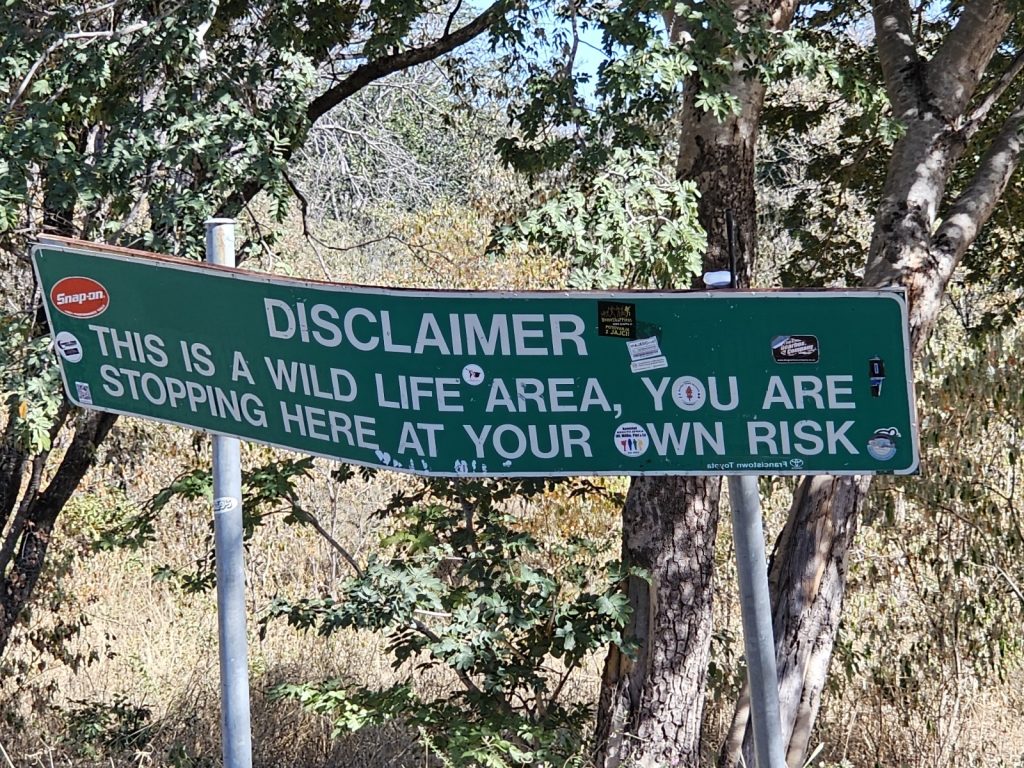
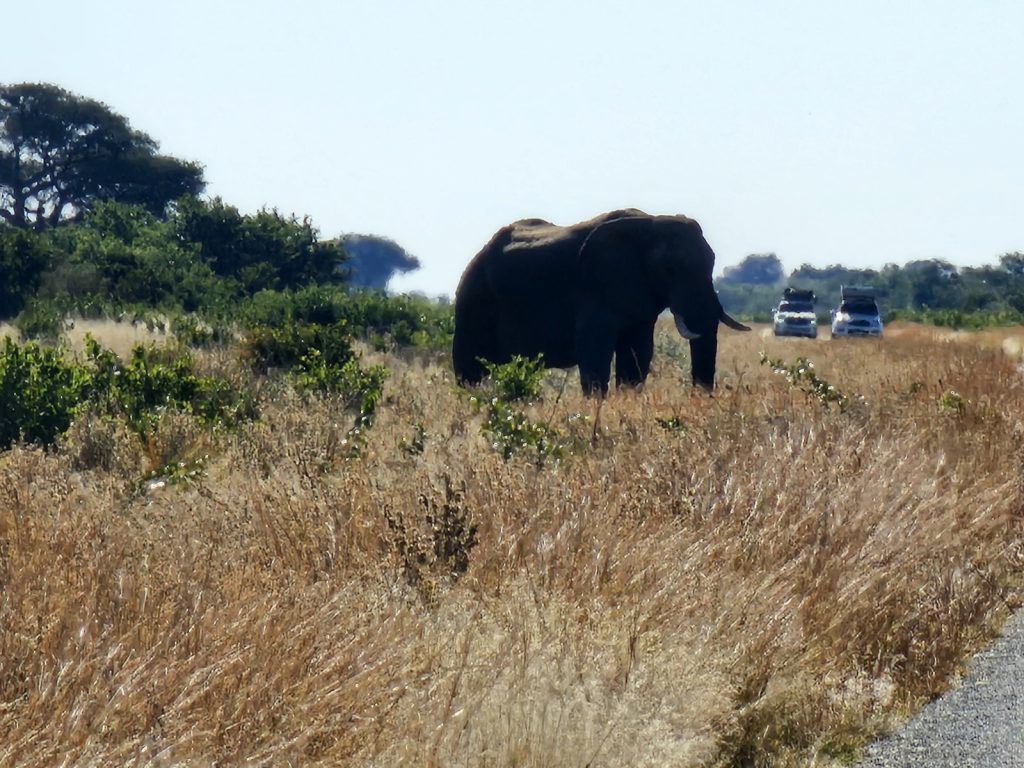
 

Back

KH Day 01. 28 June. Thorl Maglern to Refugio Nordio Deffar. 20 km. 9 hours. 1790m up. 1060m down. We set off just before 0800 after a superb stay at The Pension Galle in Unterthorl. We ate a good breakfast as the first part of the day was a near 1000 metre climb without respite and there was another 800 metres later in the day also. It was sunny, warm and windstill when we walked through the beautiful hamlet of Unterthorl which merged into Oberthorl. It was even more quaint with a huge hay barn with a large overhanging roof covering all the racks where hay would hang in a month or two once it was cut. 

The route followed the track for a km or so as it left the fields and went into the warm beech forest. As the track zig-zagged the route initially followed the track, but it soon cut across a zig-zag through the forest on a small overgrown path. As we climbed into the beech the path cut across more and more until in the end it was purely on the path. It was small and sometimes faint but there were always the characteristic blazes on the trees to indicate where it went. It was a relentless climb with no respite. The day was warm and humid and I was soon sweating. On and on the path climbed through the tall straight beech whose shade was a mercy. 

After a good hour the path met a track and followed it to a great view point where the mountains to the south and east rose like huge grey tombstones. The Carnic Prealps to the south in Friuli were perhaps the most jagged and spectacular but the Julian Alps in Slovenia just 10 km away were larger and there were a few glaciers here. We followed the track for a bit climbing less steeply now and in conifers which I think were firs but did not look closely. In the glades there was a riot of summer alpine flowers and it was nice to see them again, like old friends. The route occasionally followed a track but essentially it was on a path through the forest. However whatever the path went through it was always up. As we climbed more onto the spine of the ridge we got some great views down into the Gailtal valley to the north of the Main Carnic Alps ridge, which we were now following. It was peppered with small hamlets and looked like very good agricultural land, nourished by the silt of the river. 

01. Climbing up the ridge between the start at Thorl Maglern (out of picture to the right) and Göriacher Alm (out of picture to the left). this is the view looking NW down to the Gailtal valley and the voillaghes of Feistritz and Notsch each side of the Gail River

After 3 hours we eventually burst out of the forest and onto an alp where some horses were shading under trees. There were some alm houses further up and we had hoped to have lunch here. We passed a couple of small ponds and then climbed the grassy meadows to reach the small quaint alm houses of the summer farms. There were 8 houses where families would have come for centuries to oversee their animals and do dairy tasks. Most of the houses were in good condition and very quaint. The alm, or alp, was called Goraicher Alm and it was idyllic with great views over the Julian Alps in particular. In the middle of the houses was a large table which could seat perhaps 20 with benches on each side. I have seen them before with the whole alm and its families eating a seasonal feast. Beside it was a great church bell and a small spring of cold fresh water. There was only one family here I think and so we sat at the table and ate our modest lunch. 

02. The view from Goriacher Alm, circa 1650m, looking ESE towards the Julian Alps in Slovenia. On the right Mangrt, 2679m, and right in the middle is Prisojnik, 2547m blocking the view to Triglav behind it, the highest of the Julian alps at 2864m. Thorl Maglern is unseen in the valley in the photo’s middle

After lunch we left at 1200 and continued west. Initially our route took us down a newly made track into the fir forest again, We followed it for a few kilometres as it traversed the hillside on the south side of the main ridge before crossing to the north side. It was not particularly scenic in the trees but we occasionally caught glimpses south into Italy and north across the Gailtal valley to range after range. Eventually the easy track came to an end and we started a long 600 metre descent to a very deep saddle on the ridge. It was disheartening to go down knowing we had to climb back up again, The descent was steep and relentless and was mostly on small paths through the forest. Initially it was dry and dusty between small firs, but as we descended the firs got bigger and bigger, each one growing straight up to try and get its canopy into the direct sunlight. Soon the firs gave way to the beech and which were much more comforting to walk through. It was soft underfoot here and we continued down for well over an hour in all until we reached the Bartolo Saddle. 

We crossed a track and then started up the west side of the Bartolo Saddle. Suddenly I saw a large owl and then another silently follow each other through the trees until they settled on one near us. They had large round faces and one sat still long enough for me to photograph it. It was one of the highlights of the day. It was not a steep climb initially and the cool of the beech forest helped so we soon reached a small cabin on the edge of a meadow. We had a second lunch here to fortify us for the final push up the hill. There was a spring marked on the map but we could not find it. 

03. A Tawny owl in the woods at Bartlosattel (Bartlo saddle) 1173m before the long climb up to Achomitzer Alm, about 1800m.

At about 1500 we left in the middle of the afternoon heat to slog up the final slopes. The route was largely along the border of Italy and Austria as it wove between fir trees. It climbed steeply and it was a hard slog up these metres for an hour and a half without respite until we could see the alm houses of Achomitzer alm. Soon we hauled ourselves out of the flower-filled forest onto the meadow of the alm. There was a spring here so we filled our bottles and then climbed up to the 5 houses and the dairy. There was no one here but it was a lovely calm place and the large mixed herd of cattle and horses gently grazed the meadow as we passed. 

There was still one more climb but it was mercifully small. Initially we had to drop down 100 metres or so to a saddle on a small alm track. It was an easy descent and we cut across the meadow between the bends of the road. After 20 minutes we reached the saddle and started the final climb of the day up to a small chapel which we could see on the descent. The climb was pleasant but tiring at the end of the long day. It was called the Almkapelle Maria Schnee  (Madonna of the Snow). It was a nice place to rest with a large table beside it. 

05. Between Achomitzer Alm and Feistritzer Alm was a pastoral hill with the chaple Maria Schnee (Maria of the snows). It is just visible on top of the lower ridge on the left.

From here it was a short walk down the track to the north across close cropped meadows to the large Feistritzer alm at about 1700 metres. This alm had about 20 houses and a large house with a menu and tables outside. It looked like a mountain hut but it was difficult to see if it was open or not. There was nothing on the internet to say it was previously, so I had already decided to not risk it and push on for another 45 minutes to Refugio Nordio Deffar. However if the Mountain Lodge at Feistritzer alm was open it would have been a great place to stay as there was a real dairy culture here with some 50  cows and also 50 horses grazing nearby. A few of the horses had foals. 

We did not stop here but continued down the easy path across the meadows and into the forest. The path got steeper and steeper as it went through the fir forest and in a few places it needed caution as the track was damaged by a small landslide. After dropping nearly 300 metres we crossed a stream and reached the new Rifugio Nordio Deffar after the old one had burnt down a few years ago. I hoped it would be quiet but it was busy and our room was a bunk room with 8 beds and 6 were already taken. It was a bit of a disappointment after the long day as the manager had said we would be the only ones when I booked. It was now busy and there was no option. However the food was delicious and plentiful and the staff were very friendly and chatty. We sat inside while everybody else ate on the terrace. We had had enough sun for the day. After supper I wrote the blog while Fiona read before going up to the crowded room.  

KH Day 02. 29 June. Rifugio Nordio Deffar to Eggeralm . 13 km. 5.5 hours. 700m up. 710m down. Like most refuges the food was much better than the sleeping arrangements and Nordio Deffar provided a generous breakfast. As everyone was chatting on the terrace getting ready to go, two of our roommates from Germany said they had a friend in Edinburgh. It turned out she was also a friend of mine and we had a lively 10 minutes chat about that before taking a photo of the two of us to send to her. The Germans were on a 3 week hike from Salzburg to the Adriatic, which is getting well known. We all set off in different directions, the Germans south to Tarviso, others east to Thorl Maglern and us northwards to Dolinza alm.

It was a short hike north up the track for about 15 minutes climbing slowly and gently until we reached the saddle and the border with Austria again and burst out onto the open pastures. The sun was shining on the west side of the pastures but where the 15-odd alm houses were in an orderly line it was still in the shade. There was a gasthaus here but it was completely closed save a chalk menu on the outside. I think the gasthaus house was only open at the weekends in the high season, when it was worth their while. We wandered through the alm as the sun chased the shade off the two rows of orderly old log alm houses with their wooden shingle roofs. 

08. Looking east from Starhand hill, 1965m, near Gortschacher Alm towards the Julian Alps. The prominent peak in the middle is Skrlatica, 2740m, some 35 kilometres away.

The route now started to climb westwards in earnest. It went steeply up through the fir and spruce forest on small zigzags. The path was not well marked and often quite faint but it followed the obvious course up the north side of a ravine. The forest floor was full of flowers, especially geranium and buttercup species. As we climbed the forest became thinner and the spruce disappeared to be replaced by fir and larch. The ground cover now was largely Alpenrose, a short Rhododendron which was still in flower. After climbing past the last of the trees the path reached a saddle on the north side of the lower hill of Sagran, which was our highpoint of the day. It was warm and wind still and the sky was clear blue with the occasional hazy sky so the views over to the Julian and Carnic Prealps in Slovenia and Friulian Italy were spectacular. They were immensely jagged mountain ranges. 

06. The wonderful Gortschacher Alm, circa 1700m, was on the north side of the main Karnischer ridge on the Austrian side. The green pyramid hill to the west is Poludnig, 1999m, and Egger Alm is on the otherside of it. The rocky mountains are further west on the main Karnischer ridge beyond the Nassfeld Pass.

We now started the long descent to the valley floor. It was initially very pleasant through the upper larch and fir forest, which was quite thin. Cows were grazing here, heads down chomping on the lush grass and tails swishing to keep the flies at bay. It was an idyllic setting. As we continued down we reached Gortschacher Alm which was about 10 houses, again in a line and all pretty much the same build. There was very little life here at the moment and I guess the cows in the vicinity were not milk cows. Just before we reached the alm we came across a family of young marmots who must have been this year’s kits. They were small and relatively fearless and just scurried into their burrows at the last minute.  They had yet to learn of the dangers overhead. 

07. One of the alm houses at Gortschacher Alm. There were 10 such houses and they probably belonged to farmers in the hamlet of Gortschach in the Gailtal valley, and had done so for centuries.
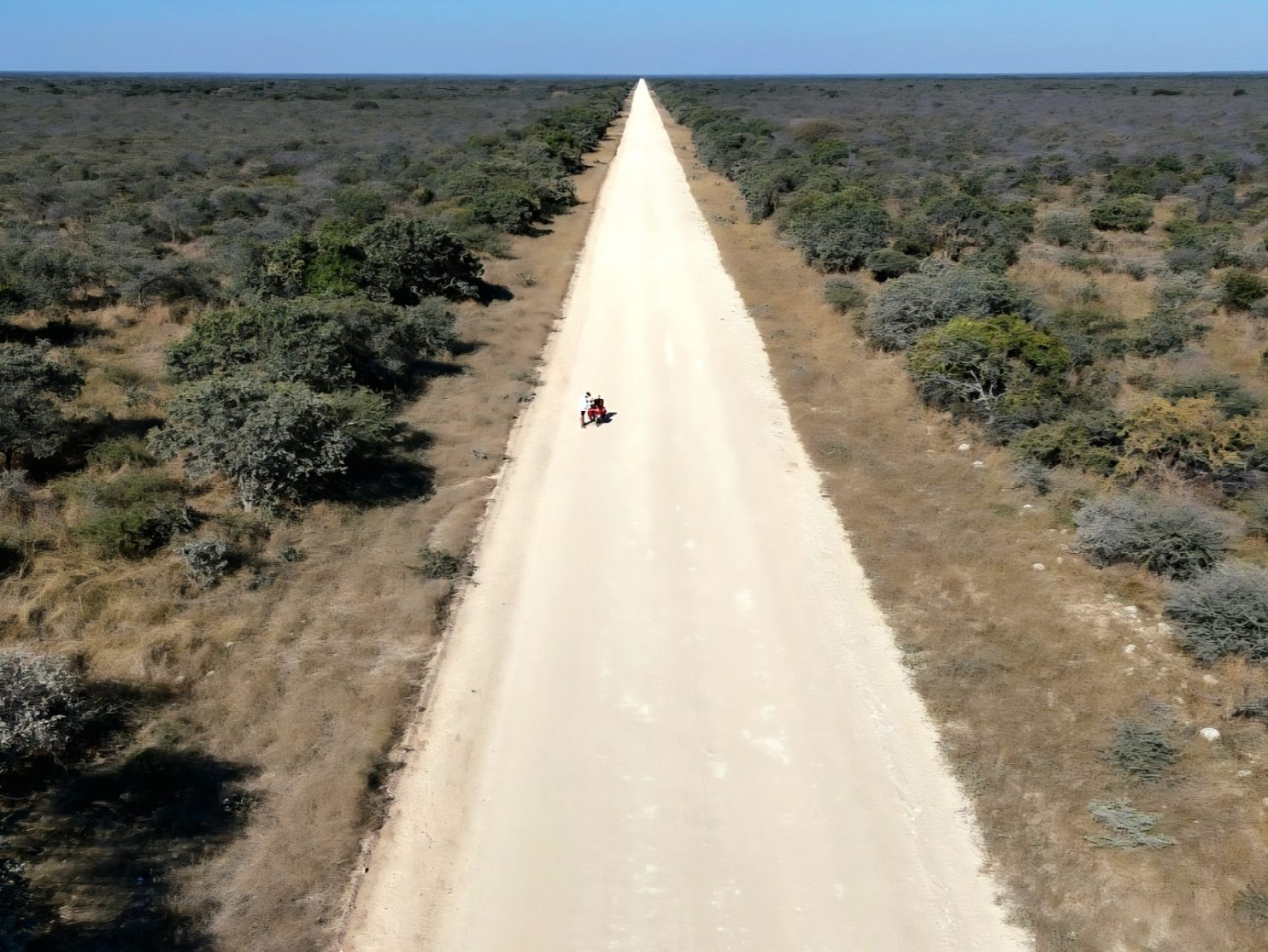
After Gortschacher Alm the route followed the track down into the side valley on a long series of zig-zags until even these were not steep enough so it left the track and continued down through the forest steeply until it got to the small river on the side valley floor. We wanted to stop for lunch here as we had been going 3 hours but there was nowhere great so we carried on down this side stream for another half hour through the forest. We descended into mixed woods until we got to the main side valley with the Seebach stream where we found a log to sit on beside the stream. 

We now had to make one more climb but it was only 200 metres or so. However the hillside was not only steep but the forest had been harvested some 5 years ago and the route was quite overgrown with the first phase of coloniser plants. They often covered the path which must be little used despite it being on a few longer and well known walking routes. The climb was very hot and it was a joy to reach the shade of trees again when the overgrown route met a forest track. A short half hour down the track we reached a large alm called Dellacher alm. Its 30 odd houses were arranged on each side of a track and surrounded by a large pasture. There were some signs of dairy work here but not much and I think most of the alm houses were holiday homes and some even rented out for a week at a time. There was a small restaurant here and as we were parched we went down to it and had a soft drink each.  The other clients all seemed local from the alm houses. 

Refreshed, we continued west for the last leg of the day. We followed the small alm road for a good kilometre until we reached the reed fringed Eggeralm See, which was a small lake. Here we thought going round the roadless side of it on the path would have been nicer so we left the track and quickly found the path. There was a large mixed herd of cows and horses here with at least 100 animals in it. Many of the horses were huge and strong. I am not sure why there are so many horses in these alms and assume they are for the table eventually. Past this herd we met the shores of the lake and flushed a few ducks from the reeds which mostly swam to deeper water, but some took flight. It was a lovely walk across the meadows with occasional giant silver fir standing alone and proud with their huge branches drooping down to the ground. At the west end of the lake was another large herd of cows and horses again with about 100 healthy large beasts. We rejoined the road soon after and then followed its level course across the open valley floor to Eggeralm. 

09. The lovely Egger Alm which lay at about 1400m altitude in a pastoral valley had about 40 alm houses, 2 guesthouses a dairy and a small chapel. It was a very active alm with a strong community cooperation and thriving cheese dairy.

Eggeralm was large with about 40 houses and a chapel. It also had a guest house and a diary. Most of the houses were log and timber with pretty balconies. The houses usually sat on a stone or concrete basement which would have once been the diary. However it seemed many of the houses were now holiday homes, often for the original families which owned them. There were two guesthouses here and we had booked into to the nicer of the two “Zum alten Kaseri” which was right opposite the cheese dairy. The owners took us upstairs to the upper floor where there was a long corridor with 3-4 rooms on each side and a big balcony adorned with young geraniums along the edge. It was idyllic. We were shown a room with two old wooden beds next to the balcony. There was a shower and we soon had one and hung the washed clothes out to dry. Thereafter we went down for a drink at the pub, or stube, underneath. 

The dairy opposite had a shop so we went in to enquire about the cheese and butter it made to try and find out more. The 40 cows were milked at the far end of the building and then their milk went into the middle part of the dairy where it was made into butter and cheese. The ladies in here showed us the vast stainless steel vat where the cheese was curdled and formed, and then the press which had 4 large truckles in it wrapped in cloth where the whey was squeezed out and the cheeses were set. At the end nearest the gasthaus was a small shop where the camembert-type cheese, butter and other local dairy products were sold. It was a fascinating place but my German was just too clumsy for us to have anything but an awkward conversation and I was worried we might be a nuisance so left.  We learnt the cows were milked at 1700 and 0500 so hoped to find out more then. However when the 40 cows were driven down the hill to the dairy we could just watch them. I tried to initiate a conversation in the hope we might get invited in to watch but they were too busy to bother with us. 

10. Watching the 50 odd cows being escorted down to the milking parlour beside the dairy and cheese production. The cattle were milked twice a day at 0500 and 1700 and their milk turned into cheese and butter almost immeadiately, as it has always been.

Dinner was early at 1800 and we both had a large plate for food. I think Austrian hospitality is the most generous in the Alps and this place did not disappoint. The menu was full of local specialities and dumpling varieties. Nobody in an Austrian guesthouse goes hungry. As we ate the wind picked up and the skies which had been getting darker all day were now a dark grey. It seemed the weather might change and the forecast was not great for tomorrow. We went upstairs after the meal where I wrote the blog on the balcony overlooking the busy alm. It seemed a very sociable place and everybody greeted everyone else. It seemed everyone here was involved in the dairy to some extent. I wish I could have found out more but the language barrier prevented me asking even if the cows were individually owned or part of a collective, and if the former, were the profits distributed accordingly. It had been a very nice day and it was a perfect evening at the quaint and interesting Eggeralm.  

KH Day 03. 30 June. Eggeralm to Nassfield. 14 km. 5 hours. 640m up. 530m down. We both had a long undisturbed sleep in the dark pine panelled room in the lovely Gasthaus. Breakfast was also a sumptuous affair with a board of cured meats and a selection of cheeses all on dark heavy bread which filled one up. In my experience Austrian hospitality is the best in the Alps and better than the French or Italians. The Swiss are the worst with parsimonious servings at exorbitant prices. They need to take a lesson from the generous Austrians. We ate outside under grey skies with a good breeze blowing. However it was still warm even though we were at 1400 metres. 

We set off at 0900 and followed a gravel track as it contoured across the hillside through forest on the north and the west side of Planja mountain, 1720m, a forested knoll in the alpine scale. It was an easy and pleasant 3 km and we covered the ground quickly. There was a carpet of flowers in the glades between the fir trees. However after these 3 km we reached a saddle, the Stallen Sattel 1496m, on the main ridge, and the border with Italy, and then started to descend. The descent was rich in flowers as the landscape was less densely covered in trees as it was south facing and dry. As we descended there was the occasional section of path which had been washed away in Biblical rainstorms over the last 20 years and here the path was narrow, loose and exposed for 10-20 metres. To our south there were frequent steep gravel slopes where small landslides had scoured the hillside. On three occasions there were old metal cables to hold onto as we crossed the rim of the landslide on a narrow shelf. This section went on for a good two kilometres but it felt much longer. As we traversed down the steep hillside the valley, called Vallone de Rio Blanco on account of the small stones which had been washed down, came up to meet us and the terrain eased off. We seemed to be walking along an old military road as along the steeper more precarious bits on the steep dry pine clad rocky valley side and also the gentler section through the beech forest there was once a narrow track perhaps for horse and cart. Generally the track was OK but where the deluges had damaged it in rocky ravines and swept away the terraces or bridges in the last 50 years no repair was done. When we reached the floor of the Vallone de Rio Blanco we headed west again up a better track to a saddle on the main ridge and the Austrian border. The saddle was called the Stutenboden sattel, 1440m. Just before it we passed a herd of beige bullocks chomping the grass in the glades of the forest and I took a photo. 

After the saddle we passed over a small alm with a single house and climbed slowly on a track on the north side of the main ridge and high above a deep wooded valley with the Garnitzenbach stream. Across from this on the other side of the valley rose the very imposing Gartnerkofel mountain, 2195m. It was the highest and most alpine of all the mountains on the ridge so far and looked like it was from the Dolomites with its sheer light grey walls rising up to jagged inaccessible peaks. Below the walls were fields of steep  scree much of which were covered in the dwarf pine, Mugo mugo. As we walked up the fir lined road two ladies drove up and stopped. They were local farmers and had lost their cows. I showed them a photo to confirm they were the ones they were looking for and they were delighted. I told them they were in the woods half a kilometre into Italy. 

The track soon ended and then we had to stumble along a path through the woods for nearly a km until we got to a green open ski piste, which was well grazed in the summer. We crossed the piste and climbed up to a large hut with a terrace wrapped round it. It was called the Garnitzeralm and it was open so we went in to have a soft drink and bread and cheese. The hosts were very friendly and it seems there were rooms available here also. However it was only an hour away from the fleshpots and bright lights of Nassfield, which is where we were heading. However there was still a good 300 metre climb up past a water pond and through the woods beside the piste to the top of top of the pass on the south side of Gartnerkofel mountain. The water pond was artificial and it used to make snow in November and December to extend the ski season. 

11. Climbing up past Garnitzenalm under the south face of Gartnerkofel mountain, 2195m, to go over a pass and descend to the road as Nassfeld Pass where there is a ski resort.

At the top of the pass, 1856m, Nassfield appeared some 300 metres below us on a major crossing over the main Karnischer Alps ridge. This pass was called the Nassfield or Pramollo Pass depending on language. It was a ski resort in the winter and there were loads of dormant hotels which were closed, waiting for the snows to return. However there were also many hotels which were open for hikers, cyclists and motorists. We had chosen the Wulfenia da Livio which had a restaurant also. It was beside a small lake on the Italian side and away from the sprawl of the ski resort which was mostly on the Austrian side half a kilometre away. 

12, Vibrant meadows, full of buttercups, just above Garnitzenalm enroute to Nassfeld Pass

The walk down was both on the piste and in the woods beside it. It was raining now and some of the bare rocks were greasy and slippery in the forest and we had to take care. The rain continued all the way to Watschiger Alm where there was a chairlift at the end of a road. The chairlift was running for summer visitors and hikers. We bypassed this slightly industrial complex and walked 2 km down the road to a chapel on the border with an Italian flag on the south side of it, and an Austrian flag on the north side. We went down a track on the Italian side to the lake and our hotel. We had a great room with a large balcony and a view over the lake and tomorrow’s mountains. However it was still raining and the mountains were covered in mist. After a shower we went down for a second lunch of a salad and then I wrote the blog before dinner. The hotel restaurant was closed for dinner but the owner’s daughter had a pizzeria some 200 metres away which had some of the best pizzas I have tasted. During the walk to this pizzeria the rain stopped and blue sky appeared but the forecast for tomorrow was wet.

KH Day 04. 01 July. Nassfeld to Straniger Alm.  17 km. 7 hours. 850m up. 860m down. It was still dry in the morning but the mist was low and covered pretty much everything. We could not even see across the small lake. Breakfast was at 0800 and it was a buffet. It was not well prepared and there was no one about except the owner’s daughter and she was on her phone. So we helped ourselves and then made up a couple of rolls and boiled some eggs for lunchtime. By the time we eventually set off it was 0900 and the air felt very damp. 

We walked round the lake to the dormant borderpost at the pass. Here we left the road just at a large hotel complex with about 6 adjacent modern wooden blocks which were all part of a ski hotel. We initially walked up the piste climbing slowly in the mist until the expected rain finally arrived. It was heavy with large droplets splashing off our jackets and rivulets running down the path. It stayed with us all the way up to the top of the piste when it eased and then stopped.

At the top of the piste was a curious set of water features, a small lake and play area, which all seemed to celebrate that this once war torn area was now at peace. We dropped down through it and then continued down towards the base of some ski lifts. I was worried we were losing too much height and that we should have taken a higher path but then the mist cleared to reveal Rosskofel mountain, 2240m. The other path I wondered about went over the ridge of this large jagged mountain above the huge cliffs which were now obvious. It would have been a much longer alternative. The route took us down the piste but before it got to the bottom a path branched off to the west. We took it and wove between outcrops and larch trees beneath the large cliffs and scree slopes on the north side of Rosskofel mountain. 

After half an hour of weaving through boulders and trees the path started to climb. The rain started again as we began the climb and it was very heavy. Rivulets were streaming down the outcrops and flowing down the path. There was the odd clap of distant thunder. The further up we climbed the more the path became obvious as it must have been a 100 year old military construction to move soldiers or supplies. However as we climbed the rain continued to pummel us, and the thunder was more frequent and loud with some violent claps occasionally. After an hour, and some 2.5 hours after leaving Nassfeld, we reached Rudnigsattel, 1945m. I thought this would be the end of the climb and the more awkward part, but there was a lot more to come. 

13. Looking down Valle di Aip on the Italian (South) side of the Karnischer Ridge during a brief lull in the torrential rain and thunder.

Instead of dropping down the otherside of the pass into the lovely Valle di Aip on the Italian side with its characteristic red bivouac shed with 9 cramped beds, it continued to climb along a ridge. This ridge was a narrow crest between two bowls, the one we had just ascended and the Valle di Aip. Occasionally we had to clamber over a outcrop while the rain continued to fall and the thunder roared overhead.  Half way along the rain stopped and the skies cleared to reveal a massive mountain we were walking towards called Trogkofel, 2280m. As soon as the rain stopped the choughs came out to play, soaring along the ridge. 

Once we reached the base of Trogkofel the route veered west along the base of the cliffs. We picked our way along this rocky path, which was covered in interesting flowers which must have enjoyed the south facing aspect. The path went on for much longer than I thought as it undulated across the scree. Half way along the rain and thunder started again and it was heavy, with some hail mixed in. Rivulets started to cascade down Trogkofel and also on the mountain on the south side of the Valle di Aip, called Creta di Rio Secco. At the west end of Trogkofel I thought surely we must go down now but it continued to traverse round the shoulder for another half hour before we started to descend. We dropped down through the dwarf pine to a junction of paths at the east end of a long scrub covered ridge called the Rotterndorfer Schneid. We had been going for 4.5 hours without stopping, so in a brief lull in the rain and with atmospheric mists swirling around the jagged peaks we stopped for a late lunch. 

14. Walking round the south side of Trogkofel, 2280m. It rose steeply to the right (north) from this path.

We set off again a little after 1400 and walked along the low scrub covered Rottendorfer Scheid for a good hour. Although the slopes were gentle the path was rocky and slow and we had to be careful as we pushed through the scrub. By now it was raining again I could feel my feet getting wet as we had to slosh through large puddles. There were many salamanders out and about on the track, perhaps 50 altogether today and we had to take care not to step on them as they were slow and clumsy. Slowly we climbed up the gentle rocky ridge to a shallow pass and then crossed over into Italy. Down in the bowl below the ridge was a beautiful Magla, or dairy, called Cordin Grande. It had 3 buildings one of which was the alp house and one the dairy. The whole complex looked like a Victorian romantic painting with the mist hanging over the trees and meadows. As we circled around the bowl which the dairy sat in we came back to the border again and a fence. Crossing the fence to Austria we then started the final descent. 

Initially it was on a lovely path which was wide and even as we dropped into the larch and then fir trees. Soon we could hear cow bells and knew that we were back in the safety of the forest. It was an easy path and despite the rain there was relief to be back in the conifers again with the usual flowers. One which we saw a lot of was a tall white geranium. After an easy hour walking down the path we finally met a track. This track led us all the way to Straniger Alm through the tall fir trees. The wind which blew the rain into our faces earlier in the day on the higher paths was now completely gone. It was a very easy track to follow with just the right gradient to keep the momentum going. After a T junction we rounded a corner and reached a herd of some 50 cattle being driven down the track for the evening milking. We followed them for 100 metres to reach the main building of Straniger Alm which was the Gasthaus. We went in, dripping wet, to a fire and great reception. 

15 Straniger Alm, circa 1500m, is a working alm making cheese from both goats and cows. It has a good guesthouse attached to the dairy where the cheese is made. Pictured is the alms milking parlour

We were given a lovely room with 3 beds and were shown the shower. After sorting ourselves out we went down to the small stube (living room) with the fire where there were another 6 hikers. It was quite cosy. We all ate together from a selection of local dishes, with many of them featuring the cheese the alm made in the dairy, which was the other half of the gasthaus building. When we finished I wrote the blog. The only downside was that just before 2000 some 25 Austrians arrived by car. They had already booked but the stube was taken over by them and we were all squeezed into a corner. I feared they would be noisy later but they were not. 

16. Goats were also kept at Straniger Alm and some of the cheese produced were a mix of cows and gosts milk.

KH Day 05. 02 July. Straniger Alm to Zollner See Hutte. 6 km. 3 hours. 450m up. 220m down. Everyone was surprisingly quiet in the night and there were no disturbances from the group of 25. Breakfast was served at 0700 and was good. It included 2 mature cheeses, a soft cheese and a quark type soft cheese, all made at Straniger Alm. The mature cheeses were from last year and had overwintered in the valley before being brought up again. The two mature cheeses were a mix of 50/50 and 90/10 cows milk and goats milk. Even the butter was made in the dairy next door. There was also smoked meats, muesli, yoghurt and buttermilk with the dairy products being inhouse. It was a great breakfast. We said goodbye to the other hikers who were heading to Nassfeld and then went down to the milking barn where the goats were all penned in waiting to be milked. From here the route went west up the hill.

17. Looking back down to Straniger Alm with the dairy and guesthouse visible and the milking barn mostly hidden by trees

It was an easy climb through the fir and then larch forest to the treeline at around 1750-1800 metres. The weather was improving and the morning mist was clearing quickly. Soon there were large patches of blue sky and these soon merged together so the clouds were isolated. It was a far cry from yesterday. Near the top of the trees I saw a couple of goshawks. They were about the size of buzzards and predominantly white underneath. They were gliding into the wind and had their wing elbows thrust forwards as if in a dive.  We passed a local repairing a fence to keep his cattle from staying out of his pastures. He was older and dressed with a typical Tyrolean hat made of felt. Above these pastures we continued up through a knee high forest of the alpine Rhododendron, alpenrose, which were at their prime giving the whole hillside a purple hue. Well over an hour after leaving Straniger Alm we reached the top of the 400 metre climb at a watershed by Lodingtorl and half the day was already done. 

For the second half of the day we contoured the steep slope on the north side of the craggy Findenigkofel, 2016m. The path was quite small in places and there were steeper drops below across the scrub covered scree. It was not exposed but occasionally awkward. Above us the much steeper bare rock slabs rose up to the craggy ridge. As it was north facing it was slightly damper and yet in the summer months the sun still shone here so the entire 2-3 kilometre hike was ablaze with flowers. There were every type here and some very unusual ones with arnica, sow thistles, geraniums, lilies, louseworts to name a few and they formed a waist high forest. Occasionally there were also thickets of willow. The whole hillside was stunning and ablaze with colours. It was also teeming with insects which were feeding on the wildflowers and these in turn were being fed on by squadrons of passerine type birds, like chiffchaffs and Blackcaps. It was a slow walk however, on account of the rockier terrain and small path. 

As we traversed across on this flower filled balcony path we passed over two alms, each of which had a herd of cows nearby. If the alms did not make cheese themselves I am sure a small truck would have collected the milk once a day and taken it down to a collective cheese dairy in the valley. This eastern half of the Karnischer Alps is renowned for its cheese dairies. After we passed the second dairy, called Achornach Alm, the narrow balcony shelf became broader and more heathlike with less flowers and more low scrub of juniper and rhododendron. There was the occasional marsh, which was a lake once which had silted up completely over the last 5000 years since the ice left. Far down in the deep U shaped valley we could see the green fields on the floor of the Gailtal valley. There was a village here too called Dellach. 

The wide undulating shelf, now on the westside of Findenigkofel, rose up to a saddle on the main Karnischer ridgeline before the next craggy mountain rose up called Hoher Trieb. We did not climb to the saddle but continued to contour westwards reaching a lovely reed fringed lake called Zollner See.  It was about 300 metres long and 100 metres wide and was refreshing to see as the sun was now almost unobstructed by any cloud and the day was warm. Just after the lake the path descended slightly down to a bowl on the northside of Hoher Trieb where the Zollner See Hutte stood at about 1750 metres on the treeline. Beside it was a peace chapel to commemorate all those who died in the First World War. We made our way to it past a bulging marsh, also a silted up lake, and a small pond full of tadpole and juvenile Alpine Newts. It was just after 1200 and the day was done. 

18. The idyllic Zollnersee lake at 1766m. The mountain lodge lies just beyond it. The mountains in the distance are the ones to cross tomorrow and lie the other side of the deep Kronhograbben gorge like valley.

I had booked a dormitory bed as everything else was taken, however they had had a cancellation and to Fiona’s delight we could upgrade to a small room with a bunk bed. We were soon ensconced and then went outside to sit on the benches in the sun and eat lunch. One of the region’s specialities was cheese dumpling soup which Fiona tried. We also chatted with a very fit young French sportsman from Annecy, who was half running and half walking the entire Alps from Ljubljana in Slovenia to Nice in France. After lunch we went for a short walk to the neighbouring Rosseralm where there were some goats. Later I wrote the blog while Fiona sat in the sun and painted. By 1800 we were done and could relax over dinner and chat with other hikers, all of whom were coming in the opposite direction down the Karnischer Alp ridge, having started in the higher craggier west.    

19. One of the goats at Rosseralm which also offers accommodation and lies near Zollnerseehutte mountain lodge

KH Day 06. 03 July. Zollner See Hutte to Untere Valentinalm.  19 km. 9.5  hours. 1050m up. 1580m down. The hut warden at Zollner See hutte was a very easy going and relaxed man and he said we should just make our pack lunches at breakfast. We knew we had a long day so we made double lunch packs, and had a good breakfast too. We were pretty much ready to go at 0730. There was rain forecast for later in the day and we hoped to be over the narrower more slippery sections before it arrived. 

From the hut we went over a shallow saddle, just to the west of the hut, on the north side of Hoher Trieb and then started the first of a few descents. The first took us down through the larch and first trees on a narrow path. It was quite steep and occasionally overgrown, however the route was obvious. After a short hour we approached the cow bells in the Obere Bischofalm. The alm itself consisted of the chalet type house which was in good condition and had the flag of Karnten province hanging limply outside in the yard. I think it occasionally served food and there was beer in a water trough and an honesty box. Beside it was a barn also in good condition. I don’t think there was any milking here and all the cows were bollocks or cows not in milk. There were perhaps 30 and also 20 horses. The farm was really perched in a high inaccessible bowl and the only track up to it was from Untere Bischofalm far below in the deep Kronhof Graben valley which was almost like a gorge. 

20 On the way from Zollnerseehutte down into the deep Kronhofgraben valley we passed the beautiful old Obere Bischofalm, which did not have a working dairy.

From the alm we now followed the track down zig-zags to the valley. The hillside was steep and the track was a godsend but it was short lived as after a good half hour and well above the valley floor our route branched off and started to traverse up the side of the valley on the east flank. The path here was narrow and the hillside steep but it was covered in scrub which made it safe. There were a few outcrops to cross but these were quite easy really. After rounding a spur the whole upper part of the valley revealed itself. It was a great smooth bowl, the rim of which was the Italian border. At the saddle it was relatively low but on each side the mountains rose up into the mists. We walked up to the centre of this bowl pushing our way through the deep and lush vegetation of waist high wildflowers. It was a very fertile area and the flowers were dense. 

21. The sides and floor of the Kronhofgraben were covered in wild flowers including many of these, called Phyteuma nigrum or black rampion,

In the centre of the bowl there was a path which continued up to the saddle and over to Italy, but our path continued to circle round the bowl and started to climb up the west flank. It rose up above the crags which lined the bottom of the gorge-like valley on a diagonal path, which eventually climbed to a shelf where there was a hunters cabin. We had been going for nearly 3 hours so we stopped outside this cabin for our first lunch looking over the deep valley and the Obere Bischofalm on the other side. It was not far away as the crow flies and we could hear the cow bells from here. 

22. The climb up the west side of Kronhofgraben was across lush hillsides covered in wildflowers and small shrubs. It was on a good path and led up to a small halfway hunters cabin just visible centre right

As we ate lunch the mist came and went and came again but by and large the mist just remained on the summits over 2000 metres. It was up one of these summits, Koderkopf 2167m, which we now had to go to. The path climbed steeply from the cabin and entered a shallow valley which rose steeply up the side of the mountain. The slopes were covered in alpenrose rhododendron and much of the hillside was ablaze with patches of deep red. Slowly but surely we gained on the summit and alerted a number of marmot sentries whose shrill whistle warned the rest of the colony that there was danger about and it was best to head back to the burrows. At the very top there was a brief view back over the route we had taken and even Zollner See hutte was just visible. On the west side of Koderkopf the view to the mountains was impressive as this was the higher end of the Karnischer Alps ridge, but the mist soon obscured it. Near the top Fiona spotted a ptarmigan with about 10 chicks which scattered into the short grasses and bushes as we approached. 

23. The hunter’s cabin with Koderkopf mountain, 2167m, behind it. We stopped here before the climb up this mountain.

24. At the top of Koderkopf we came across a ptarmigan with 9 chicks. They were well camoflaged on the path, but broke cover as we approached as we did not see them until the last minute.

We heard the descent down the otherside was on a wider path and relatively easy, however it was not. It took a good 3 hours to follow the small rocky path down dropping some 7-800 metres. The path was narrow, rocky and sometimes a little slippery, although there was no great danger. We had to walk carefully and virtually place every step. Occasionally the path traversed across the hillside into a small stream bed but then dropped again. As we dropped down and traversed west we passed over a forested valley far below us with scattered alms in it and distant cow bells echoing across the valley sides. Far to the west was a huge mountain, the most easterly of the big mountains in the Karnischer Alps and it rose very steeply with a sheer north wall to nearly 2800 metres. It was called Hohe Warte and we would walk under it tomorrow. At last we came to a derelict alm which was built in 1932, probably as part of a socio-economic project like the nearby Italian ones from the same era which Mussolini built. This alm was called Obere Tschintemunt alm. From here the path became much wider as it was constructed nearly 100 years ago to serve the alm. 

26. Looking back to the steep and tricky route from Koderkopf from above the riuned Obere Tschintemunt Alm. The route descended from thje saddle to the left.

We traversed up the wider grassy path which contoured round the open valley climbing slightly. It was a welcome relief to be able to stride out and we could relax a bit at last. It took us a couple of kilometres to a small modern wooden hut, called Obere Speilbodenalm, on a prow which had a great view. It also had a bench outside it so we had our second lunch here. We knew there was a long descent to follow but we were lulled into a false hope by a track to serve the wooden hut. However when we set off again we discovered that the route did not go down the track but on a small path through the forest. 

25. In the more rocky places around the ruined Obere Tschintemunt alm there were many Mountain Houseleeks, Sempervivum montanum.

It was a long and tiring descent and it seemed to go on for ages, nearly 2 hours, during which we dropped a further 700 metres. The only respite was an open pasture where we had to weave through a herd of bullocks and cows not in milk. The path was never very steep as it zigzagged a lot, not was it very exposed or dangerous but it was occasionally slippery, especially now the predicted rain had started to fall. At last we rolled out of the woods onto the side valley floor where there was a small lake, called Grunsee. It marked the end of the descent, but by now our legs were tired. 

We walked round the north side of the lake and down a track passing another large working Alm with cattle outside and then reached the road over Plockenpass, the main pass over the Karnischer Alps between Gailtal in Austria and Friuli in Italy. There was an old gasthaus and restaurant here which was boarded up having seen better days many decades ago. We crossed the road and started the very last section of the day. We had to climb over a small spur some 100 metres high and then walk up the side of the Valentin valley for a couple of kilometres to reach our Gasthaus for the night. It was a lovely walk in deciduous forest, mostly beech. The shallow track down the other side of the spur was covered in many wild flowers, and some I had never seen before like a giant blue gentian and bright lilies. With tired legs we crossed the stream which came down the valley under the very imposing north wall of Hohe Warte, which loomed above us, and walked up to the Gasthaus at Untere Valentinalm. We got there just as the rain started in earnest and rushed through the door as it started to pour. 

27. The tremendous walls on the south side of the Valentintal valley which led up to the highest mountains in the Karnischer Alps namely Hohe Warte, 2780m and the adjacent Kellerspitzen, 2774m.

It was busy inside with hikers and diners. Eventually we were shown a small double room, the shower room and told to take our time and relax before coming down. It was already 1900 but they said the kitchen would stay open for us. After a great shower and clothes wash, we went down at nearly 2000 for our meal. It was large and unhealthy but we had earned it. After the meal I found an empty room upstairs to write the blog and where I could charge all the gadgets and was eventually done by 2300 after a long hard day.

KH Day 07. 04 July. Untere Valentinalm to Wolayersee hutte. 6 km. 3.5 hours. 950m up. 190m down. It poured in the night and it was cosy to lie in bed and hear the rain battering off the zinc roof outside. By the morning it had stopped, but mist hung over the valley and everything was dripping wet. There was no rush today as we only had a 6 km hike with 1000 metre climb which should take 3 hours, so we started breakfast a bit later at 0730. It was a very good buffet style breakfast with heavy bread flavoured with caraway seeds and cheeses, meats and jams to make it more palatable. I managed to upload the blog after breakfast and so we did not set off until 0930 by which time the sun had started to burn off the mist. 

28. The floor of Valentintal valley was perhaps the richest botanically of the entire trip with hundreds of spieces of flowers. Here is one the Lilium martagon, the martagon lily or Turk’s cap lily,

We initially followed the track up the valley. It was very deep and U-shaped at the bottom of a slot with the enormous Hohe Warte on the south side and Gamskofel on the north. There was a huge wall, perhaps 7-800 metres of vertical face which rose up towards Hohe Warte, which must be a climber’s paradise. As we walked up the track deeper into the slot the sides of the valley squeezed together and the gradient became steeper. It was very spectacular. However what was also very impressive was the wild flowers. I have hiked in much of the Alps in different seasons but have never quite seen flowers like this. There was such a variety and they were so densely packed together it almost looked like a herbaceous border at a botanical garden. Soon the track started to zig-zag and a path cut across the bends through the woods making the route shorter. After a quick hour we emerged from the woods onto the track again just by the new and well maintained Obere Valentinalm. This alm had about 40 cows around it and was near the treeline. 

29. Heading up Valentintal valley towards the Valentintorl pass, 2138m. The mountain to the left is Hohe Warte. 2780m.

Above the cows the track vanished and a rocky path started across the scrub covered hillside. There were lots of marmots here and none sounded the alarm when hikers went past so they must have been used to hikers. The valley split now with an open steep grassy slope heading up to a high saddle to the NW and the deep slot with snowfields to the SW. We had to take the latter and were forced to cross a few shallow snowfields which lingered. They were here because it is where the winter avalanches left them. The snow however was deep and firm and easy to walk across. 

30. Loking back down Valentintal valley to the east where we came. Beyond the Plockenpass in the deep valley photo’s middle rises the steep Polinik. 2332m, mountain which we skirted to the south (right) of yesterday.

The higher we walked up this deep valley the more impressive it got, especially the massive walls on the south side leading up to Hohe Warte, which I discovered was the highest mountain in the Karnischer Alps. There were more snowfields and I walked up them as they were firm and shallow, while Fiona clambered up the rocky path. This valley ended in a bowl with just a single pass to escape out of the circle of rock walls. The climb up to the pass was relatively easy and the path was good. It crossed a few small snowfields but so many people had walked across them there was a shallow trench. At the top was a grassy saddle called Valentintorl at 2138 m. 

31. Loking down the top of Valentintal valley from Valentintorl pass. The big mountain on the right is Kellerspitzen, 2774m.

The pass was actually a superb viewpoint with the main ridge of the Karnischer Alps just to our south, but way above us some 3-500 metres higher up where there was a string of very jagged and totally inaccessible peaks, all a top vast walls of a lighter coloured limestone type rock. The route we walked up was spectacular, but to the west the descent was also immensely impressive with sheer sided mountains.  We could see down the valley we had to take to the light blue Wolayersee lake below. This valley was full of snow but it was shallow and there were tracks across it. At the saddle there was a small group of marmot on the grass. Their burrows were nearby and they made no effort to hurry to them as we approached. Instead two adults actually started to play wrestle with each other. 

35. There were a lot of marmots on the grassland at Valentintorl pass. They were fattening up for the winter and playing in the sun.

After a good pause to take in the surroundings we set off down the path on the west side of the pass. After a short descent down a headwall there was a continuous snowfield which went all the way down to the lake. I took it as it was fast and easy on the knees, while Fiona came down the path beside it occasionally crossing the snow when the path did. It took a quick half hour to reach the lake which was fringed with a green and then turquoise hue when the sun shone on it. It was quite busy at the lake as there was a track to the Wolayersee hutte which now appeared at the north end of the lake. We had to clamber over limestone type rock slabs with crevices filled with gravel and silt, and now a mass of flowers, especially geraniums. This rugged path was not long but took time and it led us to the lodge which looked newly refurbished and well cared for. 

32. Looking down the west side from Valentintorl to Wolayer See lake and then the rocky tower of Seekopf, 2554m, rising beyond it.

33. The easy descent on the snowfield from the pass of Valentintorl, picture behind, down to Wolayer see lake

It was 1400 when we arrived and got a hearty welcome from the lively hut warden. He told us our room number which was a dormitory as we expected. It had 8 beds in it, 4 below and 4 on top with a divider in between the middle beds, so there were two mattresses on each side. The room was very new and clean and had a great view onto the NW ridge of Hohe Warte which rose up nearly vertically just across the lake for 600 metres. After we unpacked we went down to the dining room with the same spectacular view out of the large glass windows for lunch. We sat at a table with a cowherd, called Johannes, who had just dropped in for a meal. He was looking after cows for 9 families and had 80 beasts to keep an eye on all summer. He had a chalet house beside the path we would pass tomorrow and invited us in for a coffee when we passed tomorrow.  After lunch I wrote the blog while Fiona went to explore and look at the flowers and view near the hut. I was done by 1630 and intended to relax and socialise for the rest of the day.  

34. The flowers on the east side of Wolayer See lake were thrinving on the limestone rich rock and silt. In the background is the renovated the Wolayerseehutte mountain lodge, 1967m.

36. Looking SE from the dormitory window of Wolayerseehutte, 1967m, across the lake and towards the huge tower of Seewarte, 2595m, which is a spur on the west ridhe of the even higher Hohe Warte just behind

37. Wolayerseehutte mountain lodge can sleep about 70 guests. They sleep mostly in dormitories with about 8-10 to a dorm. The beds are on two levels with 4 to 6 below and the same above. The beds are frequently seperated by small barriers. You sleep in your own sleeping bag liner and use their blankets.

KH Day 08. 05 July. Wolayerseehütte to Hochweisssteinhaus. 6 km. 3.5 hours. 950m up. 190m down. It was a beautiful day when we woke up at 0600. There were another 4 people in our room and we all got up at the same time so it was a bit congested getting ready. Breakfast was buffet style and we took enough for a packed lunch also, which we paid extra for. By 0730 we were ready to go and said goodbye to the 4 young Germans from Dusseldorf who were on their first hike and were loving it. As soon as we left the congested hut and the outside dining area we were alone again. 

38. The absolutely idyllic Obere Wolayer Alm at 1700m, where Johannes lived for the summer looking after a herd of 80 cows, which belonged to a collection of farmers in the valley.

Initially we dropped down the track, which served the hut, for half an hour cutting the zig zags occasionally. It spilled us into a high valley right on the tree line where about 20 cows were gathered round a salt lick. There was a small shed here but we thought it was too small for the cowherd who we met yesterday so we carried on down along a mixture of track or forest path for another half hour until the roof of Obere Woyaler Alm appeared through the treetops. 5 minutes later we arrived at the lovely traditional chalet house with a small barn beside it. It was at the end of a long meadow which had a further 40 cows on it. It was a stunning setting with a wall of cliffs surrounding the meadow but far enough away so as not to make it feel claustrophobic, or impede the sun. There was the sound of wood chopping coming from the barn so we went in and found Johannes in there. 

Johannes was delighted to see us and offered us a coffee in his chalet. It had a surprisingly modern kitchen with a very new and efficient looking wood burning stove. We then went outside and sat in the sun. Johannes was a very bright and learned man who was quoting Shakespeare to us.. His English was great and he said he had been a businessman once. It was a far cry from his current role in life as a carefree shepherd in the mountains. It was a summer job and in the winter he worked at Kitzbuhel ski resort. He was supremely fit and healthy looking and was 41 years old. We chatted for a good hour and could have chatted all day were it not for the fact we had another 6-7 hours to go.  He gave us a small stone with a smiley face on it which he asked all hikers to take, and then we shook hands heartily. It was a great visit for us to see some of the local transhumant culture which still exists in the Alps. We wandered down the pasture where the cows were and saw the old 15 year old which Johannes said he massaged as her hips were arthritic.

39. Looking back to Obere Wolayer Alm where Johannes lived. Beyond it is a small saddle where Wolayer See Lake is and then the huge spire of Hohe Warte beyond on the left.

At the end of the meadow I noticed some wispy clouds were forming but the day was now warm. We left the north west end of the meadow and entered a path traversing across the forest with the valley below the meadow dropping away from us. This traverse through the dry rocky woods was about a kilometre and it took us to the foot of a grassy slope which was the only chink in the rampart of cliffs which surrounded the valley. It was a short sharp climb of 400 metres up the grassy slope to reach the top. The slog was eased by the abundance of wild flowers here which were terrific. At the top there was a shallow high valley which led us across grassy mounds filled with marmot burrows. After a kilometre of this we reached Giramondopass, 2005m, which was an old First World War battle ground. It was now on the border between Italy and Austria. As we rested an eagle flew overhead circling on the thermals. It was only 200 metres above us initially and we took some OK photos. No doubt the marmot sentries in the valley we just walk up would be whistling alerts as it was spotted. 

From Giramondopass the route now crossed across a vast scree slope which was about 35 degrees. However there was a wide and stable path beaten across it by thousands of hikers. It skirted the south side of the Creta de Bordaglia mountain, which is where all the scree had come from over the centuries. It took a good half hour to shuffle along this path to gain firmer ground again passing a couple of small tarns filled with tadpoles and newts to the grassy Sella Sissanis pass, 1987m. We had been going for over 3 hours so stopped and had lunch here on a large grassy mound on top of the ridge. The meadow here was covered in buttercups. 

40. Looking SW from the Giramond Pass at 2000m on the Austrian-Italian border towards Lago Bordaglia on the Italian side of the Karnischer Alps

By now the sky had almost completely clouded over and the massive mountains to the south of the Karnisher Alps had their summits in the mist. I realised that these mountains were the Carnic Prealps to the south of Sapada and they were only 15 kilometres away as the eagle flies. Our route however had to continue west along the southern flank of the Karnischer Alps but on the Italian side. Unfortunately we had to drop down the Sissanis valley for 600 metres and then climb up Val Fleons for 600 metres. However the valleys were beautiful and full of interest. At the bottom of each in the larch woods were old Malga dairies which were built in the 1930’s and had now largely fallen into disrepair. There was still some sheep at one of them and another was being done up by some older Italians who were working on it. It had a stunning old alm house made of logs which had a bay window under the apex of the large solid overhanging roof. From here the climb up to the pass, 600 metres above us, was taxing. However it was cool in the overcast afternoon and we pressed on through the rest of the forest and onto the open heath covered hillside to reach the Ofner Joch pass, 2011m. Here a grand new vista opened up for us which would be tomorrow’s project but immediately we could see Hochweisssteinhaus hutte just below us some 15 minutes away. It was a quick and easy descent to get there and we reached it at about 1600. 

41. The stunning alpine dairy house at Casera Fleons di Sotto, just in Italy, was once a thriving dairy and is now being restored so animals can return for the summer months

We got a warm welcome and were shown a room with 16 beds. We took two lower ones with partitions forming a small compartment. We then washed a bit and went downstairs to the dining room. It was a lovely character filled wood lined with 5 big tables. We sat at one and the room slowly filled up as hikers arrived. Most had done the “Kings Stage” of the Karnischer Hohenweg and had high spirits and the glint of victory in their eyes. It soon became very jovial and convivial and the noise of conservation soon rose to a crescendo. We were joined at our table by Christa and Gernot who were two bright, intelligent Austrians from Vienna. They were great company and we chatted and played games with them through the delicious supper and later in the evening until 2200 when the lively hut suddenly started to go to bed. It was a great hike followed by a lovely sociable evening in a mountain hut, exactly what one hoped for when you set off after breakfast in the Alps. 

KH Day 09. 06 July. Hochweißsteinhaus to Pofzehutte. 18 km. 9.5 hours. 1310m up. 1240m down. We had a long day today. It was the longest stretch in the entire trip; the so-called “Kings Stage”. So we woke early at 0600 and packed up ready to go down to breakfast at 0630. It was a good buffet breakfast and despite already having ordered packed lunches we made up a couple more rolls as inevitably we would need two stops. We were finished by 0730 and off after saying good bye to Christa and Gernot. The mist was coming and going but generally it was overcast with a grey sky and the tops all in the mist. As soon as we had gone 50 metres from the Hutte we were in the quiet of the mountains again.

There were two ways from the hut to Thorkopf some 2 km away and roughly on the same altitude as the hut. One way dropped some 200 metres down into the valley and then climbed up again while the other traversed across the hillside climbing and descending over a range of obstacles. The hardest of these was two snowfields. The first was covered in so much debris that the snow was almost hidden, however the way to get from the path to the snowfield and up to the path again on the other side was awkward. The second snowfield was much shorter but quite steep. In retrospect it would have been easier to drop the 200 metres rather than struggle over the snow and other obstacles like ravines and small ridges. After a good hour and a half we eventually reached Thorkopf and then climbed up beside the small stream to Luggauer Torl, where there was a small tarn and a flock of long legged sheep which a shepherd was rounding up.

42. Zwolferspitz, 2592m, appeared above the small tarn by Luggauer Torl pass, 2232m. While this mountain was an outlier to the main ridge it had the same craggy character.

It was clearing slightly and some of the tops were visible now but it was still completely overcast. From the pond we continued to climb to the main ridge on an easy path. It took us up to the main ridge with Italy on the south side and Austria on the north. There were lots of old fortifications and trenches here from the First World War when this was the front line. It seemed slightly easier to walk along the path on the Italian side of the border rather than the Austrian side although they were just 20 metres apart. However there was a misty wind on the Italian side while the Austrian path was clear and had a view over a great pastoral bowl. After half an hour the two paths met again just by the mountain of Steinkarspitz, 2534m, which was the highpoint of the day. We stopped here for our first lunch as we had been going for 3 hours. As we ate the mist lifted and the ridge we had to continue along appeared. It looked craggy. 

The next stage was between Steinkarspitz and Hochspitz, 2584m. It was very craggy and the path was slow and demanding. After descending for half an hour towards a pass we reached a more difficult section which had a cable across it. They were needed really to cross the slab safely otherwise it would have been precarious. Immediately after this was another cable to descend a ravine for 10 metres and it was also necessary. The climb back up had some more areas with cables but these were not so necessary, but nice to hold onto as a handrail. It was during this section that we passed about 30 people coming towards us going the other way. We did not have to go over Hochspitz but went over its south ridge and then descended very steeply down the west side of it, again on a series of cables well anchored into the rock. It led us down to a saddle called Hochspitzsenke, 2314m. which was a welcome respite as it was flat and grassy To the south well below us was a white gravel track contouring across the hillside connecting a string of somme 4-5 alms which had both cows and sheep. The track looked enviably easy compared to the main ridge.

43. After a few hours of scrambling along the south side of Steinkarspitz, 2524m, sometimes using cables, the route descended the south ridge of Hochspitz to a grassy saddle.

From this saddle the path generally stayed on the south side contouring across the grassy slopes which were sometimes quite steep. The mist had cleared enough now so there was a great view across the valley to the tremendous spires of the Carnic Prealps. We continued west climbing and descending over grassy ridges which came down from the main Karnischer Alps ridge. There were ruins of trench warfare here and marmots galore, fattening up on the lush grass. We stopped for our second lunch here crossing over to the Austrian side at a grass pass to get out of the wind. before continuing west again now with weary legs.

44. Despite the damp overcast weather and inhospitable terrain there were still flowers on this ardous section also called the “Kings Stage” on account of its length. Here is the flower Alpine Toadflax, Linaria alpina.

45. More marmots this time at the Winklerjoch towards the end of the long “Kings Stage” day. The marmot fatten up on grass all summer and then hibernate in burrows under the snow until it melts in June and they reappear.

We still had a lot to do and the first task was to climb almost to the top of Reiterkarspitze, 2422m. There was the odd tricky bit of path here but by and large it was OK. From here we then had a sensational and airy walk between Reiterkarspitze and Barenbadegg, 2431m. This 2 km ridge dropped down to a saddle with a series of rocky crags along it. The path went up and down each of the crags which were never exposed or steep but quite varied and with great views down the steep north side and the shallower pastoral south side to the white track connecting the alms. The final climb up to Barenbadegg was a good 100 metre ascent and at the end of this day it made its incline felt. However, at last we reached the summit and could start the final descent.

46. The final mountain of the “Kings stage” on the longest day. This mountain is called Barenbadegg, 2431m. After it there is a long descent to Tilliacher Joch pass and the Neue Porzehutte mountain lodge, 1942m.

This descent in all was about 500 metres and was easier than I feared. There were just 2 areas with cables and these were reasonably easy. However, the path was frequently rocky and these rocks were a little slippery having been polished by many boots. Down and down we went descending the west ridge of Barenbadegg and it took up a good hour to get to the Tilliacher Joch saddle at 2094m. Here we met a good path which came up from the Austrian side which had been used 110 years ago to supply troops at this important stronghold. We followed it down to the large new wooden lodge called Pofzehutte and got there 15 minutes later at the end of a very long day. 

47. On some of the rocky sections of Barenbadegg mountain there were clumps of Livelong Saxifrage, Saxifraga paniculata.

The hut was busy and all the tables were full so I knew we would have a poor sleeping area as it was late and supper was already being served at 1800. Unfortunately we did get top bunks in a full room. I would be sleeping right next to someone so I took my mattress and put it on the floor. Fiona had a single mattress in a perch near the window which would be quiet. We then went down for a good meal and a chat with our table mates all of whom were Czech. After dinner we cleaned up a bit and then I wrote the blog at a large table while Fiona chatted to yet more Czechs about the route tomorrow. It did not seem nearly so arduous and there was a lodge halfway after 2.5-3 hours. However, there was rain forecast which would make it more difficult. 

48, The final part of the ridge up to Barenbadegg was taxing on tired legs. Here is the view to Barenbadegg, 2431m, from Kesselscharte, 2293m.

KH Day 10. 07 July. Pofzehutte to Obstanerseehutte. 11 km. 6.5 hours. 1080m up. 730m down. The rain came earlier than forecast and there were a few times in the early morning I woke with it battering off the roofs and even splashing through the open window onto me. We were early for breakfast which was a good thing as the buffet was in a tiny area and the queue moved through it at a snail’s pace. This was a very new and clean hut but I think the architect had too much of a free rein and there was too much design over function. We finished breakfast at 0730 and set off soon after by which time the rain had stopped. There were about 6 people going in our direction, Claude and an older eccentric Frenchman who was doing a longer trek. An Older Czech couple and two single Germans who teamed up for the crossing. We all set off about the same time. 

The first part of the walk was west through dripping flowers. Occasionally a shower came through and we had to don waterproofs and it became obvious soon it was best to leave them on. The path climbed to go under power lines and enter a large bowl with a wall of cliffs around it. We just walked across the lip of the bowl climbing slightly to a ridge on the NW side of it. There was a great view here down to a very pastoral valley, called Leiter Tal with many haylofts and a few small farmers’ chalets dotted about it. There were a couple of lakes in the valley also, further down the valley the mist covered the forest and blocked the view down to the main valley with the Gail river. We had to go down into the valley on a zig-zag path and then halfway down the slope traversed west up the valley descending slightly until the Leiter Tal valley came up to meet us at the Oberer Stuckensee. I got a glimpse of the Standschultzhutte here high up on the main ridge. It was a sustained, consistent and quite easy climb up to it and the whole time the mist remained absent so we could get a view down the valley and up to the high ramparts. At last we reached the hut after 3 hours and decided to have lunch here. Inside the hut was tiny and it was like going into someone’s sitting room. However the hut was very cosy, the hut warden was great and the food was excellent. The older Czech couple walked on but the two Germans also came in for a meal.

49. The view north from Heretriegel pass, 2170m down past Untere Stuckensee and the alpine meadows around it and down Leitertal valley where the mist obscures the view.

When we emerged an hour later the mist was back and enveloped everything. There was also a wind and it was not pleasant as we walked on an easy path up to the nearby saddle on the border. Here we crossed into Italy and went on the south side of the ridge where we had to skirt the south side of Grosser Kinigat, 2689m, one of the largest mountains in the Karnischer Alps. There was a path which skirted the south flank of the mountain so we did not have to go over it luckily. However the path traversed a steep scree slope for about a kilometre which in the mist seemed relatively exposed and the slopes just vanished into the mist beneath us. The path also had a camber on it which sloped downwards and was occasionally narrow, so Fiona was cautious with every step. Occasionally there were hazards like a washed out ravine where a torrent had come down but these were few. At the end of the traverse we reached firmer ground as we clambered up Kleiner Kinigat, 2674m. This ascent was frequently a clamber up little crags and across small grassy paths. There were frequent simple fortifications and trenches here from WW1. It was quite unbelievable the front line was here in these alpine mountains. At last we reached the summit. 

From here we had one more saddle to cross and a mountain to climb. There were many bits to clamber over and the going was very slow. It took nearly an hour to do a kilometre. The mist was dense and rain came and went as we slowly picked our way forwards. The rain meant the rocks were wet, and as such not too greasy, but we still had to take care. The wind was also quite strong and buffeted us. At last we got to the saddle and then started the long ascent to the final mountain called Pfanspitze 2678m. It took a while to climb and we frequently had to clamber up rock crags and spurs which came down from the main ridge. There were a few false tops but at last the summit cross appeared out of the mist and it signalled the start of the descent to the hut.

The descent was initially quite slow as we had to come down the steep rocky ridge, losing a good 100 metres in height. It was airy in places and we had to take care here too. There was one exposed ledge with a long drop on the northside of one spur we crossed. After a good half hour we reached the Obstanser Saddle 2462m. Here we left the main ridge and headed down a forming valley on the north side. The terrain was now much easier and it was quicker underfoot. Soon the floor of the burgeoning valley was covered in snowfields and it was easy to stomp down them without care and attention as they were shallow. It led us to a small spur where the path re emerged from the snowpack and went down the true left side of the valley. It zig-zagged for a good half hour until the Obstansersee Lake and Hutte came into view just 15 minutes below us. It was an easy descent now and a relief to finally reach the cow pastures at the side of the lake where the hut was. 

It was quite busy in the hut with about 40 guests. We got a great welcome and then were shown a room with just 5 beds none of which were taken. We took two and hoped no one else would be assigned the other 3. In the afternoon the rain returned with a vengeance and the hut seemed especially cosy. We sat at a table with the Frenchman and the two Germans who had done the same trip, and a German girl called Anke and reminisced about today’s hike. It was a great shame the visibility was so poor as this section would have had sensational views, perhaps the best of the trip, and we saw nothing. I wrote the blog before supper and was done by 1800. The 6 of us round the table tried out various schnapps the hutte had. The gentian was bitter and left a bad taste but the pine cone one was sweet and delicious. Unfortunately our room filled up so there were 5 of us in the room now. 

KH Day 11. 09 July. Obstanerseehutte to Sillian. 17 km. 8 hours. 630m up. 1870m down. Breakfast was at 0645 and it was the usual bun fight with 70 odd people all weaving in and out of each other to get to the various plates of hams and meats, cheese, museli’s, fruit yoghurt, coffee, and bread. People loaded up their plates and then returned to the table to come back for orange juice. It was not silver table service by any means but it did mean we could eat our fill and take a couple of snacks for the day if it was a long one. Today was not a long day and we had a hut, called Sillianer Hutte after about 4 hours where we could have lunch. We eventually set off at 0830 with the mist clearing and the forecast promising.

50. Looking east back down to Obstansersee hutte and the lake around it from the climb up to the highest point of the entire trail at Eisenreich, 2665m, on the last day

There were about 8 of us walking to Sillianer hutte this morning, against the flow as most people went west to east. We were the last to leave but most were just up the trail from the hut climbing up out of the bowl where the hut sat beside the lake. The mist was coming and going lower down but the tops were all covered. It would be a great shame if the sun did not come out as this morning was the last of the really spectacular sections and the other two had been plagued by mist, wind and rain. As we climbed the mist started to lift a bit and soon we could see down to the valley where we would eventually be going. The hut really was in quite a cosy bowl with just a small lip in the cirque where the stream left the lake so plummet down the side valley. We soon reached the main ridge where we could look down into the Sexten Valley on the Italian side. Beyond the Sexten Valley were the Dolomites which rose sheer above fields of white scree which looked like snowfields. However the top of the spires were covered in mist. From here we veered north a bit and climbed without difficulty to the summit of Eisenreich, 2665m, the highest we had been on the entire trip. 

51. The view to the SE back along the main ridge of the Karnischer Alps. This should habe been a tremendous view for 30 kilometres but the mist obscured the vista after about 5 kilometres

We should have got a great view from here back along where we had been for the last 4 days since Hohe Warte but much of it was obscured. However I thought I could make out all but the last 400 metres of Hohe Warte.  For the next 2 hours we headed west along the main ridge from summit to saddle to summit again. Most of the summits were either just in the mist or had occasional mist swirling around them, but the saddles were clear and we could see down each side and also back along parts of the ridge and also the steep rocky spurs which came off the peaks. Generally the path was quite good but occasionally near the peaks there was the odd section we had to clamber up or down. The ups were quite easy but the downs required more attention. There were three groups which passed up and all seemed to have walking guides. The groups were mostly middle aged people and many were out of shape. Everyone had new boots that were really too heavy for the trip. These guides were going to have to earn their wage shepherding their teams of 7-8 clients over the craggier bits over their next few days. 

By most of the peaks there were the remains of old First World War garrisons on the ridge, many trenches and look out posts for defence and even a concrete turret where snipers could repel any Italian attack which might come up the steep slope. It must have been miserable here in the summer months and unbelievably harsh in the winter when everything was covered in snow. I had heard that in all 100,000 people died on this battle front and I am sure many would have been from the cold. Just after one top, Demut La Mura, where the still intact snipers turret was. lay a small lake with a memorial beside it to fallen soldiers in both German and Italian. We passed a couple more tops after the lake and then noticed things starting to get busy with day trippers. 

52. As we neared Sillianerhutte the paths got bigger and busier. Here the path near Hollbruker Spitze, 2580m, pictured behind.

At the last top, Hornischegg, 2550m, which the path skirted round, there were more and more bicycles appearing. Nearly all were electric. They were the first signs that we were approaching civilization and after another 15 minutes we came round the corner and saw it. It was Sillianer Hutte, a mountain lodge which was now besieged by bright lycra clad day trippers like bees to a hive. We walked down to it hoping to have lunch inside. However it was full of day trippers who had taken the chairlift up to get the mountain views and then gorge themselves on traditional fare. There were 4 dining rooms each with 7 to 10 tables and not one was free. We sat outside in the cold wind waiting service at a table watching a fashion show of barely used outdoor gear go past draped on portly urban models.  Eventually the very efficient manager took our order and we ordered something simple so it would come fast, and it did. As we ate Anke arrived. She had been at our table in Obstansersee Hutte and had been the most lively conversationalist and also spoke perfect English. We chatted with her as we ate and then left her as she was spending the night here. 

We however still had about 4 hours to do and it was all down. We had to descend some 1400 metres to reach the village of Sillianer and the end of our trail. The first half hour was on a large path out towards a prominent building on the last mountain in the range called the Helm, 2433m. On the other side of it was a cable car which ferried the day trippers and electric bicycles up and down. Well before the gentle climb up to the Helm where the vast majority of people went we branched off to the north on a small marked path. 

It went down for 20 minutes across heath and scrub covered in flowers. The alpenrose was especially bright and it was in its prime, with both sides and the floor of the little side valley we were descending, covered in large contiguous patches of red flowers. The other flowers were also rich here, especially beside the small beck which was forming with every step down until it was a small stream. There was a strong smell of cows here and dung everywhere but we did not see them or even hear their bells. 

53. After Sillianerhutte the route continued towards Helm but then veered off to the north to descend through Alpen Rose. Rhododendron ferrugineum, initially before entering the forest

As the path descended it went through the full range of climates and ecosystems. At the top it was like arctic tundra with just smaller coloniser plants and flowers growing in the stones and gravel. It then passed into the upper tree zone with scattered larches and alpine flowers. The larches eventually merged into a forest and soon some Silver firs started to appear. The path became very steep at times and I feared for my knees at some points. The descent was relentless with small zig-zags which were plagued by slippery tree roots and bedrock. However after a good half hour of this very we dropped some 300 metres and the steep path eventually reached a track. 

54. On the descent from Sillianerhutte on the ridge to the small town of Sillian in the valley the path went into the forest which was waist deep in flowers.

At this track the official Karnischer Hohenweg, which is track number 403 headed off to the west to begin a series of gentle hairpins down to the village of Arnbach. However it made much more sense to leave path 403 and continue on path 473 which kept to the east of the Frauenbach stream, as opposed to the 403 which went to the west of it. Our new path descended much more gently on a comfortable surface but it was still steep enough to lose height quickly. We dropped some further 700 metres on it as it went past a cabin called Forcher Kuser. Below this it was a very rough track which was no longer suitable for vehicles but great to walk down. It got warmer and warmer and the weather improved. The flowers changed constantly as we went through different zones and towards the bottom there were thousands of tall thistles in flower. Bee and beetles were crawling all over the flowers and many aphid colonies were on the stems with ants milking the sap they produced, and in turn protecting them. 

55. The small town of Sillian is typically Tyrolean with a massive solid church and balconies and windows covered in flower boxes. It was the end of the Karnischer Hohenweg journey of 11 days.

At last the forest cleared a bit and we were thrust out into the warm sunlight on the edge of the village. We walked down over the railway line and then followed a preplanned GPX through the village under the massive traditional Tyrolese church with its onion shaped spire into the centre of the large village. We hoped to pass a shop to get a drink but before we knew it we reached the Gasthof Sprenger where we were booked in. We got a perfunctory, professional welcome with no charm but were given a great room with a south facing balcony and a bath. My stinking clothes were soon soaking in the bath so I would have something to wear tomorrow on the train. I followed them in and washed them then hung them on the balcony. There was a restaurant downstairs with a reasonably priced menu and we decided to eat here rather than wander off to a pizzeria 5 minutes away. The food was great and we drank 4 litres of fizzy water and no alcohol to try and rehydrate. By 2200 we were already sleepy having been conditioned by the mountain huts go go to bed early. I was tired but wrote the blog and was done by 2300 before we fell into bed with clean sheets, no one else in the room and an en suite toilet. All now luxuries after the mountain huts. The trip had been more challenging than we thought, especially after Hochweisssteinhaus, and I am not sure if doing it the other way round, which 95% of people do, would have made it any easier. It was enjoyable and varied but the bad weather at the most spectacular parts was a disappointment but we had not wavered and taken the easy option. 


Back